Anonymously penned scripts are rare—and rarer still when the identity of one of its two characters is obscured. In Murdoch: The Final Interview, a multimedia drama/farce directed by Christopher Scott, that actor portrays both an enigmatic interviewer and media magnate Rupert Murdoch.
Caroline
“You don’t need to be better. I like how you are.” In a story about a trans child, this line is something one might hear from the parents of that child, as they learn to adjust and accept. But in Caroline, trans playwright Preston Max Allen defies expectations for a story about a trans child. It is the trans child in Caroline who speaks this line to her mother, an eight-years-sober alcoholic talking about her recovery.
This Much I Know
Jonathan Spector’s This Much I Know is an erudite, ambitious, and wide-ranging play in the vein of Tom Stoppard. Three actors play dozens of parts, spanning nationalities and time periods; historical events and personages alternate with the everyday problems of people trying to navigate 21st-century life; and questions of cognition, epistemology, and politics are interrogated.
The Honey Trap
Leo McGann’s The Honey Trap, tautly directed by Matt Torney at the Irish Rep, probes memory, violence, and reckoning in Belfast. What begins as a seemingly ordinary night in 1979 reverberates across decades, forcing one soldier to confront the shadows of his past.
Weather Girl
Brian Watkins’s Weather Girl is a state-of-the-nation play that delivers 70 minutes of theatrical fireworks and a dire warning. No names of politicians or officeholders get mentioned; no political parties or ideologies are discussed. Yet Weather Girl is unmistakably about our nation’s well-being (or lack thereof), with special attention to the lethal effect we’ve had on the earth and its atmosphere.
And Then We Were No More
This is pretty high-profile stuff for La MaMa, and a far more elaborate production than their norm: A major stage performer and a noted film actor in a new play by a well-known movie and TV actor. And Then We Were No More, by Tim Blake Nelson, thrusts the audience into a depressing future that may not be far off—but one that feels more familiar, what with the surfeit of apocalyptic and otherwise downbeat futuristic dramas flooding the marketplace, than Nelson likely intended.
The Other Americans
John Leguizamo’s The Other Americans, now playing at the Public Theater, depicts not a melting pot of cultures, all successfully rising to the top, but rather the isolation and obstacles of the immigrant’s reach for a piece of the American pie.
The Essentialisn’t
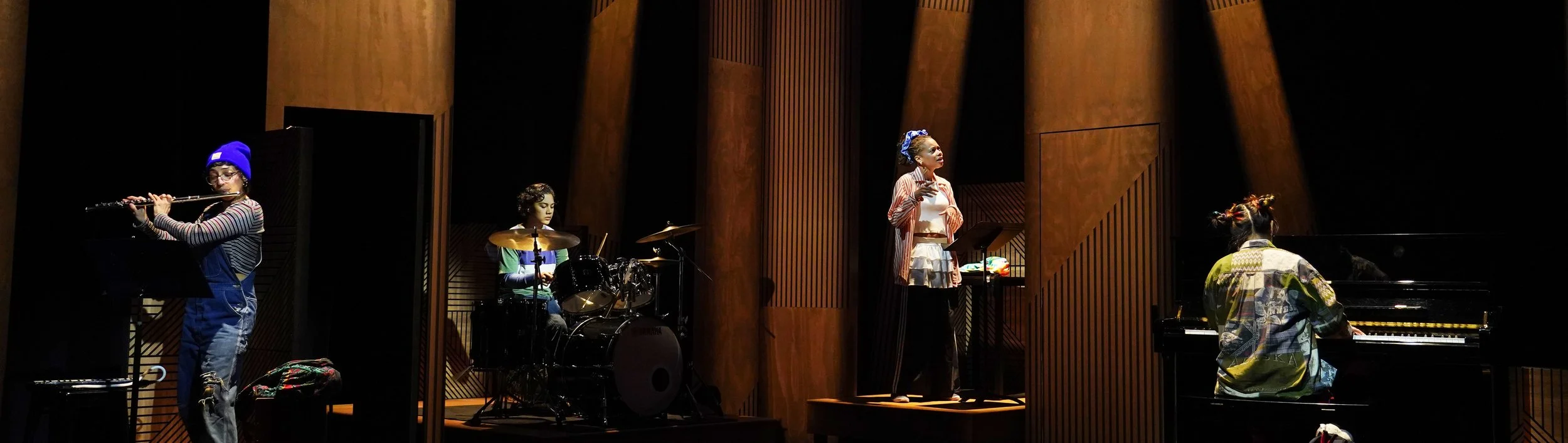
The Essentialisn’t is the most awkward title of the theater season so far, but never mind that. Eisa Davis’s intimate musical enfolds its spectators in the cultural recollection of the earliest Africans brought to this country and in Davis’s own search for identity through music, acting, and dance. It’s an ambitious undertaking focused on what Davis calls “personal sovereignty.” Davis, who is billed as creator, performer, and director, poses a multivalent question—“Can you be Black and not perform”—which appears in bright fuchsia neon onstage throughout the play.
The Porch on Windy Hill
Emotions turn on a dime in The Porch on Windy Hill, the “new play with old music” at Urban Stages. They’re illogical and inconsistent, and that’s why you’ll probably enjoy the old music more than the new play, which is by Sherry Stregack Lutken, Lisa Helmi Johanson, Morgan Morse, and David M. Lutken. But as for the old music, you are likely to enjoy it very much indeed.
House of McQueen
Just like that other Alexander currently celebrated on the New York stage, fashion designer Alexander McQueen rose from humble origins to make his mark in an elite milieu. Darrah Cloud’s new bio-play House of McQueen features Bridgerton heartthrob Luke Newton in the title role, with Broadway musical star Emily Skinner as McQueen’s mother, Joyce, and Catherine LeFrere as his friend and patron Isabella Blow—the two most important women in McQueen’s life.
The Wild Duck
Henrik Ibsen’s play The Wild Duck received a confused reaction from most critics after it was published in 1884. Almost alone, George Bernard Shaw acclaimed it, and while its reputation has gradually grown, it isn’t performed nearly so much as A Doll’s House or Hedda Gabler or Ghosts: the last New York City production in English was in 1987. For a play that the stern critic John Simon called “one of the finest tragicomedies in all dramatic literature,” the neglect is shocking, so Theatre for a New Audience deserves kudos for resurrecting it. The result, however, is often disappointing.
The Whole of Time
Romina Paula’s The Whole of Time chronicles the seismic impact of a seemingly casual visitor on an Argentine family. Written in 2009 and translated for the English-speaking stage by Jean Graham-Jones, the play was first presented in New York in 2024 at Torn Page, a nonprofit theater company in Chelsea. It was nominated for a Drama Desk Award that season. The Torn Page staging, directed by Tony Torn, has now been reassembled at The Brick in Williamsburg, Brooklyn, as a co-production of The Brick and A/Park Productions.
In the Shadow of Her Father
In Omar Bakry’s In the Shadow of Her Father, directed by Vincent Scott, Ava Wolski (Inji El Gammal), in her forties, lives a quiet life in rural Ohio with her adoptive father, Walter (Roger Hendricks Simon), in his seventies. Walter is a man haunted by alcoholism and post-traumatic stress disorder (PTSD). But when a stranger appears at Ava’s door, he ignites buried secrets and desires. Tackling alcoholism, PTSD, and the immigrant experience, Bakry’s drama is both a meditation on survival and a tender love story.
Sulfur Bottom
Playwright Rishi Varma was motivated to write Sulfur Bottom by his concern for environmental justice, defined by the show’s partner organization WE ACT as “ensuring that people of color and/or low-income residents participate meaningfully in the creation of sound and fair environmental health and protection policies and practices.”
Ava: The Secret Conversations
Elizabeth McGovern is spending the dog days of 2025 Off-Broadway in Ava: The Secret Conversations. Known in recent years as the beloved chatelaine of Downton Abbey, McGovern has written herself a role that’s the antithesis of Lady Cora Crawley. Her new play depicts the twilight of Ava Gardner, screen goddess from backwoods North Carolina who married both Mickey Rooney (the “biggest star in the world” when she met him) and mob-adjacent crooner Frank Sinatra.
Amaze
Anyone searching for a rabbit-out-of-hat show in which a master magician saws a femme fatale in half or makes her disappear should look elsewhere than Jamie Allan’s Amaze. Allan’s show has some dazzling glitter and glitz, but underneath it all there is a moving story that director Jonathan Goodwin has deftly and incrementally integrated with Allan’s sleight-of-hand illusions and interactions with his audience.
Well, I’ll Let You Go
Well, I’ll Let You Go is written by actor Bubba Weiler, who’s a little over 30, and directed by Jack Serio, still under 30 and seemingly ubiquitous in New York theater. It’s set in a mid-size, midwestern town that has lost its skill-based, manufacturing economy. Weiler’s characters are adjusting, in sundry ways, to coarsening influences, including the regional fulfillment facility of a gargantuan online retailer, which is the town’s sole surefire source of regular employment. Weiler and Serio bring a balance of intellect and feeling to their work, and the result is a fresh, engrossing chronicle of ordinary citizens contending with change for the worse.
Gene and Gilda
If only the romance of Gilda Radner and Gene Wilder were as straightforward as two comic icons collaborating on a professional project and eventually falling in love. For Wilder and Radner, it wasn’t nearly that simple. Cary Gitter’s Gene and Gilda provides the backstory of how these talented individuals managed a complex personal magnetism, bolstering each other’s confidence and respective on-screen personas, that morphed into a deep love.
The Weir
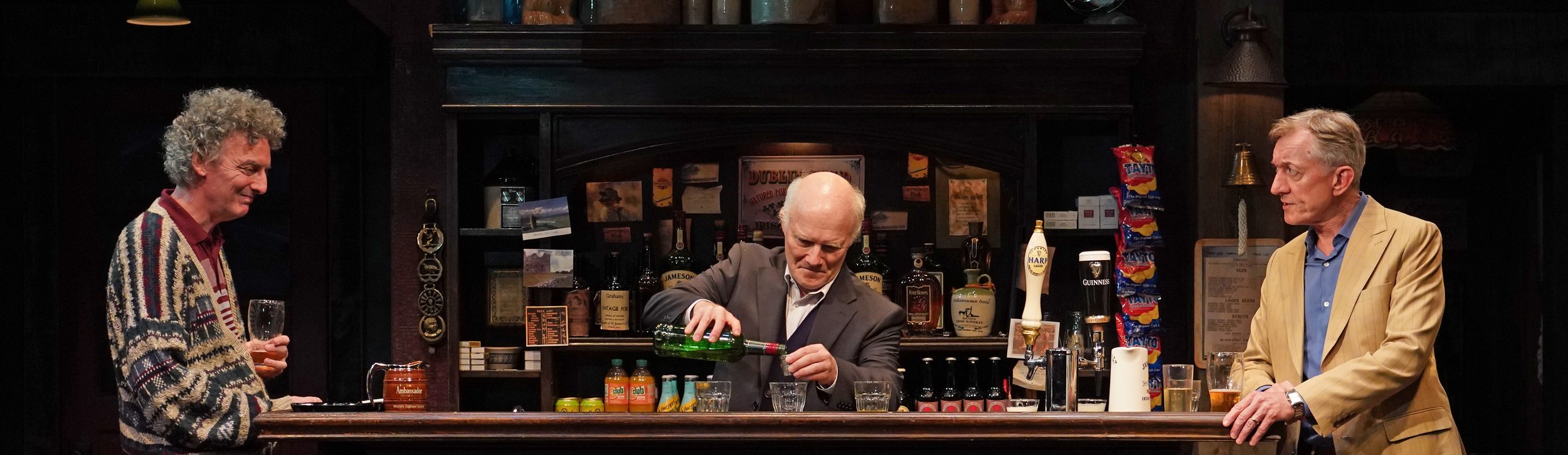
The Irish Rep is currently staging its fourth production since 2013 of Conor McPherson’s 1997 play The Weir, with several of the cast reprising roles. And yet there is nothing stale about this staging—instead, the play is brought to exhilarating life by a marvelous ensemble, under Ciarán O’Reilly’s assured direction. The Weir is essentially a collection of four ghost stories, which arise naturally out of the banter in a rural Irish pub, that ultimately reveal more about the loneliness of the people telling them than anything supernatural.
Transgression
A multitude of transgressions come to light in Terry Curtis Fox’s Transgression. This melodrama about New York artists consists of 19 scenes toggling back and forth between 2010 and 1970. At irregular intervals, the playwright detonates ugly, morally irksome surprises. The result is a two-hour, slow-motion collision between louche mores in the Warhol era and the subsequent new-millennial sensitivity that augured the eruption of #MeToo.