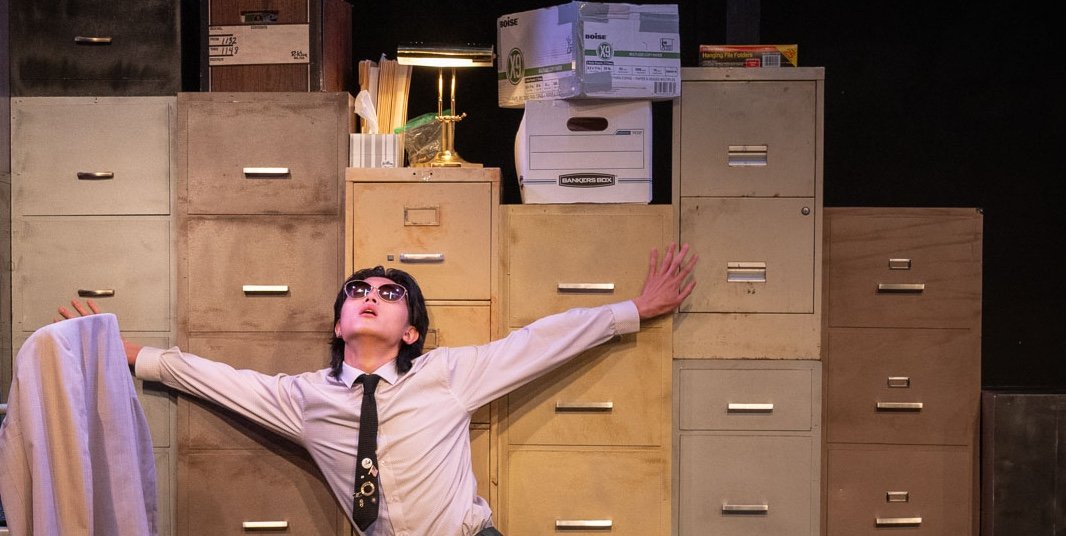
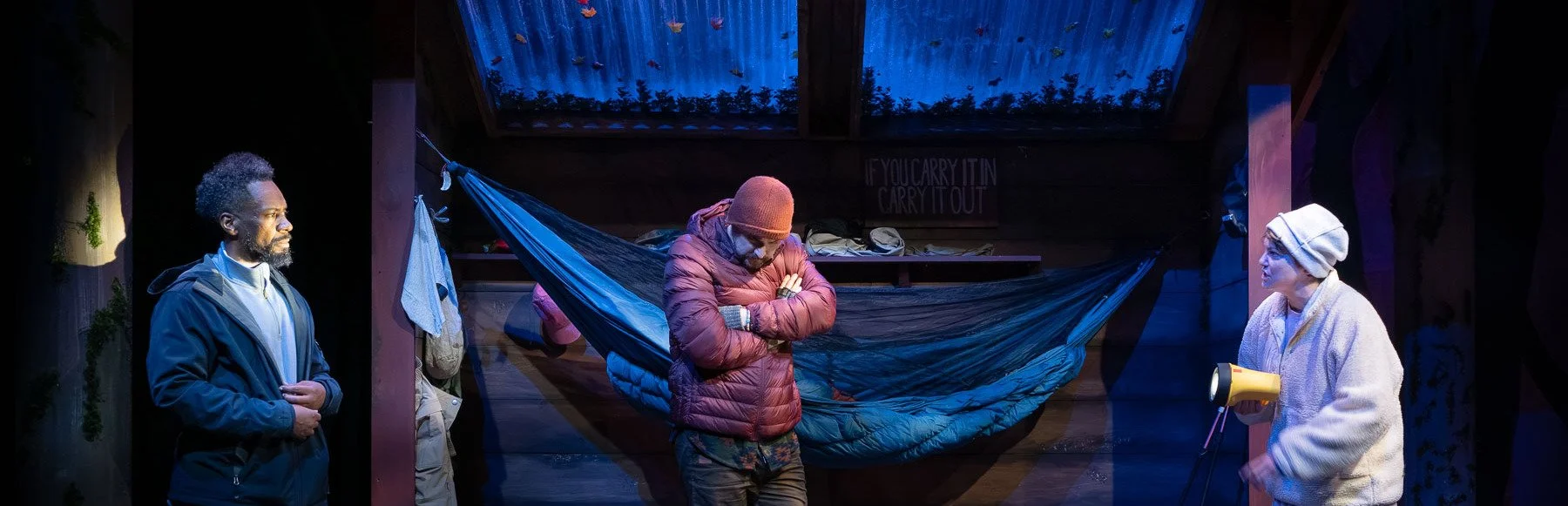
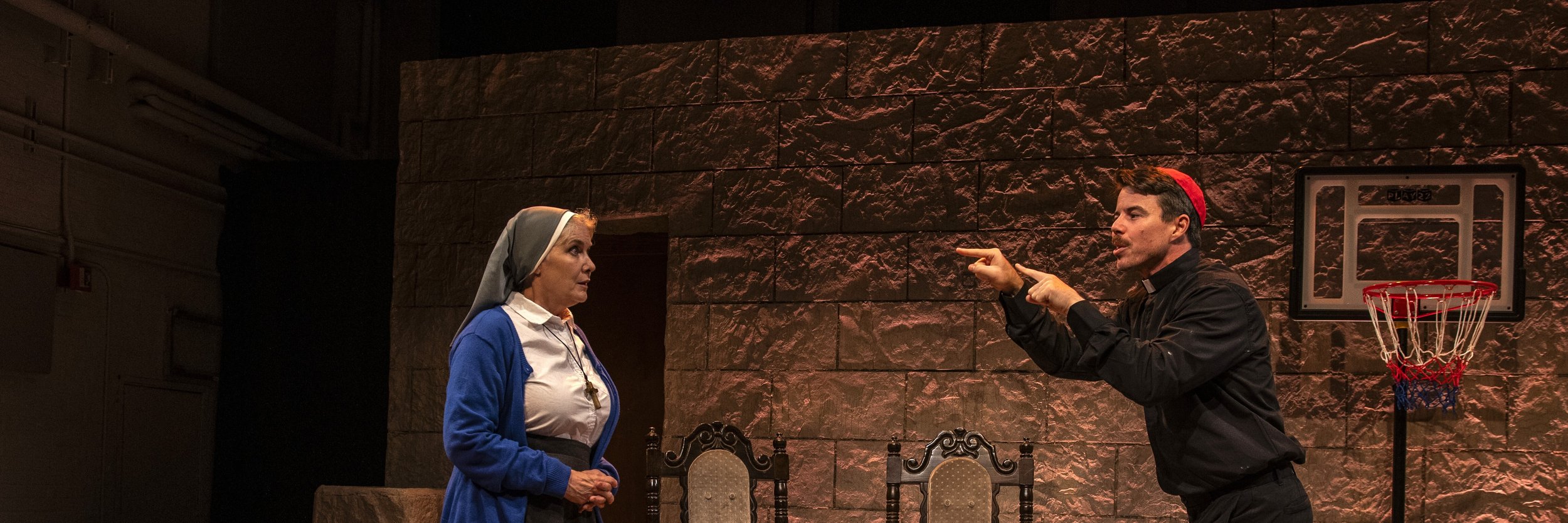
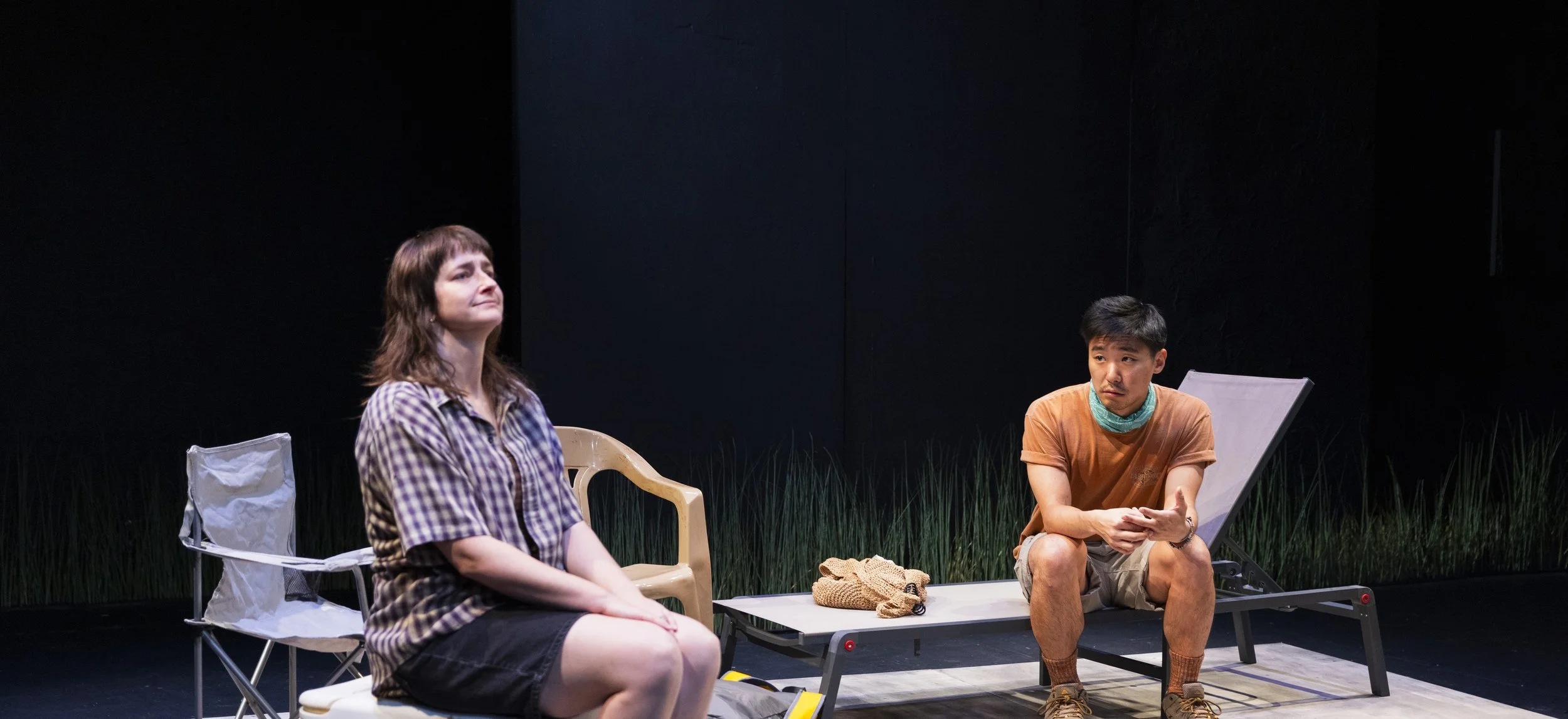
He plays dozens of characters. He bolts around the stage like a dervish, rearranging props, setting up mikes, climbing stairs and changing personas with every move. He works up as much sweat as Jonathan Groff in Just in Time. And he tells a chilling true-crime story in the process, one to leave the observer unsettled as to whether justice was done, and if so, what the price of that justice was.
The Pushover
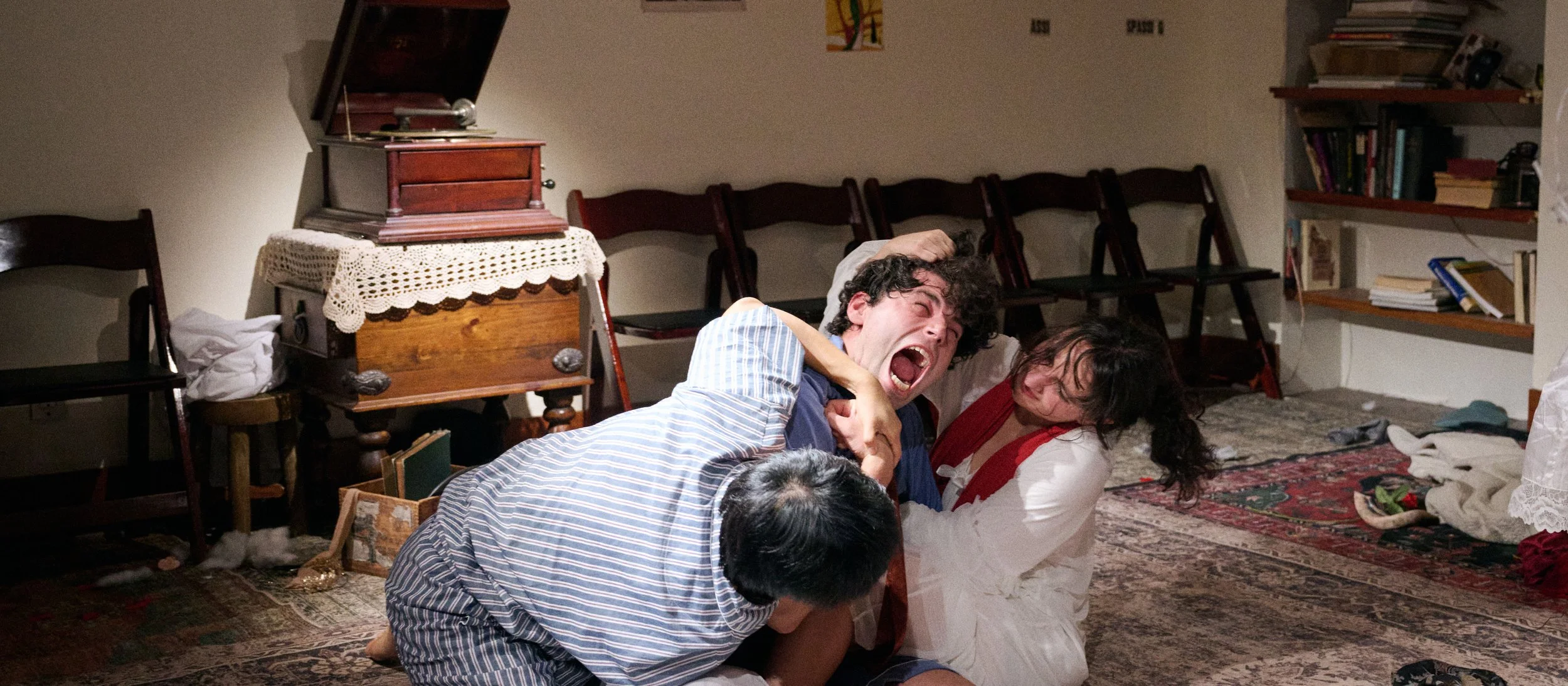
Just what is John Patrick Shanley, a major playwright and screenwriter, doing at the Chain Theatre, a black box on the third floor of a dowdy Garment District office building? Premiering a lesser work, that’s what. Much lesser. The Pushover, his frenetic new drama, might generously be described as an exploration of good vs. evil, a character study of troubled individuals struggling to wriggle free of the personas they’ve created for themselves, or a noirish crime caper. Mostly, what’s on the small Chain stage is three romantically entangled women, arguing, acting out, and pulling power plays on one another. It’s very loud, even without miking, and while there are intimate moments and the occasional arresting snatch of Shanley dialogue, the tone seldom varies from harsh and antagonistic.
How My Grandparents Fell in Love
Two occupants of 59E59 from recent seasons inform the new musical now playing there. The Sabbath Girl, from 2024, was a sweet musical romance of a Jew and a non-Jew in modern-day Manhattan. Dear Jack, Dear Louise, from 2025, had playwright Ken Ludwig affectionately serving up the epistolary wartime courtship of his parents, an Army doctor and a chorus girl. Pour these two shows into a blender, add a generation, hit Purée, and you come up with How My Grandparents Fell in Love.
About Time
There are, a variety of sources have it, no legitimate rhymes for “orange.” But get a load of: “Yes, I know it feels foreign/ Just to suck a week-old Mandarin orange.” In About Time, the new revue at the Marjorie S. Deane, Richard Maltby Jr. does it. And he’s 88.
Hans Litten: The Jew Who Cross-Examined Hitler
“My goal is to write plays with exciting stories, smart characters and sharp dialogue. The reviewers report that my plays are full of philosophical ideas. So be it. I’m tired of plays about dysfunctional families and jumbled identities. For me, ideas are more exciting.” So goes the program bio of Douglas Lackey, author of Hans Litten: The Jew Who Cross-Examined Hitler, a new historical drama at Theater Row. And he’s true to his words, or at least two of them: “philosophical ideas” dominate, sometimes at the expense of character development, tension, and atmosphere. What’s onstage isn’t uninvolving or unmoving, but one is very aware of what’s missing.
Picnic at Hanging Rock
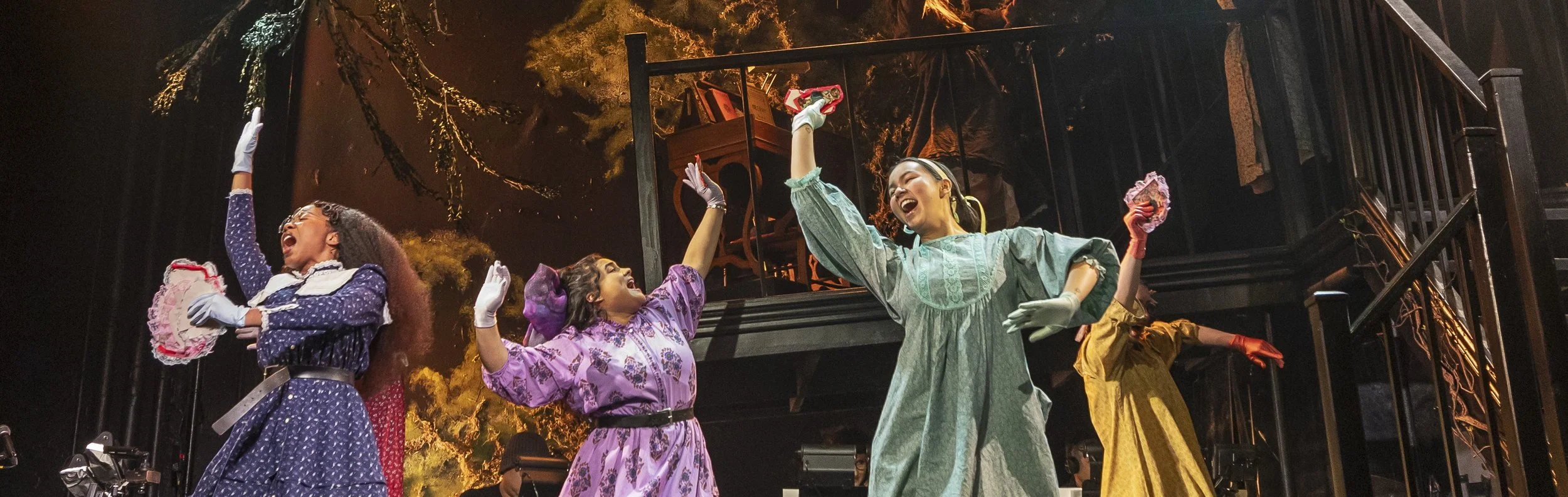
The 1975 Australian film Picnic at Hanging Rock unfurls an atmospheric, unsettling little story of mysterious forces disturbing the titular outing, enjoyed by students at a Victoria, Australia, girls’ school circa 1900. In the movie, director Peter Weir keeps the proceedings eerie and foreboding as some of the girls on the picnic just vanish, leaving their classmates and the school personnel baffled and devastated. A well-deserved international success, Picnic at Hanging Rock grips the viewer even as not a lot happens: the film is all mood. The emotions are strong, but nothing about it screams, “I need to be sung.”
Fixing Frankie
Rare is the musical that begins with an undescended testicle. But that’s the opening parry of Fixing Frankie, by Joe Langworth (book and lyrics) and Steve Marzullo (music). More than the troubled hero’s scrotum needs fixing, and Langworth and Marzullo take him down some curious byways, piling on unnecessary details and side stories. Ultimately, though, Frankie’s healing is a touching little story, if one that could use a little touching up.
And Then We Were No More
This is pretty high-profile stuff for La MaMa, and a far more elaborate production than their norm: A major stage performer and a noted film actor in a new play by a well-known movie and TV actor. And Then We Were No More, by Tim Blake Nelson, thrusts the audience into a depressing future that may not be far off—but one that feels more familiar, what with the surfeit of apocalyptic and otherwise downbeat futuristic dramas flooding the marketplace, than Nelson likely intended.
The Porch on Windy Hill
Emotions turn on a dime in The Porch on Windy Hill, the “new play with old music” at Urban Stages. They’re illogical and inconsistent, and that’s why you’ll probably enjoy the old music more than the new play, which is by Sherry Stregack Lutken, Lisa Helmi Johanson, Morgan Morse, and David M. Lutken. But as for the old music, you are likely to enjoy it very much indeed.
This Is Government
It’s a minor theatrical annoyance, but one that does irk some critics: When your set displays a large wall clock, center stage, make sure it’s running. The wall clock in This Is Government, Nina Kissinger’s disappointing new comedy at 59E59, displays 4:55 in the 15-minute first scene and stays there, with the three denizens of Washington’s Cannon House Office Building moving the hands manually to tick off the subsequent scenes in a roughly seven-hour dramatic arc. It plays amateurishly, and so, unfortunately, does much of This Is Government.
Beau the Musical
The first thing to know about Out of the Box Theatrics’ Beau the Musical is that it’s mostly not about Beau. He’s an important supporting character in the show by Douglas Lyons (book, music and lyrics) and Ethan D. Pakchar (music), but Ace Baker (Matt Rodin) is very much the star. He narrates, plays the guitar, and sings practically every song. The next thing to know about Beau is, you have to stick with it. At first it feels pat, clichéd, and straight off the gay-pride-musical assembly line. Then, finally, Lyons’s characters acquire some individuality and become more interesting.
All the World’s a Stage
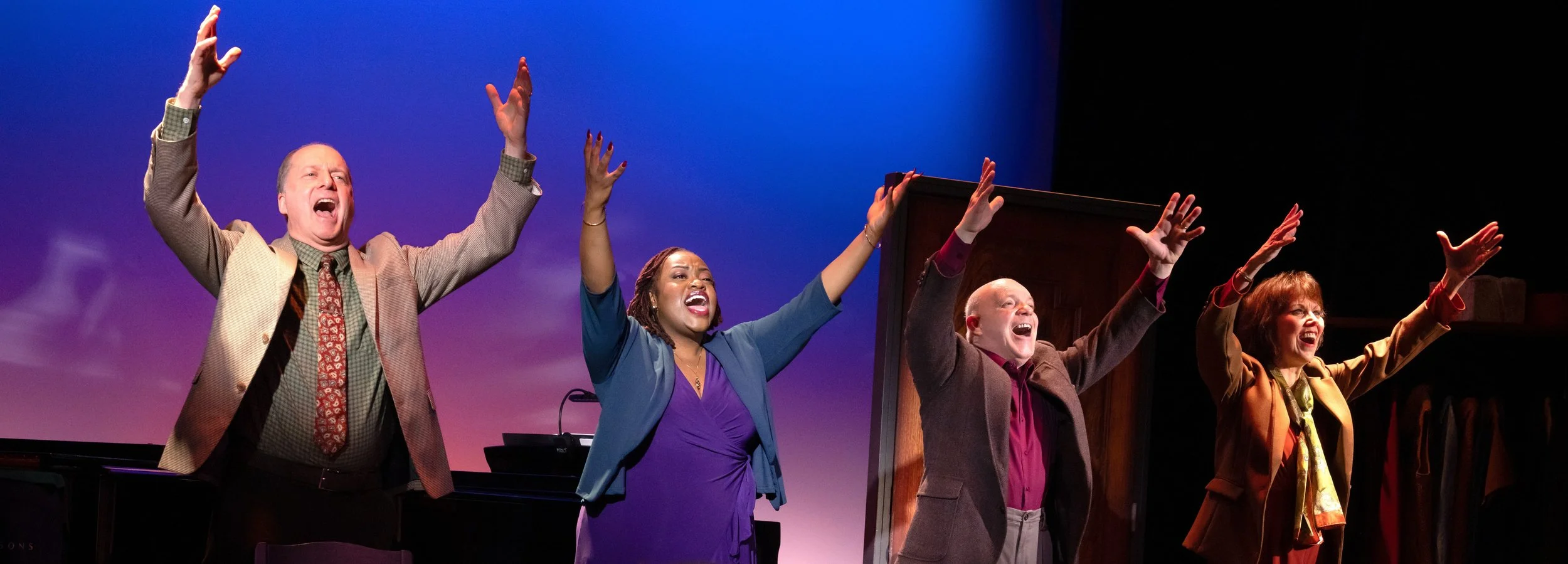
There’s a lot to like about All the World’s a Stage, the Keen Company’s new musical at Theatre Row, but the most likable item of all might be … the strings. Michael Starobin’s orchestrations comprise piano, cello, violin, banjo, and guitar, infusing Adam Gwon’s songs with warmth, color, and the sort of lush sound that new scores haven’t proffered for years. We’ve gotten so used to artificial-sounding synthesizers, ear-rattling drums, and over-miked accompaniment that Gwon’s and Starobin’s work sounds fresher and newer than anything going on at whatever jukebox musical is playing down the street. And it’s serving a story that bears telling, and is told well.
Vanya
A one-man Uncle Vanya could easily have come off as a stunt. How do you turn an Anton Chekhov staple, one that has visited New York stages multiple times in the past few seasons alone, into a solo show, and an utterly new experience? But Vanya turns out to be good theater and, more surprisingly, very good Chekhov.
Garside’s Career
The Mint Theater Company is doing what it does best: acquainting audiences with a long-ago play, and author, most people have probably never heard of. Here the author is Harold Brighouse, and the play, Garside’s Career. Billed by the Mint as “bright, witty political satire,” it traverses more genres than that, also taking in domestic drama and commentary on relations between the sexes, and serves as parable about misplaced ambition. The production is mostly excellent. The bright and the witty are relative.
My Man Kono
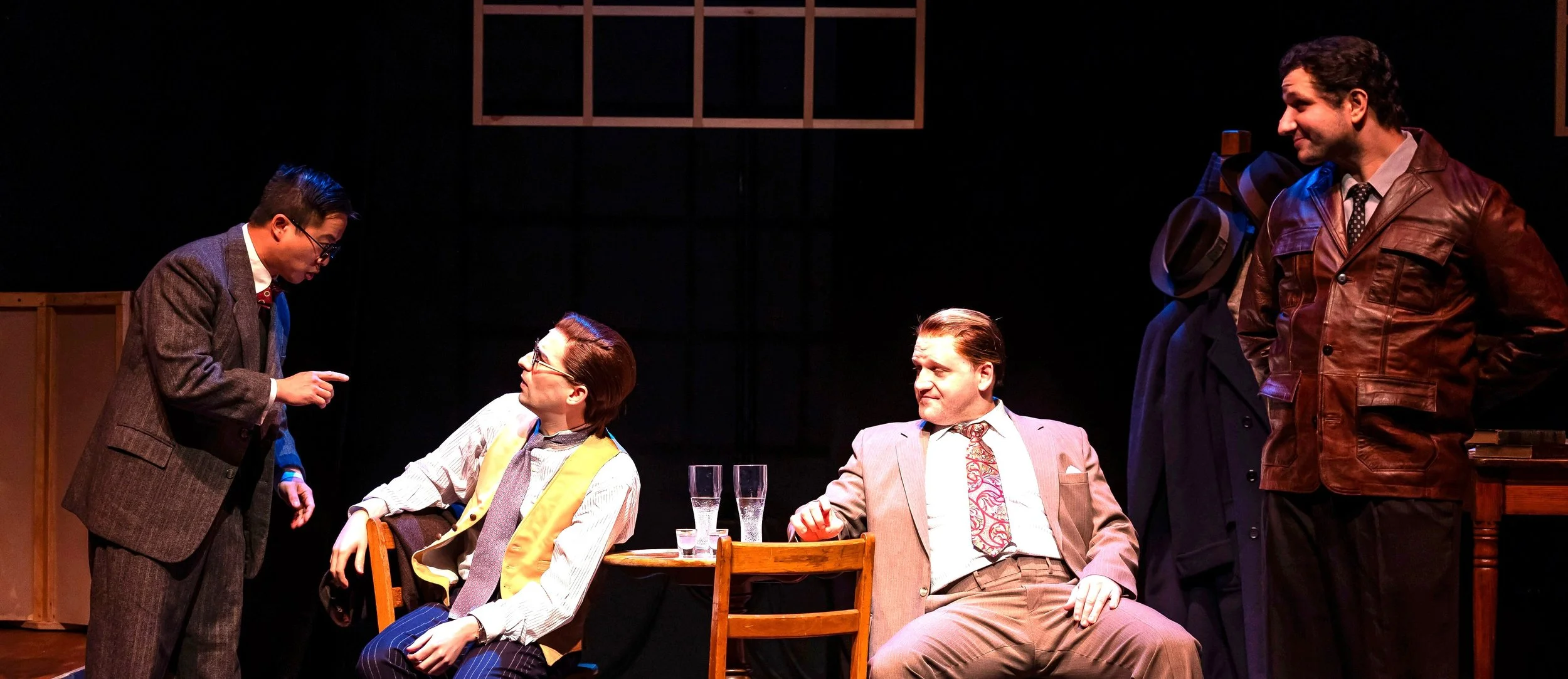
With My Man Kono, now premiering at Pan Asian Repertory, playwright Philip W. Chung has an interesting story to tell. He tells it dutifully, thoroughly, and for the most part clearly. But not excitingly. Chung has done his research. His title character, Toraichi Kono (Brian Lee Huynh), was a Japanese immigrant who made it to the United States in the early 20th century and rose to a position of relative wealth and importance, then saw his fortunes dramatically reverse.
Dear Jack, Dear Louise
Ken Ludwig, who’s generally out to make his audiences laugh a lot and not think too hard (Lend Me a Tenor, Moon Over Buffalo, Crazy for You), strikes a more mellow and reflective tone than usual with his latest, Dear Jack, Dear Louise, at 59E59. An epistolary lark, it shares some traits with Pen Pals, still puttering away at St. Clement’s: two characters, a deepening relationship between them, lots of letters, punctuated by dialogue. Again, though, the audience doesn’t have to think too hard: Dear Jack, Dear Louise is friendly and diverting, but it sure is light.
Pen Pals
It’s impossible to discuss Pen Pals, Michael Griffo’s new two-hander at the Theatre at St. Clement’s, without first bringing up A.R. Gurney’s Love Letters. A Pulitzer Prize finalist, Love Letters consisted of nothing more than two actors reading letters to each other, recounting an epistolary romance spanning almost a half-century. It was so popular because, first of all, it was easy to produce: small set, small cast, and celebrity actors who could jet into town, get onstage, and read the text without having to memorize anything.
Mama I’m a Big Girl Now!
Mama I’m a Big Girl Now!, the new musical entertainment at New World Stages, seems so eager to race to the exclamation point that it’s even missing a comma. The show wants to spread exuberance, excitement, and joy. It mostly succeeds.
The Z Team
It may be an overgeneralization, but let’s put it out there: In stage comedies, the more the cast laughs at its own purportedly hilarious exploits, the less the audience does. The onstage hollers and whoops are frequent and loud in The Z Team, Jeff and Jacob Foy’s workplace yuk-fest at Theatre Row, and while some of the audience seemed to enjoy it, those seated in E1 and E2 barely cracked a smile.
Medea: A Musical Comedy
There’s sure been a passel of Medeas lately. An operatic one by Fusion Theatre back in March. Red Bull Theater’s Medea: Re-Versed, the recent hip-hoppy version. And now Medea: A Musical Comedy, written, directed by and starring one John Fisher, currently infesting the Actors Temple Theatre. The very title is a joke, and be assured, Fisher will keep piling the yuks on top of one another. If only the vast majority of them weren’t so juvenile.