
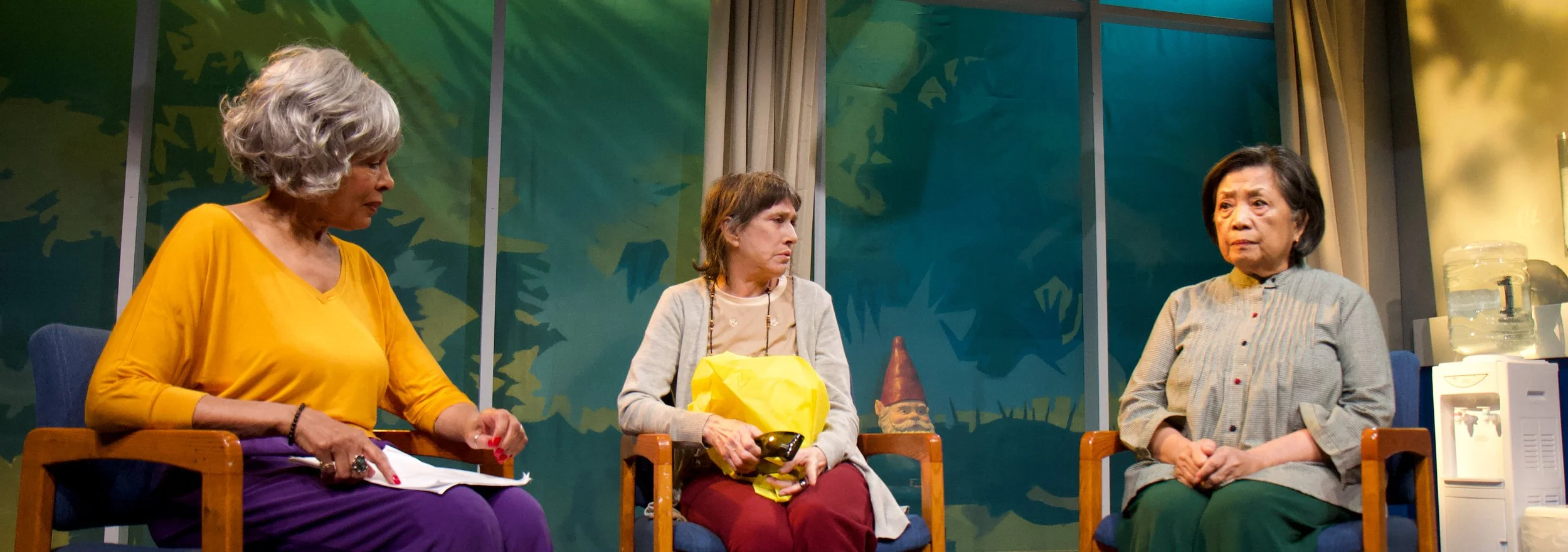

Bev (Jan Leslie Harding, left) is set up for an acting exercise by Grant (Pete Simpson) while Bonnie (Petronia Paley) and Janice (Mia Katigbak, far right) look on.
Peggy Stafford’s Everything Is Here explores the later stage of the life cycle—what some call the golden years, and others call the twilight years—by focusing on three women in their 70s: Bev (Jan Leslie Harding), Bonnie (Petronia Paley) and Janice (Mia Katigbak). Living in senior housing, they find their days are punctuated by the visiting nurse, Nikki (Susannah Millonzi), who has a sadness beneath her cheerful demeanor, and the lanky and handsome Grant (Pete Simpson), who leads meditation and mindfulness classes at the home while he auditions for acting roles.
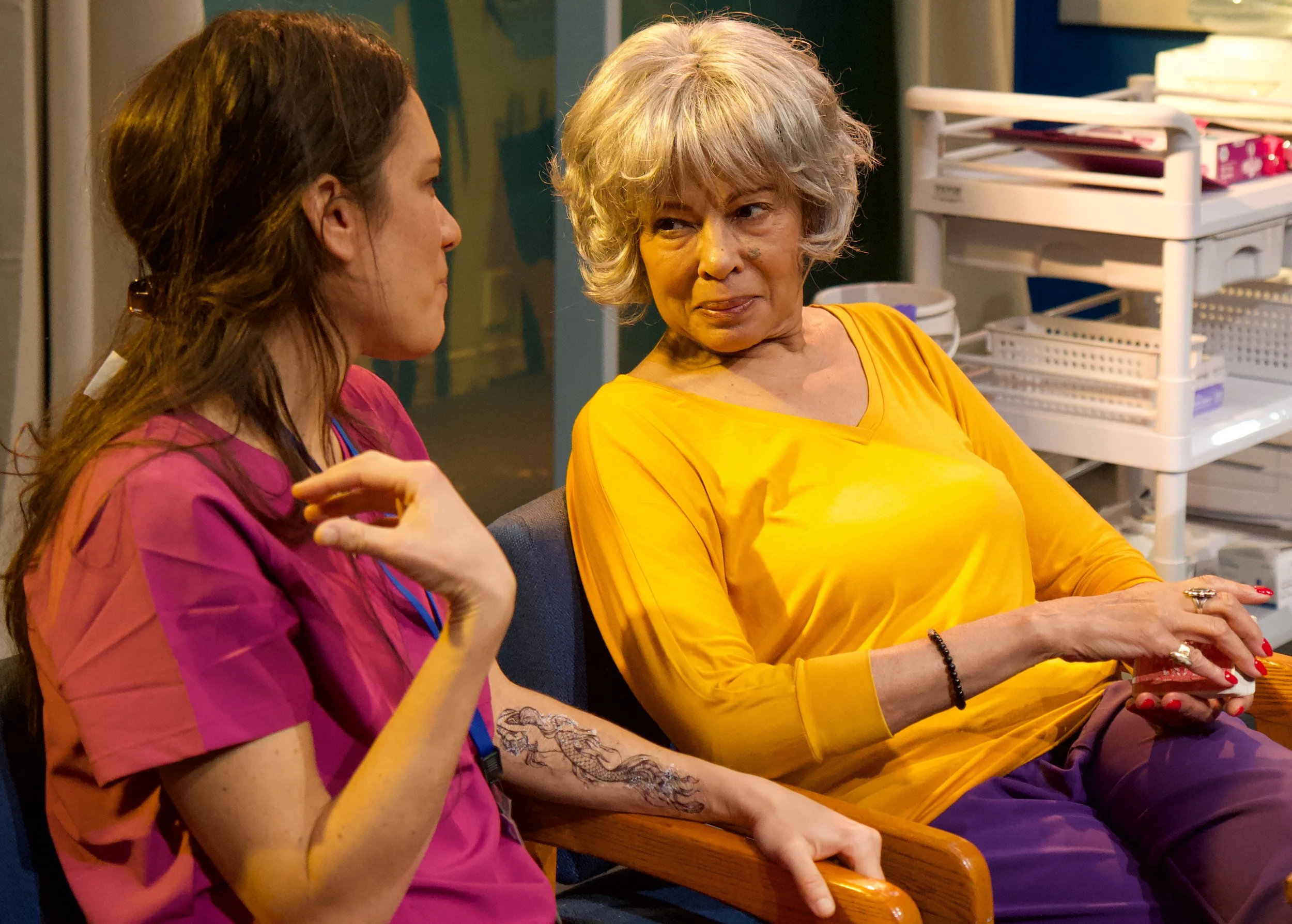
Nurse Nikki (Susannah Millonzi) and Bonnie discuss life in Everything Is Here, which takes place in senior housing.
The women initially appear upbeat and engaged, but the play quickly reveals that a profound sense of boredom and unhappiness underscores their daily lives. The monotony is temporarily shattered by a moment of excitement when Grant gets an audition for the role of Mitch in A Streetcar Named Desire. He immediately enlists the three women to help him rehearse and sets to work on the script. The kooky and childlike Bev, whose voice is often full of wonder, plays the flower lady, plaintively calling out, “Flores, flores, flores, por los muertas.”
Bonnie, a former flight attendant, reads the role of Blanche first. Her experience in the service industry lends her an air of poise and sophistication that she brings to the role of Blanche when she reads with Grant. Blanche’s lines of rumination are quickly over-run by Bonnie’s own ruminations, as she drifts into nostalgic memories, vividly recalling the days of real food served on China with silverware, and luxurious desserts—“Lemon bars, coconut cream pie. I remember once this chocolate raspberry torte. You should have seen the looks I got when I delivered that one.” With airline service not what it once was, she finishes: “This is why the whole world is unhappy.”
“Stafford successfully captures the meandering nature of people caught in a space where time passes without relevance. ”
Janice reads Blanche next. When her voice drops and she delivers Blanche’s lines quietly: “Crumble and fade and—regrets—recriminations. ... ‘If you’d done this, it wouldn’t’ve cost me that!,” it sounds like she’s lamenting about her own life. On the surface she’s amiable and lighthearted, but Blanche’s lines provide a window into a darker interior. Janice, too, is hiding something. Early in the play, Bev is missing a letter opener. In a scene in the middle of the play, Janice confesses, to an empty room, that she started stealing when she was a kid. Her stealing is not something anyone confronts head-on, and when Bonnie gently mentions it, Janice evades the question and the subject is quickly dropped.
Stafford successfully captures the meandering nature of people caught in a space where time passes without relevance. Director Meghan Finn works to keep the play cohesive, but the lack of significant backstory for the women keeps them at arm’s length, making their profound ennui less impactful.
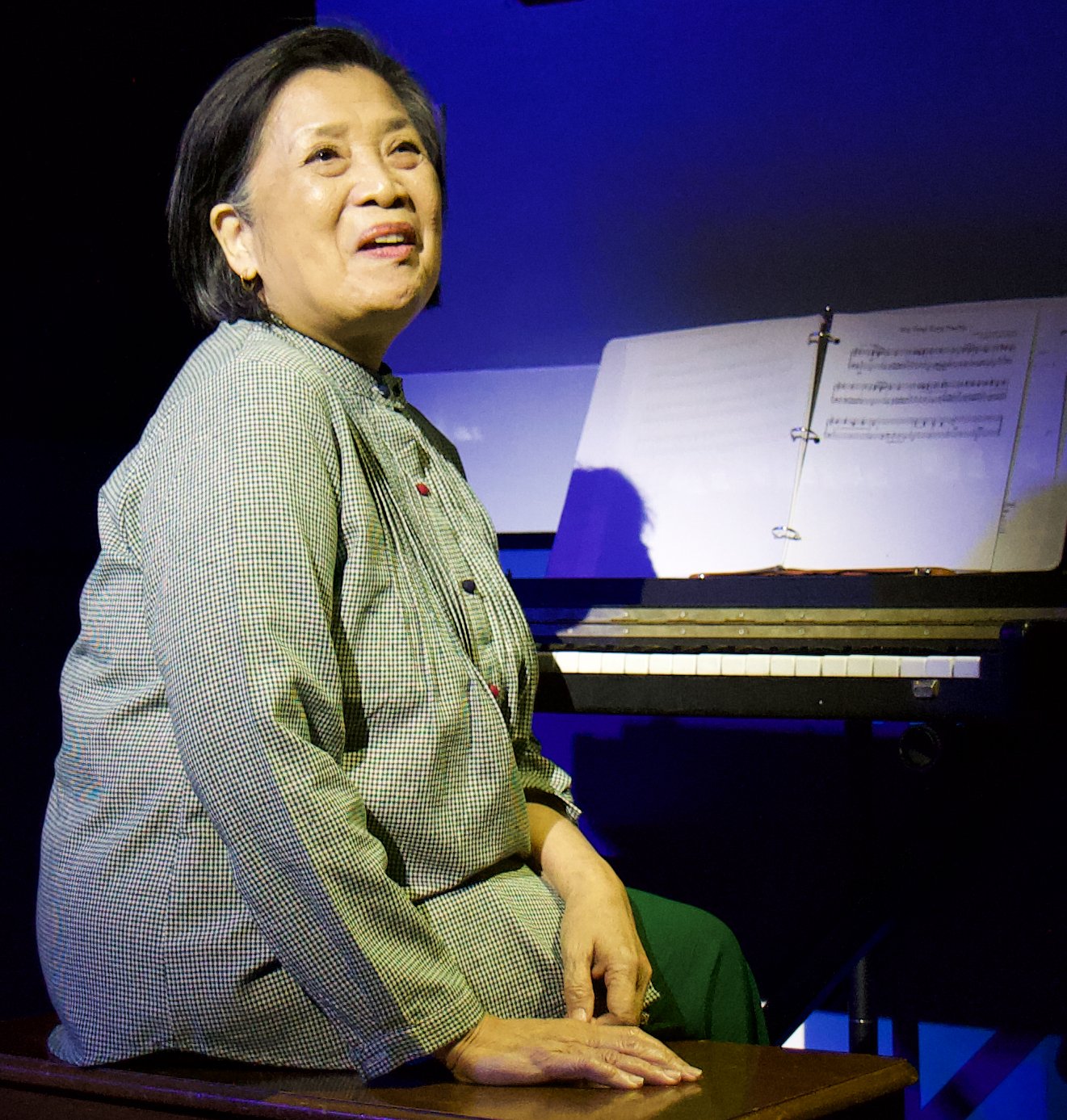
Janice (Katigbak) is always looking for a diversion. Photographs by Mari Eimas-Dietrich.
The feeling of stagnation is captured by Richard Hoover’s compact set, in which everything is closely set: a water cooler, three armchairs, a piano, and a little fish tank. Behind a scrim, is a patch of Astroturf and a large gnome, which appears to be an onlooker throughout the play. Yang Yu’s lighting design creates a sense of time as the days pass only because the light gets brighter or dimmer, even though the set doesn’t change.
The play incorporates a significant amount of movement, choreographed by Lisa Fagan, but much of it feels random or disconnected from character motivation. One sequence, however, effectively drives home the tedium: in unison, Bev, Janice, and Bonnie mechanically move their arms and heads while sitting, making as if to stand up but immediately sitting back down, repeating the phrase several times.
By contrast, the play’s ending features nurse Nikki dancing a jerky sequence of movements in a corner of the stage as Bev says goodbye to the community room, having found another place to live. Though actress Millonzi moves well, the motivation for Nikki’s sudden, expressive dance at this moment remains a mystery.
Everything Is Here deals with the topic of life in senior housing delicately, highlighting the vulnerability of these women. In the end, you may want to tuck these women under your arm and take them home. It would be a pleasure to hear more of Bonnie’s tales of travel, to learn why Janice steals things, and Bev, who could easily be anyone’s eccentric aunt, reminds us that not everything in life is complicated. Sometimes it’s OK to say good-bye to the fishbowl.
The Tank’s production of Peggy Stafford’s Everything Is Here runs through Dec. 20 at 59E59 Theaters (59 East 59th St.). Evening performances are at 7:15 p.m. Tuesday through Friday; matinees are 2:15 p.m. on Saturday and Sunday. Post-show talkbacks are Dec. 12 and 19. For tickets and more information, visit 59e59.org.
Playwright: Peggy Stafford
Direction: Meghan Finn
Choreography: Lisa Fagan
Set Design: Richard Hoover
Costumes: Patricia Marjorie
Lighting: Yang Yu
Sound: Shane Rettig
