
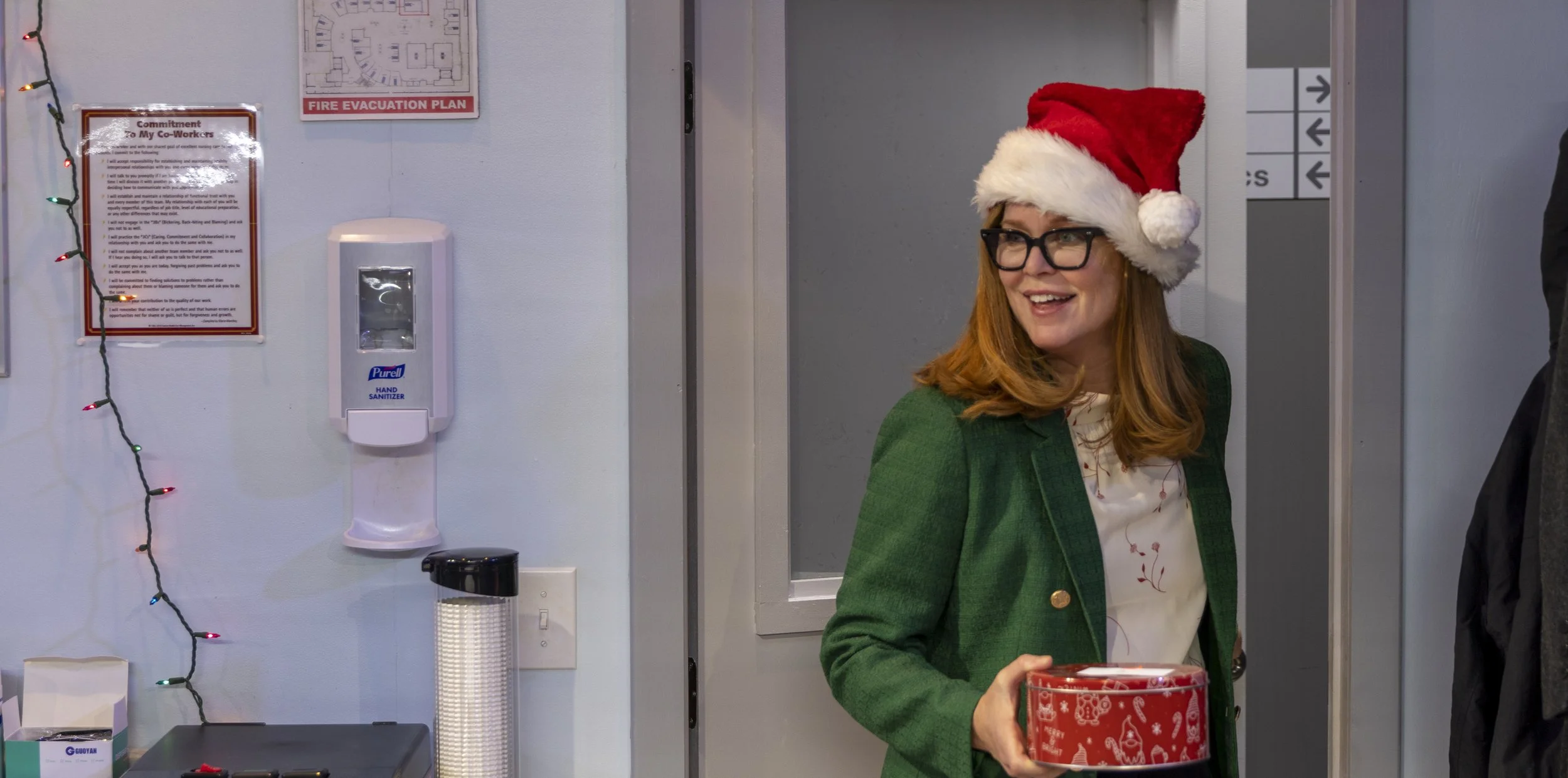
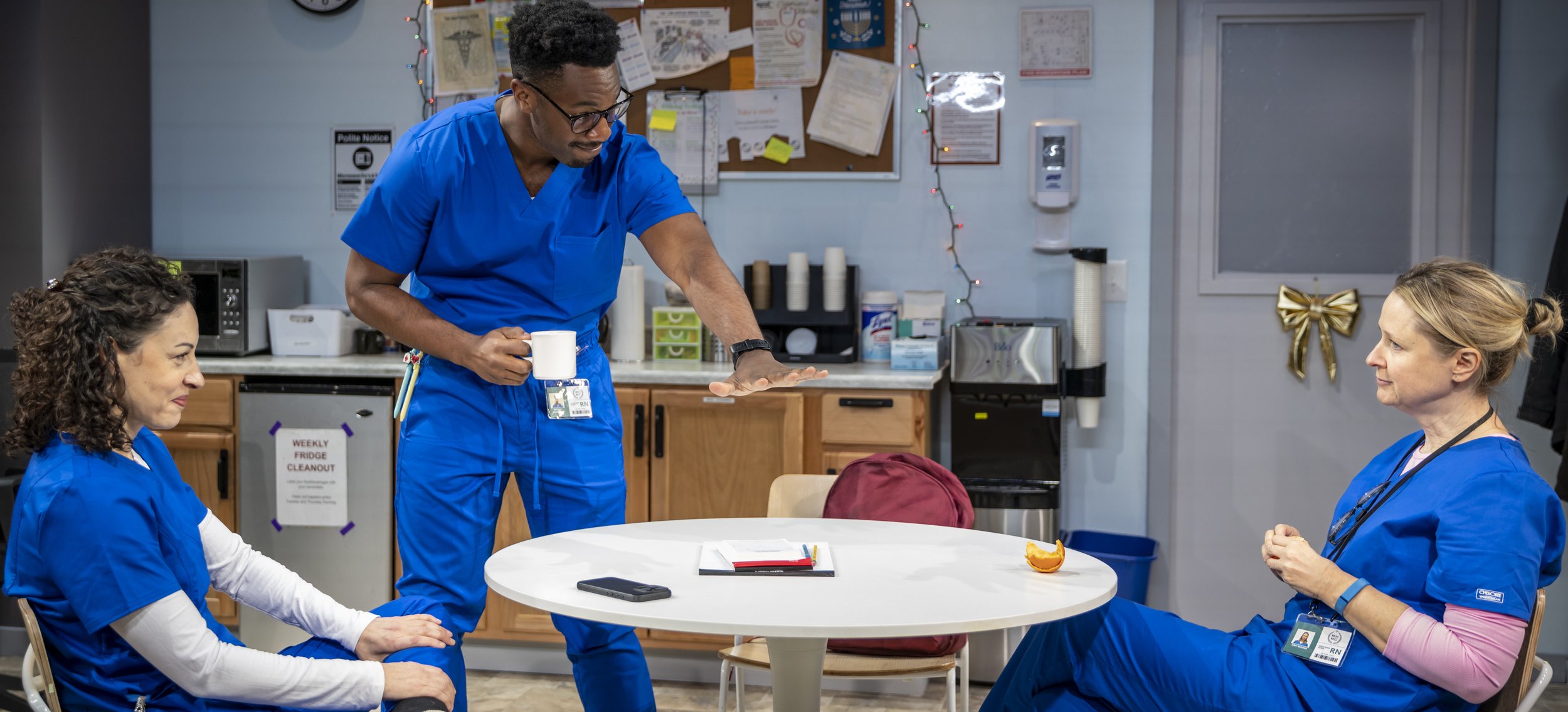
Nurses Emilia (Tricia Alexandro, left), Mike (Connor Wilson) and Amy (DeAnna Lenhart) take a break in Scott Organ’s Diversion.
Playwright Scott Organ excels at creating characters whose mistakes in their jobs and relationships lead to agonizing consequences. His 2020 drama, 17 Minutes, was a harrowing tale of a sheriff’s deputy in a crumbling marriage who failed to stop a mass shooting. For his new work, Diversion, Organ reunites with director Seth Barrish and the Barrow Group to focus on a close-knit nursing unit on the verge of unraveling. This quiet and absorbing think piece examines the hardship of opioid addiction and the post-traumatic stress of the COVID-19 pandemic.
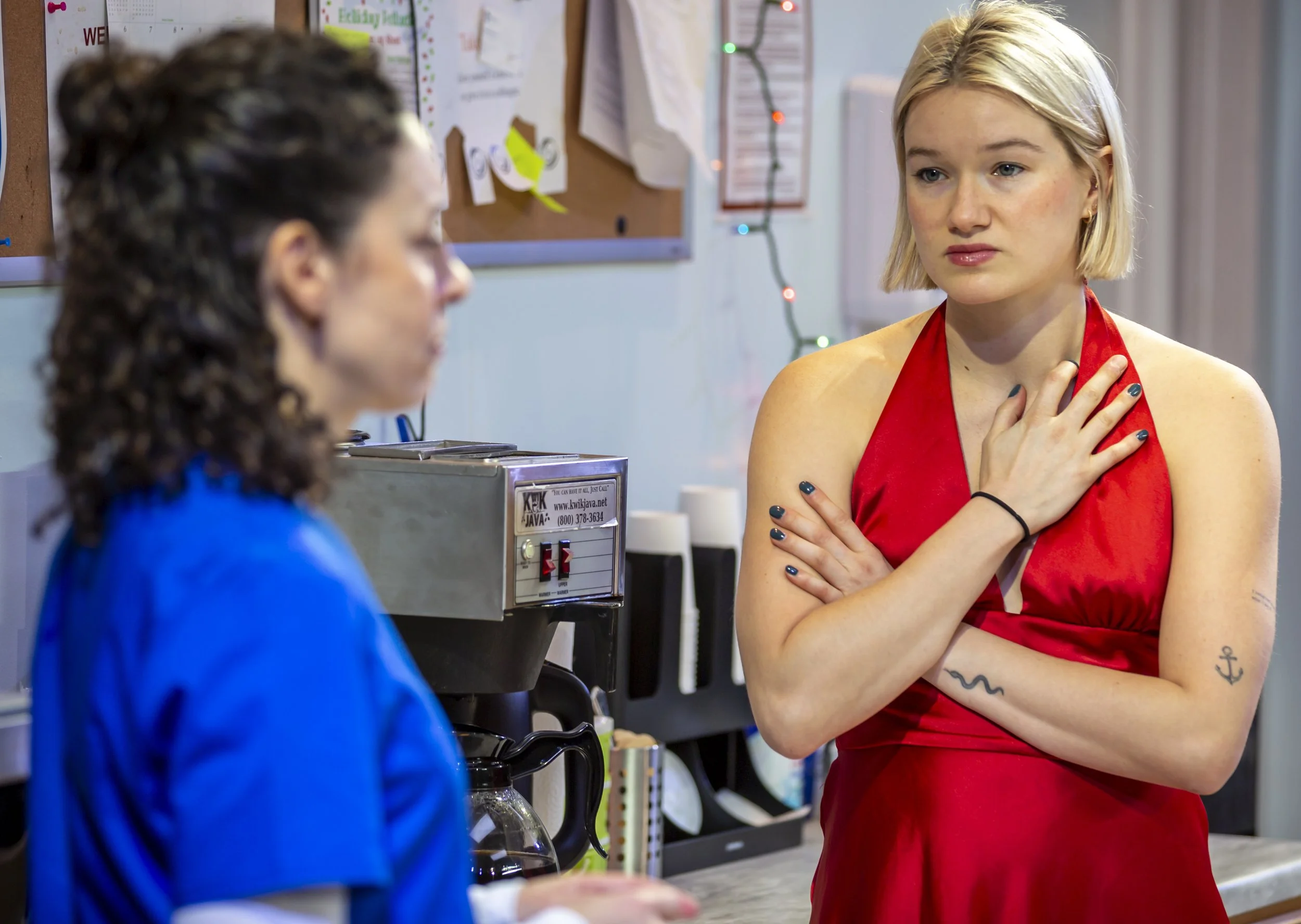
Emilia and Mandy (West Duchovny, right) share a tough New Year’s Eve.
In the ICU break room of the hospital where the play is set, the wall clock is broken, and the nurses who inhabit this space are not in great working order themselves. Mandy (West Duchovny) is new to the night shift and to the profession. Prone to sleeping on the job, she gets little rest at home thanks to an uncaring and hard-partying boyfriend.
Amy (DeAnna Lenhart) is Mandy’s opposite, a by-the-book veteran who is as hard-nosed as Mandy is easygoing, with all the tense talk to prove it. Emilia (Tricia Alexandro) is the friendly voice of reason, though her calm façade is masking a panoply of pains. And Mike (Connor Wilson), a single father with a child in need of therapy, does his best to keep things light.
The four of them know that trouble is brewing when they are summoned by their manager, Bess (Thaïs Bass-Moore), for a staff meeting. It turns out that drugs have gone missing. Someone has been “diverting” fentanyl patches as well as oxycodone pills, either for personal use or to sell on the street. Bess makes it clear that the suspect or suspects have yet to be identified. It might even be a nurse from another shift, or a doctor, for that matter, but coming clean sooner rather than later would save the hospital from having to escalate the case.

Mike and Mandy do a little shopping. Photographs by Edward T. Morris.
The subsequent silence means that an outside consultant, Josephine (Colleen Clinton), is soon snooping around. “Just here for data,” she tells the staff, who welcome her with all the passive-aggressive angst one would expect. At this point, the play risks becoming a procedural whodunit, the audience already calculating the clues and choosing the likely thief. But the playwright, instead, cleverly pivots the work into a kind of “why-dunit,” the possible and all-too-real reasons behind the theft taking precedence over the crime itself.
Was it Mike? Treating his son’s ailment is no doubt expensive, and he is quite familiar with the street price of fentanyl. Mandy, it seems, would do anything to help out her struggling boyfriend, just gullible enough to make an error in judgment. Amy may be only human, after all. She keeps quiet about her physical injuries, the back pain that came from “every day, hauling bodies onto beds,” during COVID. And it becomes apparent that Emilia is not only broken up over a relationship gone bad, but having to harbor the life-and-death management decisions she was forced into during the pandemic has been quietly eating away at her for years. Josephine tells her it’s known as a “moral injury.”
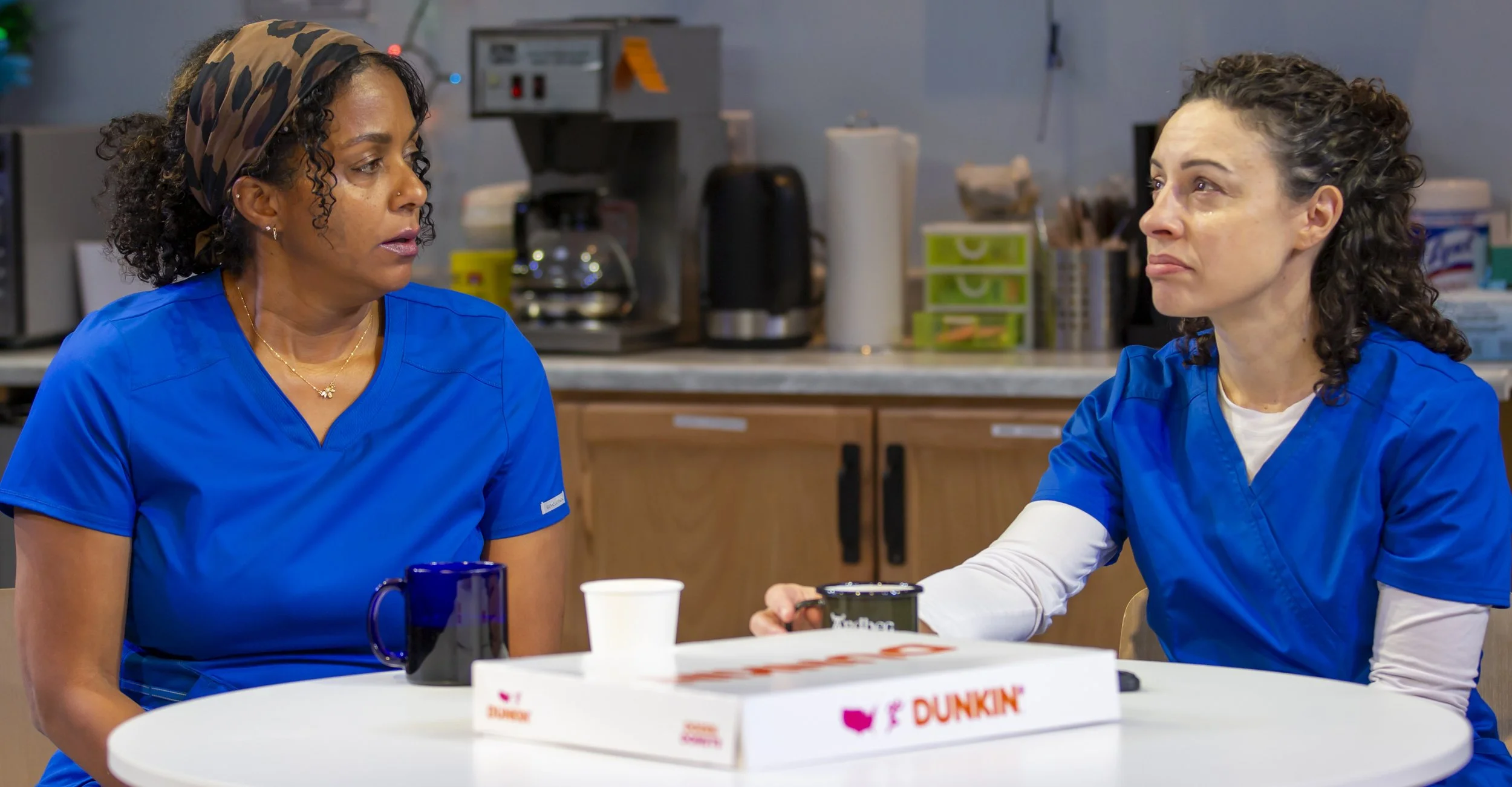
Bess (Thaïs Bass-Moore) and Emilia face some hard truths.
Those who are ultimately responsible are eventually revealed and may or may not be the same as those who shoulder the blame, but the larger points are that, but for the grace of God, it could have been any of them; that addiction is a disease easily acquired and not cured without sacrifice; and that the scars of COVID-19 are slow to heal.
Barrish directs his cast at a low simmer, the hushed intensity playing well against the occasional beeping alarms that interrupt their face-offs, sending the nurses running to attend to their offstage, ailing patients. Lenhart, who portrayed Samantha, the put-upon wife in 17 Minutes, is equally powerful here as Amy, finding her way toward sympathy. In her Off-Broadway debut, Duchovny, the daughter of David Duchovny and Téa Leoni, establishes herself as a charismatic artist to keep an eye on. Clinton works through some clunky dialogue to form a believable, almost likable Josephine. And with her Emilia, Alexandro, a teaching artist at the Barrow Group, gives a master class in understatement and the art of the slow meltdown.
Edward T. Morris’s functional scenic design offsets the broken clock with a working microwave, cooking up instant noodles and even popcorn for the hardworking nurses. It’s a small thing, but it is nonetheless a touch of realism that helps drive home the play’s poignancy. On the night of this preview performance, the curtain call found the actors, as well as the audience, in tears.
Diversion runs through Dec. 21 at the Barrow Group Performing Arts Center (520 8th Ave.). Evening performances are at 7:30 p.m. Tuesday through Saturday; matinees are at 3 p.m. Saturday and Sunday. For tickets and information, visit barrowgroup.org.
Playwright: Scott Organ
Direction: Seth Barrish
Sets: Edward T. Morris
Costumes: Gina Ruiz
Lighting: Solomon Weisbard
Sound: Geoff Grimwood
