
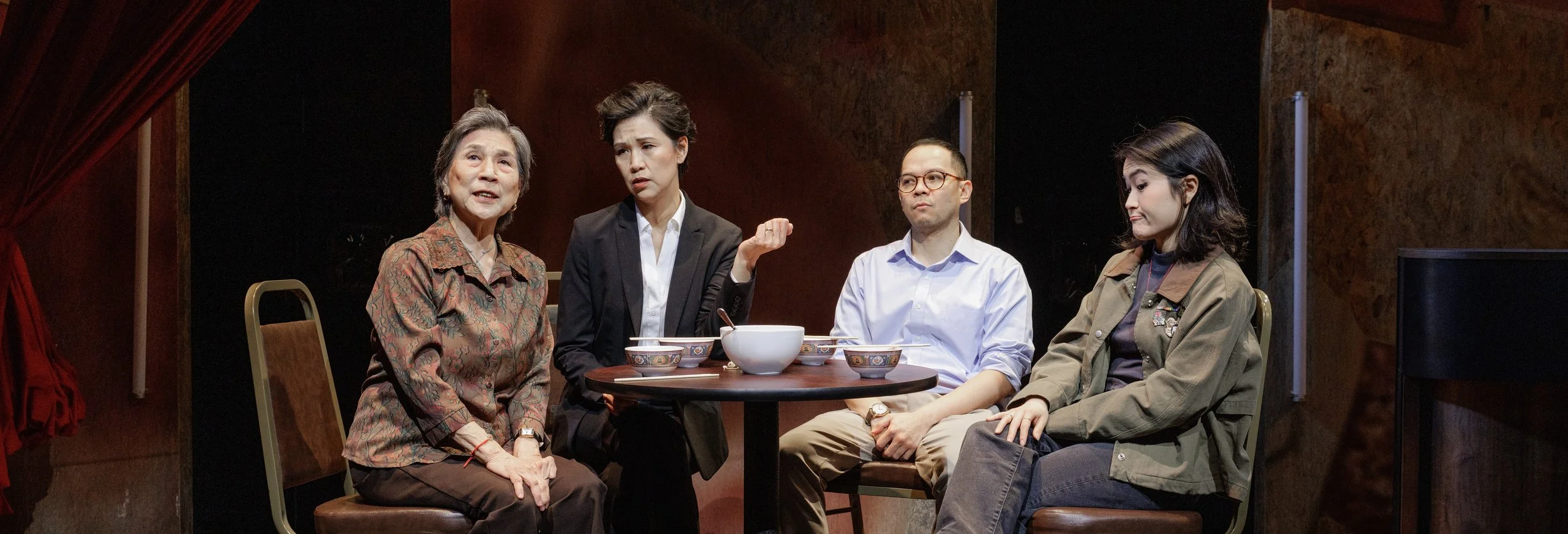
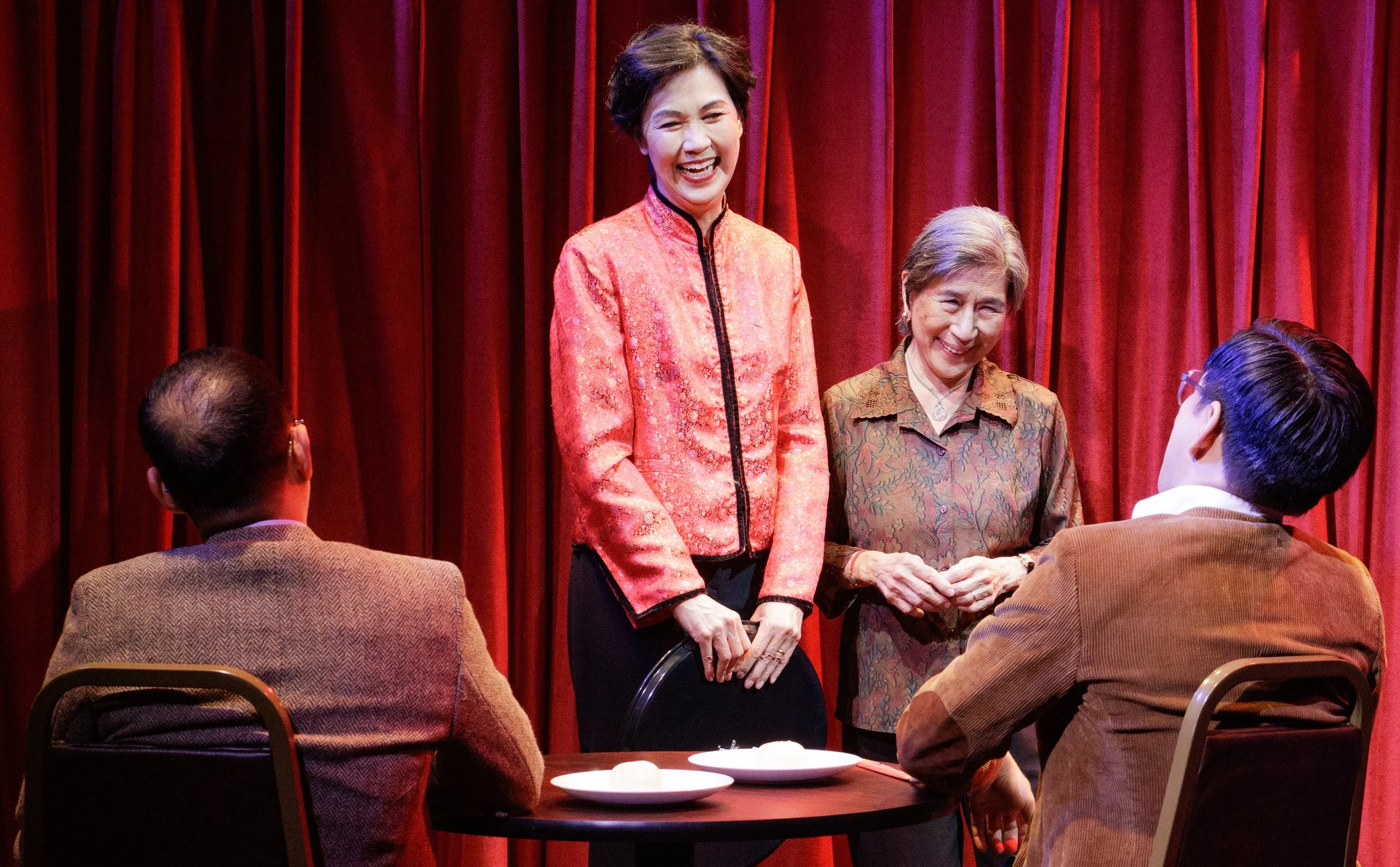
Cindy Cheung (center left) plays Amy and Wai Ching Ho (center right) is A-Poh in Alex Lin’s farcical melodrama Laowang: A Chinatown King Lear, a Primary States production at 59E59 Theaters. (John Norman Shneider, left, and Daisuke Tsuji, right, double as minor characters.)
Titles, even subtitles, sway playgoers’ expectations. Take, for instance, a recent press performance of Laowang: A Chinatown King Lear. Alex Lin’s new farcical melodrama zips relentlessly around jocose hairpin turns. The dialogue, stylishly delivered by a first-rate cast, is witty, urbane, and frequently arch. Yet the audience—presumably anticipating King Lear or something akin to that monumental tragedy—sat in suspended, churchlike repose throughout the play’s early scenes.
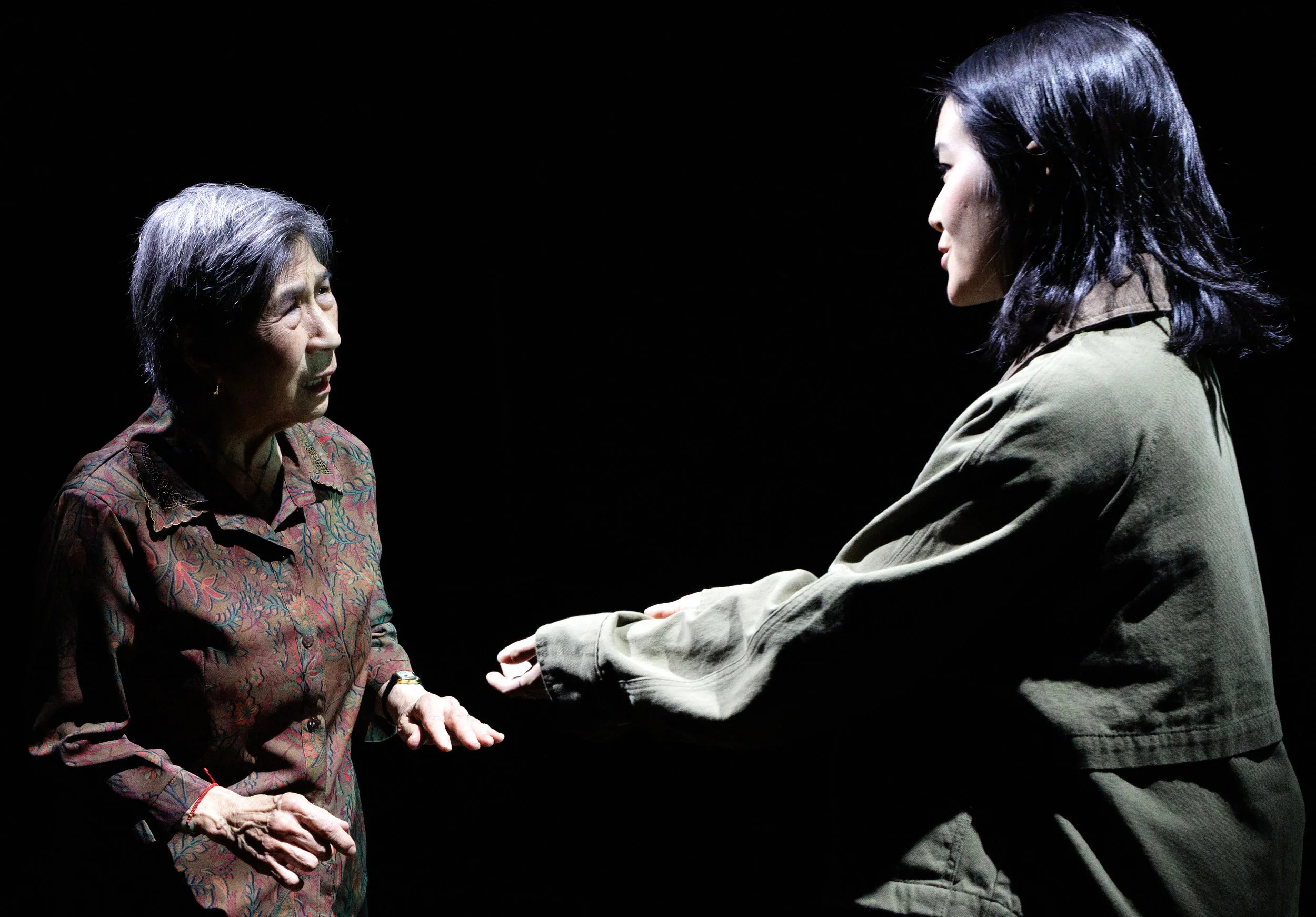
A-Poh exhibits symptoms of dementia with Lily (Amy Keum, right), the Cordelia-like granddaughter, in Laowang: A Chinatown King Lear.
Laowang, a dysfunctional-family yarn, concerns the aged Margaret Choy (Wai Ching Ho) and her three adult grandchildren. Margaret—widely known as A-Poh (the Cantonese endearment for maternal grandmother)--was born in China and immigrated to Manhattan’s Chinatown as a child. A Type-A personality, she spent much of her adult life making a go of China Bull & Bear, an Allen Street restaurant (three-star rated by the New York Times) where the culinary specialties (barbecued ribs; macaroni and cheese) and the sound system’s playlist (heavy on Elvis) were calculated to attract free-spending, non-Asian tourists.
After four decades and a long spell of dwindling business, A-Poh has closed the restaurant. A snide acquaintance of the Choys describes the vacant premises (A-Poh’s principal economic asset) as “a dilapidated 2,000-square-footer,” burdened by a tax lien and very near “the homeless shelter on Bowery.”
“The play’s twisty plot chronicles the grandchildren’s competitive bickering.”
That snide acquaintance is Wesley Chiu (Daisuke Tsuji), a contemporary of A-poh’s grandchildren. In childhood and adolescence, Wesley worked as a dishwasher at the restaurant. Now he’s a real estate executive with axes to grind against all the Choys. He’s angling to purchase the restaurant building and the parcel it sits on. Effecting that purchase is key to Wesley’s larger scheme for revenge against A-Poh and her kin.
The canny A-Poh negotiates Wesley’s bid up from two million dollars to eight, plus a long-term share of the site’s annual revenues. While awaiting delivery of the draft contract, she summons her three grandchildren to a family conference. Amy (Cindy Cheung), the oldest, flies in from Los Angeles, where she’s an entertainment lawyer and helicopter parent. Middle grandchild Steven (Jon Norman Schneider), an otolaryngologist, drives from New Jersey. Lily (Amy Keum), the youngest, living still in Chinatown and pursuing a social-work degree at City College, bicycles from nearby. When A-Poh informs them of the impending sale, their reactions are split two-to-one.
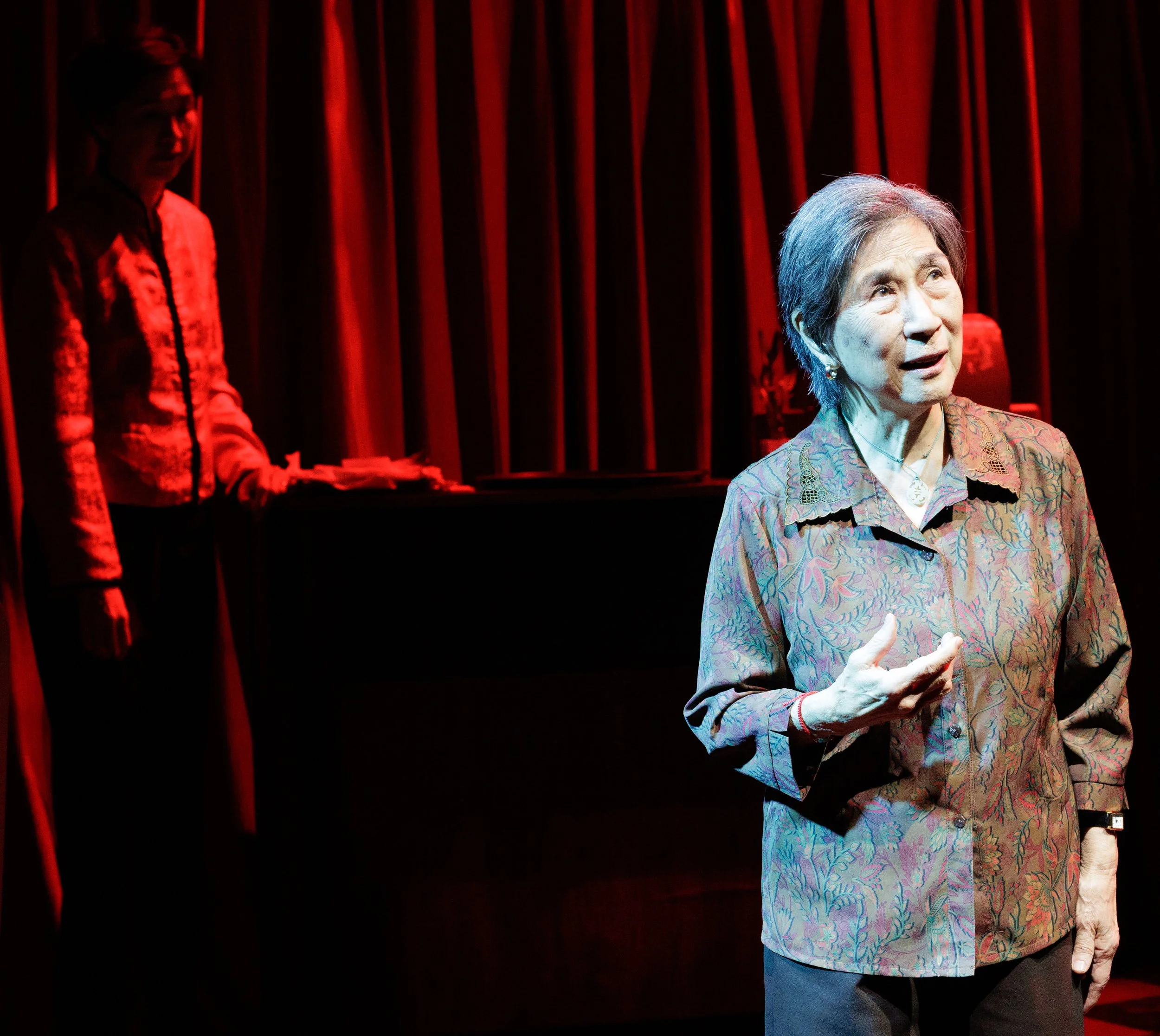
As A-Poh in Laowang: A Chinese King Lear, Ho depicts the disorienting effects of advancing dementia.
Amy and Steven are rapturous with fantasies of personal enrichment: “We deserve a cut of it,” says Steven. Amy counters: “We deserve the whole thing.” Lily, on the other hand, focuses on A-Poh, who “built that restaurant from the ground up.” She alone sees the sale as assurance that her grandmother will have a secure retirement and comfort in advancing age.
The play’s twisty plot chronicles the grandchildren’s competitive bickering; the disintegration of A-Poh’s cognitive capacities (galloping dementia prevents her recognizing Lily); and Wesley’s ambisexual stratagems to seduce each of the grandchildren (all of whom are tempted, for their individual reasons, to succumb to his blandishments). Wesley’s master plan is to bilk A-Poh and the grandchildren of as much money as possible. (No spoilers here about his long-festering grievances.) Playwright Lin conjures references to Shakespeare’s great tragedy; but unlike in grander, more sober works inspired by Lear (Akira Kurosawa’s epic film Ran and Jane Smiley’s tragic novel A Thousand Acres, for instance), the allusions here to the Bard’s text are offhand and waggish.
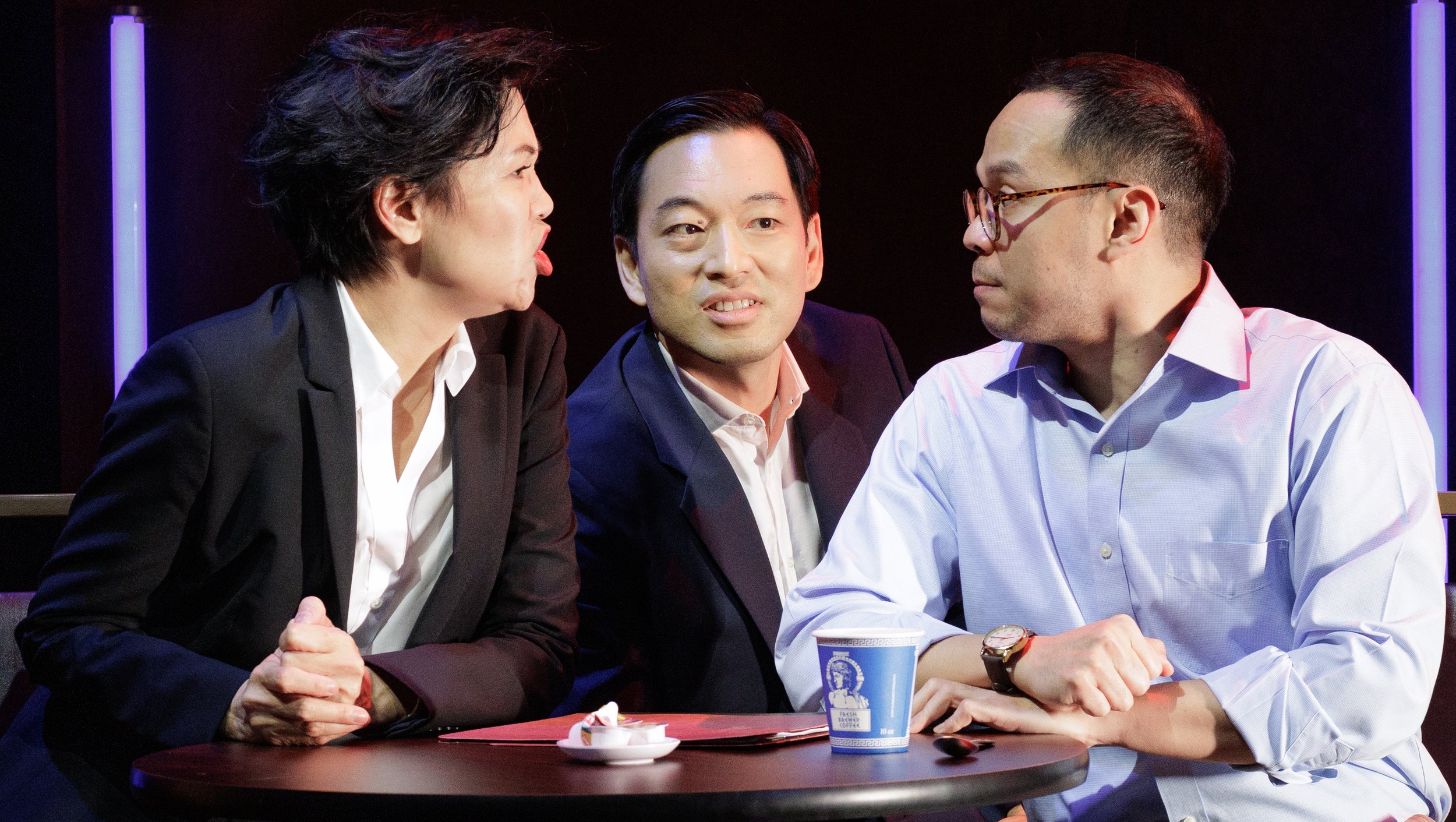
From left: Amy with Wesley Chiu (Tsuji), and Steven Choy (Schneider) are a trio of unscrupulous characters in Laowang: A Chinatown King Lear. Photographs by James Leynse.
Joshua Kahan Brody’s direction keeps the action moving at breathless velocity, demonstrating his affinity for the playwright’s manic humor. Brody coaxes suitably melodramatic performances from Cheung, Schneider, and Tsur, who play the morally bankrupt characters, and touching authenticity from Ho and Keum as, respectively, the emotionally embattled A-Poh and the sincere, virtuous grandchild. The five-member ensemble executes the script’s farcical machinations with a Three Stooges kind of timing.
Wilson Chin, whose scenic-design career straddles theater and opera, gives the production a look reminiscent of those multi-paneled cartoons by Roz Chast in The New Yorker (though nothing about his enchanting art is derivative of Chast or anyone else). Reza Behjat’s lighting complements Chin’s designs and eases transition from scene to scene in a play that roams all around Chinatown.
Laowang is an exuberant romp, with the added benefit of insights about human folly and other timeless subjects. Without that subtitle—A Chinatown King Lear (solemn as a funeral wreath), spectators would likely laugh from start to finish. At the performance under review, most in attendance were as inert as children anticipating a dose of cod liver oil, until tentative chuckles became contagious and the audience capitulated to the author’s humor with the hearty guffaws her work deserves.
Laowang: A Chinatown King Lear, presented by Primary Stages, runs through Dec. 14 at 59E59 Theaters (59 East 59th St.). The performance schedule is somewhat irregular; for dates and curtain times, visit 59e59.org.
Playwright: Alex Lin
Director: Joshua Kahan Brody
Scenic Design: Wilson Chin
Lighting Design: Reza Behjat
Costume Design: Tina McCartney
Sound Design & Original Music: Nicholas Drashner
