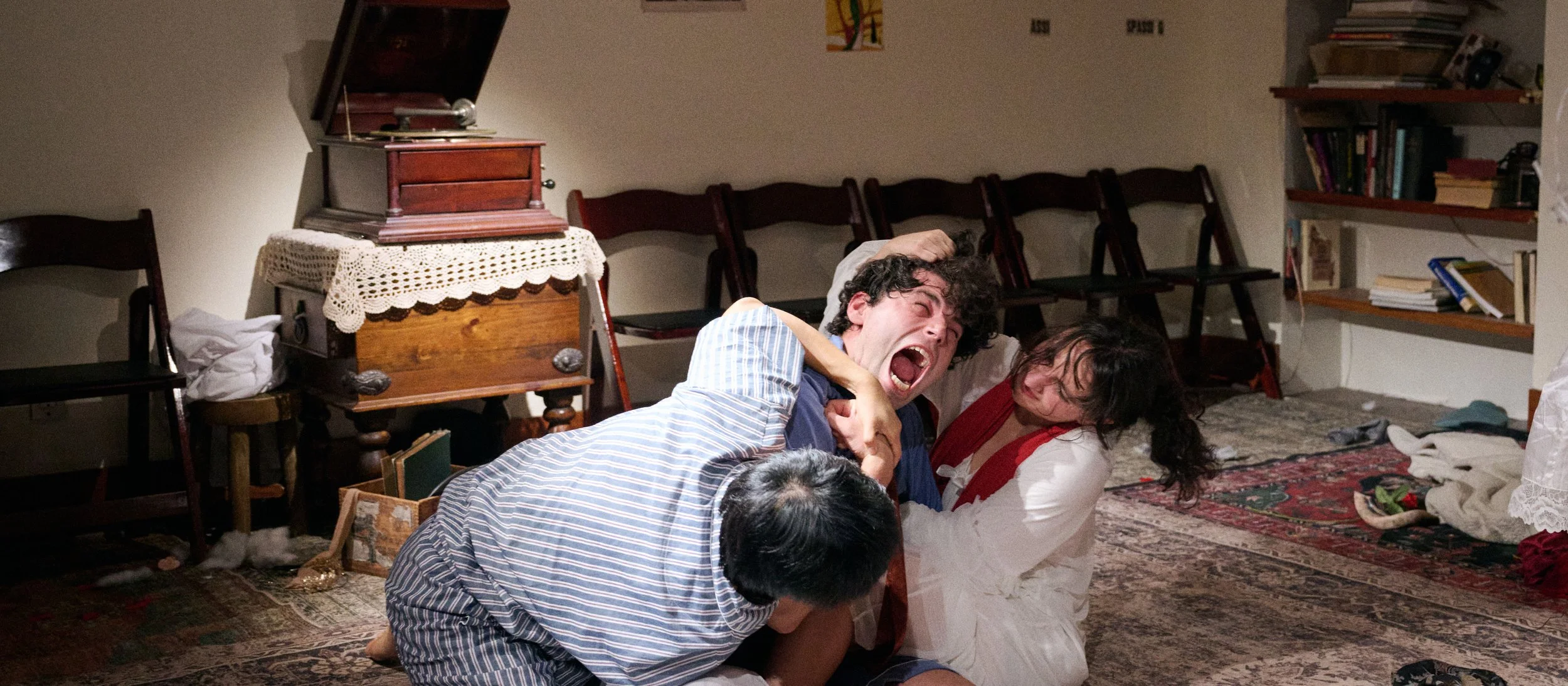
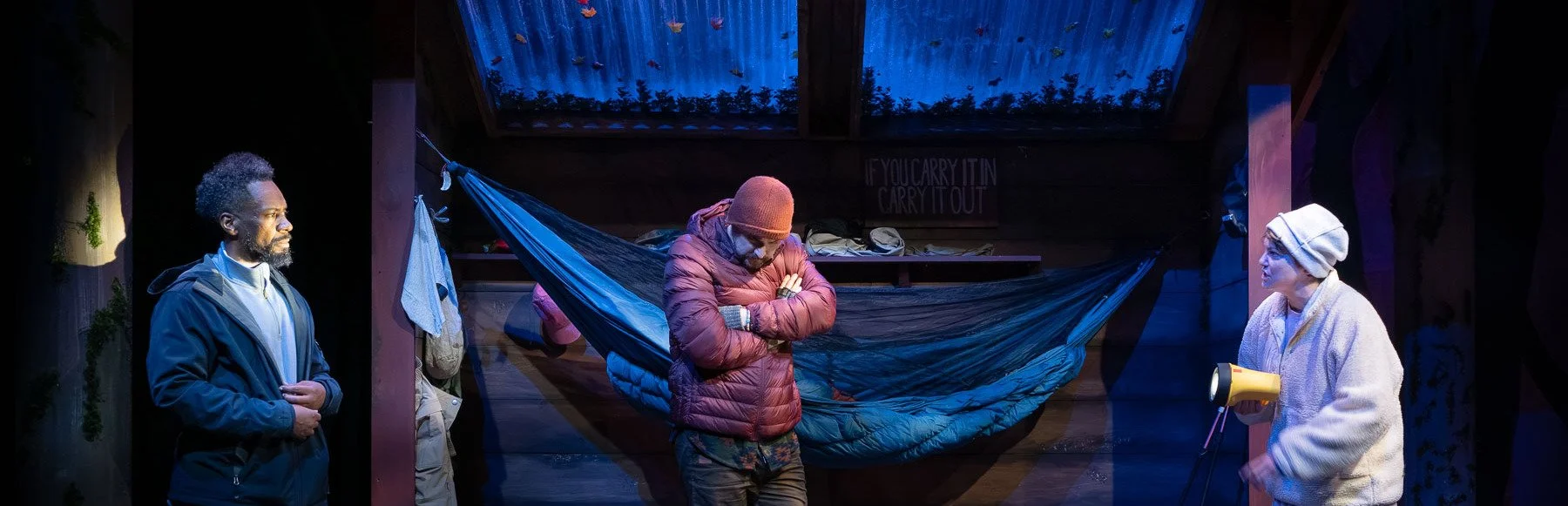
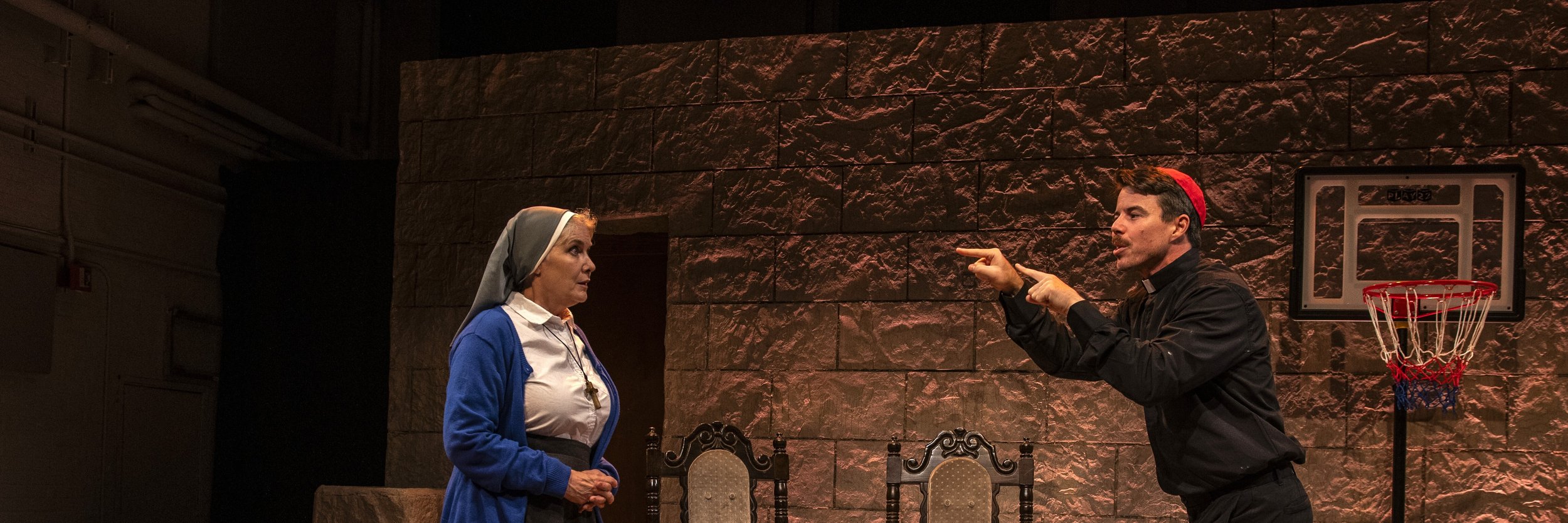
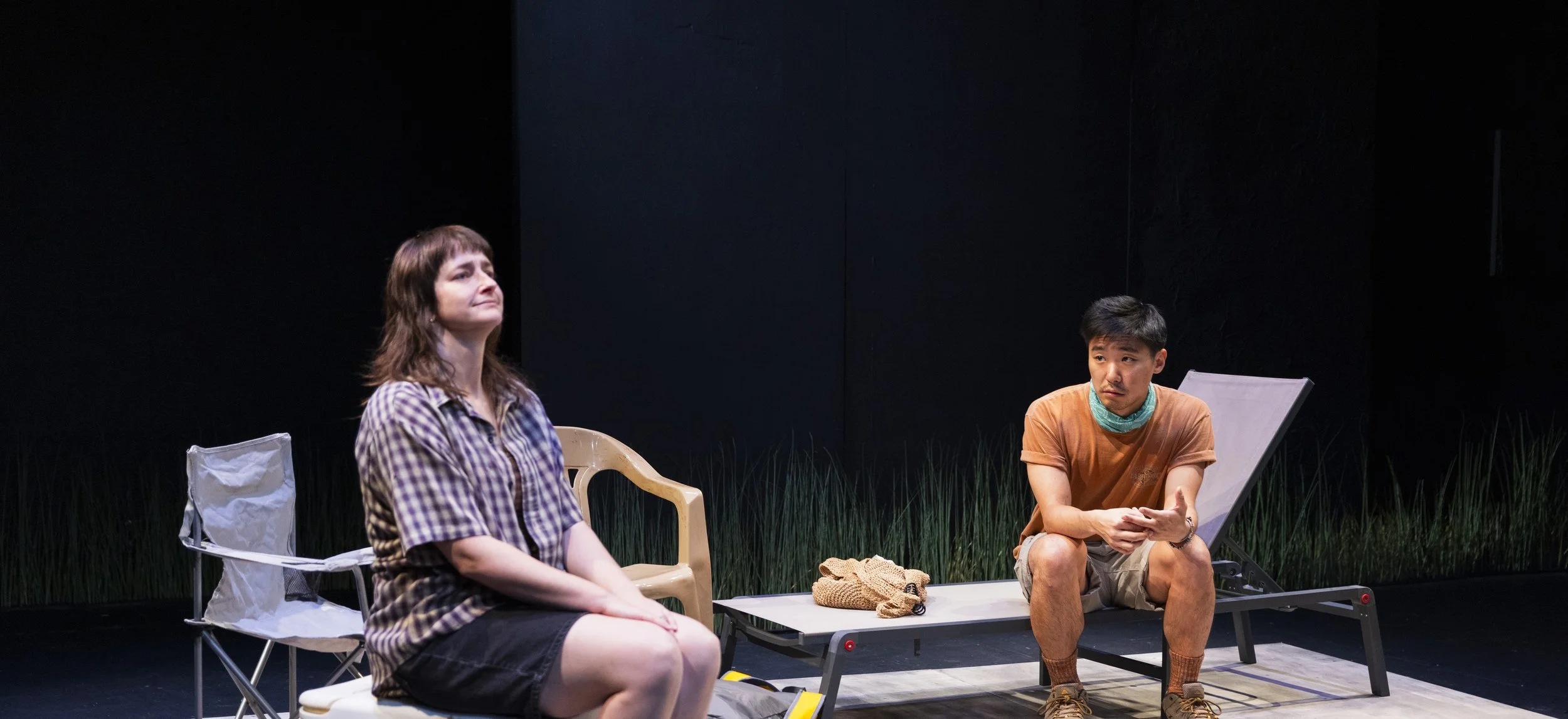
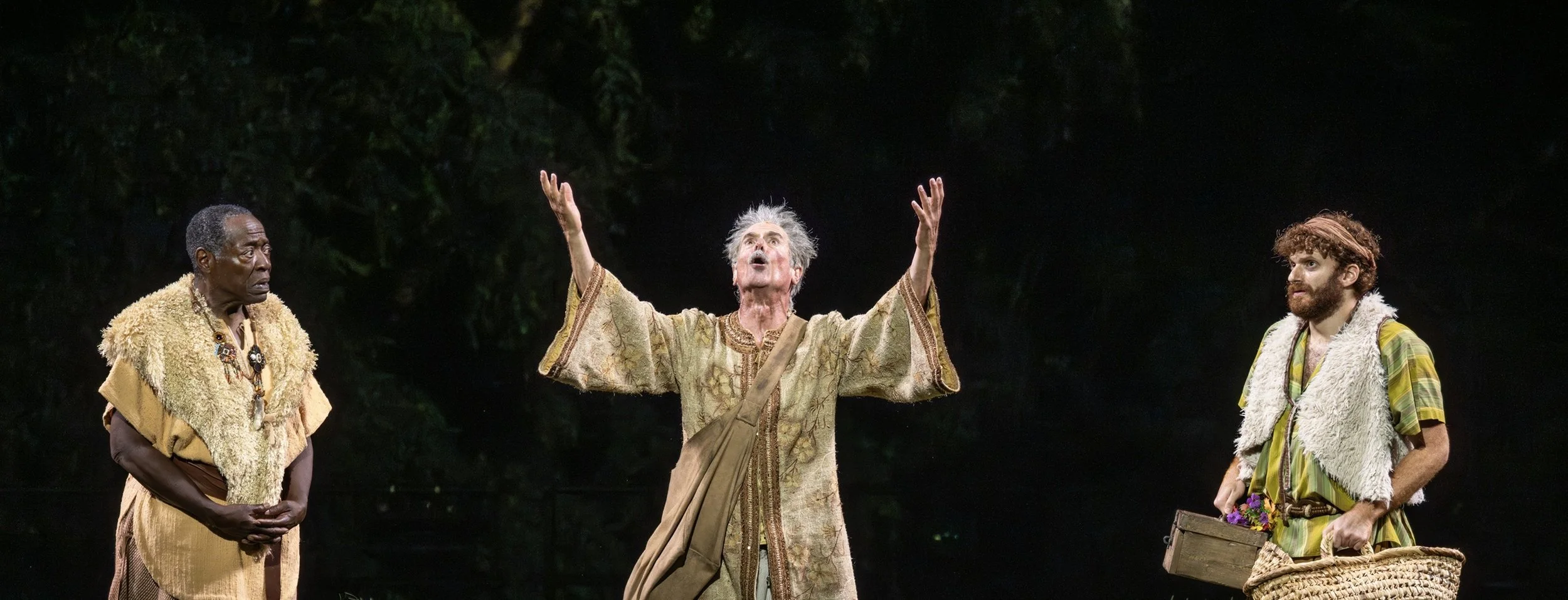
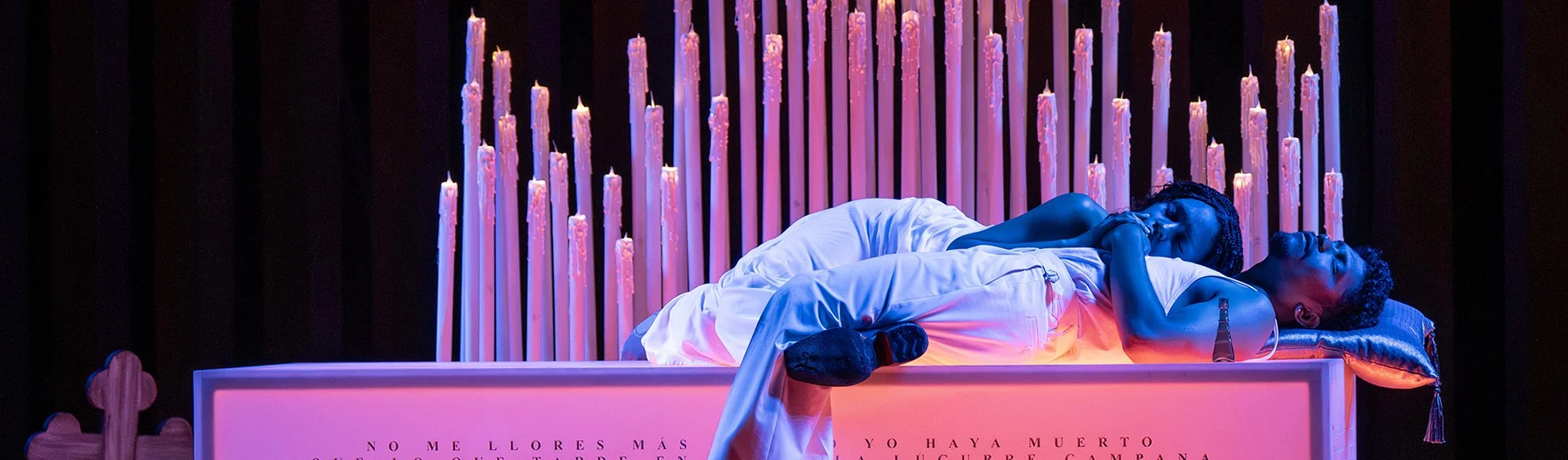
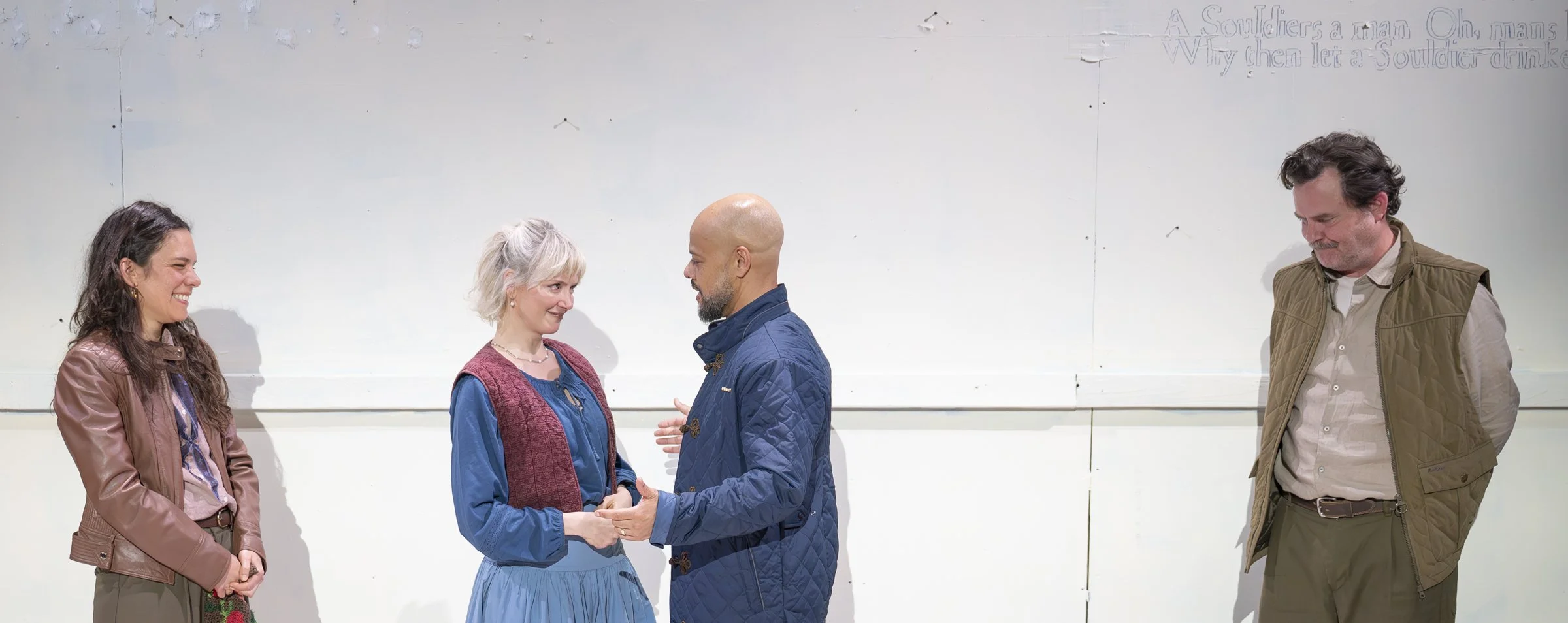
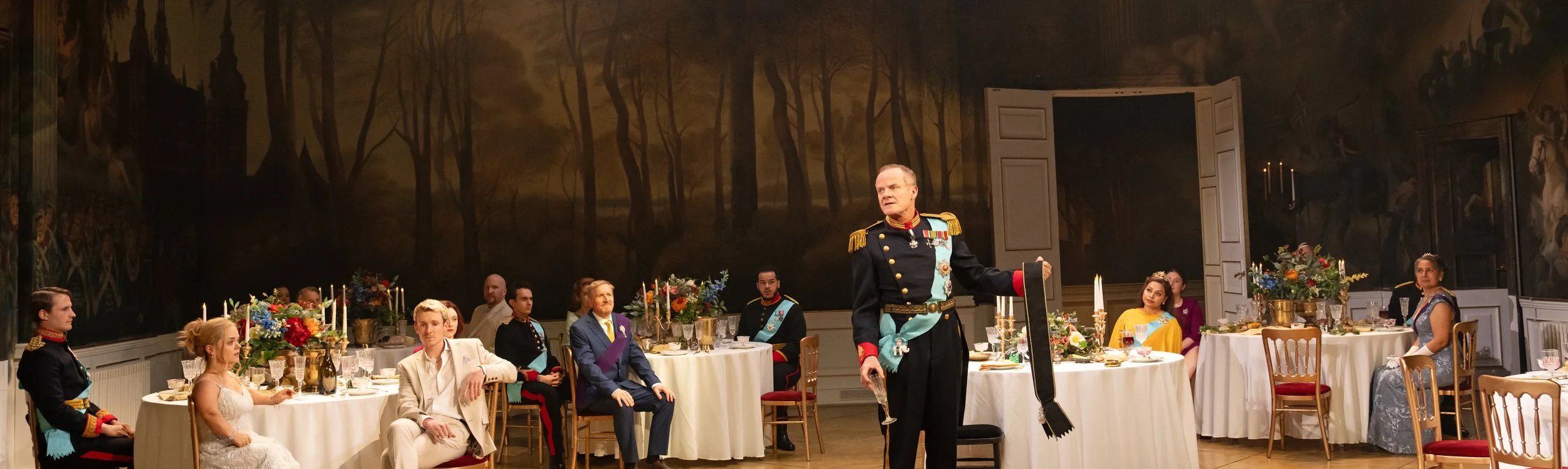
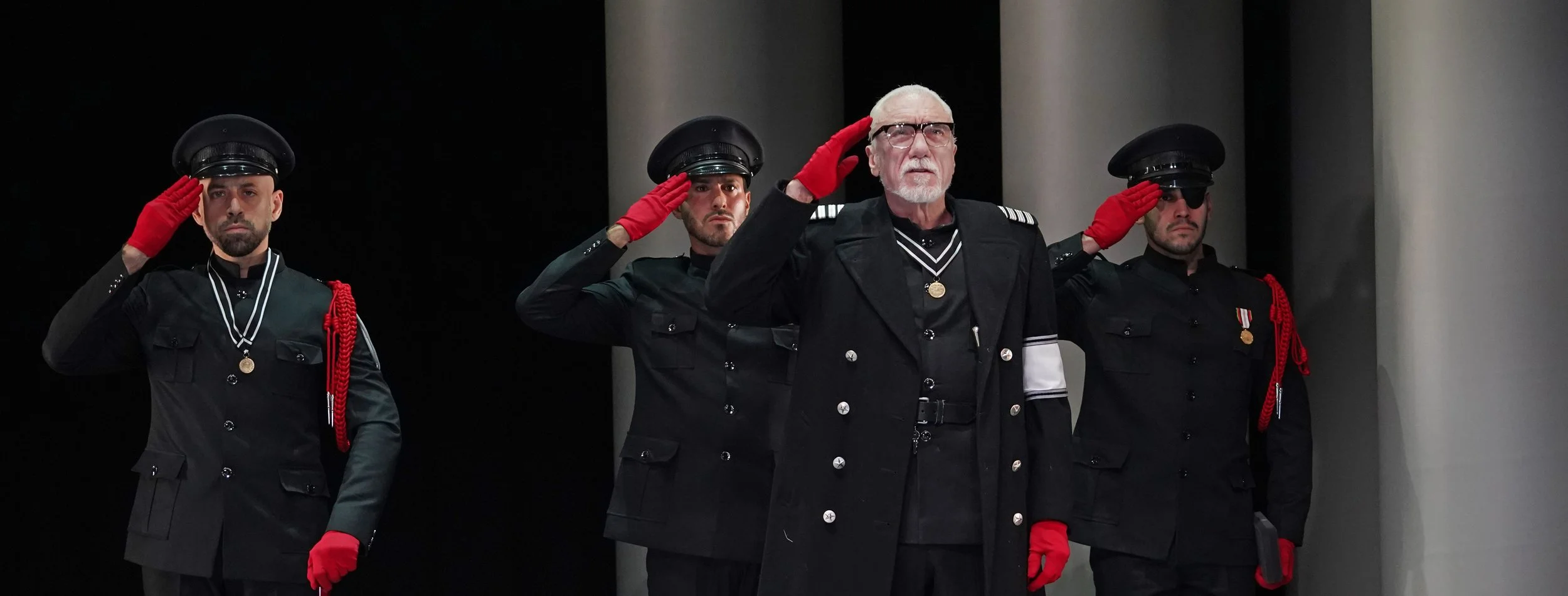
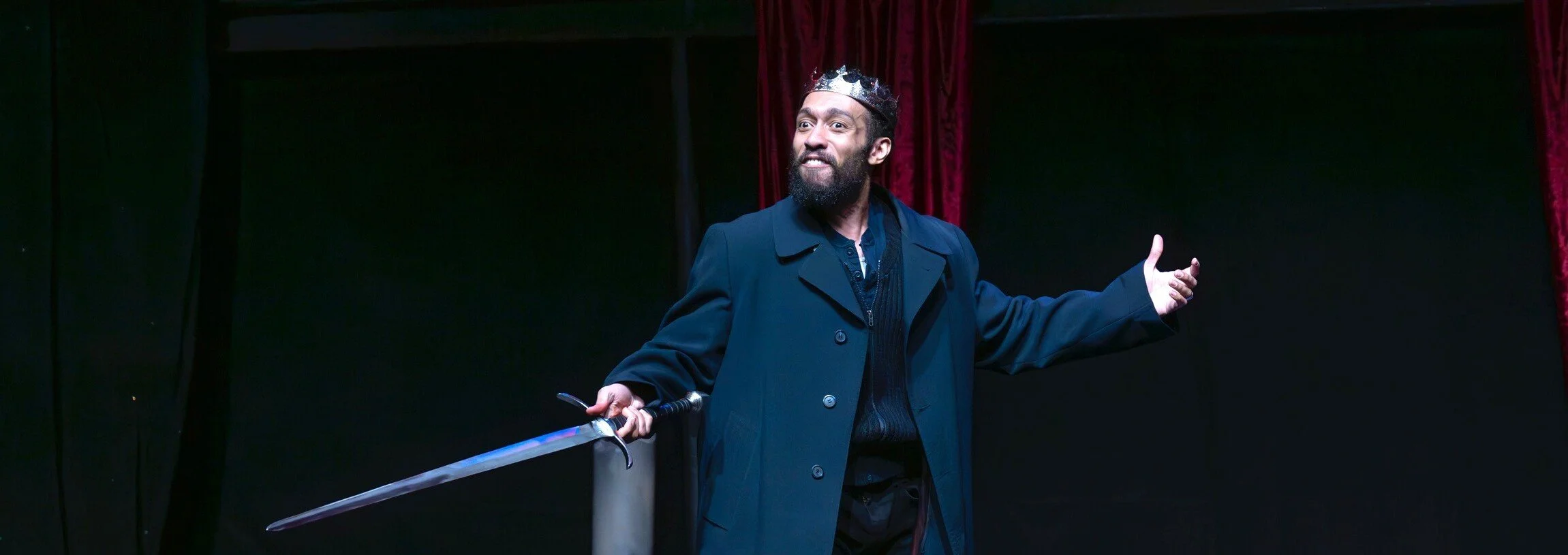
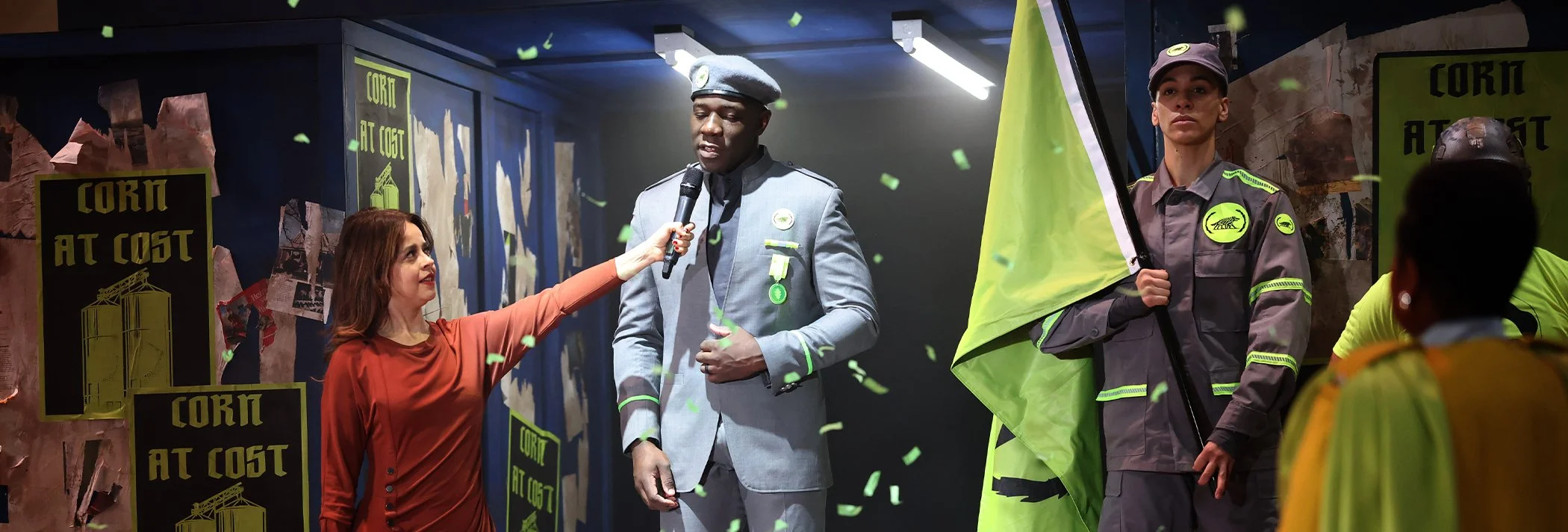
Bedlam’s stripped-to-the-bone staging of Othello proves that less can indeed be electrifyingly more, as four actors conjure a harrowing world with precision and nerve. Under the incisive direction of Eric Tucker, this revival foregrounds the play’s racial tensions with clarity, inviting audiences to lean in—and reckon—with every word.
Hamlet
Director Robert Hastie brings his bold and inventive production of Hamlet for the National Theatre of Great Britain to the Brooklyn Academy of Music (BAM), a fitting first outing in the new partnership between these venerable institutions—BAM first performed Hamlet in 1861, and it was the National’s inaugural production in 1963. Hiran Abeysekera portrays the moody Danish prince as sweet, neurotic, and impish, drawing out the comedy in the play without sacrificing its complexity and tragic weight. Hastie and Abeysekera seize on Hamlet’s theatricality and theatrical self-awareness, taking it to a new and provocative level.
Titus Andronicus
Though apparently popular in its own time, Titus Andronicus (ca. 1592), Shakespeare’s first tragedy, and his bloodiest, hasn’t enjoyed much esteem since. One 17th-century playwright declared it a “heap of rubbish”; T.S. Eliot thought it “one of the stupidest and most uninspired plays ever written.” Others conveniently decided that something so barbarous could not have been written by Shakespeare (although it likely contains some material by the dramatist George Peele, there is no doubt of Shakespeare’s authorship of the bulk of the play). It’s a good thing, then, that Red Bull Theater, led by Jesse Berger, was undeterred: Berger directs a harrowing, and funny, production of the play, featuring a ferocious Patrick Page in the title role.
Macbeth
The Frog & Peach Theatre Company—fancifully named for a classic comedy sketch by Peter Cook and Dudley Moore—has been producing William Shakespeare’s plays on shoestring budgets for three decades. Currently, this scrappy Manhattan troupe is promoting its presentation of Macbeth with the tag line: “What if a madman were king?” That’s cheeky marketing that captures the directorial vision of Lynnea Benson, who’s at the helm.
The Tragedy of Coriolanus
The setting for the Theatre for a New Audience’s production of The Tragedy of Coriolanus is “just after now.” Teeming with multimedia elements, including combat surveillance footage, a four-sided video screen suspended above the stage, and computer-generated imagery (CGI), the conceit effectively mirrors how contemporary politics and war are manipulated by selective images and social media. The drawback to this interpretation is that the volatile relationship between the ruling elite and the common people, so central to Shakespeare’s play, feels elusive and out-of-reach in this nominally futuristic world.
Richard II
The Red Bull Theater production of Shakespeare’s Richard II (1595) is welcome, if only because it is so rarely staged. A Public Theater production scheduled for 2020 was presented online because of COVID; the last Delacorte production was in 1987. In the 2000s, BAM has hosted two major British productions: Ralph Fiennes in 2000, and David Tennant in 2016.
Twelfth Night
After a year’s hiatus, Free Shakespeare in the Park triumphantly returns to the revitalized Delacorte Theater with Saheem Ali’s multicultural staging of Twelfth Night. With wit, music, and romance seamlessly entwined, this timeless comedy revels in love’s unexpected twists and delightful disguises.
Cymbeline
Although the all-Asian, all-female production of Shakespeare’s late romance Cymbeline by the National American Asian Theatre Company (NAATCO) doesn’t succeed on all dramatic fronts, it’s brimming with vitality. It draws on fairy-tale elements, including a wicked queen, an unscrupulous villain, a wronged hero, and an extended scene of revelations that give it the aura of a fairy tale. Cymbeline perhaps can best be summed up as a myth of national origin that reveals how the British and Roman heritages came together under its ancient, peace-loving title character.
Much Ado About Nothing
The skirmish of wits between Shakespeare’s Beatrice and Benedick takes on a modern spin in a new production of Much Ado About Nothing, set in 1940s Italy. Director Thomas G. Waites utilizes the unflagging energy of a rotating cast from Waites TGW studio to fire up Shakespeare’s romantic comedy.
Twelfth Night
The Axis Theatre Company’s new adaptation of Shakespeare’s Twelfth Night is something to celebrate. Directed by Randall Sharp, and superbly performed by a 12-member ensemble cast, this Twelfth Night is a wild and wonderful romp through Illyria.
Macbeth (An Undoing)
Theatergoers yearning to see a new spin on Macbeth need look no further than Zinnie Harris’s Macbeth (An Undoing). Written and directed by Harris, it is a feminist version of Shakespeare’s original that puts Lady Macbeth at its center. But while Harris succeeds in expanding Lady Macbeth’s presence in the story, ultimately the playwright is defeated in increasing the character’s agency, given Shakespeare’s clear-cut trajectory of the doomed Queen.
Eddie Izzard’s Hamlet
Great love and labor has clearly gone into the performance of Eddie Izzard’s 2½-hour solo Hamlet. The adaptation by Mark Izzard (Eddie’s older brother) is generally true to Shakespeare’s text, the split-level set by Tom Piper is wisely uncluttered, and Izzard delivers Shakespeare’s verse with remarkable ease.
Pericles, Prince of Tyre
Pericles, the first of Shakespeare’s late romances, is the only play not in the First Folio. Most critics agree that the first two acts are by someone else, possibly the work of George Wilkins, who wrote the “prose narrative” on which the play is based, and from which Fiasco Theater’s galloping production sometimes borrows. But the last three acts are the Bard, and this play, even though Ben Jonson called it “a mouldy tale,” has proven resilient.
Richard III
New York Classical Theatre (NYCT) is a small troupe presenting distinguished plays, mostly tried and true, with occasional novelties in public spaces around New York City. Stephen Burdman, the company’s founder, espouses a performance style he calls “panoramic theater,” which involves spectators following actors as they perform scenes in multiple spots.
Romeo and Juliet
The National Asian American Theatre Company’s Romeo and Juliet may just go down as the season’s most misdirected production. Employing Hansol Jung’s modern-verse adaptation as its text, codirectors Jung and Dustin Wills no doubt intended to revamp Shakespeare’s tragedy by leaning into its comedy to point up the darker aspects. But what one gets is a travesty of the play.
Pericles
Shakespeare’s romance Pericles has washed up at the Doxsee, the Brooklyn home of Target Margin Theater, with all the “outrageous fortune” in the 1607–08 play intact. Clocking in at 105 minutes, this new staging by David Herskovits, though wildly uneven, delivers some limpidly beautiful moments that redeem the production.
Othello
The New Place Players’ production of Othello at Casa Clara, a former foundry replete with balconies and staircases, is an unusual, site-specific staging that pulls the audience into the world of Shakespeare’s tragedy. Makenna Masenheimer directs the 1604 tragedy without a fourth wall, and a limited audience of 50 assures an intimate experience.
The Winter’s Tale
Shakespeare’s late romance The Winter’s Tale poses two huge challenges to any director. One is that Leontes, the king of Sicilia who has been hosting his bosom buddy Polixenes, king of Bohemia, for nine months, suddenly and without reason suspects his queen, Hermione, of adultery with his old friend. The other is a jump in time between the first three acts—steeped in tragedy—to a fourth act of pastoral comedy, and a last act of redemption. Director Eric Tucker’s production of The Winter’s Tale for Bedlam seems to have taken its approach from the company’s title: it’s almost all bedlam.
As You Like It
Maybe it’s the Jan. 6 mob attack on the U.S. Capitol and the subsequent House Committee hearings this past summer, but the idea of fleeing to the Forest of Arden has rarely been so enticing. Directors often reinvent it as a rowdy retreat, replete with music and dance, but in Lynnea Benson’s production of Shakespeare’s As You Like It, Arden is mellow, soft, and dappled in sylvan light (created by Dennis Parichy).
Hamlet
“If a work is quite perfect,” wrote W.H. Auden about Hamlet, “it arouses less controversy and there is less to say about it.” Across four centuries, critics have found plenty to discuss in this longest of Shakespeare’s plays (also one of his most frequently performed). Auden is prominent among those viewing it as severely flawed. Director Robert Icke has joined the colloquy with an absorbing stage production, now at the Park Avenue Armory, that handles the script’s ostensible defects with aplomb and, in so doing, refutes T.S. Eliot’s suggestion that Hamlet is an “artistic failure.”