
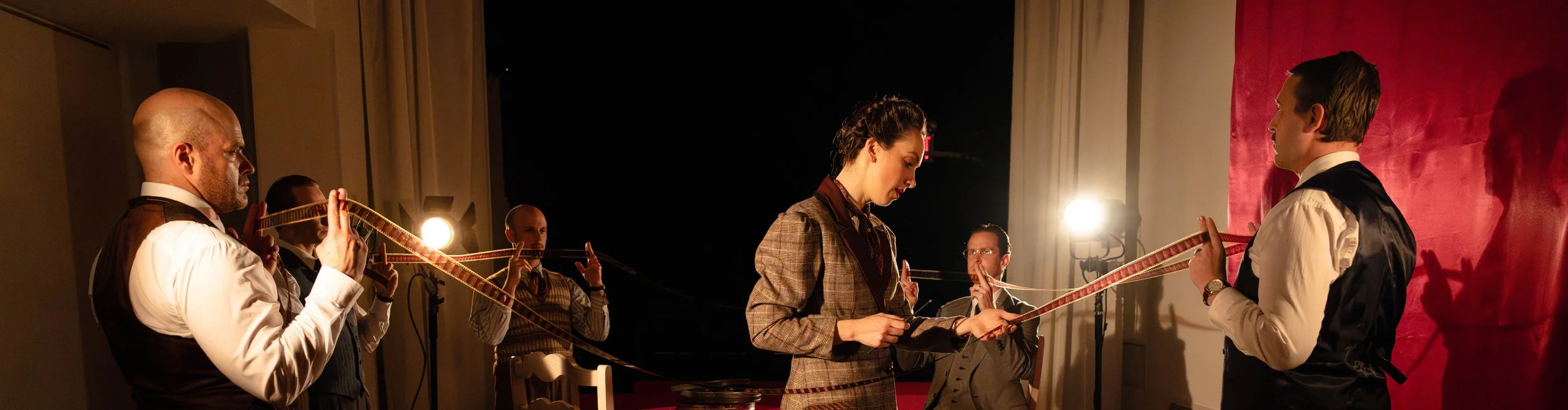
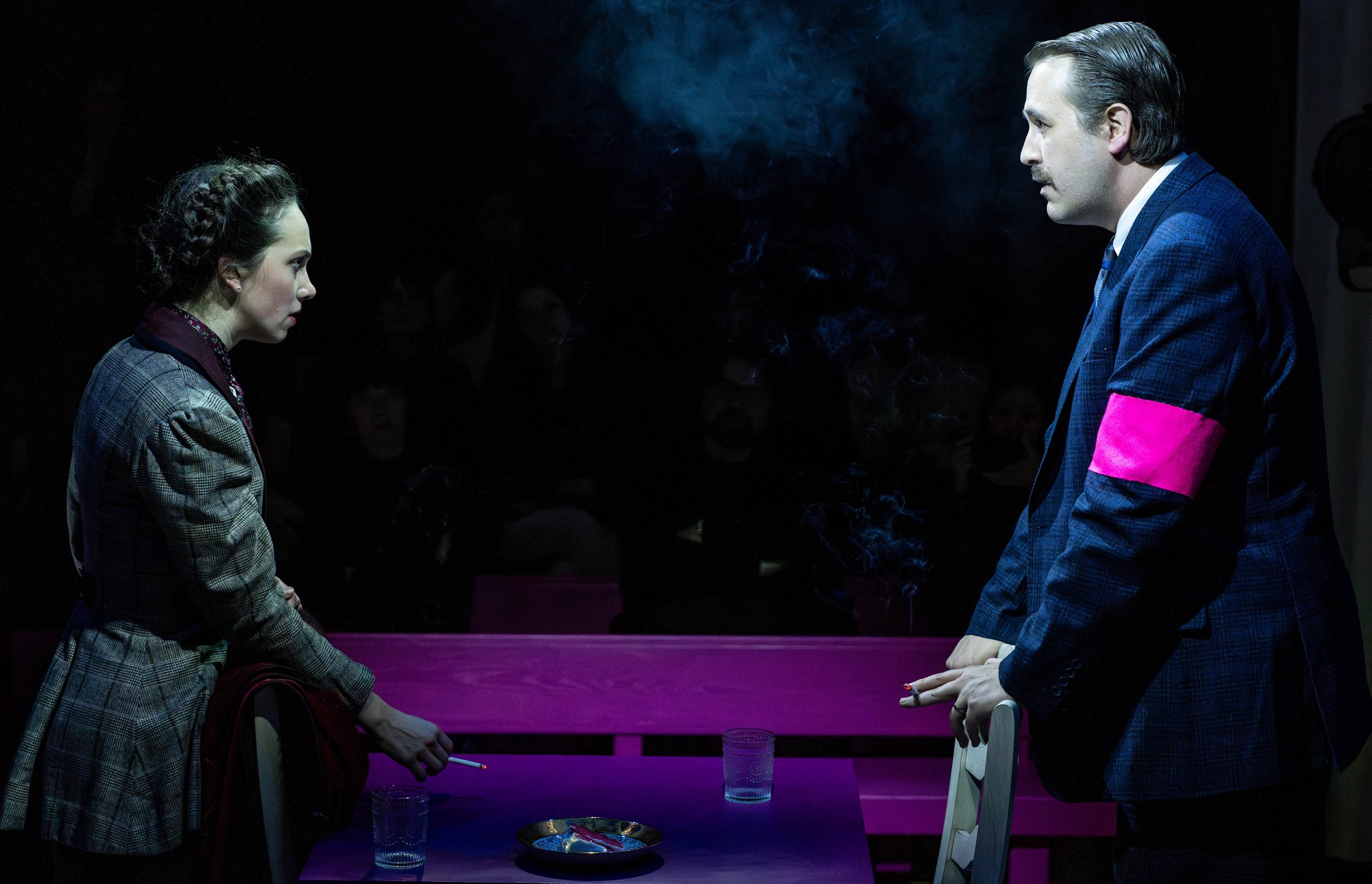
Filmmaker Leni Riefenstahl (Baize Budan, left) squares off with Werner Klingenberg (Sam Hood Adrain), senior member of the German Olympic Committee, in Beauty Freak.
Josef Goebbels, Hitler’s master propagandist and serial womanizer, almost always had his way with women. Nevertheless, when he challenges filmmaker Leni Riefenstahl it’s a classic case of “the unstoppable force meets the immovable object.” It’s unclear from James Clements’ Beauty Freak whether Riefenstahl is the unstoppable force or the immovable object, but regardless, she emerges the winner—or so one is led to think.
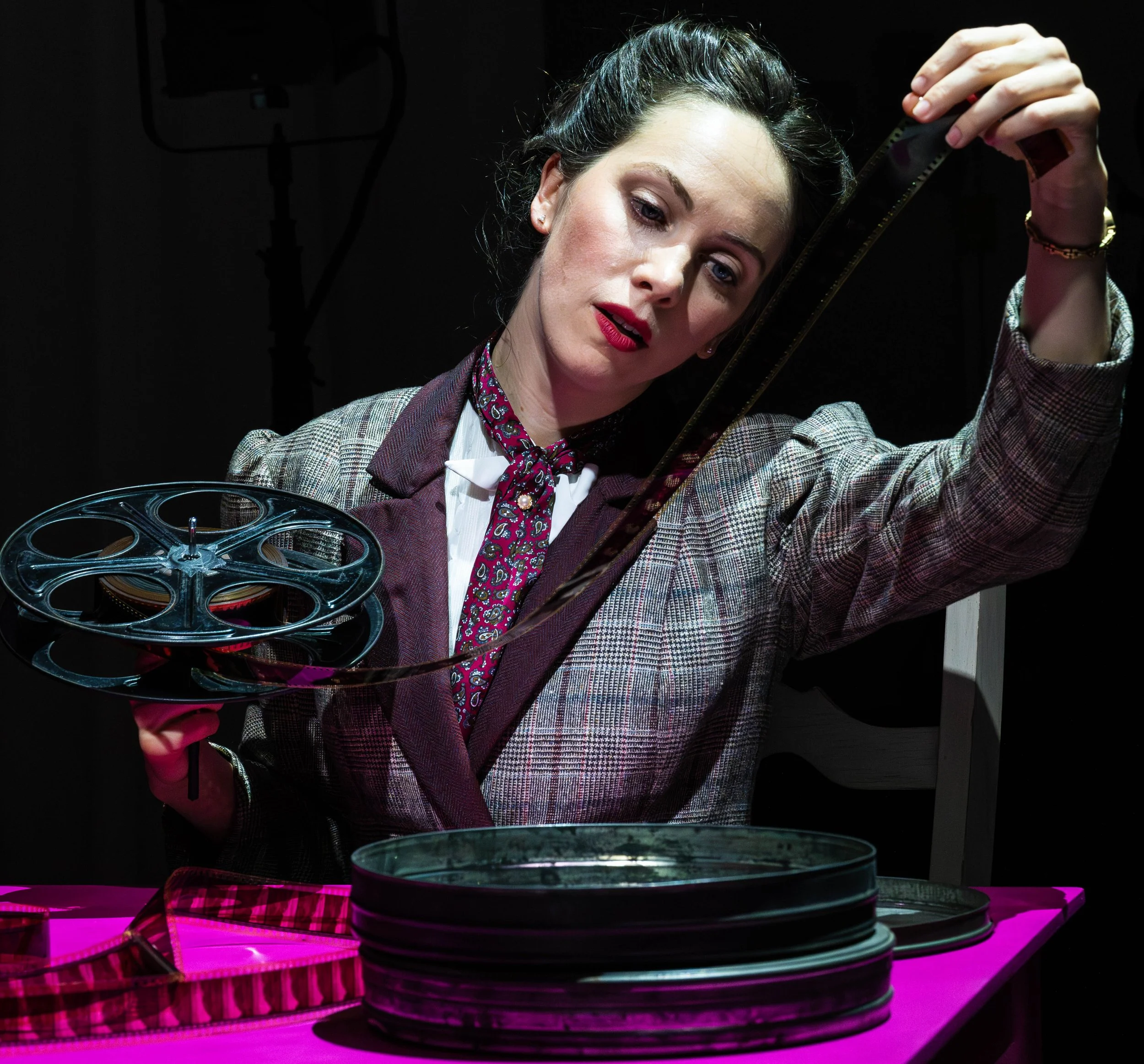
Riefenstahl scrutinizes the raw footage that will become her next documentary. Photographs by Alexia Haick.
At the outset of Clements’ play, Goebbels (Peter Coleman) is frustrated by the autonomy that Riefenstahl (Baize Buzan) has in filming Olympia, the 1936 Munich Olympics documentary. He resents being “bested” by a woman director (one he failed to seduce), whose Triumph of the Will had been acclaimed by Hitler. He seethes when he learns of the film’s extravagant budget, but all he can do is to ask her for expense accounts. Riefenstahl retorts, “I suppose this is only natural. If you cannot control my art, you wish to control my purse strings.”
Clements focuses on Riefenstahl, who, in her desire to curry favor with those who can fund her films, has intentionally shielded herself from reports of the Führer’s terrorizing of German citizens. But her assistant and confidant, Ernst Jäger (Keith Rubin), observes the way her ambition clouds her ethics and tries to serve as a moral conscience in Beauty Freak.
Although Jäger’s wife is Jewish, his wake-up call to Riefenstahl goes beyond self-interest, as he describes escalating German violence and repression against the Reich’s critics. Jäger questions why she agreed to film Olympia for the Nazis, and the first signs emerge of an ideological divide between them:
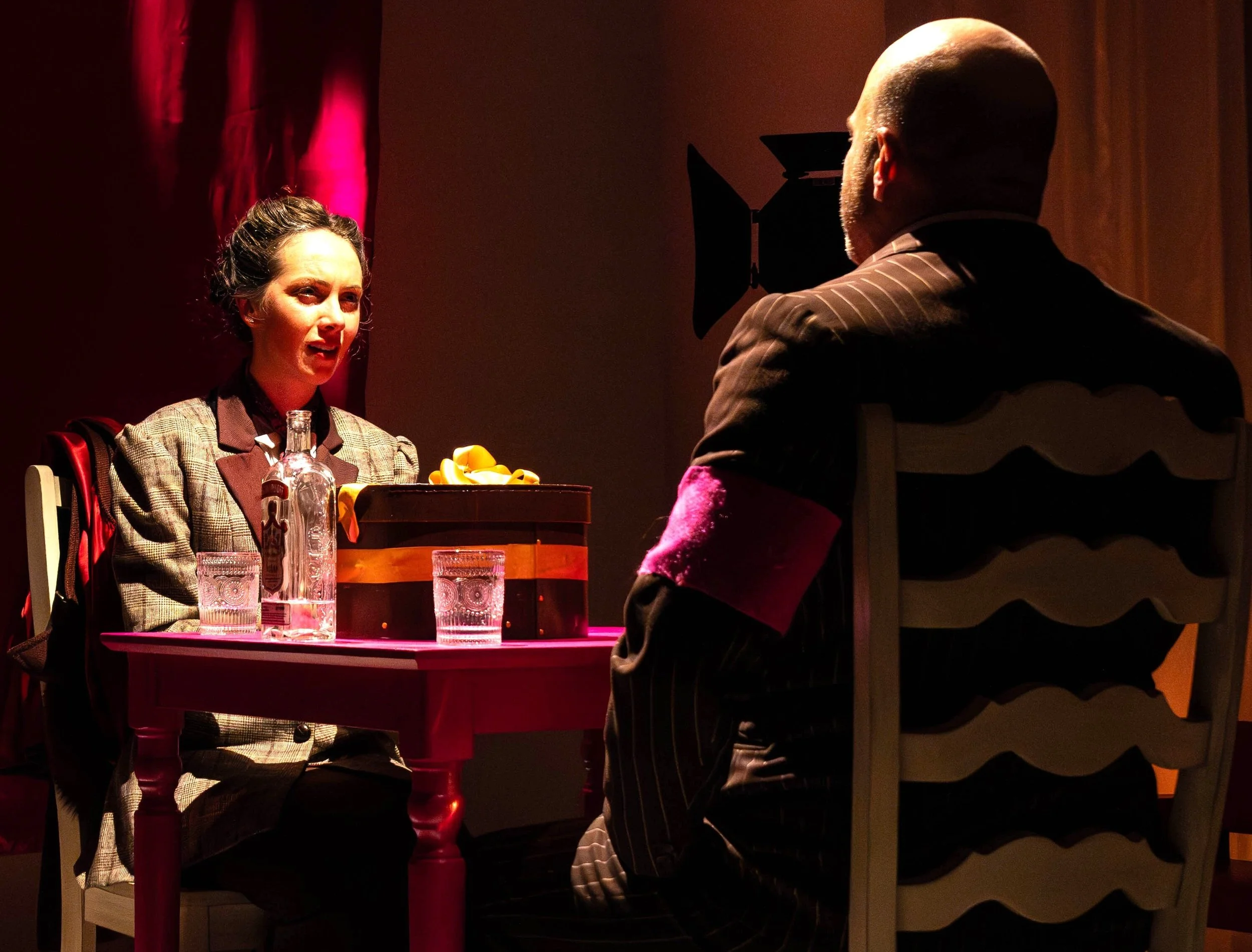
Riefenstahl listens to some disturbing information from Ambassador Hans-Heinrich Dieckhoff (Slate Holmgren).
Yes, Leni, we must still buy food. But at what moment is it no longer a question of necessity and instead one of power, advancement? Those are two very different ethical questions.
As Nazi repressions accelerate, their mutual friend and colleague Max Borgman (Luca Fontaine) a gay actor and designer, is murdered. Their ideological divide eventually becomes a gulf. during a Goebbels-ordered tour of the United States in November 1938, accompanied by Jäger and Werner Klingenberg (Sam Hood Adrain), a senior member of the German Olympic Committee and a party lackey. Riefenstahl, who has already removed Jews’ credits from Triumph of the Will to stay in favor) hopes to cut deals with Hollywood, and Goebbels hopes to win America’s support. During the visit, Jäger tells Riefenstahl about the Kristallnacht riots against Jews of Nov. 9–10, 1938, that have occurred back in Germany. The reports of the Nazis’ brutality undermine both Goebbels and Riefenstahl.
When a reporter asks for comments, Riefenstahl dissembles. “Lies. … It cannot be true,” she says. But privately Jäger reprimands her:
My God, Leni. They are burning down synagogues and beating people to death in the streets. And all you can think about is finding some good old anti-Semites with deep pockets?
Her response? “I am making a professional calculation, Ernst, not a moral judgment.”
Hollywood distances itself from Riefenstahl, as does renowned antisemite Walt Disney (James Clements), who, after a face-to-face discussion with her says that he will deny they met. Her only endorsement is from German Ambassador Han-Heinrich Dieckhoff (Slate Holmgren).
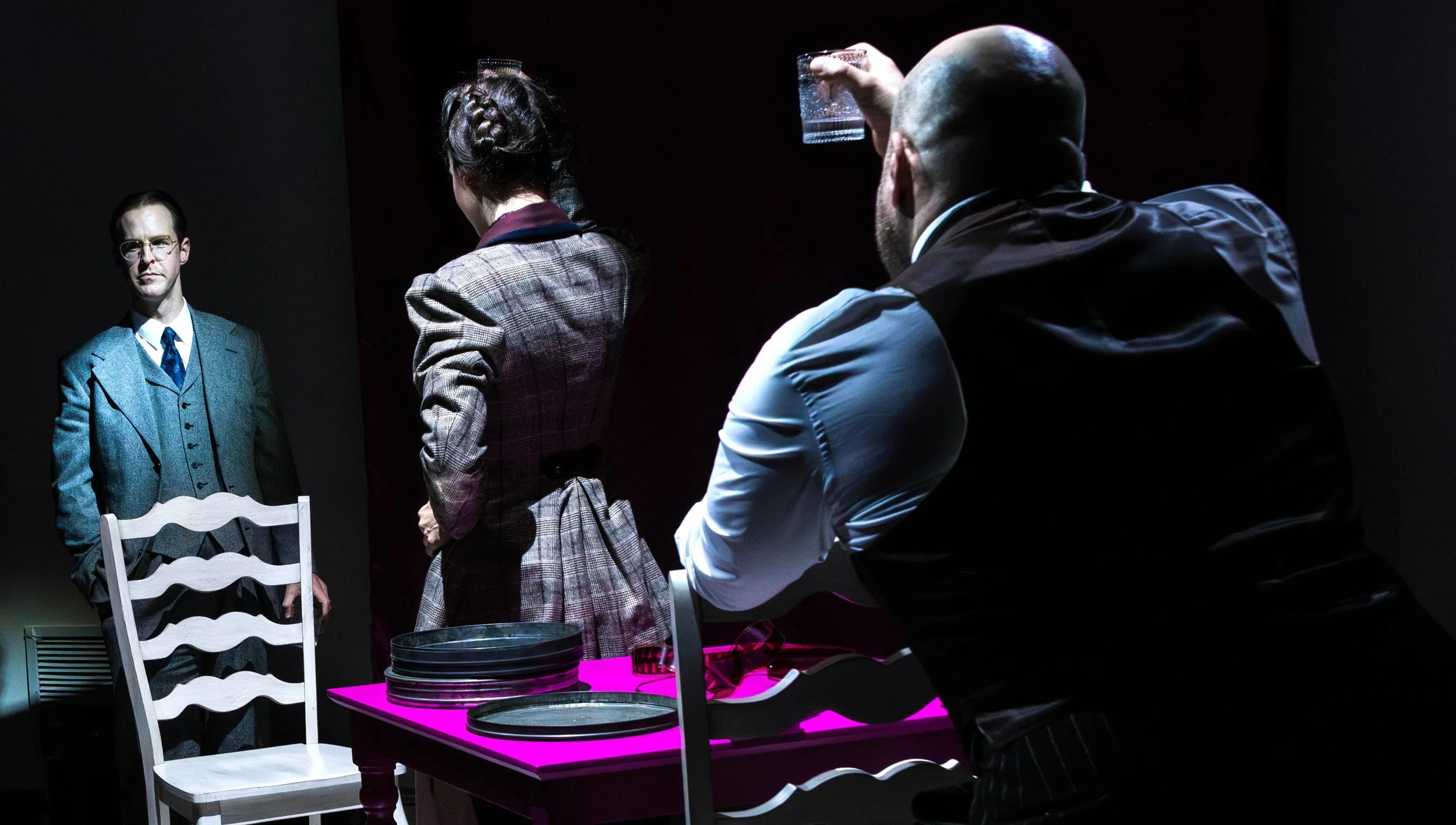
Jäger looks on as Riefenstahl and Dieckhoff toast the completion of the film.
Buzan, through her demeanor, voice, movement, and very rare moments of empathy, has a physical and emotional range that totally evokes Riefenstahl, who is both her own heroine and victim, and who, despite being famous (or notorious), can rationalize her actions but cannot detach herself from the horrors around her, no matter how inured she has become. The filmmaker is equally adroit at being self-serving, obsequious, and self-punishing when the truth is too much.
Riefenstahl’s visible gall and angst can coexist effectively on a platform housing a small table with a few chairs. In a complex piece of direction by Clements, during the two- or three-person scenes, the other actors stand at the platform’s edge as observers: they play production crew, reporters, servants and members of the Hollywood Anti-Nazi League, as well as stepping in as the occasional named character (Goebbels, Max, Dieckhoff and Walt), and not always the same one. Kudos to director Clements and set designer Suku Sakai for pulling this off.
Each performer’s characterization is intrinsically credible—frighteningly so—except for those of Borgman and Jäger, who are credible but not frightening. As foil to Riefenstahl, Jäger is the surviving voice of conscience of that lot. Up close, philosopher Hannah Arendt’s phrase about “the banality of evil” doesn’t hold up. Riefenstahl and her cronies are consciously and consistently evil personified
Beauty Freak runs at The Cell (338 W.23rd St.) through May 17. Evening performances are at 7:30 p.m. Wednesdays through Sundays; matinees are at 3 p.m. on Sundays and on Saturday, May 16. There are no performances from May 11 to 15; For more information, or to purchase tickets, call (646) 861-2253 or visit thecelltheater.org.
Playwright: James Clements
Director: Danilo Gambini
Sound Designer: Liam Bellman-Sharpe
Set Designer: Suzu Sakai
Costume Design: Stephanie Bahniuk
Lighting Designer: Yung-Hung Sung
