
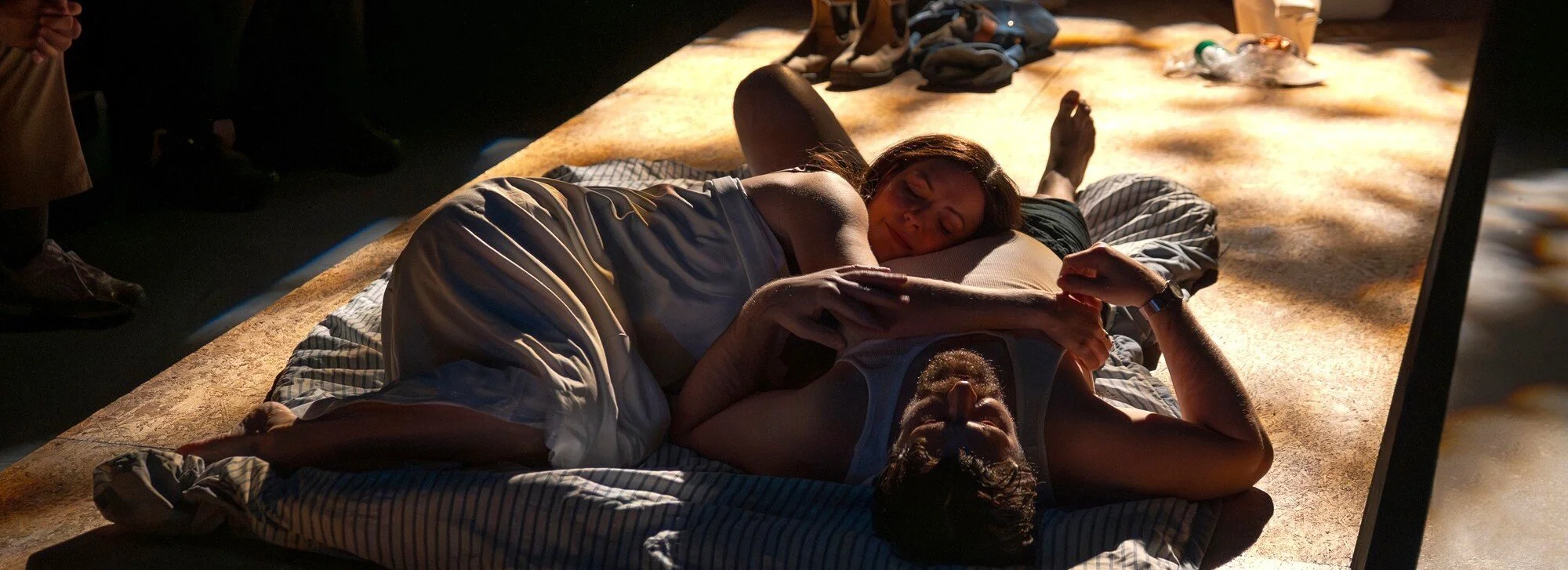
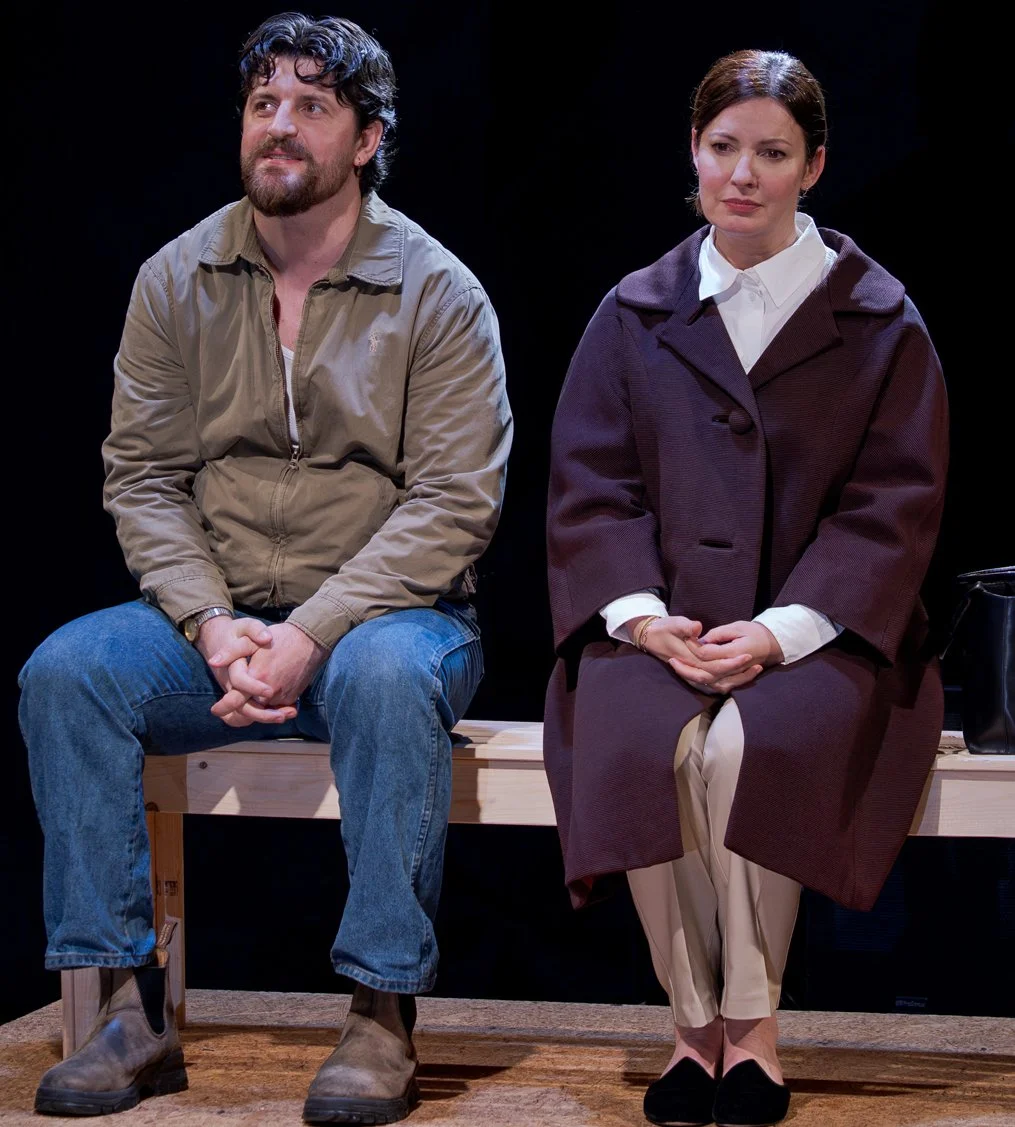
Shane McNaughton and Kate Arrington play dysfunctional daters in Derek Murphy’s The Bad Daters.
The Bad Daters, by Ireland-born New Yorker Derek Murphy, arrives Off Broadway with a winning blend of sharp Irish wit and disarming emotional honesty, transforming a premise about romantic misfires into something unexpectedly tender. Under the deft direction of Colin Summers, and buoyed by finely tuned performances from Kate Arrington and Shane McNaughton, this U.S. premiere proves as affecting as it is entertaining—a love story that earns its poignancy without sacrificing its bite.
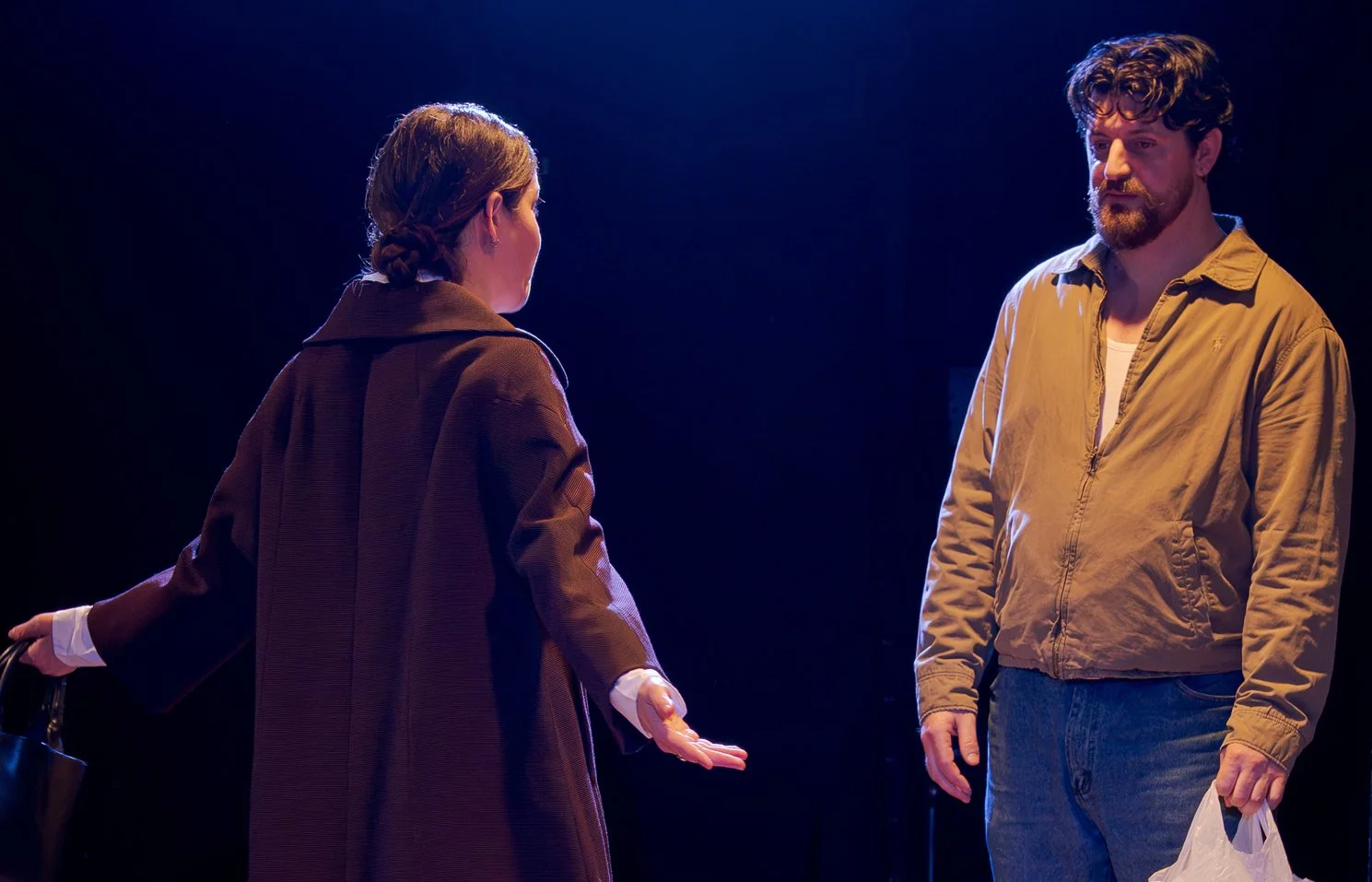
Wendy (left) finds her guardedness giving way when Liam discloses the painful facts of his wife’s suicide. Photographs by Emma Kazaryan.
Murphy’s play follows Wendy and Liam, two reluctant participants in the modern dating circuit, brought together by an app that neither is using for entirely straightforward reasons: she is nudged into it by an overbearing sister, while he approaches it as a kind of quiet atonement for a shadowy past. Their awkward first meeting—weighted by grief, guilt, and a conspicuous lack of romantic promise—nonetheless leads to a second date, and then several more, as the play traces their tentative connection over months, leaving open the question of whether something genuine can take root between two people so guarded and uncertain of themselves.
Humor and hardship are tightly interwoven in The Bad Daters, creating a tonal balance that feels both acerbic and unexpectedly poignant. From the outset, Wendy bristles like a guard dog—brandishing pepper spray and a battery-operated whistle (“I just want you to know that I have a really loud whistle, which works on a battery so I don’t even have to blow that hard”) and compulsively sanitizing her hands at even the slightest contact—while Liam, more spaniel than suitor, meets her prickliness with a gentle, almost disarming affability; together they form an unlikely pairing whose uneasy chemistry fuels this dark romantic comedy, richly inflected with Irish vernacular.
“‘The Bad Daters’ resonates less as a conventional romantic comedy than as a quietly affecting meditation on the risks and rewards of emotional exposure.”
What gives Murphy’s one-act its dramatic charge is the way Wendy and Liam, for all their early sparring, are in fact engaged in a kind of mutual unmasking—stripping away defenses in an effort to reach something honest beneath the bluster. By the second scene, Liam’s mild demeanor begins to harden into resolve as he pushes back against Wendy’s sharp-edged provocations, emboldened, perhaps, by having already disclosed the most painful fact of his past: his wife’s suicide and her parting plea that he “make an effort.” In turning his gaze forward, he recognizes that doing so requires a break from passive accommodation, culminating in a rare moment of candor in which he challenges Wendy’s self-styled “honesty” as a cover for cruelty—an outburst that lands with particular force precisely because it is so uncharacteristic of him:
You want to know what I really think? . . . All this “honesty” stuff is just you giving yourself permission to say whatever you like. You’re right, you’re not quirky or cute, you’re just rude.
Wendy’s evolution, though less immediately apparent, is no less significant. Beneath her barbed wit and defensive posturing lies a woman for whom control has become a shield against vulnerability, and as the play progresses, that shield begins to show fissures. In fleeting but telling moments, her abrasive “honesty” softens into something more uncertain—and more revealing—suggesting that her resistance to connection may be less a matter of temperament than of fear. Even in moments of unexpected intimacy, her instinct is not to retreat but to question where she’s headed, her guardedness briefly yielding to a flicker of self-awareness, as she tentatively wonders what, exactly, she and Liam are “getting . . . into.”
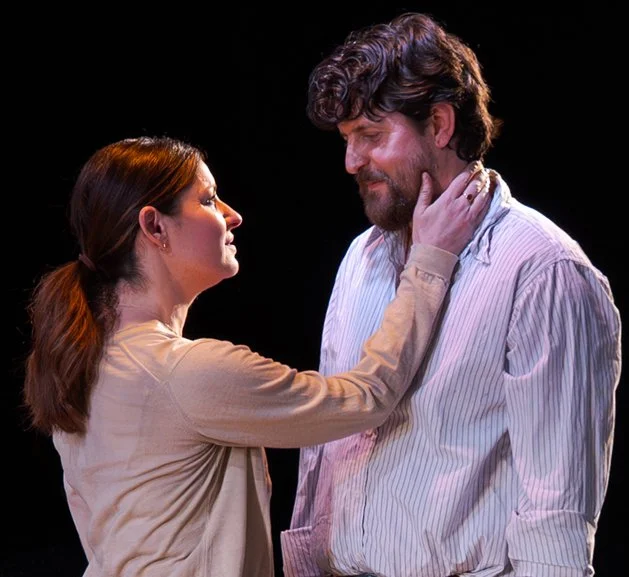
The sassy Wendy finds herself in a moment of unexpected intimacy with McNaughton, who plays the guilt-ridden widower Liam.
Murphy’s two-hander demands performers of considerable range, and in Arrington and McNaughton. the production finds actors more than capable of meeting its emotional and tonal demands. Arrington brings a ferocious precision to Wendy, while McNaughton proves equally compelling, imbuing Liam with a disarming warmth and quiet resilience.
The Bad Daters marks a notable departure from Murphy’s earlier works—such as his Dublin Trilogy and A Short Wake—in its focus on the tentative formation of a romantic bond. Yet for audiences attuned to Murphy’s sensibility, the play remains unmistakably his, sustaining his signature strain of dark comedy while continuing to probe familiar thematic terrain: love, redemption, and the complexities of the Irish experience.
In the end, The Bad Daters resonates less as a conventional romantic comedy than as a quietly affecting meditation on the risks and rewards of emotional exposure. Murphy resists easy resolutions, instead allowing his characters to arrive at something more tentative and human—a recognition that connection, however imperfect, requires effort, honesty, and a willingness to move beyond the past. In this finely calibrated production, that hard-won insight lands with disarming clarity, leaving audiences with a sense that even the most unlikely pairings can edge toward grace.
The Bad Daters plays through May 17 at Paradise Factory (64 E. 4th St.). Evening performances are at 7 p.m. Thursday through Saturday; matinees are at 2 p.m. Sunday. For tickets and more information, visit paradisefactory.org.
Playwright: Derek Murphy
Director: Colm Summers
Scenic Design: Tyler Herald
Lighting Design: Betsy Chester
Costume Design: Kindall Houston Almond
Sound Design: Tye Hunt Fitzgerald
