
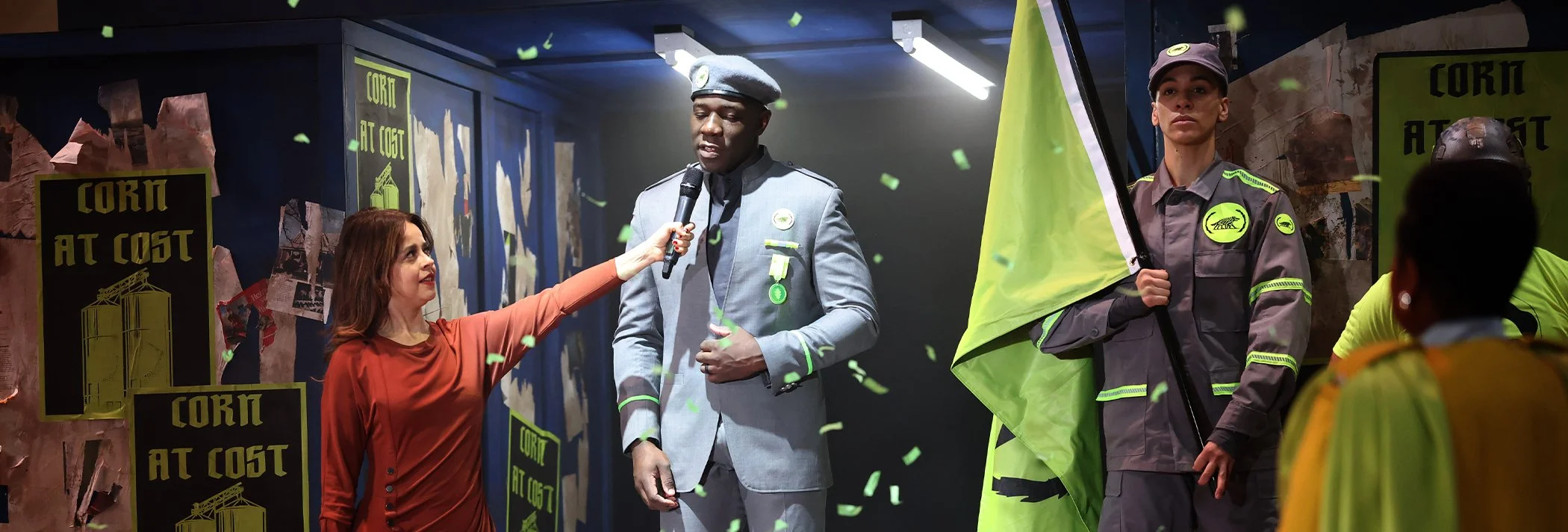

War hero Caius Martius Coriolanus (McKinley Belcher III, center left) and General Cominius (Barzin Akhavan, center right) stand protected against a throng of angry plebeians in Shakespeare’s The Tragedy of Coriolanus. Photograph by Gerry Goldstein. (Banner photograph by Hollis King.)
The setting for the Theatre for a New Audience’s production of The Tragedy of Coriolanus is “just after now.” Teeming with multimedia elements, including combat surveillance footage, a four-sided video screen suspended above the stage, and computer-generated imagery (CGI), the conceit effectively mirrors how contemporary politics and war are manipulated by selective images and social media. The drawback to this interpretation is that the volatile relationship between the ruling elite and the common people, so central to Shakespeare’s play, feels elusive and out-of-reach in this nominally futuristic world.
As the valorous war hero Caius Martius Coriolanus, McKinley Belcher III is suitably standoffish and magisterial. His disdain for the Roman plebeians is palpable, his addresses dripping with condescension. To him, the masses are merely fickle, a point he makes with scathing bluntness:
With every minute you do change a mind,
And call him noble that was now your hate,
Him vile that was your garland.

Volumnia (Roslyn Ruff), attempts to reason with Coriolanus, her headstrong son. Photograph by Hollis King.
While Coriolanus is flanked by savvy politicians, he stubbornly resists them. He rejects the counsel of his mentor, Menenius Agrippa (a deliciously oily Jason O’Connell), and actively undermines the praise of his commander, Cominius (a stately Barzin Akhavan). Only his mother, Volumnia—played with steely determination and effortless nobility by Roslyn Ruff—can crack his hardheadedness. She shares his low opinion of the masses, but she possesses a tactical patience he lacks. As she tells him, “I have a heart as little apt as yours / But yet a brain that leads my use of anger / To better vantage.”
Goaded by a pair of devious tribunes, Sicinius Velutus (William Demeritt) and Junius Brutus (Zuzanna Szadkowski), the people turn on Coriolanus when he refuses to show humility. In one of the most thrilling moments of the evening, the proud general erupts, practically roaring at the ungrateful populace:

Mickey Sumner is Tullus Aufidius, Coriolanus’s foremost rival turned confederate. Photograph by Hollis King.
You common cry of curs whose breath I hate
As reek o’th’ rotten fens, whose loves I prize
As the dead carcasses of unburied men
That do corrupt my air, I banish you.
Exiled from Rome, Coriolanus joins forces with his former adversary, Tullus Aufidius (Mickey Sumner), threatening to bring down the city.
Directed by Ash K. Tata, this Coriolanus is visually striking but, except for the scenes with Belcher and Ruff, is emotionally uninvolving. Running nearly three hours with an intermission, the text is largely intact, but there are some alterations. Notably, Aufidius is portrayed as a woman, and Sumner is both formidable and seductive. This gender switch adds a layer of romantic intrigue, especially when Coriolanus’s wife (Meredith Garretson) attempts to appeal to his family responsibilities, but amid the battlefield backdrop, these human elements never truly take root.
The dystopian concept, at least theoretically, should work. Afsoon Pajoufar’s evocative scenic design utilizes orange draped tarps to denote war camps, which are juxtaposed against graffitied plywood walls representing a city in economic upheaval. (The sense of looming violence is further enhanced by Masha Tsimring’s lighting and Brandon Keith Bulls’s sound design.) Avery Reed’s costumes look like a cross between Call of Duty and Squid Game: dark, drab military uniforms, featuring a Day-Glo Capitoline wolf (Rome’s mythical she-wolf nursing Romulus and Remus), are juxtaposed with the brightly colored wraps (suggesting togas) worn by the nobility.

Menenius (Jason O’Connell, left) warns the populace against rash decisions while the rabble-rousing tribune Sicinius (William Demeritt) looks on. Photograph by Hollis King.
The production’s most problematic aspect, however, is the video and projection design by Lisa Renkel and Possible. While technically impressive, the visuals eventually become overwhelming; the ominous digital shadows and constant surge of virtual-reality images feel far more insidious than the comparatively toothless tribunes and ineffective plebeians (which is exacerbated by Tata’s slack direction).
During the intermission, a continuous stream of social media posts scrolls down the Jumbotron above the stage. The messages triumphantly herald Coriolanus’s banishment and proclaim the dawning of a new era. One of the messages states: “The age of the soldier is over. The age of the people is now.” Ironically, and befitting this production, there are no people on stage, and the most prominent voices are disembodied and shouting into a digital void.
The Theatre for a New Audience production of The Tragedy of Coriolanus runs through March 1 at the Polonsky Shakespeare Center. Evening performances are at 7:30 p.m. on Tuesdays through Sundays; matinees are at 2 p.m. on Saturdays and Sundays. There are no performances on Feb. 25 and 26. For tickets and more information, visit tfana.org.
Playwright: William Shakespeare
Director: Ash K. Tata
Scenic design: Afsoon Pajoufar
Lighting design: Masha Tsimiring
Costume design: Avery Reed
Sound design: Brandon Keith Bulls
Composer: David T. Little
Projection design: Lisa Renkel & Possible
