
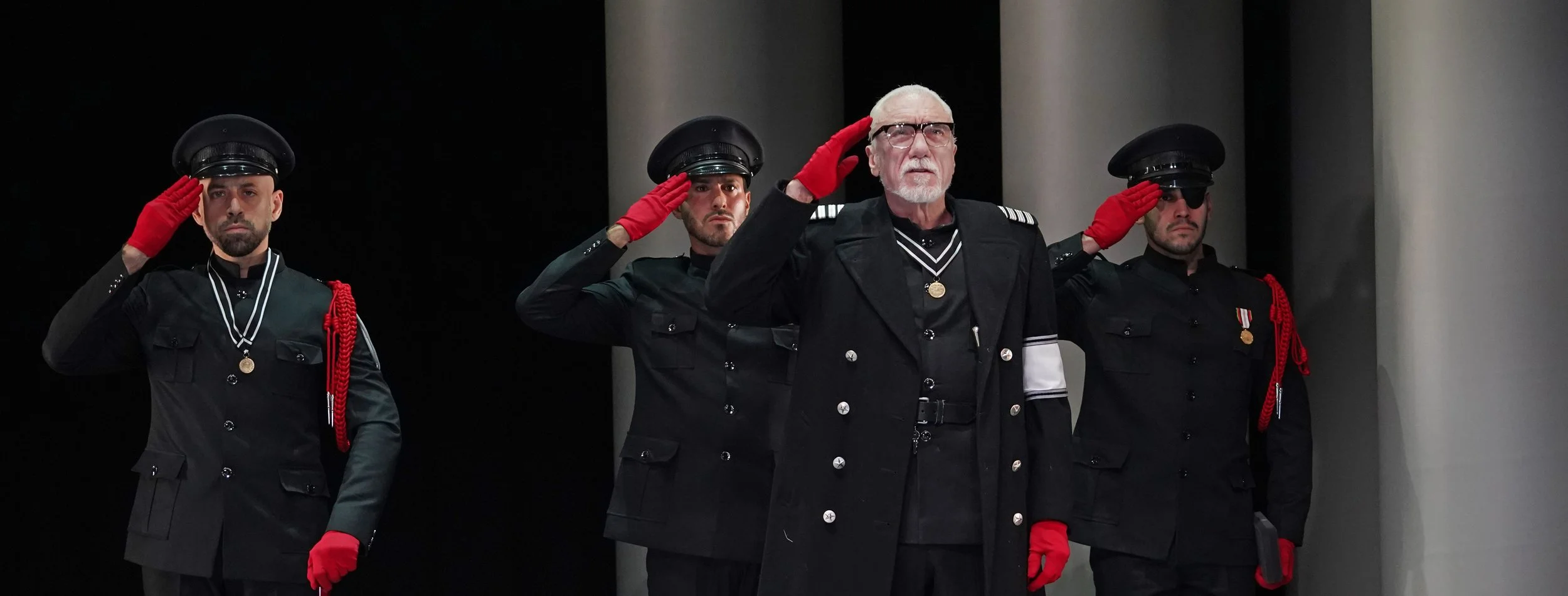
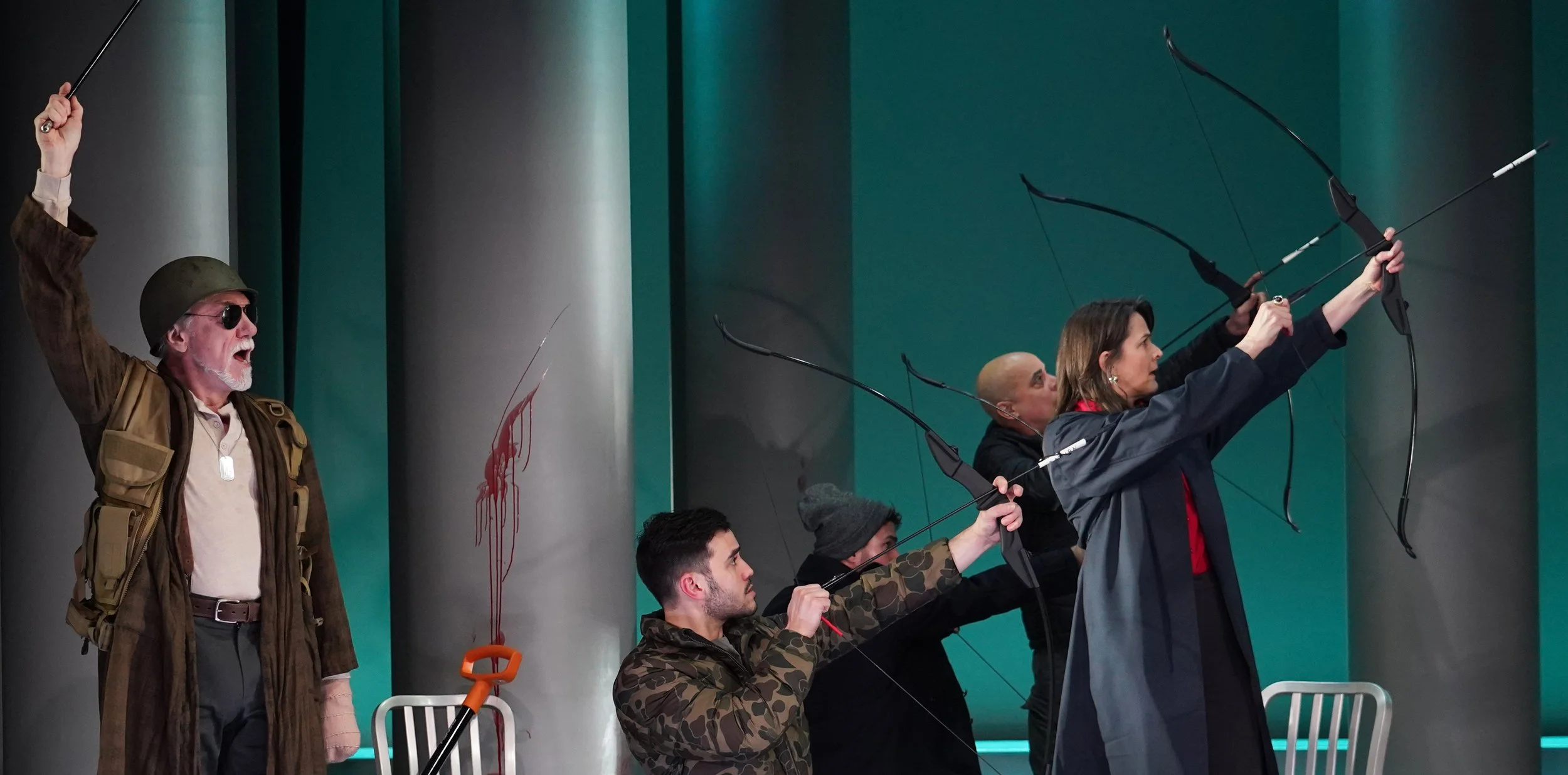
General Titus Andronicus (Patrick Page) orders members of his household to shoot arrows with messages attached—appeals to the gods for justice—in the Red Bull Theater production of Shakespeare’s Titus Andronicus.
Though apparently popular in its own time, Titus Andronicus (ca. 1592), Shakespeare’s first tragedy, and his bloodiest, hasn’t enjoyed much esteem since. One 17th-century playwright declared it a “heap of rubbish”; T.S. Eliot thought it “one of the stupidest and most uninspired plays ever written.” Others conveniently decided that something so barbarous could not have been written by Shakespeare. (Although it likely contains some material by the dramatist George Peele, there is no doubt of Shakespeare’s authorship of the bulk of the play.) It’s a good thing, then, that Red Bull Theater, led by Jesse Berger, was undeterred: Berger directs a harrowing, and funny, production of the play, featuring a ferocious Patrick Page in the title role.
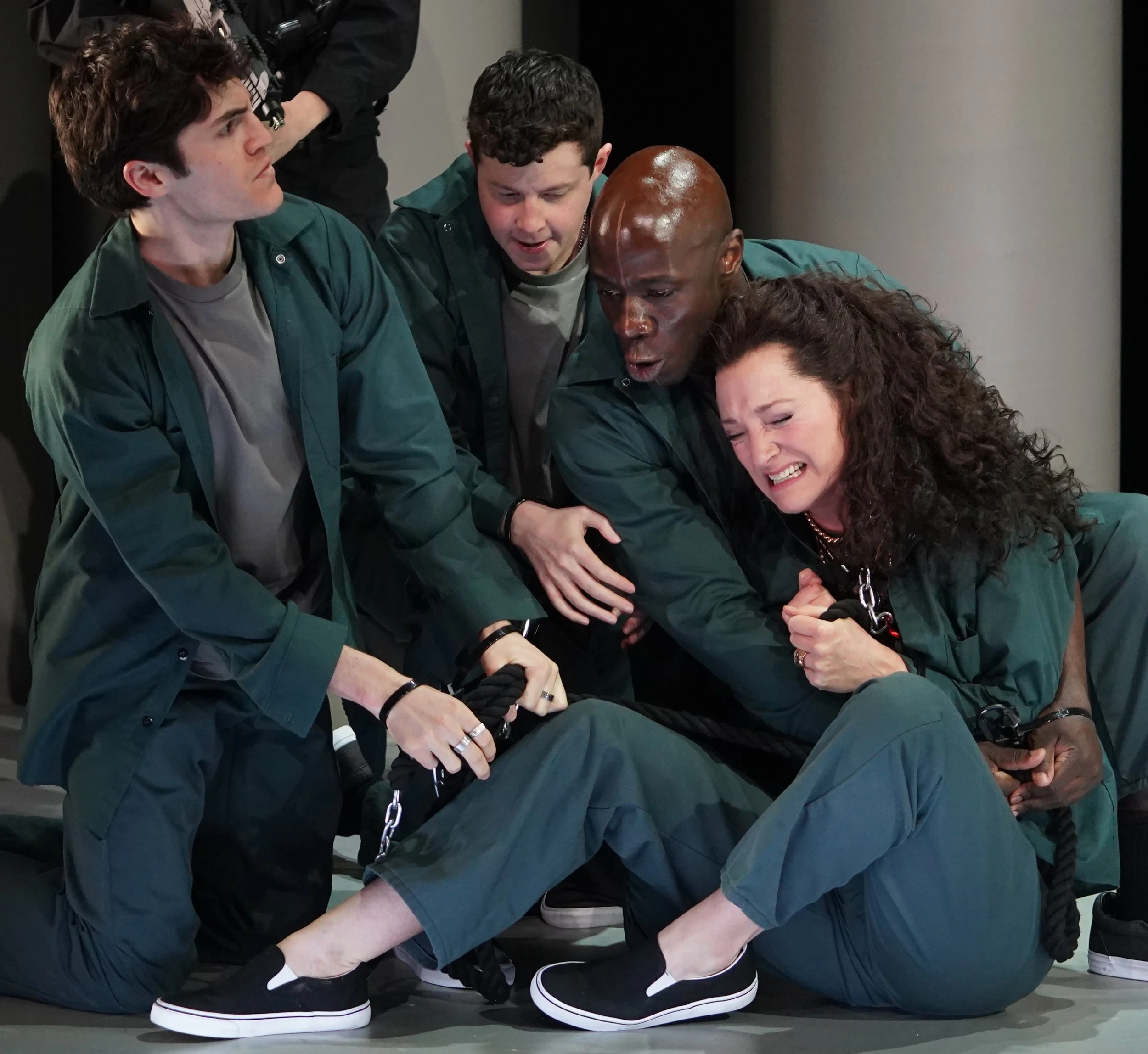
Tamora (Francesca Faridany, right), the Queen of the Goths, is held by Aaron the Moor (McKinley Belcher III) after the killing of her eldest son; her two other sons, Chiron (Jesse Aaronson, far left) and Demetrius (Adam Langdon) look on.
The play’s fortunes seem to be waxing at the moment, and perhaps Titus now has a case to make for contemporary resonance. It contains corruption, slaughter, moral decadence, and an extreme amount of gore, but its deeper relevance may lie in its depiction of an empire in decline. Titus is set in Rome in the late fourth century C.E., and while the titular general has just returned home from a victorious 10-year campaign against the Goths, the time is near for the end of Roman power.
Titus has not returned empty-handed from war: he has five prisoners, including the Goth queen, Tamora (Francesca Faridany), and her three sons. He also has three surviving sons of his own, and three who return in caskets. (Page has wisely cut and adapted the text, so any changes, such as Titus’s 25 sons becoming six, are his.)
In accordance with Roman custom, Titus designates Tamora’s oldest son for sacrifice. Tamora begs for mercy. Page’s Titus wavers momentarily, but then proceeds with the killing. This act initiates a cycle of revenge, starting with Tamora’s upon all things Andronicus.

Aaron is the secret lover of Tamora, and both of them are enemies of Titus Andronicus.
Meanwhile, the brothers Saturninus (Matthew Amendt) and Bassianus (Howard W. Overshown) are squabbling about who should be Rome’s next emperor. The people’s tribune, and Titus’s sister, Marcia (Enid Graham), attempts to bestow the title upon Titus, but he demurs and gives his blessing to Saturninus, humorously played as a petulant, childish imbecile by Amendt. After a brief attempt to have Titus’s daughter Lavinia (Olivia Reis), who is betrothed to Bassianus, as his empress, Saturninus pivots to Tamora, who instantly goes from captive to queen once again. Faridany captures Tamora’s fury, roiling underneath her seemingly forgiving and politic exterior.
Patrolling the edges of Beowulf Boritt’s spare, monumental set, flanked with massive columns, and looking on with menacing curiosity, is Aaron the Moor (an excellent McKinley Belcher III). He’s Tamora’s lover and a self-declared villain who anticipates characters such as Richard III, Iago, and Edmund, taking the audience into his confidence with his plans to wreak havoc:
Then, Aaron, arm thy heart and fit thy thoughts
To mount aloft with thy imperial mistress …
Away with slavish weeds and servile thoughts.
I will be bright and shine in pearl and gold
To wait upon this new-made empress.
To wait, said I? To wanton with this queen,
This siren that will charm Rome’s Saturnine—
And see his shipwreck and his commonweal’s.
As part of a plan to have Titus’s sons framed for the murder of Bassianus, Aaron convinces Tamora’s sons, the cretinous Chiron (Jesse Aaronson) and Demetrius (Adam Langdon), to do the deed and to rape Lavinia.
The violence in Titus is so extreme that productions can sometimes lean into cartoonishness, even camp. In the play’s first half, Berger opts for something closer to realism: the scene of Lavinia’s rape, in particular, is excruciating, as is her subsequent mutilation, meant to prevent her from revealing her attackers’ names, and Reis meets it with a brave performance. Titus is then tricked into cutting off one of his hands, and, covered in blood, with the mutilated Lavinia and the heads of two of his sons beside him, he laughs maniacally and swears revenge.
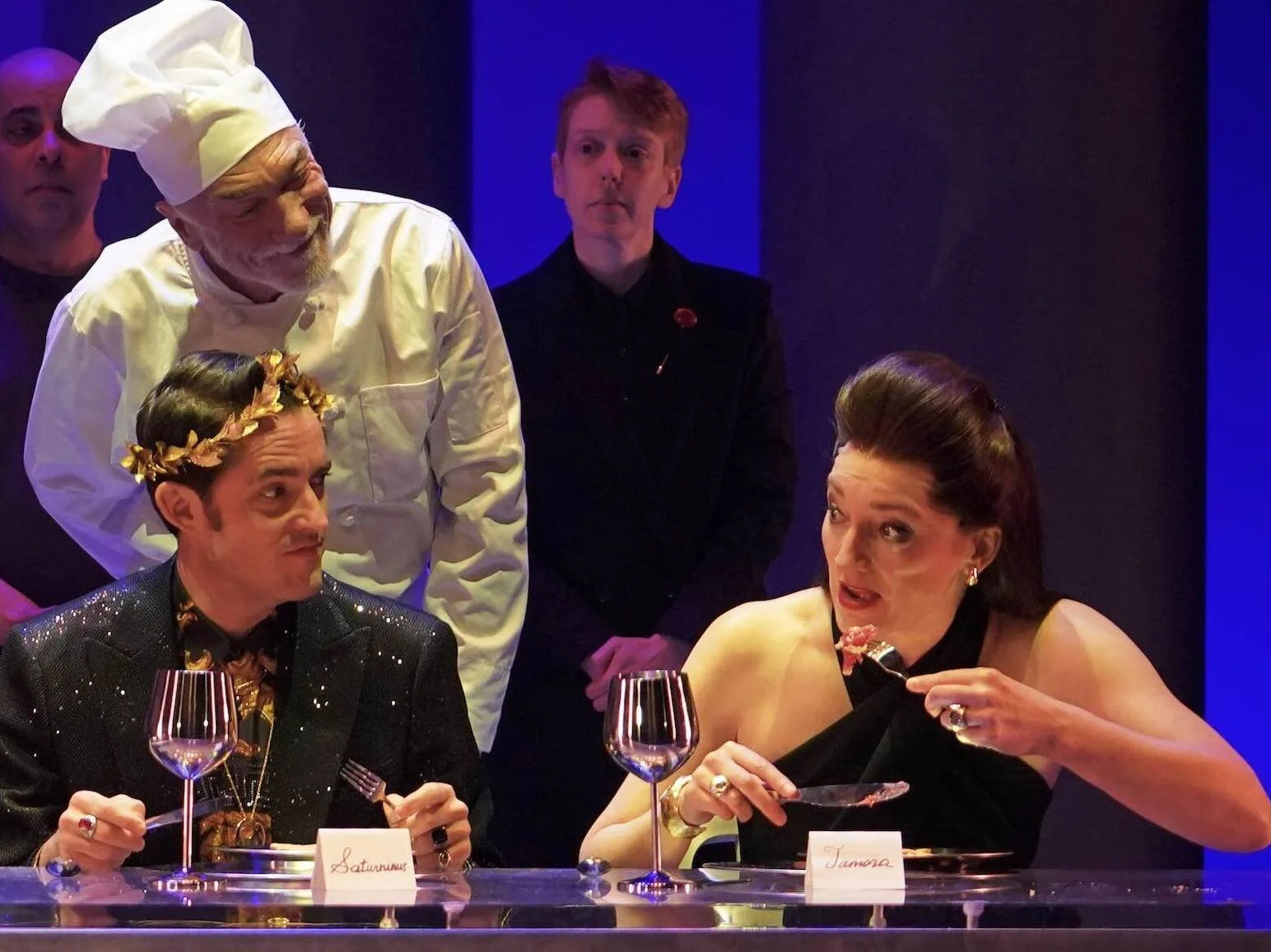
Titus (rear) has prepared a gruesome meal for the cruel Emperor Saturninus (Matthew Amendt) and his wife, Tamora, in Shakespeare’s bloodiest tragedy. Photographs by Carol Rosegg.
The second half leans more into the over-the-top nature of the play for comic effect, as Titus, descending into madness, enacts his own revenge, on Tamora and her sons. When a curtain opened to reveal Page in a chef’s hat, smiling wide and about to serve Saturninus and Tamora a feast for the ages, the audience was raucously cheering him on. Page is brilliant in capturing Titus’s many sides—imperious, funny, stern, loving, shortsighted; Emily Rebholz’s modern costumes track his changing fortunes.
One may not leave convinced that Titus is a great play, but Berger’s lucid, sure-handed direction and a stellar cast make it a gripping theatrical experience—unsettling and disturbing, but nevertheless entertaining.
The Red Bull Theater production of Titus Andronicus runs through May 3 at Pershing Square Signature Center (480 W. 42nd St.). Evening performances are at 7 p.m. Tuesday through Saturday; matinees are at 2 p.m. Saturday and Sunday. For tickets and more information, visit redbulltheater.com.
Playwright: William Shakespeare
Director: Jesse Berger
Set Design: Beowulf Boritt
Costume Design: Emily Rebholz
Lighting Design: Jiyoun Chang
Composer: Adam Wernick
Sound Design: Shannon Slaton & Adam Wernick
