
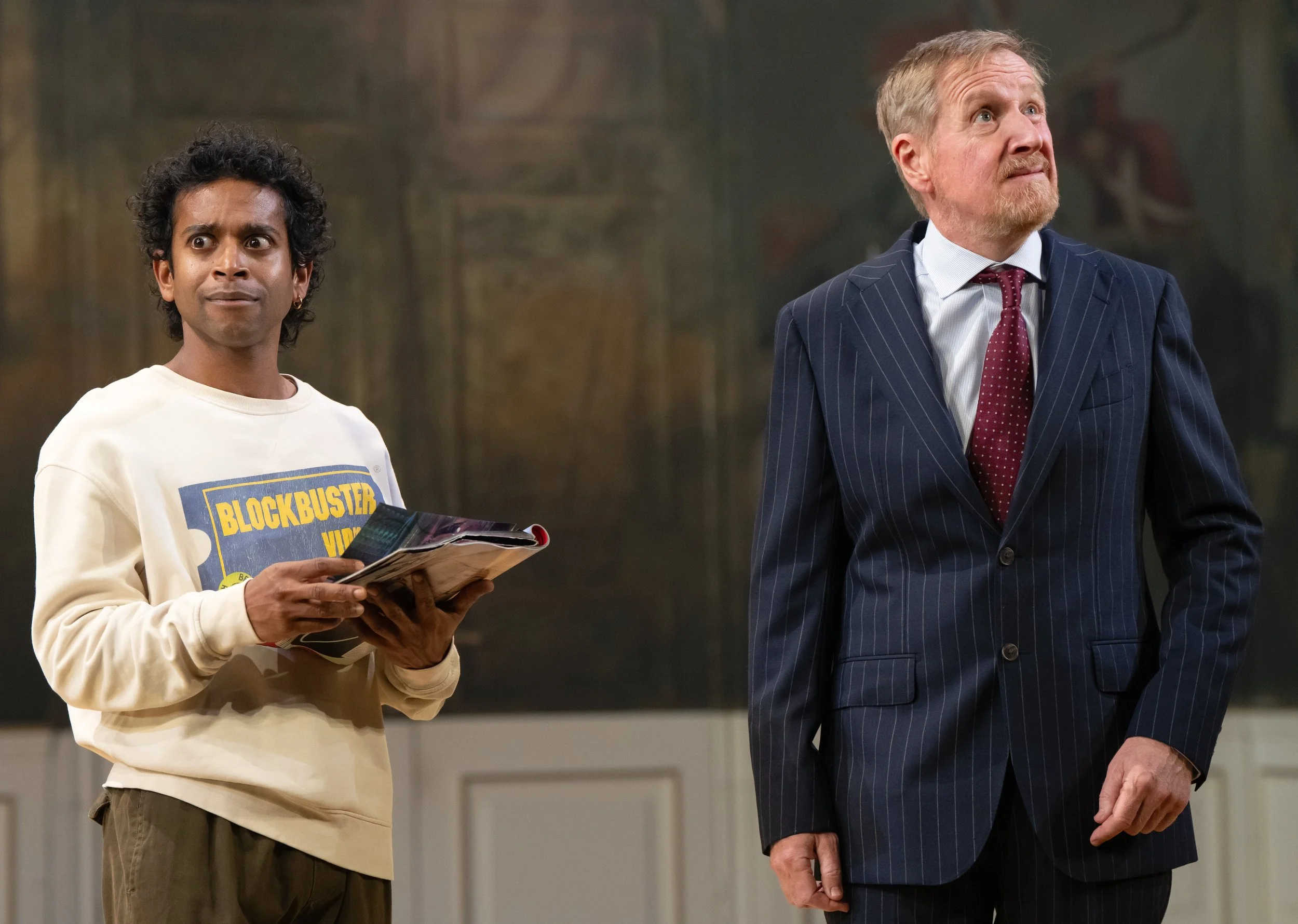
Hamlet (Hiran Abeysekera, left), reading “words, words, words,” here breaks the fourth wall in reaction to what Polonius (Matthew Cottle) is saying in an aside, in Robert Hastie’s production at the Brooklyn Academy of Music (BAM).
Director Robert Hastie brings his bold and inventive production of Hamlet for the National Theatre of Great Britain to the Brooklyn Academy of Music (BAM), a fitting first outing in the new partnership between these venerable institutions—BAM first performed Hamlet in 1861, and it was the National’s inaugural production in 1963. Hiran Abeysekera portrays the moody Danish prince as sweet, neurotic, and impish, drawing out the comedy in the play without sacrificing its complexity and tragic weight. Hastie and Abeysekera seize on Hamlet’s theatricality and theatrical self-awareness, taking it to a new and provocative level.
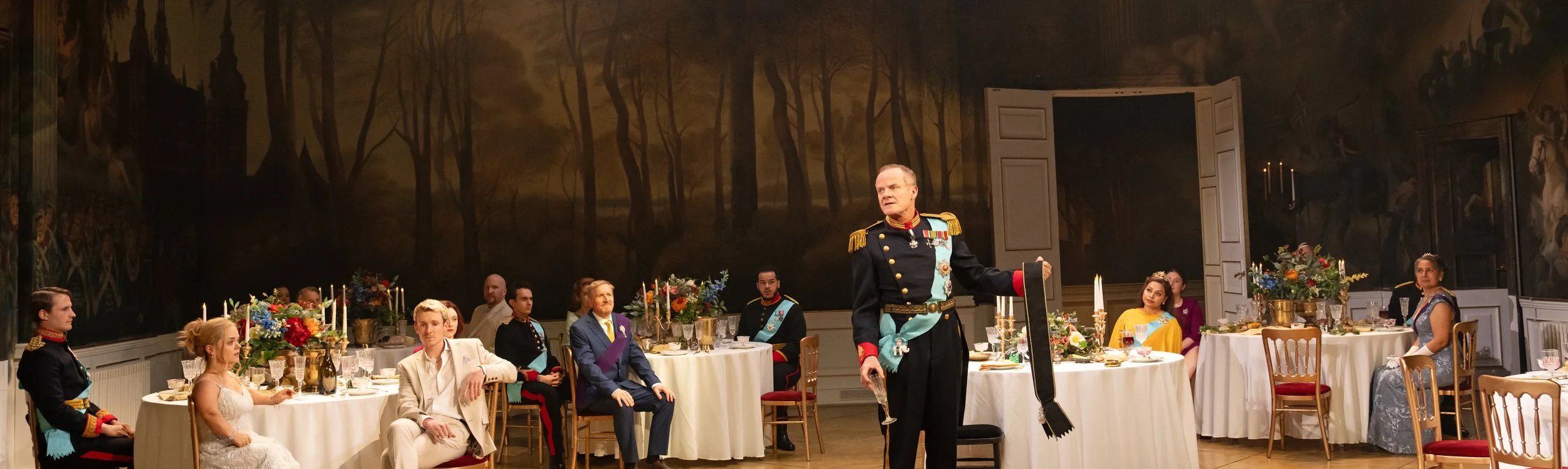
The audience first encounters the young prince in a state of revulsion at the marriage banquet celebrating the union of his mother, Gertrude (Ayesha Dharker), to his uncle, Claudius (Alistair Petrie), a mere two months after the death of his father, King Hamlet. Ben Stones designs the opulent ballroom set and formal, modern costumes, with Hamlet in his customary all black.
During his first soliloquy (“O, that this too, too sullied flesh would melt, / Thaw, and resolve itself into a dew”) the scene behind Hamlet freezes into a tableau, while Hamlet addresses the audience directly, coming to the edge of the stage, as he often does. At other moments, Hamlet breaks the fourth wall, turning to the audience for a smile or a shrug.
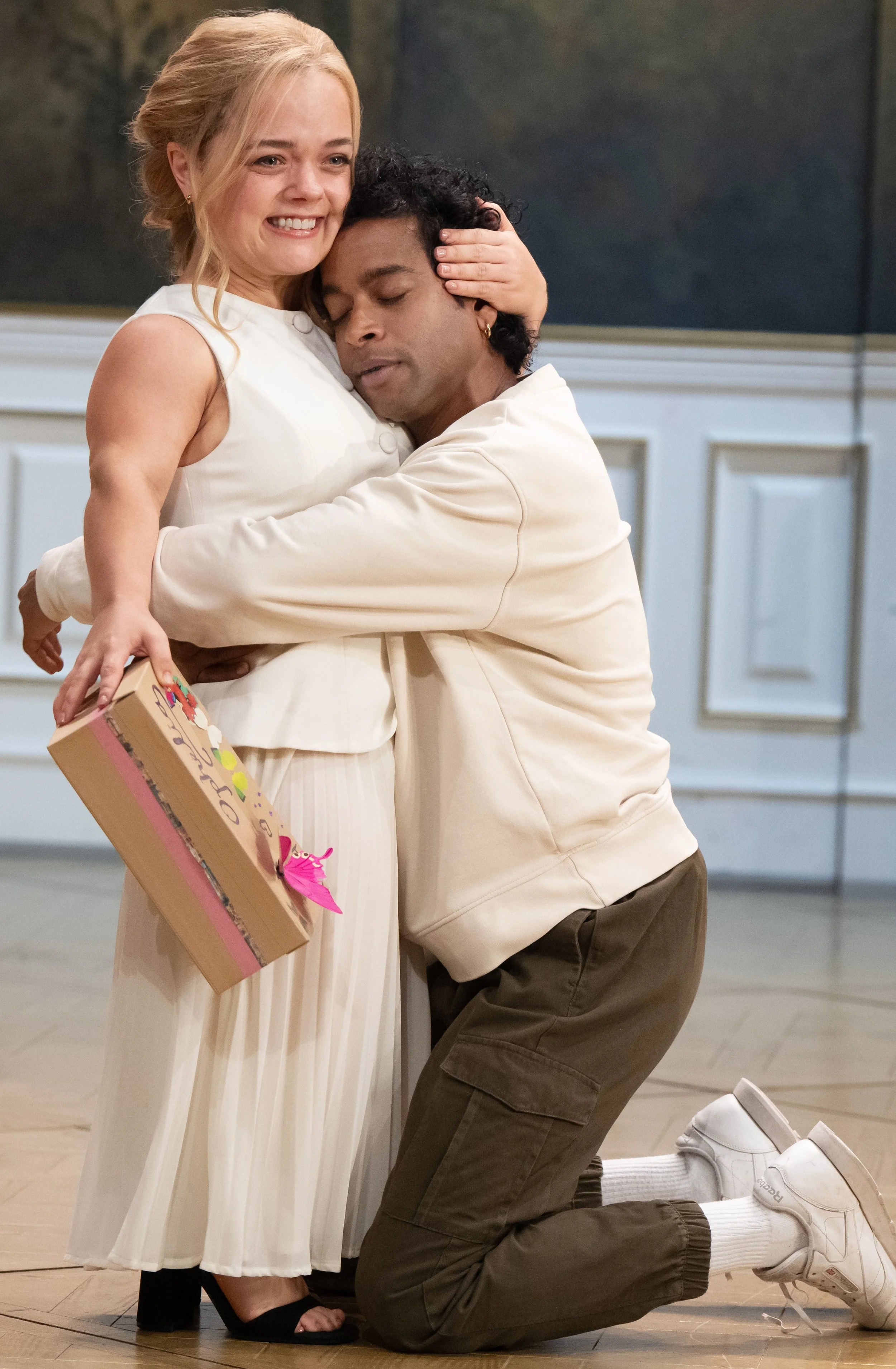
Ophelia (Francesca Mills) tries to return love tokens to Hamlet to demonstrate his madness, while her father and King Claudius watch unseen. Photographs by Julieta Cervantes.
The dynamic among Polonius (Matthew Cottle), his son Laertes (Tom Glenister) and his daughter Ophelia (Francesca Mills) unfolds with great naturalness and affection. In Cottle’s performance, Polonius is foolish (how could he not be?) but genuinely kind, and Mills, in a standout performance, invests Ophelia with fortitude, sarcasm, and wit, which shines through even when being ordered about by her father or Hamlet. The deep bond that this Polonius and Ophelia clearly share make her madness after his death more believable.
The presence of the Ghost (Ryan Ellsworth) uses Jessica Hung Han Yun’s lighting design and Alexandra Faye Braithwaite’s sound design to frightening effect—no wonder that Horatio (Tessa Wong) exclaims, “It harrows me with fear and wonder.”
Abeysekera’s Hamlet deviates from recent, more soldier-like interpretations; it’s clear by the comically inept way he holds a gun when warning his companions not to interfere with his following the Ghost that it’s not something he’s accustomed to. Abeysekera finds comedy in these moments, but also in lines that usually receive unintended laughs, here deliberately played up—for example, Hamlet’s boast before the fencing match that “I have been in continual practice,” which he most certainly has not.
Hamlet is deeply preoccupied with theater—from his delight at receiving his “good friends” the city tragedians, to writing a speech for a play he stages to tease out Claudius’s guilt, even to instructing the players how to act (or not to act). Hastie and Abeysekera seize on this facet of his character, and Hamlet grows increasingly aware of his audience.
When Polonius, confronting the “mad” Hamlet, speaks his asides to the audience, Hamlet stands by him and clearly overhears; at one point, he responds to one of the asides. Before the play within the play, Hamlet hands out playbills to some actual spectators. When he murders Polonius, thinking it is Claudius hiding behind the arras of his mother’s chamber, he points two fingers to mimic shooting a gun, but a gun sound goes off and then later an actual gun appears in his hand.
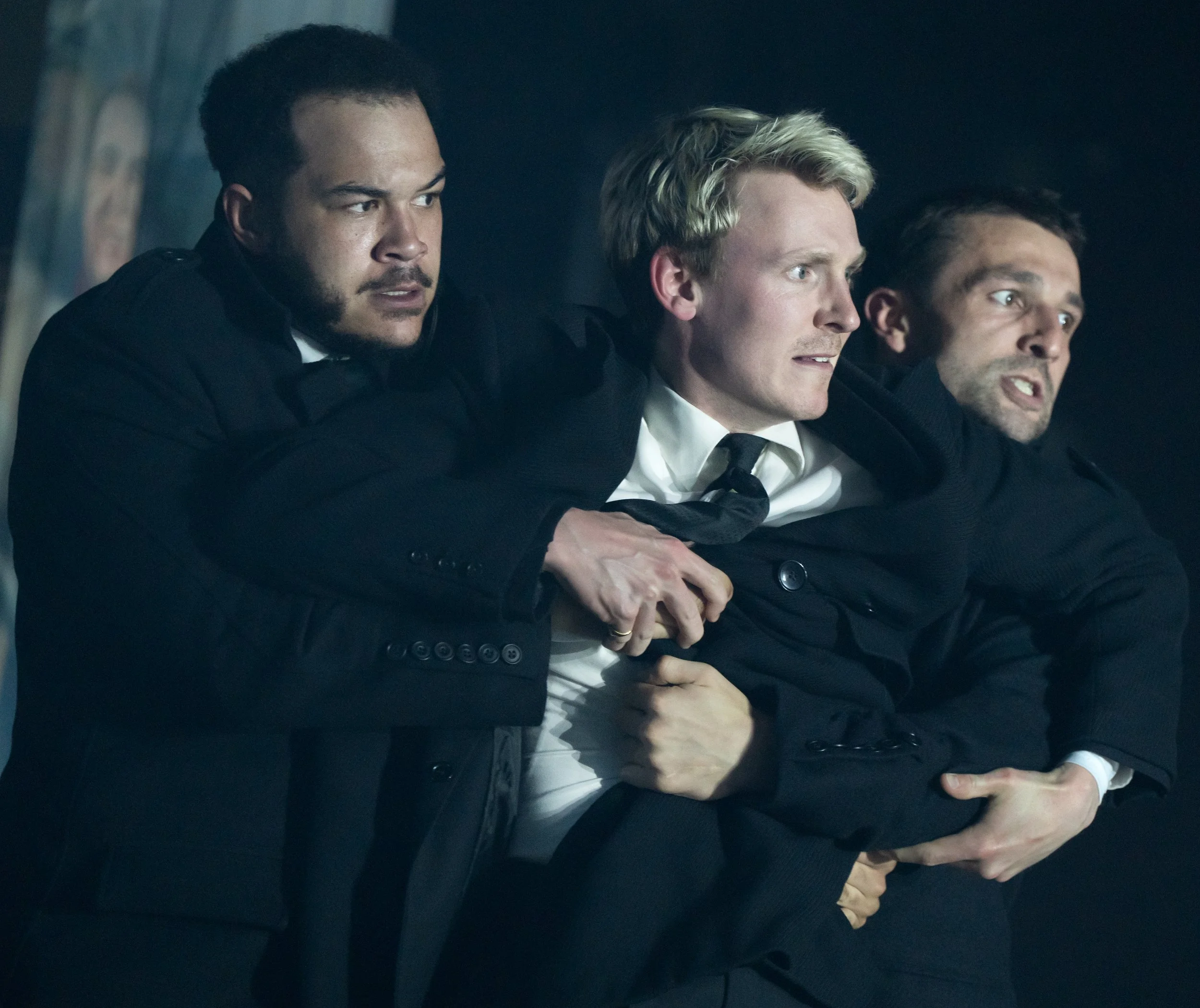
Laertes (Tom Glenister) is restrained by palace guards at his sister’s funeral.
In this production, Hamlet’s “antic disposition” becomes actual madness—born of realizing that he’s a character in a play. His madness, clearly tied to his theatrical self-awareness, is reinforced by a directorial choice: Hastie doesn’t show the Ghost in Gertrude’s chamber—like the queen, we see “nothing at all.” That said, this crucial scene with Gertrude lacks tension: Petrie’s Claudius is buttoned-up (he’s no “bloat king”), and Dharker’s Gertrude is oddly dispassionate, so Hamlet’s sexual revulsion here seems to come out of nowhere.
Hastie has rearranged some of the text, most jarringly the “To be or not to be” soliloquy, which is relocated to come just before the final scene. However, Act V Hamlet is so radically changed from his earlier self: “We defy augury. There is a special providence in the fall of a sparrow” represents his new attitude, which seems far from the tortured vacillation and doubt of “To be,” which would normally come much earlier in the play.
But these are quibbles. The greatest challenge in mounting Hamlet must be in finding insight into a play that has been picked apart word by word for centuries. And Hastie, with superb performances by Abeysekera and Mills, has achieved that—a Hamlet driven to distraction by his awareness that all the world’s a stage.
Hamlet runs through May 17 at the BAM Harvey Theater (651 Fulton St., Brooklyn). Evening performances are at 7:30 p.m. Tuesday–Saturday; matinees are at 1:30 p.m. Saturday and 3 p.m. Sunday. For tickets, visit bam.org.
Playwright: William Shakespeare
Director: Robert Hastie
Set & Costume Design: Ben Stones
Lighting Design: Jessica Hung Han Yun
Sound Design: Alexandra Faye Braithwaite
Composer: Richard Taylor
