

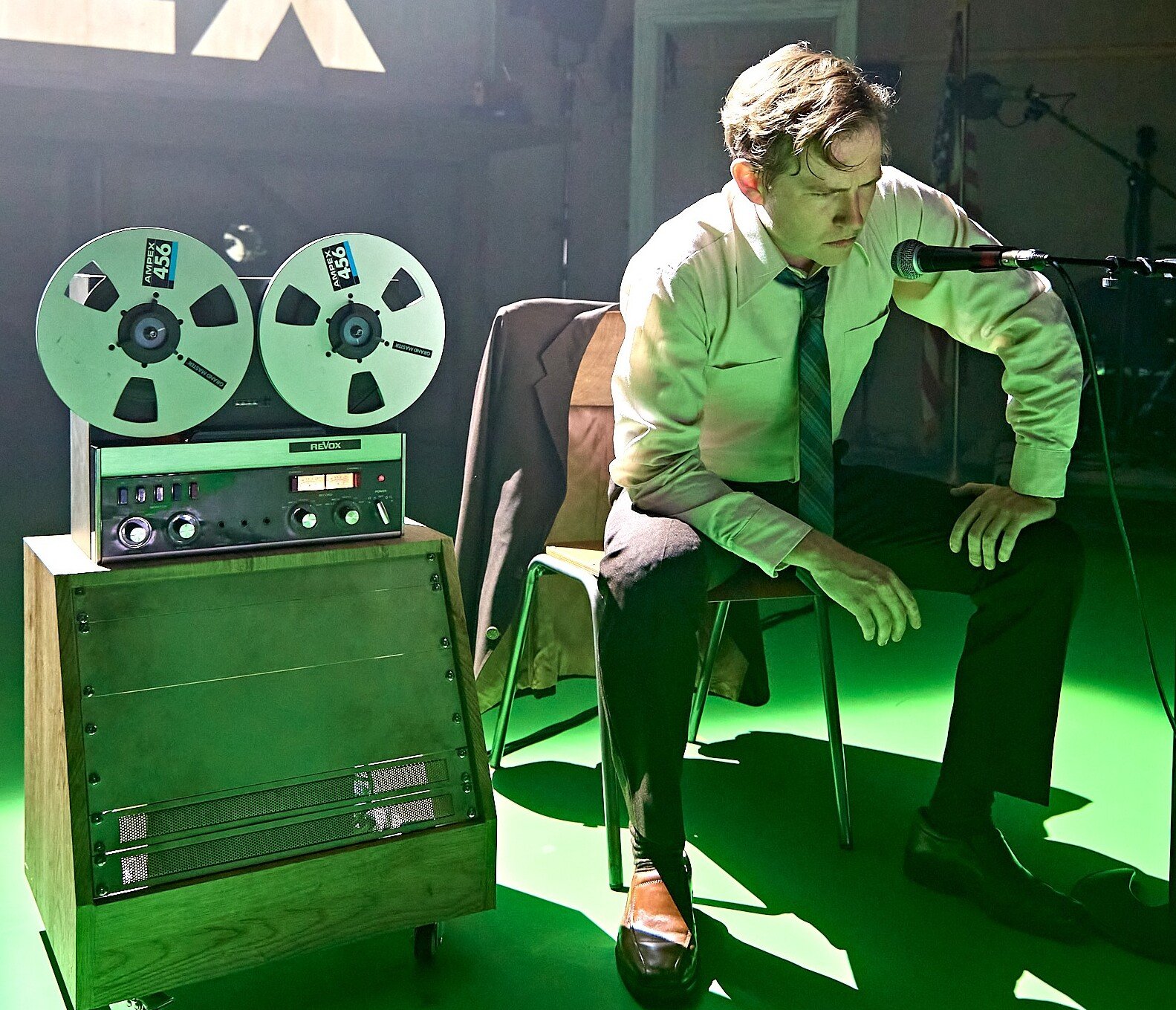
Jack Holden as David Baird, county prosecuting attorney, listens to an unsettling tape in Kenrex, which he cowrote with Ed Stambollouian.
He plays dozens of characters. He bolts around the stage like a dervish, rearranging props, setting up mikes, climbing stairs and changing personas with every move. He works up as much sweat as Jonathan Groff in Just in Time. And he tells a chilling true-crime story in the process, one to leave the observer unsettled as to whether justice was done, and if so, what the price of that justice was. The actor is Jack Holden, uncovering a bit of unsavory Southern history in Kenrex, in which he plays everybody.

Holden plays all the characters in the show, including the town bully, Ken Rex McElroy, twisted in body and in mind.
And Kenrex is Ken Rex McElroy, a local tough in tiny Skidmore, Mo., in the early 1980s—“Kenrex” to the residents. At the outset it’s clear that someone was murdered, and that David Baird, Nodaway County’s prosecuting attorney, is recounting the facts to a federal agent (a female voice, on tape; his timing with the back-and-forth on tape is unerring). What happened will take in a goodly part of the Skidmore population, from aging hippie and bar owner Ida Smith to grocer Lois Bowenkamp, equal parts kindly and judgmental, to rah-rah Mayor Steve Peter. Yet it’s never unclear who’s talking because Holden, who co-authored the piece with the director, Ed Stambollouian, has developed distinct, identifiable personalities for each of them.
But back to Kenrex, “the town bully,” as Baird accurately has it, a man of few words and few wants. Among the latter is definitely Trena, the 14-year-old cheerleader who sings “The Star-Spangled Banner” at a high school game. Playing both Kenrex, with a loping walk and deep, intimidating voice, and Trena, shy but intrigued by Kenrex’s sweet talk, Holden is truly creepy. Soon enough, Trena is pregnant and married to Kenrex. Lectured by Lois on her poor life choices, Trena complains to Kenrex, who’s not shy about making a stink over what he perceives as her mistreatment. Threatening Lois and almost killing her husband will be just one more incident on a long crime list. And for that Kenrex has a secret weapon: Richard McFadin, the craftiest and sleaziest lawyer in the area.
“Holden has more voices than a concert choir, and there’s no end to his vocal and physical variations.”
As McFadin, Holden goes all nerdy-charming, smiling a bucktoothed smile and plying a reedy, cooing voice as, in a montage both amusing and infuriating, he employs every trick in the book, and a few that aren’t, to get his deadbeat clients off. His strategy for delaying Kenrex’s arraignment is a masterpiece of legal flummery that would do Todd Blanche proud.
The repeated delays ratchet up the tension in Skidmore, where the residents have had enough of Kenrex and are ready to take matters into their own hands if the law won’t provide their definition of justice. And that leads to—well, it’s no surprise, because Holden and Stambollouian foreshadowed the fate of Kenrex at the Act I curtain. Maybe they shouldn’t have.
And maybe John Patrick Elliott, who has been sharing the stage with Holden for the duration, shouldn’t be musically commenting so much. Singing and accompanying himself on guitar, keyboard, and drums, he provides plenty of atmosphere, and those who have never been near Nodaway will understand it better through his contributions. But there’s maybe more music than there has to be, including times when it intrudes on the action.

John Patrick Elliott supplies near-constant music. Photographs by Manuel Harlan.
But that action crackles throughout. Holden has more voices than a concert choir, and there’s no end to his vocal and physical variations. (Sarah Golding, billed as “movement director,” very likely helped.) He’s especially good at playing two people in conversation; the last time such quicksilver character changes were made so successfully by one actor, it was also at the Lucille Lortel, in Andrew Scott’s Vanya.
Holden is framed by a set, by Anisha Fields, that uses simple devices to dart around Skidmore, and dramatic lighting, by Joshua Pharo, that evokes not only shifts of time and place but the red and blue flashing lights of a police car. Then there’s Giles Thomas’s sound design, which is remarkable. It gets the jukebox at Ida’s bar just right; it can sound like radio or phone voices at will; and it convincingly spreads the whispers of Skidmore residents throughout the theater—how did he do that?
Holden never lets up, and one can only hope his voice holds out. And if Kenrex doesn’t have much new to say about the limits of small-town mentality or the shamelessness of legal maneuvering, it says it entertainingly. This is one standing ovation that feels earned.
Kenrex runs through June 27 at the Lucille Lortel Theatre (121 Christopher St.). Evening performances are at 7 p.m. Monday through Saturday, and 8 p.m. on some Sundays. Matinees are at 2 p.m. on Wednesday and Saturday, and 1 p.m. or 3 p.m. on Sunday. For tickets and a full schedule, visit kenrextheplay.com.
Playwrights: Jack Holden and Ed Stambollouian
Scenic & Costume Design: Anisha Fields
Lighting & Video Design: Joshua Pharo
Sound Design: Giles Thomas
Music & Music Supervision: John Patrick Elliott
