

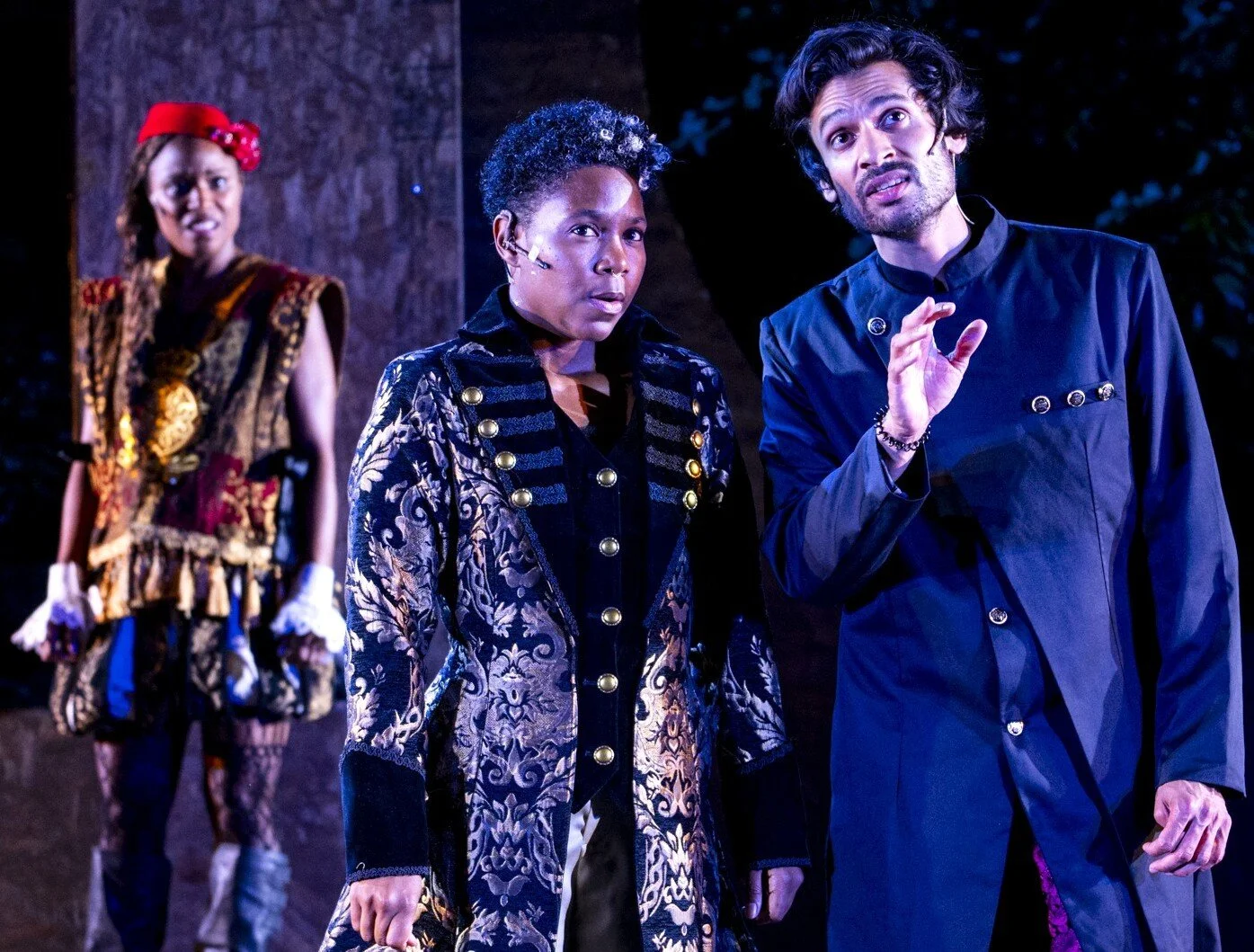
Kaliswa Brewster (left) is Sganarelle, Naomi Lorrain (center) plays Don Carlos, and Keshav Moodliar (right) is Don Juan in Molière in the Park’s Don Juan.
Molière’s Don Juan takes audiences on a feverish journey from seduction to reckoning, blending farce, tragedy, and the supernatural in a provocative examination of hypocrisy, morality, and the consequences of unchecked desire. In the free outdoor production by Molière in the Park (MIP), this darkly comic masterpiece proves as entertaining as it is unsettling, holding up a mirror to human folly while leaving audiences to determine where they stand.
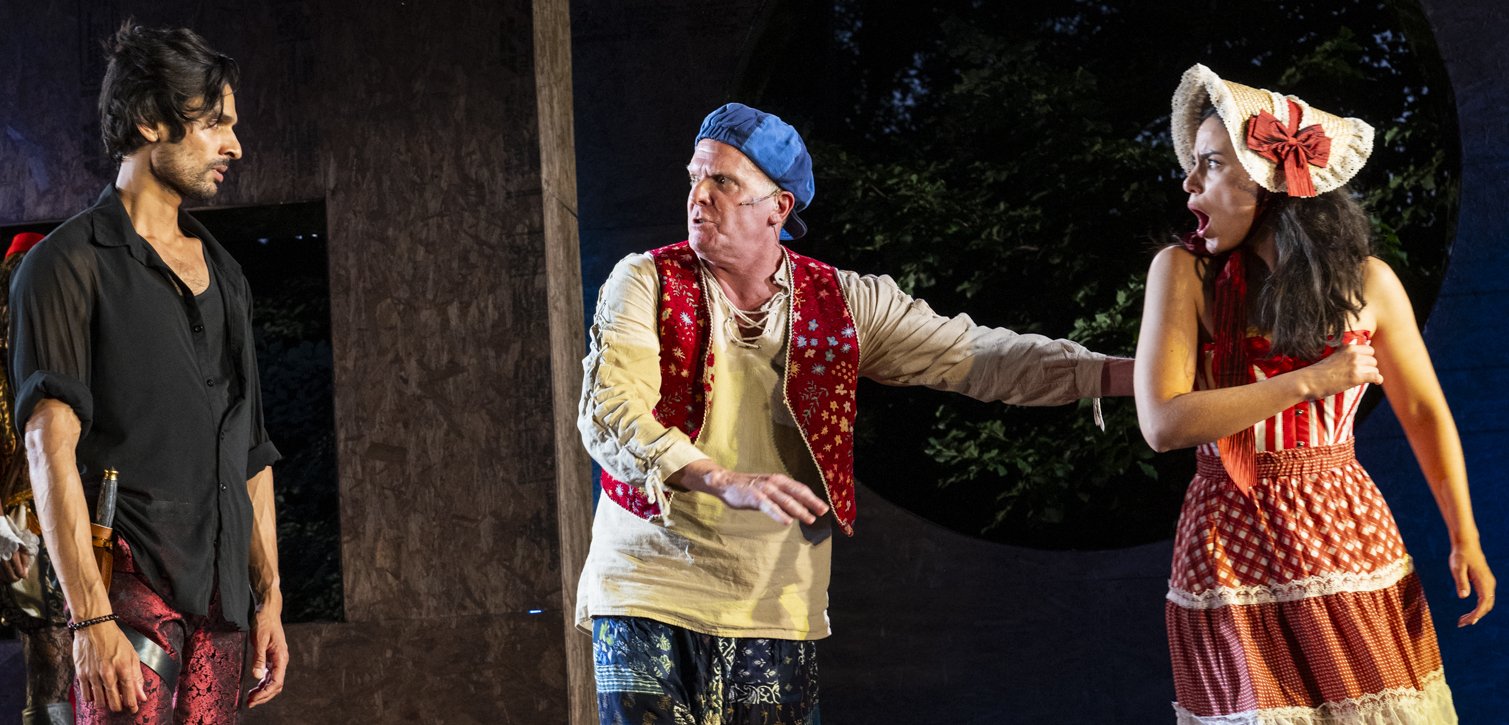
The peasant Pierrot (Daniel Pearce, center) demands an explanation from Don Juan on why he was about to kiss the hand of his fiancée Charlotte.
Having seduced a woman in a convent, Donna Elvira, and persuaded her to marry him, Don Juan has already moved on to his next conquest. Accompanied by his devoted, if sometimes cowardly, servant Sganarelle, he spends a whirlwind day encountering people whose lives he has disrupted, pursuing new women while flouting convention, ridiculing religious beliefs, and provoking anyone who challenges him. But his brazen behavior is becoming increasingly difficult to sustain as his past catches up with him, forcing the inveterate libertine to confront the possibility of repentance—and whether he is capable of anything more than pretending to reform.

Mathurine (Lorrain again, left) and Michelle Veintimilla’s Charlotte spar over who will marry Don Juan, while Sganarelle serves as referee.
Don Juan premiered in Paris in February 1665, shortly after Molière’s Tartuffe had been suppressed. With his company in need of a new work, Molière turned to the fabled roué whose story had already inspired other playwrights. Unusual in both form and subject matter, Don Juan was written in prose rather than the alexandrine verse of serious French drama, while its episodic structure defied the conventions of classical theater. It ran for only 15 performances, and it was not published during Molière’s lifetime. Seldom produced in the English-speaking theater, it remains surprisingly unfamiliar, particularly beside Mozart’s more frequently performed operatic adaptation (Don Giovanni). MIP’s production is therefore welcome, giving New York audiences an opportunity to encounter Molière’s original, and to discover how remarkably fresh it remains.
Richard Wilbur’s English translations of Molière may be regarded as the gold standard, but Stephen Wadsworth’s superb translation and adaptation of Don Juan deserves equal attention. First published in 2008, this version draws on an Amsterdam text from 1683 that escaped the French censors, allowing Wadsworth to restore material suppressed after the play’s 1665 premiere. The result, directed by Lucie Tiberghien, has a distinctly subversive edge, nowhere more evident than in a scene involving a pauper at the play’s midpoint. Don Juan offers the impoverished man a large gold coin on one condition: that he blaspheme. “It’s yours if you blaspheme. But you must blaspheme,” Don Juan insists. A beat passes before the initially tongue-tied pauper finds his words: “No, Monsieur. For the love of God, I would rather die of hunger.”

Don Juan changes clothes with his valet Sganarelle to escape a dozen horseman who are pursuing him in the forest.
Fortunately, Keshav Moodliar, in the title role, captures not only Don Juan the serial seducer but, more important, the iconoclast with a taste for the glamorous life. His Don Juan is not given to brooding over his darker impulses or contemplating the ominous consequences of his actions. Instead, Moodliar plays him as a spoiled boy who has never quite grown up, accustomed to having his every desire indulged and seemingly oblivious to the moral codes that govern everyone around him. Although Moodliar does not fully plumb every facet of Don Juan’s personality, he is impressive in delivering his character’s famous final speech in Act V, a monologue of absolute defiance. He nails its hypocritical bravado, particularly in the snobbish declaration, “I’ll find everyone wanting and have a high opinion only of myself.”
Playing opposite Moodliar is Kaliswa Brewster, who portrays Don Juan’s valet, Sganarelle, with impeccable skill. Brewster provides the ideal counterbalance to the protagonist with her unwavering devotion to Don Juan, even when that loyalty ultimately leads to personal harm—in the loss of her wages.
As his abandoned wife, Donna Elvira, Michelle Veintimilla displays impressive emotional range, entering the play in Act II consumed by grief, humiliation, and fury: “False man, Heaven will punish you for violating me, and if Heaven holds no terrors for you, then fear the power of a woman’s anger.” When she returns in Act IV, she has shed her anger, revealing instead a genuine desire to save Don Juan’s soul: “I beg you with these tears do not refuse me your salvation.”

Don Juan confronts his abandoned wife Donna Elvira (Veintimilla) as Sganarelle looks on. Photographs by Russ Rowland.
Riveting performances are also delivered by the rest of the company, Naomi Lorrain and Daniel Pearce, each of whom takes on multiple roles and holds their own. Composer-cellist Johnathan Moore adds rich, mellow music to the production.
Molière in the Park’s mission is “dedicated to fostering empathy, dialogue, and community through free theater, founded on the belief that access to the arts benefits all, individually, and collectively.” Its current production of Don Juan succeeds wonderfully in fulfilling that mission.
Don Juan plays in Prospect Park (171 East Drive, Brooklyn) through Sept.27. Performance dates and times are somewhat irregular and may be viewed, along with other information, at moliereinthepark.org.
Playwright: Molière
Director: Lucie Tiberghien
Scenic Design: New Wilderness
Lighting Design: Marie Yokoyama
Costume Design: Ari Fulton
Sound Design: Chad Raines
If you enjoyed this review, please click on the Like icon below.
