
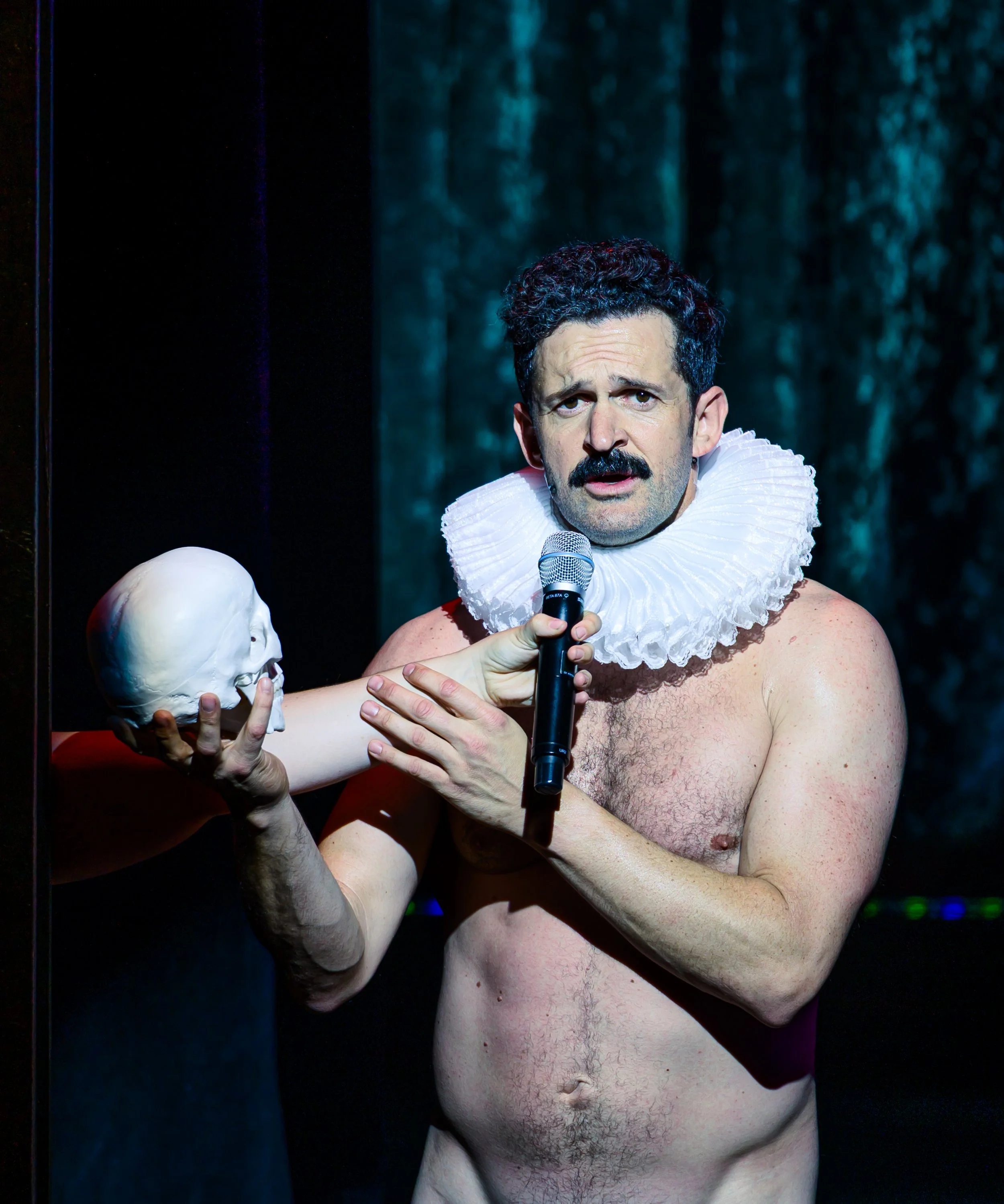
Garry Starr is the host of Classic Penguins, a comedy free-for-all involving Penguin paperbacks, silly interpretations of famous titles, a huge amount of audience participation, and plentiful nudity.
Crikey! Garry Starr: Classic Penguins makes one wonder what the Aussies are consuming besides cold ones. A quarter century after Puppetry of the Penis, the lunatic 2001 production from Down Under that introduced “genital origami,” comes this brash, loopy clown show, written and performed by Garry Starr (the stage persona of Damien Warren-Smith).
At first the atmosphere is semi-intellectual, as wall projections show the famous Penguin Books bird replacing figures in various art masterpieces: Michelangelo’s The Last Supper; Grant Wood’s American Gothic; John Everett Millais’s Ophelia. A soprano sings an aria, and from the back of a swivel chair facing upstage one sees a top hat and smoke curling upward. It’s as if the unseen Starr might be Alistair Cooke or Vincent Price on PBS.
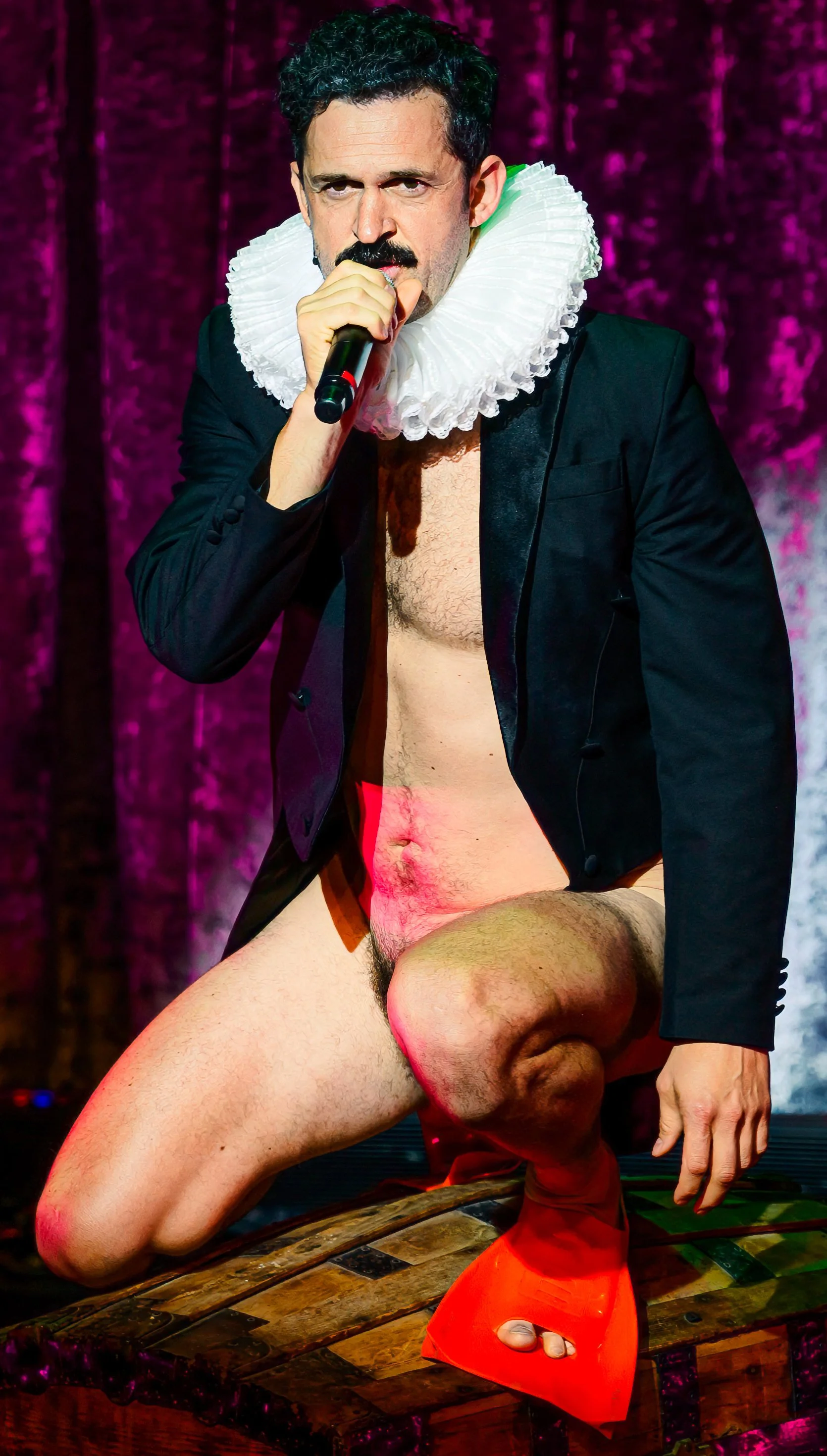
Starr begins the evening dressed as the Penguin logo, but his costuming quickly dwindles. Photographs by Austin Ruffer.
Once the chair turns to the audience, the tone flips. Starr accessorizes his top hat with a swallowtail coat and an Elizabethan ruff; the rest is his birthday suit. He adopts an aristocratic tone, and presumably the pronunciation of upper-crust Australians, as he says, “Litt-er-a-toor-eh”—the extra syllable dangling in the air in tandem with body parts. Near him a small rolling bookcase holds the orange-and-white spines of classic Penguin paperbacks. A camera focuses on the top shelf, where Starr puts each of the titles addressed in the show and projected on the wall. The first up is self-referential: Dostoevky’s The Idiot. “Words,” he says poshly. “Mair boooks,” adding a third O and almost slipping into German (mehr, or more).
“Our journey begins right here—in French France,” he says, placing Selected Short Stories by Guy de Maupassant under the camera. But the book titles are mere jumping-off points for plenty of raucous interactivity with the audience. Dropping the affected accent, Starr segues into Patrick Suskind’s Perfume, and then comes down from the stage and offers his hand to audience members. He kisses the women’s hands and ends up leaning into the second or third row for handshakes, putting his nether region in proximity with the front-row viewers.
“Starr’s most improbable coup is to persuade someone to ‘get naked on stage’ with him.”
You won’t hear about theme or characters in The Waves by Virginia Woolf, nor any mention of Phileas Fogg or Passepartout in Jules Verne’s Around the World in Eighty Days, one of the more prominent episodes. For that one, Starr grabs a beach ball that looks like the earth and proceeds to revolve around it 80 times—with the audience loudly counting each turn.
For The Waves, the genial Starr encourages the audience to sway and do “the wave”; then he picks a point down front and persuades everyone to hoist him up, mosh pit–style, and pass his frame overhead to the rear of the house. There is a good deal of grunting—he’s a solid dude, even unclothed—as he ascends upward.
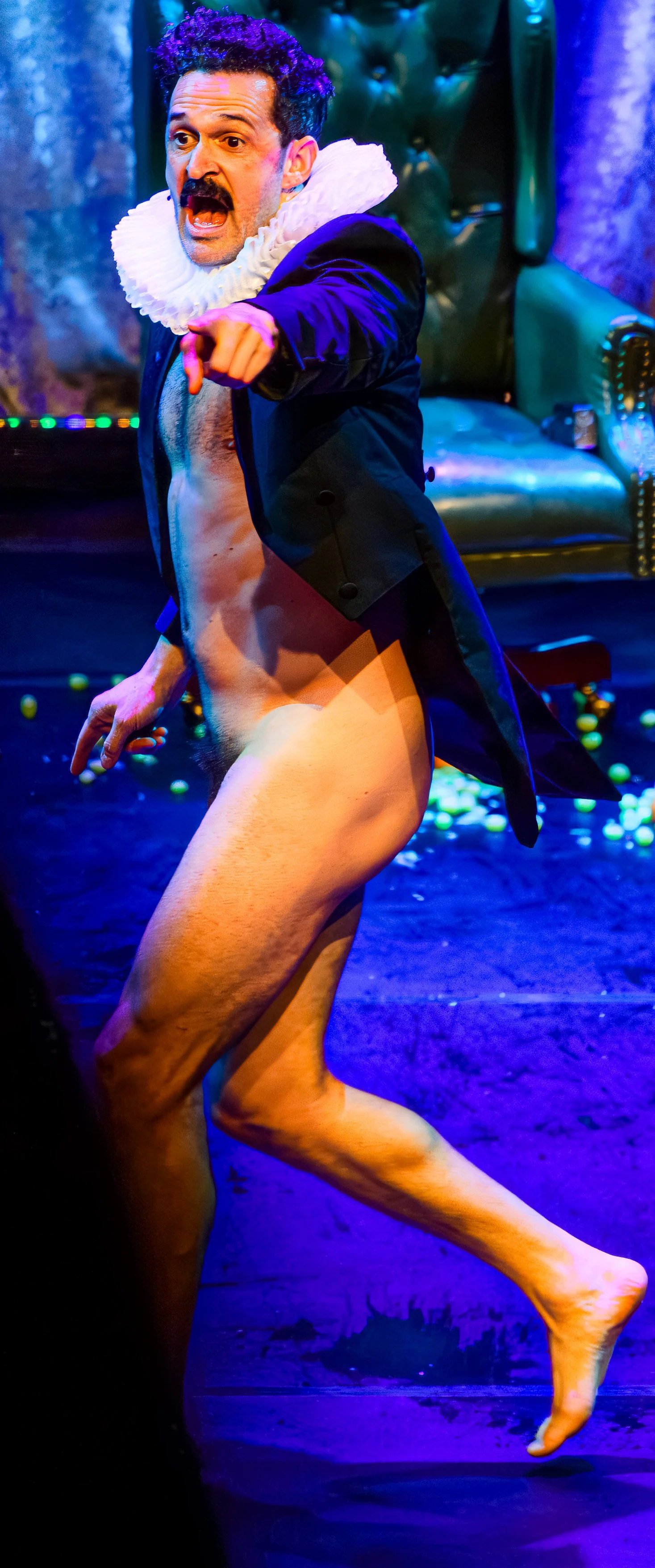
Starr continually interacts with his audience.
Starr has a deft line of patter as well. He introduces Frankenstein with the question: “Has anyone brought somebody into this world that, on reflection, they wholeheartedly regret?” He solicits a woman named Erin to “come up and play.” “You be Oscar Isaac,” he tells Erin, referring to Guillermo del Toro’s 2025 film, “and I’ll be Jacob Elordi. You’re going to build a monster.” As Erin lifts and places imaginary body parts over his supine form, Starr’s own limbs elevate and shake, along with his appurtenances. (Many of the sketches are accompanied by sound and lighting effects or well-chosen music, such as the sea chantey “Wellerman,” Kate Bush’s “Wuthering Heights,” and James Blunt’s “You’re Beautiful.”)
He solicits a woman named Lucinda to come up and asks, “Do you hate people in positions of authority?” The book changes to Nineteen Eighty-Four as they throw grapes at each other, while the titles rush through The Grapes of Wrath, War and Peace, and War of the Worlds. Then he hands her a big bag of oranges to throw, and she clocks him with the first one as the book changes to, naturally, A Clockwork Orange. “Nobody ever hits me the first time!” he exclaims, sending off Lucinda with the rest of the oranges.
Starr’s charm helps put over even a gross bit involving chewed grapes, yet his most improbable coup is to persuade someone to “get naked on stage” with him for a segment involving Rudyard Kipling’s The Jungle Book and a figure dressed as the bear Baloo in the Disney film. A volunteer named Anton stepped up, his confidence clearly boosted by long hours at the gym. And the sequence involved a neat bit of misdirection, as much of the show does. The nudity eventually loses its shock value, and occasionally becomes incidental to the fun. Perhaps Starr is offering a lesson for Americans’ still puritanical culture.
Garry Starr: Classic Penguins plays at Studio Seaview (305 West 43rd St.) through Oct. 4. Evening performances are at 8 p.m. Tuesday through Saturday; matinees are at 5 p.m. Saturday and Sunday. For tickets and more information, visit studioseaview.com.
Playwright: Damien Warren-Smith
Director: Cal McChrystal
Lighting Designer: Lily Dawford
If you enjoyed this review, please click on the Like icon below.
