
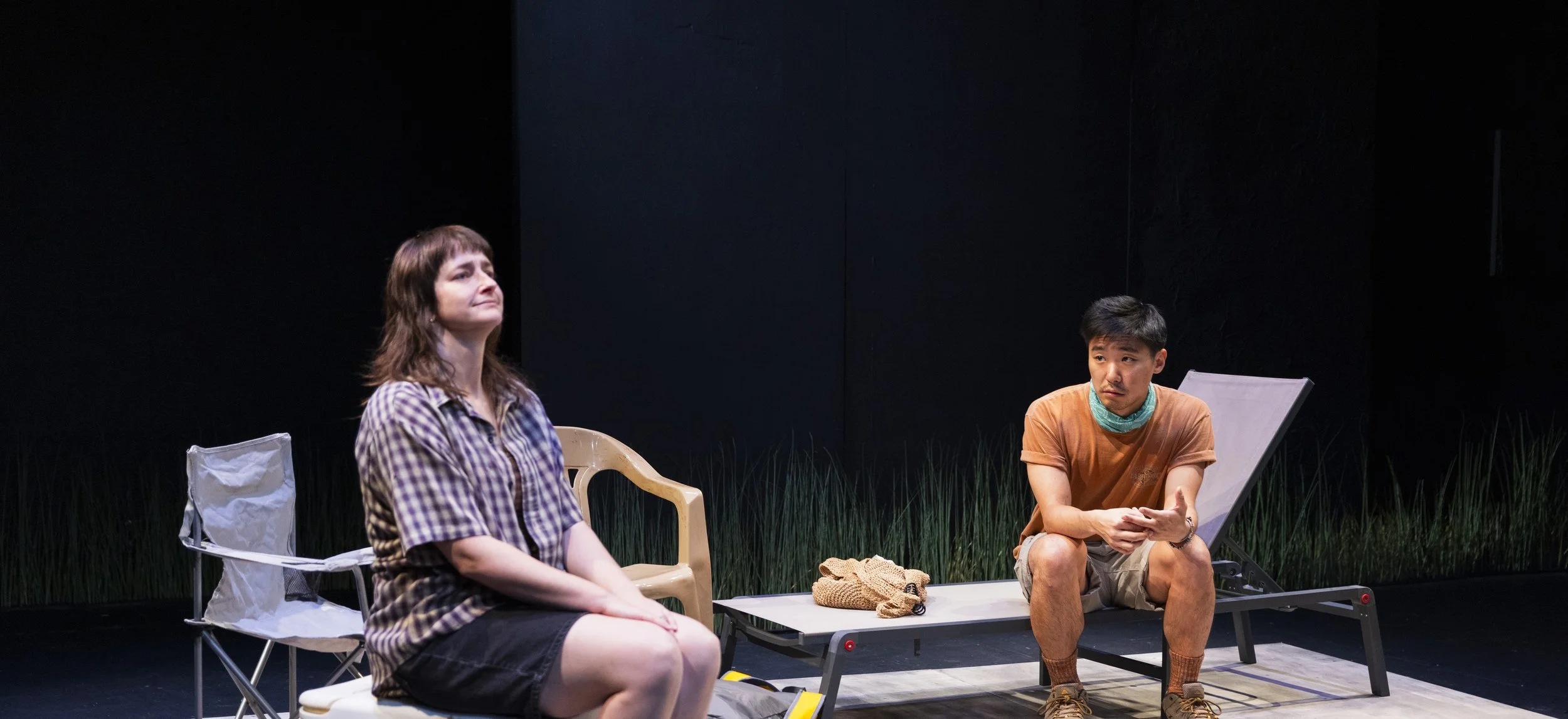
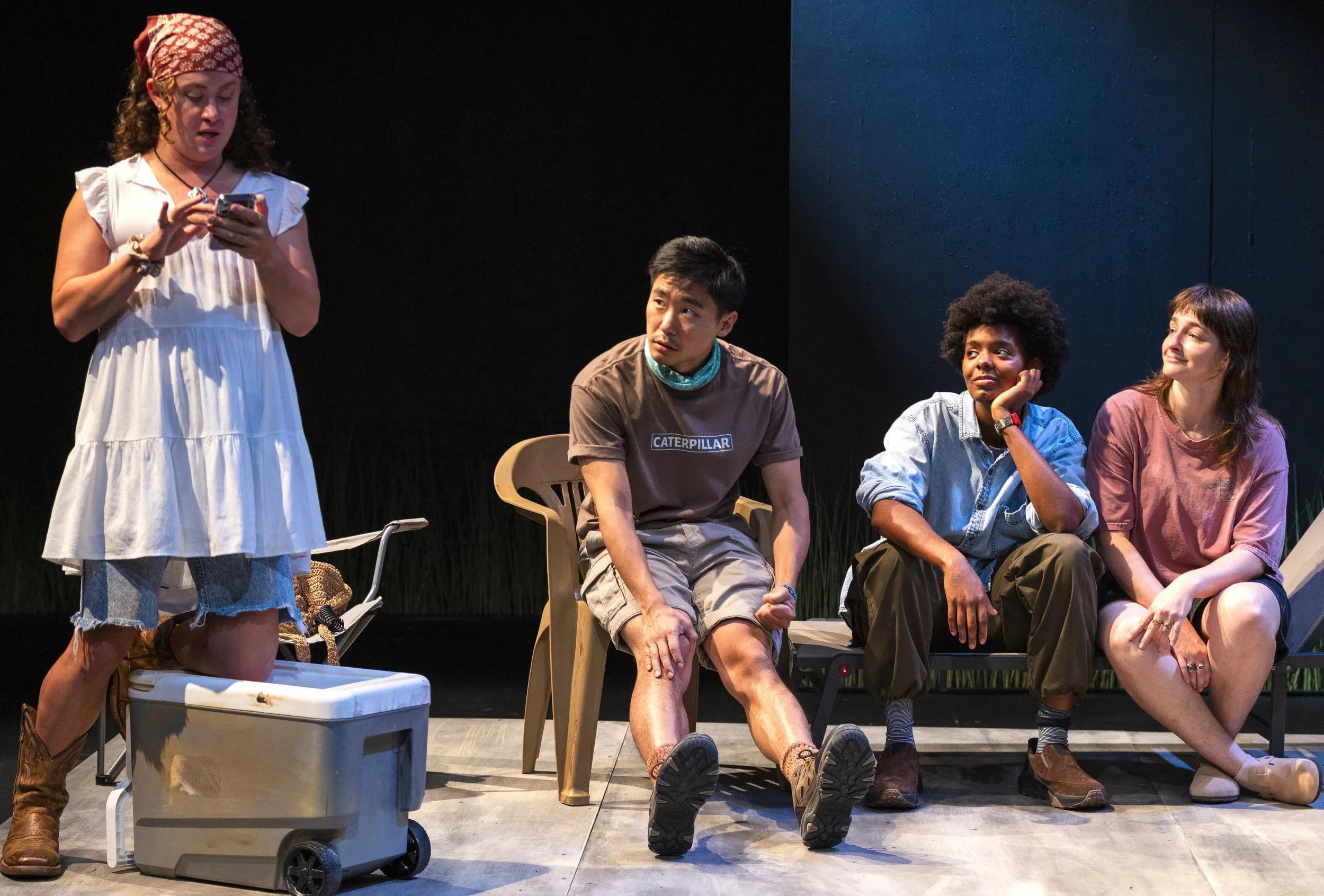
The four principals of Very Blue Light are (from left): Magna (Dom Martello), Coleman (Sam Im), Michigan (Anita Parrott), and Angela (Ellenor Riley-Condit).
Marfa, Texas, the shooting locale for the George Stevens epic film Giant 70 years ago, is known as a dot of cultural sophistication, big on minimalist art, amid hundreds of miles of Texas brush and desert. It’s also renowned for the Marfa Lights, a nocturnal phenomenon of distant brightness that can appear orange, yellow, blue, red. It’s not known as a hangout for anxious thirtysomethings yapping about politics, gender, and muddled friendships, but that’s the upshot of Very Blue Light, Daphne Silbiger’s new drama at The Tank. That it plays as well as it does is a tribute to Silbiger’s clever invocation of familiar themes, and a beguiling cast of four up-and-coming actors.
Raphael Mishler’s modest set nicely evokes the barren surroundings, dying tall grass and wide-open vistas. It’s the backyard of Angela (Ellenor Riley-Condit), a bird expert about to depart to Alaska for a job, who’s hosting a weekend get-together. The participants: Coleman (Sam Im), a long-unseen school buddy who now works for Tesla, and if that sounds like an “uh-oh,” it is; Michigan (Anita Parrott), whose name is never explained, a good-natured trans; and Magna (Dom Martello), a local conceptual artist and Angela’s best bud, who was also Coleman’s bestie when they were Mike back in college. “I don’t have a problem,” Coleman says of Magna’s transition, and it’s immediately clear that he does.
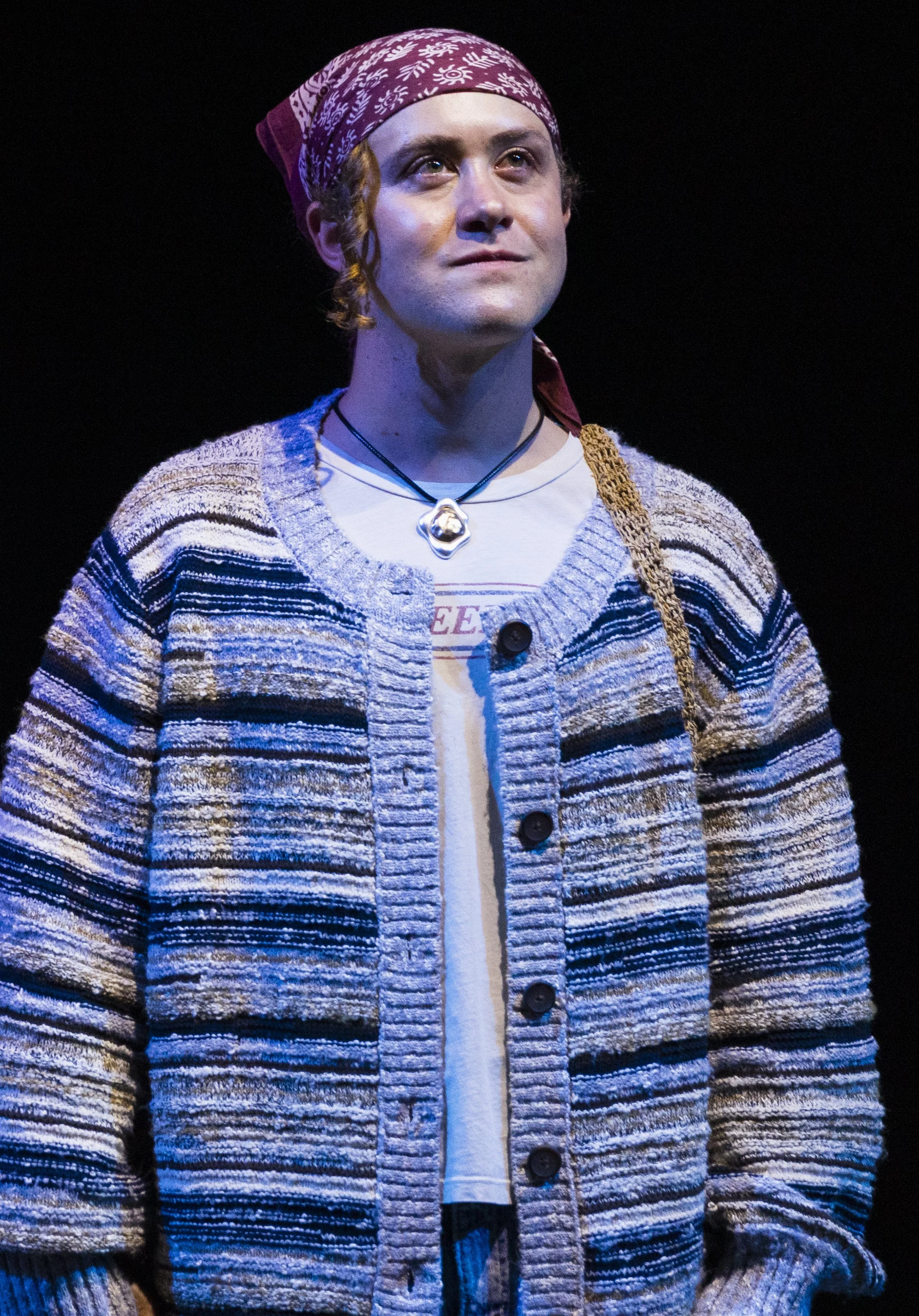
Magna copes with being trans at a tough historical moment.
Coleman’s and Magna’s initial encounter is awkward, and awkwardness rules the stage from there. Angela initiates an awkward flirtation with Coleman, which eventually yields awkward results. Magna and Michigan retreat to the Marfa Lights Viewing Pavilion, where that titular light appears, which ends in an awkward kiss. Characters variously confront one another directly or awkwardly glance away, afraid to step up to their true feelings. Director Emily Moler stages it all quite well, keeping the bodies close together to indicate intimacy or far apart to accentuate temporary emotional distance. A couple of staging conceits, though, are awkward in the wrong way: a Magna-Michigan phone call, with Magna in the audience, ends with the two facing each other directly and not miming phones, which is confusing; and strobe lights signal scene changes, which is distracting.
But the talk is, if verbose, intelligent. Silbiger gets deep into this quartet’s heads, never more so than when they spar politically. Coleman, credibly declaring himself non-MAGA, nevertheless is miles away from the left, where the other three reside, to varying degrees. Michigan, for instance, speaks about technofascism:
The data we generate, our capitulation to surveillance, it’s all mechanics of that existing system. Because it's always been about classification. It's always been about commodity. The human body has always been the ultimate perishable good. And so the problem now isn't necessarily some kind of new exploitation, it's that the practical foundations for any kind of alternative system have been compromised.
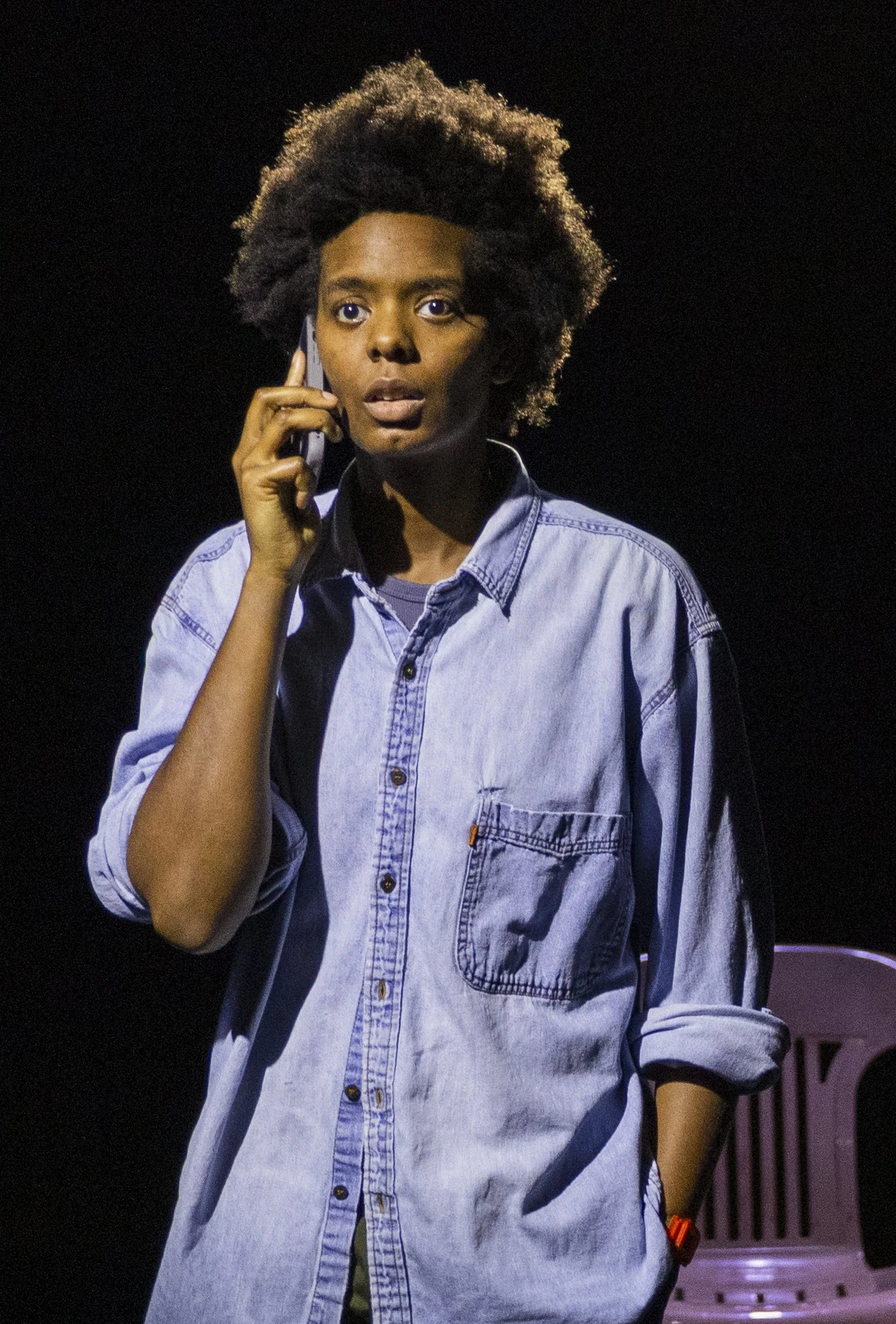
Michigan is a calming presence in sometimes fraught circumstances. Photographs by Travis Emery Hackett.
What a mouthful! And there’s more where that came from. Some of the discourse is provocative: “If all the left-wing frogs are together hugging each other, the pot still boils, right?” asks Coleman. But the dialogue zips by so fast that it’s hard to keep up with it, and while you’re processing the last idea, others are flying past. Moler might have eased the pace somewhat, and Silbiger might have clarified exactly where each character stands; complex personalities aren’t to be discouraged, but the inner contradictions, such as Angela’s worry that she’s more to the right than she surmises, become difficult to navigate.
Still, they’re often engaging company, and the four comprise a likable bunch. Im, while conveying Coleman’s unappetizing rigidity and wish to dominate, ably peddles the charm that helps him win arguments. Riley-Condit’s Angela is all hey-girlfriend affability, and Parrott’s Michigan has an appealing stillness that tempers all the shouting. Martello, with the toughest role, nails Magna’s determination to survive and prosper at an undeniably bleak moment for trans rights. Riley-Condit and Parrott aren’t even Equity members yet; this ought to help them get there.
They’re backed by able lighting (Jiahao Qiu and Elijah Thomas), costumes (Annie Hoeg), and sound (Ari Cleveland). And if the talk grows wearying in spots, it’s also bracing to watch a group of smart, articulate, and engaged young Americans hash it out.
Very Blue Light plays at The Tank (312 West 36th St.) through Oct. 4. Evening performances are at 7 p.m. Thursday through Saturday, with an additional performance Monday, Sept. 28; matinees are at 3 p.m. Sunday (no performance Sept. 29). For tickets and more information, visit thetanknyc.org/calendar-1/verybluelight.
Playwright: Daphne Silbiger
Director: Emily Moler
Scenic Designer: Raphael Mishler
Costume Designer: Annie Hoeg
Lighting Designers: Jiahao Qiu & Elijah Thomas
Sound Design: Ari Cleveland
If you enjoyed this review, please click on the Like icon below.
