Musical

Instant Insight

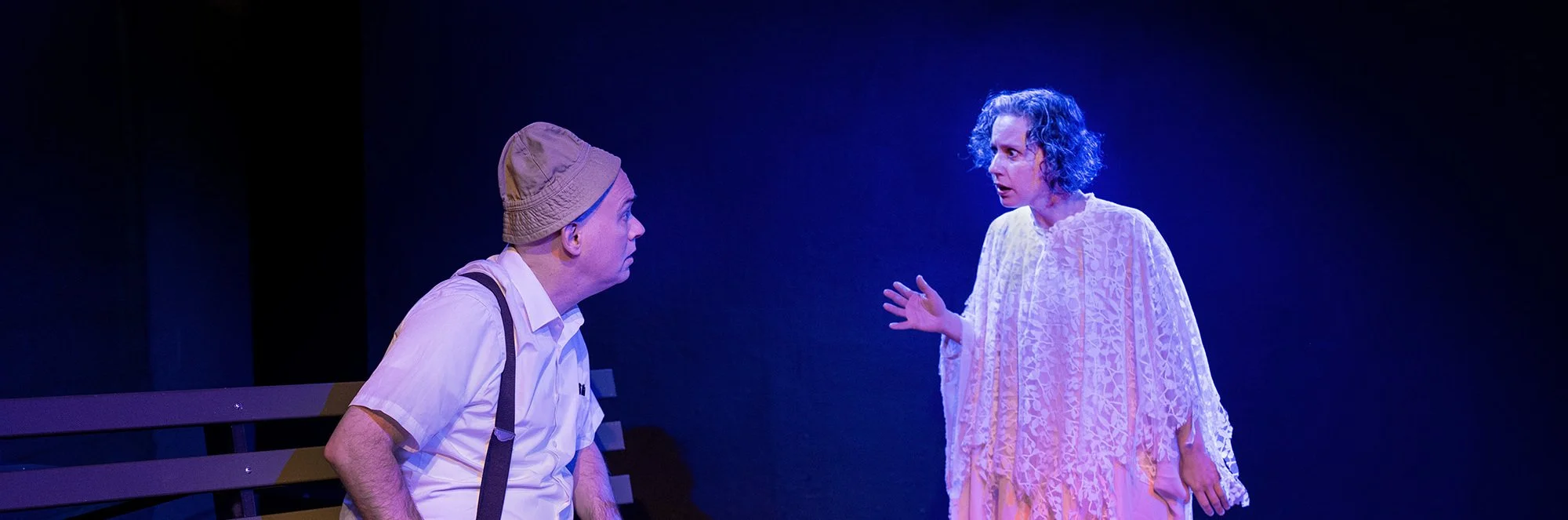
Off the Leesh Productions's Help Me Help Myself: The New York Guide to Love, Fame, Fortune and Everything You've Ever Dreamt of in 30 Days or Less, despite its lengthy title, is a streamlined piece of theater that nonetheless delivers more laughs than many shows twice its length. The 75-minute play is an ironic, comic odyssey through the intersecting lives of one very Zen New Yorker and four neurotic ones. Claire (the endearingly wry Marina Kotovnikov) is a struggling writer, frustrated at how her blissful childhood has hindered her ability to "contribute to the general malaise that is afflicting [her] generation." Claire meets Becky, a self-help-obsessed actress played with appealing sincerity by Julie Tortorici, who touts the program set forth in her favorite Oprah Winfrey-endorsed book, Help Me Help Myself. The two characters play off each other's contrasting personalities to delightful comic effect as Becky tries to convince Claire to join her on the road to self-actualization.

In Claire's efforts to find her own copy of the book

Click for print friendly PDF version of this blog post

Olsens: The Musical!

The highbrow tradition of the theater and the lowbrow phenomenon of celebrity culture seldom go hand in hand. Usually, the only times the two worlds converge is when a Hollywood A- or B-lister decides he or she needs to be taken "seriously" as an actor by performing in something with no loud explosions, and preferably by Shakespeare. Occasionally, though, these two areas do come together on a decidedly less erudite mission, and the results of this unorthodox partnership can currently be seen at Don't Tell Mama. The Misadventures of the Wholesome Twins, running through Dec. 19, is a musical parody based on the travails of America's favorite twins, the Olsens

Click for print friendly PDF version of this blog post

Contrarian

Recently on National Public Radio, artists, musicians, and scholars talked about the enduring effects of Moby-Dick on American culture. Playwright Tony Kushner (Angels in America) cited the novel's expansiveness as an influence on his work

Click for print friendly PDF version of this blog post

Cyrano Out West

Like attracts like. Or something like. Despite the best efforts of sociologists to pin down the hows and whys of human attraction, there are always, always, exceptions to the rule. In Cowboy v. Samurai, Michael Golamco's freshly acute (and hilarious) reinvention of the classic Cyrano de Bergerac story, characters negotiate the sketchy terrain of romantic attraction as they wrestle with expectations, reservations, pride, and prejudice. The National Asian American Theater Company has produced a superb incarnation of Golamco's script. Welcome to Breakneck, Wyo., where out of 1,000 inhabitants, only two are Asian: our Cyrano, Travis (Jose de la Fuente), a high school English teacher who escaped from Los Angeles after a disastrous relationship, and Chester (C.S. Lee), the assistant manager at Taco Tuesday, the only ethnic restaurant in town. (The irony isn't lost on him.) The militant Chester also leads the Breakneck Asian Alliance (population of two), but everything changes when Veronica (Hana Moon), a beautiful Korean woman from Flushing, Queens, arrives to teach biology at the high school.

Travis and Veronica strike up a fast friendship, swapping stories about their families and lamenting the lack of tofu at the local grocery store. As the conversation shifts to past relationships, however, Travis is offended when it becomes apparent that Veronica, as a rule, does not date Asian men. "Race has nothing to do with attraction," Travis argues, but it is clear that, at least for Veronica, race figures predominantly into the equation.

Although he is falling for Veronica, Travis knows better than to pursue her; instead, he decides to help his friend Del (Timothy Davis) win her over. Del is a lovable, dimwitted hunk of a cowboy who teaches phys ed at the high school. While he is also smitten with Veronica, Del is threatened by her intellect and enlists Travis to write letters to her on his behalf.

Travis's letters are poignant, clever, humorous, and wise, and, at least from our perspective, they could not possibly be written by Del, who uses "dumb" as a noun. But Veronica, after ascertaining that Del's sock drawer contains no Asian porn, happily launches into a relationship with her Wyoming cowboy. When things begin to turn sour, however, she turns to Travis for comfort. The secret of Travis's masquerade inevitably leaks out, and he must face his fears and restraints, while Veronica must account for, as Travis calls them, her "preferences."

Under Lloyd Suh's polished direction, the cast delivers crystal-clear performances. At the show's center, de la Fuente gives a graceful arc to his performance, effectively evoking the complexity of Travis's friendship with Del and the angst of his growing affection for Veronica. Moon makes a lovely Veronica, and she puts aside her sarcastic exterior to find something more delicate in a late-night confrontation with Chester. Thankfully, Davis moves beyond the stereotype of the hick cowboy; instead, his Del is an intriguing portrayal of a sheltered local boy forced to expand his perspective.

With expert comic delivery and impeccable physicality, Lee all but steals the show as Chester. An Asian man of indeterminate heritage (his adoptive parents never took the trouble to find out where he was born), Chester grew up in Wyoming as a self-described "island of yellow in a sea of white." Without any definite lineage to draw from, he adopts aspects of Asian culture to create his own Asian-ness, as it were. Chester worships Bruce Lee (the "Gospel of Bruce"), dresses as a ninja (complete with grappling hook), and criticizes Veronica for "playing a piano without any sharps or flats" (dating only white guys).

While it contributes to the show's humor, Chester's insatiable desire for racial definition also stirs up pathos. He wrestles with isolation and rage, and his aforementioned confrontation with Veronica exposes the self-hatred that paralyzes them both.

The show's design is strong overall, but Stephen Petrilli's lighting is a standout. As Del reads from his (actually Travis's) letters, he is bathed in a spotlight; Travis sits at his desk in the background, where only subtle streaks of light touch his face. Late in the show, Travis says, "When you write something down, you become the words." In this expert bit of staging, he sits out of the light

Click for print friendly PDF version of this blog post

Slaves to Image

The Maids was Jean Genet's first major text that did not have explicit homoerotic themes. Jean-Paul Sartre, however, claimed that Genet told him that the two maids should be played by men; Genet later denied he said this. The play's initial production met with mixed reviews. In 1965, the Living Theater, under the direction of Julian Beck, staged an unauthorized production with an all-male cast. Genet tried to close it down. In most subsequent and successful productions, though, men have performed the roles. So staged, the play becomes an enactment of simulacra dissolving into the very things they represent, even as the things they represent dissolve from reality altogether. Master and servant, image and beauty, truth and appearance

Click for print friendly PDF version of this blog post

Swiping Sizes

"Do not go gentle into that good night. Go thin." Flirting with metaphors, chewing up euphemisms, tongue set firmly in cheek, Margaux Laskey pulls out all the stops in size ate, a one-woman show that is part confessional, part stand-up comedy, part musical, and, unfortunately, part confusion. Born to a professional linebacker father who was rewarded for one type of body (big and strong) and a model-like mother who was rewarded for another (petite and demure), Laskey grew up with conflicting messages about her body. She has been every imaginable size, she tells us, and she has the history of diets, anorexia, and emotional baggage to prove it.

As her sweetly cheeky title suggests, Laskey wants to combat the fiction of "perfect" size in our culture. Set designer Julie Walker has wisely provided Laskey with nine mannequin torsos (labeled in even-numbered sizes from 0 to 16), which, under Steven McElroy's direction, strongly illustrate Laskey's rhetoric. Laskey lugs the mannequins into various configurations

Click for print friendly PDF version of this blog post

For the Love of God

To update one of the best-known stories from the Bible is to run the risk of alienating all sorts of groups: strict constructionists who feel these stories need no adaptation; audience members looking for something fresh to watch rather than stories they have already read in Sunday school; and those who prefer their theater fare on the lighter side, not weighed down by allegory. That Working Man's Clothes's production of Bekah Brunstetter's To Nineveh is an accessible, let alone engaging, work is a miracle worthy of the play's source material. Nineveh is a modern-day amalgam of several Old Testament stories, and while the character names include Delilah and Jonah, the crux of the plot focuses on the plight of Isaac (Roy Miller), a successful lawyer, and Rebekah (Ellen David), his Sunday school teacher wife. Isaac favors his hotheaded son Esau (Jared Culverhouse), who has followed in his career footsteps, while Rebekah is loyal to the more sensitive Jacob (Paul Fears), a music student and a closeted homosexual who has just taken up with his professor, Jonah (David Carr-Berry).

There is one other integral relationship

Click for print friendly PDF version of this blog post

Honor Among Thieves

In 1948, Jean Genet, arrested for the 10th time for burglary, had been condemned to life imprisonment. By this time, his salacious autobiographical novels had gained him enough notoriety among the underground literati that such luminaries as Gide, Cocteau, and Sartre successfully petitioned the French government for his release. After their intervention, he turned from writing prose for the fugitive and solitary reveries of his novel readers to writing for the stage, which he helped transform into an equally dim-lit and dream-like forum. Deathwatch was his first play. Three prisoners confront each other in a small cell and jockey for a place in the prison's pecking order. They are only as good as the stories they tell, and the scars and tattoos that prove them. Green Eyes, a murderer soon to be condemned, sulks and explodes by turns with an unpredictable rage. His act has imbued him with a saintly nimbus within the inverted moral calculus of the jail cell.

Lefranc, a shrewd-eyed, small-time con artist, manipulates others with his smooth talk and ability to write letters for them. He is scheduled to go free in only a few days. Maurice, a petty thief, uses his good looks to get what he wants. While compulsively egging others on, he remains a coward

Click for print friendly PDF version of this blog post

Devil's Due

At first, the concept for Out, Out Damned Clock: Faust Meets Macbeth! seems a thought-provoking one. Faust and Macbeth, two of literature's most well-known characters, are so alike in their ambition and hubris that they could be brothers. The parallel may be easy to identify, but it's much more difficult to dramatize adeptly. In trying to do so, Footlight Players' production falls disappointingly short. As playwright and director Nathaniel Green writes, "The Faust theme is one of the most borrowed in world literature." Even a list of only the tale's most familiar incarnations must be abbreviated: Christopher Marlowe's Dr. Faustus, Goethe's Faust, Arrigo Boito's 1868 opera Mefistofele, Damn Yankees. Such a pedigree is difficult to live up to

Click for print friendly PDF version of this blog post

Love and Death

With performances at the Ontological Hysteric Theater and an exhibition at the New Museum of Contemporary Art to its credit, 31 Down radio theater seems well qualified to be experimental. And true to experimental fashion, its production of That's Not How Mahler Died takes great risks as it attempts to explore the themes of death, voyeurism, and guilt. The payoff for these risks, however, is a definitive failure. Which is not to say that production values are lacking. Nor is the crew in any way untalented

Click for print friendly PDF version of this blog post

See Jane Hook

If ever a set more intuitively captured the strengths and defects of a play script's construction than the one built for John Pallotta's Jane Ho, now playing at the Lion Theater at Theater Row Studios, I haven't seen it. A plush boudoir replete with lighted mirrors and velvety reds sits beneath a spare, back-lighted bedroom, with only a curved, lushly carpeted staircase to join the two. As attractive as they are, designer Gregg Bellon's interiors are appropriate for being just that, interiors. Entering the world of the four anonymous sex workers at the heart of Pallotta's work is like slipping on earmuffs

Click for print friendly PDF version of this blog post

Love and Marriage

When a playwright presents a piece about a cancer survivor, the audience expects to be treated to a revealing glimpse of staring-down-death emotions or grueling treatment routines. Cancer is, after all, fairly well-charted dramatic territory and an all-too-common disease. Most people have had firsthand or second-hand experience with the illness, or at least have a strong knowledge of it through the news or made-for-TV movies. There really isn't a need for someone to tell us about how chemotherapy saps your energy and makes you bald, or how beating cancer forever defines you, both positively and negatively. In Reconstruction, author Clifford Lee Johnson III at least presents us with a more intimate format for the same old discussion by focusing on the attempts of breast cancer survivor Ally and her husband, Ford, to sexually reconnect when her cancer goes into remission. Ally is nervous about sharing herself and her body, despite Ford's insistence that he finds her as arousing as ever. One can understand Ally's reticence

Click for print friendly PDF version of this blog post

Deadly Puzzle

Imagine a series of books, like Ukrainian nesting dolls, whose parallel plots lead the reader further and further back in time. And then imagine that the characters depicted in those books are real people who discover the books and are unnerved to read about themselves, as well as others leading parallel lives. That is the original premise of Canadian playwright Jayson McDonald's Jigsaw, an enjoyable mystery receiving its U.S. debut at the Wings Theater. Alas, the play, which McDonald also directed, staggers under this complex structure while recycling one too many horror genre clich

Click for print friendly PDF version of this blog post

Friends Forever

"Ohmygod! That is, like, so totally cool!" If this is an expression you often hear around your house, you are probably living with a "tween." Journalist Michele Willens is credited with coining the term to describe the group of kids who find themselves stuck between two worlds: childhood and adolescence. In her play Dear Maudie, playing at the 78th Street Theater Lab, she explores the tight bond formed by two fourth-grade girls, Nicki and Maudie, as they struggle to make sense of their changing lives. One would be hard pressed to find another play whose target audience is tweens. There are no adults playing children, no patronizing tones or after-school-special themes, and no coming-of-age epiphanies. Maudie and Nicki are on the brink of becoming teenagers, not adults. They are trying desperately to preserve their innocence, not lose it.

The girls are realistically portrayed by two cute-faced young actresses, Allison Brustofski (Nicki) and Danielle Carlacci (Maudie). The production's success relies entirely on their personality and charisma, since the story is told through the letters and e-mails they write each other during class. As they read the letters aloud, other actors, seated on benches behind them, will occasionally rise to illustrate what they are typing. But the play mostly rests on their shoulders

Click for print friendly PDF version of this blog post

All in the Family

We want to be normal. We need to be normal. We constantly calibrate our lives to land within the safe, normal margins of being. Try as we might to protect ourselves, however, tragedy can interrupt at any moment, shattering even the most elaborately constructed facades. The Transport Group's ambitious new musical, Normal, brings us up close to a quintessentially normal American family disrupted by a daughter's eating disorder. Although it sometimes veers dangerously close to cheesiness, this production is ultimately an immensely rewarding exploration of a family in crisis. Normal courageously exposes fractured lives and messy situations, where glaring abnormality has the power to precipitate epiphanies.

The Freemans are an emphatically normal nuclear family (father, mother, son, daughter), and they first appear to be quite cartoonish. They sing and dance in unison in the opening number, "Happy Family," but their disconnection from one another quickly becomes apparent. When teenage Polly (Erin Leigh Peck) tries to talk to her mother, Gayla (Barbara Walsh), over the sound of her hair dryer, they both stare straight ahead without making eye contact.

Soon Polly succumbs to the forces of peer pressure

Click for print friendly PDF version of this blog post

Earthbound

It was one small step for a man and one giant step for mankind, but what about womankind? Neil Armstrong spoke his now-legendary words while taking the first steps on the moon in 1969. Americans were glued to their TV sets, watching history in the making. Little did they know, however, that behind its bold advances, NASA was hiding a dirty little secret

Click for print friendly PDF version of this blog post

In Revue

Spanning locations ranging from its mythical titular tropical island to the borough of Staten Island, and embracing such weighty topics as death and the passage of time, Roger Rosenblatt's Ashley Montana Goes Ashore in the Caicos...Or What Am I Doing Here? covers a great deal of physical and emotional geography. Even so, with all the journeying going on at the Flea Theater, there is no destination in sight. Rosenblatt has subtitled Ashley Montana "Almost a Play," and as a result many of its broad sketches seem unfinished, despite a solid cast

Click for print friendly PDF version of this blog post

The Return of the King

The Vortex Theater Company's production of Agamemnon is a feast for the eyes, ears, and even the nose as sight, sound, and smell join together in director Gisela Cardenas's bold new adaptation of Aeschylus's enduring tragedy. This innovative production is highlighted by strong performances and tight direction, and, despite a few wrong turns and an ending that overstays its welcome, it proves to be a unique theatrical event. Agamemnon tells the story of the great King's victorious return from the Trojan War. Anxiously awaiting him in Argos are his treacherous wife Clytemnestra (Linda Park), his faithful daughter Electra (Catherine Friesen), and his loyal citizens. Clytemnestra has ruled Argos during the King's 10-year absence with a secret hatred burning in her heart as she dreams of avenging her eldest daughter Iphigenia's death, a death for which Agamemnon (Jonathan Co Green) was culpable. With her new lover Aegistus (Seth Powers) by her side, Clytemnestra plots to murder the King upon his homecoming, with the impending action set against the backdrop of a great banquet.

Cardenas has written an inspired, if dense, adaptation. She reinvents the traditional Greek chorus as a team of chefs preparing Agamemnon's welcome feast. The Fates are transformed into three crudely mechanical dogs, brilliantly designed by Andrea Gastelum and maneuvered and "voiced" with excellent precision by a trio of actresses.

In addition, food is a major ingredient in this highly conceptualized adaptation. Much of the text concerns itself with food

Click for print friendly PDF version of this blog post

Ladies Who Improv

What Women Talk About is the theatrical equivalent of throwing spaghetti against a wall and seeing what sticks. Rather than keeping to a script, its cast creates an introductory scenario ahead of time and then largely improvises the specific action and dialogue. The performances have an overarching plot line tying them together, but each evening lifts out of the episodic structure enough to stand out on its own. And while the walls of the Kraine Theater remain pasta-free, the place does resound with much earned laughter. Women centers around Lauren Seikaly as Bonnie, an in-control casting director, and her three less tightly wound friends: Katharine Heller as free spirit Sara, Brenna Palughi as the promiscuous Sophie, and Lynne Rosenberg as the self-deprecating Jean. The premise for this performance found the ladies preparing for a red carpet event devoted to Bonnie's client Jude Law. As they ready themselves for the evening, the actresses ad-lib away, discussing everything from Law's sexual proclivities to the art of female grooming, including plenty of swearing and scatological humor.

It's unclear exactly how much of the show is mapped out beforehand and how much develops during the run; the program says the actresses have created their characters over the course of the last year. But this quartet is quite a well-oiled machine. Despite the occasional awkward pause and several occasions where the actresses talk over one another, the cast is remarkably in sync. Heller in particular is a font of spontaneous energy. On average, she probably threw out more bons mots off the cuff than her fellow cast members did.

But each actress contributes admirably. In fact, while Seikaly seems to improvise less dialogue (though one throwaway line confusing rapper Kanye West with Cond

Click for print friendly PDF version of this blog post

Get Surreal

"The hunchback took in the pregnant girl to hide her from high school until the baby popped out." Author Aimee Bender certainly knows how to get your attention. In her short story collection The Girl in the Flammable Skirt, each story begins with an irreverent statement designed to keep you reading. Bender neatly twists a phrase, bends a meaning, and bam

Click for print friendly PDF version of this blog post