
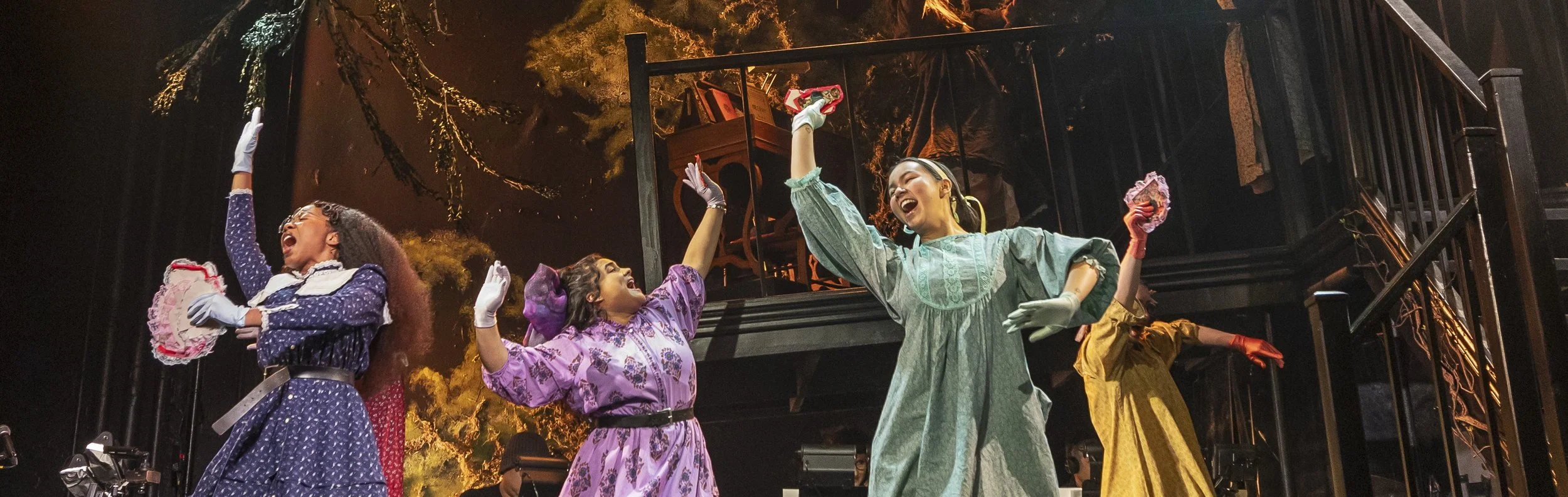
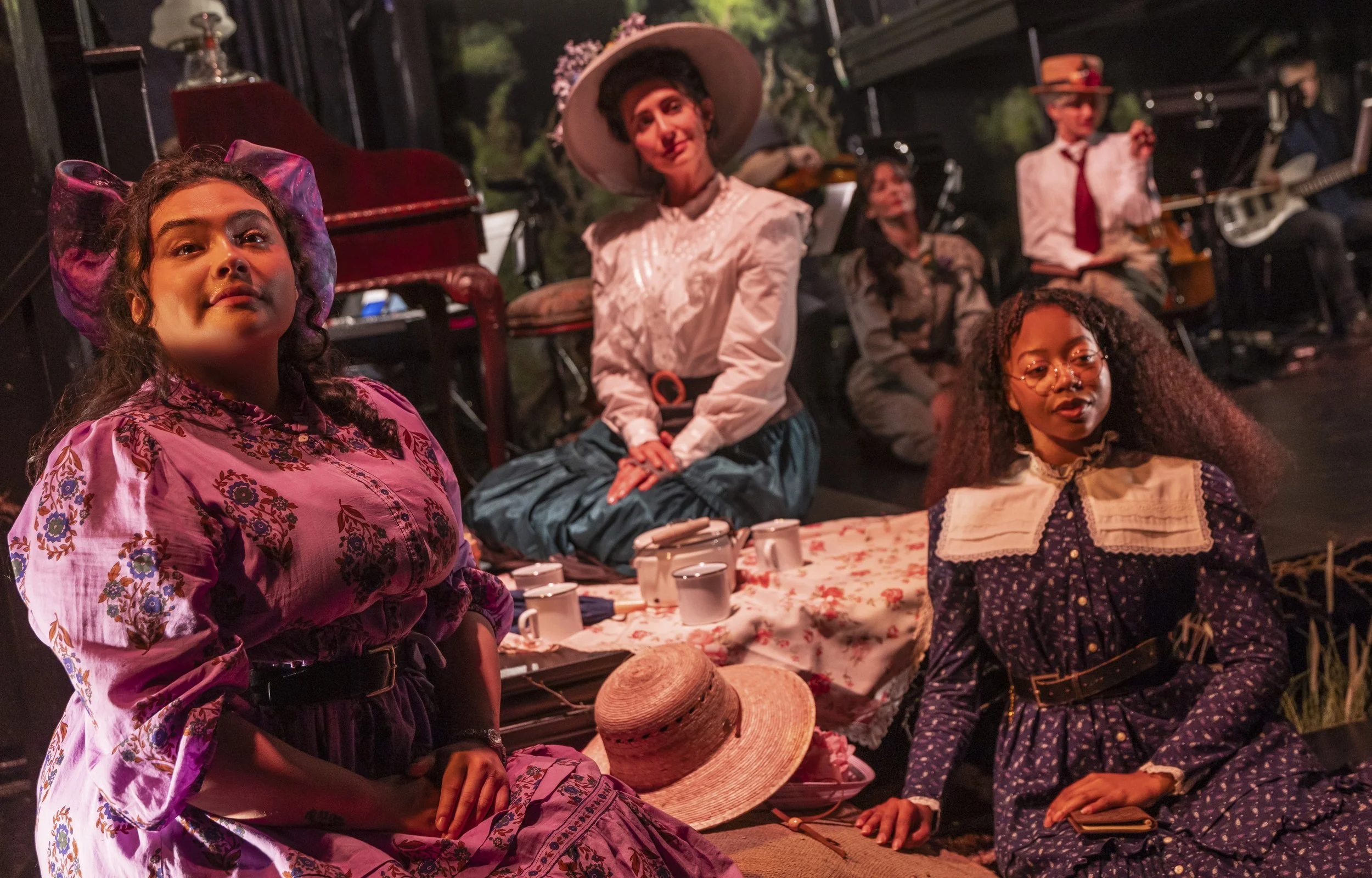
Irma (Tatianna Córdoba), Mademoiselle (Marina Pires), Miranda (Gillian Han), Marion (Kate Louissaint) and Miss McCraw (Kaye Tuckerman) enjoy a Picnic at Hanging Rock, for a while.
The 1975 Australian film Picnic at Hanging Rock unfurls an atmospheric, unsettling little story of mysterious forces disturbing the titular outing, enjoyed by students at a Victoria, Australia, girls’ school circa 1900. In the movie, director Peter Weir keeps the proceedings eerie and foreboding as some of the girls on the picnic just vanish, leaving their classmates and the school personnel baffled and devastated. A well-deserved international success, Picnic at Hanging Rock grips the viewer even as not a lot happens: the film is all mood. The emotions are strong, but nothing about it screams, “I need to be sung.”
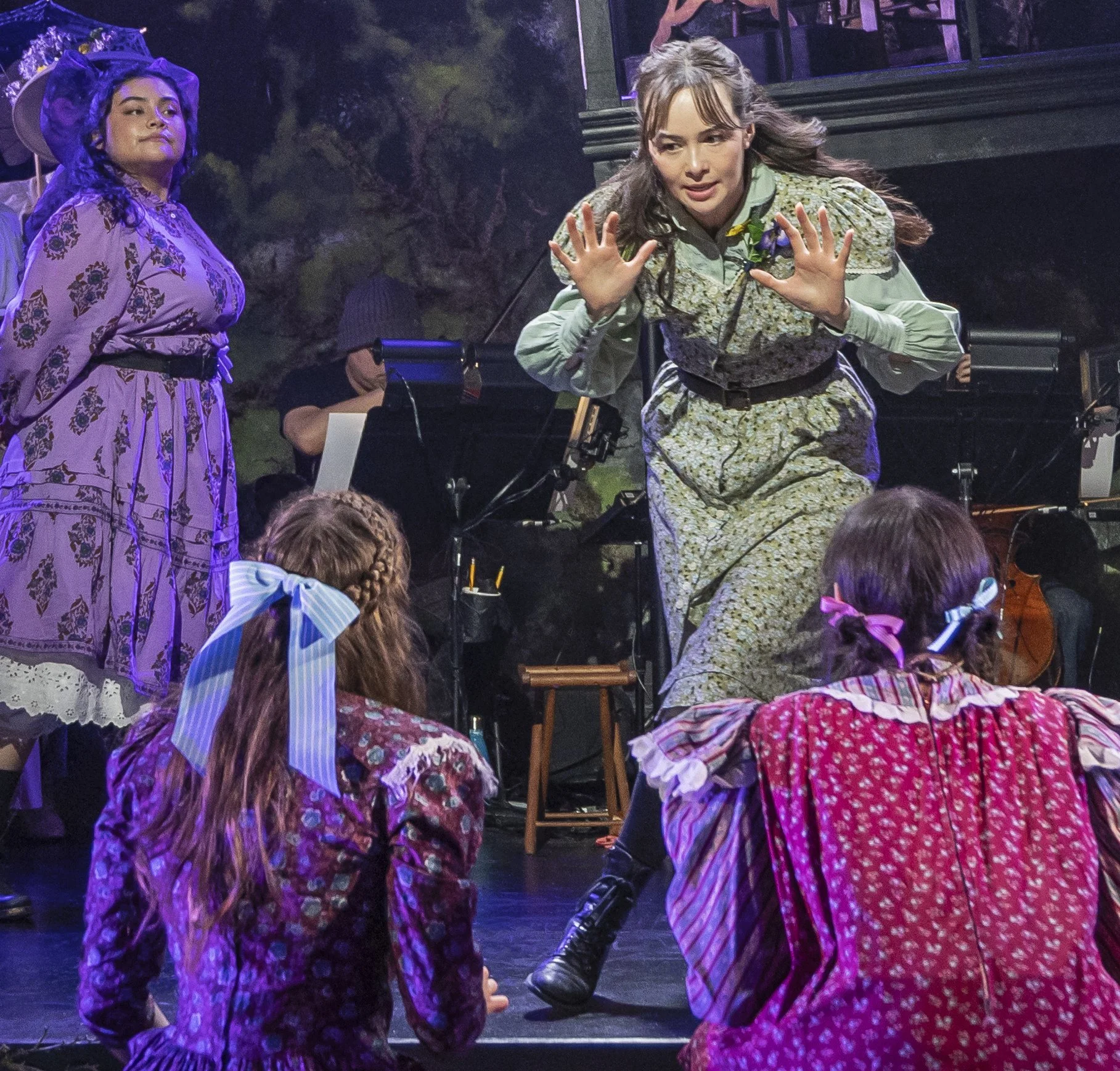
Miranda (Gillian Han) indulges in a bit of storytelling.
Still, something in the material convinced Hilary Bell (book and lyrics) and Greta Gertler Gold (music and arrangements) to musicalize it, although the authors have emphasized that they were motivated not so much by Weir’s film but by its source, Joan Lindsay’s 1967 novel. Yet most of the musical seems directly derived from the movie. Despite a 2½-hour running time cited in the press materials, the show runs a little over two. Maybe some of the novel got cut. Certainly what remains is fragmented, as if missing some connective tissue.
The action flashes backward and forward, and that confuses the storytelling—as does Daniel Zimmerman’s scenic design, clumping Appleyard College and the rock together on a crowded stage. That’s Appleyard as in Mrs. Appleyard (Erin Davie), the stern, self-made headmistress who goes slowly batty as she wrestles with the consequences of the disappearances of students Miranda (Gillian Han), Marion (Kate Louissaint), and Irma (Tatianna Córdoba). Irma is eventually found, and timid Edith (Carly Gendell), who ran off with the other three, races back to the picnic site.
There are a lot of other students up there, and more school staff: kindly French teacher Mademoiselle (Marina Pires) and Miss McCraw (Kaya Tuckerman), the officious, necktie-wearing math teacher whom Appleyard praises for her “masculine intelligence,” one of several potentially interesting backstories that never get told. Others include just how far the bond goes between Miranda and Sara (Sarah Walsh), the lonely, orphaned misfit who worships her, and how Sara got separated from her brother Albert (Bradley Lewis, with the most authentic Australian accent onstage), the salty servant to Michael (Reese Sebastian Diaz), the young British gentleman who gets caught up in the mystery of what happened at that rock.
“Louissaint’s lovely voice, and Marion’s smartness and eagerness, make her disappearance that much more of a shame. ”
What happened? “Nobody knows except the rock,” several characters sing, in one of Bell’s more pungent lyrics, and the supernatural forces that may or may not be at work propel much of the narrative. Another good Bell lyric occurs at the top of the second act, with “Blood and Scandal,” a quick portrait of rather slimy reporters exploiting the unfolding tragedy at the rock. But the mood shift is so abrupt, it feels like it’s from another musical. Humor is nil; about the closest line that comes to it is “the rock must have a heart of stone.”
Gold’s music is mostly of the if-you-get-anywhere-near-a-melody-play-it variety, an unwieldy mix of rock and near-opera. But she did score it attractively (Adam Gold and Rob Jost assisted in the orchestration)—heavy on the strings—and it’s a challenging vocal repast for the cast, who are, in the main, splendidly up to it. Davie struggles a bit with Appleyard’s high notes, but she has a marvelous belt. Louissaint’s lovely voice, and Marion’s smartness and eagerness, make her disappearance that much more of a shame.
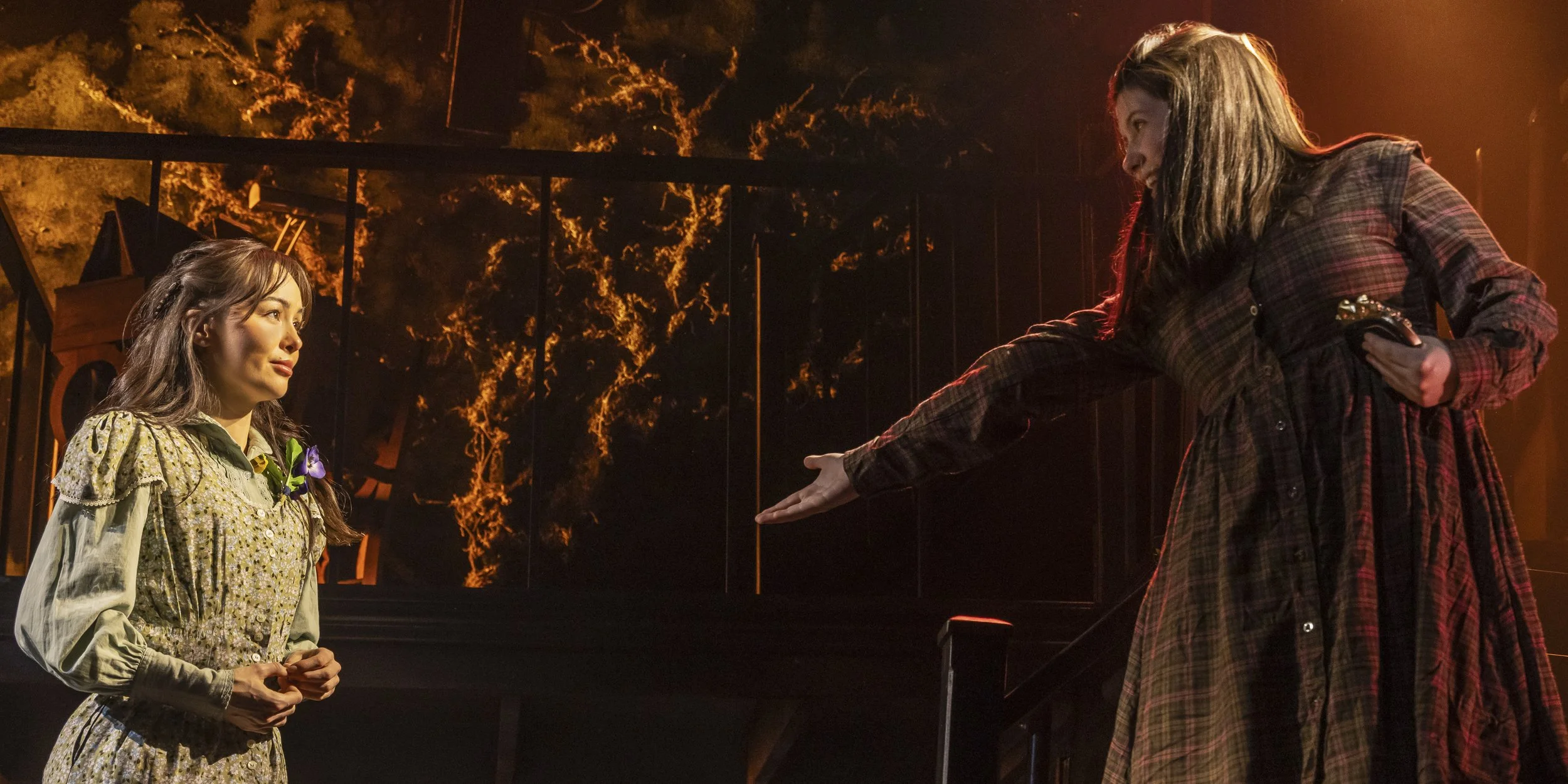
Sara (Sarah Walsh) begs Miranda for … what? Photographs by Matthew Murphy.
Córdoba makes the most of “Stopped Clock,” Irma’s unraveling after returning to civilization. Diaz seems light-voiced compared with his castmates, but he does convey the well-meaning cluelessness of a gentleman caught in an elite social stratum he really doesn’t want.
Director Portia Krieger’s staging verges on the rambunctious, with characters frequently rushing down the aisles into the audience, and Mayte Natalio contrives some lively choreography, which, unfortunately, doesn’t seem to be about anything. Ásta Bennie Hostetter’s costumes are period-accurate eyefuls, and Barbara Samuels contributes some expressive lighting, especially the harsh red of a setting sun. Nick Kourtides, the sound designer, really has his hands full, having not only to (over)amplify the vocals but also providing bird calls, cicadas, and strange, unworldly whooshings around the rock.
A lot of effort has gone into this one, and the personnel are to be congratulated for preserving the languid, menacing atmosphere that endeared audiences to Weir’s vision some 50 years ago. But the question, “Why turn Picnic at Hanging Rock into a musical?” still hasn’t really been answered.
The musical Picnic at Hanging Rock runs through Jan. 17 at Greenwich House Theater (27 Barrow St.). Evening performances are at 7:30 p.m. Sunday through Tuesday and Thursday through Saturday; matinees are at 2 p.m. on Saturdays and Sundays. For tickets and more information, visit picnicthemusical.com.
Book & Lyrics: Hilary Bell
Music & Arrangements: Greta Gertler Gold
Scenic Design: Daniel Zimmerman
Costume Design: Ásta Bennie Hostetter
Lighting Design: Barbara Samuels
Sound Design: Nick Kourtides
Wig & Hair Design: Rachel White
