
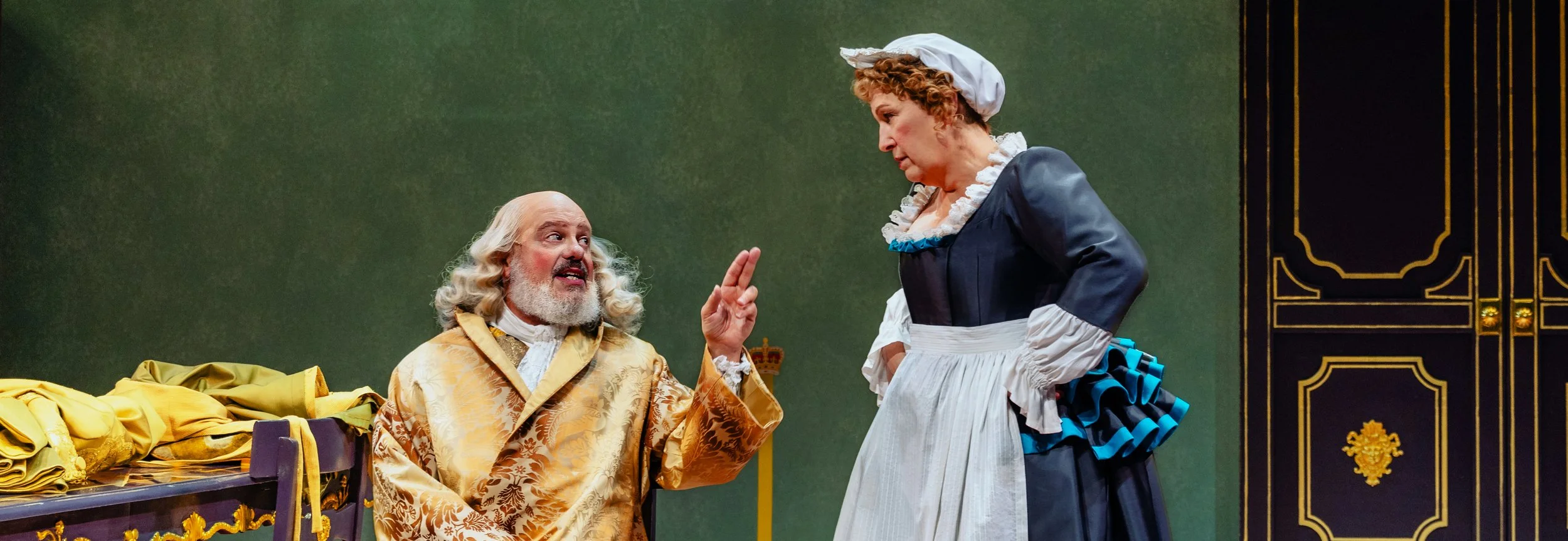
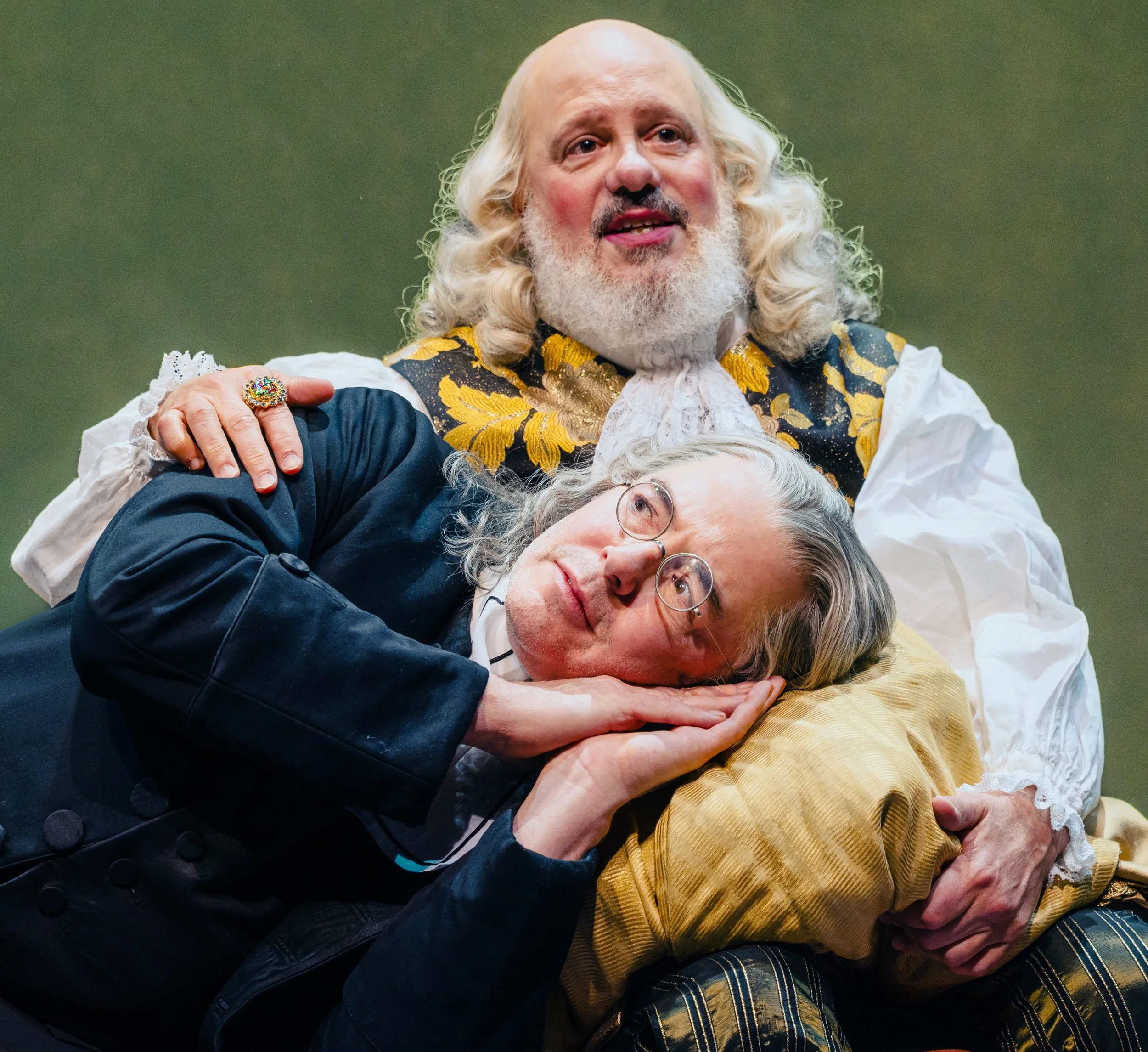
Matthew Broderick (front, lying down) portrays the fraudulently pious Tartuffe and David Cross is the gullible Orgon, in Lucas Hnath’s new version of Tartuffe at New York Theatre Workshop.
Molière’s Tartuffe is robustly reimagined by Lucas Hnath in a randy new version directed by Sarah Benson, turning the classic comedy of hypocrisy into a breathless, contemporary satire. With choreography by Raja Feather Kelly and a fearless cast led by Matthew Broderick and David Cross, the production unleashes ferocious wit and gleeful buffoonery.
At the center of Tartuffe stands Orgon, a prosperous middle-aged bourgeois whose creeping sense of diminished authority has curdled into moral panic. He compensates by embracing an exaggerated, punitive devoutness—an impulse that leaves him ripe for manipulation. His malaise coincides with the arrival of the fraudulently pious Tartuffe, who is swiftly installed as spiritual advisor in his home. When Orgon tells his brother-in-law Cléante that his mother, children, and wife could die without stirring his heart (“My mother, children, brother and wife could die, / And I’d not feel a single moment’s pain”), he grotesquely perverts a Christian ideal rooted in Scripture. Having withdrawn all natural feeling from those closest to him, Orgon creates a domestic climate that echoes—comically but no less destructively—the moral blindness of King Lear, in which bonds of love and trust steadily unravel.
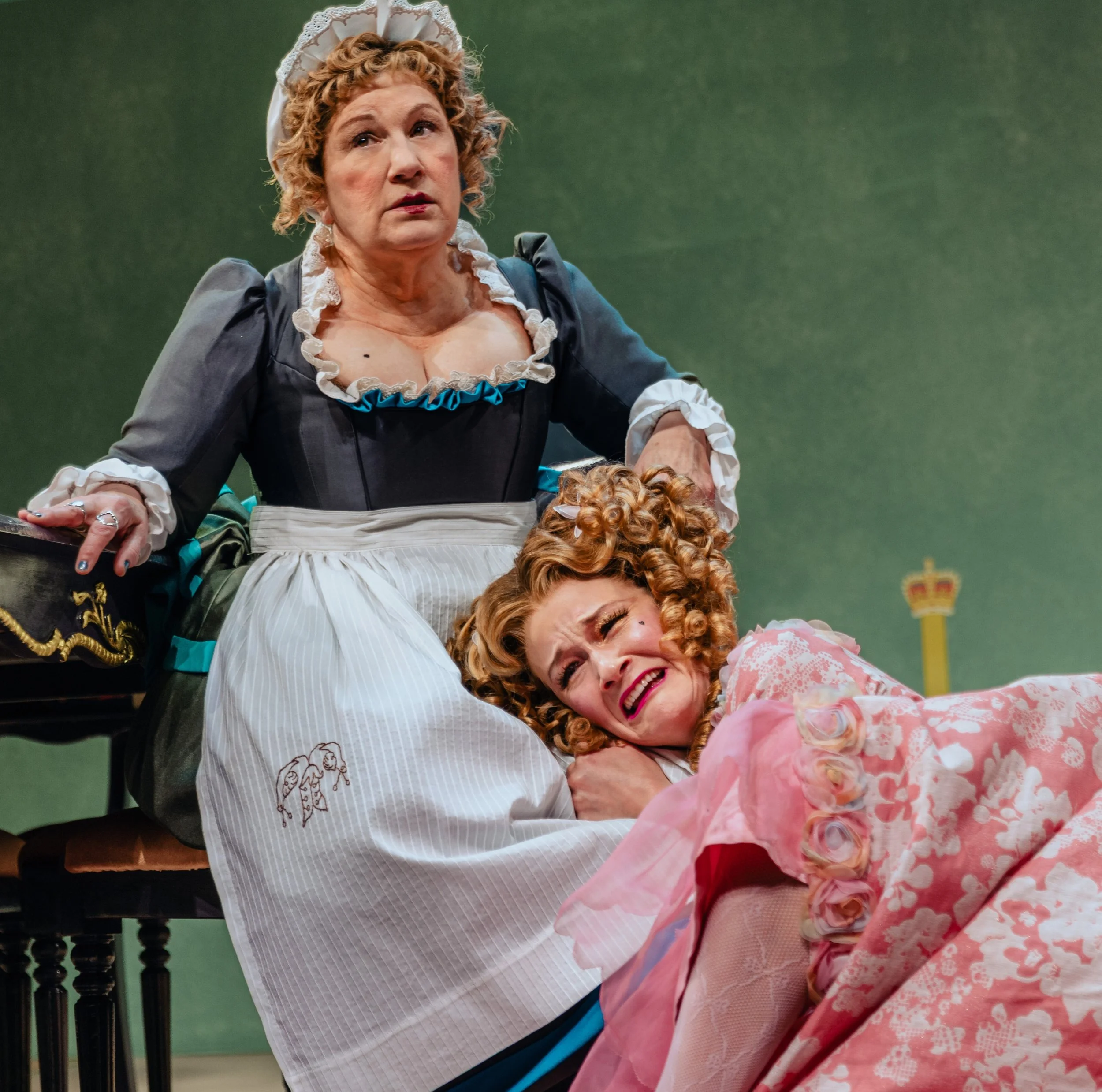
Lisa Kron (left) portrays the tough-talking maid Dorine, and Emily Davis is Orgon’s obedient daughter Mariane, with her marriage hopes thwarted by her father.
Yet Orgon is not merely Tartuffe’s victim; he is also, unwittingly, his enabler. In the name of righteousness, he attempts to force his already engaged daughter Mariane into marriage with Tartuffe, refuses to believe his son Damis when he reports Tartuffe’s advances toward Orgon’s wife, Elmire, and banishes the boy from the household before signing the family estate over to the impostor. Even Dorine, the sharp-tongued maid, cannot pierce Orgon’s willful blindness. Only one voice applauds Tartuffe’s ascendancy: Orgon’s mother, Madame Pernelle, who welcomes the intruder as a corrective to what she sees as her son’s chaotic household.
Hnath’s brash new take on Tartuffe pushes the theatrical envelope with profane wordplay and imperfectly rhyming couplets—an approach that may well jolt purists. In Act III, for instance, Tartuffe’s attempted seduction of Elmire erupts into a line as blunt as it is startling: “Now I only ask you give me what you’ve made me want—come on Elmire, let’s not be a stingy cunt.” While Hnath’s translation is unlikely to supplant Richard Wilbur’s elegant and enduring version—long regarded as the gold standard of Molière in English—it excels elsewhere, particularly in capturing the tough, streetwise wit of the maid Dorine. By leaning into contemporary idiom and abrasive humor, Hnath gives fresh energy to the 1664 comedy, sharpening its satire for modern ears.
If Hnath sharpens Molière’s language to a provocative edge, director Sarah Benson meets that challenge with a buoyant, visually playful staging that knows precisely when to lean in and when to let the comedy breathe. Drawing on the talents of some of downtown theater’s most imaginative artists, Benson situates the action within a surreal, contemporary mansion conjured by the design collective dots—a sleek, minimalist living-and-dining space punctuated by eccentric details, including a looming chandelier and bowls of tennis balls that quietly signal gamesmanship, privilege, and shifting power. Those props find kinetic expression in the ballet-like tennis matches that glide through scene changes, turning transitions into metaphors for social maneuvering. Stacey Derosier’s relentlessly bright lighting ensures that every act of deceit is laid bare from the outset. Completing the picture are Enver Chakartash’s anachronistic costumes, which blend period silhouettes with modern flourishes—none more pointed than Dorine’s 17th-century maid’s uniform paired with unapologetically millennial sneakers—visually echoing the production’s collision of old and contemporary forms.
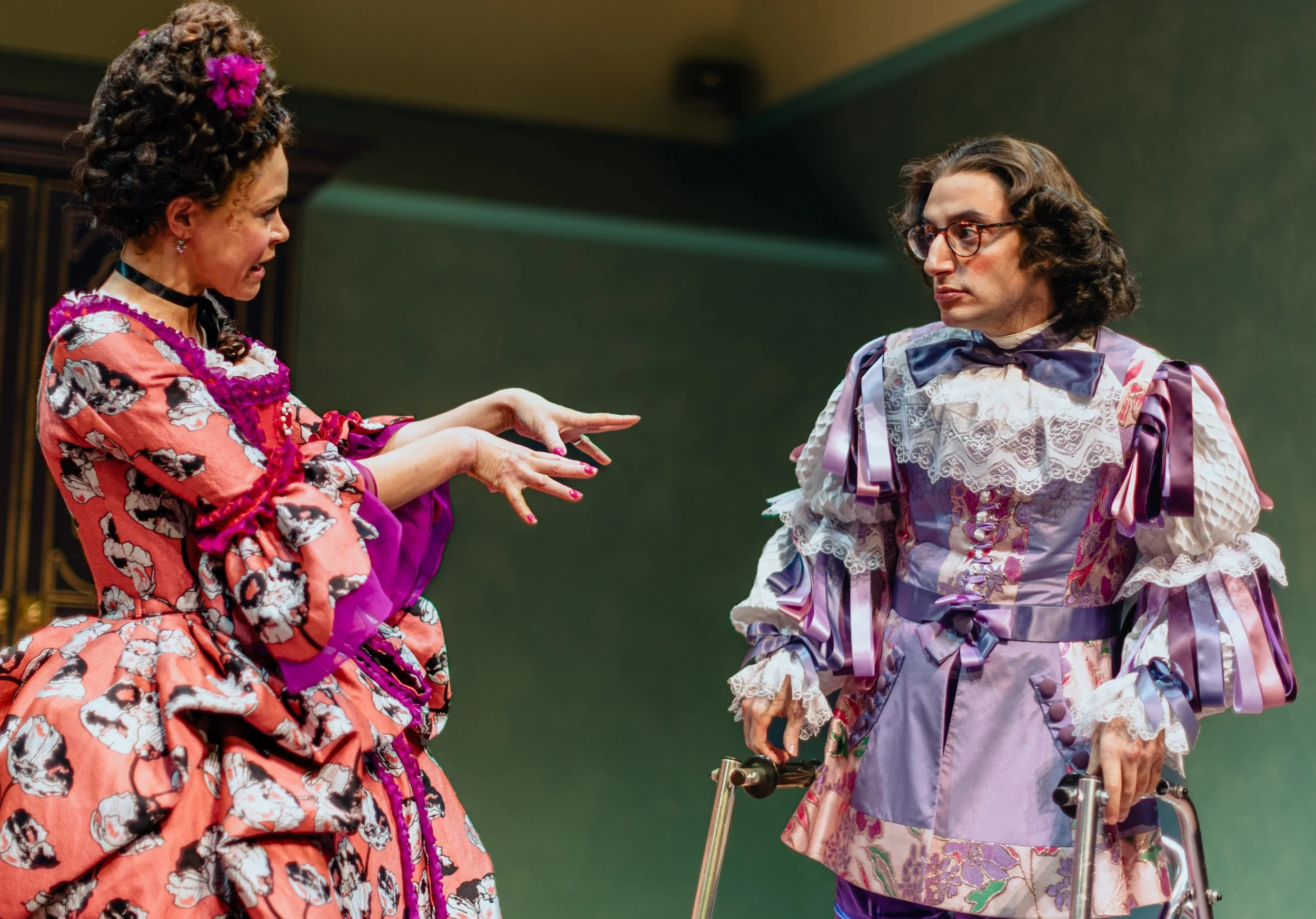
Amber Gray (left), as the practical Elmire, urges Ryan J. Haddad as her stepson Damis not to reveal Tartuffe’s adulterous advances toward her. Photographs by Marc J. Franklin.
The performances largely rise to the production’s comic and conceptual ambitions. Matthew Broderick’s Tartuffe is meaningfully mannered—head held aloft, eyes fixed on higher things—his butter-smooth delivery and serene affect masking predatory intent. As Orgon, David Cross navigates torrents of rhymed couplets with impressive dexterity, lavishing blind devotion on his idolized Tartuffe to the mounting horror of his family. The supporting cast is equally adept: drag performer Bianca Del Rio’s opening-scene Madame Pernelle lands the play’s barbed comedy with ferocious precision; Francis Jue brings wit and psychological grounding to Cléante’s voice of reason; and Lisa Kron is tough and unsparing as the truth-telling maid Dorine. Ryan J. Haddad lends combustible energy to Damis, while Emily Davis captures Mariane’s constrained innocence, a young woman stalled by paternal authority. Amber Gray brings practical intelligence to Elmire. Ikechukwu Ufomadu, doubling as Valère and Officer, neatly dispatches the play’s final deus ex machina with sly efficiency.
Provocative without being gratuitous, this Tartuffe earns its shock tactics by using them in service of Molière’s enduring satire of hypocrisy and moral panic. Hnath and Benson strip the comedy of reverence but not intelligence, revealing just how easily false piety still finds shelter in the modern household.
Tartuffe plays through Jan. 24 at New York Theatre Workshop (79 E. 4th. St.). Performance dates and times are somewhat irregular and may be viewed, along with other information, at nytw.org.
Playwright: Molière, in a new version by Lucas Hnath
Director: Sarah Benson
Scenic Design: dots
Lighting Design: Stacey Derosier
Costume Design: Enver Chakartash
Sound Design: Peter Mills Weiss
Original Music: Heather Christian
Choreography: Raja Feather Kelly
Wig & Hair Design: Robert Pickens
