


Caitlin Kinnunen (right) portrays Meg Crane, and her castmates play a multitude of roles, in Predictor.
Playwright Jennifer Blackmer takes great pains to jazz up a history lesson in Predictor, her tribute to the unheralded woman who created the home pregnancy test, Meg Crane. The chronological account of Crane’s invention is interspersed with musical and joky skits, as well as scenes representing Crane’s thoughts or flashbacks in her life.
In one parodic vignette, Crane imagines herself on a game show called Who Made That? in which contestants are quizzed about the inventors of everyday objects—and “E.P.T.” is deemed the correct answer for “home pregnancy test.” E.P.T. was the first brand to hit the market, in the late 1970s, but Crane had devised the home pregnancy test a decade earlier, while working at the pharmaceutical company Organon.
Crane was a graphic designer, not a scientist or doctor, and she didn’t create the test for her job but because she’d been shocked to learn that up to a month could pass while a diagnostic lab (such as the one run by Organon) tested a woman’s urine sample and mailed the results to her doctor. Apparently, none of the other Organon employees—all men, except for the typing pool—found anything untoward about the idea that a woman would have to wait weeks to find out if she’s pregnant, when the test itself took only a couple of hours.
Predictor stars Caitlin Kinnunen, a 2019 Tony nominee for The Prom, as Crane. The six other cast members, credited as Chorus, perform—with ace teamwork and timing—all the musical and comic interludes. They also have roles in the based-on-fact story: Lauren Molina as Meg’s mother; April Ortiz, her grandmother; Jes Washington as best friend Jody; John Leonard Thompson as her avuncular boss Martin Stamper; and Nick Piacente as Ira Sturtevant, the adman Organon hires for the pregnancy-test project, who becomes Meg’s lifelong partner.
Eric Tabach plays Jack Mullins, the chauvinistic project manager. He discourages Meg’s involvement, keeps ordering her to get him coffee, lies about doing the due diligence on her prototype, and screams and swears at his coworkers. “This is why women have no business in the workplace!” Jack rants at one point. “You can’t make rational decisions, you’re too emotional, too selfish. … Women never think about the larger consequences of anything!”
With this portrayal (the character is a fictionalized composite), along with many other moments in the show, Predictor is not subtle about the sexism that Crane faced trying to move her invention forward, growing up in a Catholic household or just being a woman during that era. A lack of subtlety predominates throughout the script, and some of its humor seems forced, particularly in Chorus episodes that are too tangential to the main action—like a jingle about the Yellow Pages that accompanies a scene in which Meg cold-calls accessory suppliers out of the phone book to estimate how much the pregnancy kit would cost to produce.
Another example occurs when Meg and Ira start falling in love while working together. “So you’ve met the man of your dreams!” exclaims an ensemble member, portraying a voice in Meg’s head. “But isn’t Meg frightened by the feelings and changes she’s experiencing?” chimes in another Chorus actor. They then present “an instructional film about your changing body”—a spoof of those old health-class lessons about puberty and menstruation. But that’s irrelevant to the scene, where Meg is reaching a different milestone (and is at least a dozen years past puberty).
All the Chorus interstitials have the effect of making the historical plotline feel like reportage rather than a dramatization with fleshed-out characters and relationships. Crane and Sturtevant’s unconventional yet enduring bond—in real life they were together, unmarried, for more than 40 years—is relegated to a single scene where each makes a short speech rattling off what they want in a mate. Meg repeatedly talks about her love of art, hanging out in Greenwich Village and her aversion to marriage and motherhood, but none of it is shown, so she doesn’t truly come across as a bohemian rebel.
Costume designer Alicia Austin may have chosen Kinnunen’s pants outfit to represent this aspect of Crane’s personality, but it looks butch rather than nontraditional (and more ’50s than ’60s) and probably wouldn’t have been acceptable business attire in a corporate office at that time. The characters’ cursing in the workplace seems anachronistic, too, and even today the religiously freighted goddamn wouldn’t be thrown around so casually.
Predictor does succeed in reclaiming a piece of “herstory,” and with their mastery of the play’s vaudevillian spirit, the cast ably supports Blackmer’s effort to inject entertainment into the historical record.
Predictor has moved up its closing date and now runs through Dec. 28, at AMT Theater (354 W. 45th St.). Performances are at 7 p.m. Tuesday and Friday through Sunday, with matinees at 2 p.m. Saturday and Sunday. For tickets and more information, visit predictorplay.com.
Playwright: Jennifer Blackmer
Director: Alex Keegan
Sets: Cat Raynor
Costumes: Alicia Austin
Lighting: Zach Blane
Sound: Uptown Works NYC (Daniela Hart, Noel Nichols & Bailey Trierweiler)

Kinnunen and Lauren Molina (right), both Broadway veterans, headline a cast that includes Nick Piacente (background).
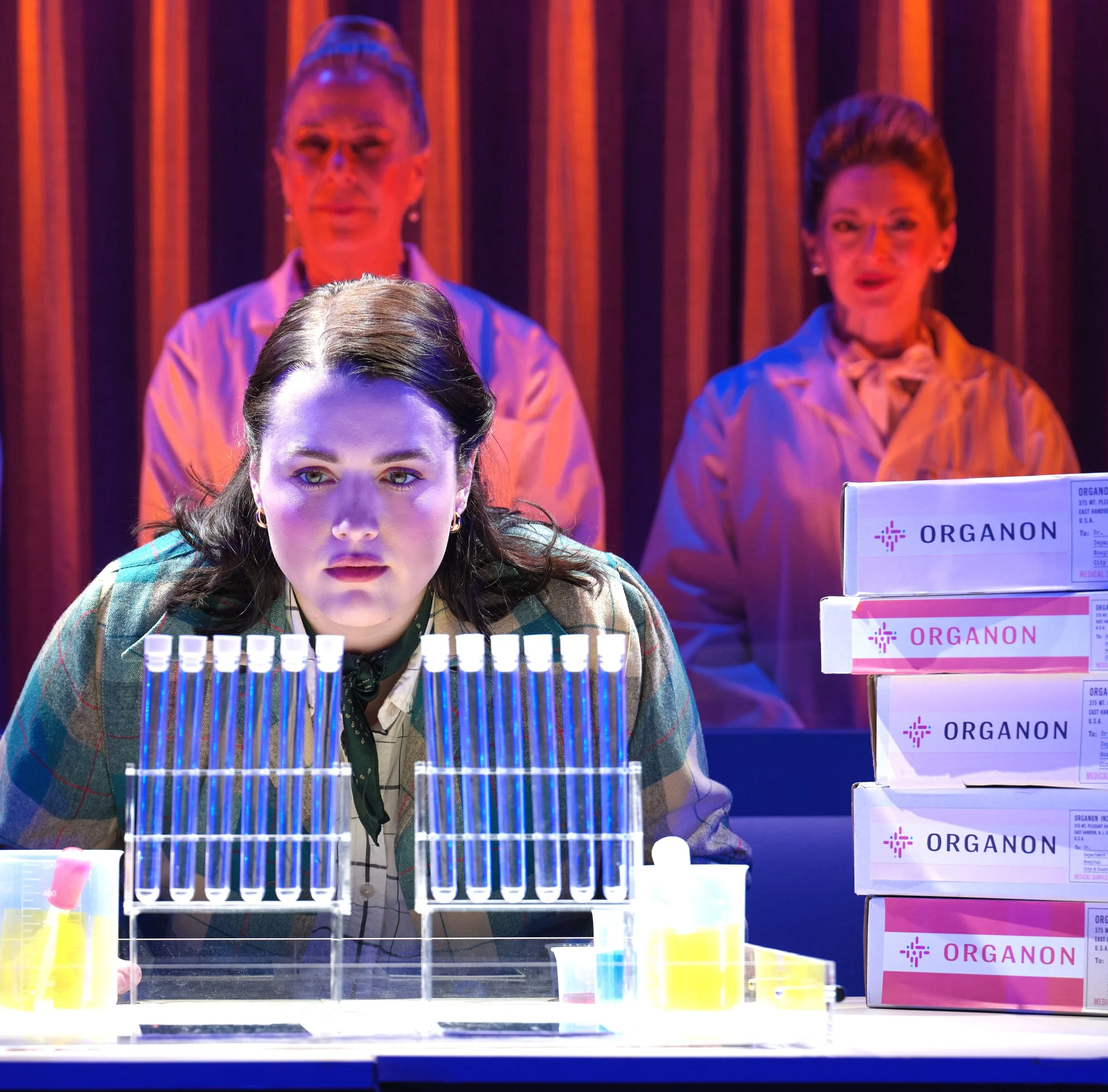
In the Organon lab that inspired Meg Crane’s revolutionary invention: Kinnunen, April Ortiz (rear, left) and Molina. Photographs by Valerie Terranova.
