
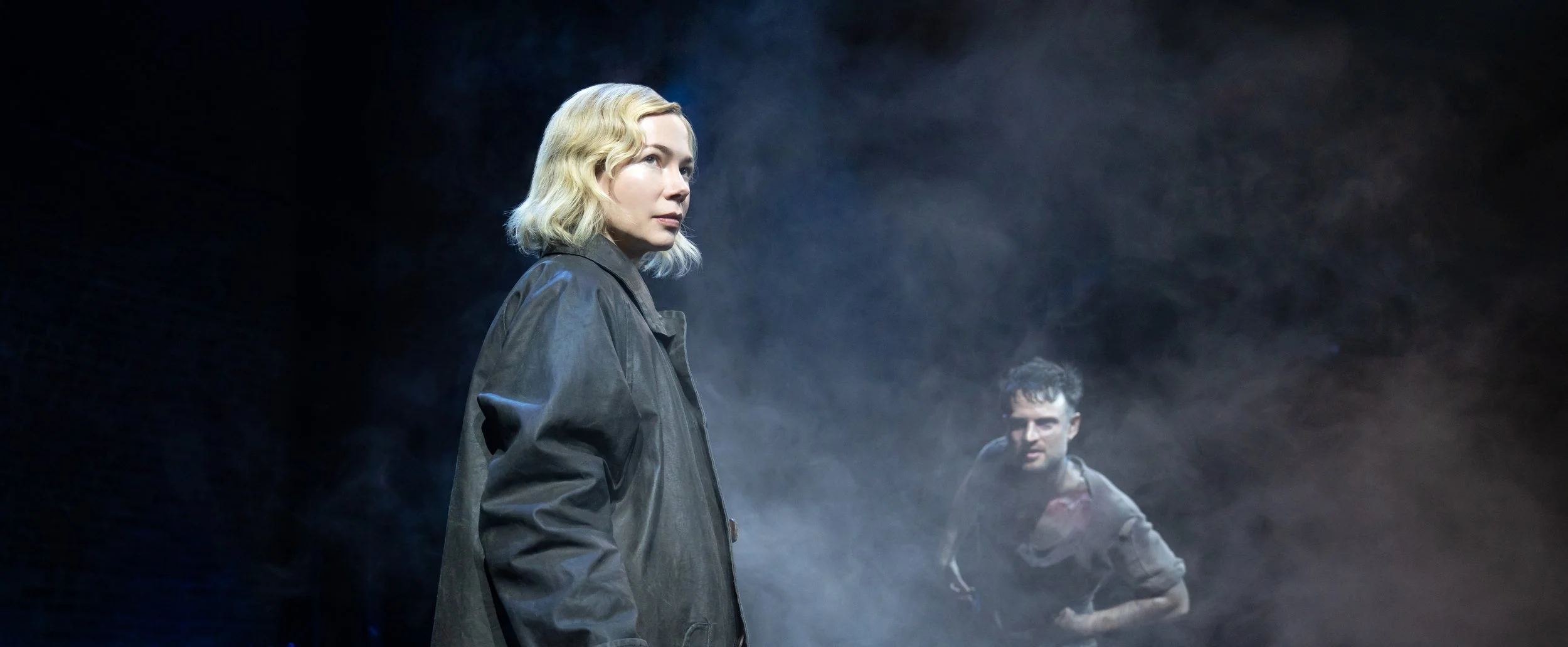

Michelle Williams (left) plays the title role in Eugene O’Neill’s Anna Christie, and Tom Sturridge is Mat Burke, a stoker who survives a shipwreck and pursues her.
Anna Christie, Eugene O’Neill’s 1922 Pulitzer Prize drama, has been overshadowed by his late, great behemoths: Long Day’s Journey into Night and The Iceman Cometh are more often seen than the briefer play. Yet Thomas Kail’s enthralling production at St. Ann’s Warehouse makes a strong case for this neglected earlier work.
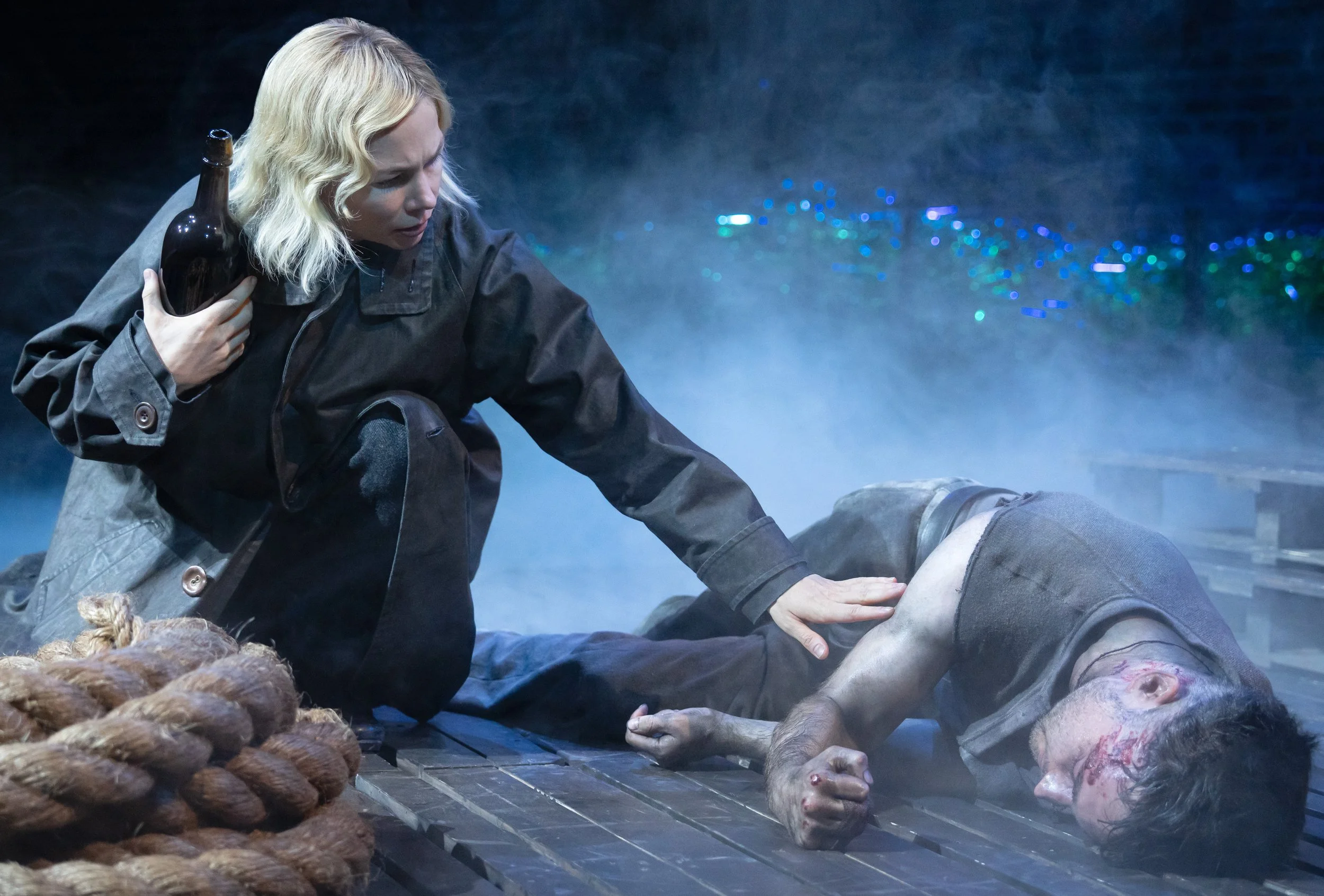
Anna discovers Mat after he has climbed aboard her father’s boat. Photographs by Julieta Cervantes.
The setting of Anna Christie takes O’Neill a few steps away from his previous one-act sea plays, such as The Long Voyage Home and The Rope. Here the dive bar owned by Johnny-the-Priest (Timothy Hughes), where plenty of alcohol is consumed, is right on the waterfront. In the bar, peripatetic seaman Chris Christopherson (Brian d’Arcy James) waits uneasily for the daughter he hasn’t seen since his wife died and he placed her with cousins on a Minnesota farm.
In 1921, the critic John Mason Brown described Pauline Lord, who created the part of Anna, as “bursting into the waterfront saloon,” but Michelle Williams’s Anna enters bone-weary, trudging up to the door. Nonetheless, her Anna is a survivor, even if her stamina is less overt than Lord’s. She’s riveting.
The Minnesota clan has abused Anna, including sexually, and to survive she has been a prostitute, something that Chris’s gimlet-eyed doxy Marthy (a terrific Mare Winningham, by turns sour and sweet) perceives right away.
The father-daughter reunion becomes more complicated when Chris lets Anna sail with him. “Makes me feel clean,” she says of the fog and water. But when they rescue survivors of a shipwreck, one of them, Mat Burke (Tom Sturridge), decides that she is his ideal. The skeptical Anna seems alternately repelled and attracted, but Chris opposes Mat’s overtures: his daughter won’t marry a sailor.
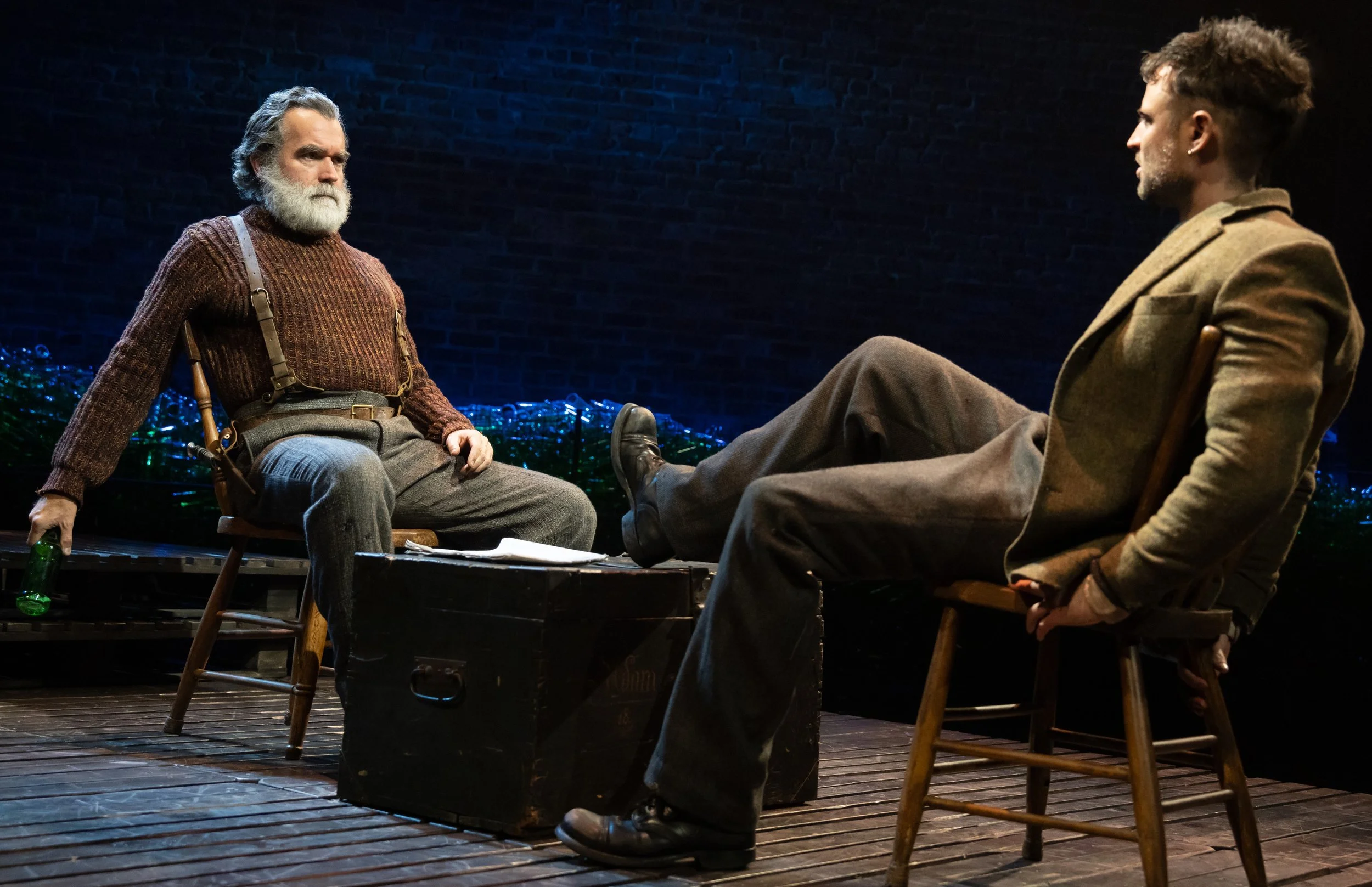
Chris Christopherson (Brian d’Arcy James, left) plays Anna’s father, and he doesn’t want her getting mixed up with a sailor like Mat.
A criticism of the play voiced by Irish critic Francis Hackett in The New Republic in 1921 still has merit: O’Neill “thinks that it is enough to tip people’s emotions up and down.” And indeed, the plot involves a lot of “will she or won’t she?” Will Anna confess her past to Chris? Will Anna confess her past to Mat? Can Chris and Mat get along? The struggle between father and suitor, and the push-pull between Anna and Mat, is the meat of the play.
Kail’s production blunts those fluctuations in various ways. Anna Christie is sometimes derided because of the thick Swedish accent of Chris, always yammering about “dat old davil sea,” but James so completely masters the Swedish accent without becoming a caricature that from the crucial opening scenes the play is on solid ground.
While Chris and Mat struggle over who will control Anna, she fends off both, keeping silent about her history, although Mat’s fierce wooing has an effect on her and Anna truly wants a new start. “He’s a regular man, no matter what faults he’s got,” she tells the disapproving Chris. “One of his fingers is worth all the hundreds of men I met out there—inland.” Afraid of revealing her past, she tries to be noble and reject Mat, but both father and wooer demand her allegiance, until she erupts:
I wasn’t no nurse girl the last two years—I lied when I wrote you—I was in a house, that’s what!—yes, that kind of a house—the kind sailors like you and Mat goes to in port—and your nice inland men, too—and all men, God damn ’em! I hate ’em! Hate ’em!
Mat spurns her cruelly but then relents. In one of O’Neill’s comic moments, Mat demands: “Swear I’m the only man in the world ivir you felt love for.” Anna swears, but he suddenly balks:
Burke: Is it Catholic ye are?
Anna: No. Why?
Burke: Oh, God, help me! There’s some divil’s trickery in it, to be swearing an oath on a Catholic cross and you wan of the others.
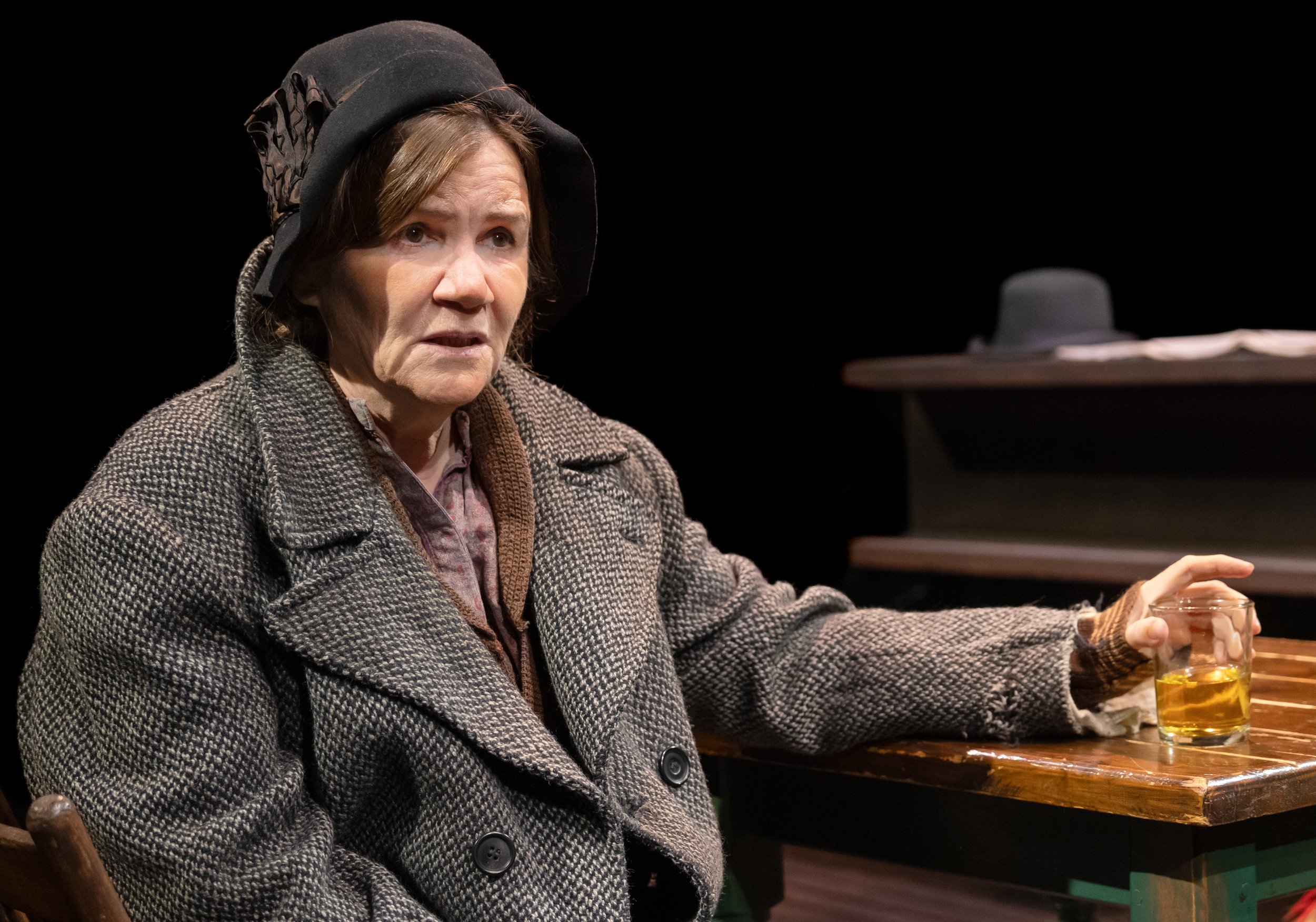
Mare Winningham is the worldly-wise Marthy, Chris’s live-in companion.
However, because Mat’s declarations of love arise from nowhere, his condemnations of Anna carry more force than his praise, pushing one’s sympathies toward Anna. (Sturridge’s choice of a near-impenetrable bog-Irish accent may prove a barrier to the listener too.)
The rough-hewn sets by Christine Jones and Brett J. Banakis—in several scenes pallets are stacked to form playing levels—are dominated by a raised girder that slowly turns one way and then another, just as the relationships in the play do. The hard elements are balanced by Natasha Katz’s softer lighting and lovely music by Nicholas Britell, which add romance to the mood.
Although O’Neill ends the play ambiguously, Kail’s production reaffirms that, no matter the flaws, the work is an important and satisfying drama, not easily dismissed when handled intelligently and creatively.
Eugene O’Neill’s Anna Christie plays through Feb. 1 at St. Ann’s Warehouse (45 Water St., Brooklyn). Evening performances are at 7:30 p.m. Tuesday through Saturday; matinees are at 2 p.m. Wednesday, Saturday, and Sunday; some times differ, so check the website at stannswarehouse.org.
Playwright: Eugene O’Neill
Director: Thomas Kail
Scenography: Christine Jones & Brett J. Banakis
Costume Design: Paul Tazewell
Lighting Design: Natasha Katz
Sound Design: Nevin Steinberg
Original Music: Nicholas Britell
Movement: Steven Hoggett
