
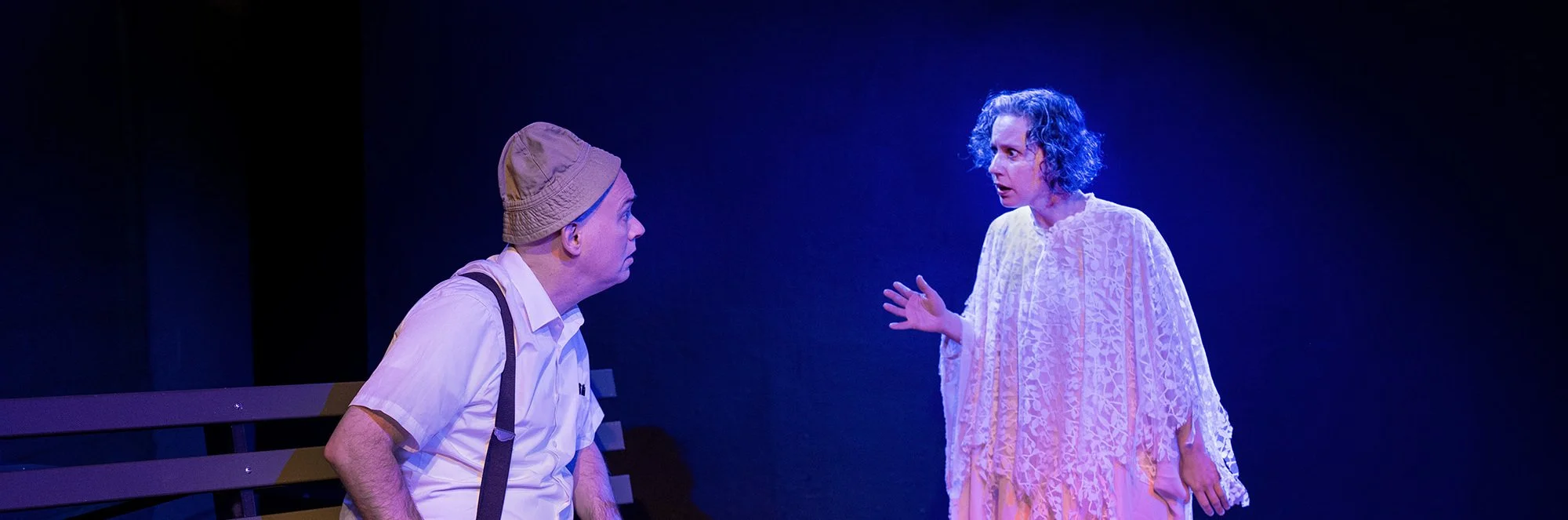
Shane Baker (left) plays Chaim Urison and Miryem-Khaye Seigel plays his wife, among other characters they take on, in Night Stories. Photograph by Raquel Seidenbaum. (Banner photograph by Jeffrey Wertz.)
The Holocaust is never light fare for anyone, and it may be presumptuous to say, but its darkness is no more acutely felt than by those who survived it. The Congress for Jewish Culture’s production of Night Stories: Four Tales of Reanimation dramatizes the Yiddish poems of Avrom Sutzkever, widely acknowledged as the most eloquent Holocaust poet. Sutzkever’s poems, which depict the ghetto in Vilnius, Lithuania, under Nazi occupation, reflect the emotional roller coaster of its residents’ existence, pivoting among horror, humor, and an ambivalent desire for both death and redemption.
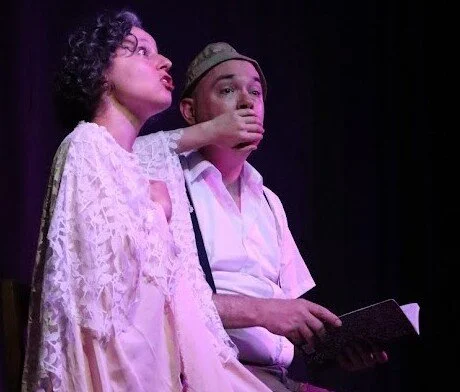
Lili (Seigel, left) silences an outcry from the writer (Baker). Photograph by Raquel Seidenbaum.
Sutzkever was also a literary journalist and a member of the Paper Brigade, an underground resistance group that strove to save Jewish culture from the Nazis, who looted Jewish art with the intent of opening a museum with stolen artifacts. The Paper Brigade buried the artworks and literature created by residents of the ghetto to foil the Nazis.
In his poems, Sutzkever observed and captured how the ghetto’s residents reacted to their dehumanization and the way they lived in the shadow of death. Consequently, Night Stories’ characters represent prototypes of its hungry, desperate, suicidal, delusional, hopeful and vengeful ghetto inhabitants. Given that the four poems/vignettes are recited completely in Yiddish, English supertitles are projected at the top of the backdrops.
Directors Moshe Yassur and Beate Hein Bennett have taken these gut-wrenching and totally plausible Holocaust poems and, thanks to lighting designer Cameron Darwin Bossert, illustrator Alona Bach, and composer Uri Schreter, rendered them even darker and more illusory than one might expect. Schreter’s atonal music is otherworldly and a frightening accompaniment to those demoralized subjects whose pain, fear and mortality Sutzkever documents.
“A lost painting and an artist’s visit validate Sutzkever’s bravery.”
The poems A Child’s Hands, Lupus, and Where the Stars Spend the Night are chilling reminders of the tortured psyches experienced by many Holocaust survivors. The first conveys the fragility of a child victim, whose only proof of existence is a set of frozen handprints on a window (illustrated by Alona Bach). The handprints face outward from the cellar where the child, together with an old woman and a black horse’s head, hid in vain from the Nazis. In a surreal vocalization the handprints express the child’s profound sorrow for the horse and apology to its “marble black eyes”; the child and old woman would have resorted to eating it.
“Suddenly—dogs.” [The Germans’ dogs, specially trained to sniff out humans, discover them in the cellar, and the hand imprints speak to the horse’s head.]
“They attack her, your frozen flesh, the boy to whom we belong. ... We wanted to help him ... ran to this pane, the forest of frost, and ... where are we now?”
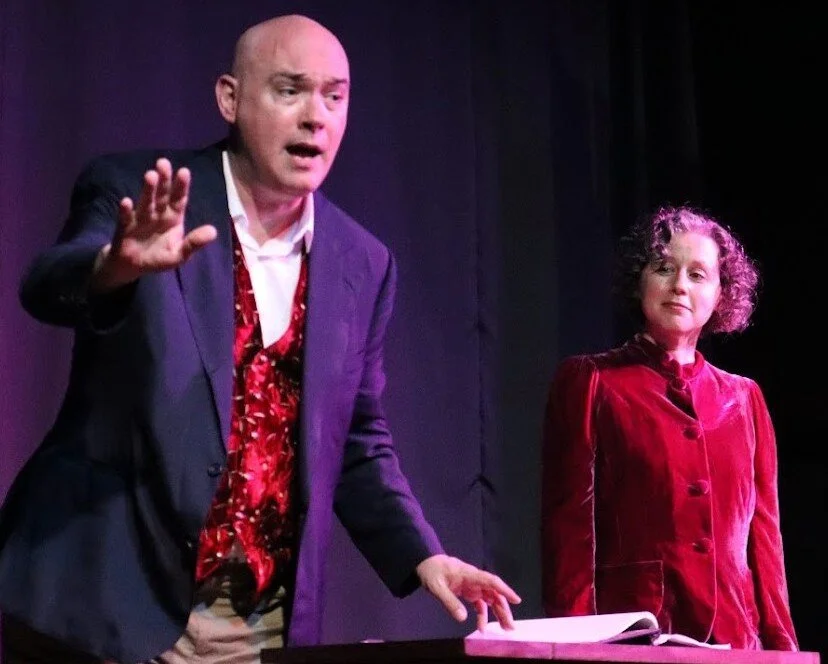
In the eerie, pitch-dark room, actor Shane Baker, haunting and ghoulish as Lupus, a cyanide merchant and apparition, recounts to a narrator who survived how exhausted, living corpses in the ghetto begged and paid him to make them “unalive,” only to ingest adulterated cyanide that was too weak to kill them. In his twisted memories of the ghetto, the narrator obsesses about Lupus, his cyanide and his beloved, whom he could not save.
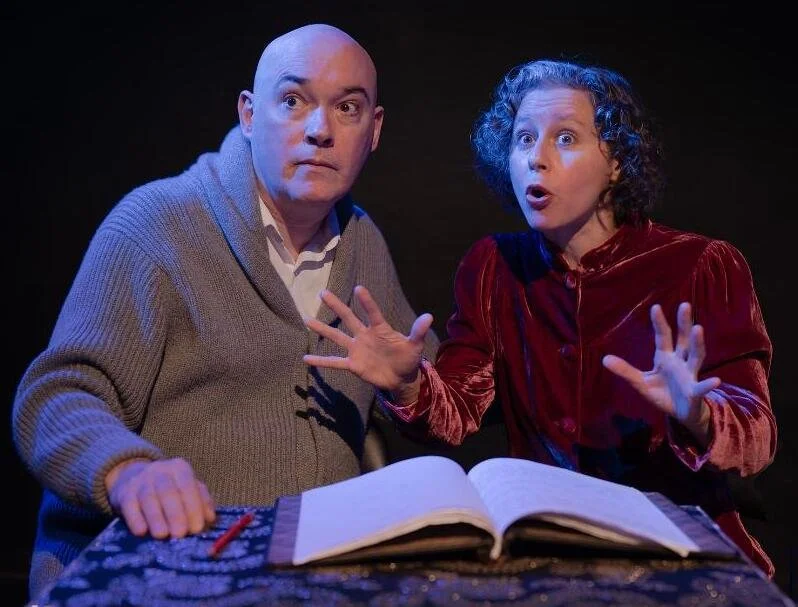
Urison (Baker, left) and his wife (Seigel) are surprised by an unexpected visitor. Photograph by Jeffrey Wertz.
In Where the Stars Spend the Night, a survivor’s (Baker) hallucinatory visage of “Lili” (Miryem-Khaye Seigel), dressed in an ornate, shroud-like off-white dress—or, alternatively, a bridal gown (by Ramona Ponce)—confounds his memory: he imagines that they hid together in a swamp during the war. His guilt renders him so delusional that he thinks that the dead Lili has eaten his soul.
Lest one think that these stories are devoid of hope or redemptive power, in Portrait in Blue Sweater, Sutzkever summons these positive attributes and weaves them into a story about karma. It’s a true story, told by Sutzkever, who’s at its core. Good emerges from senseless evil and comes full circle, eventually circumventing the oppressors. A lost painting and an artist’s visit validate Sutzkever’s bravery in smuggling Jewish arts and literature away from the grasp of the Nazis and ultimately redounds to the poet’s benefit. The world regains its color, a modicum of justice, and good comes full circle.
Ostensibly, Sutzkever’s poems, which lay bare Holocaust survivors’ postwar guilt, trauma and gaping, open wounds, might appear less accessible to the non-Yiddish speaker, even with the supertitles. Nevertheless, the visual signifiers—a small child’s frozen imprint; a bride’s dress that takes on the aspect of a shroud; an immersive, claustrophobic, haunting set; and dissonant music—effectively evoke fear, revulsion and empathy, even when words are absent. In a period when Holocaust awareness and education are in decline, Sutzkever’s poems are a stark reminder that in every era, darkness must be extinguished.
Night Stories runs at Wild Project (195 East 3rd St.) through Jan. 11. Evening performances are at 7:30 p.m. Tuesdays through Saturdays; matinees are at 3 p.m. on Sundays. For more information, or to purchase tickets, call (212) 505-8040 or visit thewildproject.com.
Poet: Avrom Sutzkever
Directors: Moshe Yassur & Beate Hein Bennett
Lighting Designer: Cameron Darwin Bossert
Composer: Uri Shreter
Illustrator: Alona Bach
