
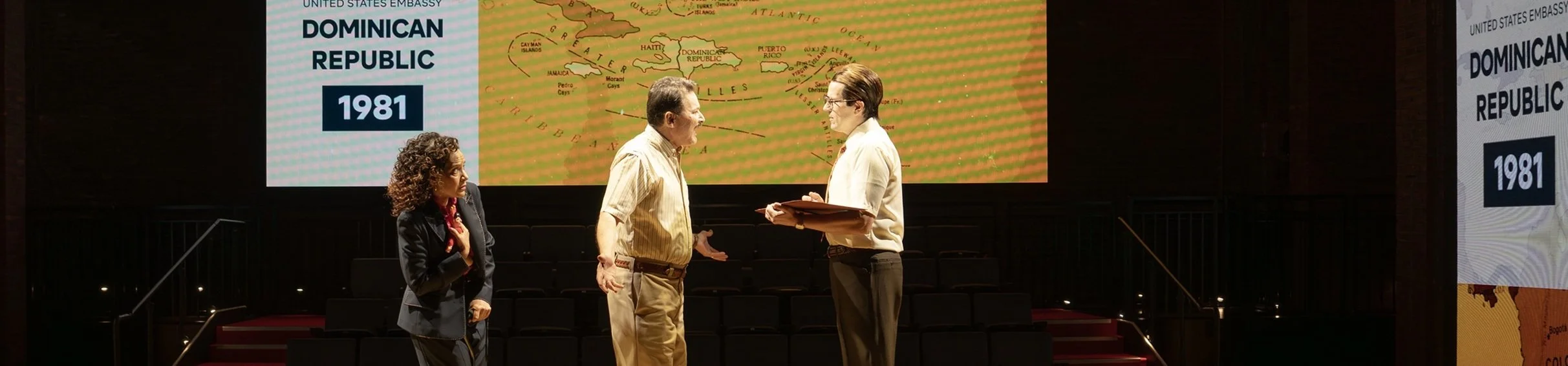
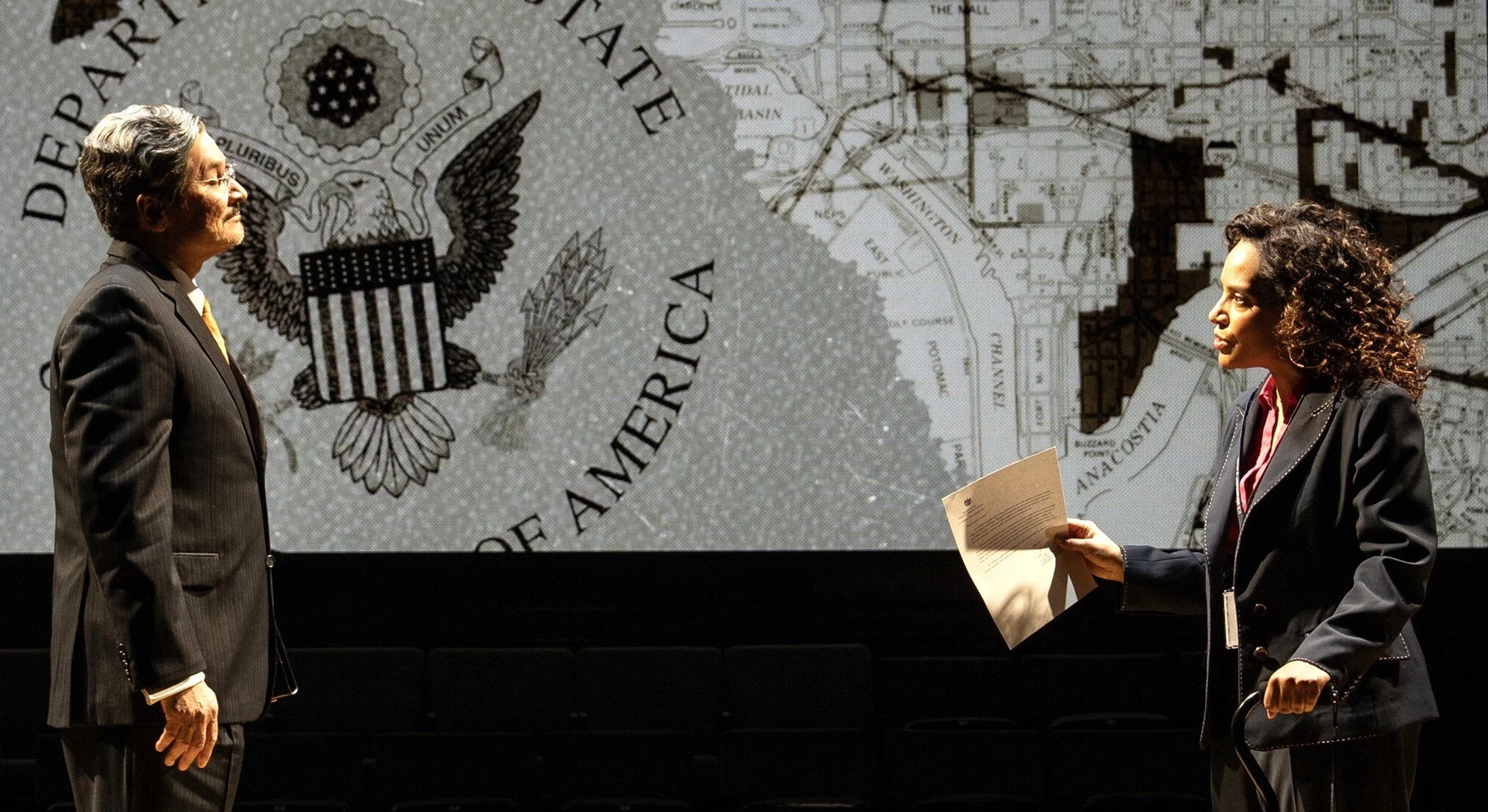
Al Rodrigo, as Cuban diplomat Jorge Bolaños, and Zabryna Guevara, as American diplomat Julissa Reynoso, tread warily with each other in Reynoso’s autobiographical drama Public Charge, co-written by Michael J. Chepiga.
In Julissa Reynoso’s autobiographical drama Public Charge, co-written by Michael J. Chepiga, one witnesses how Reynoso, played with fierce tenacity by Zabryna Guevara, solved a political impasse as a senior diplomat in the Obama administration. While the play offers an earnest and often compelling meditation on democracy in action, its heavy-handed didacticism ultimately mutes its dramatic impact.
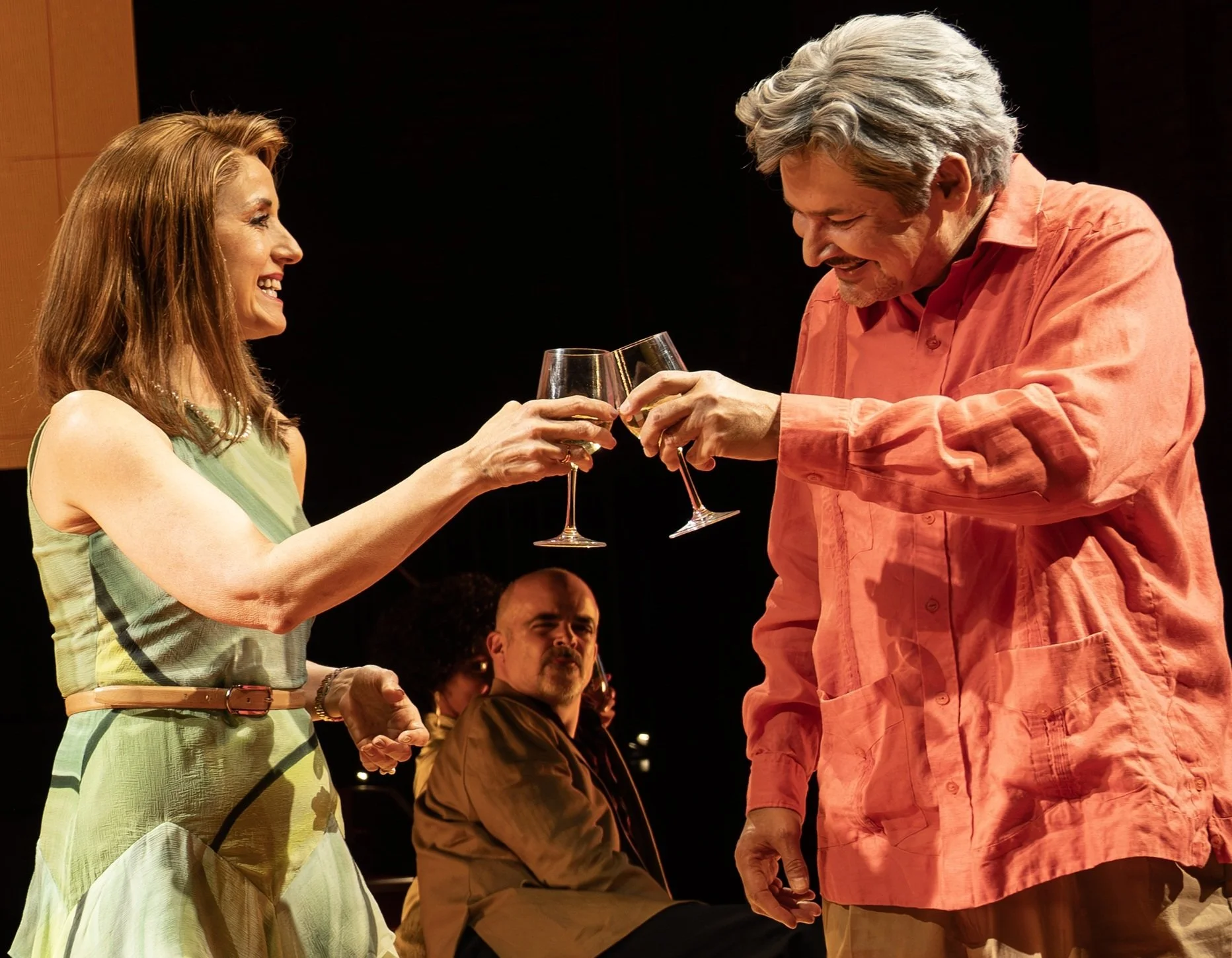
Maggie Bofill (left), as Cuban diplomat Josefina Vidal, and Al Rodrigo, as Uruguayan President Jose “Pepe” Mujica, enjoy a rare festive moment at a holiday party in his open-air cabin in Uruguay in December 2013.
The play follows Reynoso’s journey from her childhood immigration from the Dominican Republic to her rise as a Harvard-educated lawyer within the upper echelons of American diplomacy, where she serves under Secretary of State Hillary Clinton. Along the way, the narrative moves briskly across global flashpoints—Haiti after the earthquake of 2010, the charged terrain of U.S. immigration policy, covert intelligence operations, and delicate negotiations to free an imprisoned American in Cuba—each episode underscoring the high-stakes realities of public service. Though episodic in structure, these moments collectively sketch the formation of a diplomat shaped by both personal history and geopolitical urgency.
The play’s central shortcoming lies in its impulse to overeducate the audience about humanitarian crises across multiple global hotspots—Haiti, Uruguay, and Cuba—within a compressed 100 minutes. Much of this material unfolds through a barrage of outward-facing phone calls between diplomats and State Department officials, a staging choice that creates emotional distance rather than immediacy. As a result, the drama struggles to build momentum, leaving little room for the tension needed to draw the audience viscerally into the political maelstrom.
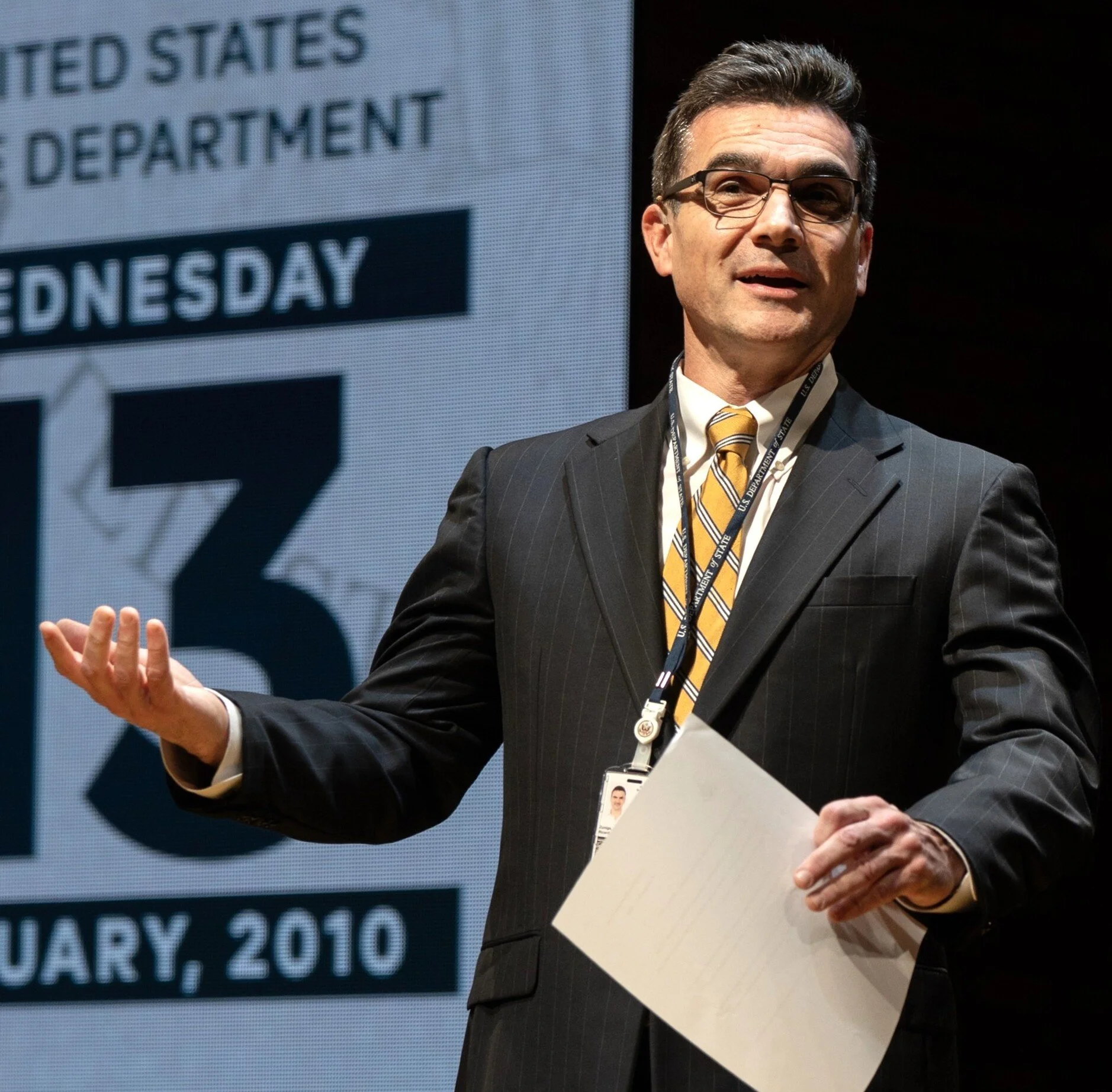
Dan Domingues portrays Ricardo Zúñiga, a seasoned State Department insider whose skepticism provides a steady counterpoint to Reynoso’s idealism. Photographs by Joan Marcus.
The central conflict follows the negotiations with Cuba to secure the release of an imprisoned American aid worker, Alan Gross. (He remains offstage throughout the play.) Yet even this potentially gripping storyline is drained of dramatic urgency when the character of Reynoso shifts into explanation, articulating the political impasse rather than embodying it. In one such exchange with veteran State Department official Ricardo Zúñiga (Dan Domingues), the stakes are spelled out rather than dramatized:
The posturing drives me crazy. This fight has taken so many twists and turns that nobody remembers or cares where or how or why it all started. So who’s right?
Even so, moments of genuine theatricality do emerge. One of the most effective occurs midway through the play, when Reynoso and Cheryl Mills (Marinda Anderson) descend into the dim basement of a bar near United Nations headquarters to meet with Cuban diplomat Josefina Vidal (Maggie Bofill). As Nat King Cole’s “Quizás, Quizás, Quizás” (“Perhaps, Perhaps, Perhaps”) drifts wistfully in the background, the scene acquires a quiet undercurrent of possibility. On the surface, little is resolved in their guarded exchange, prompting an exasperated Cheryl to cut the meeting short with the blunt admission, “This discussion is leading nowhere.” Yet Vidal subtly recalibrates the terms of engagement, reframing the impasse not as a prisoner swap but as a call for “reciprocal humanitarian gestures between the U.S. and Cuba,” momentarily shifting the tone from stalemate to cautious diplomacy.
Director Doug Hughes brings a clear tonal throughline and lean energy to an otherwise conversation-heavy script. He maintains a disciplined pace and keeps the focus squarely on performance, mitigating—though not entirely overcoming—the play’s tendency toward discursiveness. Complementing this approach, Arnulfo Maldonado’s minimalist set places the audience on opposite sides of the stage, framing six identical platforms that actors traverse throughout the evening. While the design lends a clean, uncluttered aesthetic, its visual repetition can flatten the action. Lucy Mackinnon’s projections, however, provide essential context, orienting viewers with clear markers of time and place.
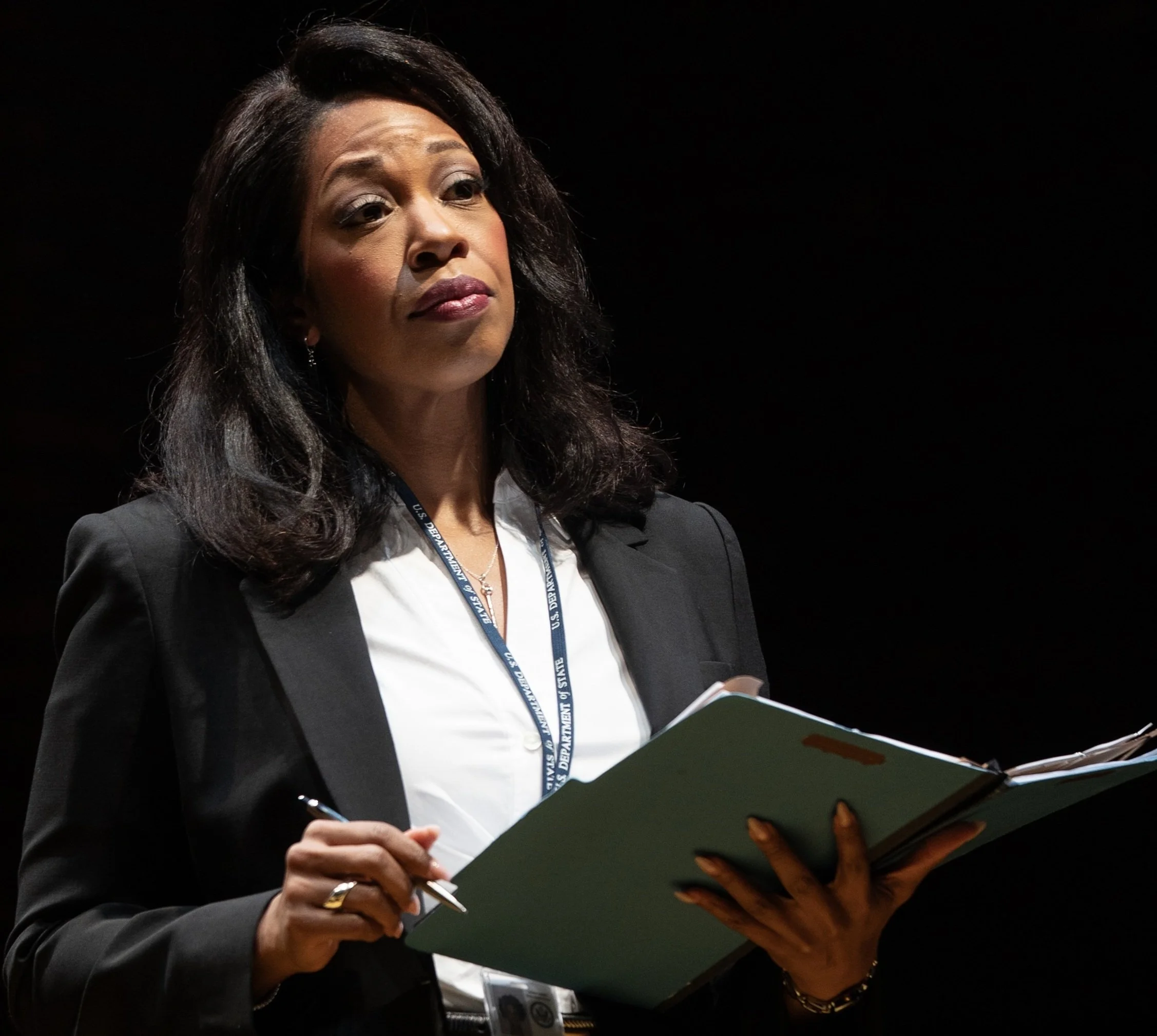
Marinda Anderson plays Cheryl Mills, Hillary Clinton’s high-powered and no-nonsense chief of staff in Public Charge.
Portraying real-life diplomats and public servants is no small feat, yet the ensemble rises to the challenge with assurance. While all acquit themselves well, several performances stand out. Guevara is especially effective as Reynoso, embodying the Dominican-born diplomat with intelligence, resolve, and flashes of hard-earned fire. Anderson, as Cheryl Mills, brings understated sharp wit and authority to her role as Hillary Clinton's chief of staff. As Judy Gross, the wife of a wrongly imprisoned American, Deirdre Madigan wears her indignation openly, delivering pointed rebukes of Reynoso’s diplomatic restraint—“You are just another Washington politician, spinning the truth … at the expense of Americans like Alan”—with bracing directness. Meanwhile, Domingues brings a cool, measured presence to Zúñiga, shaping him into a seasoned State Department insider whose skepticism provides a steady counterpoint to Reynoso’s idealism.
In the end, Public Charge strives to dramatize the ideals and contradictions of American democracy through a deeply personal lens, but its instructive impulses too often blunt its theatrical force. Even so, the characters’ commitment to public service as a meaningful, if complicated, endeavor lingers, offering a portrait of governance that is as earnest as it is imperfect.
Public Charge plays through April 12 at The Public Theater (425 Lafayette St.). Performance dates and times are somewhat irregular and may be viewed, along with other information, at publictheater.org.
Playwright: Julissa Reynoso & Michael J. Chepiga
Director: Doug Hughes
Scenic Design: Arnulfo Maldonado
Lighting Design: Ben Stanton
Costume Design: Haydee Zelideth
Sound Design: David Van Tieghem
