
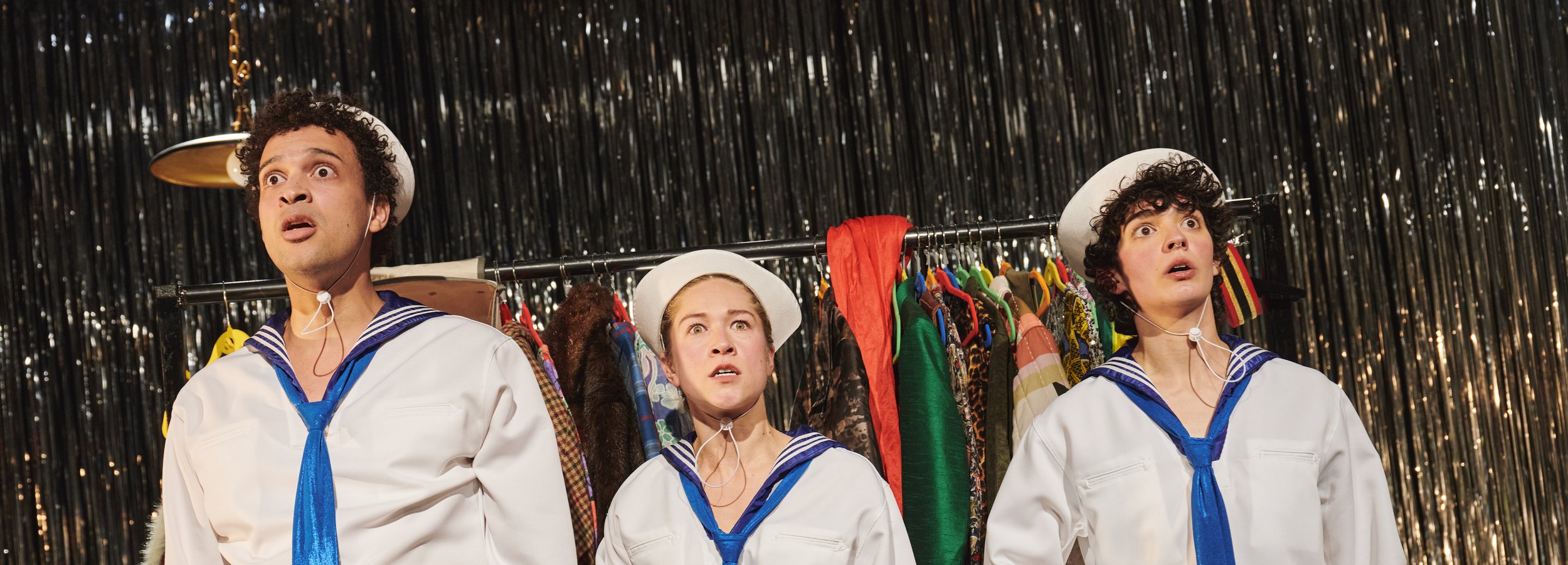
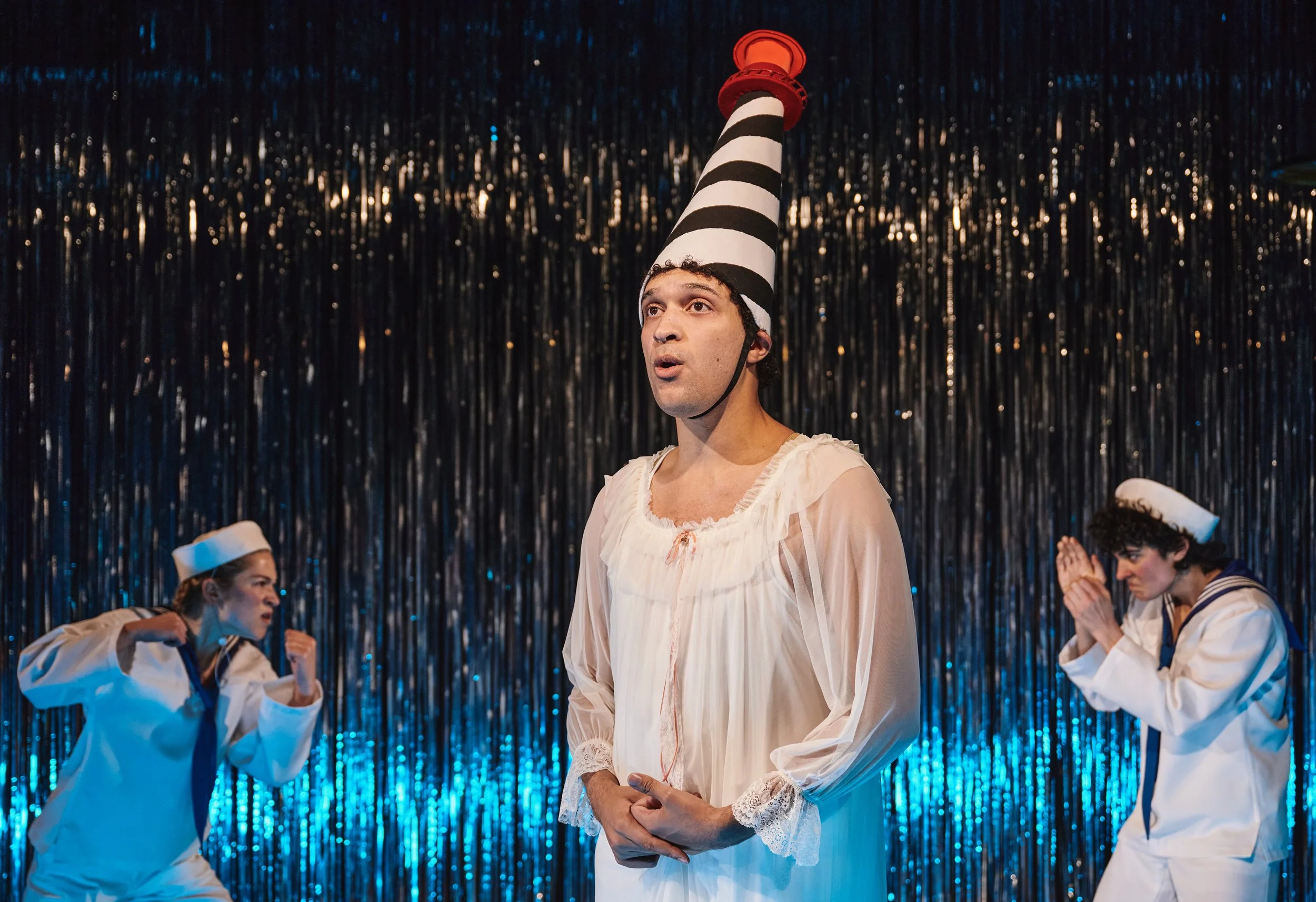
Elliot Sagay (center) plays both a lighthouse and a lighthouse keeper’s daughter, the object of affection of Sailor 1 (Bailey Lee, left) and Sailor 2 (Ellen Nikbakht), in Milo Cramer’s No Singing in the Navy.
The poster for Milo Cramer’s No Singing in the Navy, showing three wide-eyed sailors, evokes classic military-themed musicals—not only wartime ones like On the Town (1944) and Anchors Aweigh (1945), but also the nostalgia-tinted shows of a generation later: Dames at Sea (1966) and Over Here! (1974). Its “score,” however, bears little resemblance to melody-rich 1930s and ’40s musicals, and its book is awash with absurdist episodes that misfire.
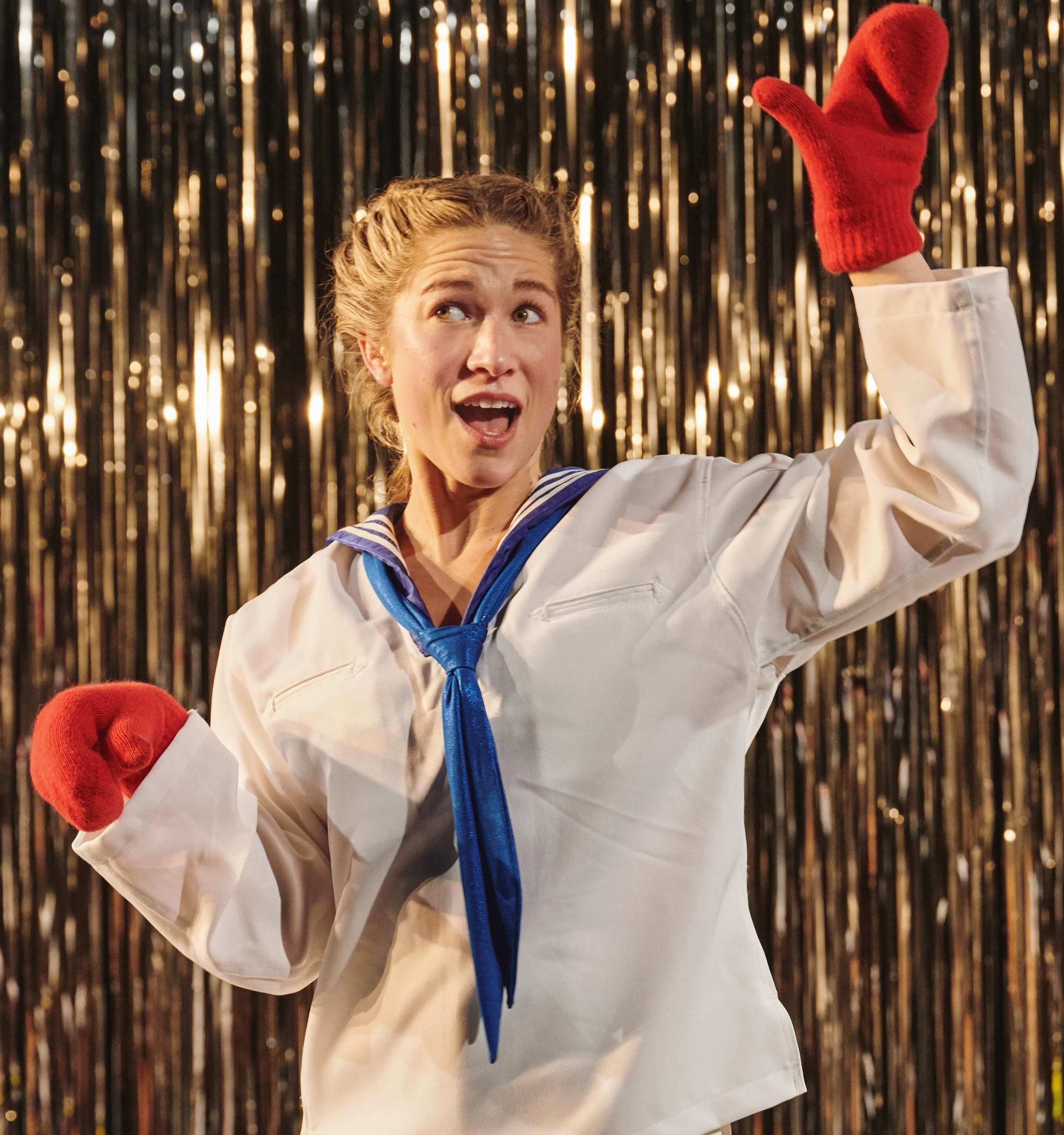
Bailey Lee, donning red mittens, also plays Heroine Crab.
Bailey Lee, Ellen Nikbakht, and Elliot Sagay play three sailors and all other parts, swapping hats and costumes as they assume various roles. (Cramer’s script designates them merely as Sailors 1, 2, and 3, with Sailor 2 as a male. In the production itself, Sagay is Sailor 3; Lee is 1 and Nikbakht is 2; they are so denoted below.)
The opening scenes find the trio summoned by the captain (a chameleonic Nikbakht), who forbids all singing, even on a 24-hour pass ashore before they sail to “war” (where is unspecified, but war is repeated 28 times). It’s a hint of the problems to come that troops on a pass wouldn’t be subject to such an unenforceable order.
Almost immediately a new set of characters is introduced, as the actors don red mittens to play three crabs in a crab bucket. Heroine Crab (Lee) is eager to leave the bucket and see the world. Father Crab (Nikbakht) and Brother Crab (Sagay) try to discourage her. Brother sings:
We used to play games?
Don’t you remember our games?
I’m your little brother
You don’t have another …
Why Heroine Crab would need a reminder that she only has one brother is bizarre, but, to be clear, Cramer isn’t creating a world of real people encountering fantasy characters, as in J. M. Barrie’s Peter Pan. The plot only occasionally offers realism as a touchstone to the childish silliness. In the middle of their adventures, the sailors describe what they’ve been doing: going to an art gallery, attending a baseball game, gambling at a casino—all reasonable—and, improbably, going to the dentist. (The lists and repetition here and in other scenes are extensive.) Later on, two of them converge on a lighthouse to woo the female lighthouse keeper. All this in 24 hours!
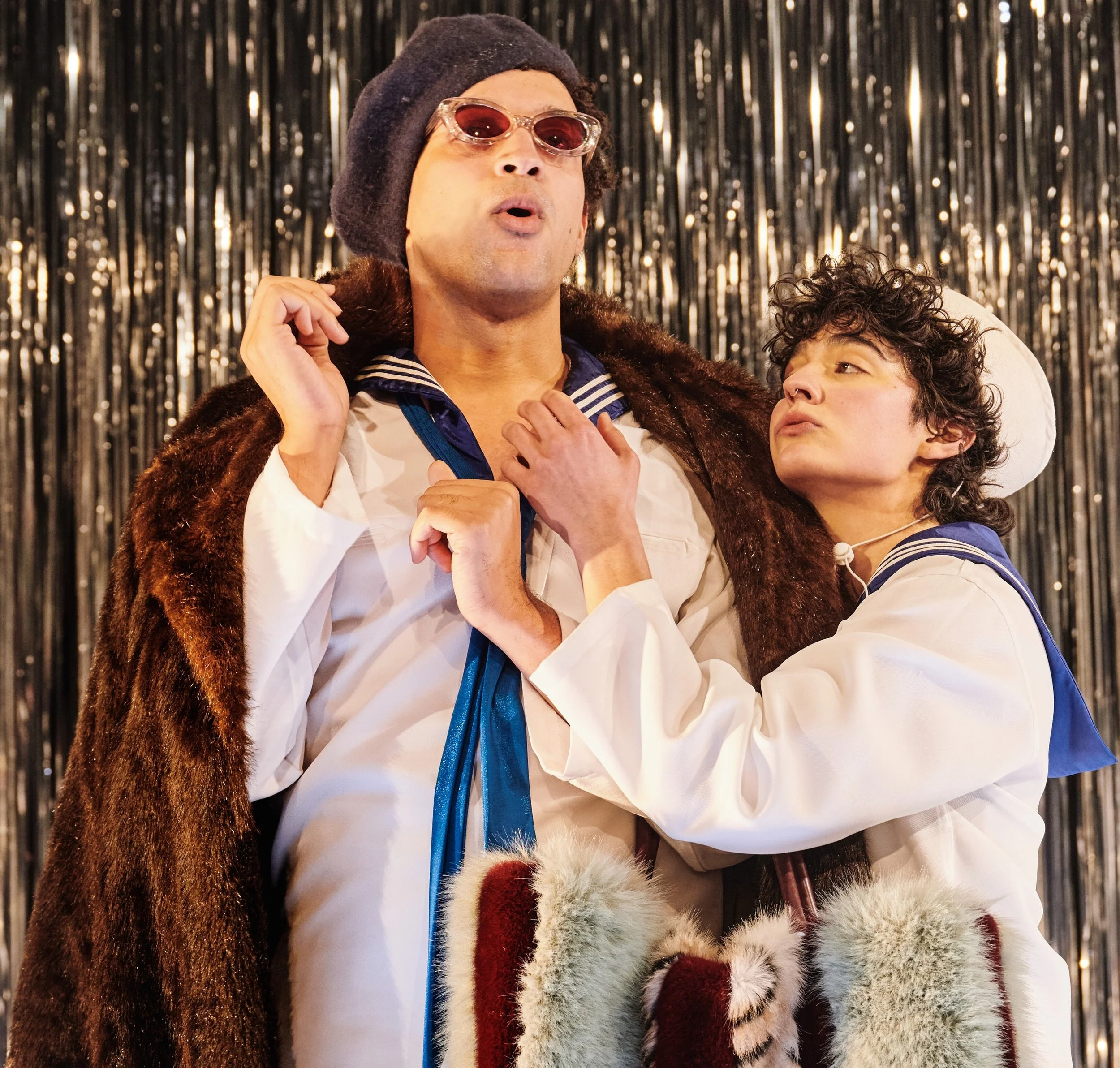
Sagay plays one of 100 women that Sailor 2 determines to kiss on a 24-hour pass. Photographs by Valerie Terranova.
One object for Sailor 3 is to work on his novel at the library, to which Sailor 2 says, “A novel, eh? I hearda that.” “It’s like a story, see,” explains Sailor 3. “It’s like a long story full a’ words and feelings in it.” Shortly after, they go to a theater, and the build-up is equally condescending (or, perhaps more accurately, jejune):
Sailor 2: Say, fellas—that there’s a the-a-ter. A real, live, honest-to-god the-a-ter.
Sailor 1: I ne’er seen no the-a-ter show before. Is it hard?
This is pushing the trope of innocents in the big city (e.g., Wonderful Town, Elf, Thoroughly Modern Millie) beyond credibility. Cramer’s characters aren’t human beings from planet Earth. They’re as bogus as a soliloquy from the stage show:
And are we really born in sin?
Or are babies innocent?
Are all babies really equally innocent?
At what exact moment do new babies become complicit in the shit and all the systems—perpetrators and victims
Is it at 4 or 5 or 6? Or 16? Or 66?
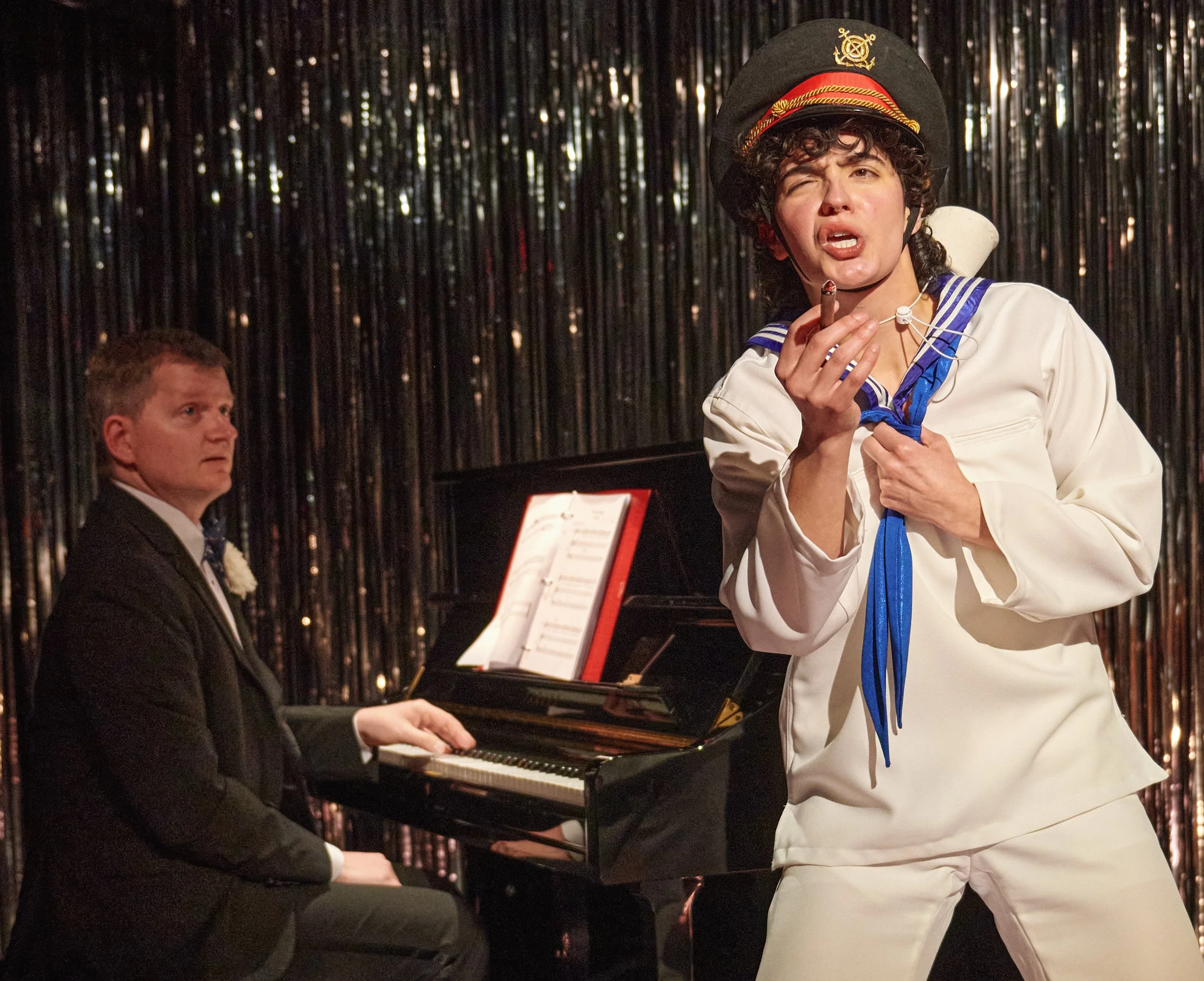
Nikbakht plays the squint-eyed ship’s captain, who gives the “no singing” order of the title, and Kyle Adam Blair accompanies the sung portions on the piano.
Aysan Celik’s direction is no help, whether it be to smooth out the many tonal jumps—the captain has a secret affection for sailors that’s undeveloped; the dimwitted swabbies veer into Beckett territory to ponder the brevity of life—or just to catch glaring mistakes. The result is bilge like “Do you think we’ll have to kill people? In the war? Staring down the barrel of a rifle at an enemy soldier.” Since when do sailors on a warship face down the enemy with rifles? And in one lyric they refer to the bridge of their vessel as a cockpit!
The songs, such as they are (no composer or lyricist is listed, although Kyle Adam Blair, the pianist, has a musical director credit), lean on recitative and have slant rhymes that one wouldn’t hear in the Great American Songbook: proud/around; worthless/purpose. And the overall tone is lugubrious, not joyful.
Before the show ends, one encounters not only crabs but ants, and Sailor 2 kisses a procession of female characters on the street, in a scene that is briefly amusing but goes on too long, as many do.
Amid this goulash, though, Sagay somehow manages to keep his head out of the soup. He has a rich baritone and an easygoing demeanor. He’s someone to watch.
Milo Cramer’s No Singing in the Navy runs through April 19 at Playwrights Horizons (416 West 42nd St.). Evening performances are at 7 p.m. Thursday through Saturday; matinees are at 2 p.m. Sunday. For tickets and more information, visit playwrightshorizons.org.
Playwright: Milo Cramer
Director: Aysan Celik
Scenic Design: Krit Robinson
Costume Design: Enver Chakartash
Lighting Design: Masha Tsimring
Sound Design: Tei Blow
Music Director: Kyle Adam Blair
