

Revolutionary Relations

A powerful and thought-provoking drama, A Man Like You tells the story of a British diplomat abducted by Somali terrorists and held for ransom for months. Throughout the work, Kenyan-born playwright Silvia Cassini addresses one overarching question: What constitutes terrorism? The piece chillingly delves into a world ravaged by colonization, the plight of the Somalis, radicalization, Islam, the current political scene, and what exactly so many so-called legitimate governments do in the name of democracy and thinly veiled corporate interests. Very little is being referenced in the media about Somalia beyond piracy. A Man Like You is a play to be experienced.

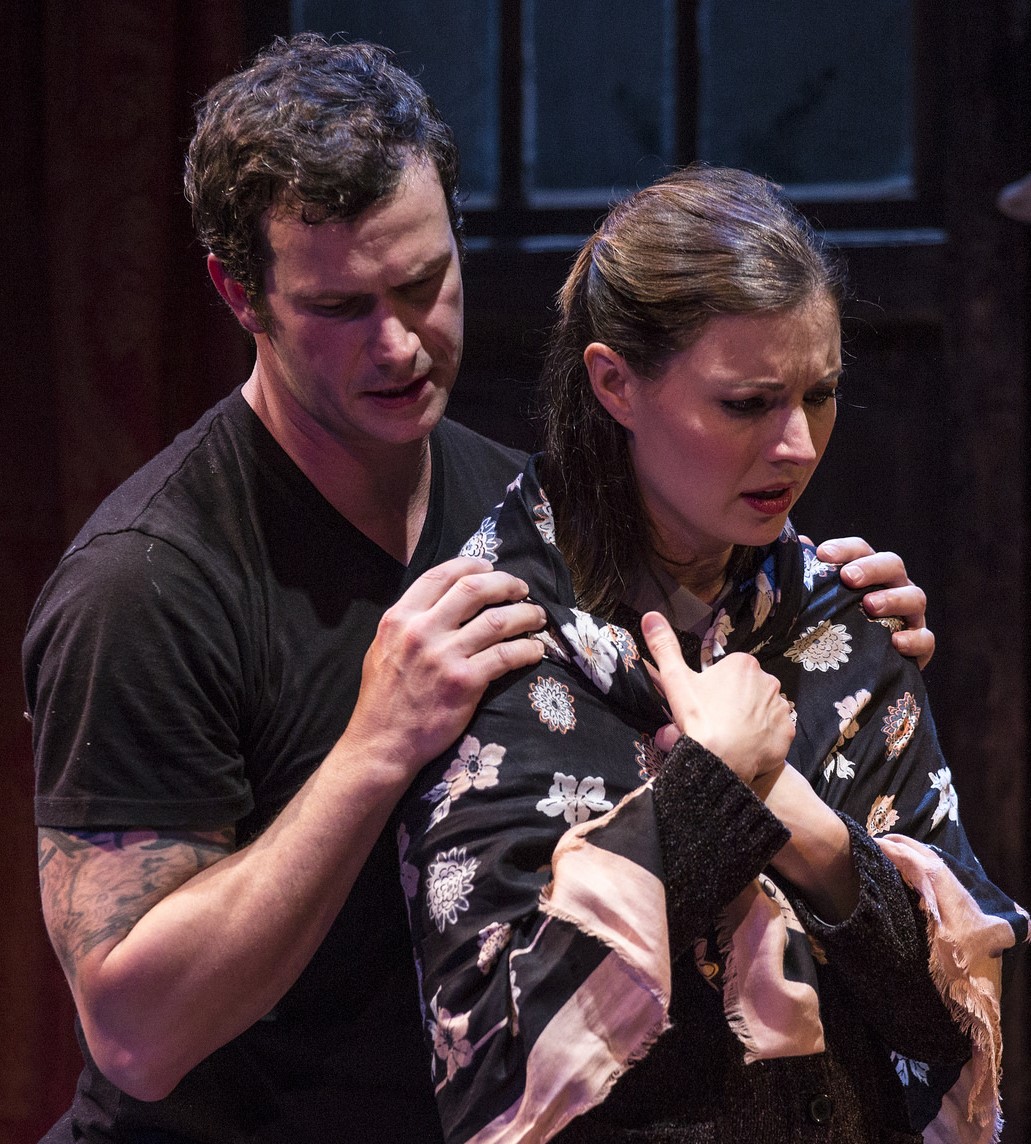
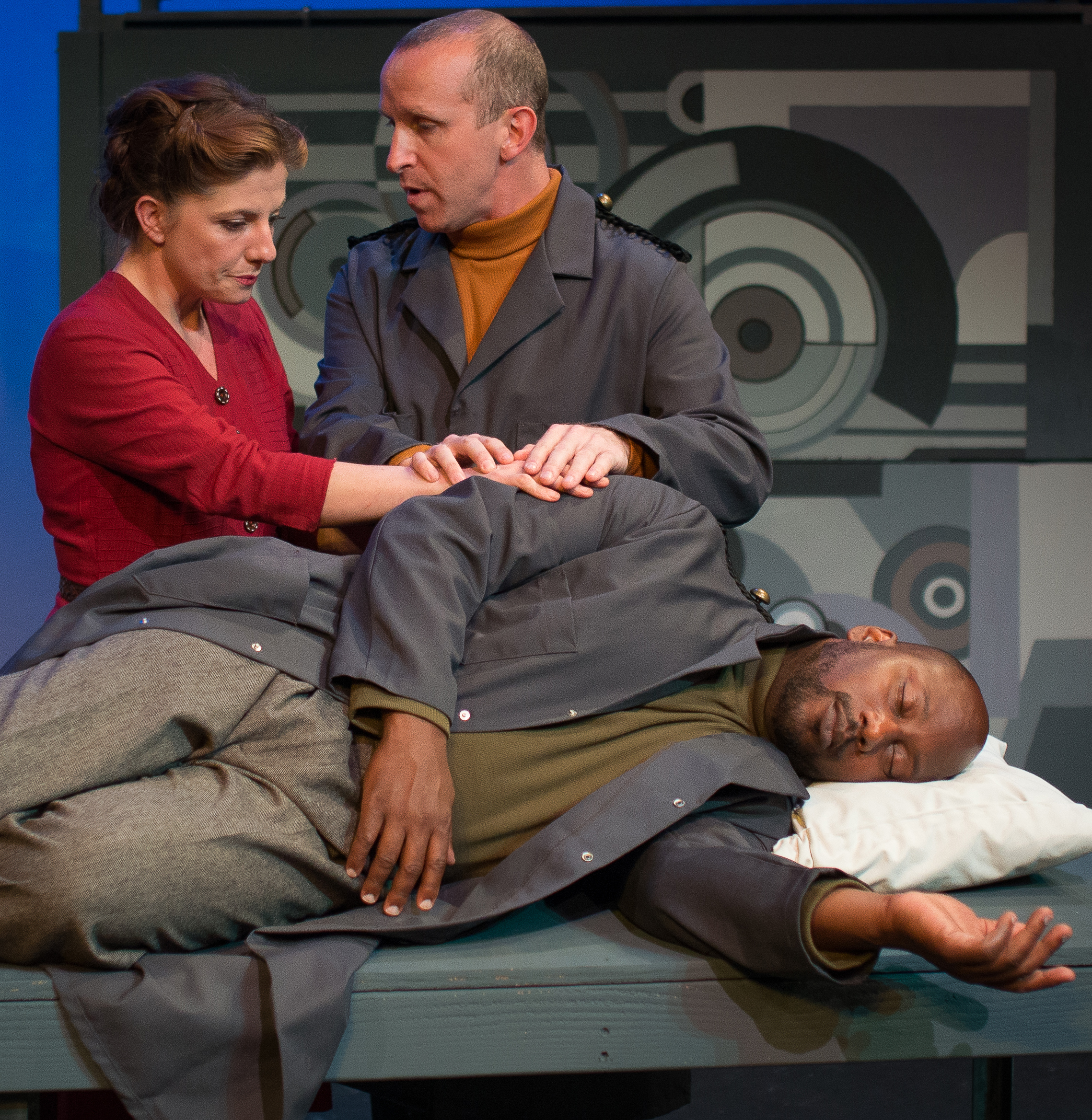
The vast majority of the fast-paced and intricate dialogue, against the backdrop of a distraught wife, is between Patrick North (Matthew Stannah) and his abductor, Abdi (Jeffrey Marc). Andrew Clarke plays a Somali rebel guard.

Director Yudelka Heyer heightens the emotional and often violent physical relationship between North and Abdi. By design, the tension is palpable from the moment North, hooded and gagged, is thrown into the cell and chained to a metal cot. Taunted by his captor, North eventually acquiesces to what seems like his abductors’ only demand—that he sign a letter replacing a company that has been preferred for a government contract, but not after challenging them: “You really expect me to believe that all this is just to remove a single individual who some warlord ‘dislikes’?” If this were the only reason for his abduction, life would be simple, and A Man Like You is not simple.

It is wrenching and skillfully presented, with acting that is complete and detailed. The audience is on two sides of the stage and in some cases sitting at stage level. The smartly designed set, by Christopher Wharton, bifurcates the stage with a windowless cell at the front closest to the audience; behind it, slightly raised, is the living room of the North’s home in Nairobi.

Credit is due Cassini for what must have been exhaustive research, resulting in a script that is as tightly crafted as a century-old Berber carpet. The argumentative dialogue details the plight of the Somalis through decades of colonization, and it becomes clear that they are just pawns in a greater political and well-funded chess game.

Heyer is from the Dominican Republic, a country with its own history of strife and political upheaval. As director, she helps Stannah and Marc deliver a knockout punch that drives their performances to the edge of sanity. They, along with Clarke, realistically play the strongly staged fight scenes. Interjected as counterpoint to the scenes in the cell are the monologues of North’s wife, Elizabeth (Jenny Boote). Boote brings a calculated, reserved British air to her nuanced performance as North’s clearly distraught wife.

Much has been written about the American Revolution rejecting the control of Britain and the monarchy. No doubt the conversation in Britain was about the terrorists commonly referred to as “the colonies,” while on this side of the pond it was considered a revolution. Using the conflict in Somalia as the canvas, A Man Like You rips apart the oft-used language we are quick to label terrorism.

Performances of A Man Like You, presented by RED Soil Productions, are at 8 p.m. Wednesdays-Saturdays and at 3 p.m. Sundays through July 31 at IATI Theater (64 East 4th St., Manhattan). Tickets are $30 and may be purchased by calling (800) 838-3006 or visiting BrownPaperTickets.com.

Click for print friendly PDF version of this blog post

’Shroom Relief

Desperation courses through Adam Strauss’s performance in The Mushroom Cure. The solo show, which he has written and stars in, details his battle with obsessive-compulsive disorder (OCD) and his attempts to find help. It’s a serious subject: the illness preys on the mind of its victims, allowing them no assurance that what they’re doing at any given moment is the right thing. It keeps them on a psychological yo-yo, and can impair their ability to form lasting relationships. Yet Strauss, a stand-up comedian, tells his story with humor as well, as the best playwrights do for serious material. (The piece won an Overall Excellence Award for Solo Performance at the New York Fringe Festival.)

The Mushroom Cureis structured as a series of scenes, with Strauss playing varying characters. Sometimes Strauss is the host, sitting on a vermilion swivel chair and speaking to us about his drug dealer, Slo. The chair also serves as office furniture when Strauss seeks help from a bizarre psychotherapist who turns out to have post-traumatic stress disorder. (A scene when they meet for a session in Tompkins Square Park is very funny.)

Strauss is becomingly ordinary, with his mop of black hair itself displaying some disorder, but less than his personality provides. He works up the courage to speak to a pretty young woman named Grace in a bar. She’s from Kansas, and he envisions her as innocent and not quite beautiful but acceptable. His waffling is a subtle indicator of the OCD at a mild stage. In any case, they have a one-night stand, and he finds he wants to see more of her, but she has only been visiting New York and is leaving for California. Stepping out of the present, Adam speaks of the ex-girlfriend Annie who left him, and reveals that Grace is the first woman who has slept over since Annie.

His relationship with Grace leads Strauss to search ever more desperately for biochemical relief for his disorder. He has already read about psilocybin mushrooms in a psychiatric journal—Grace is conveniently also studying medicine, and supports him. The article relates that some people have found their OCD entirely eliminated after the mushroom cure, so he has tried to order them through his marijuana dealer, Slo. But mushrooms are nowhere to be had; there’s a shortage.

Strauss then embarks on a series of other cures. He tries strange white powders ordered from China, and they arrive in plastic bags coded with numbers and letters. As each new avenue opens up, he gets jumpier and more fraught with anxiety.

In his search for relief, Strauss also tries cacti, as he and Grace get out of the city to a sojourn on Martha’s Vineyard, in a segment that’s particularly evocative and poetic. They see shrimp larvae misting in the moonlight by the shore. But Strauss’s OCD still has hold of him, and Grace’s patience with it seems unending. Until she can’t do it anymore.

Under the direction of Jonathan Libman, Strauss does a splendid job of navigating romance, pain, desperation, and humor in the piece. (During the press performance I attended, however, Strauss broke character to ask a woman in the front row not to scribble notes; it was a stunning breach of theatrical protocol, but given the history he was pouring forth, it was understandable. He did his best to incorporate the episode as a joke later on and alleviate the writer’s discomfort.)

Ultimately, Strauss acquires the psilocybin mushrooms and returns to Martha’s Vineyard alone, in the winter, to try them out. (The playwright in him carefully indicates the passage of time.) The experiment skirts a near-disaster, and brings him a measure of relief. That’s surely why the actor/playwright is donating all profits from the show to the Multidisciplinary Association of Psychedelic Studies (MAPS). It is the nonprofit behind the study that caught his eye.

Adam Strauss’s The Mushroom Cure is playing at the Cherry Lane Theater (38 Commerce Street, three blocks south of Christopher Street) through August 13. Evening performances are at 7 p.m. Tuesday and 8 p.m. Wednesday through Saturday. Matinees are Sunday at 2 p.m. Tickets may be ordered by calling OvationTix at (866) 811-4111 or visiting themushroomcure.com.

Click for print friendly PDF version of this blog post

Sliding into Darkness

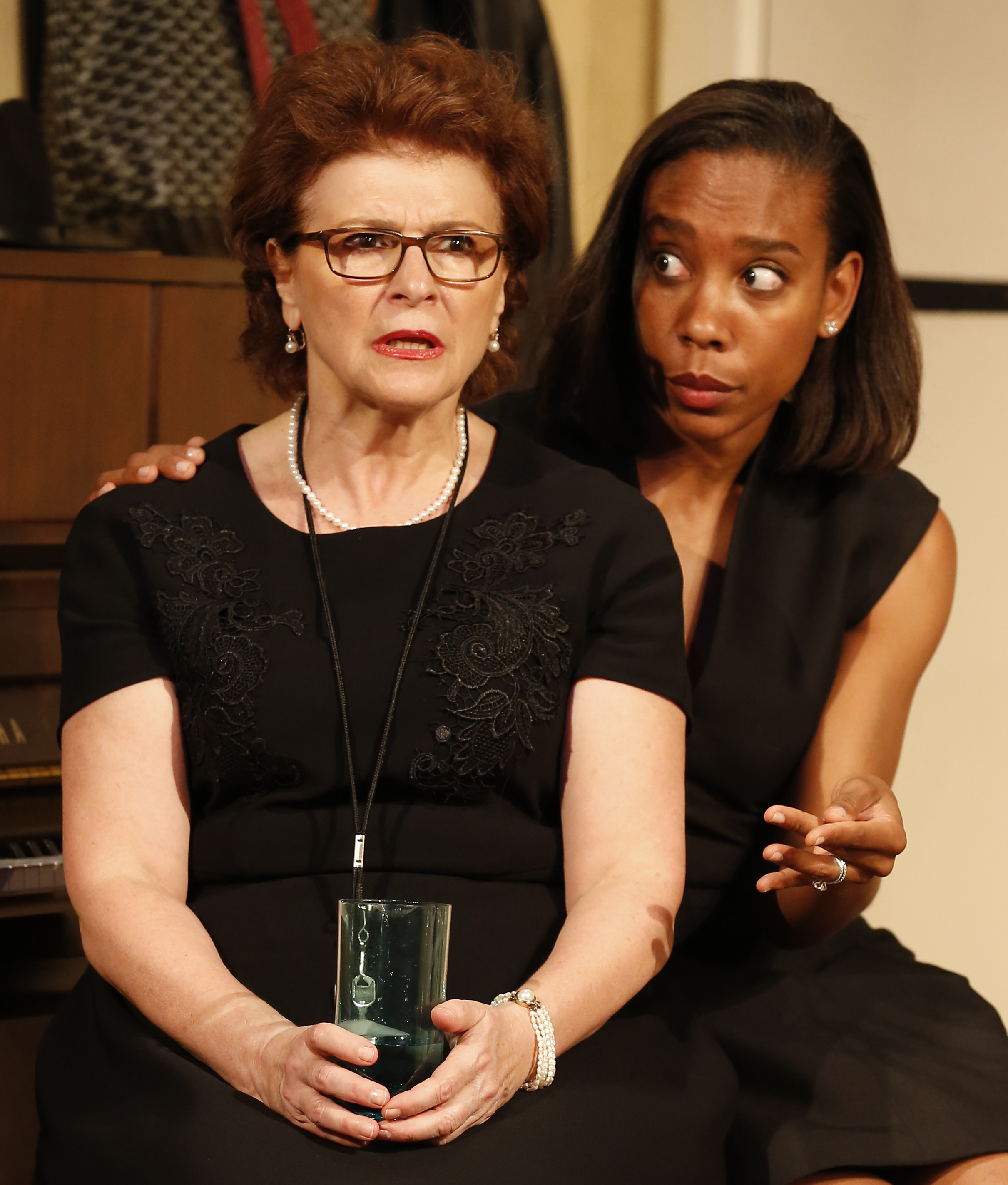
 If you ever wondered how Nazi Germany and the Holocaust came to be, look no further than Good. Originally produced by the Royal Shakespeare Company in 1982, Good, by C. P. Taylor, asks the question, “What does it take for decent, intelligent, otherwise sane people to move to such an extreme that dehumanizing others seems normal?” Adolf Hitler and the Nazis created an extraordinary propaganda machine and manipulated a nation; Good shows exactly how it was accomplished. 

The play has been lauded as one of the best English-language examples of the German experience during the Nazi regime. It follows the life of John Halder (Michael Kaye), a professor devoted to his wife (Valerie Leonard) and children who falls in love with a student (Caitlin Rose Duffy). His elderly mother (Judith Chaffee), who can no longer see and suffers from neurotic breakdowns, is institutionalized in a health care facility. She laments often, “What have I got to live for?” Halder has been so moved by her experience that he has written a book on compassionate euthanasia that has caught the attention of the Nazis.

Halder succumbs to the praise the Nazis have foisted on him. Though one of Halder’s best friends is Maurice (Tim Spears,) a Jewish analyst who is well aware of the coming dangers and hopes to get his family to Switzerland, Halder continually tries to reassure him, stating, “...all that anti-Jewish rubbish. Just balloons they throw up in the air to distract the masses.” They use his writings and his work at the university to pressure him to lead a book burning, which he does, asking if he can keep his books.

An underlying popular musical theme provides Halder an Everyman appeal as he shrugs off the propaganda as a passing fad. A longing to belong and the middle-aged man’s desire to avoid his family obligations round out the character. Whatever core beliefs Halder has held are overshadowed by the sheer power of the Nazi machine and the propaganda— “Deutschland Über Alles.”

The overall set design is inventive yet simple—wooden boxes of different sizes that are thrust together or pulled apart to create seating, along with an upright piano that is used to house props. Both are employed by Petosa to create the height, movement, and tension appropriate to the play. The palette for the costumes by Jessica Vankempen seems appropriate for late-1930s Germany. Only the lighting by Hallie Zieselman is problematic. It could be that she is at odds with the house trading off curtain times with the PTP/NYC production of Howard Barker's No End of Blame, but the lighting is sketchy, too often leaves the actors in the dark, and feels like an afterthought.

Frankly, the great challenge for director Jim Petosa’s heart-wrenching revival is the backdrop of politics 2016. The vitriol used to deliver misogyny, xenophobia, and homophobia among so many other divisive tactics being employed by politicians and pundits today makes this play almost pale by comparison. In Good, the horrors of Nazi Germany can be felt in Petosa’s direction of Kristallnacht, with so many good people standing aside. The question is, Can mankind learn?

C. P. Taylor’s Good runs through Aug. 6 at The Atlantic Stage 2, on 16th Street between Eighth and Ninth Avenues. Evening performances are 7 p.m. Tuesdays through Sundays; matinees are at 2 p.m. Wednesdays, Saturdays and Sundays. Good runs in repertory with No End of Blame by Howard Barker; for exact days and times, visit PTPNYC.org. Tickets are $35, $20 for students and seniors and may be purchased  by calling 1-866-811-4111 or online at PTPNYC.org.

Click for print friendly PDF version of this blog post

Out of the Past

First-time playwright Mat Schaffer is fortunate to have Brian Murray in the cast of his play Simon Says. Murray lends gravitas to the story of a “channeler”—emphatically not a medium, according to Murray’s character, Professor Williston—who connects to an entity named Simon. It’s been a while since the estimable Murray had a good part, and one wishes he were able to lift Schaffer’s serious-minded play beyond fiddle-faddle, but it just gets talkier and sillier in spite of the talented performers.

Williston, who has been the guardian of a young man named James since his childhood. James (Anthony J. Goes) has extraordinary paranormal powers as a channeler; but his mother exploited his renown until he had a meltdown during a tour, whereupon she abandoned him in Las Vegas. Williston then took guardianship. James has been lying low since that time, but the unscrupulous—or perhaps just blinkered—Williston wants to pursue James’s powers in the name of science and a book he has written. To do so, Williston has himself diverted funds for the overdue college education that James desperately wants in favor of their pursuing a money-making tour for the book. His plans change, however, upon the arrival of a young woman named Annie Roberts.

Annie has arrived for a channeling. She wants to contact her dead husband, Jake, who was killed in a car accident in the Berkshires that she survived. Strangely, the letter requesting this particular date was never opened by Williston, who nonetheless has expected her. Though James refuses to channel Simon for her, he ultimately relents.

Under Myriam Cyr’s direction, one’s disbelief may be suspended for awhile, and there’s certainly a frisson of creepiness when James, following the first channeling, says that he still hears Simon’s voice and a sudden, unexpected transformation occurs. Before you know it, poor James’s corporeal being has become Grand Central Terminal for spirits who are far from blithe, including Simon. Though Simon is known to Williston as a being who has existed through centuries and been “a priest at Luxor, a concubine in the Han dynasty,” the ancient shades go back to the Essenes, an early Christian sect  to which Simon belonged that is best-known for the Dead Sea Scrolls. In addition to the sought-after Jake, the Essene intruders pop up in Williston’s cramped and book-strewn study (nicely realized by scenic designer Janie Howland).

From then on, the story of Judean love and betrayal is one that perhaps only Shirley MacLaine could buy whole hog. More notable than the direction is John R. Malinowski’s snappy lighting: it works overtime, changing with each new inhabitant’s arrival and departure, until you may find yourself admiring the light show more than the story.

Schaffer leaves it unclear whether a belief in the paranormal is the central issue or whether it’s reincarnation. Both are invoked as the bodies on stage become repositories for the insubstantial spirits, and though to some extent they can be related, the two prongs here overwhelm a story that needs more credibility.

Murray is blustery and gimlet-eyed as the sneaky Williston, and it’s pleasant to see him indulge in his formidable gift for comedy. Sitting under a teardrop glass lamp, he describes to Vanessa Britting’s Annie the division of labor: “He and I work as a team,” says Williston. Lightly flicking his fingers at a potted fern, he adds, “I create the ambiance.”

Goes is an effective and sympathetic James—working-class, sweaty and desperate to find his freedom from his past. One senses his yearning for independence, and Goes throws himself into the physical aspects, falling kerplop in and out of trances. Britting is a lovely and sympathetic Annie, although her hysteria at recounting her husband’s death is a bit over the top. As the catalyst for the evening’s revelations, however, she serves admirably.

The play is diverting, though one’s pleasure may depend more on individual thresholds of disbelief. For people with scant interest in credibility and a high tolerance for mumbo-jumbo, its romance-novel message of love surviving across millennia may be just the ticket.

Simon Says plays at the Lynn Redgrave Theater (45 Bleecker St., between Bowery and Lafayette) through July 30. Performances are at 7:30 p.m. Wednesday through Saturday. For tickets, call OvationTix at (866) 811-4111 or visit simonsaystheplay.weebly.com.

Click for print friendly PDF version of this blog post

Liberty for All

Liberty: A Monumental New Musical captures an America not unlike the one we see today: a place where people want to come, but also where many struggle to find work and build a simple but stable life. The story begins when Frédéric-Auguste Bartholdi, a French artist, lovingly completes his statue and sends her to the United States (it's a gift from France to commemorate a century of independence), as if she were his own child. Liberty (played by teenage actress Abigail Shapiro) comes looking for a pedestal on which she can stand to spread her message of hope and freedom.

However, when she arrives at Ellis Island, she is given the same treatment as every other immigrant. She is poked and prodded, and given the twice-over; only to be rejected—after all, what is her purpose here anyway? Hope? That’s not enough. Commissioner Francis A. Walker, who was responsible for the census in the mid-1800s (played with a debonair charm by Brandon Andrus), schedules her to return to France on the next boat. Liberty perseveres. After all, hope is not only for the immigrant, but for everyone seeking freedom and a better life.

The wonderful cast brings life to a variety of characters: an Italian immigrant (Nick Devito), an Irish foreman (Mark Aldrich, who also plays news mogul Joseph Pulitzer), a Russian knish seller (Tina Stafford, who moves gracefully between the Russian Olga, and a wealthy American heiress named Regina Schuyler), a former slave (C. Mingo Lingo), and a native American Indian (Ryan Duncan).

Liberty is a love song to New York—a city that embraces everyone, or at least tries to—but it’s also a history lesson. There’s a great deal of information about Emma Lazarus, played with tight-lipped determination by Emma Rosenthal, who is the most well-drawn character in the play, and the most interesting. She teaches English to Giovanni, an Italian immigrant who seems to hang around the port (is he being deported, or just a loafer?). His improved English increases his betting options: “Ten to one!” he says triumphantly and skitters off. Emma looks after him with a wry smile, clearly amused. This intrigue, however, is forbidden: Emma is from an affluent Jewish family that has been in America for four generations. Hanging around the port and new immigrants is not what a society girl is supposed to do, even if she is a poet, and Regina Schuyler, a wealthy woman who puts her money where it will give her the highest profile, makes sure Emma knows she’s being watched.

With book and lyrics by Dana Leslie Goldstein, there are some laughs along the way. Particularly funny are “The Charity Tango” sung by Liberty, Commissioner Walker and Schuyler, and “We Had It Worse” in which the Russian immigrant Olga and the Irish immigrant Patrick McKay compete to see who had  it worse when they first arrived in America. However, as they crescendo in their comparisons, they also discover they agree on something when they sing: “Kids have no idea what hard work is” (…) “Soft” (…) “like a boiled cabbage,” and do a double-take in each other’s direction; they finish the song with a broad smile.

The production is fun, and kid-friendly, but very uneven. While the libretto is outstanding, the music by Jon Goldstein sounds canned; all the tracks seem to have been created on a synthesizer. The stage also feels small, not only because it is small, but because Evan Pappas's staging lacks dynamics and, at times, deflates the production. Some choreographed movement would have given the actors some breadth and depth and the production real musical-theater flair. Nonetheless, the cast clearly has their musical theater chops, and is led to a hopeful finale by Lady Liberty, who proves that perseverance pays off—a message we know is often true.

Liberty: A Monumental New Musical plays an open run at 42 West, 514 West 42nd St., between 10th and 11th avenues. Performances are Sundays at 2 and 5 p.m.; Mondays and Wednesdays at 3 and 7 p.m.; and Thursdays at noon and 3 p.m. Tickets are $72/$36 (premium/child premium); $63 (adult); $27 (children 4-12) and may be purchased by visiting LibertyTheMusical.com.

 
Click for print friendly PDF version of this blog post

Hats for Free!

It’s rare to see anything remotely like Torry Bend’s The Paper Hat Game: a seamless and brilliant performance collage of live puppets, small-scale set models, a variety of video modalities, intricate soundscape, and more. The delicacy, virtuosity, and utter freshness of this avant-garde theater work at the 3LD Art & Technology Center will delight you long after you’ve left the theater. Unselfconsciously Dada, surrealist, naturalist and psychodrama by turns, it is also none of those things: something utterly new. 

Click for print friendly PDF version of this blog post

A Heartsong for Hades

Anaïs Mitchell’s Hadestown, a concept album turned folk opera, adapts the myth of Orpheus by infusing it with American folk and New Orleans jazz music. Now playing at New York Theatre Workshop, Hadestown follows Orpheus (Damon Daunno) to hell and back again in pursuit of his young lover, Eurydice (Nabiyah Be), who has been lured there by the lord of the underworld, Hades (Patrick Page). Being a “folk opera,” the production is almost entirely sung-through, and Rachel Chavkin’s direction carries one song fluidly into the next. Like its classical source, Hadestown is alternatively gorgeous and dark, and the heartfelt commitment of the cast and musical ensemble brings the myth’s paradoxically sad beauty into full bloom.

As an energetic balance of hope and sadness, Hadestown finds light in the darkness and vice versa. The production’s casting reflects this balance: the naiveté of Be’s Eurydice and Daunno’s Orpheus contrasts starkly with the underworldly knowingness of Amber Gray’s Persephone and Chris Sullivan’s Hermes. Sullivan’s portrayal of his character is particularly complicated, as an enlisted messenger for the underworld with a soft heart for the young lovers. The Fates (played by Jessie Shelton, Shaina Taub, and Lulu Fall) are similarly uncommitted in their alliances, singing at times of great love and at others of shattering despair. As the brooding, unrelenting Hades, Page’s reverberating bass vocals figuratively open the doors of hell itself. In voice and movement, this hugely talented ensemble strikes near-perfect harmony in Act I. Act II contains major strengths, including some of the show’s most tear-jerking moments, but overall it lacks the simpatico energy of Act I.

Based on Mitchell’s celebrated folk album, music is the absolute center of Hadestown.  Indeed, at times this music-forward production feels more like a highly-produced concert than a play—which works well with such a polished songbook. Michael Chorney and Todd Sickafoose’s co-arrangements and Liam Robinson’s musical direction sonically transform the space into a concert-in-the-round, immersing audiences with powerful voices and instrumentals.  

Chavkin puts the space, reconfigured to stadium seating, to great use with entrances and exits from all angles and levels. Visually, Bradley King’s lighting synergizes with the music, especially in Act I’s penultimate “Wait for Me.” In this number, the Fates swing hanging wire lamps to and fro, visually embodying the show’s undulating emotional landscape between hope and uncertainty.

Adapting ancient Greek myths is nothing new for off-Broadway directors, but Mitchell and Chavkin’s Hadestown feels particularly fresh right now. In the “Wedding Song” Eurydice asks her new lover Orpheus how their young, penniless relationship will ever survive with “times being what they are—dark and getting darker all the time.” Eurydice’s ambiguity resonates in a time when the American middle class is dwindling and senseless acts of violence continue to erupt here and abroad. Later in Act I, Hades delivers a timely diatribe in the song “Why We Build the Wall,” echoing the latent xenophobia drummed up by the current election campaign’s fear-based politicking. 

At the same time, amid this darkness, the pure love between Eurydice and Orpheus shines through—even Hades and Persephone's fraught relationship contains a hidden softness. Indeed, the sweet vulnerabilities embedded in the music and performances of Hadestown convey the very joys and hardships that make being human so painfully beautiful.

Hadestown runs through July 31 at New York Theatre Workshop (79 E. 4th Street between Bowery and 2nd Avenue.) No late seating. Tickets are available here or by calling 212-460-5475.

Click for print friendly PDF version of this blog post

Number One or Number Two?

Comedy is a tricky commodity. Many a writer, comedian, and movie has gone down in flames, and it would be too simple to say that it’s all in the writing. Yet, even the best comedic writing in the wrong hands can feel flat and lifeless. Satirical, musical comedy is even more challenging. Some of the best theater has been created by a team, adept at pulling and pushing each other to new heights. Here I Sit, Broken Hearted ... A Bathroom Odyssey is written, directed, and stars Seth Panitch with original music by R. Johnson Hall. It chronicles the world of bathroom graffiti and also stars Ian Anderson, Matt Lewis, and Chip Persons.

The set design, by Mike Morin, is a men’s bathroom with four stalls scribbled with graffiti. The back wall above the stalls is used for projection of corresponding graffiti and photos; given the set design, it is difficult to read the visuals displayed and it quickly becomes annoying. The speakers for the music are keenly hidden in the trash receptacles on either side of the stage.

Coughing and shuffling can be heard behind the stall doors and they open to reveal the actors sitting on the commodes. Spoofing “Taking a Chance on Love,” they begin to sing.

Here I go again,
I hear those trumpets blow again.
Me on my throne again...
Taking a chance on love!

Sadly, the comedy of Here I Sit, Broken Hearted never rises above these lyrics; it misses the mark on practically every level. The saving grace, beyond the short 60-minute length, is the pure joie de vivre of the cast, specifically Anderson and Lewis. If the actors suspect that the material isn’t funny, current, or satirical, they never let on. Purely for trying to make it work they deserve kudos. A cameo appearance by an unnamed young woman is quite cute. Thinking she’s entered the women’s room, she walks in to find four white guys rapping. Incredulous, she asks “Were you guys ... you didn’t happen to be—rapping, did you?”

The fault in this piece lays squarely on Panitch. When one is so heavily entrenched in the creative process, it can be difficult to step far enough away from the material to discern what’s really good and what should be dumped. The monkey mind keeps insisting, ‘This is really good.’ This time the monkey lied.

With "South Park" and The Book of Mormon, not to mention countless movies, bathroom humor, full of innuendo and fart jokes, has been done, and Here I Sit, Broken Hearted feels dated. It takes a deft hand and slightly twisted mind to write new bathroom material. The song choices sound as if they are meant for an older audience, as well as the lyrics. Imagine the Catskills circa 1970. Second, it’s unusual to find a public bathroom like this any longer except at the beach or maybe a highway rest stop, so the references are difficult to pull off in 2016 Manhattan. A giant blow-up condom bit, immediately followed by a scene with two giant blow-up penises, is not even sophomoric enough to relish a laugh.

Given the sexual exploits of politicians and bathrooms, Panitch misses opportunity after opportunity, instead choosing to dress two of the actors to look like Donald Trump and Hillary Clinton who have little, if anything, to do with a public restroom. Gilded, maybe, but a public restroom, hardly. Public restrooms are notorious for sex, yet there is little that is sexy about Here I Sit, Broken Hearted.

While the four actors get on and off the toilets they continually wear some form of underwear. There are countless ways to be coy and funny while teasing some nudity, a la the full monty, with sleight of hand or lighting, and it would seem appropriate for a bathroom musical. Instead, they continue to pull up underwear on top of underwear, stopping short of what could have been quite fun.

The icing on this pile is when Panitch recounts a visit to the Western Wall in Jerusalem when he turned 13, seeing prayers stuffed into the crevices between the ancient stones. “So, when I entered that fateful bathroom stall that day, and saw once again that famous refrain on the wall, I was strangely reminded of the Western Wall.” Attempting to correlate one of the most sacred sites on the planet, holding the prayers of the faithful, to bathroom graffiti is beyond a stretch of the imagination and borders on the profane.

Here I Sit, Broken Hearted… A Bathroom Odyssey runs until July 9 at the Beckett Theatre at Theatre Row (410 W. 42nd St. at Ninth Avenue). Performances are Wednesday through Saturday at 8 p.m. and Sunday at 3 p.m. Tickets are $19.25. To purchase them, call 212-239-6200 or visit Telecharge.com.

à la

Click for print friendly PDF version of this blog post

Comedy and Cabaret Cocktail

Audiences at the Broadway Comedy Club are in for some head-scratching and knee-slapping as the cast of On The Spot improvises and sings its way to creating a zany new musical performance every Monday night. The cast, made up of five singers, four improv actors and one pianist work together to create an entertaining, eclectic and somewhat perplexing hour and a half of comedy and cabaret.

Click for print friendly PDF version of this blog post

Ripped From the Headlines

Kim Davies’ deftly written new play, Stet, is inspired by the hotly debated 2014 Rolling Stone article, “A Rape on Campus,” which detailed a purported gang rape on the campus of the University of Virginia. The publication later retracted its story amid accusations of poor journalistic practices. 

Stet follows journalist Erika Novak (Jocelyn Kuritsky), a journalist assigned to write a story about rape on college campuses. The unsentimental Erika claims to be exhausted—“raped out” is the way she puts it—from a media saturated with similar stories, but her editor, Phil (Bruce McKenzie), challenges her to find a new way to cover the story—cutting to the heart of what really happens to the victims in the aftermath of sexual assault. The playwright herself is no stranger to the heavy topic. As an undergraduate, she attended a college with a pervasive date-rape problem. In 2014 her play Smoke was produced at the Flea Theater and received critical acclaim. Smoke took place at a bondage and fetish party.

In Stet, journalist Erika wades through endless accounts from victims as she tries to find one that stands apart from the typical “rape is bad” story. She discovers Ashley (Lexi Lapp), a college freshman with a horrific story of violent sexual assault by multiple men during her first few weeks on campus. Her accusations, ignored by the school because she didn’t file an official report, implicate a fraternity on campus.

Erika and Phil have found their hit cover story. Erika’s research leads her to Christina Torres (Dea Julien), the project coordinator for Sexual Misconduct Response and Prevention at Ashley’s college. Erika is frustrated by Christina’s confirmation that many cases go unreported to police or campus security, but Christina is adamant that her job is to support the victim in whatever course of action she wishes to pursue. Erika also speaks with Connor (Jack Fellows), the leader of “One in Four,” an activist group on campus. Connor also happens to be vice president of the fraternity Ashley claims is responsible for her rape.

As Erika becomes more invested in the piece, Ashley grows more and more concerned about the implications of speaking out against her attackers. When Ashley says she no longer wants to be a part of the story, Erika talks to Phil about presenting Christina’s personal story instead—a much more “normal” rape story involving drinking and an acquaintance.

Erika, clearly affected by the emotional nature of the piece and her own connection to the topic, must grapple with presenting a story that will turn heads and land her her first cover piece or relating a familiar tale that is often ignored. Kuritsky does a wonderful job portraying Erika’s transformation from unattached, factual journalist to emotionally involved storyteller, helped by Jo Winiarski’s straightforward set, alternating between Erika and Christina’s offices yet morphing easily into a college bar with the help of walls that double as screens. Thanks to Katherine Freer’s projections, the screens add a multimedia element to the production. Scenes from the advocacy event “Take Back the Night” play on the walls as well as text messages between Erika and Ashley.

Multiple red flags throughout her investigation give Erika pause and in the end, she must use her journalistic moral compass to decide what story she shares with the world. Will she forge ahead despite the truth and “let it stand”—literally the meaning of the Latin stet, a common term in editing journalistic copy.

Stet presents audiences with a myriad of moral questions throughout its hour and forty minute run time, which flies by due to the snappy script and smooth staging by director Tony Speciale. The supporting cast of characters really shine as well. As Christina, Dea Julien brings an immediately energetic and likable personality to the stage. There isn’t a line she throws away the entire time she’s performing—brilliantly delivering small talk and moving monologues with the same level of skill.

As Connor, Jack Fellows speaks powerful and thought-provoking dialogue while believably remaining the typical “frat bro.” McKenzie plays Phil with a frustrating lack of self-awareness and detachment.

Davies’ script is full of lines that may sound cruel or politically incorrect when they come out of the actors’ mouths, but what is so powerful is the realization that similar things are said time and time again in the national conversation around sexual assault.

Stet runs through July 3 at the Abingdon Theatre Company (312 West 36th St.) through July 3. Evening performances are at 7 p.m. Tuesday through Thursday and at 8 p.m. Friday and Saturday; matinees are Sundays at 2 p.m., and there is an additional matinee at 3 p.m. June 25. You can order online at http://abingdontheatre.org/stet/ or by calling the box office at 212-868-2055. (A portion of all ticket sales will be donated to Take Back the Night.)


Click for print friendly PDF version of this blog post

’Tis Better to Have Loved ...

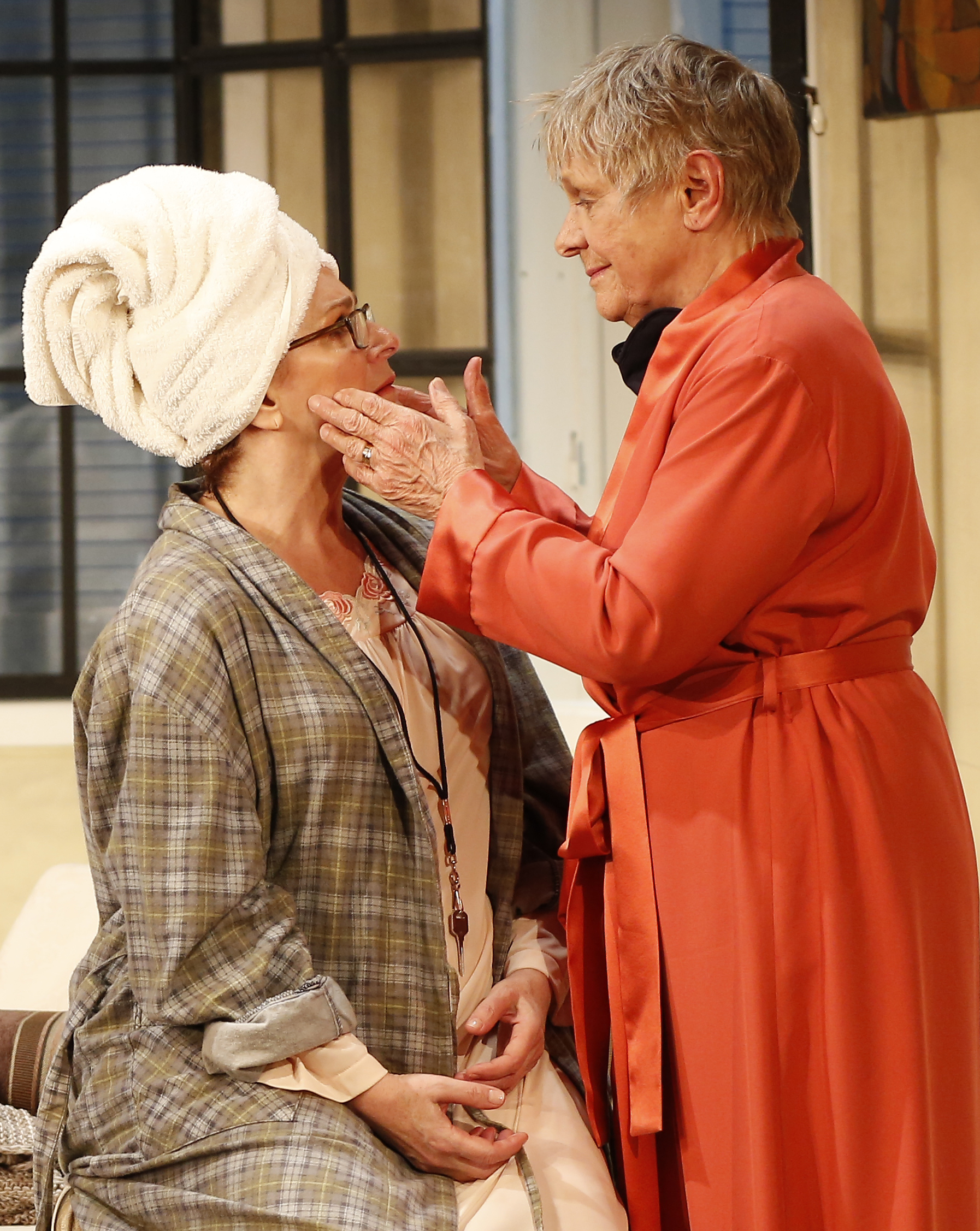
Out of the Mouths of Babes, a fun new situational comedy by Israel Horovitz, explores both the light and dark sides of life. In it, four women, three older and one younger, gather on the eve of a funeral. The deceased was a man they were all either married to or lovers with. In the opening scene, Evelyn (the remarkable Estelle Parsons) and Evvie (the earthy yet fiery Judith Ivey) meet in his apartment. It is familiar to them both because they lived there at apparently separate times. However, it turns out there was some overlap, and you know what that means.

Added to the mix is the morose Janice (Angelina Fiordellisi, an actress with the commanding and stentorian voice of an old-school stage actress, and founding director of the Cherry Lane Theatre), who was not invited at first because she was thought to be dead—she has a history of suicidal tendencies. Her first attempt was out a window in the very same room where they are all meeting. She left him for the same reasons the others did: infidelity. Marie-Belle (effervescently played by Francesca Choy-Kee), the thirtysomething kooky and idealistic most recent girlfriend of the departed (who was 100 when he passed away), has invited them all here. She appears to have psychic access to the deceased man and channels his thoughts as well as appears to remain, literally, in touch with him when she breaks into fits of laughter from the tickling matches he engages in with her from beyond the grave.

Death, rarely welcome, but always inevitable, can provide a microscope for the living to look at their lives in the present. Although at first they are cynical and even antagonistic toward one another, the women develop a rapport and join together in their concern for Janice. Whenever they lose sight of her, they immediately bond and frantically ask: “Where’s Janice?” And, unfortunately, at one moment when the other women are caught up in a reminiscent reverie about the past and the man who is now gone, their worry proves valid. There is nothing funny about suicide, but a topic can be made funny by the right ratio of drama to comedy. Under Barnet Kellman’s direction, the balance is perfect.

Neil Patel’s scenic design not only captures the airy and orderly nature of a Parisian apartment but is further complemented by the warm and intimate space of the Cherry Lane Theatre where the play is running. Paintings adorn the walls in Parisian salon style (and turn out to be the works of famous actors such as Rosie O’Donnell, Billy Dee Williams, and Joel Grey, among others). The one painting, however, that is given the most attention is Untitled Peonies, a work that Evelyn recognizes as her own creation from when she lived in the apartment in the ’60s. She can’t believe he still has it hanging on the wall.

Each of the women—Evelyn, Evvie, and Janice—left the man for the same reason. His unfaithfulness drove them away, but the initial bitterness and anger over his infidelity covers up the sadness and lament for the loss of a great love. When Evvie says, “He was a collector,” she means it as a bad thing. However, Horowitz suggests that collecting things, like lovers or paintings of former lovers, is a way of celebrating life.

Marie-Belle turns out to have an odd agenda. She extends the idea that they should all live together after the funeral. She claims she is rich, and although she appears to be an interminable airhead, has made a lot of money playing the stock market on advice from a friend. Between the apartment and the money, she feels they could have a good life together. Perhaps she is onto some kind of new age, enlightened concept of co-housing. Janice jumps at the chance, rather than out the window again. Evelyn, who is 88, and Evie, who is 68, warm to the idea. It’s attractive, not only because of their age, but because, truth be told, they are lonely, and living together may be a good antidote. They certainly know the apartment, and for all the bad memories, there are lots of good ones as well. It was their home once before. Why not again?

Israel Horovitz’s Out of the Mouths of Babes is playing at the Cherry Lane Theatre, 38 Commerce St. (near Sixth Avenue South). Evening performances are at 7 p.m. Wednesday through Saturday; matinees are at 3 p.m. Wednesday, Saturday, and Sunday. For tickets, call OvationTix at 866-811-4111, go online to www.cherrylanetheatre.org, or purchase them at the Cherry Lane box office. 

Click for print friendly PDF version of this blog post

The Healing

The Healing

Samuel D. Hunter is no stranger to writing about people with physical disabilities—or people living in Idaho, where he’s from. His play The Whale (2012), which concerned a morbidly obese man mostly confined to his sofa, won him a special Drama Desk Award. So it makes sense that he’d receive a commission to write a play for Theater Breaking Through Barriers (TBTB), a company that employs actors with disabilities. The result is The Healing, a strange play that fuses religion and faith with the struggle of people who have physical disabilities.

Click for print friendly PDF version of this blog post

Consumerism Gone Mad

What would you do to get a home? How far would you go? What if it were free? These are just a few of the questions posed to the audience by Jill and Ollie, a young married couple at the center of Philip Ridley’s sharply satirical Radiant Vermin. If anyone ever thought rampant consumerism is an American phenomenon, look no further. Ridley takes strategic aim at relatively new spectacle in the UK and hits a bull’s-eye.

Playing Jill and Ollie, Scarlett Alice Johnson and Sean Michael Verey, along with the charming and talented Debra Baker, bring Ridley’s hilarious script to life. Jill and Ollie, who have a newborn on the way, intimate early on that they are not proud of what they’ve done, but they have received a letter from the "Department of Social Regeneration Through the Creation of Dream Homes" offering them a free home. The letter invites them to meet Miss Dee (Baker) at their new residence to receive the keys. After much back-and-forth, Jill and Ollie decide to meet her in the rundown, relatively empty neighborhood. Miss Dee arrives and produces the contract from a satchel that is very reminiscent of Mary Poppins’. Although they have concerns about the local homeless camps near the house, they sign the contract.

The antics begin the first night in their new home when Jill and Ollie hear someone in the kitchen downstairs. Ollie, who looks like he wouldn’t hurt a mouse, investigates wielding a brass candlestick. The fight with the intruder, who was rummaging for food, is brutal fun, with Verey showing off a gift for physical comedy: he chokes himself and pulls at his own hair before taking a fatal swipe at the intruder with the candlestick. The actor is affable and charming, yet quick and nuanced. Ollie runs to get Jill and, instead of finding a body, they return to find a brand-new kitchen, “the kitchen we saw in Selfridge’s!” But they quickly learn that “renovating” takes on serious implications.

Ridley is known for examining the darker side of humanity, and Radiant Vermin is no exception. There are few if any props, and yet between the detailed script and superb staging by David Mercatali, it is as if everything described is physically in place. Playing only against a solid white backdrop, Verey and Johnson not only portray their characters but also each neighbor as the houses begin to fill up around them and the “keeping up with the Joneses”-type conversations with the neighbors, about furniture and lighting, gardens and automobiles, builds to a mad pace. In order to “remodel,” Jill and Ollie lure more homeless in. The neighborhood becomes a hotbed of consumerism: the “Never Enough Shopping Centre” is opening nearby and their unfettered remodeling begins to tear at the fabric of their souls. Baker reappears as Kay, one of the homeless they have brought home. In a touching scene, she relates the rumors on the streets about people luring the homeless, who never return.

The crescendo, when Jill and Ollie are cajoled into throwing their son’s first birthday party for all the neighbors, is outstanding. Between Ridley’s fantastical writing, Mercatali’s direction, and Verey and Johnson’s acting, numerous neighbors come to life in a frenzy of mime, dialect, and comedic timing. Lighting choices by production designer William Reynolds heighten the frenetic dialogue at the birthday party. If occasionally amid the British accents some of the words are lost, the birthday-party scene is nevertheless priceless.

Verey and Johnson are the heart of this fast-paced black comedy, delivering Ridley’s satiric dialogue. He allows a peek behind the curtain of civility and jabs at human nature. It’s easy to see with Radiant Vermin just how seductive our buying habits become with just a little coaxing. If this is the best Britain has to export, long live Brits Off Broadway.

Radiant Vermin continues at 59E59 Theaters (59 East 59th St., between Park and Madison avenues) through July 3. Evening performances are at 7:15 p.m. Tuesday to Thursday and at 8:15 p.m. Friday and Saturday; matinees are at 2:15 p.m. Saturday and 3:15 p.m. Sunday. Tickets are $35. To purchase tickets, call Ticket Central at (212) 279-4200 or visit www.59e59.org.


Click for print friendly PDF version of this blog post

What If—Robots?

What would happen if technology rebelled against us? One possibility is explored in Mac Rogers’ Universal Robots, a science-fiction play set in Czechoslovakia after World War I. It is inspired by the 1921 sci-fi drama R.U.R., by the Czech playwright Karel Čapek. Čapek’s play, whose initials stand for “Rossum’s Universal Robots,” introduced the word “robot” to the English language and was instrumental in establishing the robot as a character.

Rogers expands upon Čapek’s world and creates his own universe filled with wired beings. The play eases into the realm of human-like robots in the first act. It begins with the gathering of the ensemble of robots (of which the audience is not aware) chanting of how they tell their story to remember. Remember what? This chant will surface again and connect many dots for the audience of whose story they are truly telling.

As the play opens, the characters are gathered at their local watering hole in Prague. The café is frequented by a playwright, Karel (Jorge Cordova), his sister, Jo (Hanna Cheek), who is a sculptor, and their barrage of friends. Here, they drink, laugh and discuss many of society’s conundrums. Life is good. Helena (Brittany N. Williams) enters the café, pushing a wheelchair containing an automaton, and introduces them to the object that will change their world. She asks them to come see the lab where the human-like robot was created. Their intrigue and fear grow, yet they ultimately agree to go with Helena to visit the plant and meet the automaton’s creator, Helena’s mother, Rossum (Tandy Cronyn).

After their visit, the world they know changes. They decide to embark on a mass production of automatons. They fear the loss of human employment and self-efficiency but establish ground rules to keep their creations in balance. They all agree to an established set of boundaries, and a union is formed. The robot production begins.

As the play progresses, Hitler is on the rise and a representative from the United States visits the President of the Czech Republic (Sara Thigpen), who is one of the major people in charge of the automaton project. Up to this point the group had decided that the automatons would not be used for war or programmed to kill, and now they are faced with saving millions of people or going against their values. They choose humanity—or do they?

Rogers outlines the deterioration of many of the close-knit human relationships from the beginning of the play. The pressure and guilt of programing the robots to kill prove to be too much to handle for some. One relationship with a sweet, sad dynamic is that of Jo (Hanna Cheek) and the robot Radius (Jason Howard), who was a human waiter, Radosh, who passed away and is later reincarnated as the face of the lead automatons. Radius is no longer human, but the physical association and emotions that tie Jo to Radius are very human. It brings up the question of where does humanity live, in the flesh or the soul? Howard shows versatility as he skillfully switches from human to robot with his diction and physicality. In his scenes with Jo he is able to capture the softness of a human yet parallel it with the sterility of a robot.

Rogers does a fantastic job of posing such deeply rooted questions that force the audience to really think about choices, good, evil and humanity as a whole. Rogers delves deeply into these complex themes and creation questions. He poses a hypothetical where choosing the lesser of two evils could be at the expense of humanity. Although the play deals with relevant issues, at times it feels as if he might be trying to tackle too many deep questions for one sitting.

Director Jordana Willams has put together a diverse cast of 10 in Universal Robots, a powerful, thought-provoking play that should be appreciated not only by sci-fi enthusiasts but anyone who is interested in thinking about the world’s “what ifs.”

Universal Robots runs through June 26 at the Sheen Center (145 6th Ave.; entrance on Dominick Street). Evening performances are at 8 p.m. tonight and Wednesday through Saturday; there is also a 2 p.m. matinee on Sunday. Tickets are $25 for general admission and $18 for students and may be purchased online at web.ovationtix.com/trs/pr/957321.

Click for print friendly PDF version of this blog post

The Private Is Now Public

Who doesn’t feel good when a posting on Facebook gets lots of “likes”? It’s a place where, when something momentous in your life happens, like a marriage, or a death, your FB friends—all hundreds of them—can give you a virtual hug. It’s also where the theater company Five on a Match culled the dialogue to create its production of Seen/By Everyone, directed by Kristin Marting at HERE Theater. Although the production feels fragmented—it’s nonlinear in both story line and dialogue—it does resonate. Primarily, it asks the question through the production itself: what is the effect of social media on our lives? It’s not an original question, and certainly not one that can be definitely answered, but it’s one worth considering from time to time.

The creators (Matthew Cohn, Amir Darvish, Meg MacCary, Enormvs Muñoz, and Jean Taher) use Facebook as a starting point, and every word in the show is from Facebook posts. The play, however, is not a head-on commentary on social media, but rather about the weight and depth of what is shared in this milieu. The writers focused on two major themes: relationships and death, and as in real life, conversation about these topics may be scaled down to their lowest common denominator, or fragmented. Also true to life is the pattern of everyday communication in which we respond to immediacy of information, as well as the tendency to meander down many different roads. No wonder we love social media so much: it mirrors our needs and patterns of communication so perfectly.

The play begins with a death, and picks up different fragments of different stories about relationships. One character, a perky but lost-looking character named Maggie (Alesandra Nahodil), dressed in a pleated white skirt and a crocheted blouse (costumes are by Oana Botez), sits at a bar. She says,­­­­­ “I made up a birthday so I felt justified getting wasted today.” Then, “I’m good at being homeless. But not that good.” The Bartender, dressed in tremendously tall lace-up platform boots, like the gatekeeper to a leather bar, addresses her with platitudes: “It’s OK to be alone,” he repeats over and over. Later, he gives her a list of all the things she can do to feel better: “write a story, read a new book or magazine, take a nap.” She seems unappeased. Later we learn why. She’s restless but not for the reasons we think. It’s a part of the play that remains a mystery until the end. However, in his attempt to soothe her, the gatekeeper/bartender (as usual) turns out to be the wisest one.

In some scenes, more naturalistic acting and narrative bring characters together. They gather at the bar, or at tall, round tables in the center of the space and gossip, fight, laugh, cry and over share. At one point, Rose (Katie Brustele) and Bernice (Jen Taher) exchange superficial tidbits. Bernice aptly launches into a diatribe about the elimination diet she’s doing in which she can’t eat any “gluten anything, no corn, soy, chocolate, booze, pork/beef/shellfish, no dairy/cheese/yogurt/egg, no sugar, maple syrup, agave, or honey.” It’s funny because it’s timely. Everyone knows someone, or knows of someone, who is consciously taking something out of their diet.

Without the development of characterization and a story line, however, it’s hard to get a sense of who these characters are. When Bernice accuses Fred (RollsAndre) of being cynical, we have to take her word. In this world, we have to take the other’s word, and there is some suggestion that social media nullifies our individuality. This is particularly implied when actors don masks with mirrored tiles, and line up. The masks make them faceless, and take away their individually, perhaps representative of the virtual FB community that is based on photos, disembodied words, and still images, rather than real interactive ones.

The experience of watching Seen/By Everyone can be disorienting if you’re not willing to leave your typical theatergoing road map of expectations behind. In the end, it offers a thought-provoking experience about the nature of what happens when important events, or everyday issues, are filtered through the lens of sharing vis-à-vis Facebook, a place where our identities are easily socially constructed, and where information, when isolated, can be disembodied.

Five on a Match’s world premiere of Seen/By Everyone runs through June 25 at HERE (145 6th Ave.; entrance on Dominick Street). Performances are at 8:30 p.m. June 16-19 and 22-25. Tickets are $25 and may be purchased online at http://www.seenbyeveryone.com/tickets/.

Click for print friendly PDF version of this blog post

Love’s Lasting Effect

How tightly does the average American cling to a confabulation of love? If pop culture’s steady stream of uninspired TV shows and mildly erotic paperbacks is any indication, people seem to be grasping for any and all channels that lead to answering this question. Unsurprisingly, New York theater offers an intelligent, mesmerizing counter: The Effect, a play by Lucy Prebble. The Effect has a singularly moving tension at its core: can two people fall in love under “the effect” of a powerful anti-depressant? Or is love simply the side effect of that drug?

Barrow Street Theatre’s exceptional take on this award-winning play (it received rave reviews and multiple awards in London and has struck similar chords of awe Off-Broadway), pushes us to seriously consider a fanciful four-letter word that ordinarily inks the pens of poets. Director David Cromer orchestrates this production with white-knuckled excitement at the mere prospect of discovering something unknown about love. The Effect suggests a new, intoxicating interpretation of modern romance, unbothered by moral clichés or excessive sentiment.

The play opens inside a sanitized hospital room, with quiet colors and sensible chairs and white lab coats. Connie Hall (played by a fantastic Susannah Flood) is being interviewed by Dr. James, her clinical supervisor. She is careful and precise, answering every question with painstaking clarity—sometimes to humorous effect. Next, Tristan Frey (a terrific Carter Hudson) plops himself down in from of Dr. James and proceeds to flirt, extemporize and generally misbehave. These two main characters could not be more different from each other. In the confines of their six-week-long aphrodisiac existence as part of the drug trial of an antidepressant, Connie and Tristan discover each other in themselves, each pushing the other to believe in their respective ideas of love.

Cromer urges nervous humor in Flood and Hudson’s performances. The two protagonists carry conversations like precocious babes endowed early with the power of speech. Flood’s Connie is a study in fastidious, think-first-talk-later practicality, but Hudson’s inspired Tristan Frey is endlessly energetic, dancer-like and hell-bent on talking Connie into falling for him. It isn’t enough to say that their chemistry is palpable; when their eyes meet, each magnetizes the other’s performance, elevating the entire production to goosepimply electricity.

As for the emotional trauma of falling in love—for it is, the play argues, a kind of trauma—Cromer reserves such hefty work for Steve Key and Kati Brazda. Understated, Brazda plays the most unexpectedly affecting character, Dr. Lorna James. As the lead psychologist of the antidepressant study, James begins her arc as a dry clinical supervisor, reining in the sexual urges of Connie and Tristan with the amused authority of an animal handler. But as her interactions with Dr. Toby Sealey (Key) reveal, she hides a deep, corrosive wound, thanks in large part to her beliefs in love and attachment. It is through James that we see the real pitfalls of love—the ones Prebble wants to warn us about.

The players are not Cromer’s only tools, however; moving walls, suggestively dark corners and flashing text are sleek supplements to the overall effect of the play (the scenic design is by Marsha Ginsberg and lighting design is by Tyler Micoleau). These additives do not distract from the entire play, as one might expect, but rather enhance Prebble’s narrative. A particularly hilarious scene involves both Connie and Tristan taking a psychological test in which they must name the colors of the words that flash on a screen before them. James dryly notes that her subjects will falter at words that they associate with emotional burden. “Father,” “diet,” “breasts” and “guilty” prove particularly difficult for our lovers.

Cromer aims to show us a precise examination of falling in love, with all its awkward pauses, fitful first moves and, yes, even sex, in all its clinical vulnerability. Prebble’s commentary on modern love is a moving, masterly ode to humanity’s endless pursuit of answers to nebulous ideas. The Effect disturbs and excites—your notions of everything from intimacy to depression will take a hit, for the better.

Barrow Street Theatre’s production of The Effect runs through Sept. 4. Evening performances are Tuesday through Sunday at 7:30 p.m.; matinees are Saturday and Sunday at 2:30 p.m. Tickets may be purchased by visiting SmartTix.com, on the phone at 212-868-4444, or in person at the Barrow Street Theatre box office, open at 1 p.m. daily. For more information, visit www.BarrowStreetTheatre.com 


Click for print friendly PDF version of this blog post

Define Liberated

It’s difficult to get excited about six straight, homogeneous women sitting around in a weekly support group in Brooklyn eating Chinese, drinking wine, and going on about work, men, and sex in the age of Tinder. Imagine watching The View—add food, wine, and Zumba but without an ethnically diverse panel or politics and you’ve got a gist of #liberated, playing at the IRT Theater in Manhattan. Conceived and written by Lillian Meredith, who is one of the actors, the play is created by an ensemble of artists known as The Living Room, dedicated to creating work about contemporary American women.

#liberated starts out relatively innocuously. The “Sister Support Group for the Daily Trials of Being a Woman,” a.k.a. W-I-P-E (an acronym which is never explained), meets weekly and begins each meeting with a fast and crazy video on learning Zumba moves. This week one of the members has invited another woman to join them without asking the group first. The women seem to be put off by someone new inhabiting their “safe space,” but they soon acquiesce. They pour her a generous mug of wine as if to symbolize acceptance into the tribe. The topic this evening starts out smartly enough about the sexual exploitation of women in advertising, and the conversation devolves into who watches porn and who doesn’t. Over the next few meetings the women decide to bring samples of porn that each likes to share with everyone, and the reactions to one another’s choices are quite funny. Then they get the idea to create a more feminist version of porn, with each creating a scene to be acted out and videotaped. Realizing that this may actually empower and liberate other women, they upload the finished product to the Internet with one swift click.

The video takes off—like after like, share after share—that is, until the Internet trolls, hiding behind avatars and fake names (probably sitting in the dark in their underwear in their parents' basements) come out of the woodwork. The scene is similar to watching celebrities read mean tweets about themselves. The trolls are horrific, one wishing they would “drink bleach and die” and another spewing, “I’m ready to pump GENIUS level sperm into your football-shaped body.” The women lose focus on their original intent and create a new set of sexual videos trolling the trolls. Nothing good comes of it, and the play turns extremely dark.

#liberated is codirected by Rachel Karp and Jaki Bradley—it’s almost as if one directed the first half and the other directed the second. There are some good comedic moments early on, although not sustained, and it’s easy to see that the women enjoy being with one another. Dancing to Enya with multicolored scarves to simulate an undulating vulva is actually a pretty funny moment. However, there is nothing sexy enough nor hardcore enough to warrant the vitriol foisted on them by the Internet trolls. The sexual scenarios mostly come off as silly and tame, which begs the question, why the backlash? These are women who most likely would have experimented in college. They know of PornHub and Max After Dark, but beyond that the script lacks imagination and daring.

As an ensemble piece, #liberated includes Tamara Del Rosso, Zoë Sophia Garcia, Lillian Meredith, Gabby Sherba, Taylor Shurte, and Madison Welterlen. They are good enough, given a marginal script. The Brooklyn apartment set design by Frank Oliva has an Ikea look, which includes nice lighting credited to Scot Gianelli. The sound design by Ben Vigus is across the board and oddly employs misogynistic rap music between the scenes. Vigus evokes Internet sounds, television newscasts, and lively Zumba-type music.

In the world of oversharing on the Internet, between Facebook and every social media app, #liberated seemed to want to say something profound. Unfortunately, it never says enough. It does not include women of color or create a powerful, lasting conversation. In a year where we may see the first female president in this country, it’s way past time for women to step up and truly make a difference in the world for women. At best the only message here is don’t engage in a battle on the Internet—no one ever wins.

#liberated runs until June 19 at IRT Theater (154 Christopher St., 3 Floor, #3 B) in Manhattan. Performances are Wednesday through Monday at 7:30 p.m. Tickets cost $18 and are available at rttheater.org.

Click for print friendly PDF version of this blog post

Paranormal Problems

For the first production by Irish Repertory Theatre on its return to its 22nd Street location after a year’s renovation and exile, artistic director Charlotte Moore has chosen (or perhaps approved) Conor McPherson’s Shining City, a 2004 play about a psychiatrist and his patient who wrestle with secrets and regrets that is directed by longtime associate Ciarán O’Reilly. (Shining City was eventually seen on Broadway in 2006.) In some ways the play is a mixed bag: McPherson’s early works, such as The Weir (1997) and Port Authority (2003), rely on interrelated monologues to tell a story. In The Weir, for instance, a group of people gather in a bar and tell ghost stories, one by one. In later works, such as The Seafarer and The Night Alive, McPherson becomes less reliant on speeches than on give-and-take that resembles real conversation.

Shining City concerns a Dublin psychiatrist, Ian (Billy Carter), who has taken on a patient, John, a man who cannot sleep in his home since he saw the ghost of his dead wife, Maury, killed in a violent traffic accident. Played by Matthew Broderick with a deft Irish brogue, John is worried about his sanity. The memory of the apparition haunts him, and he cannot stay overnight in his home. John seeks Ian’s help in restoring him to sleep at night. In a series of near-monologues with the psychiatrist, John reviews his life and marriage.

Ian, meanwhile, has troubles of his own. He wants out of his marriage to Lisa Dwan’s Neasa, and when Neasa arrives and listens to him explain, she seems rather a dunce, cottoning to the fact that he’s leaving her long after the audience knows it. The couple have a row in his home office, and he assures her he’ll take care of her but that he won’t return to the marriage. There’s less give-and-take than there is of Ian’s staking out his position fully, and then Neasa delivering her side of the story. O’Reilly’s direction can’t disguise that the playwright is still adapting to conversational back-and-forth.

Anyone familiar with McPherson’s work knows that something eerie is going to happen, but when it does, unfortunately, the effect is much less chilling than it was in the Broadway production. Whether it’s due to Broderick’s laid-back delivery, which, although an appropriate choice for the character, somehow makes the proceedings too cozy, and the audience too comfortable, or whether O’Reilly’s staging simply fails to do the moment justice, is unclear.

But Broderick is doing better work than he has in a long time. He’s taken on a gigantic role and he’s never less than enjoyable in it. Billy Carter as the psychiatrist is also exemplary. His Ian is energetic, sympathetic, emotionally torn and yet willing to face hard truths. A late entrance by James Russell’s Laurence, a pickup for sex, reveals much about Ian, who abandoned the priesthood in order to marry Neasa. Yet a final scene further complicates the nature of Ian’s character, and one senses that perceptions are not to be relied upon. It calls to mind Hamlet’s observation, “There is more in heaven and earth, Horatio, than is dreamt of in your philosophy.” It's a good epigraph for the play’s finale as well.

That Ian’s name is the Gaelic version of “John” is a subtle hint at the haunting climax. The Irish Rep’s Shining City is a satisfying, if not ideal, rendering of what feels like a transitional play by an important modern playwright.

The Irish Rep’s Shining City plays through July 3 at the company’s refurbished home at 132 W. 22 St. in Manhattan. Evening performances are at 7 p.m. Tuesday and Thursday and at 8 p.m. Wednesday, Friday and Saturday. Matinees are at 3 p.m. Wednesday, Saturday and Sunday. For tickets, call Ovationtix at (212) 727-2737 or visit irishrep.org.

Click for print friendly PDF version of this blog post

Home Town Unpleasantries

Alan Ayckbourn’s plays have been a fixture of the Brits Off Broadway Festival for several years. This year, along with a revival, the festival is presenting the world premiere production of Hero’s Welcome, first seen at Ayckbourn’s own Stephen Joseph Theatre in Yorkshire, England, and now on an international tour.

Ayckbourn, the author of 79 plays, may be one of the most underrated playwrights alive. Many of his works are comedies, but there are often dark underpinnings. From his classic Absurd Person Singular (1975), in which a hilarious attempted suicide takes up the entire second act, to Arrivals & Departures (2013), one of his darkest, he has been a masterly commentator on British society in plays that range from science fiction (Comic Potential, Communicating Doors) to astute social observation (Things We Do for Love, Absent Friends)—always using comedy to make his points.

Unlike many Ayckbourn plays, Hero’s Welcome feels a bit long and complicated. Opening with Elgarian music and a TV interview, it concerns a soldier named Murray (Richard Stacey) who has returned to his small home town to take up residence with his new wife, a woman from the unidentified foreign country in which he conducted his heroic deeds. Her name is Madrababacascabuna, but she goes by Baba. The interview elicits a confession from Murray that he left under a cloud; he was “a bit of a tearaway,” as his interviewer puts it. As Ayckbourn’s play unfolds, it becomes clear that the heroes in the play are the three wives we see; their husbands are cruel or ineffectual. The mayor of the town, Alice (Elizabeth Boag), was abandoned at the altar by Murray. Now she is matched with a kind-hearted duffer named Derek (Russell Dixon), who plays with toy trains all over their house, and who describes himself as a “consort.”

Murray’s old mate Brad, meanwhile, is married to Kara. But the upper-class, wealthy Brad refuses to acknowledge that he and Murray were close childhood friends. The competitive Brad is, in Wodehousian terms, a blackguard. He repeatedly insults Charlotte Harwood’s cheery, giggly Kara, and she accepts it.

Murray hopes to resurrect the family business, an old hotel called the Bird of Prey. It’s listed as historically important but is rundown. Moreover, Murray’s father couldn’t pay the taxes on it, and now it belongs to the town council, and Alice is bent on tearing it down. Although she’s not vicious, it suits her impulse for revenge to prevent Murray’s buying back the property.

Ayckbourn’s play is about the public faces people put on that conceal their private personalities, and how the past shapes those personalities. Just as Kara remains chirpy in order not to recognize Brad’s cruelty, Brad himself is cruel in order to forget his lack of courage in throwing over a woman he loved in the face of his parents’ threat of disinheritance. Murray, meanwhile struggles with some bad behavior of his own. In addition to jilting Alice, his heroism is a sham.

It’s often unwise for an author to direct his own work, but in the past Ayckbourn has proved the rare exception to the rule. This time, though, the play feels a bit longer than it need be, and a bit overstuffed with incident. What a different director might have done to tighten it is uncertain, but the actors, at least, are outstanding. Stephen Billington’s Brad is all surly arrogance, and Boag’s Alice is stiff and competent, but frosty from a life of suspicion sparked by her jilting. Dixon is a comic pleasure, and Derek’s rising to his Lochinvar moment, when he excoriates Brad, is deeply satisfying. Stacey’s Murray is perhaps the least interesting character—he’s not the hero of the title, since it’s an ensemble piece—but he conveys decency, modesty and honest regret.

Still, it’s Evelyn Hoskins’ Baba who is first among equals. Learning English slowly and painstakingly, bravely facing a future in as a refugee, ultimately befriending Kara and confronting Alice, Baba’s journey becomes the play’s real focus. Early on, after she has met the people from Murray’s past, she asks him: “Why they hate you?” Like Winnie in the Ayckbourn masterpiece My Wonderful Day (2009), she knows the truth that others cannot see.

Two Alan Ayckbourn plays, Hero’s Welcome and Confusions, run in repertory through July 3 at the Brits Off Broadway Festival at 59 East 59 St. between Park and Madison. Tickets are $70 but two-show packages are available. For information, visit 59e59.org.

Click for print friendly PDF version of this blog post

Jesters of the Jazz Age

The Marx Brothers—four actual brothers, best known for their timely political commentary, sophisticated puns and physicalized comedy—left no stone unturned. They poked fun at everyone and everything: aristocrats, hobos, history, and especially relationships between men and women. I’ll Say She Is, now at the Connelly Theater, written by Will B. Johnstone, went to Broadway in 1924 and put the Marx Brothers on the map. Their rise was mercurial, and they made many movies that spread their popularity even wider.

But I’ll Say She Is, unlike their other stage shows, never became a film. It centers on a rich heiress named Beauty, played by the lovely Melody Jane, whose problem—“Society Woman Craves Excitement”—headlines the newspapers. The Marx Brothers, actors looking for work, are sent by their casting agent to woo her, and presumably get money from her. After all, her problem seems to be of great local concern. Fabulously rich, she lives with her also very wealthy aunt, Ruby, played by Kathy Biehl, who lends the role the right amount of stentorian authority. When the Brothers arrive at Ruby and Beauty’s door, the butler, played comically by C.L. Weatherstone, asks: “Gentlemen, did you come by appointment?” to which Chico responds, “No, we came by subway.”

The literal use of language is what made the Marx Brothers so brilliant. When Chico asks Harpo to cut the cards, he takes out an ax and chops them up. However, their comedy doesn’t completely rely on fast-paced antics. Instead, there are many quieter, more theatrical moments, as well as moments that showcase the array of talent the Marx Brothers had. Harpo was a gifted harpist, and Chico learned to play the piano with a special one-handed technique, and the actors successfully capture these talents.

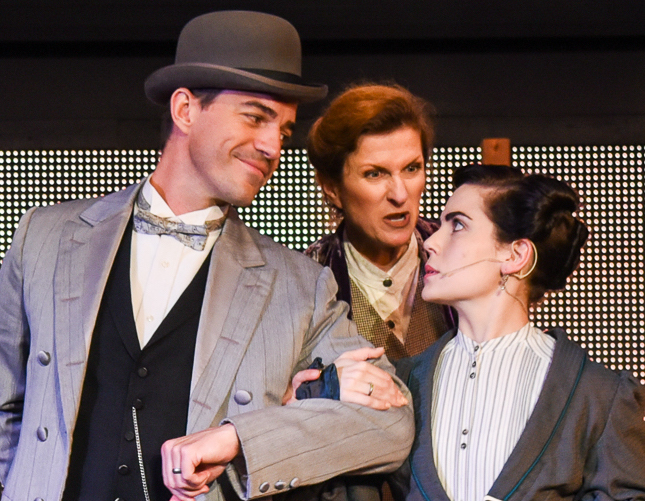
When actors play famous personae, we want to see exactness, but what we really should be looking for is likeness. The four actors who play the Marx Brothers do a fantastic job of capturing the broader aspects of each of the brothers’ personas. And personas they were. Matt Roper captures Chico’s tight-lipped, one-sided grin, casts the sideways glances that made Chico seem both wary and earnest. Seth Shelden plays Harpo’s muteness with energy. Harpo was a pickpocket of sorts, and to recreate this theatrically takes a certain kind of magician’s ability. In one scene, Ruby suspects that he has stolen some cutlery, but she then backs off her claim. At the same time, several forks, spoons and knives fall out of Harpo’s sleeve. Shelden masters the great physical control needed to play Harpo’s mute but mischievous character.

Groucho was surprisingly successful in romance. The older women adored him for his quasi-romantic nature, and sharp humor. During a scene while courting Ruby, she calls, “Ah! My dear! At last I’ve found you.”

Groucho: “Yes, my darling, here I am.”
Ruby: “I was referring to my niece.”
Groucho: “Well, I’ll have you on your niece in no time.”

However, his exaggerated black eyebrows, painted thickly above his own, the long waistcoat, and cigar dangling from the side of his mouth make him also the most comical-looking. Noah Diamond does a wonderful job of getting Groucho’s famous walk just right with the back bent forward, and knees in a deep plié that often made Groucho look like he was gliding across the room.

And last but not least, Matt Walters plays Zeppo with all the leading-man charm reminiscent of those classic film stars Cary Grant and Clark Gable. Beauty falls in love with him at the end of the play and realizes that “there is no greater thrill than the thrill of love.”

Diamond lovingly restored the lost script by working with Johnstone’s rehearsal notes to adapt the play to the Connelly Theater, a historic venue dating back to the mid-1800s. Director Amanda Sisk, choreographer Shea Sullivan, and musical director Sabrina Chap do a marvelous job of capturing the voluptuousness of a Broadway revue during the age of vaudeville. The play, produced by Trav S.D., includes an array of 10 chorus dancers who are a triple threat: they dance, sing, and act. And of course, they all tap-dance. In their sparkly art deco dresses they bring an additional vibrancy to the stage that makes the play all the more fun in its reminiscence of a vaudeville spectacle.

I’ll Say She Is runs through July 3 at the Connelly Theater (220 E. 4th St., between Avenues A and B). Evening performances are at 8 p.m. Thursdays through Saturdays and at 7 p.m. on Sunday; matinees are at 2 p.m. Sundays. Tickets are $35 ($25 for students and seniors), available at 212-352-3101 or www.illsaysheis.com.

Click for print friendly PDF version of this blog post