

No Regrets

The world premiere of Rising Circle Theater Collective’s production This Time, written by Sevan K. Greene and adapted in part from Amal Meguid's memoir Not So Long Ago, is an extraordinary example of juggling multiple timelines with exacting deftness. The storylines weave in and through one another, much like a memory comes in and out of consciousness. The underlying theme? A life of no regrets.

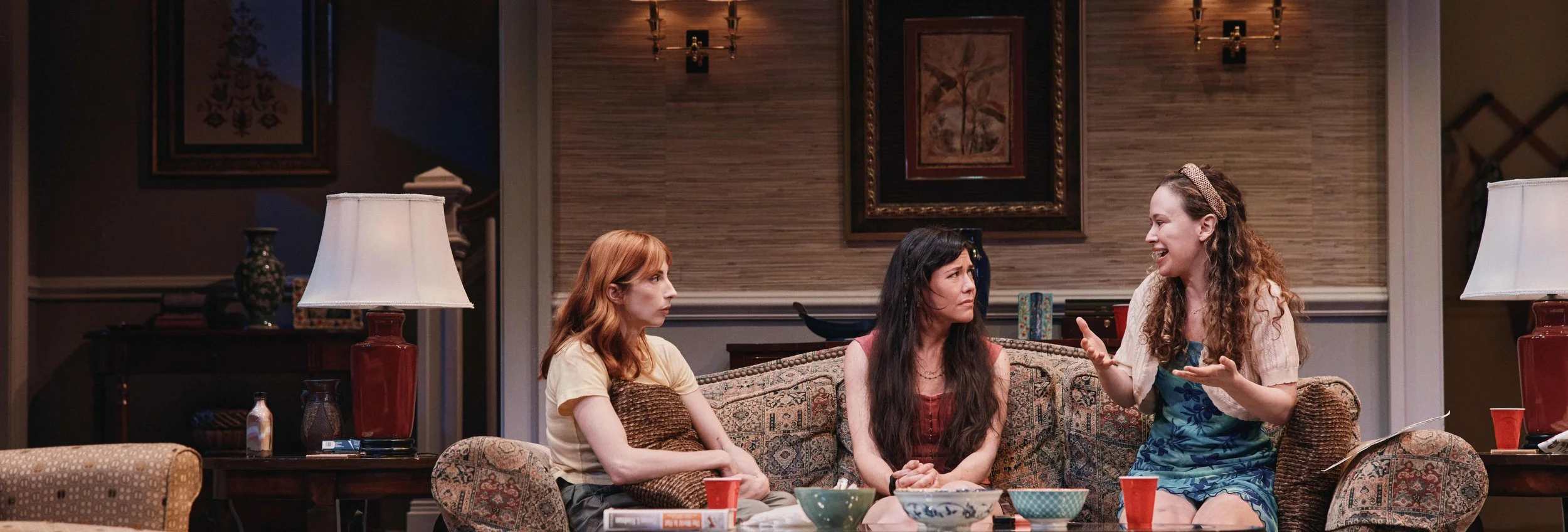
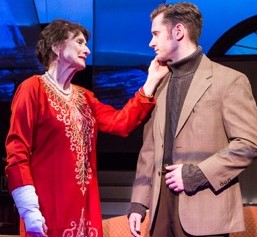
Delphi Harrington is brilliant as Amal, an overbearing, ethnic mother, one who professes to want only the best for her child but has a distinct opinion about everything. She exhibits the mannerisms and inflections of an older, well-traveled woman. Salma Shaw as her divorced daughter, Janine, comes to her aid when she has broken her arm bringing her home with her to recover. Janine is attempting to pack up her own home to put it on the market, downsize, and restart her life.

In flashbacks to 30 years earlier, the younger Amal, played by Rendah Heywood, meets a charming man-about-town, Nick (Seth Moore), at a party in Cairo. Heywood is cocktail-party elegant as she employs aloofness to counter Nick’s advances.

Nick: “Alone?”
Amal: “Married.”
Nick: “Happily?”
Amal: “Married.”
Nick: “Unfortunate.”

She eventually succumbs, wanting to be free of the oppression she feels in Egypt, yet comes to struggle with Nick’s life choices. 

A scene near the end has each of the four main actors taking a seat at the dining table, eating and arguing across one another, and at times sharing the same line. The actors’ timing is impeccable in this charged interaction, demonstrating a fluidity of movement between decades that brings the play alive. 

Amal: “You’re leaving.
Younger Amal: “I’m leaving.”
Nick: “You could use a break.”
Younger Amal: “I said I’m leaving.” Amal: “I said you’re leaving.”
Nick: “Good.” Janine: “Good.”
Younger Amal: “No, Nick, I want a divorce.”
Amal: “And what about me?”

The direction by Kareem Fahmy keeps the action moving smoothly  between decades. At times Amal remains onstage, as an observer, while her younger self and Nick interact. In one touching scene she “feels” Nick holding and whispering to her, as if she were the younger Amal, with the younger Amal standing just to the side, also experiencing Nick. 
Ahmad Maksoud dexterously plays multiple characters, including an Egyptian shopkeeper; Amal’s son, Hatem; and Janine’s younger love interest, Tom. Together, the cast brings the story of This Time to life using English, Arabic, and French. Their accents are delicious. 

Designer David Esler’s set of a house in Toronto circa 1990s transitions easily to an apartment in Cairo roughly 30 years earlier. The Toronto house is split-level with a dining room, kitchen doorway, and entry hall, stairs to a second floor, and a sunken living room. Employing five panels, scenic backgrounds transition from the skyline of Egypt to the coast of Rhode Island and winter in Toronto, gently helping to delineate location and time. 

The settings are enhanced by the sound design of Mark van Hare, from the opening sound of Edith Piaf modulating from house music to the distinct sounds of a phonograph playing in the living room. The costumes designed by Sarafina Bush are bold and smart.

Two quibbles. First, although the lighting by Scott Bolman is generally quite effective, it sometimes results in actors’ obscuring one another in shadow. It may be the result of a lack of technical rehearsal, but it can be distracting. Second, the end of the play is abrupt. The ever-giving Janine, whose children have grown and whose husband has gone, is at odds with her purpose in the world. “This is supposed to be my time,” she cries. “What the hell do I need?” The end is meant to feel generational, almost as if passing a baton from a strong woman to another strong woman; Nick’s presence is a distraction.

Too often, it seems, modern playwrights are challenged with creating a strong enough arc to engage an audience for two acts, instead relying on one long act. That is not the case with This Time. Greene’s storytelling is compelling and fresh, with engaging narratives. Piaf may have said it best, though: “As you leave, I can say, no, we will have no regrets.”

This Time is playing through May 21 at The Sheen Center’s Black Box Theater (18 Bleecker St. between Mott and Elizabeth streets). B/D/F/M trains to Broadway/Lafayette stop. For more information and tickets, contact The Sheen Center or visit sheencenter.org.

Click for print friendly PDF version of this blog post

On Your Feet for NoFit

Circus has long been a beloved popular entertainment in the United States (and in many other places around the globe). From P.T. Barnum's early acts to New York's very own Big Apple Circus, a day at the big top brings up many different associations: balancing elephants, high-flying trapeze artists, the smell of peanuts and popcorn in the air. NoFit State Circus, a collective of circus performers from Wales, presents its own modern take on this classic performance form with its latest touring show, Bianco, pitching its tent just outside St. Ann’s Warehouse in Brooklyn. .

Click for print friendly PDF version of this blog post

'Hommage' to an Idiot

Idiot, now at the lovely main space at HERE, is a feast of multimedia effects. With crisscrossed Persian carpets forming aisles that divide the audience into four quarters, video panels above, and heated Oriental rhythms in the background, the story unfolds. How to capture the innocence and depths of the epileptic Prince Lev Myshkin, portrayed by Daniel Kublick, in this theatrical version of and hommage to the great Dostoevsky novel? With a script that focuses on the tempestuous relations of four key characters of the Dostoevsky work; with philosophical riffs; with inventive use of video, light, and sound; with song, dance, gesture and interaction with the audience! This is immersive theater, a specialty at SoHo’s HERE, an award-winning theater organization devoted to the support of new work that cuts across artistic disciplines. Eve Ensler’s The Vagina Monologues was developed at HERE.

If romantic triangles usually involve a triad, the triangle in this case has four corners: the lascivious Parfyon Rogozhin is obsessed by Nastasya Filippovna. Her hand in marriage, however, is also sought by the Prince who is, at the very same time, in love with the vivacious Aglaya Epanchin. The central conflict of the play, then, concerns the Prince’s love for both women.

The fallen, dissolute, but proud Nastasya Filippovna, fetchingly portrayed by Purva Bedi, disdains money (at one point she throws 100,000 rubles of Rogozhin’s money into a fire) and sees through the lies of others no less than the mind-reading Prince himself, who loves her “out of pity.” Lauren Cipoletti plays Aglaya. Also loved by the gentle Prince, and a beauty of good family standing, Aglaya shares much with him, including a great love of children. The blue-eyed, soulful and energetic Prince Myshkin, beautifully performed by Daniel Kublick, is the “idiot” of the title. 

Rogozhin is played with verve and flourish by Merlin Whitehawk. The audience is treated to extremes of passion of the most brutal and delicate varieties; a motif of execution to emphasize the underlying question of life, its purpose and the experience of it; as well as the stormy relations among a virgin-harlot dyad (the female characters), a lecherous drunk, and an invalid Prince who is spiritual and hardly of this world.

This is the third partnering of Robert Lyons (text) and Kristin Marting (director and choreographer) in the adaptation of a work by Dostoevsky. And theirs is a rollicking and “immersive” production, to say the least. The point of immersive theater is to move past the limits of merely “watching” a staged production in order to create an experience that is more active, richer, and, presumably, deeper by “immersing” the audience in multiple theatrical effects. Always, the question must finally be asked, what exactly was accomplished by all of these theatrical goings-on?

There were arresting moments in this production. On several occasions, the sound of the Prince’s speech is engineered so that his words are somewhat muffled and have the distant sound of an echo, brilliantly suggesting the interiority of his spoken thoughts. At another point, the Prince is deeply moving as he wanders among the audience, accosts individual audience members and soliloquizes on the subject of human love, bringing some in his audience to tears.

But, for the most part, inventive use of video, gesture and dance, the dramatic story and interludes of deeper rumination do not, finally, cohere to immerse us in anything more than that spectacle itself. We are entertained but, finally, not enlarged in the course of this production.

It is unfair to require the depth of spiritual exploration and of character that is the greatness of the large and rambling Dostoevsky novel. This is another work entirely, in another genre entirely. The achievement of Dostoevsky cannot be condensed into a mere 75 minutes. But it is not unfair to ask that the heart and soul be moved in the course of those 75 minutes and, given the extremes of human feeling and experience brought into view, moved deeply. That, one would hope, is the real goal of the best work in experimental immersive theater.

Idiot plays through May 21 at HERE Arts Center (145 Sixth Ave.; entrance on Dominick Street). Performances are at 8:30 p.m. Tuesday through Sunday. Tickets are $25 and can be purchased at www.here.org or by calling (212) 352-3101 or at the HERE Box Office (5 p.m. until curtain on show days).

Click for print friendly PDF version of this blog post

The Secret's Out

Gorey: The Secret Lives of Edward Gorey is a delicious observation of a well-lived, if secret, life that is easily enjoyable even if one hasn’t heard of the subject. A writer, illustrator, and animator who is best known for his macabre cartoon books for children, such as The Doubtful Guest and The Unstrung Harp, and the opening graveyard credits of the PBS series Mystery!, Gorey left a treasure trove of ephemera and memorabilia when he passed away in 2000. Drawing from 1,074 items in Gorey’s home, writer and director Travis Russ has crafted an engaging script, assembled a trio of charming and vibrant actors and a production team that bring to life a vision of the artist, brimming with creativity. 

Phil Gillen, Aidan Sank, and Andrew Dawson play Gorey at three stages of his life: in his early 20s after college, in his late 30s, and just before his death, in his mid-70s. They interact easily with one another and occasionally break the fourth wall to address the audience. Although the dialogue carries an undercurrent of “What would you tell your younger self?” it has much more to it.

In one instance, it’s clear the older Gorey (Dawson) knows the answers to the younger Gorey’s query but won’t say, leaving the younger version (Gillen) visibly shaken. In the moments where the older Gorey relives events from earlier days, Dawson shines. Sank, the middle-aged Gorey, delves into the collection of vintage postcards of dead children with curiosity and deference. What is unique about the actors is that all three share similarities, including mannerisms and inflections. However, each delivers the attributes of the character in keeping with his period of Gorey’s life.

Russ and Carl Vorwerk, who designed the set, fill the intimate space with memorabilia, creating an atmosphere in keeping with Gorey’s collecting habits. Three tall, open-shelving units are filled with leather traveling cases, LPs (including Balanchine, a Gorey favorite), a Harvard scarf, and a myriad of notebooks. The back wall is complete with hundreds of 8½” x 11 sheets of paper with Gorey’s drawings and writings.

Lighting and projection designer John Narun uses the wall  to display videos including a clever projection where the elder Gorey “climbs” into a white frame and draws moving characters on the wall. Narun’s lighting is brilliantly crisp and dramatic. At times it is so striking that, when Gillen and Sank are seated around the writing table, their shadows on the back wall subtly appear to move in and out from a single person. Sound designer Emma Wilk with music arrangement by Chad Stoffel have an absolutely blast with an old phonograph using music from the 1940s as well as creative sound effects, in particular for the 8mm film projection.
 
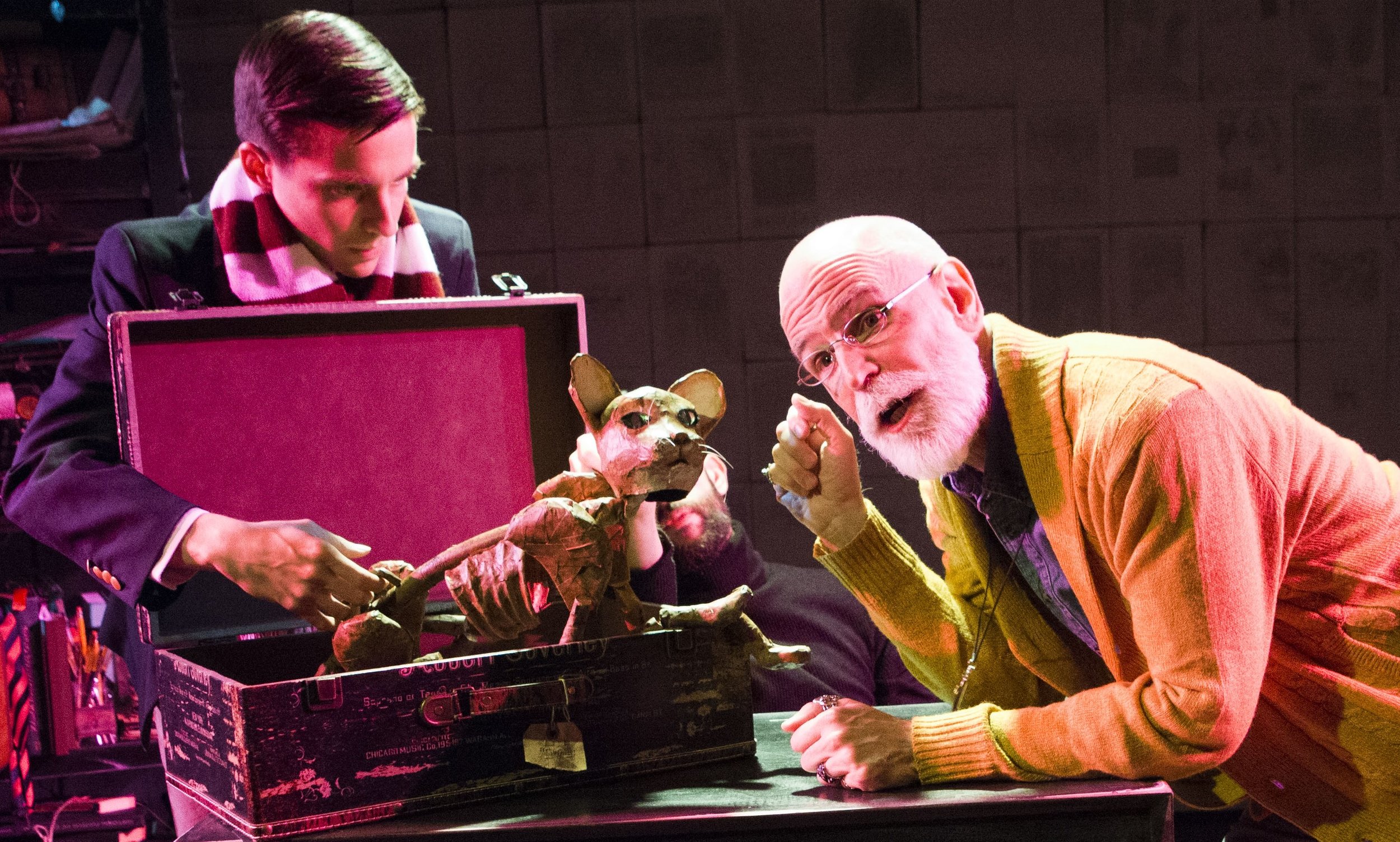
Gorey was known for his passion for cats, and in his later years wrote puppet shows complete with libretto. In homage, Russ writes for the elder Gorey: “I’m currently working on Madama Butterfly. It’s just community theater, but it fills the days. Now, I must warn you, this is not your standard, traditional Madama Butterfly. It is a modern—slightly bastardized—version. Very pastiche.” He goes on to say that the part of Madama Butterfly is played by a homeless Abyssinian cat, here created by puppetry designer Elizabeth Ostler and manipulated by Gillen and Sank.

There is a moment or two near the end where Gorey falters and seems unsure where it should end. The scenes and transitions linger a little too long, and it’s evident that the play is winding down, but when? Having used a voice-over interview previously, the use of it again seemed redundant for the finale.

For the greater part of the evening, Gorey is smart and cleverly crafted from the things the quixotic artist left behind. Gillen, Sank, and Dawson make the absolute most with the great material provided, as well as one another, in a well-equipped playground. Even seated with their backs to a third of the house, they never forget the audience, engaging them at every turn. The young Gorey enjoys one of the best lines, “You know, my friend Ted Shawn, the choreographer—he used to say, “When in doubt, twirl.” Gorey never has to resort to twirling.

Gorey: The Secret Lives of Edward Gorey is playing at HERE, 145 Avenue of the Americas through May 22. (Entrance is on Dominick Street one block south of Spring Street.). Take C/E trains to Spring Street stop. Tickets are $18, For more Information and tickets, visit  www.LifeJacketTheatre.org or here.org, or call 212-352-3101. 

Click for print friendly PDF version of this blog post

A Stroll Down Memory Lane

The Marvelous Wonderettes, a 2008 jukebox musical that is being revived at Theater Row, shows how far women have come since the days of the Drifters, with naive bobby-socksers at the high school gym lost in crinolines and pink. Roger Bean’s playful show features a nostalgic storyline that spans the decade 1958-68 as it focuses on the lives of four women in high school and then, in the second act, at their 10-year reunion.

Christina Bianco plays the bossy, fiery Missy, who is in love with their teacher, Mr. Lee. Kathy Brier is Suzy, happily in love. Jenna Leigh Green is the vamp, Cindy Lou, and Sally Schwab portrays the ever-duped-in-love Betty Jean. Each character represents a different aspect of women’s issues, whether it’s marriage, work, or loyalty, and the story follows the evolution of women’s rights. As the girls weave their narrative of life since the high school prom around the lyrics of the old favorites straight from the American Bandstand Top 10 charts, the audience gets a sparkling overview of women’s struggles to make their dreams come true.

Under the direction of Tom and Michael D’Angora, the top-notch cast share a glimpse at that journey as they deliver the lyrics of the oldies but goodies, such as “Leader of the Pack” and “Son of a Preacher Man.” The production is full of color and glitz; it feels like memory—the way the mind’s eye makes it pretty and delusional about how simpler the times were then. It is not a thought-provoking, deep show, even though Bean hits on some serious themes, such as women coming together in sisterhood rather than being pulled apart by the social forces that have often oppressed them, though the themes are not fully realized yet.

The women sing with superb harmony (the musical director is William Wade) and dance, perfectly synchronized, to the choreography of Alex Ringler. The well-rehearsed moves work beautifully as the women swirl in their jelly-bean-colored prom dresses, created by Bobby Pearce. All the chiffon and crinoline in rhythm with the music makes an audience sway and bask in the joy of more innocent times. 

William Davis has designed a crisp, clean set of right angles and Day-Glo colors—exactly what is remembered of those halcyon days. With family-friendly slapstick, the direction is perhaps a bit too over-the-top in its pantomimed physicality, but at the same time it is faithful to the period variety shows like those of Red Skelton and Jackie Gleason.

The high school competition between Cindy Lou and Betty Jean over the unseen, two-timing Johnny has the potential to make some important points about women and how they are pitted against one another because of society’s codes, but as yet isn’t strong enough. This becomes more obvious in the second act, when the girls come back to perform at the 10-year high school reunion. A very pregnant Cindy Lou, crying her woes over a faithless husband, embodies the issue of staying committed to a marriage and raising a family in an unhappy union.

Meanwhile, Missy, who is still trying to catch Mr. Lee and yet hold onto her own identity, is a clear reflection of the issues of independence women faced during this period. As the girls rally around her and berate the unawares Mr. Lee (played by an audience member brought on stage), reminding him that “He doesn’t own her,” the ladies improvise terrifically.

This is a classy production with a group of very talented young women. Although it’s a fun blast from the past, we really have come a long way, baby.

The Marvelous Wonderettes is playing at the Kirk Theatre (410 W 42nd St.) in an open-ended run. Evening performances are at 8:15 p.m. Wednesday and Thursday; matinees are at 2:30 p.m. Wednesday 3 p.m. Sunday. For tickets and information, visit http://www.theatrerow.org/kirknowplaying or call (212) 239-6200.

Click for print friendly PDF version of this blog post

Bodily Functions

What’s odd about Body: Anatomies of Being at the New Ohio Theatre, is that, as much as it wants to break the audience out of being shocked by nudity, the script doesn’t measure up. The dialogue goads the audience to be comfortable with the body and all of its functions, “Wake up. Fart. Pee. Blow nose while pooping. Burp. Yawn. Drink water. Burp. Cough. Blow nose. Pick at clogged hair follicle under right arm. Burp.” But seriously, to what end? When all the actors have plucked and trimmed their pubic hair to a landing strip, are you really that comfortable with the body? A number of challenges steer this production off purpose.

Click for print friendly PDF version of this blog post

Bringing Home the Bread

Six men who work in a bread factory call themselves “bread plant operatives,” a glamorous, James Bondian phrase to describe a life of working-class burden, in Richard Bean’s Toast. First staged in 1999 and now revived at 59E59 Theaters as part of Brits Off-Broadway, with Snapdragon Productions, Bean’s freshman play is littered with such comeuppances to the class divisions inherent in British society. Its main players are blue-collar breadwinners (and bread-makers) who live paycheck to paycheck; they are given to cursing creatively, and often, about their jobs, their wages and their “lasses.” Bread isn’t the only thing that’s baking in Toast; director Eleanor Rhode imbues nervous energy into a production that proves both raucously entertaining and moving. 

It’s the 1970s, and a side-burned Blakey (Steve Nicolson), the foreman at the Rosedale Street Bakehouse, is clocking in. In the canteen, he (obviously) makes himself a cup of tea, before grudgingly greeting Colin (Will Barton), a harrumphing, middle-aged man with strike wages to complain about. Three other players also enter: Peter (Matt Sutton), a talkative young man with an ambitious itch; Cecil (Simon Greenall), an ever-smiling, avuncular bread-maker and Dezzie (Kieran Knowles), a former ship’s deckhand with a new home, and incidentally, a loving wife who takes hot-water baths—a luxury in their lives. Lumbering through these life-threads is Nellie (Matthew Kelly), a bread mixer at the factory for 30 years and the type of man who works ceaselessly and unquestioningly till senescence overtakes him. 

At the behest of his (unseen, yet somehow still present) boss Mr. Beckett, Blakey takes a student called Lance (John Wark) under his wing. Immediately out of place in his tweed jacket and crisp, affable accent, Lance is an outsider in the blue-collar bubble of the bread factory. We, like Lance, slowly grow accustomed to the spirited slang of Northern English accents: “‘Kinell!” “Are you pulling my plonker?” He might as well be from another country, as the audience is, and still feel the same rift in social connection. The other workers immediately nickname him “Sir Lancelot.” But in due course, Lance begins to tease and pull at Toast’s existential strings; class conflict is negated in the face of wanting to live a meaningful life, it seems. 

All are worried, some violently so, that the factory’s central oven will break down and put them all out of work. When a tin inside the oven gets jammed, tempers flare and panic sets in. It’s indicative of the weight and salience these men afford their jobs. To say that Nellie’s work is his life seems a conflation of identities—his life’s work is baking bread. His legacy is baking bread. A threat to their labor, which shares so intimate a friendship with life for these characters, is tantamount to sacrilege. “The bakehouse is my church,” says Blakey, for there is no other arena of life that exists so dependably, and so religiously, as his work at the bread factory. 

Unsurprisingly, Bean’s particular brand of screwball satire, most famously shown in One Man, Two Guv’nors, is found only in shades here. Peter and Cecil carry on a balls-grabbing competition; Blakey gives his crotch a great deal of unconscious comic readjustment as well. Yet for all of Toast’s good humor, farce gives way to a darkly spiritual kitchen-sink drama.

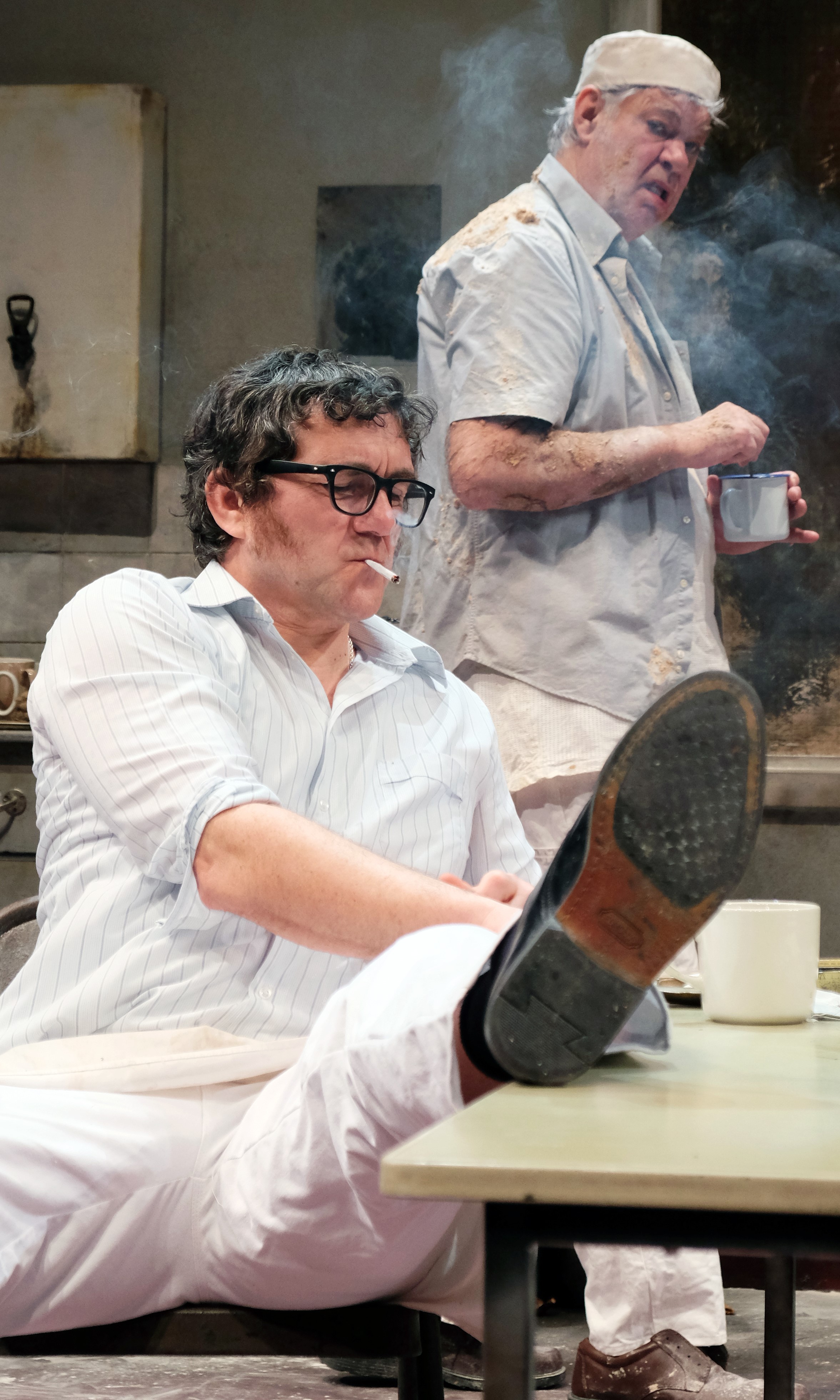
Rhode’s trump card is Matthew Kelly’s devastatingly haunting portrayal of Nellie, the ever-laboring, broken yes-man. Arms varicose with dermatitis and lungs heaving with cigarette smoke, Nellie’s monosyllabic dialogue leaves plenty of room for an actor of Kelly’s ability to indulge in invention, and he does not disappoint. Even Kelly’s deadpan stares take on uncomfortable, survivalist meaning. Is his reticence keeping him sane as he mixes bread day in and day out, year after year? John Wark’s Lance is a chattering antithesis of sorts to Nellie’s silence, yet has the most trouble keeping his wits about him as the play proceeds. 

The fairly stifling vacuum of factory life, so apparent in the nervous, chaotic conversations of the characters, is almost nonexistent in the physical space that Toast occupies. Set designer James Turner has made the canteen a blinding white and pastel blue; stark white light bathes the canteen (Mike Robertson is the lighting designer) almost constantly. Swinging doors lead out towards the factory, while a Max Pappenheim’s constant soundtrack of grinding machinery plays behind each performance. Holly Rose Henshaw has provided appropriately understated clothes that affirm the greatest concern of the characters: their job. 

But spread on every open surface is a fine film of white flour. It sticks to the walls, on door handles and the forearms of the workers—it is the non-erasable costume that the characters wear, reminders of their station. Matt Sutton’s Peter hastily wipes every chair before sitting down on it, but it manages to stick to his bell-bottomed jeans all the same. 

Richard Bean’s Toast runs in the Brits Off Broadway festival at 59E59 Theaters (59 East 59th St., between Park and Madison avenues) through May 22. Evening performances are at 7 p.m. Tuesday through Thursday at 7 p.m. and at 8 p.m. Friday and Saturday; matinees are at 2 p.m. Saturday and 3 p.m. Sunday. Tickets are $70. To purchase them, call Ticket Central at (212) 279-4200 or visit www.59e59.org.  


Click for print friendly PDF version of this blog post

No Words…

The thing most everyone loves about birds is their ability to fly, yet one of the first things we do is catch them and put them in a cage. The same can be said of love. Told without a single spoken word, Butterfly, currently at 59E59 Theaters, unwraps a story of a kite-maker who is courted by a customer but is smitten with a butterfly catcher. The hour-long production is rich with symbolism, European and Asian sensibilities, and movement choreographed to haunting original music.

Click for print friendly PDF version of this blog post

Vive ‘Le Dingdong’!

Director Hal Brooks unbridles five actors in The Dingdong, Mark Shanahan’s updated adaptation of Georges Feydeau’s 1896 farce Le Dindon. He propels it even further into the absurd by having those five actors bring to charming, boisterous and nuanced life 12 distinct characters.

The farce begins with Lucy Vatelin (Rachel Botchan), a married woman, attempting to slam the door on an overzealous suitor, Pontegnac (Bradford Cover). With Pontegnac’s arm and leg precariously lodged in the door, she is leaning against it, insisting he go away. “Everyone this side of the Seine heard you shout that you wanted to make passionate love to me!” she complains loudly, while screaming for her husband to save her. Unfortunately, Pontegnac is an old friend of her husband (Chris Mixon). 

Lucy has another suitor, Redillon (Brad Heberlee), who calls on her as well. With Vatelin out of the room taking a business call, Redillon and Pontegnac square off. Meanwhile, Mme. Pontegnac (Kelley Curran), suspecting her husband's infidelity, has followed him to the Vatelins’ home, where Lucy, worn down, makes a pact with Pontegnac, agreeing to have an affair with him if her husband should ever be unfaithful. Pontegnac knows full well he hasn't been.

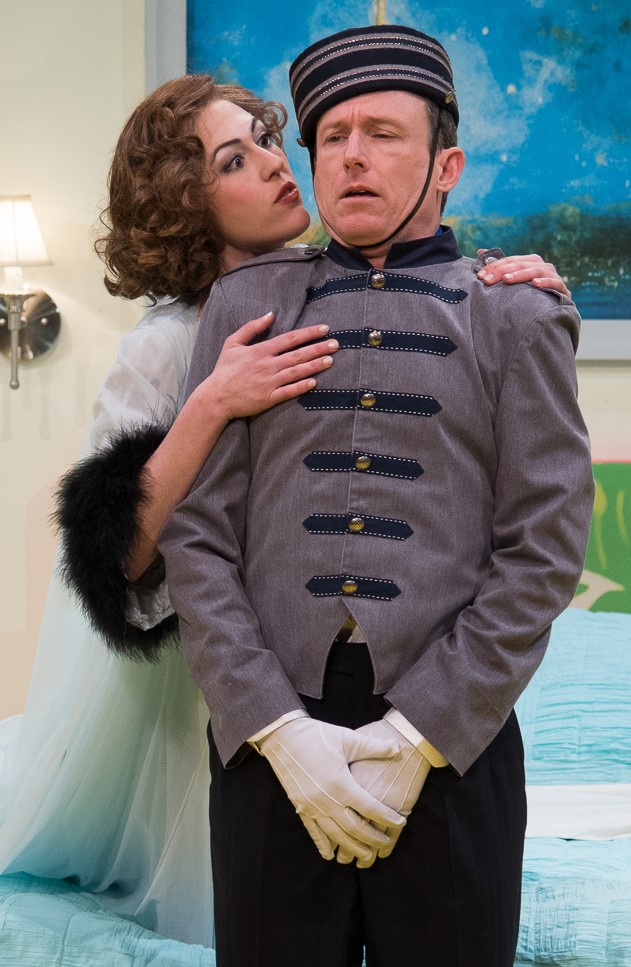
The first-act characters include Fabiola (also Curran) as Vatelin’s Italian lover, who has traveled to Paris (with her Hungarian husband) to find him and profess her love. The second act introduces even more, at The Hotel Ultimus, with doors slamming, a 17-year-old bellboy and a Parisian policeman (both played by Heberlee), luggage mix-ups, a French chambermaid, an old, practically deaf woman (Botchan) with uncontrollable flatulence, and a New Yorker named Mandy (Curran).

Two multifaceted performers capture the pure essence of farce in their multiple roles. Kelley Curran bursts onto the stage as the epitome of a sophisticated, bold Frenchwoman and shortly after reappears as an Italian lover with all the bravado of an early Sophia Loren. Act II opens with Curran as Mandy and, only to outdo herself, she closes the play as a fetching French maid. Wigs, costumes and shoes take an actor only so far in a role—Curran is each character.

Heberlee is also a delight, energetically embodying three characters—the flamboyant, sex-driven Redillon (who is a doppelgänger to Feydeau), the bellboy and the policeman. It is his role as Redillon in Act I, at one moment writhing on the floor and professing his love to Lucy, and in the next attempting to explain to Vatelin why he is on the floor (he is cleaning, after all) that is the most endearing. During the standoff with Pontegnac the actors pose like two preening cocks in the farmyard, arguing who is the greater lothario (“I would never discuss matters of intimacy with another man’s wife”).

Cover appears to have the most difficulty playing multiple characters, relying on his best Tim Conway impression, at times shuffling or gasping before each line. Act I finds him and Botchan in awkward and unnecessary movements with odd pacing.

Designing a 1938 French townhouse, Sandra Goldmark uses striking black and white striped walls, a sunrise-yellow floor, and tone-on-tone fabric chaises for Act I. Lighting designer Mike Inwood adds a wonderful layer of sunlight streaming through a lattice window. In Act II, at the Hotel Ultimus, there are bright green and yellow panels with a matching headboard and bedspread. A brief set change and the scene becomes the Honeymoon Suite of the Hotel Rue Cromartin, where the stagehands, decked out à la Marcel Marceau, replace the fabric with bright red floral patterns, as well as a painting of the Eiffel Tower.

Working in concert with the set designer, costumer Amy Clark mixes and matches contrasting colors and patterns. Her attention to detail with smart wigs and colorful hats, down to gartered socks and Redillon’s man-about-town look, is like pure icing on a Pimm’s Cup cupcake from Prohibition Bakery.

George Feydeau is one of the most famous writers of bedroom farce, and Mark Shanahan’s adaptation is a remarkable homage. Witty banter, along with exaggerated physicality, are at the heart of The Dingdong. Even the most pursed lip might be cajoled to laugh out loud.

Performances run through May 15 at the Pearl Theatre, 555 West 42nd St., (212) 563-9261. Tickets are $65 regular, $85 premium ($40 members, $20 student rush, $20 Thursday rush). Visit pearltheatre.org for specific dates and times.

Click for print friendly PDF version of this blog post

Laughs, Both Light and Hearty

By the time that Richard Brinsley Sheridan premiered The School for Scandal at London’s Drury Lane Theatre in 1777, the era of licentious, innuendo-ridden Restoration comedies had long passed. So, too, had the more recent heyday of sentimental comedies, which sanitized the dirty-minded plots and dialogues of the Restoration in order to produce what Sir Richard Steele called “a pleasure too exquisite for laughter.” With its good-hearted lovers and amoral gossips, Sheridan’s The School for Scandal fell somewhere between Restoration and sentimental comedy. Red Bull Theatre’s production of Scandal, directed by Marc Vietor, delightfully balances this classic play’s sweet, charming love story and its bawdy, boisterous comic gags.

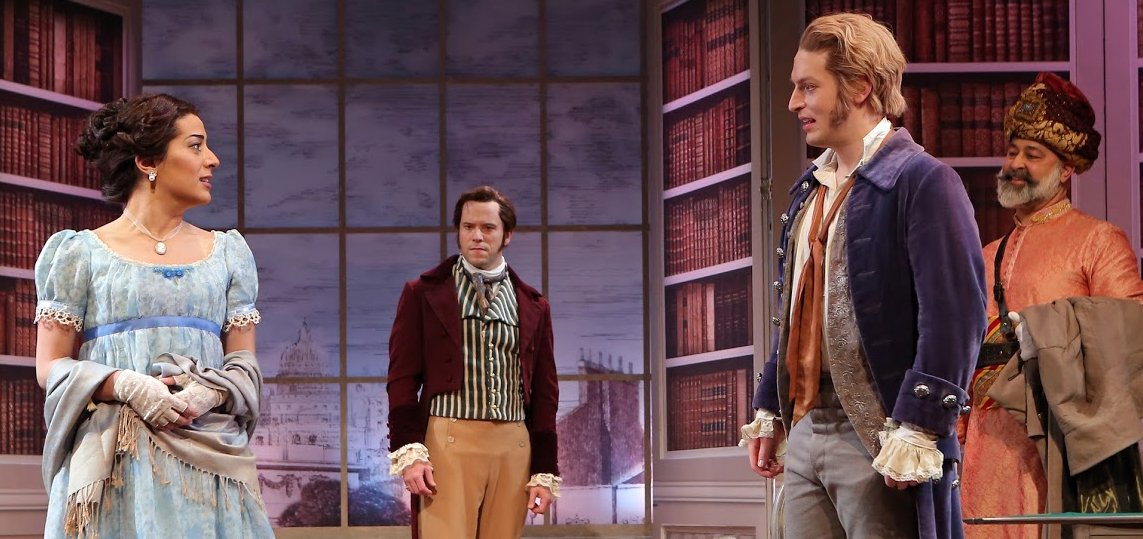
Examining the foibles of 18th-century British society, The School for Scandal weaves several plot lines together.  First, there is a salon of gossips, led by Lady Sneerwell, who keep a collective ear to the ground for any and every morsel of news about town. Lady Teazle, the young wife of Sir Peter, is one of Sneerwell’s lackeys and is becoming dangerously flirtatious with Mr. Joseph Surface. He and his brother, Charles, are vying for the love of Maria; but while Joseph is after her family fortune, his financially ruined yet idealistic brother truly loves her. Meanwhile, the brothers’ uncle, Sir Oliver, returned from the East Indies, decides to observe his nephews’ affairs in disguise. 

Known for its curation of historical works with heightened language, Red Bull Theater is a venerated and well-supported Off-Broadway institution. The production values of Scandal’s costumes, lighting, and set design are remarkably high. Anna Louizos’s functional and dynamic set beautifully absorbs the precise lighting design by Russell H. Champa. Louizos and Champa take few risks in their designs, but this simplicity suitably frames the more ornate costumes and acting.

The wigs and costumes by hair designer Charles G. LaPointe and costume designer Andrea Lauer are themselves characters in this show. LaPointe’s wig creations for the play’s active gossips (including Lady Sneerwell, Mr. Snake, Lady Teazle, and Mrs. Candour) are as overdone and extravagant as the stories these characters fabricate in their salons. Lauer takes some historical liberties with her costume design, such as Mr. Midas’s mobster look and Lady Sneerwell’s leopard-print bodice, but her real shining moment is in her selection of colors and textures. Lustrous brocades, sparkling lace trimmings, dainty rosettes: down to the last detail, Lauer’s costumes take center stage in every scene. Viewers will delight in the curtain call, when the entire costume design comes together, revealing a veritable rainbow of characters.

This is not to say that the actors are upstaged by the resplendent costumes. On the contrary, the cast brings forth a delightful, stylized, and measured ensemble performance. This is an especially formidable accomplishment because of Sheridan’s love of soliloquies, which offer an actor plenty of opportunities to ham it up at the expense of other cast members. Each actor takes his shining moment, but no character seems to be pulling all the comic or dramatic weight.

As Sir Peter Teazle and Lady Teazle, Mark Linn-Baker and Helen Cespedes manage to elicit some likability amid their constant bickering. Though they are not so likable, the gaggle of society gossips is alternatively hilarious. Led by the Tony-nominated and Obie-winning Dana Ivey as Mrs. Candour, these colorful characters drum up energy and humor whenever the production begins to lull. Also notable are the vocal and physical comedic choices of Sir Benjamin Backbite (Ryan Garbayo), his uncle Mr. Crabtree (Derek Smith), and especially the foppish Mr. Snake (Jacob Dresch). Quadruple-cast in the small roles of Rufus, William, Hastings, and Trip, Ben Mehl manages to find a different delightful quirk for each servant.

Overall, Vietor’s direction emphasizes the skills of these well-trained actors, as well as the polished design elements. The infamous screen scene in Joseph's parlor is delightfully blocked for maximum ridiculousness. The pacing flows, and the jokes are well-timed.

The scenic transitions are their own little mini-vignettes. The production is, in a production sense, largely flawless. Paradoxically, the play's flawlessness is its only fault—and this is also the weakness of Sheridan’s genre. While it is nice to escape to a world in which good is good and bad is bad, the polished morality and well-made plot of The School for Scandal may feel too much like a fairy tale for a viewer to relate to it on a more personal level. Nonetheless, the production elicits laughs both light and hearty and is an excellent example of the genre.

Red Bull Theatre's The School for Scandal runs through May 8 at the Lucille Lortel Theatre (121 Christopher St. between Hudson and Bleecker). Evening performances are at 7:30 p.m. Tuesday and Wednesday and 8 p.m. Thursday through Saturday; matinees are at 2 p.m. Saturday and 3 p.m. Sunday. Tickets are available at the Red Bull Theatre’s website, redbulltheater.com, or by calling (212) 352-3101.

Click for print friendly PDF version of this blog post

Sins of the Past

Scottish playwright Sharman Macdonald’s When I Was a Girl I Used To Scream and Shout, directed by John Keating, at the Clurman Theater, captures the tensions that often exist between parents and children. In this case, the play centers on a mother’s attempt to reconcile with her daughter. Morag (pronounced “MORE-ag”), played primly with repressed exuberance by Aedin Moloney, treats her daughter, Fiona, to a seaside holiday on the Scottish coast—to the town where they once lived.

Morag has a difficult time connecting with Fiona, who, at 32, is childless and unmarried. Morag is upset that Fiona hasn’t given her any grandchildren and tells her that “every woman needs to have a child” and, later, “a woman’s body is a clock that runs down rapidly.” Fiona, played by Barrie Kreinik with the needed detachment that comes from a childhood of disappointment, is also a vegetarian, a lifestyle choice that her mother understands as little as her marriage and childless state. In John Keating’s production, Luke Hegel Cantarella’s simple set allows rapid scene changes between the past divisions and the present encounter of the two women. The whole is enhanced by the lilting music of Paddy Moloney of the Chieftains.

Morag talks a blue streak and, as Fiona says, “cares passionately about everything: life and a ham sandwich.” Morag has packed not only tea in a thermos, but coffee and a picnic basket full of sandwiches and other goodies. Morag is clearly prepared for the activities that people undertake in life, but not really for life itself. She has believed so firmly in the traditional institution of marriage that it led her to make choices that deeply affected Fiona. Five years after Fiona’s father left, she finally met a new man whose work will take him to the Middle East. Morag makes arrangements for Fiona to live with the family of her best friend, Vari, played with spunk by Zoe Watkins. But Fiona wants her mother to stay. After all, she’s only 15.

Morag, however, chooses the new man over her daughter, and while she’s making plans to leave, Fiona is looking for ways to make her stay. She finds what she thinks is a surefire solution: getting pregnant. Having explored her sexuality with Vari, Fiona lures Ewan (Colby Howell), a winsome boy a few years older than her, and one whom Vari had let kiss and fondle her, to the beach and tells him she’s ready to have sex. He’s eager to lose his virginity so willingly gives in. Fiona gets pregnant as a result of that encounter, but the plan backfires, and her mother still goes off with her new husband. It’s a bitter pill to swallow, and Fiona’s sadness over her past abandonment engulfs her. We see why Fiona’s mother wants to reconcile with her daughter, but it’s very hard for people to change. Morag only knows one way: her way. Her ideas about life hang in delicate balance. If she didn’t believe in what she had done—choosing a husband (a man) over her daughter—life probably would have broken her.

In comparison to Fiona’s childhood friend Vari, who has let herself become fat as a result of an unsatisfying marriage and three children, Fiona is thin and independent. Vari calls Fiona a “privileged feminist.” However, in reality Fiona is haunted by the ghosts of the past. She carries her confusion and resentment silently into the present. At the end of the play, when her mother begs her to talk to her, Fiona sits stonily beside her, but the fight is gone. Perhaps the barriers of contention have finally been torn down on this seaside excursion. At least, the vision of the three women eating a soft ice cream and sharing a shot of whiskey indicates a ray of hope that the wounds of the past and the relationship between mother and daughter will eventually be repaired. 

Fallen Angel Theatre Company's production of When I Was a Girl I Used to Scream and Shout is playing through May 8 at the Clurman Theatre on Theater Row (410 W. 42nd St. between Ninth Avenue and Dyer Street). Evening performances are at 8 p.m. Wednesday through Saturday; matinees are at 2 p.m. Saturday and 3 p.m. Sunday. Tickets are $46.25; for more information visit fallenangeltheatre.org or telecharge.com


Click for print friendly PDF version of this blog post

Gather, Ye Illuminati Hopefuls

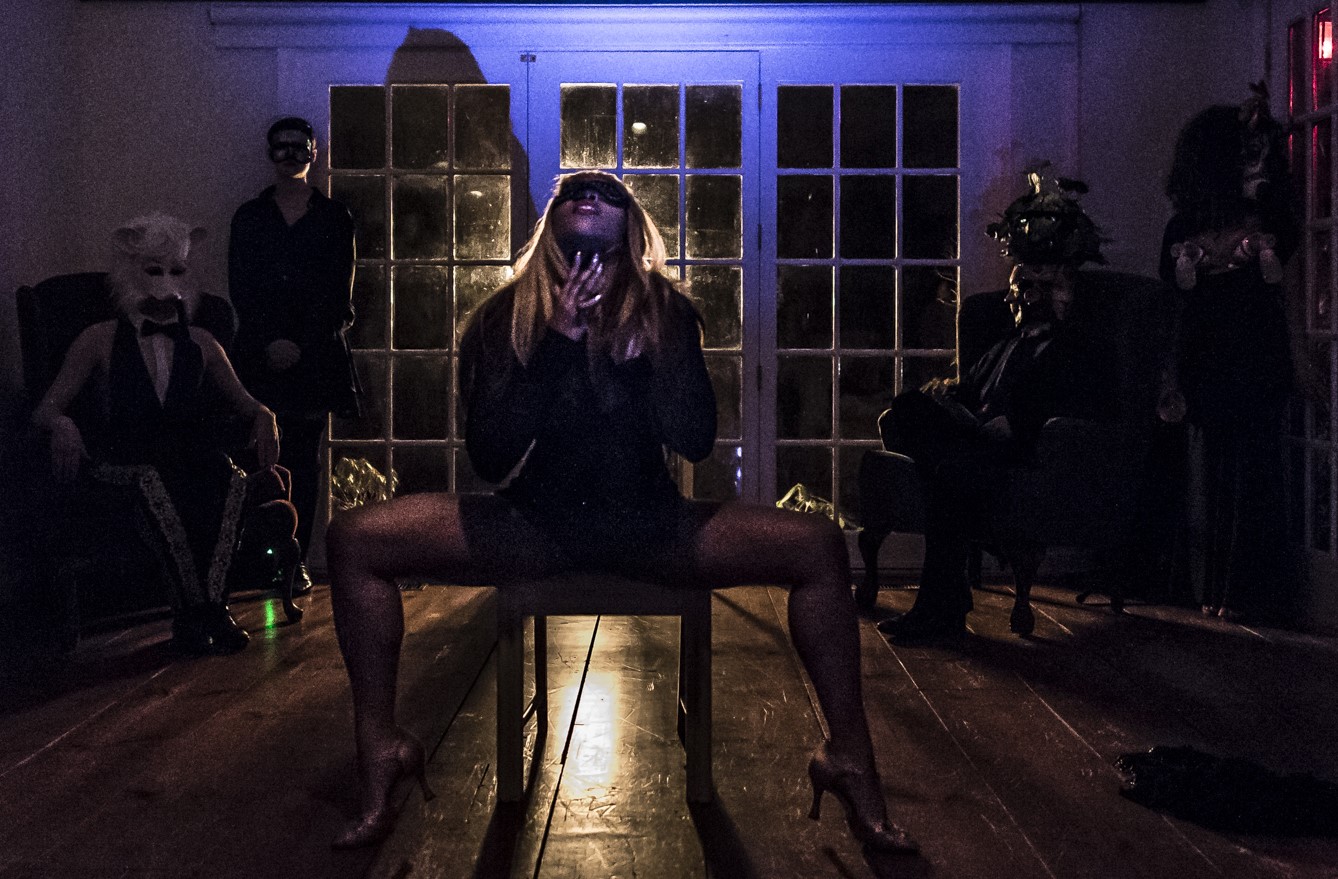
In 1972, wealthy Parisian socialite Marie-Hélène de Rothschild threw an elaborately occult Illuminati Ball at her family’s chateau. Guests of honor included Salvador Dali and Audrey Hepburn, and the coveted invitations requested “black tie, long dresses, & Surrealist heads.” Today, nearly 50 years later, immersive maven Cynthia von Buhler reimagines the Illuminati Ball at her estate, and her guest list could include you. Known for her previous immersive productions Speakeasy Dollhouse and Midnight Frolic, von Buhler is at it again with her most exclusive experience yet. 

Like the original Rothschild event, von Buhler takes care to construct an atmosphere of selectivity and secrecy beginning at the participant’s initial point of entry. Potential guests must apply for attendance and, once chosen, are delivered precise instructions on what to wear and where to meet. Von Buhler then shuttles participants to her estate via a limousine fitted with blackout curtains. For even the most seasoned immersive theatergoers, the secretive applications, invitations, and strict instructions are enough to drum up some excitement and anticipation about the evening to come.

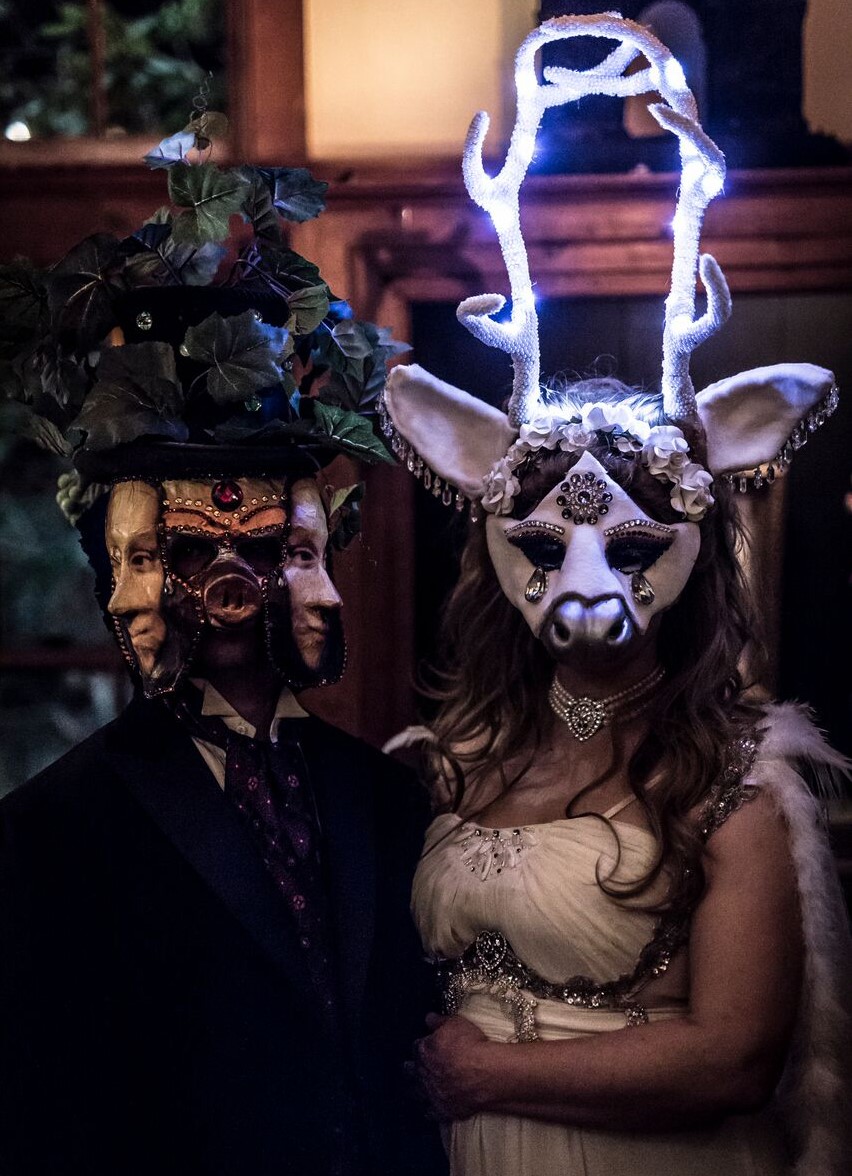
Once at the estate, participants are greeted with an intriguing welcome ritual, which sets the mood for the evening’s slate of variety performances. The masks and costumes designed by Kat Mon Dieu skillfully echo the leaked photos of the original ball, reiterating the pagan imagery of hybrid human-animals that continues throughout the experience.
 
As in Midnight Frolic, von Buhler convenes a dream team including burlesque legend Delysia LaChatte (Circe), operatic songbird Katie Kat (Parthenope), and fire performer Lady Blaze. LaChatte especially captivates with her dynamic fan and chair work (and as a woman of color she also adds some much needed diversity to the cast). During dinner, aerial duo Rachel Boyadjis and Sara Zepezauer will leave guests speechless with their strength and sheer beauty.  While strong female performances recur in Illuminati Ball,so does female nudity. Oddly, however, none of the men in the production disrobe—an unfortunate perpetuation of traditional gender politics. 

While the individual talents of the interspersed performances provide ample diversions, certain aspects of The Illuminati Ball disrupt its immersive flow. A bit of shuffling amongst organizers while boarding and riding the limousine partially dispels the illusion that participants are actually being considered for candidacy in the Illuminati. While it is no small feat to conceal the complicated logistics involved in such an elaborate immersive experience, the success of the production relies on this very concealment. Furthermore, Illuminati Ball seems only partially committed to its narrative. Some performers, such as the honey-voiced Eden Atencio as Kamadhenu and von Buhler herself as the heiress of the estate, seem more committed to interacting candidly with audience members.  Other characters seem more concerned with advancing the plot, which crescendos confusingly in the middle of dessert. Transitions between dinner, group scenes, and individual interactions feel a bit like herding cats.

Casting the production’s somewhat disjointed storyline aside, Illuminati Ball provides something else far more special in its discarding of the fourth wall. The ability to eat with and interact with the actors and the fellow attendees is the production’s greatest joy. 

The conviviality is amplified by the evening’s spread of small plates and cocktails, the quality of which far surpasses any usual dinner theater fare. The dinner, lovingly prepared and artfully plated by chef Erin Orr, consists of delightful colors and textures. The real sorcerer behind this production is mixologist Bootleg Greg, whose (virtually unlimited) flavorful concoctions fuel the evening’s revelry. For better or for worse, the drama of Illuminati’s muddled storyline is eclipsed by the evening’s more sensual pleasures of food, drink, socialization, music, and dance. In any case, the most pleasant surprise of The Illuminati Ball is its unique ability to facilitate connections among audience members, actors, and performers as they carouse in the moonlight. 

The Illuminati Ball: An Immersive Excursion by Cynthia von Buhler runs bi-monthly on Saturday evenings through Aug. 20 (specific dates here) at 6 p.m. at a secret location one hour outside of Manhattan. Apply for attendance here

Click for print friendly PDF version of this blog post

Loss Takes On Many Forms

Holding on to the past can weigh upon a family. In her first play, Keep, Francesca Pazniokas explores how the emotional weight of a missing woman burdens her three sisters. Keep is inspired by her years of struggling to mask an addiction to hoarding. The production centers on a young hoarder, Naomi (Kim Krane), and her older sisters, Jane (Madison Comerzan) and Kara (Jenna D'Angelo). As Jane and Kara attempt to clean Naomi’s cramped apartment, they learn about what happened to their sister, Margo (Leslie Marseglia), who disappeared some years earlier. No, Jane and Kara do not find Margo’s decaying body underneath Naomi’s rug. Instead, they discover how disconnected their sisterhood has become.

Naomi does not sleep much and spends most of her time within a small area of her apartment, surrounded by junk and next to her filthy mattress. Jane and Kara arrive, and the three women blend together. They give bland first impressions as characters and are not easily distinguishable. Shortly after, Jane is revealed as more than a doting, artificial suburbanite who affectionately calls Naomi “Nooni”; she’s a lesbian who is in a relationship with a psychiatrist. Kara takes on a reckless and commanding leadership role and demands that the apartment be cleaned. Meekly, Naomi follows along with uncluttering her apartment and goes in and out of spouting incoherent passages like, “A rabbit, I think. A rabbit kicks a clot of blood and it–or someone boils it. I’m trying to remember. I think it was a rabbit.”

What doesn’t ring true is the sense of an actual intervention like those shown on an episode of A&E’s addictive television show Hoarders. The twist that is offered in Keep does not cure Naomi of her hoarding disorder. Other disorders like attention-deficit/hyperactivity disorder (ADHD), obsessive-compulsive disorder (OCD), obsessive-compulsive personality disorder (OCPD) and depression can be associated with hoarding. It is ambiguous if Naomi is struggling with any of these associated disorders or if she is just schizophrenic or bipolar. Hoarders are likely to be more guarded and attached to their items than Naomi’s passive nature indicates, and so Naomi’s hoarding disorder lacks some credibility. Although director Stephanie C. Cunningham brings out the sense of loss the sister feel, perhaps she could have urged bolder character choices.

The play is supposed to take place somewhere along the East Coast during the transition from winter to spring, but this is also ambiguous. Set designer Alfred Schatz creates a hoarder’s haven, with stacks of unpacked moving boxes, piles of old mail, and random pieces of furniture. It is like an antique store that has been turned into a storage unit. The set becomes enchanting after Margo appears, when lighting designer Cate DiGirolamo transforms the ceiling into a sparkling starry night.

The storytelling techniques used to show how these three sisters deal with the loss of Margo is the real value of this 80-minute production. Though they start out seeming indistinguishable, it becomes clear that Naomi lives in the past, Kara lives in the present, and Jane lives in the future. The distance between the three of them also brings them together because the separation reminds them of the intimacy they all once shared. Only Naomi really knows what happened to Margo, but, through the help of Jane and Kara, Naomi eventually reveals the truth.

Although simple and subtle, the play lands like a character study, without strong motivations from the characters. Because the characters do not coherently or explicitly stand for something, it is the plot that eventually moves the discussion forward. Pazniokas aims to dive deep into America’s “disposable society” and the value of human life, but lands somewhere between vaguely characterizing mental illness and grief.

The production is more successful at conveying how young women cope with isolation and alienation. The sisters’ disconnection is not due to modern technology or even mental illness in Keep, but because these characters have withheld who they really are from one another for so many years. The bonds of sisterhood began disintegrating after Margo left; the absent sister is the only one who frees herself of this burden but is unsuccessful at transforming her sisters—and this is where the true divide lives. Keep reminds theatergoers that the affinity shared between sisters can be powerful and ephemeral.

Keep runs until April 30 at the TGB Theatre (312 West 36 St., between 8th and 9th avenues) in Manhattan. Evening performances are at 8 p.m. Thursday through Saturday; there is an additional performance on April 27 at 8 p.m. There are no matinees. Tickets cost $18. To purchase tickets, call 800-411-8881 or visit BrownPaperTickets.com.

Click for print friendly PDF version of this blog post

Breaking Gender Barriers in ‘Shrew’

New York theater is known for challenging the status quo, and  that is what the Queen’s Company is all about—breaking down barriers by creating gender-blind performances of the classics and reaching out to a broader, more diverse community in its perspective on those classics, in particular Shakespeare. Artistic director Rebecca Patterson’s vision shows she understands that Shakespeare transcends time and place. His characters represent all of humanity and hit at a deeper core—the truly humane one. Because every actor was cast according to how her personality fit the role, not according to gender, the production is an organic ensemble theatrical experience.

photo by Bob Pileggi

Patterson, a Lucille Lortel Award winner, is an actor’s director. Every moment in the play was active, honest and alive with brilliance. Having the role of Bianca played by the lovely Sweetie Doll (a blow-up sex doll) was a hysterically funny touch. In that single choice, Patterson shows one of the most important themes of the play—women’s oppression by men’s control of sexuality. Choices in music that fit key moments of the performance further heighten that theme and the emotional tension of this famous love story. Particularly funny yet thought-provoking was the pantomime of a Tina Turner song performed by Petruchio’s motley servants, led by Ashley Samona Baker as Grumio. As they perform, Katharina fights her shrewish instincts to be right. The lyrics and their playful performance reveal the inner conflict of that moment when Kate breaks and realizes she is fighting a losing battle.

The cast is perfect. The entire ensemble deserves praise for playing multiple roles with ease. Elizabeth Preston as Petruchio was spot on. Catherine Dalton as Hortensio was delightful in her Brant Russell physicality. Their playful interaction was reminiscent of Orlando Bloom and Johnny Depp in Pirates of the Caribbean. But Preston was no overacting pirate; she was more like Depp in Chocolat—sexy, sensitive, cool. She captured Petruchio’s arrogance and willfulness, but also his vulnerability. Preston reveals Petruchio’s genuine respect and interest in Katharina when Petruchio reflects on how Katharina aggressively deals with Hortensio as the ill-fated music instructor: “Now, by the world, it is a lusty wench. I love her ten times more than e'er I did.” Preston’s performance breaks the gender barriers, yet nothing is overstated or falsely posed. In her direction, Patterson has shown the true meaning of Petruchio and Katharina’s relationship—they represent all the nuances of falling in love and giving oneself over completely to another.

photo by Bob Pileggi

Tiffany Abercrombie is a stoic Katharina, creating a mother of the modern woman. The chemistry between Petruchio and Katharina is crucial to this play, and these two sensual interpretations reveal perhaps a more honest point Shakespeare was making—that love is not a prideful battle but a partnership made from love and respect. Under Patterson’s thoughtful direction, Abercrombie’s heartfelt confession as Katharina, as she infamously reprimands women, becomes more a proclamation of true love. And Petruchio’s response becomes that of a repentant faithful lover.

Their final kiss truly is a declaration of respectful love. It no longer is an issue of man’s will against woman’s but more about how wonderful love can be when it is with the mate who is a perfect match. Patterson’s interpretation gives Shakespeare’s play a fairy-tale ending of renewed faith in love, not a battle of wills and submission.

The set, lighting and costuming were simple and basic, with a dance of colors rich with textured fabrics of wool, fur, and velvet fully enhancing the raw beauty of the time and place of this wonderful play. Muted blue lighting against the brown wools and furs for the servants, the burgundy velvet for Baptista, and the bold red lace for Katharina mirrored the emotions of the characters but also reflected the barriers of caste and class.

Patterson’s talented entourage of technical artists worked seamlessly within her artistic vision. Set designer Angelica Borrero, lighting designer Alberto Ruiz, costume designer Elizabeth Flores and sound designer Beth Lake created an atmosphere that set the tone and playful mood of this timeless story. Patterson and her troupe really honored Shakespeare and all he represents in theatrical history. For Shakespeare lovers, this is a must-see production.

The Queen’s Company’s The Taming of the Shrew runs through May 1 at the Wild Project (195 East 3rd St., between Avenues A and B). Performances are at 8 p.m. Tuesday through Saturday and at 3 p.m. on Sunday. Tickets are available by calling (866) 811-4111. Tickets are 2-for-1 on Tuesday nights. For information, visit http://QueensCompany.org.

Click for print friendly PDF version of this blog post

Ancient Cradle of Rationalism

The pleasures come out of left field in Nathan the Wise, a 1787 play by Gotthold Ephraim Lessing that most theater aficionados would not expect to see staged—if they had ever heard of it. Even Lessing never saw it produced; the original production, after his death in 1781, flopped. Schiller revised it for a successful 1801 production, and Goethe acclaimed it, and if not for the championship of those two great playwrights, it might still be gathering dust in a library in Deutschland. So artistic director Brian Kulick deserves kudos for choosing this rarity as his valedictory production before handing the reins of Classic Stage Company to John Doyle.

Lessing’s original runs more than four-and-a-half hours, according to adaptor/translator Edward Kemp, who has rendered the verse into prose and made massive cuts. What’s left still reflects Lessing’s Enlightenment respect for Judaism, Christianity and Islam. The conflict of the three great religions is interwoven in Lessing’s plot, which rests on coincidences, but ones that are unforeseen, for the most part.

Lessing’s story involves Nathan (F. Murray Abraham), a kindhearted Jewish merchant living under the rule of Saladin in 1192, after the Sultan has driven out the Crusaders. He has just returned from a trip to buy goods. During his absence, his daughter, Rachel (Erin Neufer), was rescued from a fire by a Knight Templar (for film buffs, the Knights Templar are the same guys who fashioned a falcon on Malta a few centuries later).

The knight, Conrad, was walking the streets after being released from prison by a merciful Saladin (Austin Durant). The Templar, a rarity now that the Crusaders have been driven out, finds himself attracted to Rachel. Meanwhile, Saladin’s unexpected mercy to the Christian soldier is rumored to be due only to Conrad’s resemblance to the Sultan’s brother Assad, who disappeared years earlier. (Lean and pale, Stark Sands doesn’t resemble anyone Middle Eastern, so whatever resemblance one is expected to embrace is a stretch.)

For his part, Nathan is married to a Christian woman, Daya, who was born in Europe and apparently maintains her religion while married to Nathan, although Rachel has been raised as a Jew. Other characters include Saladin’s sister, Sittah (Shiva Kalaiselvan), who keeps her brother company and bails him out financially from the cost of his wars, although he is close to bankrupt and needs to borrow from Nathan. Lastly, there’s a dervish who has become Saladin’s treasurer and has seen how the sultan’s wars have drained the country’s coffers.

Tony Straiges’s simple décor of Oriental rugs, a chessboard and camp chairs for the characters evokes Jerusalem in 1192, shortly after Richard the Lionheart has departed. Indeed, Saladin’s sister Sittah was once considered a possible mate for Richard’s brother Prince John, the same Prince John who persecuted Robin Hood and later signed the Magna Carta—but those are other stories.

Still, Kulick maintains the atmosphere of a fable as Lessing's Enlightenment rationalism shows a society in which characters of different religions figure out how to live in relative harmony. A projection of bombed-out clay homes in the Middle East, with satellite dishes and telephone lines, overlain at times by Arabic script, provides some connective tissue to modern strife, and the characters, though dressed in gorgeous robes—the Jews’ have Hebrew lettering—occasionally appear with modern clothes. But the contemporary touches are subtle, and there’s a gentle, friendly atmosphere. All the characters are so good that it’s just a tad dull. By intermission one questions where the conflict is.

The second half provides it, as Conrad, whose roots are in Swabia, a district of Germany, learns Rachel was born Christian; his heathen-hating Crusader instincts kick in. Danger increases after Conrad approaches an old priest (John Christopher Jones) with a hypothetical situation—Jew raises Christian girl—to seek guidance, but the priest reports him to the patriarch, and Conrad is called on the oriental carpet, as it were. The patriarch wants him to assassinate Saladin, who has learned of Conrad’s relationship to Rachel and has also been befriended by Nathan, who wants to lend him money.

How it all plays out is unexpected, although the twists may become apparent shortly before they occur. But there’s such a pleasant atmosphere of idealism, respect and generosity that one comes away delighted by its virtues.

Brian Kulick’s farewell production, Nathan the Wise, plays at Classic Stage Company (138 E. 13th St. between Third and Fourth Avenues) through May 1. Evening performances are at 7 p.m. Tuesday through Thursday and 8 p.m. Friday and Saturday. Matinees are at 2 p.m. Saturday and 3 p.m. Sunday. For ticket information, call (212) 352-3101 or visit classicstage.org.


Click for print friendly PDF version of this blog post

Pleasing the Parents Moscowitz

Right out of the gate Marshall Goldberg’s original comedy Daddy Issues gets the audience laughing. As lights go up on the lead character, Donald Moscowitz, the audience sees his perfectly toned tush doing what appear to be butt exercises while he’s looking for his cat. “Here pussy-puss-puss. That’s a good kitty. Meow,” croons Donald.

Click for print friendly PDF version of this blog post

Tongue, Meet Cheek

Follow Nasty Drew (no not a typo) and the Harder boy (well, there is only one after all) as they attempt to solve The Mystery of the Family Jewels, a fun, sexy, raucous evening of tongue-in-cheek comedy, a little drag (hello, family jewels?) and some outrageous burlesque. What burlesque has to do with a spoof of the teen-mystery-novel genre is a good question, but somehow they seriously pull it all together and take it all off. 

The mystery is set up by Franklin W. Dixon and Carolyn Keene, respective authors of the super sleuths’ series, The Hardy Boys and Nancy Drew. Tigger! as Dixon and Fancy Feast as Keene are as colorful as their names, in a Dead Men Don’t Wear Plaid kind of way, and create a playful, publishing-world rivalry. When Dixon attempts to engage Keene in a dialogue about the Hardy Boys, she dismisses him with, “Those two boys, always carousing around in that flashy convertible, always seeking to emulate and please the Hardy patriarch. Such strong father issues.” Dixon, not to be outmaneuvered, refers to Nancy Drew’s “questionable relations with those lady ‘cousins’ of hers…” The evening is filled with double entendres (“It’s even more colossal than my ‘Case of the Mysterious Hole in the Wall’”) and early Batman/Boy Wonder dialogue (“Jumpin’ catfish, what is it?”) Laughter, mixed with a ton of silliness and a whole lot of skin, will certainly chase the workday blues away.

Dixon and Keene introduce Nasty Drew (Nasty Canasta) and That Harder Boy (Chris Harder) who take on solving The Mystery of the Family Jewels, which is written and directed by Harder. In the course of the investigation, they meet with the buxom Lady Sussanah LaVeux De Cock; her bawdy cousin Mona Crackers; randy Police Chief McDaniels; the mechanic with lesbian tendencies Nadina North; and Cecilia “Sissy” LaVeux De Cock, Lady LaVeux De Cock’s estranged “twin” sister, among others. (The characters are played by a rotating cast of performers based on the show’s schedule.)

In The Mystery of the Family Jewels the puns, sight gags and extraordinary burlesque keep coming. Pearls Daily as Mona Crackers, who is purportedly from the wrong side of the tracks, delivers a 1920s style flapper number in a wonderful homage to the queen of burlesque, Gypsy Rose Lee. Nasty Canasta follows with a funny and entertaining undercover number employing a fake nose, glasses and mustache, which at first glance seems silly, but just wait.

Feast, who also plays North, Brookeville’s “semiretired, show-stopping sensation of stage and screen,” performs a most bodacious burlesque piece and steals the show with dialogue in the manner of legendary Mae West. Not to be outdone, the men have their own time baring all in the limelight. Ben Franklin as Police Chief McDaniels pulls off “You’ve gotta have a gimmick” burlesque that is straight—in this context used loosely—from Gypsy with hula hoops, the unbelievably limber Tigger! takes it down to a sock puppet, and Chris Harder woos the fans in his unforgettable, charming style, sock garters and all.

The show is sponsored in part by a few local businesses, and commercials are written into the script to promote them. It’s a fun gimmick that needs more attention to detail in the venerable, radio announcer style. Although issues with the show's sound and lighting may be attributed to the slightly random performance schedule, the biggest drawback is that some comic lines can’t be heard and sound levels overpower a few of the songs.

It’s evident that the Mystery of the Family Jewels has a following with a rowdy, adoring audience in attendance, and it’s easy to see why. The cast, taking their lead from Harder and Canasta, has a blast giving their all and baring all. If they break character or a prop doesn’t appear as expected, don’t be surprised, it just adds to the frivolity.

Performances of Mystery of the Family Jewels are 10 p.m. April 29 and  May 13 and 9:30 p.m. May 1 and 15 at the Laurie Beechman Theater inside West Bank Cafe (407 West 42nd St.at Ninth Avenue). The theater is accessible from the A,C,E,N,R,V,F,1,2,3 trains at 42nd Street. Tickets are $22, plus a $20 food/drink minimum. A $35 VIP ticket includes reserved seating, a gift bag and a meet-and-greet. To purchase tickets, call 212-352-3101 or visit www.SpinCycleNYC.com.

Click for print friendly PDF version of this blog post

Q&A: The Queen’s Company’s ‘Shrew’ Is on Message

The very notion or necessity of taming an outspoken, independent woman—or a shrew—is about as offensive as it gets. It’s a criticism Shakespeare came up against even in his time, so any production today must partly run afoul of such discussion. But Rebecca Patterson has been directing the play long enough to know better. Having first done Taming of the Shrew in 2005 and having workshopped it for the last few years, she’s secure in the knowledge that Shakespeare always moves “toward the light” and doesn’t worry that the real message will be lost.

OffOffOnline: What is your interpretation of The Taming of the Shrew?

Rebecca Patterson: Shakespeare is a humanist. He has extreme compassion for people who are getting the short end of the stick, so this is not a battle of the sexes. It’s about marriage and the oppression that happens at the most intimate of places, which is in our hearts and our bedrooms. On the other hand, he’s also extremely honest, and writing in a misogynistic time. This meant he explored his world but still hoped to shift domination and submission in relationships on a path toward egalitarianism.

OffOffOnline: Are we allowed to laugh?

Patterson: That’s what’s so amazing about the play. It’s dark, it’s dangerous, and it’s funny. Of course, the situation Katherina is caught in is not funny. But one of the most empowering things you can do is laugh or tell a joke.  So there are points that are hilarious, but the one thing that is often ignored is the Bianca story. What I’ve done—given the expectations for her suitors—was have her played by a—

OffOffOnline: By what?

Patterson: A blow-up doll.

OffOffOnline: Oh, really.

Patterson [laughing]: Exactly. A blow-up doll is perfect, because she’s what everybody wants her to be.

OffOffOnline: Does she speak?

Patterson: That’s what made it so easy to lift out her lines. She doesn’t really affect anybody and doesn’t have any effect. So people talk around her, but she does speak at the end because even the blow-up doll finds her voice.

OffOffOnline: What are you trying to get across by using an all-female cast?

Patterson: Nothing. One of the things that I’ve found is contemporary women are better able to channel the Renaissance male reality, which is emotionally accessible and strong. Still, Shakespeare is all about humanity—not necessarily men and women. So if we do an all-female cast, it resonates simply as human.

OffOffOnline: Why do you think women have better access?

Patterson: Because contemporary men from a young age are taught not to show their emotion, but the Renaissance man must have a fully expressed emotional life to understand Shakespeare’s journeys. You have to see into their souls, and that degree of inner transparency is easier for contemporary women.

OffOffOnline: How else do you diverge from the original?

Paterson: Shakespeare is like a diamond: there are so many difference facets. But I am true to the words that are spoken. The only thing is I have streamlined some scenes because the theatrical expectations are different from the audience. Still, people always ask if I keep the final scene where Katherina lays out the expectation that women had to be subservient. That’s what he wrote. Shakespeare was being honest, but the play doesn’t end there. We take a modern context. For anybody who’s been caught in a marriage of subservience, there’s a journey that still needs to be taken—especially for the dominator to get to a place where they can truly love.

OffOffOnline: Was Shakespeare the only one who wrote in rhyme?

Patterson: They all wrote that way at the time. It was thought that the elevated speech was how you unleashed the human heart. Shakespeare was just the one who did it best.

OffOffOnline: What if you don’t necessarily speak Shakespeare. Can you still enjoy this?

Patterson: My actors are extremely talented and well trained classical actors. So people walk out of our play, and say, “I’m impressed how you updated the language.” But we don’t. The trick is you have to find the rhythms of the language. I liken it to rap. So we make him strut, and the consonants and vowels actually reach inside of us to play our hearts.

OffOffOnline: How do you see your role as a director?

Patterson: My actors see the text as I do, so all I do is guide them to places where there might be a misinterpretation. It’s less about doing it wrong, and more about “There’s something else here” or “I don’t think this is what the moment is about.”

Tickets can be purchased by calling OvationTix at (866) 811-4111 or online at web.ovationtix.com/trs/cal/621/1459483200000. The Taming of the Shrew runs through May 1 at the Wild Project (195 East 3rd St. between Avenues A and B) in Manhattan.
Performances are at 8 p.m. Tuesday through Saturday and 3 p.m. on Sunday.

Click for print friendly PDF version of this blog post

Henry V

Henry V

Henry V, the capstone of the Royal Shakespeare Company productions at BAM in this 400th anniversary year of Shakespeare’s death, is a robust staging of a play often regarded as excessively jingoistic. Yet in the hands of director Gregory Doran, it proves far more nuanced than that, a lively and fascinating mixture of the heroism and opportunism that war produces. Alex Hassell inhabits the nobility of Henry V more persuasively than he does the callow prince in the two parts of Henry IV; tall and strapping, he bears the weight of duties with confidence and speaks the renowned speeches thrillingly.

Click for print friendly PDF version of this blog post

Henry IV, Parts 1 and 2

Henry IV, Parts 1 and 2 feature image

Shakespeare’s two plays that focus on the reign of King Henry IV are a panoramic view of medieval life. The historical portions, which occur early in the 1400s, take on the question of a monarch’s duty to his country, not least of which is preparing the heir to take over. Ignoring his father’s complaints, Prince Hal (Alex Hassell), Henry’s heir, fritters away his time with lowlifes, notably Falstaff, the fat, rascally knight who is one of Shakespeare’s great creations. The political maneuvering of nobles in rebellion also shapes the narrative about high-born responsibility, leadership and compassion.

Matthew Needham plays Hotspur in Henry IV, Part 1. Top (from left): Antony Sher as Falstaff, Sam Marks as Poins, and Alex Hassell as Prince Hal.

Matthew Needham plays Hotspur in Henry IV, Part 1. Top (from left): Antony Sher as Falstaff, Sam Marks as Poins, and Alex Hassell as Prince Hal.

Yet in the tavern scenes and, in Part 2, the country scenes with Justice Shallow and Silence that involve conscription of men for war, the life of the common man is portrayed, more closely reflecting Shakespeare’s own time. From the king down to the lowest conscriptee, the plays provide a broad view of issues that touched Queen Elizabeth I and her subjects.

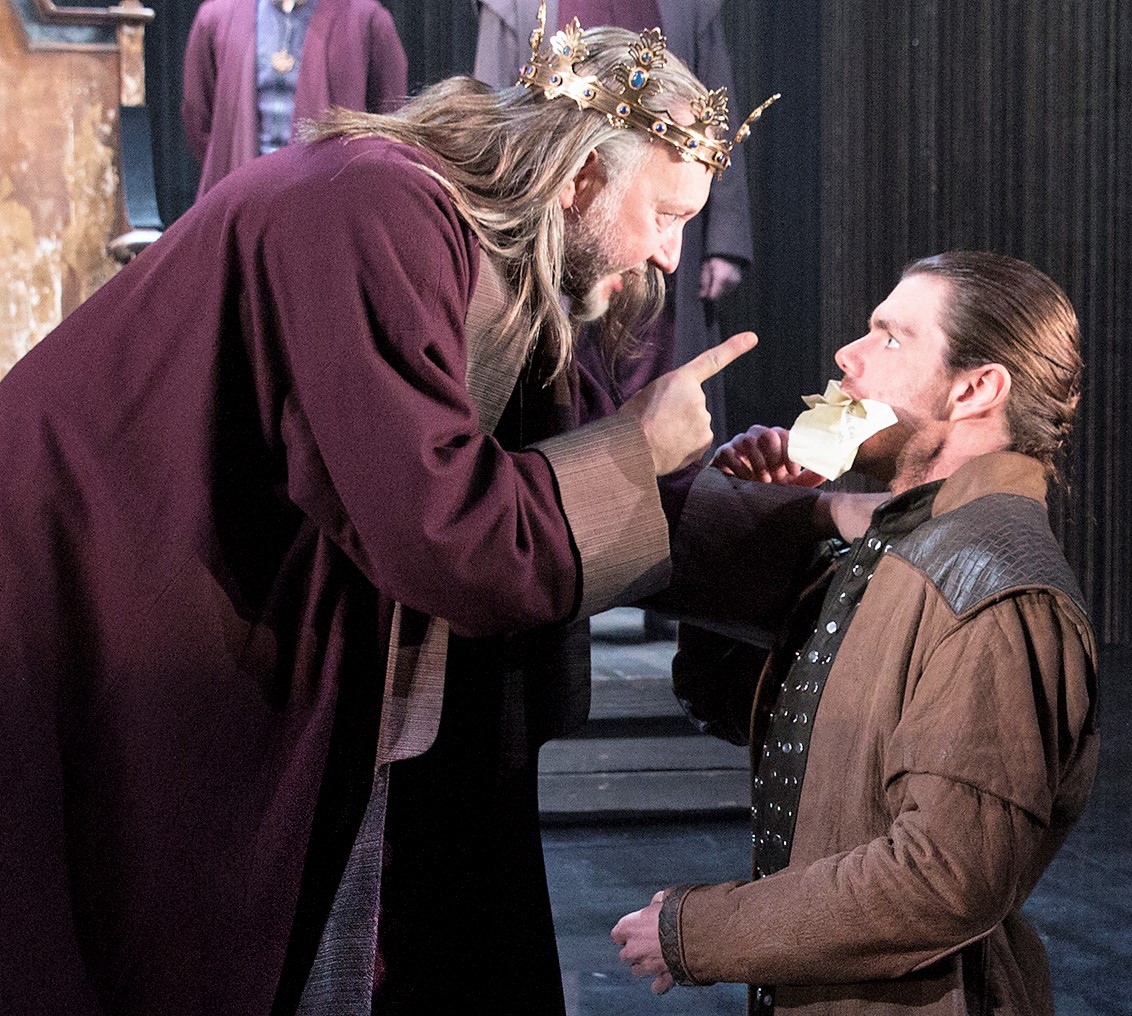
As Henry IV, Part 1 opens, the king (Jasper Britton) announces plans for a crusade to Jerusalem to retake the city from the Saracens—something he promised in his last speech in Richard II, the chronological predecessor (and also part of the RSC’s visit to the Brooklyn Academy of Music). Quickly, however, Henry is advised of rebels gathering against him: the Earl of Northumberland (Sean Chapman), a former ally in deposing Richard II; his brother, the Earl of Worcester (Antony Byrne); Northumberland’s son, and Lady Percy’s brother, Lord Mortimer (Robert Gilbert). Chief among them, though, is Matthew Needham’s stunningly good Hotspur, a fierce, intemperate warrior whose skill at arms is set against the dissipated life of Prince Hal (Alex Hassell). The trip to the Holy Land must be postponed.

Falstaff, the surrogate father to Hal, is embodied by Antony Sher, a great actor who has nevertheless seldom tackled comedy. Anyone who has seen him in classical roles (Massinger’s The Roman Actor, Marlowe’s Tamburlaine, Marston’s The Malcontent) knows he is a master of the language and a powerful stage presence. As Falstaff, though, something is not quite right. Sher growls a lot to sound dissipated and lumbers around to seem overweight. He can nail the wit, but one has the impression of someone giving a grand performance (and Falstaff is an actor at heart) but not completely inhabiting the character. He’s great fun to watch, but his roistering as Falstaff doesn’t feel natural. Yet there are splendid moments: when he’s trying to connect with his cronies in the darkness on Gad’s Hill to rob some pilgrims, he comes on, stepping slowly and whispering loudly, “Poins? Poins?” to find his compatriot.

Needham (right) with Jasper Britton as King Henry IV. Photographs by Richard Termine.

Needham (right) with Jasper Britton as King Henry IV. Photographs by Richard Termine.

In a similar way Hassell is not totally persuasive as Hal. Frivolity and callowness don’t sit naturally on him, but as he assumes the gravitas required of a future king, he becomes more persuasive. He gives the speeches clearly but, perhaps because he’s the centerpiece of three plays, there are times when they’re closer to masterly recitation than insightful characterization.

In Part 1, however, Britton, overshadowed in Richard II by David Tennant’s terrific performance, comes into his own as Henry, the usurping king who struggles with his son’s wastrel ways. His halting first lines, “So shaken as we are, so wan with care,” present a royal whose voice literally trembles. And news of Hotspur’s valor against rebels brings joy until his counselor Westmoreland remarks, “It is a conquest for a prince to boast of”—pointing up that Hal should have been leading the victory. The haunted Henry’s grappling with his son’s fecklessness is an important through line for both parts. Part 2, however, also affords Hassell the opportunity to navigate from Hal’s callowness to something that fits the actor better: nobility and valor.

Looser than Part 1Henry IV, Part 2 also lacks Hotspur. Moreover, the lower-class scenes in it prove a slog. One problem is that Antony Byrne’s Pistol, a swaggering braggart soldier, is a type that may have been funny 400 years ago but grates now. Made up as a yob, with thick black mascara under his eyes and a braid, and dressed in a punkish leather outfit by Stephanie Arditti, he is a tedious figure, offsetting Falstaff’s raillery. Thus, much of the first half of Part 2 is an ordeal, redeemed after intermission by Oliver Ford Davies’ hilarious Justice Shallow, paired with Jim Hooper’s wide-eyed, perplexed Silence.

Hassell as Hal banters with Sher as Falstaff.

Hassell as Hal banters with Sher as Falstaff.

But the most memorable scenes are those with Hotspur. “I can call spirits from the vasty deep,” says Joshua Richards’s Gandalfian Welshman, Owen Glendower, a behemoth in skins and long gray beard, and Hotspur’s in-law. To which Hotspur replies: “Why, so can I, or so can any man/But will they come when you do call for them?” And his scenes with his wife (Jennifer Kirby) are both touching and frustrating; though in love, each tries to connect emotionally with the other and doesn’t always succeed. Other standouts are Sam Marks’s vital Poins and Richards (again) as a red-nosed, dryly comic Bardolph, one of Falstaff’s cronies.

The plays are rich with smart business by director Gregory Doran. With Hotspur on a tear, his father, Northumberland, grabs him by the scruff of his neck and forces him to his knees. Some extended comic business with the serving-boy Francis plays beautifully (and sets up a cameo for Henry V). One clumsy interpolation, however, is Doran’s opening Part 2 with Rumour (Byrne) coming on in modern clothes against a field of projections of #Rumour. It may be intended to parallel gossip on the Internet, but it’s a jarring moment.

Though the first part is the stronger play, together the pair are an indispensable challenge that any lover of Shakespeare’s work will want to experience. They aren’t often done together, and this is an opportunity to hear verse-speaking of a high order and experience outstanding, if not flawless, productions.

The Royal Shakespeare Company’s Henry IV, Part 1 and Part 2 play in repertory with Richard II and Henry V through May 1 at BAM Harvey Theater (30 Lafayette Ave. between Ashland Place and St. Felix Street in Brooklyn). Tickets start at $35. Visit www.bam.org/theater for information.

Click for print friendly PDF version of this blog post