Annnd He Was Still Hungry!

What do a blue horse, an egg-carrying seahorse, a lonely firefly, and a hungry caterpillar have in common? They are all characters created by beloved children’s author Eric Carle. These characters and others are brought to life through innovative storytelling and puppetry in Jonathan Rockefeller’s The Very Hungry Caterpillar Show. Of more than 70 books that Carle has written, Rockefeller's production draws on four: The Artist Who Painted a Blue Horse, Mister Seahorse, The Very Lonely Firefly, and The Very Hungry Caterpillar.
 
Although Carle’s books are recommended for children aged 10 and younger, this show has a wider appeal. When you get a reaction from audience members between the ages of 2 and 82, you know that you are doing something right. Everyone from all different backgrounds can relate to the deeper meaning in these four stories—expressing your true creative self no matter how wild and quirky your imagination might be, and the importance of a supportive loving family. The production also explores how a deep hunger for change can lead one to transform into the most beautiful butterfly.
 
Rockefeller and Eric Wright of the Puppet Kitchen have done a superb job engineering puppets and story to convey the artistry behind Carle’s storytelling. The Puppet Kitchen has replicated Carle’s unique illustrations down to his use of color, distinct lines, and shapes, and the use of tissue paper through puppetry. Specifically, the details of how each creature moves and looks are spectacular: some of the effects that were lifelike included the angelfish, the way the fireflies light up, and how the caterpillar hatches from its egg.

The cast (Kayla Prestel, Weston Long, Ariel Lauryn, and Jake Bazel) has worked hard to get the characters to step off the page. They have forged living, breathing creatures by manipulating the puppets in a realistic way and paying attention to each animal, insect, and human characterization: for example, the way the black bear raises its head to sniff the air or wiggle its bum, how Mister Seahorse twists and glides through the water, the way the pink rabbit hops, and how the caterpillar inches along. Long must also be praised for his vocal skills in giving each character an individual identity.

The puppets aren’t the only thing that makes this show great. The Very Hungry Caterpillar Show has both illusion and spectacle. With simple sleight-of-hand, lighting, and the old bait-and-switch routine, this show finds seemingly magical effects to produce wonder and awe. Paintings appear without real paint, confetti and light combine to create fireworks that burst into the audience, and a drum light becomes a floating moon. In addition, the venue, a converted fire station with a highly raised stage, has good sight lines for every height of person.

If you have children or if you a child at heart, you're likely to find this show worth braving the cold for. It's a great indoor attraction to escape your cabin-fever blues.

The Very Hungry Caterpillar Show is playing through March 27 at the 47th Street Theater, 304 W. 47th St. Tickets are $49.50-$69.50 and may be purchased by visiting ticketcentral.com or by calling (212) 279-4200. For more information, visit hungrycaterpillarshow.com. 


Click for print friendly PDF version of this blog post

Nothing But the Truth

Why Not Just Tell the Truth is an ambitious, yet over-reaching, play at The Tato Laviera Theatre. It is extremely current and very raw, with great music selection for a television show. Based on a web series, of the same name, it brought the challenges of the average TV show to the stage; the need for a talented script doctor and a seasoned director. The play desperately wants to be edgy, however what’s missing is an understanding of theatrical character development, voice projection and pacing. The playwright offers 25 separate scenes in three acts, and as he explains before the current rises, the play is in your face; however it lacks the tightness cinema may forgive but the stage demands.

Written, co-directed and produced by Carleton King, who also plays the lead, Why Not Just Tell The Truth is challenged by King assuming too many duties. His character is on stage for most scenes, never allowing him the latitude to tighten the script or deliver deeper, richer characters. As an actor, King’s vision for the role of Jason requires a deeper, spiritual quest (especially as he argues with God). Throw the Bible on the ground but make it matter. The audience is afforded less time with the characters enduring long scene changes that soften the impact of drama

As a teenager, Jason inherited an extremely large sum of money from his parents. He has been married for two years to a woman who verbally taunts him all the while cheating on him. After finally separating, she is physically abused by her new boyfriend, ridiculed by Jason’s new female companion who proclaims herself a “high-powered attorney” and eventually returns to Jason longing for whatever it is she thinks they had. While Jason has no desire to take her back, her new boyfriend, who is unhappy with her departure, exacts his revenge but on the wrong person. Jason’s best friend Tony struggles with the transition from the dating scene to a more serious relationship, having perfected the persona of a player. Jason’s childhood sweetheart-turned-mafia "hybrid princess" is still longing for a relationship with Jason knowing that his wife is not good for him. Tony, returning from the dead to offer Jason advice, comes off as a cliché rather than sage closure for the character. 

The young actors, who anxiously want to do a respectable job delivering every line, lacked exciting direction with a script that includes a lot of story but provides little room for character nuance. Rarely does co-directing enhance the result and in this case merely muddies the result. Why Not Just Tell The Truth is co-directed by Melissa Diaz. Repeatedly, dialogue is swallowed making scenes difficult to understand, and in almost in every scene someone is outside of the pool of light. The lighting technician, Hector Orta, chose not to light stage right but rather use a wide follow spot. A more seasoned director would have caused the actors to deliver more than just basic emotions, while addressing the most important need of an audience—the desire to care.

The Tato Laviera Theatre is a great space with stadium seating, a large stage to work with and an awesome light board. The main set includes a sofa, end table and a Queen Anne, high back chair, and stage left, which is Tony’s bedroom, has a single bed pushed up against the wall. Stage right starts off empty; however throughout the evening, two chairs and a table are noisily moved on and off set. Since most of the scenes that take place in this part of the stage utilize the table and chairs, it would have been simpler to work around them and light the area appropriately. Additionally, stagehands are too often seen, voices are heard from back stage and lighting, and music cues are missed.

Why Not Just Tell The Truth does not have that luxury of a boom mic or editing room. The musical selections are well chosen for a TV show or movie, but on stage, it fragments the story rather than bring it together. The bones of the play—love, betrayal, revenge and forgiveness—are spoken about but without deeper development of the characters, believability has to be suspended leaving little truth to tell.

Performances of Why Not Just Tell The Truth, produced by Tru Luv Entertainment, run on Friday, Feb. 19 at 5 p.m. and 7:30 p.m. at The Tato Laviera Theatre (240 East 123rd St. between 2nd and 3rd Aves.) in Manhattan. Tickets are $25 and can be purchased by visiting https://www.eventbrite.com/e/why-not-just-tell-the-truth-the-play-tickets-19703885853.

Read our Q&A interview with Carleton King on his inspiration behind Why Not Just Tell The Truth.

Click for print friendly PDF version of this blog post

Q&A: King Brings Web Series to Theater

Carleton King grew up in Brooklyn, had head shots as an infant and was pushed toward the profession by his parents. Even so, he always knew he had a knack and evolved with the craft by studying acting and theater at St. John's University and Long Island University. After a number of acting credits over the last decade in theater, film and TV, King developed the web series Why Not Just Tell The Truth. With a few thousand subscribers across the globe, King has decided to go Off-Broadway to gauge whether he should add to the 11 episodes already in the can. Either way, coming clean is at the heart of his inspiration.

Carleton King: Honesty is a very deep rooted idea. Most people hate to be lied to but sometimes we even lie to ourselves. This can leave you in a lot of trouble when you’re in denial or being dishonest in interpersonal relationships. So I wanted to explore some of those situations.

OffOffOnline: Taking a look at some of the episodes, I see characters with some heavy weaponry and situations that go on beyond just lying to your girlfriend.

Carleton King: Yes, some of the characters allow certain situations to become bigger than normal life and stem mostly from Tracey (Ana Araújo). Her father was a mafia boss, and her mother comes from a Cuban crime family. That causes her to have this weird dichotomy of a personality, but her friendship with Jason helps drive the plot. So anyone who disrespects him has to worry about her coming after them.

OffOffOnline: Jason is your character. Tell me about him.

Carleton King: He’s a good guy. He believes in love, marriage and making things work. That can work to his detriment because he’ll try to make a bad thing work when he probably just needs to let it go.

OffOffOnline: I guess that includes his marriage.

Carleton King: I’ll just say it. Kathy (Charese Annel) is a bitch. He got his heart broken in college by Janette (Margaret McDuffy and Inayah Burton). She was the one that got away and this left a lingering hole in his heart. Unfortunately, he ends up filling it with the wrong person.

OffOffOnline: Denial—if you will?

Carleton King: Yes… She is evil but hopefully people get to understand what makes her the way she is.

OffOffOnline: She sounds more suited to Tony, the player.

Carleton King: He’s in denial in the sense that he doesn’t want a real relationship or love.

OffOffOnline: Why?

Carleton King: All the characters have their face value and their underlying value. In other words, the things that make them what they are. He’s in denial in the sense that he doesn’t want a real relationship or love.Tony (Patrick Jackson) has all these women, and it’s so easy for him. But why does he chase love like that? We just hope people can come to understand what makes a player a player.

OffOffOnline: How much does Jason relate to your life?

Carleton King: If you know my life, you really wouldn’t get the correlation. But a lot of the situations were inspired by the feelings that these scenes are based on. So if you follow the emotions, then you get the idea where the inspiration comes from.

OffOffOnline: How much is New York City a character?

Carleton King: This play could take place anywhere but it does come into play in the background of the characters. Mariah (Janelle Stein) is a reformed hood girl from the projects. That’s a very specific thing because projects in other cities are not the same. The ethnic mix in New York is also different. So the intermingling in our melting point is inherently different and represents itself in the characters.

OffOffOnline: Are you using the same actors from the series?

Carleton King: Except for me, it’s a whole new cast.

OffOffOnline: What was it like converting from the web to a play?

Carleton King: You don’t have the magic of editing and multiple takes. Then we had to break things down to their basic level and rearrange to fit a more natural order so they flow better.

OffOffOnline: What will be the impact of doing this live?

Carleton King: There’s so many things that I put into the show—it wouldn’t be the same if I tried to record it. The scenes had to be done right there in front of an audience because it’s more of an interactive thing… I’ll just say I plan to raise a few eyebrows.

OffOffOnline: What do you hope people take away?

Carleton King: The truth can be a very powerful thing that shouldn’t be lost in translation, and hopefully people can have the courage to be honest in the first place.

Performances of Why Not Just Tell The Truth run on Friday, Feb. 19 at 5 p.m. and 7:30 p.m. at The Tato Laviera Theatre (240 East 123rd St. between 2nd and 3rd Aves.) in Manhattan. Tickets are $25 and can be purchased by visiting https://www.eventbrite.com/e/why-not-just-tell-the-truth-the-play-tickets-19703885853.

Click for print friendly PDF version of this blog post

The (Not So Secret) Life of Men

It’s no secret that the early days of dating are about as easy to navigate as a combat zone. A million and one books have been written on the differences between men and women and their communication and dating styles. Elsinore County’s Antony Raymond’s yeah, i met this girl… explores the life of three men in various stages of their journeys in dating.

Expertly cast are Christopher Heard as Joe, the blonde, California pretty boy, Eric Doviak as Ben who is smooth-talking and looks like he just walked out of an episode of "Mad Men," and Dan McVey who plays Guy with enough ennui to make any girl fall for him. The play is set in a bar, which Guy has inherited from his father where the guys congregate to hash out their various experiences and theories about women and dating. The play focuses on their inner life, and at first, they seem caddish and shallow; reinforcing stereotypes about what they want in a woman: eye candy. Guy calls out to the others: "That's my type!" and Ben replies: "What? Hot!" But as the play unfolds we see they also want love and can be as insecure and uncertain about it as women are.

Raymond does an excellent job of using the small stage. With the help of lighting designer, Daryl Embry, tableaus are created and broken, and the stage comes to resemble various settings including a nightclub and restaurant. The actors work well together. At first, the dialogue seems to come too fast; patter that falls off a nervous tongue, but as momentum picks up, and scenes change in seconds, the aerobic patter is needed to maintain the rhythm of the action.

There are many enjoyable things about this play, but the writing is what makes it exceptional. Raymond has his finger on the pulse of the inner lives of men and women and compacts their feelings about dating and romance in today’s era of new age thinking and technology into small and poignant vignettes. He also admits how men can come up short in communication. At one point, Ben tells his friends he broke up with someone by leaving her a voice message. They chide him, so he admits he sent a text as well. When they ask what he said in the text, he confesses that he texted to say he left a voice message. They cringe, and so do we, but also laugh.

Well captured is the arbitrary and contrived nature of dating. At one point, a couple sits at a table, getting to know one another by asking each other questions. The intensity of the questions build quickly, and take on the tone of an interview created by someone's overbearing mother. They begin with the mundane: “What is your favorite color?,” but soon climax to the most loaded question of all: “Do you want to meet my parents?” Within in a few minutes, they are arguing about the future, and the relationship is over.

Also special to this play is how tightly choreographed the scenes are. Stacey Roca, Amanda Kristin Nichols and Zina Wilde represent a gamut of female archetypes. Reminiscent of a Sam Shepard play, but much more humorous, is a scene in which the three women cycle through the arms of the three men. It captures how fickle the heart can be depending on what it wants. Sometimes you just want sex and other times you want love and intimacy. The scene suggests that ultimately it’s about the chemistry. If you’re interested in finding out what lays beyond that, you will need some time.

Love does happen—to Joe, the one who is seemingly the most flirtatious and disinterested in a committed relationship. He gets engaged but gets his heart broken. The reason is not what you think. Guy continues to swear off musicians only to be infatuated by each one that comes into his bar to play open mic. Ben is the most cynical of the three friends and chastises the others when he declares: “You keep looking for some perfect girl to come along and save you, or some broken bird that you can save, but that’s not going to happen (…) There’s no perfect person out there for anyone except the person in the mirror.” It’s hard to tell if he’s the most enlightened or the most narcissistic. We are told to love ourselves first before we can have a meaningful relationship, and that is what Ben is suggesting.

However, it is Guy’s belief that there's a woman out there for every man; a binary, that aligns us more as social creatures. He even believes in a more cosmic connection and meditates on this: “You got to think about the ying and the yang. Without good there can’t be a bad. Could it be possible there is someone out there that was created with us and for us?” Let’s hope so! It definitely seems better to grow “old and wrinkly” with someone, as one of the actress' declares, then to remain moored on an island of cynicism and defeat. After all, no man is an island.

Elsinore County’s production of yeah, i met this girl by Antony Raymond is running through Feb. 14 at Under St. Marks (94 St. Marks Place between First Ave. & Avenue A) in Manhattan. Tickets are $25 and can be purchased by visiting www.elsinorecounty.com

Click for print friendly PDF version of this blog post

Stand-Up Presidential Campaign

Filibusted, a comic review of the current presidential campaign, is the brainchild of producing artistic director of the Phoenix Theatre Ensemble, Craig Smith, who approached stand-up comic, Al Pagano, with the suggestion of an hour-long burlesque on the national free-for-all into which the sacred task of electing the next leader of the free world has devolved. If this campaign is notable for a public that looks to outlier candidates not beholden to big money and who tell it like it is, what better way to cut through the bombast, double talk, pomposity, dogma, pretentiousness and, yes, lies, than with the gentle and not so gentle barbs of humor.

Written and performed with enthusiasm by Al Pagano and Amy Loughead, Filibusted is a reference to the perfectly legal stymying of the legislative process in the Senate with endless babble; and clearly a comment on the vociferous if also loud and meandering voices in a field of presidential hopefuls who compete mercilessly for our attention as we stumble forward in our selection of a president. It is we voters who are “filibusted” in the process, Pagano and Loughead point out. Hence the brilliant and eye-opening decision of Pagano to allow the candidates to speak for themselves, as Pagano tells us at the very outset:

“Now the reason we aren’t just jumping right into the show is that we want you to know that most of the words this evening which are attributed to the candidates are actually the candidates’ own.” Yes, let ‘em hang themselves on ropes of their own fashioning! “We didn’t change, alter or manipulate much of what they said in any way... we just took their words (out of context) and like pieces of a puzzle, inserted them into scenes of our imagining, to serve our own ends.”

Just as a surgeon might cover all of the body save the segment to which she will apply her knife, Pagano and Loughead thus manage to isolate comments by our candidates, the better to hold them up for all to view and dissect. All of this is wrapped, we are told, in “a series of scenes, sketches and games,” and here begins the fun. Between opening and closing salvos (Sarah Palin and Hillary Clinton), we will hear candidates opine on topics such as flirting (“All the women on 'The Apprentice' flirted with me, consciously or unconsciously. It’s to be expected," says Donald Trump), prenuptials, safe sex (“I’m not sure we need a half a billion dollars for women’s health issues,” says Jeb Bush), staying in shape and threesomes. We will be treated to an imagined Schwarzenegger riff on amending the constitution to allow him to enter the field of candidates and listen to the privileged power brokers of our time cravenly compete in a “race to the bottom” of their hard luck stories to suggest to voters that they are who they are not: just ordinary Joes scrambling for a living like you and me (“My school had these popcorn balls ad they looked really good. But they were a nickel. I never had a popcorn ball,” says Ben Carson).

The estimable surgeon Carson is given a sketch of his own, the better to highlight such statements as “A lot of people who go into prison straight and when they come out, they’re gay, so did something happen while they were in there?” And he asks, “How about we have a transgender bathroom? It’s not fair for them to make everybody else uncomfortable.” Although clearly a man of enormous experience in his chosen field, he alludes to the fact that he has never held office noting that, “every signer of the Declaration of Independence had no federal elected office experience.” 

Stand-up includes gesture along with the written word to make its point and the exaggerations of mime in capturing the candidates was especially illuminating. Perhaps the most inspired sketch was the one called “Immigration Game” in which the audience is treated to a panorama of comments over centuries on immigration and quizzed, in multiple choice format, as to the author of the quote—present candidate or figures from the past. But better not to give away the store and leave the leavening and illumination of this sketch to the occasion of your attendance at this engaging and witty performance.

Filibusted's last performance is at 10 p.m. on Feb. 13 at The Wild Project (195 East 3rd St. between Avenue A and B) in Manhattan. Tickets are $20 and include one drink. For tickets, call 212-352-3101 or visit http://www.phoenixtheatreensemble.org/filibusted/.

Click for print friendly PDF version of this blog post

A Warm Welcome to Paradise

Third Rail Projects wastes no time in sweeping their audiences off the dirty streets of Bushwick and into the fold of their latest immersive world, The Grand Paradise. There are no tickets to The Grand Paradise, only boarding passes, and you’ll receive yours after checking in at the departures gate of their retro-fantasy airline. After a brief “in-flight” video on resort rules, you’ll disembark into the warm, indulgent terrace of the Grand Paradise resort. Crowded with sexy, sultry residents, the space is bedecked in tiki paraphernalia—fake palms, beaded curtains and a giant aquarium (indeed, every detail of the production design smacks of the culturally confused late 70s). It’s not long until you’re greeted by the swoon-worthy Siren (Elizabeth Carena) and your immersive adventure at The Grand Paradise begins.

Following their wildly popular show Then She Fell, artistic directors of Third Rail Projects (Zach Morris, Tom Pearson and Jennine Willett) have expanded their audience size and added elements of spectacle to their latest production. Yet despite the added glitz, Third Rail Projects still manages to afford all audience members the intimate moments that make this type of theater so thrilling. Certainly, not everyone is comfortable with audience participation, but Third Rail Projects has made audience involvement feel as fun and safe as possible. Around every corner of The Grand Paradise is an inviting situation that directly involves audience members (individually or in small groups). The best part about the immersive design of The Grand Paradise is that participants need only watch and listen, and they will be warmly invited into a wide variety of charming and thought-provoking situations. Audiences are instructed not to open closed doors, and there is no need to chase characters, or elbow to the front for a good view, which—for viewers like myself—is a frustrating aspect of popular participatory productions today.

The Grand Paradise keeps audiences entertained during their entire two-hour stay and, indeed, the ensemble cast is a veritable treasure trove of diverse talent. Each performer adds something unique to your experience, whether it be pondering the passage of time with the elusive Venus (Emma Hoette), topographically mapping your past and future decisions with the activities director (Alberto Denis), trashing hotel rooms with the mischievous Jett (Mayte Natalio), or tying nautical knots while at sea with the Libertine (Bryan Strimple). The truly outstanding moments of The Grand Paradise are when the theatrical experience conjoins itself with your own life—beckoning the contemplation of more universal themes of time, fate, love and loss. 

Like many immersive companies practicing in New York (Punchdrunk and Journey Lab), Third Rail Projects incorporates a good deal of contact improvisation dance into their experiences. While this style of post-modern dance is beautiful, and physically demonstrates meaningful tension and release between characters, it has become rote for many immersive performance makers. There are moments when these sequences linger for too long, losing significance and becoming somewhat monotonous. Within the marvelous bigger picture of The Grand Paradise, the slightly lengthy improvisational dance scenes are a forgettable flaw. 

Whether you are an amateur or seasoned immersive theater-goer, there is something for you at The Grand Paradise. The cohesive theme, remarkable talent and complex-yet-invisible immersive design make for a fun and refreshingly unique experience. While many immersive shows deconstruct existing pieces of literature such as Alice and Wonderland or MacBeth, The Grand Paradise creates a fascinating world of its own to which no parallel exists. Hold your breath and dive into Third Rail's The Grand Paradise.

The Grand Paradise plays in Brooklyn at 383 Troutman St. (between Irving and Wyckoff Aves.) through Sept.4. Must be 21 or older to attend. Wear comfortable shoes and clothing with pockets. Ticket prices vary and are available at http://thegrandparadise.com/tickets.

Click for print friendly PDF version of this blog post

Greek by Way of Ireland

The Irish Repertory Theatre program for The Burial at Thebes credits Seamus Heaney as the author, but the Nobel Prize-winning poet, who died in 2013, didn’t originate the story. Like many others—including Racine (Phèdre), Jean Giraudoux (Tiger at the Gates), and Jean Anouilh, Heaney was inspired to refashion G­reek drama for a modern audience. Indeed, Anouilh himself drew on the same source, Antigone, as Heaney does for The Burial at Thebes, a 2004 reworking of the third of Sophocles’ plays about Oedipus and his descendants.

­­­

The play takes place following a civil war, in which the brothers of Antigone, Eteocles and Polyneices, clashed. Heaney doesn’t delve into the source of the conflict: the brothers were to share the crown year by year, but Eteocles refused to step down when Polyneices’ turn came, and Polyneices took up arms against him. Both brothers have died in the deciding battle, and the leadership of Thebes is now in the hands of Creon, Antigone’s uncle and the brother of Jocasta—who may be remembered as both mother and grandmother to Antigone; her sister, Ismene; and their late brothers. Polyneices has been tarred as a traitor by Creon; he has declared that Eteocles will be buried as a hero, but Polyneices will be left unburied as carrion.

Heaney, who had reworked Philoctetes into a play, The Cure at Troy, in 1990, shows a keen sense of the drama in Antigone’s first words, underlining urgency and giving a streamlined sense of the conflict to come as well as the burden of the sisters’ history.

Ismene, quick, come here!
What’s to become of us?
Why are we always the ones?
There’s nothing, sister, nothing
Zeus hasn’t put us through
Just because we are who we are—
The daughters of Oedipus.

Compare that with the sedate 1962 translation by Michael Townsend:

My darling sister Ismene, we have had
A fine inheritance from Oedipus.
God has gone through the whole range of sufferings.
And piled them all on us—grief upon grief,
Humiliation upon humiliation. 

Heaney sticks with “Zeus” for the flavor of the original, rather than a Christianized “God,” and his simpler language moves more swiftly. His version of the story sounds more energetic to the modern ear (though one wishes he had avoided use of the anachronistic “beyond the pale”—it occurs not once or twice, but three times). Omitting the traditional chorus, Heaney focuses on individual personalities and equalizes their weight, especially benefiting Winsome Brown’s helplessly distraught Eurydice. 

The sisters’ dilemma is sparked by Paul O’Brien’s stern, autocratic Creon, whose edict demands death for anyone who buries Polyneices. His actions are an affront to the gods, and to Rebekah Brockman’s passionate, righteous Antigone. Katie Fabel’s Ismene is also upset but lacks the gumption to join Antigone in secretly burying their brother. To complicate matters, Antigone is betrothed to Haemon, Creon’s son (the intermarriage of the cousins in a family plagued by incest goes unremarked; after all, it’s long before blood work and DNA testing).

The cast, under the astute direction of Charlotte Moore, brings passion and fire to Heaney’s language. When Creon condemns Antigone for her actions and resists Haemon’s pleas to spare Antigone, Eurydice worries about the effect on Haemon, as well as her husband’s transgression of Greek custom. Yet Heaney’s virtue is that he simplifies as well, as in Ismene’s initial response to Antigone’s proposal: “Easy now, my sister/Think this through for a minute.” Or, also from Ismene, a passage that foregrounds a modern tension between chauvinism and feminism:

Women, defying Creon?
It’s not a woman’s place.
We’re weak where they are strong. 

Because the Irish Rep is forced to use the DR2 Theatre during renovations to its 22nd Street home, and the cramped stage means Tony Walton’s set consists of a couple raised platforms and some decorative vertical roping, the actors must sidle off awkwardly. Nonetheless, the cast is solid, with Robert Langdon Lloyd’s blind seer Tiresias a sizzling standout. Colin Lane brings comic worry to the part of the guard who has let Antigone slip by and bury Polyneices—and then redeems himself with her capture. Curiously, he and Rod Brogan as the Messenger have pronounced Irish accents, which seem to mark them as a different class from the royals; but then Ciarán Bowling’s accent as the royal heir Haemon muddies the issue. Quibbles aside, even if this version of Sophocles feels Irish only by virtue of accents of some of its cast and its author’s birth, it’s a welcome foray into seldom seen Greek drama.

Seamus Heaney’s The Burial at Thebes plays through March 6 at the DR2 Theatre (103 E. 15th St. between Union Square East and Irving Pl.) in Manhattan. Evening performances are at 7 p.m. on Tuesday and Thursday, and at 8 p.m. on Wednesday, and Friday-Sunday. Matinees are at 3 p.m. on Wednesday, Saturday and Sunday. Tickets are $71 and can be purchased at by calling 212-727-2737 or visiting OvationTix.com.

Click for print friendly PDF version of this blog post

Not Just Another Sandwich...

Currently playing at Urban Stages is the latest adaptation and world premiere of Monte Cristo by Jared Reinmuth based on The Count of Monte Cristo by Alexandre Dumas. An extraordinary cast of 13 who rarely, if ever, leave the stage deliver betrayal, lust, greed, power, and most of all, revenge. The director, Cailin Heffernan, utilizing a small space, keenly chose to keep the actors on stage as witnesses to each scene, as well as part of the scene. Ever present and always attentive, the actors pose, mimic and mime the action, create sound effects, and play musical instruments, including Spanish guitar and a drum called a djembe, while awaiting their turns in Dantes’ game of revenge chess. All these elements make the main dialogue even more compelling.

The story of Dumas’ 1844 classic is a familiar one. On the eve of Dantes’ (Tom Frank) wedding to young Mercédès (Kate Kenney), he is betrayed by three friends who devise a plot that labels him a betrayer of the crown. Imprisoned for 14 years, Dantes learns of the treasure of Monte Cristo, escapes from his captors, finds the treasure and returns to society taking on the persona of Count Monte Cristo. With wealth supporting him, he exacts revenge on his three false friends—one of whom, Mondego (Carsey Walker Jr.) has married Mercédès; they have one son, Albert (Brett Benowitz).

The plot takes place in the prison at Chateau d’If, in Rome during Carnival, and lastly, in Paris. What ties this current production by New Light Theater Project together so well, besides the multitalented cast, is original music by Henry Aronson, the film visuals created by Dedalus 7 projected onto the backdrop, dialect coaching from Theresa McElwee and superb fight direction by Dan Renkin. The lighting, by Michael O’Connor, is subtle and moody, bringing to life the simple yet creative set design by Sarah Lambert. Etched into the side walls are hash marks to count the number of days Dantes is in prison along with the phrase, “My God, let me keep my memory!”

Costume design by Cheryl McCarron consists of floor length dresses for the women, each in a different hue, while the men sport brocade vests with colored cravats. Monte Cristo is in a three-piece contemporary tux with a red cravat, which appears a little out of keeping with the period, but he wears it well. McCarron enhanced the costuming with colorful feathered masks for the Carnival in Rome, white gloves for the Parisian cocktail party and rough-hewn shawls for the men in prison. Overall, the costuming is extremely appealing.

Heffernan has molded her actors into an effective ensemble. Keeping track of the characters, each playing multiple roles with different accents, is challenging to watch at times, making it difficult to single out any actor. As a large, tight ensemble piece, each actor plays very well off the other as scenes meld seamlessly from one to another. The subtleties required to not just be present to what is happening center stage but to enhance it with sound effects and mime makes each actor an integral participant.

Frank’s portrayal as Monte Cristo is charismatic and engaging even as he manipulates his betrayers Fernand (Carsey Walker Jr.), Danglars (Vinnie Penna) and Villefort (Paul Sheehan). The young Mercédès, Kate Kenney, is bright and radiant. In an unusual scene at the wedding ceremony, Kenney dances with Mondego and they include Alana Barrett-Adkins, who then is "handed off" to portray the married Mercédès. Delivering rich performances are Liliane Klein as Mme Danglars and Margherita Peluso who played Mme de Villefort and La Carconte.

From the opening processional to the final shot, this is a vibrant production with a dedicated and talented cast. Revenge, in any century, may be sweet; however, the ensemble of Monte Cristo is rich with talent and proves it.

The New Light Theater Project's production of Monte Cristo runs through Feb. 13 at Urban Stages (259 West 30th St. between 7th and 8th Aves.) in Manhattan. performances are Thursday-Saturday at 8 p.m. Tickets range from $10-$15 and can be purchased by calling 630-632-1459 or visiting BrownPaperTickets.com.

Click for print friendly PDF version of this blog post

Fifty Shades of Activism

In Robert Lyons’ Death of the Liberal Class, directed by Jerry Heymann at the New Ohio Theatre, Nick, played with a self-deprecating aplomb by Steven Rattazzi, is a balding, pot-bellied academic who has written a book called "Robo Corp" that has garnered him great success after years of being an adjunct professor and a freelance journalist. However, after a “nervous breakdown” in which he rejects the ideas he has written about in the book—that robots will take over the world and that they are “standing on the precipice of the darkest period in history”—he has retreated to a farmhouse in Canada owned by his wife’s family.

His teenage daughter Andrea, played with a convincing mixture of indifference and righteousness by Jeanette Dilone, however, has dropped out of high school and followed him there. She has swallowed her father’s previous convictions hook, line and sinker, and has decided to pursue her own brand of activism, “hacktivism.” She is joined by the unassuming yet handsome Even, played by Justin Colon (who appears to have a magnificent singing voice revealed in one small snippet in the play) whom she has met online. The computer is the perfect tool for activism. Where it was once dangerous and possible to suffer bodily harm—think Kent State University in 1970 when four were killed and nine wounded in a melee between protesters and National Guard—computers have removed the physical component of activism and provided the safety of anonymity. Even and Andrea quietly, heads together, plan to take down the Robot Economy that her father has written about. The sexual tension is palpable even with their eyes glued to their respective keyboards.

Meanwhile, everyone is mad at Nick. He’s been sleeping with Maggie, the dewy skinned and wholesomely pretty Olivia Horton, who lives on the farm next door with her husband, and also with Daphne, his wife, when she comes to visit. Maggie’s husband beats her for sleeping with Nick and Daphne chides him for leaving New York City.

Although there is still sexual chemistry between them, Melissa Murray as Daphne captures the understated disdain that New Yorkers have for those who leave. After all, who, in their right mind, would leave an Upper West Side apartment in New York City? She may as well come out and say it: he’s a loser! But, somehow, living on the farm, in the middle of Canada has made Nick feel peaceful, and dare we say it, happy. In the opening scene, Nick’s daughter notes how happy he seems. When he retorts “I’m not allowed to be happy?,” she nearly chokes with disgust, “Not this happy!”

Nobody wants Nick to change, especially his daughter. Yet, he no longer believes in the chaotic world he wrote about in his book nor does he want to have anything to do with it. His daughter decides to carry out her own grassroots activism, and hacks into Maggie’s account. Comic relief comes unexpectedly in an exchange between Nick, his daughter, and Constable La Fontaine, a Canadian Mountie who works in the cyber division, played with wonderful restraint by the mustachioed Arthur Aulisi. When the Constable arrives at the farmhouse to investigate the hacking, they deny it. Although the Constable remains beautifully polite, it appears he knows better. It’s a moment filled with tension and irony.

Although we usually think of men as being better hackers, Andrea is actually the gifted hacker who plans to infect Wall Street computers with a virus that will bring them crashing down. Nick pleads with her, and asks her to see how it will affect the little people, but she is so full of her own—or rather Nick’s—ideological idealism that she runs off with Even to carry out the plan.

When Nick’s wife realizes he isn’t coming back to the city with her, she leaves and gives him an eviction notice from the farmhouse. In the beginning of the play, you wonder what Nick’s appeal is: he’s a middle-aged guy with thinning hair and a thickening middle who’s sleeping with two beautiful women. But then we see that it’s his underlying sensuality that makes him attractive. After he rejects his own lofty “liberal” ideas about the Robot Economy, he actually becomes more attuned to the world of living through the senses. At one point, his daughter comes to him, computer attached to her arm like an extra appendage, complaining she can’t get access. He gently says “access these trees… access the sky.”

Robert Lyons’ play asserts a very important message in this age of technology: that it can be both useful and destructive, but what it’s not, is sensual. Nick may be the underdog here, but in the end, he’s the one who is the true activist: being in tune with the senses is more likely to save humanity than anything else. The rest of the world around him needs a little more time to get there.

Death of the Liberal Class, written by Robert Lyons and directed by Jerry Heymann, runs through Feb. 13 at the New Ohio Theater (154 Christopher St., #1E between Greenwich and Washington Sts.) in Manhattan. Performances are Wednesday–Thursday at 7 p.m., FridaySaturday at 8 p.m. and Sunday at 5 p.m. Tickets are $18 and can be purchased by calling 1-888-596-1027 or visiting http://www.NewOhioTheatre.org.

Click for print friendly PDF version of this blog post

American Kitchen Sink

The characters in Utility, Emily Schwend’s drably titled but fascinating new kitchen-sink drama at the Rattlestick Playwrights Theater, belong to a social milieu that seldom appears on the American stage. They’re working-class folks in the lower socioeconomic spectrum. An offer of coffee means heating a mug of water in the microwave and mixing instant powder into it. Work constitutes holding down more than one shift at a time or just picking up shifts sporadically. Dinner, often as not, is reheated leftovers.

The play opens on a porch in east Texas, where Chris, a guy who has recovered from a pill addiction, is trying to wheedle Amber, his wife, into letting him move back in, just to help with the kids. Chris (James Kautz) has been sleeping on a sofa at his older brother Jim’s place, but Amber (Vanessa Vache) is reluctant to let him come back home. In this short prologue, Schwend lets us know further that Chris has cheated on Amber in the past, with someone at work; that he has a daughter, not by her, who is living with her mother; and that Amber is organized and self-sufficient and probably doesn’t need Chris’s supplementary income, even though her finances are stretched thin.

The focal point of the drama is a birthday party for Amber’s daughter, Janie. (Although the children are never seen, Kate Noll’s deft kitchen design reminds us of their presence: there are children’s drawings under magnets on the refrigerator.) Chris isn’t the child’s father—children with various parents are part of the fabric of this social stratum—but is helping to coordinate the birthday, which puts him in good stead with Amber’s mother, Laura (Melissa Hurst), who proves an unlikely champion for Chris.

“All I know,” says Laura, “is I seen Chris running around here all day long fixing up this house for a birthday party for a girl ain’t even his own daughter.” But, Amber is on top of school, doctors, and box lunches, and responds, “It’s not like it’s just suddenly easier with him here. I’m the one got two jobs, and he’s still another mouth to feed. Another person in the bathroom in the morning. And in and out of work. Can’t send a check when he says he gonna send a check… And actually? It’s easier when I don’t gotta think about him.” In these passages, Schwend displays a gift for dialogue to convey information and attitudes of her characters.

Meanwhile, Jim (Alex Grubbs) is working on restoring Amber’s house, which has apparently been damaged by flooding. He’s in and out of the building, and his presence irritates Amber even though he’s doing the work gratis. He doesn’t get much sympathy from Laura either; she has only a cold shoulder for him.

Director Jay Stull keeps tension in the action and yet lets the strands of Schwend’s drama play out, sometimes just a bit sluggishly, and at others in a pleasantly leisurely way—there’s a late scene that is daringly silent for a considerable stretch while Amber just smokes. His cast is superb. Vache is a grounded, skeptical Amber, a woman perhaps too easily irritable, but also hurt once too often by Chris. She is a formidable protagonist. Kautz finds in Chris an easygoing decency; whatever his past has been, he has left it behind, but he is also not a fully operational adult. The play’s title comes from the utility bill he has forgotten to put money down on—paying it all would be too much for this family—and the power suddenly goes off the day before the birthday party. Hurst’s Laura is also a bit of a strain for Amber; what help she offers comes with opinions, not just about Chris and Jim, but about the danger of vaccines, for instance; at the same time, she has money she has put by and is willing to lend if needed.

Finally, Grubbs as Jim gives a marvelous performance: laconic, grounded and probably in love with Amber. He finds comedy in the deadpan character, and in the comparatively brief amounts of dialogue he is given he manages to convey decency, yearning and self-restraint. The word, “utility,” carries a double meaning of electrical power and  “usefulness.” In that sense, the title is apt because the work serves as a useful calling card for Schwend’s dramatic talents as well as the cast’s.

The Amoralists’ production of Utility plays through Feb. 20 at the Rattlestick Playwrights Theater (224 Waverly Place between West 11th and Perry Sts.) in Manhattan. Performances are Thursday-Saturday at 8 p.m., with a special Wednesday evening performance on Feb. 17, and a 3 p.m. matinee on Feb. 14. Tickets are $18 and may be purchased by calling 866-811-4111 or visiting https://web.ovationtix.com/trs/pr/953828.

Click for print friendly PDF version of this blog post

Immersed in Ibsen

“Be careful whom you trust,” a maid whispers warningly into my ear as she swishes past me up a dark stairwell. This servant (played convincingly by Macy Idzakovich) is one of many peripheral characters haunting the halls of the historic Morris-Jumel Mansion in Journey Lab and Deaths Head Theatrical's The Alving Estate—an immersive staging of Henrik Ibsen’s Ghosts. Indeed, ghosts are central to Ibsen’s body of work and this particular production, which explore the foibles of the living, as well as the hauntings of the familial past. Though The Alving Estate experience is not without its aesthetic shortcomings, it succeeds in convincing audiences that there are deep secrets hidden within the walls of this eerie mansion. 

As my experience with Idzakovich as the maid demonstrates, the participatory nature of Journey Lab's aesthetic infuses Ibsen’s oeuvre with extra sex and intrigue. Journey Lab’s take on Ghosts, like many immersive works today, puts the audience at the center of the experience, giving participants the opportunity to choose where to go (and who to follow) within the mansion. This production choice comes at the expense of narrative cohesion, so if you’re looking for something more experiential than narrative, this is your type of production; on the other hand, if you’re interested in piecing together a storyline, you should read or familiarize yourself with Ibsen’s play before indulging in The Alving Estate.

Upon arriving to the mansion, you are given a job description and prepped for an interview for employment at the estate. After socializing over drinks with other “applicants” in the charming and dimly lit carriage house, audience members are selected at random to begin exploring the mansion. The Morris-Jumel Mansion is itself a star character in this production; its creaks, draughts, and creepy oil portraits all add unique charm and mystique to the experience. Unfortunately, there are some informational plaques visible in parts of the mansion, which distract from the time and place of the immersive experience.

While the site of this performance provides a delightful opportunity to explore an old gem of upper Manhattan, there are other aspects of this production that are less unique. Journey Lab takes a great deal of cues from British immersive theater pioneers Punchdrunk and their long running production Sleep No More, which has been running in Chelsea since 2011. The resemblances between this production and the Punchdrunk aesthetic may distract audience members familiar with the Sleep No More empire. Eerie music, intense moments of eye contact with the actors, and choreography reminiscent of contact improvisation are all pulled directly from the existing repertoire. Even some of the costumes and props—backless ball gowns, old photographs, costume jewelry—seem to be hand-me-downs from The Alving Estate’s immersive predecessor. 

Though The Alving Estate is haunted by an existing aesthetic, it still manages to showcase the raw talent and latent creativity of Journey Lab, an immersive company to look out for in the future. Surely, Punchdrunk provides a worthy aesthetic role model for aspiring immersive theater makers, but I suspect that the talent at Journey Lab could—and should—move beyond this copycat approach to become innovators in this exciting contemporary form.   

The Alving Estate runs Thursday through Saturday at 7 p.m. until Feb. 6 at the Morris-Jumel Mansion (65 Jumel Terrace) in Washington Heights. Tickets range from $20-$50 and can be purchased by calling or visiting http://journeylab.org/experiences/.

Click for print friendly PDF version of this blog post

Payment of Revenge

In this world, it seems everyone is indebted to someone for something; a job, a simple favor or an important introduction. The grateful understand this and are appreciative, often "paying it forward." However, not everyone who goes out of his or her way for another does so with a kind heart. Generosity of spirit may be misread, or at other times, the creditor plans to collect somewhere, sometime. The central theme of Creditors, written by Swedish playwright August Strindberg, weaves a demanding tale of love—controlling love and abandoned love—and, unfortunately, exacting revenge as when the creditor makes a well-planned and malicious visit. Creditors is currently playing at The Wild Project through Feb.14 and is presented by Phoenix Theatre Ensemble.

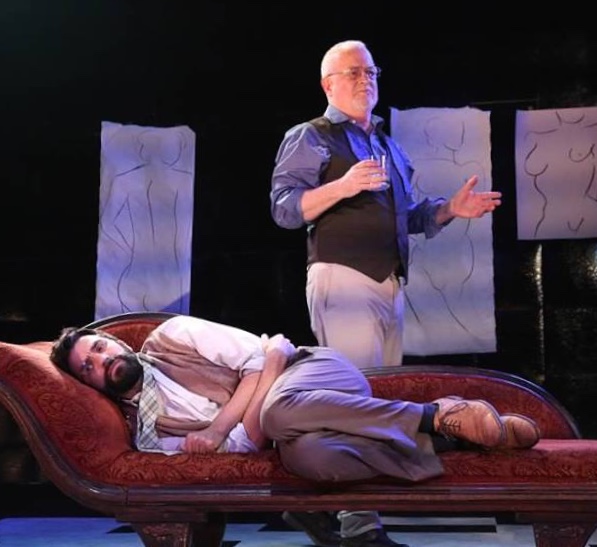
Through the filtered afternoon light of vertical blinds, disheveled artist Adolph (Josh Tyson), is fumbling with a new sculpture surrounded by finished and unfinished paintings. He is an accomplished artist who has driven himself to the edge of sanity and good health producing painting after painting, yet full of self-doubt and insecurity now toying with the idea of sculpture. His acquaintance, Gustav (Craig Smith), in an off-white summer suit and untied bow tie meanders the stage, replenishing his cocktail often. Goading Adolph in a familial manner, Smith embodies the part as an art dealer might, critiquing the work and then, just as easily, reverts to roll of doctor imparting medical diagnoses. He appears to know more than the casual friend often chiding the fragile Adolph, or at times, touching him intimately on the face. Eventually, Gustav maneuvers the conversation to Adolph’s wife Tekla, who has been away on a short holiday. Here is where Gustav frenetically whips up the dialogue to further lead Adolph down a rabbit hole of despair, teetering into the world of jealousy. It is clear that Adolph’s health and mental state are at risk.

Tekla (Elise Stone) brightly arrives after Gustav scurries off to secretly observe the interaction of the couple. In his fragile state, Adolph attempts to test her fidelity. Tekla, obviously older than her husband, desires to be adored and has no interest in sitting at home or being lectured about her flirtations. Stone’s voice is alluring even when her dialogue is burdened with childlike terms of endearment; she refers to them as "brother/sister." Tekla floats nervously across the stage in a diaphanous gown hoping to appease her husband as their disagreements intensify.

Woven throughout the dialogue is the reoccurring argument—who "made" whom. The older, educated Gustav used his position in a Pygmalion manner to bring language and style to her when she was young, a world she later abandoned. It appears as if Adolph picks up where Gustav left off. Adolph’s success as an artist may have allowed Tekla the time to write a successful book while introducing her to society but at what cost? Gustav’s students poked fun at him when they realize he was characterized in her book as a stupid fool. Anger, resentment and revenge have been fomenting—the creditor is demanding payment. Stone, Tyson and Smith deliver.

In 1888, Strindberg created a fast paced and uncomfortable, revenge-driven script in Creditors. (The current translation is by David Greig.) Kevin Confoy took complete advantage of the brisk dialogue with his direction by giving the actors the space to move about and the motivation behind the written words.

The set is a villa at the shore strewn with art and art supplies, an ample bar cart and a fainting couch. At the back of the stage hanging on a line are simple line drawings on paper. On either end of the drawings, the two stage entrances; one to the lobby of the villa and arriving ferry, while the other implies more rooms of the suite.

The entrances are lit with colors that change with a scene and during a scene. While emphasizing the mood of the dialogue, the lighting change is too noticeable at times. An interesting use of lighting is in the second scene where the bottom of the art, hanging at the rear of the stage, is lit in a razor’s edge blue underscoring an ugly undercurrent of the script. Credit for both set and lighting design goes to Tsubasa Kamei.

Although not an endearing play, Creditors is captivating and full of well-crafted characters. Stone brings the middle-aged woman not wanting to be considered old, and longing to be desired, to full breadth. The young, tortured artist and husband, who really does love his wife, is fully present in Tyson. Smith, the jilted, revengeful lover delivers a multi-faceted character to the stage through his frenetic action and vocal cadence. He easily transitions from devious to charming and almost caring as he exacts his final, gloating revenge.

Creditors is presented by Phoenix Theatre Ensemble and runs through Feb. 14 with a mix of evening and matinee performances at The Wild Project (195 East 3rd St. between Aves. A and B) in Manhattan. Tickets are $25 and can be purchased by calling 212-352-3101 or visiting http://www.thewildproject.com/performances/2016-CREDITORS.shtml.

Click for print friendly PDF version of this blog post

Confessions from a Bathtub

How does she get those bubbles to last an hour? This might be a very logical thought as audiences watch this delightful, boundary breaking, one-woman show Broken Bone Bathtub written and performed by Siobhan O’Loughlin, presented by Elephant Run District in bathrooms across New York City. The premise of the project is to have volunteers donate their bathrooms for an unforgettable evening of theater. Most of the donors are friends and fans, following in the New York tradition of playwrights who staged plays in friends' homes. The location of the show is revealed about a week before which adds to the mystical allure of the production. Upon entering the locale, the audience is greeted warmly with wine and hors d’oeuvres. The host’s living room serves as the lobby and waiting area, where complete strangers get the opportunity to mingle and converse prior to the show. The ambiance and cozy nature sets the tone for the intimate experience that lies ahead.

The audience enters the bathroom, which is quaint. It seats four if the toilet is used as a seat (which it was). Before going in, the team asks if everyone feels comfortable with audience participation and if there is anyone that really feels comfortable. Someone’s hand goes up and the selection is finalized.

Our gusty volunteer enters first. O’Loughlin is waiting in the bubble-filled tub. The show begins. At first, the setup may appear to be a naked, woman in a bathtub having an intimate conversation with four strangers in yet another stranger’s home. The levels of awkwardness have definitely heightened by this point. Yet, the true structure of the production reveals itself as she begins to tell her story of what happened to her arm and why she needed to use her friends’ bathtubs.  

After a serious bike accident,  O'Loughlin finds the strength to ask her friends for help as she heals not only her arm but her soul. She tells the explicit details of her accident as she delves into human issues and ideologies. She tries to dissect the nature of human relations and connection, all while performing the cleansing act of taking a bath. One thought-provoking moment occurs when she asks the audience, “When was the last time you held someone’s hand?” It was a simple question yet the answers can vary greatly: sad or happy, romantic or friendly, and healing or hurtful. The audience paused for a minute to fully grasp the depth of the question. After a few responses, O’Loughlin makes a rich connection to hands and touch, and how in many ways, simply holding someone’s hand is a true act of humanity. It had an endearing quality and made the audience think and feel.

O’Loughlin does an excellent job of storytelling and audience engagement. It takes bravery and heart to sit share a story and seek comfort with strangers while sitting naked in a bathtub. O’Loughlin is extremely charismatic and has a magical quality that compels audiences to stay and wash her back.

Broke Bone Bathtub is running until Jan. 31st. Tickets are sold-out for the remaining shows tonight at 7 p.m. and 9 p.m. and tomorrow, Jan. 31 at 2 p.m. and 4 p.m. For more information, visit http://siobhanoloughlin.com/nyc/ or http://elephantrundistrict.org.

Click for print friendly PDF version of this blog post

Quatorze, Rouge, Manqué, Pair!

The Gambler opens much like a Sunday afternoon in the Arbat District of Moscow in the 1800s—the cast strolling across the stage familiarizing us to the characters. Charming, enigmatic, prideful, stuffy and arrogant are just a few attributes that come to mind when observing each character. Glyn Maxwell’s play, based on the 1866 Fyodor Dostoevsky novella of the same name, is currently running at The Wild Project in New York City through Feb. 14. Dostoevsky, in a time of financial difficulties brought on by an out-of-control gambling habit, dashed off the novella to pay down debts basing the work on his current state of affairs. The set is perfectly stark with a bench and four chairs, which are aptly utilized throughout the one hour and 45 minute performance. Lighting, by Tsubasa Kamei, creates scenes perfectly suited to the sparse set, although some shadows need to be addressed. The playwright crafted an ensemble piece in The Gambler, and with the direction of Karen Lordi-Kirkham, we are invited to experience a vivid ensemble, led by the affable Alexi, played by John Cosentino. What Cosentino is truly capable of becomes evident during an interchange with Matt Stapleton, who brings all the best qualities of a Brit as Astley. Rounding out the suitors is Joseph J. Menino, portraying the ruthless French investor, de Grieux, who delivers an equal amount of bravado and rich mannerisms to his character.

These three suitors, each in their own style, desire the attention and hand of Polina, (Poppy Liu) the General’s niece and ward. Polina is conniving in a schoolgirl way, and yet, “is no one’s ward,” further declaring, “I am no one’s anything.” Given as much rousing attitude as comes through in Liu’s words and expressive eyes, a more upright attitude in her posture would have been an added bonus. Whereas next to Alexi, whose posture takes on downtrodden, subservient qualities, Polina requires the stature her upbringing would have taught her thus far in life.

John Lenartz effusively rounds out the performance as retired General Zagorski, with the vibrant Elise Stone bursting on the stage as Antonida Tsareyevitch Vassilyevna, referred to as "Granny." Add the convincing, conniving and climbing Morgan Rosse as Blanche de Cominges and the ensemble is accomplished, deep and tight. The director provides them with ample opportunities to bring their best; the carriage ride, the soup scene, and of course, the roulette table! It’s hard to take your eyes off Granny, Alexi and the General at the table as all the characters have a stake in the outcome. They each bring the scene into existence in their own delightful style.

The details are where the script becomes uneven, lacking deference to Russia and St. Petersburg in the 1860s, which is most evident with Granny’s pronouncement, “You’re not getting a f*#@*ing ruble!” And then her use of the word, "Frenchie," at the roulette table, or when she refers to her mode of travel as a "choo-choo train." For a wealthy Russian aristocrat who is richly colorful, her dialogue comes off childlike or common at times. Even referring to her character as "Granny" rings odd. Polina is spoken of as “a Russian
 spiritual young soup-stirring lady.” While her character may be spirited, she exhibits little in the way of spirituality.

Ellen Mandel deftly handles the sound design along with original music for the opening and closing. The gentle clacking of the carriage ride, the crystal and china effects at the dinner table, and the spinning wheel of the roulette table added to the experience and never overplayed the actors. Homage to Dostoevsky and the rich music of Russia, though, would have only added to the experience.

Costume designer Jennifer Stimple-Kamei delivers clothing and jewelry befitting of the characters and is well done for the most part. Alexi is attired in brown tones and a vest very much in keeping with his position, while the General, Blanche, de Grieux, Astley and Granny wear their wealth and class smartly. Polina’s costume and hair, however, occurs as an afterthought sporting a very lightweight long blue skirt and cream-colored camisole. The youthful Liu embodies a present-day feel rather than a Russian heiress in the 1860s. More options, in keeping with the period, seem readily available with Liu’s beautiful long hair than a simple ponytail.

While you might think Dostoevsky was writing about his own predilection with a title like The Gambler, you’ll find that with the exception of the Grandmother in this production, everyone delivers his or her own version of a gambling problem. No one better, though, than Alexi holding a coin high at the roulette table eagerly placing one more bet.

The world premiere of The Gambler is presented by Phoenix Theatre Ensemble, and runs through Feb.14 with a mix of evening and matinee performances at The Wild Project (195 E 3rd St. between Avenue A and B) in Manhattan. Tickets are $25 and can be purchased by calling 212-352-3101 or visiting  phoenixtheatreensemble.org/the-gambler.

Click for print friendly PDF version of this blog post

Not So Quiet on the Home Front

Dutch Kills Theater's In Quietness, written by Anna Moench and directed by Danya Taymor, examines the intersection between present-day feminism and traditional ideas about gender roles. Small in some ways and large in others, it tackles the issue, and its aftermath of what happens when a marriage isn't fulfilling and results in one spouse having an affair. In this case, the story revolves around Max, played with efficiency and grace by Kate MacCluggage, and Paul, played with an effective lethargy by Blake DeLong. They seem like the classic mismatched couple: him in his hipster jeans, bits of facial scruff and glasses, and her in her jeggings, or black tailored pants and power suit jackets. Max has a corporate job, which requires her to travel often. She comes and goes, and on one stopping, Paul drops a bomb on her while she’s ordering Thai food. “I’m having an affair,” he confesses. She pauses, but then continues with the order on the phone. After this bomb is dropped, playwright Moench uses repetition effectively. Max wheels in her suitcase several times, but only to the door and turns around, until finally, they are catapulted to Texas, and the Southern Baptist school where Paul is to study to become a minister. He has found God in a Bible studies class during Max’s business trips which was also the place where he found the woman he had an affair with. Max follows him there, but must live in the Homemaking House, a place overseen by Terri, the housemother of the Southern Baptist School. Alley Scott is sparkling as Terri, and does a superb job of playing up the cheerful, yet judgmental nature of Southern hospitality. As a character, Terri is precise, demanding and in charge. Every surface needs to be polished, scrubbed and shined; all with a smile.

Max is a fish out of water here. Once upon a time, she was in charge. She tells Beth, her roommate, that wearing high heels, which clack loudly as you walk, are necessary to let underlings know you’re coming. She has no idea how to wield a bottle of Windex or set a table. She’s been living in a world where women have as much power as men. Yet, she is compassionate, like an older sister, towards Beth when Beth confesses she doesn’t want to get pregnant before she’s married.

Beth, played by the lovely Lucy DeVito, has a complex problem: fiercely devoted to God, she is a gifted orator and potential luminary. Max, who sees the world through a different lens, tells her she should become a minister. Beth rejects the idea vehemently and proclaims that that’s a man’s job, and women are meant to serve. She is also in deep denial about the reality of her marriage prospects and is overcome at one point in which she declares that men need to “man up!” and wonders what’s wrong with them, with their “facial hair and jewelry,” and their lack of commitment to marriage when all they want to do is “take their girlfriends backpacking in Thailand” instead of settling down, getting a job and caring for a wife. Beth, the most willingly submissive to traditional ideas wants men to be strong and certain in their roles, yet she is clearly the stronger sex.

Max and Paul seem at odds throughout the play, and the dark and moody lighting by Masha Tsimring and Caitlin Smith Rapoport juxtaposed with startling brightness, plays up the tension. The fact that Max follows Paul to Texas to a Southern Baptist School where she learns homemaking is a little unbelievable. Their love seems wan, and barely worth it. Feminists would be furious with the message too: it is Max who changes and learns to cook and clean, and look after her husband. When he says, “I like this new you,” it’s almost insulting. What about a new him? He’s mopey, and spineless; confused by his calling to God and his role in the relationship. He did something wrong by having an affair, yet he punishes Max and pushes her away. It’s unclear why Max takes it. In fact, it is the new Max, the ex-corporate saleswoman, who seems even more empowered by her additional skills of learning to cook and take care of the house. In a way, she has become more self-sufficient and it seems highly plausible she could set out on her own now, and take better care of herself. Maybe even find a better man.

In Quietness examines traditional ideas about gender roles, but also highlights the confusions that have come about as ideas have changed. Today, women are more equal to men in the work world, and men are stepping up to the plate with childcare and housework. That said, it would be nice if Paul could “man up,” as Beth proclaims, instead of wallowing in his confusions about his role as a partner to Max. She deserves it.

Presented by Dutch Kills Theater, In Quietness by Anna Moench, is playing at Walkerspace (46 Walker St. between Church St. and Broadway) in Manhattan through Jan. 30. Performances are at 8 p.m on Wednesday-Saturday. Tickets are $18 and can be purchased by visiting www.dutchkillstheater.com.

Click for print friendly PDF version of this blog post

Sex, Death and Insanity

Two L-shaped, soot-blackened walls serve as the ominous backdrop of The Changeling, the first in a series of "scandalous" productions by Red Bull Theater this spring. One wall holds three glass cages, inhabited by the eerie denizens of an insane asylum, while the other is used for several lurid, thrilling acts (scenic design is by Marion Williams); cold-blooded murder and illicit sex come to mind. Director Jesse Berger's adaptation of the Jacobean tragicomedy has a great deal to work with, unsurprisingly. Aside from a few stiff moments, Berger's production steps up and delivers on the drama and suspense that is inherent in this scandalous work.

The story is a classical Spanish tragicomedy, written by 16th century playwrights Thomas Middleton and William Rowley (the former contributed to Shakespeare's Measure for Measure), and is rife with dark, morbid themes. Spanish noblewoman Beatrice-Joanna (Sara Topham) is being forced to marry Alonzo de Piracquo (John Skelley) by her deep-voiced, distinguished father Vermandero (Sam Tsoutsouvas), but she is in love with Alsemero (Christian Coulson). She is also the object of her servant, De Flores' (a fantastic Manoel Felciano) unyielding obsession. Joanna's calculative machinations to get rid of Alonzo come at the cost of her maidenhood—at the hands of De Flores himself, who yearns desperately for his mistress. Cover-ups, ploys and games of control ensue, while a subplot of similar yearnings and madness goes on in a nearby insane asylum.

The story is an admittedly noble, gory affair, characteristic of its Renaissance-Jacobean roots. The language is heightened and bombastic, as it should be. Red Bull Theater is one of the cherished few companies that has consistently produced acclaimed classical theater since its inception. In its opening scenes, The Changeling flags a little in its engagement—we briefly wonder at Alsemero's stiffness and Joanna's uncomfortable command of the stage. But such trifling missteps disappear, as the plot takes over and the actors fall into that cathartic rhythm of performance. Felciano, who plays De Flores, gives an especially intelligent performance, casting over his supposedly ugly character with a seductive poise and strange beauty. Tsoutsouvas' reverberating organ fills the stage, as does Topham's quick, shrewd movements.

Felciano and Topham, De Flores and Joanna respectively, have a terrifyingly potent chemistry. Even at the outset of their relationship, when Joanna despises De Flores for his malformed face and pathetic longing for her, each character stands on the brink of each other's sexual domains. Their interactions are fraught with an unhappy eroticism—she in the knowledge of her "taint" before marriage, and he in an impure passion of possessing his mistress, who does not requite his love. Their relationship is in quite beautiful contrast to that of Joanna and Alsemero; their love is an exercise in the age-old traditions of meeting, falling in love, and getting married. Coulson pours pure, handsome love into his character, while Felciano infects De Flores with a forbidden lust. They pivot around Topham possessively while she falls deeper and deeper into her Macbethian whirlpool of schemes. 

In a somewhat unrelated caper, the inmates of an insane asylum and their captors clash over the object of their affections: Isabella (Michelle Beck). This subplot seems a comedic aside at the beginning of the play, and tries to evolve into much the same problem that the main plot is beset with—three men who love and desperately wish to possess one woman. But for all its hilarity (and occasional bursts of choreography), the plot and its accompanying characters tie in loosely with the overall story, and does little besides. Beck dignifies her character with what little respect she is given by her lovers: her husband and man-in-charge at the asylum Alibius (a hilarious Christopher McCann), an airy, clown-like madman called Antonio (Bill Army) and an equally mad, love-struck poet named Franciscus (Philippe Bowgen). Army and Bowgen flit naturally between their mad selves and their in-love selves (the latter is an extraordinary madness). 

The play does not deflate after its initial catharsis; rather, actors, sound, stage and light blaze in bursts of activity. Berger casts every aspect of his production in the same explosive mold—that of creeping scandal and abrupt action. The sounds that we hear are either soft and haunting or brief and very loud (sound and music design is by Ryan Rumery). The relaxed stupor that some audience members might fall into, especially after an abstracted soliloquy or post-intermission, is kept at bay. If the ears are not engaged (perhaps during a soliloquy), then one can't help but admire the flowing dresses, leather jackets and colorful doublets that move about the stage (costume design is by Beth Goldenberg). Besides its occasional lags and head-scratching moments, The Changeling is a a rare chance to see a sumptuously produced piece of classical theater.

Produced by Red Bull Theater, The Changeling runs until Jan. 24 at the Lucille Lortel Theatre (121 Christopher St. between Hudson and Bleecker Sts.) in Manhattan. Tickets range from $60-$80. To purchase tickets, call 212-352-3101 or visit www.redbulltheater.com.

Click for print friendly PDF version of this blog post

Tasty to a Point

The aptly named Commedia dell’Artichoke doesn’t veer far from its roots—commedia dell’arte, the knockabout comedy style of Renaissance Italy. Carlo Goldoni’s The Servant of Two Mastersis a prime example, and although it is occasionally seen on stage nowadays, it was adapted exuberantly into the Broadway hit One Man, Two Guvnors with James Corden, who won a Tony Award for his slapstick performance.

Click for print friendly PDF version of this blog post

Disasters Change People

Audience participation in Take Care consists of three levels—featured participants, group participants and voyeurs. Featured participants give solo performances, group participants perform with three or more people and voyeurs pretty much just watch. Participants are given instructions with a starting time, starting location, action, ending time and what to do when done. There are six to eight prompts that are to be performed within 50 minutes and the prompts usually involve making sounds, reciting lines and/or moving body parts. On the walls are television screens and digital clocks that count down the time and act as timers. During the performance, anyone—even the voyeurs—can go up to the microphone and pause the performance by saying “hold.” The clock stops and the person holding up the show can share their critique, comments, suggestions or requests about the production and the actors will respond. There is only one “hold” available for the whole performance.

All theatergoers receive personalized customer service from the moment they drop off their coats at the coat check to being escorted downstairs to their seats. Each point of contact provides theatergoers the opportunity to engage with the production before the performances even start. The actors offer the audience members mints and ask, “What is your desired level of participation?” No matter what level of participation a person chooses, the production provides a space for theatergoers to explore how they respond to emergencies and dangerous environments while in group situations.

The Flea Theater’s artistic director, Niegel Smith, partnered with his long-time collaborator, Todd Shalom, to create Take Care. Smith also directs The Flea Theater’s resident volunteer acting company, The Bats, in this production. At times, the actors feel more like supportive audience members or coaches guiding the participants through their scenes. Some of the most memorable, authentic and telling moments happen when the theatergoers share their personal stories at the microphone. For example, one woman shared about being discriminated against at the DoubleTree Hotel in Jersey City during Hurricane Sandy because she was black. Another woman, who had left Singapore because of religious persecution, was confronted with her past when a Singapore news channel wanted to interview her during Hurricane Sandy because she was Singaporean. A bartender talked about spending his time at work in Manhattan donating candles to people during Hurricane Sandy. Later, participants ask their neighbors if they can put their head in their lap or on their shoulder and then everyone watches a video of people kissing each other.

The value of the production is in the range of human emotions that are evoked and experienced by the theatergoers. Climate change, natural disasters, environmentalism, racism and many other subjects are covered throughout the show, but the topics go deeper than just being thought-provoking. Audience members feel alone and isolated within the group and then loving and comforting toward each other. The events have theatergoers distinguish their own resistance to helping fellow survivors. Take Care creates a dual experience where theatergoers feel like “we’re all in this together,” while at the same time, audience members go through their own personal journeys.

The material is relevant to the modern world and reads like it was more likely inspired by Hurricane Katrina than Hurricane Sandy. The production is effective enough as a fluent expression and does not get bogged down with the subject matter. Instead, the theatergoing experiences are personalized. If the overall aim and vision were to see if people really do take care of each other, then playwright and director Smith has achieved this. The play leaves theatergoers in a different place than where they started off.

The challenge with this production is its ability to travel outside of New York City and for theatergoers in other markets to relate. A greater balance between the positive and negative events that take place would make the uplifting scenes occur more natural and less out of place. More live singing and dancing could maximize the performances.

Take Care is recommended for theatergoers who do not mind getting a little wet and who are seeking something different. It is a participatory performance with a cast that really does care about its audience members. It is not recommended for those seeking a traditional theatergoing experience that involves passively observing. The production will likely trigger past events and transform how people relate to each other during a major disaster. It is also a production that theatergoers could experience every night of the week and never experience the same show twice since the participants are always different. Each participant alters the mood of the performance with his or her sharing. The next natural disaster that happens will likely share some of the same emotional elements that are exposed in Take Care.

Take Care runs until Jan. 25 at The Flea Theater (41 White St. between Church St. and Broadway) in Manhattan. Evening performances are Monday at 7 p.m. and Thursday-Saturday at 9 p.m. with no matinee performances. Tickets range from $15-$35. To purchase tickets, call 212-352-3101 or visit TheFlea.org.

Click for print friendly PDF version of this blog post

Untold Kremlin Brotherhood

Have you ever had dreamed of meeting a person of great importance? Did your dream become a reality? Perhaps that person changed your life. That is exactly what happens to acclaimed Russian playwright Mikhail Bulgakov in John Hodge’s Collaborators. Bulgakov’s dreams, well in his case, nightmares come true in this black comedy set in 1938 in Moscow, Russia. We enter into the world of Bulgakov. It is rumored that Joseph Stalin went to see Bulgakov's play, The White Guard, 15 times (In actual history, it was the play The Day of the Turbins based on the novel The White Guard, and it is said that Stalin saw it over 30 times). Although the run of his current play, The Life of Monsieur de Molière, is successful, Bulgakov is living in dire straits. He lives in a shared apartment provided by the housing committee with his wife Yelena. There is no heat, nor water, scarcely any food to be found, and his body is plagued with disease.

To top it all, Bulgakov is confronted by the NKVD (secret Soviet military police). They tell Bulgakov that he is to write a play about Stalin to be performed at his 60th birthday celebration. When he says "no," they tell him that The Life of Monsieur de Molière will be shut down. He will write the show about Stalin or parish in “the rooms." Reluctant and fearful Bulgakov sits in front of his typewriter desperate for the words to start flowing. A mysterious voice on the phone tells Bulgakov that he can help him. Bulgakov then enters the tunnels under Moscow to meet this mystery person in a secret room under the Kremlin. Who does this haunting voice belong to? It turns out to be Joseph Stalin himself. The men become frenemies and the rest of the play focuses on the wildly twisted relationship between Bulgakov and Stalin.

John Hodge’s play is a witty seriocomic political satire that tickles your funny bone and sends shivers down your spine at the same time. His comedy is the type to slap you in the face and leave a sting. He takes truthful facts and spins them into lines that will have you laughing in 10 seconds flat. For example, the way the character of the first doctor acknowledges knowing Bulgakov with the line “smack head doc turned smut-scribe” is brilliant.

The Grand Hall at St. Mary’s Church, a prewar industry-style brick laid basement in New York City, is the perfect setting for this show. It defiantly enhances the environment of the play, in tandem with a first-rate design team including the set, costumes, lighting and sound. Rebecca Grazi (scenic designer) has created a separate two-stage design that shows the apartment of Bulgakov on one side and what represents parts of Russia on the other side. The center piece of her design is a cupboard even Mother Hubbard would be intrigued by. Her use of color demonstrates the differences between poverty and power. Light dull white, beige and brown hues for Bulgakov’s apartment set in contrast to a striking blood red set of curtains and painted pipes to represent Russia and the Soviet Union. The design may have been more functional in a raised or raked setting. The site lines from the left side of the audience were severely obscured during the scenes that took place in front of the red curtains.

Peter Dobbins' direction is meaningful and done with purpose. Each character is perfectly cast. Robin Haynes does an exceptional job in his portrayal of Vladimir, the power hungry NKVD policeman with self-confidence issues and a desire to rise above his station in life. Haynes’ snarky tone and mocking air is fantastic. Erin Bernard does a lovely job in her role of Yelena as well. She is truly believable as the loving, concerned wife of Bulgakov.

However, this production will be best remembered for its strong casting of the collaborators. Brian J. Carter as the harassed, anxiety-ridden, sickly Bulgakov and Ross DeGraw as a Stalin who delights in playing cat-and-mouse games. Carter’s physical embodiment of Bulgakov is spot on; he is so detailed in the physical that his jaw even trembles when he finds himself trapped by his tormentor’s devious wiles. Ross Degraw is even more impressive in his role as Stalin. He is pleasant and jovial; a man who seems honest and open about his life, seen in his line, “The man who is trapped but his soul is free.” There are even moments of unctuous flattery and warmth from this characterization of Stalin. That is until his eyes suddenly grow black and you see the cold calculating monster that lurks beneath the façade.

If you're a fan of political satire, you will defiantly love this show. Although, if you have very little interest in politics and can’t remember what you learned about Stalin in your 8th grade history books, a recommended brief brush up on the actual history of Stalin’s reign and the life of Bulgakov is advised before coming to this show. You will for sure have a better understanding of who these characters are and why this show is so hilarious.

The Storm Theatre Company’s presentation of Collaborators runs through Feb. 13 at Grand Hall in St. Mary's Church (440 Grand St. between Pitt and Clinton Sts.). Evening performances are Thursday-Saturday at 7:30 p.m. with Saturday matinees at 2 p.m. Tickets are $25 and can be purchased by calling 212-868-4444 or visiting SmartTix.com.
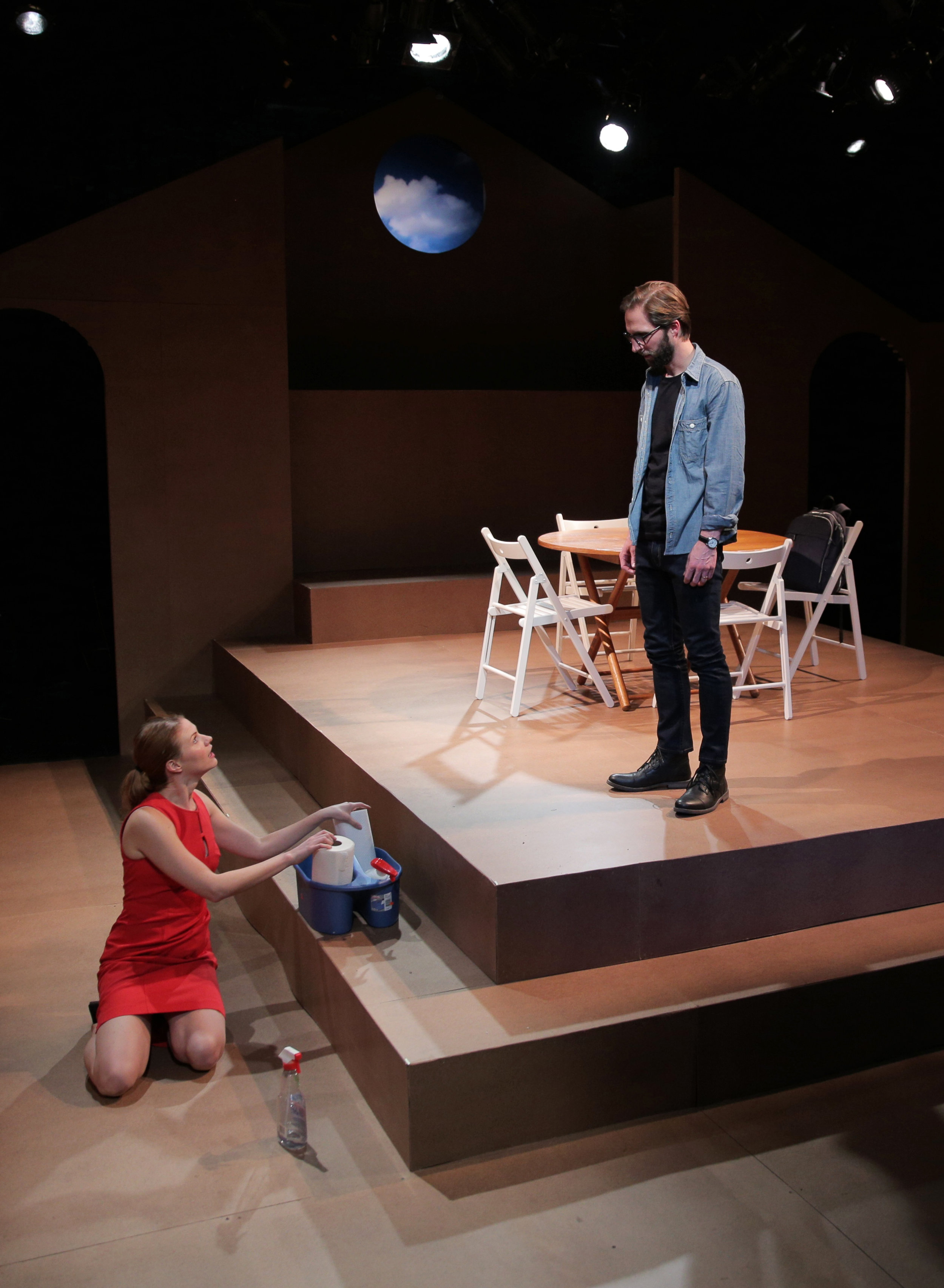
Click for print friendly PDF version of this blog post

Love is a Dangerous Game

The small stage where Almost Mata Hari: Lovers, Letters and Killers by Eva Dorrepaal which explores the life of Mata Hari, the infamous courtesan-cum-spy, as well as parallels to the dangerous loves in her own life, is tucked away in the basement of Theater for the New City. This venue has many theaters; two are in the basement on opposite sides of the building. But the spectator is rewarded with the discovery of finding the right door. And descending the dark staircase is the perfect entrée to Dorrepaal’s world. Set as a living room, it looks as if it will explode with one false move: clothing and bric-a-brac are strewn everywhere. Short directives such as “Breathe” are pasted everywhere, as are Dorrepaal’s notes about Mata Hari: a timeline of her life and lists of men. The feeling is potentially claustrophobic and one wonders if Dorrepaal has been reading up on the avant-garde theater provocateur, Antonin Artaud’s concept of a “Theatre of Cruelty” which called for the "communion between actor and audience in a magic exorcism (…) to shock the spectator into seeing the baseness of his world.” Artaud was known to stage plays or scenes in isolated places where, one person who attended an Artaud play in the '60s, claims, “there could have been a murder and no one would have known.”

Dorrepaal appears debased at first—her clothing is disheveled, and she is harried and seemingly uncomfortable. She recalls an early abusive relationship: a broken jaw leads her to a dentist whom she eventually takes up a relationship with. Dorrepaal’s play begins in an emotionally Artaudian vein: two hours of listening to stories about violent relationships would have definitely felt entrapping and scary. She briskly changes pace and shifts the focus.

As an actress, Dorrepaal is fidgety, breathless and wide-eyed, which gives the impression of a woman on the verge of a nervous breakdown. However, there are interesting angles being worked which reveal three distinct layers: how an actress prepares (Dorrepaal refers to the method acting approach of using sense memory), her personal stories about past lovers, and her response as both an actress and woman to the story of Mata Hari’s life. The premise of Dorrepaal’s show is that she is an actress writing a play about Mata Hari. However, Dorrepaal inserts herself into the performance, and comments on the difficulty of acting, as well as the role of Mata Hari. Under the guide of a less gifted actress, this triadic approach could have been confusing, but Dorrepaal is a masterful performer. And funny too. In one scene, Dorrepaal is playing Mata Hari as a dancer and courtesan. She changes in front of us and puts on an Indian dance costume, with a spangly bra and a full skirt. As Mata Hari she’s dancing, but after awhile Dorrepaal, the woman, gets fed up and screams: “She’s so crazy” (about Mata Hari) and “Fuck, I’m going to have to hire a choreographer” (about herself as a performer). There are many more moments like this that lift the show from a purgatory exploration of women’s abusive relationships to a true exploration of the complexity of being a woman, of love and of being an actress.

Dorrepaal brings to light the dangerous nature of love. Mata Hari had many lovers—particularly military men in high commanding positions—and was rewarded richly with money and goods. She was known to be a spy but no one knew whether she did it for the money or because she could. In the end, she was convicted to death by a firing squad for being a spy; supposedly betrayed by one of her lovers. Dorrepaal informs us that “she died like a man” because she refused a blindfold. Dorrepaal also experienced dangerous love, first with the man in her early years who broke her jaw, and then with Dragan Zabek, an “irresistible mystic who worked as a street performer.” Dorrepaal leaves Holland, her native land, when she wins a green card only to learn that Dragan killed his former girlfriend—viciously strangling her and dragging her from one place to another—and then hung himself in prison.

Dorrepaal is an intriguing actress. She is tall and thin and looks like she has lived life. Her natural hair, which is a wiry reddish brown, often behaves like the wig she dons when she portrays Mata Hari. When she flips it over to one side, it stays there. Other times, it flairs around her face, making her look angry or seductive depending on the angle. Dorrepaal is a shape-shifter as a performer.

In another actor, this could prove frustrating or make her seem uncommitted to her role, but in Dorrepaal, we see a range of emotion pass across her face in a small time span. Sometimes she looks beautiful, other times tormented. This shape-shifting of emotion seems more true to life in the face of dangerous love, which heightens the senses so that desire, fear and uncertainty exist simultaneously.

Almost Mata Hari: Lovers, Letters and Killers, written and performed by Eva Dorrepaal, runs until Jan. 24 at Theater for the New City (155 First Ave. between East 9th and 10th Sts.). Performances are Thursday-Saturday at 8 p.m. and Sunday at 3 p.m. Tickets are $10 and can be purchased by calling the box office at 212-254-1109 or visiting www.theaterforthenewcity.net.

Click for print friendly PDF version of this blog post