Musical

Deadly Games

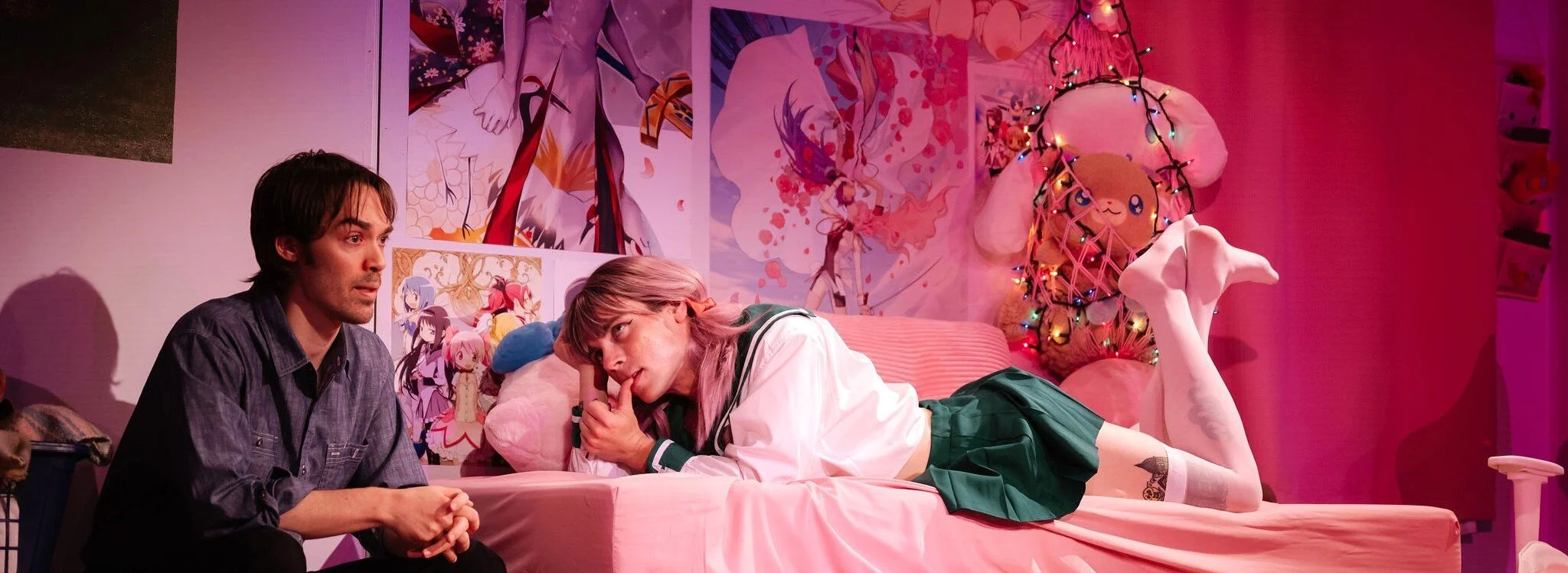
The cloudy difference between fantasy and reality is the subject of Jeff Tabnick's new play, I Found Her Tied to My Bed, an hourlong one-act about the fine line between true romantic love and ritualistic murder. Lounging around a set dominated by nothing more than a large bed, two young female roommates play games of love and death, pressing each other's buttons until they have no choice but to make their fantasies a reality or look elsewhere for someone to share the rent with. This spare but affecting production, playing every Wednesday night at Under St. Mark's until the end of the month, examines a not-so-healthy relationship between two roommates, sometime lovers, and occasional murder accomplices.

"I'm not a lesbian. I'm a killer," says Jan (played by the severe Shannon Kirk), a rebellious nurse at a retirement facility, who has taken to amusing herself at work by speeding up the turnover rate at the facility's critical wing. A pair of damp cloths her only tool, she views herself as something between an avenging angel and an agent of mercy, killing in a seeming act of euthanasia only the sickest patients

Click for print friendly PDF version of this blog post

From Scavenger to Mail-Order Bride

Smoke billows up through lofty ridges of puckered mauve fabric in which garbage nestles in a phantasmagoric rendering of Smokey Mountain, a massive dump on the outskirts of Manila that provided sustenance of sorts to 20,000 Filipino scavengers. At ground level, in complementary colors, are the study and bedroom of a real estate broker's upscale Park Slope apartment. This inventive set by Dan Kuchar depicts the twin poles of Linda Faigao-Hall's The Female Heart, an ambitious new play that follows Adelfa (played with aplomb by Rona Figueroa) in her journey from scavenger to Starbucks employee to college grad to mail-order bride.

While the political message is hammered home where a light tapping would have done the trick, the playwright manages to seed enough compelling details in Adelfa's story to sustain our attention. Director Jamie Roberts's sure-footed blocking plus the work of her talented design team help smooth the play's leaps through time and space.

We learn about Smokey Mountain, which was demolished in 1993 to make way for a never-built housing development, through the clunky device of spot news reporting by an Australian journalist, wittily portrayed by Sean Sutherland, who interviews Adelfa's brother Anghel (Victor Lirio) at the dump in 1992 in the play's opening scene and returns to the site nine years later in the final scene.

In between those expository bookends, Faigao-Hall vividly dramatizes the mercilessness of poverty, the forces that drive immigration, the miscues and incongruities between Filipino and U.S. culture, and how profoundly important the money sent by migrant relatives is for families back home. What she doesn't do as effectively, alas, is create convincing, multidimensional characters, despite the laudable efforts of the cast.

The play's title comes from the Tagalog phrase for a man or woman with a tender heart. Adelfa and her brother share that quality. Through an extended flashback, we learn that Anghel secretly took a job as a dancer in a male sex club to finance his family's escape from Smokey and pay his sister's way through college. But when Anghel falls seriously ill, it is Adelfa's turn to sacrifice in order to pay for his medical care. Adelfa and her mother decide that marriage to a rich American his surname, they happily note, is Golden�is the best choice among unappealing options.

The Female Heart picks up momentum even as the plot grows less plausible when the main action shifts to Brooklyn. Roger Golden (Tim Davis), a good-looking businessman in his 30s, turns out to be controlling and prone to angry eruptions, but penitent and self-reflective at other moments. Adelfa not only accepts her plight, negotiating larger and larger sums of money from Golden as the relationship becomes more confining and brutal, but appears to fall in love with him.

By play's end, things have come full circle. As his sister's letters and phone calls dry up, Anghel recalls the family's final day at the dump, when the three danced with hopeful glee, as the happiest day of his life. "My dear Adelfa, don't send any more things," he writes. "They're just things, Adelfa. Stuff. And it always comes down to this. Someday they'll be garbage."

Click for print friendly PDF version of this blog post

Henry IV, Part One: Much Humor, Less Horror

Of all of Shakespeare's histories, I like the two Henry IV plays the best, for their jarring combination of ribald humor and bloody horror. Over the last few years, I have appreciated them even more for their uncanny parallels to present political realities. Here we see a world leader's son spending his youth in debauchery, then turning about-face to assume his father's mantle, self-righteous in his sense of destiny. Here we see soldiers dying in a war that should never have happened, its perpetrator deceived and manipulated by his advisers. Here we see ordinary people, in taverns where they drink and in battlefields where they die, sacrificing their own destinies for another man's. And here we see the occasional extraordinary old drunk who speaks the truth better than a ruler or a Rumsfeld: "What is honor? A word."

These parallels are not lost on director Marc Silberschatz, whose troupe, Twenty Feet Productions, is presenting in repertory the eight plays that ponder the devastating Wars of the Roses between the houses of Lancaster and York in 14th- and 15th-century Britain and France. The cycle, Silberschatz says, shows how "a diseased morality acts on a people like a cancer." Retelling this story "gives us a chance to examine what we are doing today" in our own domestic and international affairs.

Whether this marathon makes the present-day connection is best evaluated by those who, like the 12 actors themselves, had the stamina to take in the entire experience. With only two plays to go on, I can report that Richard II, reviewed elsewhere on this site, effectively portrays the diseased morality that initiated nearly a hundred years of bloodshed. The actors do not have to use neckties or cigars to demonstrate how easily a vain and cocksure leader can be toppled by cunning and venal opponents. The subsequent play, Henry IV Part One, is rocky and rushed, though the effects of the growing cancer remain clear.

The secret of a good Henry IV is in maintaining a perfect balance between the comic and the tragic, but in this production the comic wins hands down.

Richard Brundage commands the stage as literature's most lovable philosopher-drunk, Sir John Falstaff. In Richard II, Brundage plays the dominating Duke of York with incongruous timidity, but here you get a real Falstaff, savoring each juicy line like an epicure tasting wine, rolling the words delightedly around the tongue with deliberate pace and timing, moving and gesturing effortlessly.

Alas, he has an inadequate match in Albert Aeed as Prince Hal, the king's heir. Admittedly, this is a difficult role for any actor

Click for print friendly PDF version of this blog post

The Obscenity Heard 'Round the World

When used correctly, the profane actually serves a very sacred social function, one that is too often lost in the shock of the profanity itself: it forcibly tears away the veil of unthinking habit and empty tradition. In this sense, French playwright Alfred Jarry was a master of the profane. Indeed, his finest creation, the infamous Pa Ubu of the play Ubu Roi, is nothing but a vessel for all that Jarry considered base and cowardly in humanity. (Appropriately enough, Ubu's famous first line in that play is simply, "Puh-shit.") Yet Elizabeth Swados's sharp new musical Jabu, based on Jarry's life and using healthy portions of his Ubu play cycle as illustration, shows us just why this high priest of blasphemy is still so sacred to modern theater.

From his childhood in Laval, France, in the late 1800's through his bohemian life in Paris and a rather messy self-destruction

Click for print friendly PDF version of this blog post

Mean Street

I live on Baxter Street, only a few blocks north of the historic Five Points in lower Manhattan, so when a musical depicting that area during its heyday came to my attention, my interest was piqued. Sure, the area known in the mid-1850s for its prostitution and gambling, racial intermingling and bawdy theater scene has entered the public consciousness thanks to the Martin Scorsese blockbuster film Gangs of New York, but perhaps this musical could add a bit of nuance to all of the Hollywood hype. The Baxter Street depicted here seems a lawless, almost Darwinian place, where street fights and accidental murders are fodder for street-corner gossip and the well bred come to gawk at the lowborn as a form of entertainment. It's evident that playwright Barbara Kahn

Click for print friendly PDF version of this blog post

Funny Men

Clowns have been a vital influence for some of the avant-garde's greatest thinkers: Antonin Artaud had a fixation on the Marx Brothers; Samuel Beckett greatly admired such silent film comics as Buster Keaton and Charlie Chaplin. It's inevitable, then, that the experimental theater returns now and then to the grand tradition of clowning to walk a tremendously complex line

Click for print friendly PDF version of this blog post

Grace and Good Deeds

The waiting periods during major conflicts and tragedies will often strip off layers of character to reveal our vulnerable and solitary selves. But while the conversations that go on during these periods may feel particularly important and profound, they don't necessarily make for good theater. Waiting: A Trilogy, the third play from Brooklyn Heights journalist and playwright Paulanne Simmons, falls short of its goal by relying too heavily on dire situations and the characters' backgrounds to deliver an underdeveloped theme.

In the three disconnected scenes, three characters go out of their way to do something nice for somebody else, supposedly connecting the ideas of serving a higher power and earthly goodness. In a hospital, a Christian Scientist attempts to comfort a co-worker who is waiting for the results of her husband's brain surgery. At a bus stop, a young schoolteacher refuses to leave the scene of an accident to ensure that her cab driver isn't unjustly blamed. And in a high-rise office building, an Orthodox Jew risks his life during a terrorist attack to wait for help with a wheelchair-bound friend.

All compelling ideas for scenes, but in the end, there's nothing to hold on to. Taking its own leap of faith, Waiting falls back on the assigned spirituality of its characters to give the performances a sense of grace. While Simmons set out to explore the connections between spirituality and good deeds, she doesn't go deep enough with the characters, nor do some of the actors.

In the first scene, Deborah Paulter (Brenda, the Christian Scientist) and Stephanie Lynn Hakun (Ethel) set a bizarre and contradictory precedent in the very bare hospital waiting room, which consisted of only a bench and a table. Paulter's Brenda was ebullient, if slightly overacted, in contrast with a hesitant and awkward Hakun, who proved in the second scene that her glaring mid-sentence stutters were not intended as part of any one character.

Also in that scene, a booming Patrick Toon (cab driver Mohammad Abdul al-Aziz Medani) and Pierre O'Farrell (a too blatantly racist bus driver, Vinnie) have it out over a bus-cab collision, and Hakun, as the cab's passenger Heidi, steps in to defend Abdul. When a police officer (Joe Salgo) winds up taking Heidi's word rather than condemning the foreign taxi driver (as he says he normally would), the scene winds up feeling like a sugar-frosted morality lesson.

In the final and most powerful scene, Toon (Aaron) and O'Farrell (Tom) did achieve the degree of stripped-down humanity that the script called for, but it was far too late in the production to provoke a reconsideration of the play itself. Toon, O'Farrell, and Salgo, each in dual roles, might have grounded the production with solid performances, but they could not rescue it from its acute case of oversimplification.

The script also has characters revealing intimate details and personal anecdotes far too detailed for a slice-of-life trilogy. And while there were moments of comic relief, they wound up feeling inserted like keys into the wrong locks of the wrong doors. For serious drama to open itself to humor, the audience needs to be emotionally invested first.

No one likes to wait, much less watch other people wait. The lesson here is that if you're going to make an audience watch characters wait, the waiting needs to be pretty damn significant.

Click for print friendly PDF version of this blog post

Leave Them Wanting More

Before I went to see The World of John Wallowitch, I didn't know that John Wallowitch is a New York City cabaret icon who has had everybody from Tony Bennett to Margaret Whiting record his songs. I wasn't aware that Andy Warhol created the cover for his first album. And I had no idea that Tosos II, the theater company that produced The World of John Wallowitch, practically founded Off-Off-Broadway and the gay theater movement. But I didn't need to know any of that to enjoy the show.

The show is a musical revue, stringing together 16 songs spanning the breadth of Wallowitch's career. There is no plot, and there are no characters to interfere with the audience's drinking (due to a two-drink minimum) and toe tapping. Plus, there are heavy doses of wit, sarcasm, and charm.

The show started off a bit slow. The first few songs were enjoyable, but failed to grab my attention. But Heather Olt soon had me doubling over with laughter with her rendition of "Dutch Ecology." The song itself is extremely sexually suggestive, tap-dancing along the line dividing naughty and dirty without ever crossing over. Yet Olt performed with such straight-faced na

Click for print friendly PDF version of this blog post

Richard II: The Journey Begins

It is almost impossible to comprehend what has been happening at the West Park Presbyterian Church on Amsterdam Avenue at 86th Street this month. The entire eight-play Wars of the Roses cycle of Shakespeare's histories (Richard II, Henry IV Parts One and Two, Henry V, Henry VI Parts One, Two, and Three, and Richard III), cut minimally, is being performed in repertory six days a week, with three plays on Saturdays, through March 4. And 12 actors do it all.

This sweeping project comes from twentysomething Marc Silberschatz, who founded the company, Twenty Feet Productions, just two years ago and last season cut his teeth on the two parts of Henry IV in collaboration with the York Shakespeare Company. In addition to directing all the plays, he assumes the title role in the Henry VI trilogy, plays subordinate roles in the other plays, handles publicity, and sometimes sells tickets at the door. Total budget: $8,000.

One immediately thinks all this cannot possibly be good. It is hard enough to mount one respectable production with twice as many players and a hundred times the budget. But judging from Richard II, the one play I have seen thus far, the results are quite astounding. The reason is that this mammoth effort runs on the power of the plays themselves and on the passion and perspicacity of the actors presenting them.

There are no sets; the church is set enough, with its spacious sanctuary, elevated and carved-wood preaching area, and balcony. The lighting is basically off-and-on. The costumes range from thrift-shop to clothes-closet. No pyrotechnics, no revolving stages, no pheromonal attractants, no haute couture. But who needs all that folderol anyway, those strained attempts to contemporize, contextualize, distract, disguise? It is the words, and the knowing movement around the words, that make Shakespeare work. And it works here.

The actors, mostly young, are unpaid. They rehearsed all eight plays together as a unit, four to five hours a day, five days a week, for four months. Each actor plays 20 or more parts in the cycle, and when the same character appears in succeeding plays, the actor retains the role throughout.

Oh yes, and one more thing: the casting is gender-neutral. Among the major figures, for example, King Henry IV is played by a woman, Queen Margaret of Anjou by a man.

Richard II is a good place for the theatergoer to start this remarkable journey, both because its subject is the king whose vanity and avarice precipitated the devastating hundred-year Wars of the Roses between the related houses of Lancaster and York that the eight plays encompass, and because it is the most poetically pure of the cycle. With no big battle scenes, no comic relief, and written entirely in verse, it challenges the actors to bring the characters alive by virtue of their interpretation of the text alone. And by and large, they do it.

Seth Duerr, an experienced Shakespearean, commanding in stature and physically expressive, plays King Richard forcefully, if perhaps too cautiously. The precipitous crumbling of a seemingly invincible personality calls for a turnaround much more drastic than he offers.

Bending gender, Kymberly Tuttle is cast in the crucial role of Henry Bolingbroke, who deposes his cousin Richard and takes the crown for himself as Henry IV. Steely, sober, calculating, brutal, Tuttle portrays him rightly. However, she's over a head shorter than her rival, with short blond hair and a face to die for, and dressed in form-fitting black to boot. She thus challenges the willing suspension of one's disbelief. Yet there is something convincing about her, and only later did I realize what it is: she bears a certain resemblance to...Hillary Clinton. This may work after all.

Of the three other women taking men's roles, Nicole Maggi as Henry Percy the Elder affords a dash more belief. She's built tough, looks tough, and acts tough, like an NYPD cop. But even her best efforts at masculinity are sometimes thwarted in competition with the bushy-bearded and impetuous Ryan Patrick Ervin as Percy's up-and-coming son Hotspur.

Kristin Woodburn

Click for print friendly PDF version of this blog post

Shaw to the Core

Worries about the ethics of policing the rest of the world? Concerns about scandals in our leaders' personal lives? Discomfort with the growing role of money and big business in politics? Sounds like a laundry list for a modern American political critic, doesn't it? It might be surprising to learn that this airing of dirty political laundry (and prediction of the future) was done by George Bernard Shaw in The Apple Cart, first published over 75 years ago, in 1929. His "political extravaganza" is being produced by Theater Ten Ten, and if you're a fan of the intricate playing of "the great game" of politics, then this uncannily pertinent classic may be worth taking a look at. Of course, Shaw's vision of the future in The Apple Cart sometimes flies a little wide of the mark. His future world has its share of misconceived predictions and even has a few features that are downright laughable today, such as the economic and military clout wielded by the League of Nations. Beyond just amusement, though, it's fascinating to look back at our past as seen in an earlier era's sense of the future, both for the perhaps understandable mistakes and, even more so, for the odd moments of eerie accuracy.

Shaw's fictional future chronicles the delicate maneuverings of the British cabinet and monarchy during a day of "crisis" for the country. King Magnus (Nicholas Martin-Smith) has offended the government by bringing his charismatic personality into an active role in politics. The debate rages over who truly rules in this democracy: the king, the government, the businessmen, or perhaps even (gasp) the people. Led by the prime minister (Damian Buzzerio), the bizarrely eccentric cabinet issues an ultimatum to the king, demanding that he become a constitutional monarch who only rubber-stamps legislation and lets his cabinet run the country "in the best interests of the people." If he refuses, they threaten to expose details of his less than saintly personal life to the press.

The Apple Cart is pure Shaw, top to bottom: the ideas fly thick and fast, while the dialogue slows to a crawl, with speeches bulky enough to choke a hungry elephant. Call it a comedy of ideologies

Click for print friendly PDF version of this blog post

That's Amore

"Afta the show, lemme know what ya think," Aldo, the thuggish protagonist and narrator of Italian American Reconciliation, says to a man in the front row during a pre-show improvisation session. While his routine is initially humorous, the stereotypical Italian accent and exaggerated facial expressions are not. Aldo (Craig Glantz) is not introduced as a man to take seriously, even though he is later portrayed as a philosophical character. Glantz, as well as the cast's other actors, are competent performers saddled with the difficult task of trying to squeeze serious emotions out of their unrealistic, over-the-top, cartoon-like characters.

In fact, the only thing authentically Italian about Italian American Reconciliation, playing at the Gene Frankel Theatre, is its soundtrack. Audience members clap along to "Mambo Italiano," sway to the romantic sounds of "Addio, Mulberry Street," and laugh at music made famous by playwright John Patrick Shanley's other Italian-American tale, the beloved 80's film Moonstruck.

A confusing love triangle develops as Aldo devises a plan to seduce his best friend Huey's abusive ex-wife Janice to prevent Huey from dumping his loving girlfriend Theresa and going back to Janice. Which raises a question: Will Huey (David Ellner) remain Aldo's best friend if he catches him in bed with his ex-wife?

Apparently, Aldo does not consider this, because later that night he stands in Janice's backyard throwing rocks at her bedroom window until she angrily emerges holding a pistol. This backyard, as it turns out, is the most authentic Italian setting in the play. Whereas other scenes consist of a generic table and chair for conversation, the backyard is elaborately realized, with a brick and vine-covered wall topped off with a railing for a balcony, a sliding-glass door that opens into the backyard, and a plastic, white picnic table standing center stage.

Throughout the course of this very long scene, Janice (Jen Peterman) remains perched on her balcony like Juliet, while Aldo and Huey take turns standing below her like Romeos, begging her to come down. She declines and draws a gun on Aldo, attempting to shoot his kneecaps after he suggests they "tear up the mattress." Terrified, Aldo leaves, and Huey enters with a different approach. Here the previously fast-paced and comedic tone set by Aldo ends, and a longwinded diatribe, spoken in desperation by Huey with overly poetic language, begins.

As an over-the-top, sadistically comic character torturing the sleazy Aldo, Janice works, but as a serious love interest to the kindhearted Huey, she does not. She says her fondest memories of their marriage include purposely burning his food, beating him, shooting his dog, and trying to shoot him when he forgives her for the dog. What she does not say is why she married him in the first place, which is the elephant in the room during this scene.

The story takes another confusing turn when Aldo steps in as narrator to explain that we should root for Janice and Huey's reconciliation even though his original plan was to prevent it. He gives a rushed and convoluted explanation as to why he changed his mind, ending with a moral teaching: everyone must learn to love.

While this may be an important lesson, the story does not clearly teach or preach it. In fact, the lesson here feels more along the lines of "how to escape an abusive relationship."

Still, it must be said that there were audible shrieks of joy from the audience whenever a classic Italian melody was played. For many of the bouncing, handclapping audience members, the Italian ambiance alone seemed to be worth the price of admission to Italian American Reconciliation.

Click for print friendly PDF version of this blog post

Who's Your Daddy?

The issue of paternity occupies a hallowed place in Western drama. The topic's draw, of course, is the intuitively satisfying idea that such intangibles as fate are just as inheritable as the more concrete, biological traits passed from father to son

Click for print friendly PDF version of this blog post

Say What?

Pop culture junkies love to talk about celebrities. True pop culture aficionados, however, go one step further and actually quote their favorite celebrities. Michael Martin, creator of Verbatim Verboten, recognizes this skill and has turned it into a new kind of entertainment. Verbatim Verboten draws on secretly recorded telephone conversations, witness testimonies, and other records of remarks by celebrities and public figures of lesser repute that have somehow fallen into public domain. It then brings them to life with a cast of local comedians. At this particular performance, the ever-morphing material included re-enactments featuring John Gotti, Jenny Jones, Madonna, Linda Tripp, and everyone's favorite newlyweds, Prince Charles and Camilla Parker Bowles.

Each performance draws on a rotating selection of 15 to 20 scenes, so there is a certain degree of luck of the draw in terms of which scenes audience members will watch. The night the show was seen, it was billed as "St. Valentine's Day Massacre: Love Stories, Mob Stories" and loosely used that thread to tie its scenes together. Scenes deemed not fit for this show but performed in earlier ones included recordings from Fred Durst, O.J. Simpson, Britney Spears, Orson Welles, and various Enron executives.

One highlight from the show, which plays Mondays at Fez (in the basement of Time Caf

Click for print friendly PDF version of this blog post

The Sole of Love

Shoes. We all wear them, but few of us give them much daily thought. Of course, nowadays most of our shoes are fashioned by machines and sweatshop workers in faraway countries. The shoemaker's art is all but forgotten

Click for print friendly PDF version of this blog post

Growing Up Disabled

At the opening of her solo work Birth Story, Hillary Baack peers out at the audience in the intimate environs of the Barrow Theater and flashes a warm, infectious smile each time she makes eye contact. Having established that connection, she begins to sign words animatedly. "Let me tell you that again in your language," she says with a chuckle, breaking the silence. "I've got three things. Three problems. Three disabilities. Three things to freak you out. Three burdens. Three blessings. Three gifts."

In the lisping cadences of the deaf, Baack tells us how her father realized when she was 6 months old that she was deaf, except for residual hearing in the lower registers. "Let me tell you that story again," she says, beginning to sign for the deaf audience members seated to the right of the stage.

Thus does 25-year-old Baack, an actress making her debut as a playwright, reel us into her world in this modest, autobiographical play that has the feel of an intimate conversation with a stranger.

In a series of vivid anecdotes, Baack tells us about her brush with death as a newborn, how the toes of her left foot fell off due to a blood clot during that episode (thing No. 2), a doctor's misdiagnosis of brain damage when she was 3, and another near-fatal illness in eighth grade that led doctors to discover she had contracted hepatitis B from a tainted blood transfusion (thing No. 3).

You might expect such a harrowing tale to rouse our pity or sympathy, but Baack is so personable and infuses her account with such zest, humor, and rich detail that her story instead creates a strong sense of connectedness to her. We root for her as she grapples with her disabilities and confronts the graceless reactions they often provoke in others.

Director and producer Alex P. Baack, Hillary's husband, has mounted a spare production, keeping the focus squarely on Baack's narrative. The lighting by Stuart Nelson is mostly naturalistic, and Stuart Dance is light-handed with the sound design. The set, by Kyle Nelson, consists of a bare stage with a wicker chair and a small trunk, out of which Baack pulls simple props such as a green bathing cap and goggles, a cloth mannequin, and cheerleading pompoms.

From a corner of the stage, LeTishia Whitney signs those long sections of the play that Baack does not. Besides serving the deaf audience, her expressive translation offers a visual echo of Baack's words.

The hourlong play flags near the end when Baack recounts recent experiences that do not have the same resonance as her coming-of-age stories, and when she drops her jaunty tone for a self-described "rant." But these are minor complaints. It is a pleasure to watch Baack's gradual acceptance and embrace of her "birth story" in this affecting play. We come away with a deeper appreciation of how life is lived in the interstices of what we are given and what we make of it.

Click for print friendly PDF version of this blog post

Love Smarts

Talk about a long-term relationship. The puppet personas of Punch and Judy have been battling it out ever since King Charles II ruled England in the 17th century. The two characters unleash the frustrations of domestic life upon each other through vituperative double entendres and physical violence.

In The Confessions of Punch and Judy at the HERE Arts Center, performers Tannis Kowalchuk and Ker Wells lend their human forms to explore, among other things, this centuries-old relationship and shed light on why the art form has remained such an ingrained part of our social consciousness. Kowalchuk and Wells, along with director Raymond Bobgan, certainly are not the first ones to develop Punch and Judy into living, breathing people. Any domestic situation comedy is a direct descendant of these puppet shows, from Lucy and Ricky Ricardo to Peggy and Al Bundy, along with the ultimate example, of course: Alice and Ralph Kramden.

What the three creators of The Confessions of Punch and Judy have produced, however, is a much more profound, lyrical, and humane portrayal of the ups and downs of a committed relationship. Confessions begins much like any romantic argument: in the course of a typical, humdrum conversation, a simple semantic contest opens the gates of a relationship hell in which every past misdeed and white lie is resurrected by a satanic personality whom you've been cursed to live with for years now. Interspersed with the argument are eloquent physical manifestations of emotional turmoil, Biblical and Greek epic storytelling, and Punch and Judy-esque antics.

Kowalchuk and Wells navigate this demanding pastiche with grace and passion. Not only engaging and charismatic performers, they prove themselves to be physical and emotional athletes as well, changing mood and power at the drop of a hat. Most notably, though, the two performers are fantastic in both filling and thwarting conventional gender roles. Punch and Judy wear all blue and red, respectively, with complementing set decorations. Punch pounds the ground with his hammers while Judy docilely dices an onion (without crying, at that). However, once the argument escalates, these quotidian actions are re-enacted, with the underpinning darkness brought out in the open: Punch recklessly brandishes a power saw while Judy violently hacks at a head of lettuce, no doubt envisioning another head in its place.

Through their journey of storytelling, role-playing, and singing and dancing, they rediscover the ways we misunderstand and misuse the emotion we call "love," leading to reconciliation and perhaps the most glorious interpretation of makeup sex ever staged.

Finding love is difficult enough; keeping it alive once it's been found can be nearly impossible. The Confessions of Punch and Judy is, at once, a damning and vindicating account of this struggle to make love last, best shown in a quiet and rare reprieve from the argument:

Punch asks, "Are we monsters?"

"No, Punch. Well, yes. I am a monster."

"Me too. I'm a monster too."

Click for print friendly PDF version of this blog post

Not Your Normal Cops-And-Robbers

There is laughter in the darkness. The lights come up on what seems to be a grandson listening to his grandfather tell a joke. That illusion of innocent fun is instantly broken when the younger man shouts,

Click for print friendly PDF version of this blog post

More Than the Sum of His Parts

I walked into the New Directions Theater to see The Flid Show, Richard Willett's play about a young cabaret singer deformed by thalidomide, feeling a bit guilty. Was I compelled by the true story of a recent medical transgression, or by the fact that the show's lead is actually a victim of that transgression? Was my interest grounded in the spectacle, or in the promise of education through art? The strength of this performance, impressively and earnestly given by Mat Fraser, is that it rendered my guilt completely irrelevant. Fraser invites us to take a simple journey of self-discovery with Duncan Mowbray that places the character's life and family in a historical context, which he was trying unsuccessfully to ignore.

When that journey begins, what we know about thalidomide is apparent in Duncan's body: his arms are deformed, the upper and forearm bones much smaller than they should be. The singer insists that he be treated "like everyone else" but only performs folk and pop songs from 1962, the year of his birth and the thalidomide outbreak.

He allows his motherly older sister, Brenda, to dress and undress him, but bristles at her attempts to meddle in his social life or publicize his cabaret act. When he is visited by a Dickensian series of ghosts, each of them a key figure in either his life or the history of the drug, Duncan's contradictory feelings about his deformity are challenged and eventually changed.

But The Flid Show is not merely a history lesson. It is also a love story between Duncan and Rachel, a self-aware doctor from the States who lets down her guard enough to not only hold Duncan but be held by him. We empathize immediately with Rachel because in her we see our clumsy attempts to understand Duncan's situation.

When he first visits her office, Duncan cloaks his attraction for Rachel in piss and vinegar. He is feisty and rude, a showoff who delights in making her squirm. The sexual climax of their relationship, an extended nude scene, has the potential to feel forced or, even worse, uncomfortable. But it is neither, because Kim Donovan succeeds remarkably at making Rachel as emotionally vulnerable as Fraser's Duncan is. In that scene especially, we confront Fraser's body

Click for print friendly PDF version of this blog post

Dinner With Felons

If you are a fan of cold beer, pub food, and some good entertainment while eating it, you will definitely be a fan of Hip-Hop Musical Mysteries' production of A Weapon Most Unusual, playing at the Playwright Tavern and Restaurant. Customers order food before the performance and settle their bills after it. The play's start time varies slightly depending on whether someone has ordered a tossed salad or sirloin steak. Fortunately, the production is sensitive to these time constraints, and the performance is kept to a 45-minute run time. Although 45 minutes does not feel like enough time to tell a story, A Weapon Most Unusual manages to draw each second out, making them all count. A woman named Miriam Cook, played by Marri Wright, has murdered her husband, declaring, "I caught you in the act." In a courtroom scene played out on a large movie screen, it is revealed that Cook has rammed her husband with a car three times after discovering him in a secluded location kissing another woman. Was it pre-calculated or an act of temporary insanity? This is what the jury must decide.

The jury is a wonderfully chosen cast of actors with expressive, captivating faces that work well in extreme close-ups. However, it is important to note that none of these characters ever appears live onstage. Their scenes are restricted to previously filmed vignettes in a courthouse, where they rap at one another across the jury table.

One man raps, "I gave her the benefit of the doubt. She's guilty, there's no way out." A woman counters, "Hold on, big guy, not so fast. Maybe he drove her to kill his ass." In between stanzas, the men rap, "Stupid bitch," while the woman shake their heads and say, "Don't let no man treat you like that."

One cannot help but marvel at the perfect coordination as the jurors speak their dialogue in sync with the hip-hop song underscoring their words. The beat pushes its way into your subconscious, causing many a serious-faced patron to tap a foot while visibly swaying shoulders to the rhythm.

The courtroom drama unfolding before your table is also gripping. Each character is unique and engaging, especially the accused killer, played with hypnotizing animation by Wright. Although her performance is cartoonish in nature, her predicament is intriguing. Her facts are always unraveling into fiction, and though clearly responsible for her husband's death, she gives a convincing argument that he deserved his fate.

And, of course, with any good murder mystery, there is a plot twist. This one does not disappoint. There is no question that Cook is the killer, or that she must stand trial for her actions, but what is the weapon most unusual that the play's title refers to? Does it have any bearing on this story? You will not know until the end.

And not to worry, the revelations all make sense in retrospect. Those with a head for problem-solving will be able to gather clues and connect the dots throughout the course of the story. The challenge in doing so is preventing your analytical mind from being distracted by the rhyming dialogue and infectious hip-hop beats, which make it hard to focus on the plot points being revealed in the testimony and confessions.

Credit must be given to the writer and director, Jacqueline Hankins, for recognizing a need for dinner theater in this New York City pub and forging a path where there was none. The play and tavern are a perfect match; together they provide a fun, family-friendly atmosphere with good food, drinks, and a very compelling murder mystery that will have you discussing its twists and humming its melodies long after you've paid the bill.

Click for print friendly PDF version of this blog post

The Sound of Silence

For most playwrights, the music of a play is in the words. Harold Pinter, however, has made his indelible mark on our modern theater not only through his use of words

Click for print friendly PDF version of this blog post