

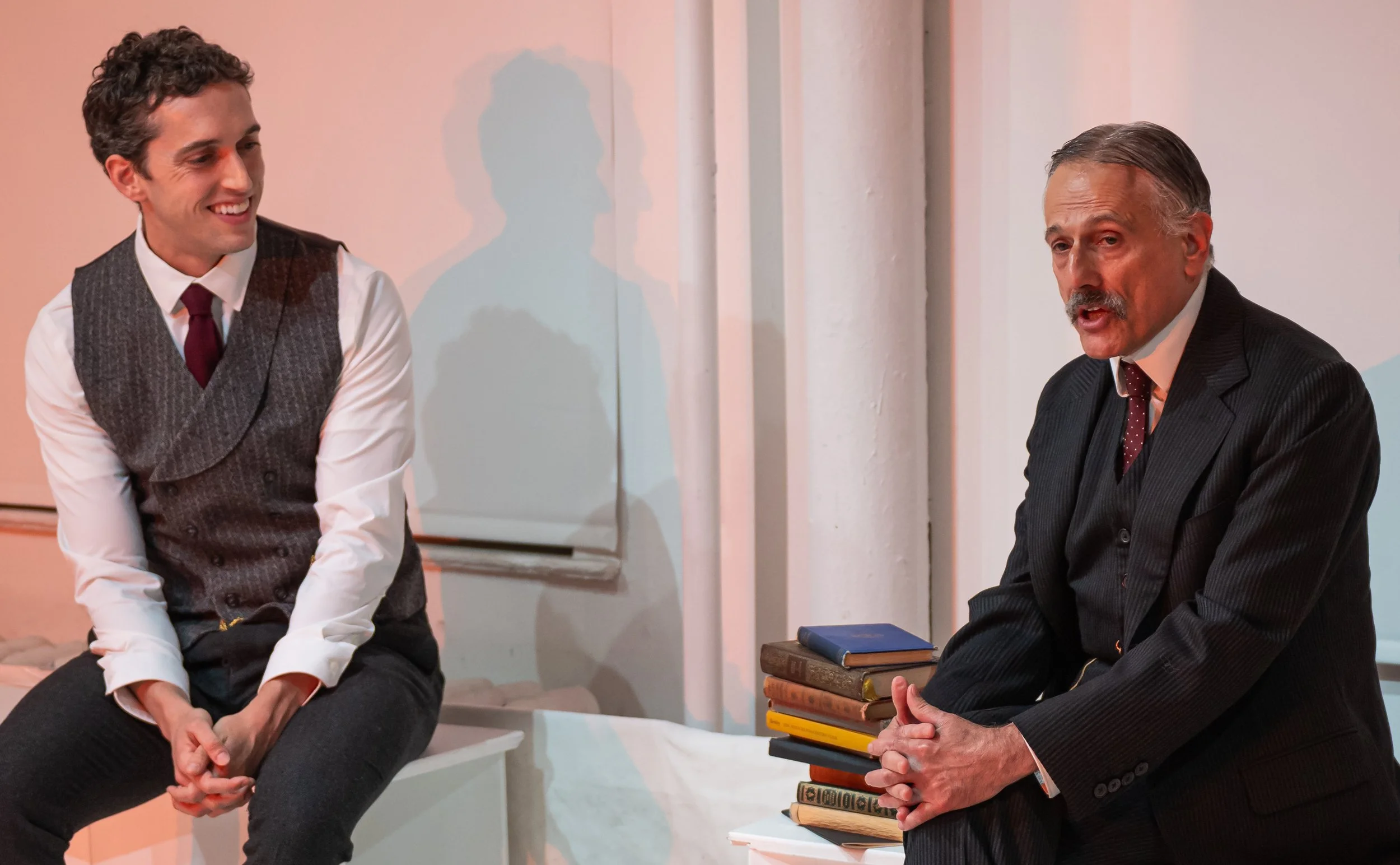
Yaron Lotan (left) plays the young A. E. Housman at Oxford, and David Greenspan portrays the elderly—and recently deceased—poet and classicist in a revival of Tom Stoppard’s The Invention of Love.
In Tom Stoppard’s The Invention of Love (1997), intellectual brilliance and unspoken longing collide as poet and classical scholar A. E. Housman confronts the love he has carried silently through a lifetime. In this rare revival, Zachary Elkind’s direction and David Greenspan’s mesmerizing performance transform Housman’s final journey into a poignant meditation on love, memory, and the price of keeping desire hidden.
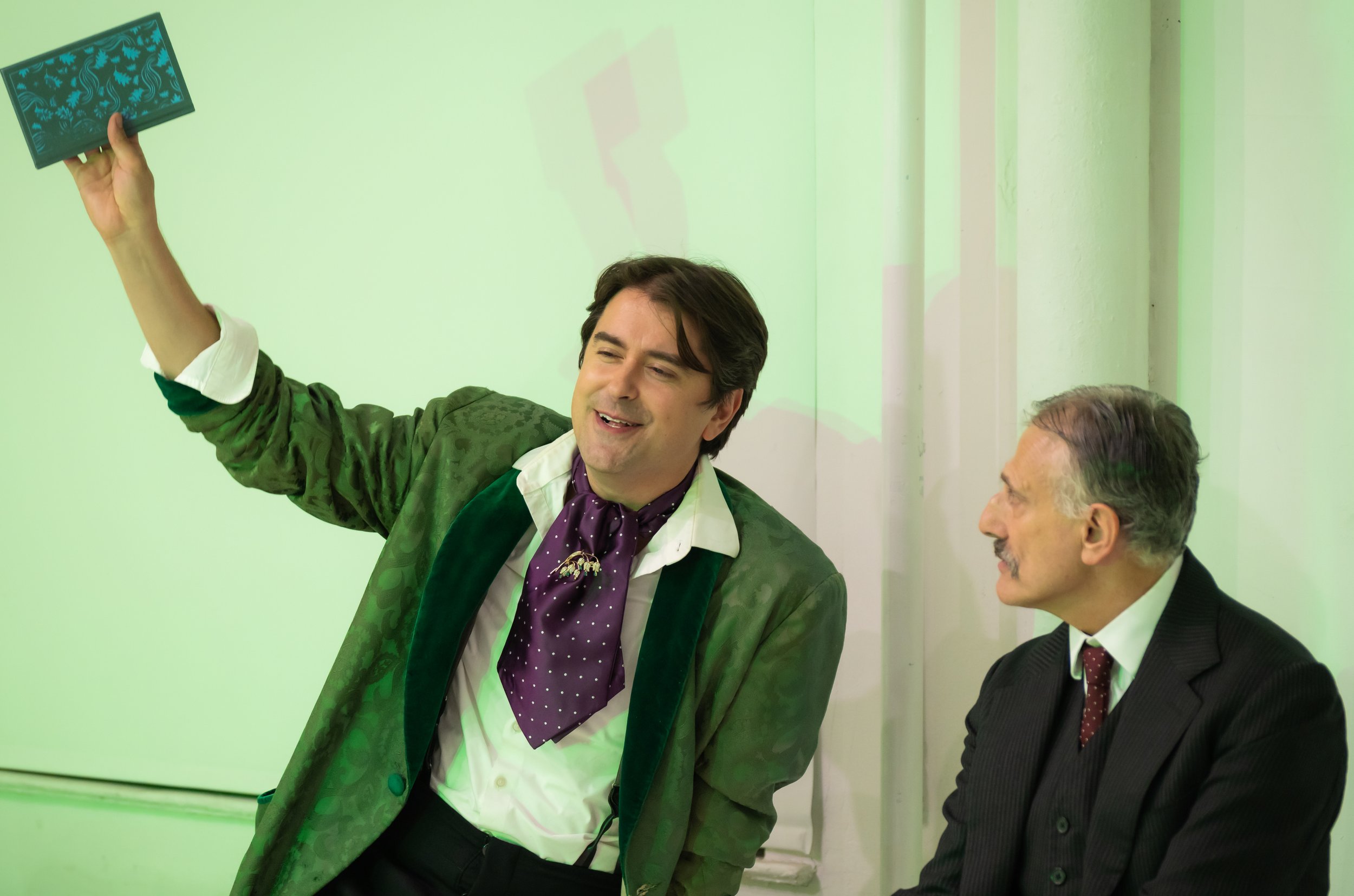
In their encounter on the River Styx, an unrepentant Oscar Wilde (Sam Bolen, left) tells Housman about his love for Lord Alfred Douglas.
After his death in 1936, Housman (AEH) finds himself on the banks of the River Styx, where memories of his life unfold before he crosses into the afterlife. He returns to his Oxford years, his unrequited love for fellow student Moses Jackson, and his fascination with Oscar Wilde, while tracing the changing meanings of love in poetry from the ancient Romans to his own 1896 collection, A Shropshire Lad. As Housman revisits the loves—romantic, platonic, fraternal and forbidden—that shaped his life and work, the boundary between scholarship and deeply personal longing begins to dissolve.
Stoppard’s remarkable gift for weaving exposition into wit and humor is evident from the outset, encapsulated in the conversation between the deceased Housman and Charon, the ferryman who is expecting a poet and scholar but does not quite know what to make of the one who arrives. Housman launches into a dry, mocking critique of Benjamin Jowett’s educational philosophy and the elite culture of 19th-century Oxford, the university where his brilliant performance in classics ultimately ended in a spectacular failure of the final examinations. He objects to Jowett’s approach to classical education, which, in Housman’s view, reduces ancient texts to instruments for practical instruction rather than subjects worthy of scholarship. But just as AEH’s erudition threatens to overwhelm his onstage and offstage audience alike, Charon abruptly interrupts: “Could you keep quiet for a bit?” Housman’s reply—“Yes, I expect so. My life was marked by long silences.”—turns scholarly exposition into a beautifully understated joke while introducing one of the play’s central tensions: a man whose life was shaped by what he could not say.
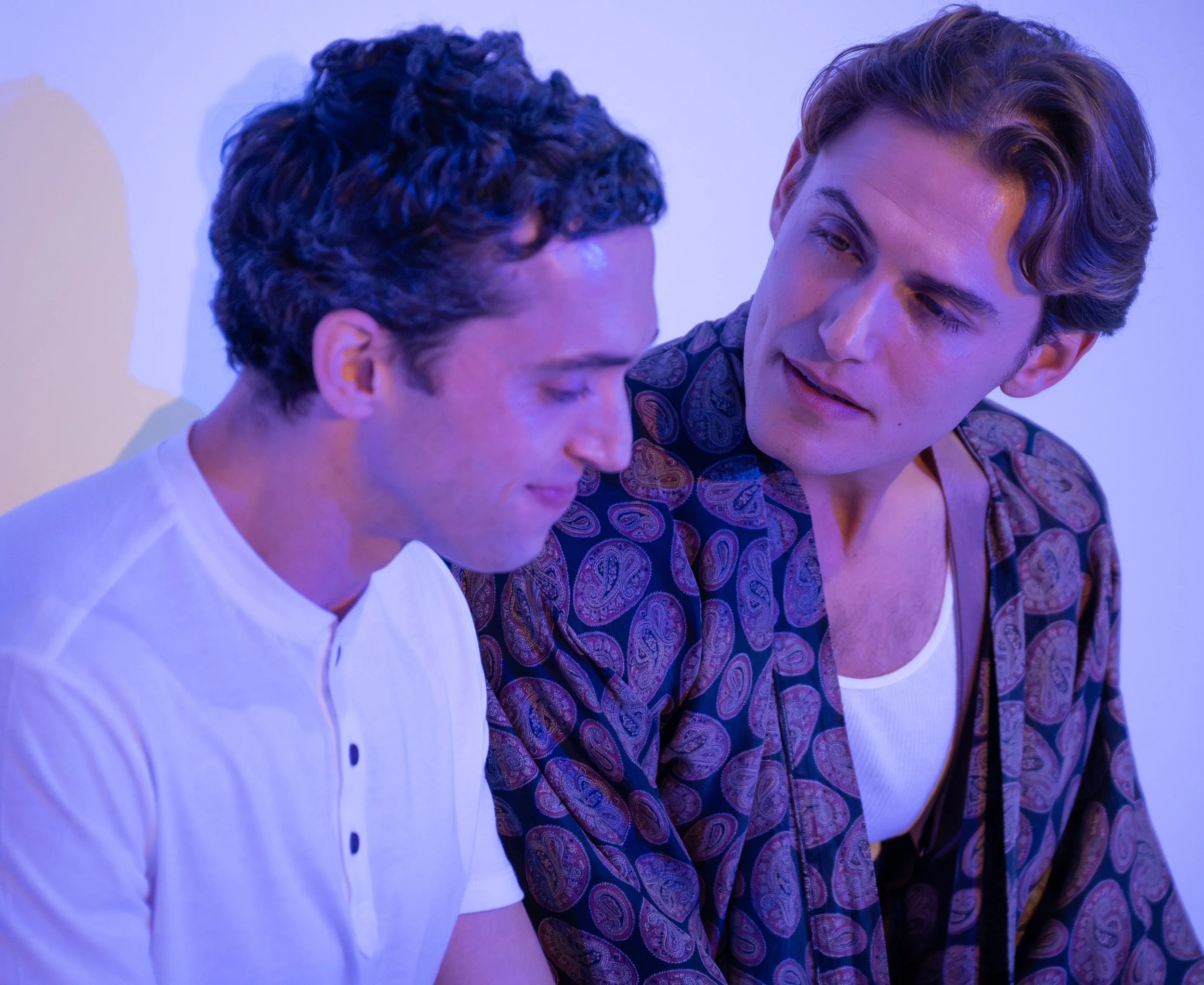
The young Housman, a closeted gay man at Oxford, represses his romantic feelings for his university classmate Moses Jackson (José Espinosa, right). Photographs by Paul Lutvak.
If AEH is temporarily reduced to silence, things change when he surreally sees three men in a boat on the River Styx: his younger self as an Oxford student, accompanied by fellow students Alfred Pollard and Moses Jackson. AEH, who had an undergraduate crush on Jackson but repressed it, begins to say his name (“Mo!”) but stifles the second syllable. In this dreamlike flashback, the post-mortem AEH confronts the dilemma of his life: as a closeted gay man, he could never express his romantic desire for Jackson without risking his academic reputation. Now he must accept that his love will forever remain unrequited. Stoppard’s dual-Housman device creates dramatic tension between the idealistic student and the older, cynical professor.
An intellectual chorus of Oxford professors—based on historical figures—bickers over Victorian morality, classical literature, and the meaning of knowledge, with their debates staged around croquet. Walter Pater, a pioneer of the English Aesthetic movement, champions “art for art’s sake”; John Ruskin views art through strict Christian morality and social duty; Mark Pattison regards classical antiquity as a model for social order while hypocritically denying its physical and homosexual realities; and Jowett treats the classics as a moral exemplar for building character and advancing the British Empire.
AEH’s post-mortem reflections and encounters with his younger self drive the plot. Oscar Wilde, however, becomes his thematic foil and, in many respects, the play’s intellectual counterweight. Mostly invoked and discussed rather than seen, Wilde arrives near the end for an ideological showdown, passionately defending his choices to the repressed poet:
Before Plato could describe love, the loved one had to be invented. We would never love anybody if we could see past our invention. Bosie is my creation, my poem. In the mirror of invention, love discovered itself.
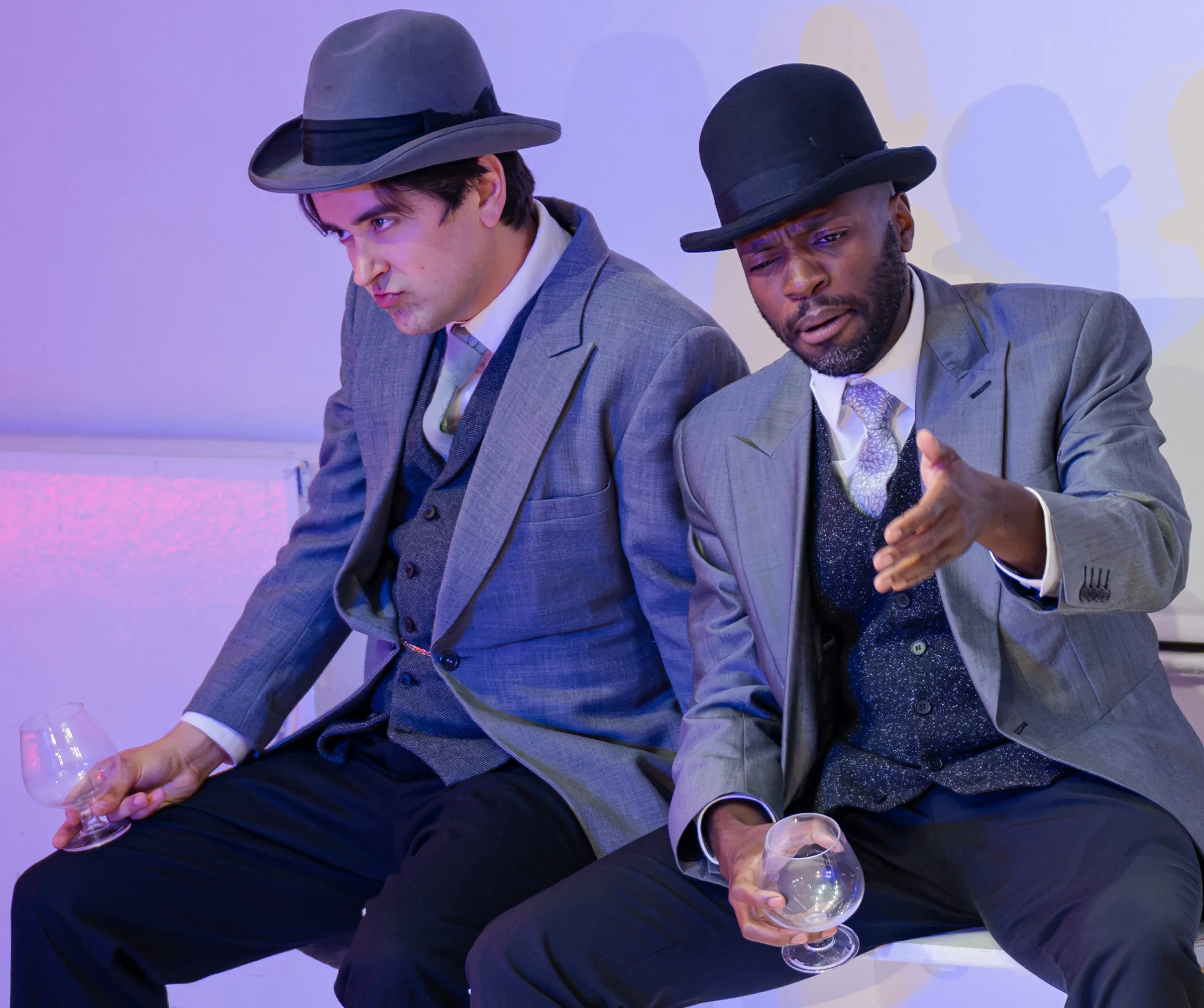
Bolen (left) and Leland Fowler as Oxford professors Mark Pattison and Benjamin Jowett bicker over Victorian morality, classical literature, and the meaning of knowledge.
Greenspan delivers the show’s standout performance. In a dark, buttoned-up suit and polished leather shoes, he looks and sounds every inch the world-class scholar who values clarity above all else, even as his pining sidelong glances betray his love for Jackson. Yaron Lotan, playing Housman’s younger self, convincingly projects the idealistic youth marked for greatness. As Jackson, José Espinosa exudes natural, magnetic masculinity and a generous spirit while remaining oblivious to Housman’s feelings. Annabel Capper, as Charon, is serviceable but lacks the petulant, cynical wit of the mythical ferryman. The rest of the ensemble give persuasive, vibrant performances.
The question at play’s end is poignant: Is it better to live with one’s heart, as Oscar Wilde did, or with one’s head, as Housman did, correcting centuries of corrupted Latin texts yet never experiencing the romantic love he yearned for?
The Invention of Love plays at Theaterlab (357 W. 36th St.) through Oct. 3. Performance dates and times are somewhat irregular and may be viewed, along with other information, at themaptheater.com.
Playwright: Tom Stoppard
Director: Zachary Elkind
Scenic Design: Bridget Lindsay
Lighting Design: Paige Seber
Costume Design: Alyssa Korol
If you enjoyed this review, please click on the Like icon below.
