
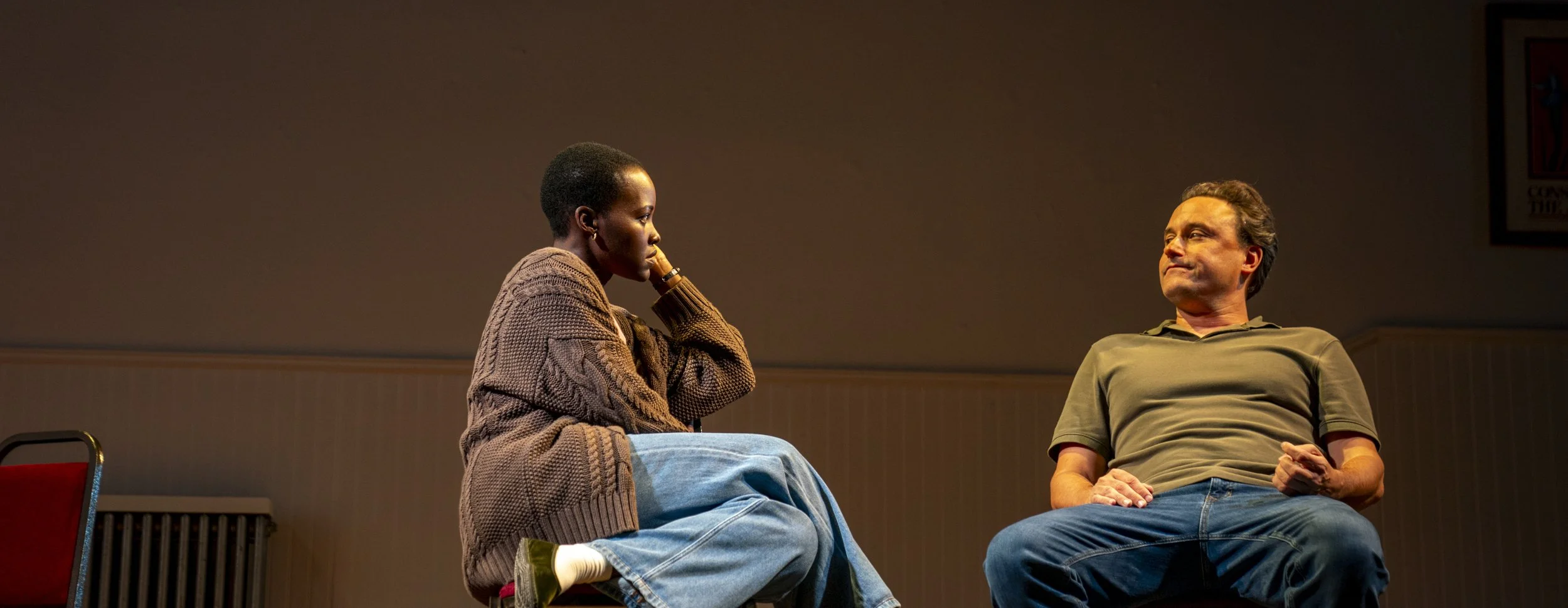
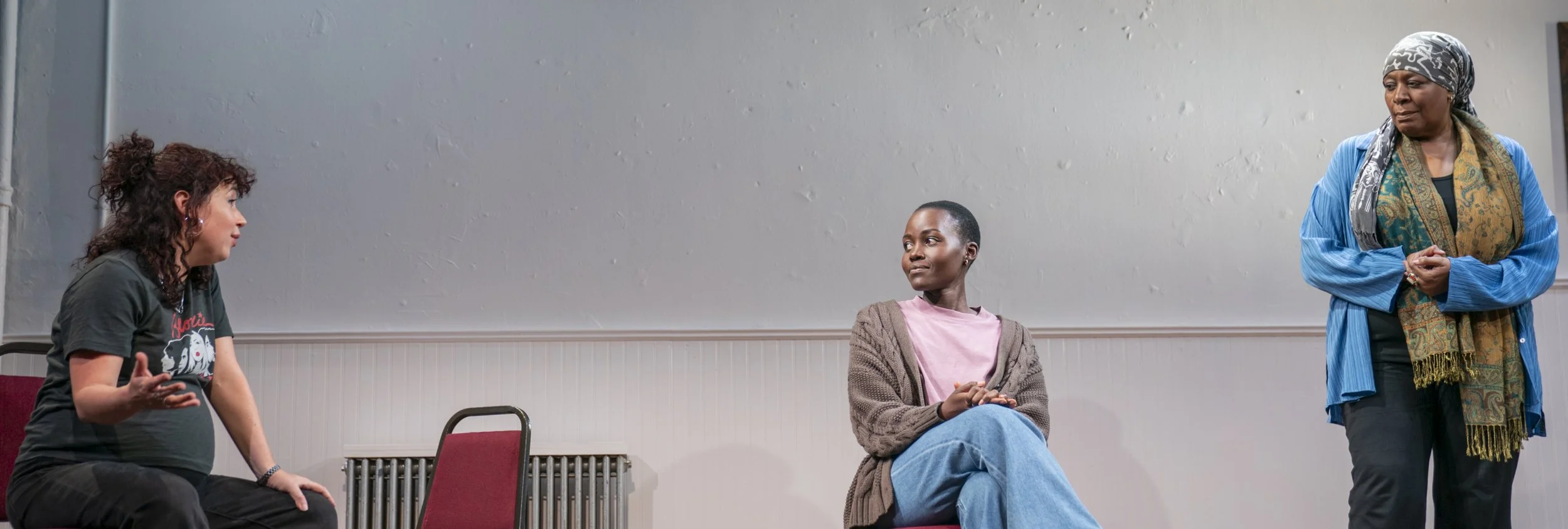
Lupita Nyong’o, center, plays A, a woman who recently left a relationship because of domestic abuse. Here she attends a support group meeting, led by characters portrayed by Sarah Steele (left) and Dael Orlandersmith.
Marin Ireland’s Pre-Existing Condition is about the emotional aftermath of domestic violence. It is a quiet, unflashy play—75 minutes, sensitively directed by Maria Dizzia, with subtle performances from an ensemble of four—but no less devastating for its restraint. Lupita Nyong’o is outstanding as the protagonist, A: with fury, self-doubt, shame, and agony roiling beneath the surface, she strains at every moment to stay composed. The audience follows her through support groups, therapy, unhelpful family and friends, and the tentative possibility of letting herself trust again.
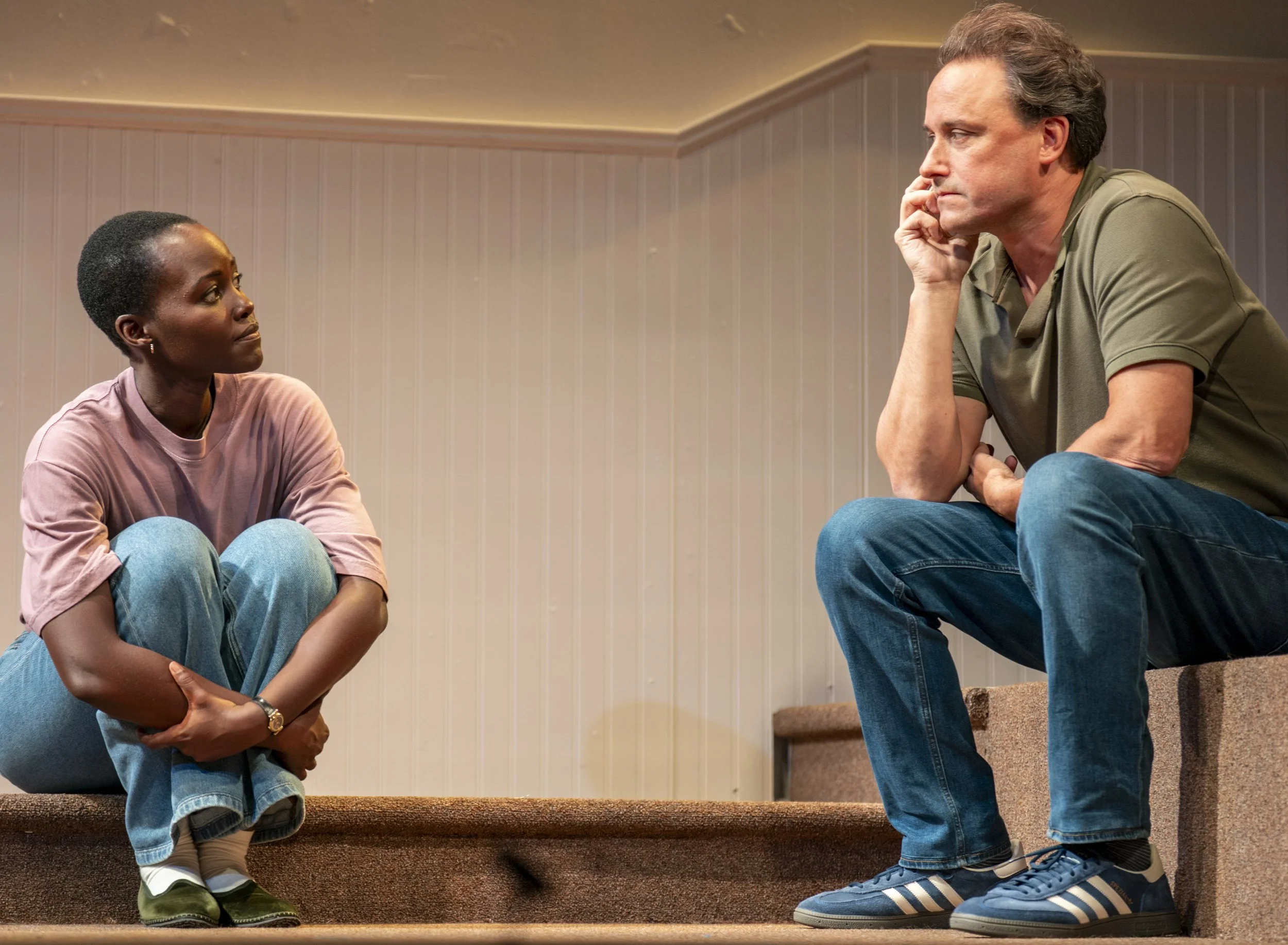
Greg Keller, right, portrays many characters, including a dismissive lawyer, A’s mother, some of A’s dates, and also a close male friend.
A has recently left a relationship after being hit by her boyfriend. Not only is there the trauma of having suffered violence at the hands of someone she loved, there are also the painfully contradictory feelings—still loving that person, thinking that this kind of thing only happens to “trash,” reckoning with the fact that she slapped him a few days prior to his violent outburst and how that slap is weaponized against her. The play points out that one in three women is a victim of abuse, and shows how, despite that shocking prevalence, friends tend to react with surprise, and the law with indifference.
Nyong’o is the first of several actresses scheduled to play A in this run: Phillipa Soo, Susannah Flood, Hari Nef, Edie Falco, and Whitney White are set to follow. By designating the main character with a letter instead of a name and having multiple actresses take on the role, Ireland gestures at universality—this could be any woman. It was also Ireland herself, in 2012, in her relationship with actor Scott Shepherd, as detailed in a 2015 New York Times article.
The three other members of the cast all take on multiple characters, also designated only by letters. A reliably excellent Greg Keller, as B, plays the largest assortment: he is an inattentive lawyer who dismisses A’s chances of legal recourse, her distracted mother who always steers the conversation back to herself, a close male friend, and some of her less-than-stellar dates, among others.
Sarah Steele is one of two leaders of a domestic-abuse support group and also portrays one of A’s friends who is intent on passive-aggressively defending her abusive ex (“He’s going through a lot too, you know?”). Dael Orlandersmith excels as A’s therapist and the other support-group leader. It is in the group, among people who don't need anything explained, that A finds real understanding, even as she mostly listens rather than shares.
Isabella Byrd’s lighting design helps distinguish the play’s institutional settings (the support group or the therapist’s office) from glimpses of what A faces outside them (calls or encounters with friends and family, attempts at romance or new friendships). The former are brightly, almost harshly lit; the latter, in which the actors transform into different characters, are dimmer and more expressive. Still, the shifts are fluid, and it can take a moment to get one’s bearings. Ireland welcomes that, writing in the script’s introduction, “The different characters don’t need to be delineated by anything, as long as the actors play the scenes truthfully. I don’t mind a little confusion in the beginning of scenes.”
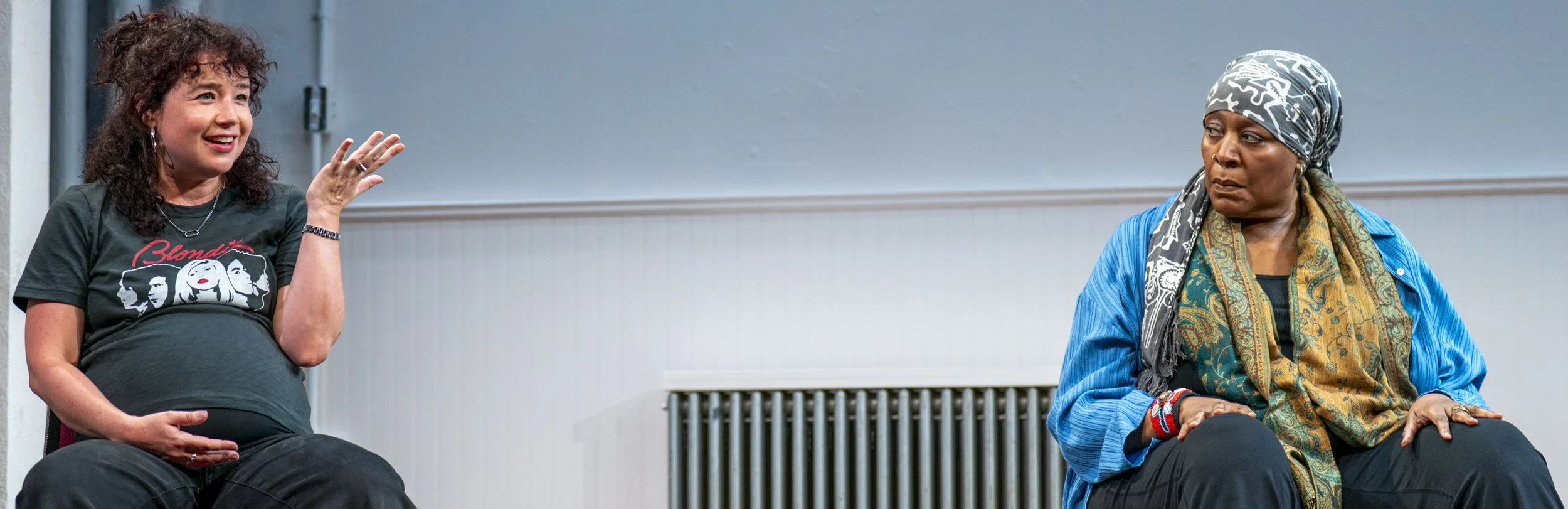
Steele speaks during a group-therapy session. Photographs by Jessica Kourkounis.
Pre-Existing Condition originally ran at the Connelly Theater Upstairs in 2024; now at the Greenwich House Theater there is a bit more space for Cate McCrea’s scenic design of a drab, nondescript setting, exactly the kind of fluorescent-lit room one would expect for support groups of every stripe. Even as scenes take place in myriad other locations, that room is inescapable.
True to its unsensational approach, the play forgoes a confrontation with the abuser and eschews major revelations or lessons magically learned. The incident has become a permanent part of A: “I keep thinking about chronic illnesses. Flare-ups. Because there are moments. There are physical moments. This lives in my body now. It’s not going to go away. Like closing my eyes to go to sleep and there’s the impact again.”
That isn’t to say that the play lacks hope: by the end, A is at least able to imagine a future where her abuser has shrunk in significance and she is not perpetually re-living the event on a terrifying loop. It is, perhaps, a modest hope, but hard-won.
Marin Ireland’s Pre-Existing Condition runs through Jan. 8 at Greenwich House Theater (27 Barrow St.). Evening performances are at 7 p.m. Monday through Thursday and Saturday, and at 5:30 and 8:30 pm. On Friday; matinees are Saturday at 3 p.m. For tickets and information, visit preexistingconditionplay.com.
Playwright: Marin Ireland
Director: Maria Dizzia
Scenic Design: Cate McCrea
Costume Design: Enver Chakartash
Lighting Design: Isabella Byrd
Sound Design: Palmer Hefferan
