
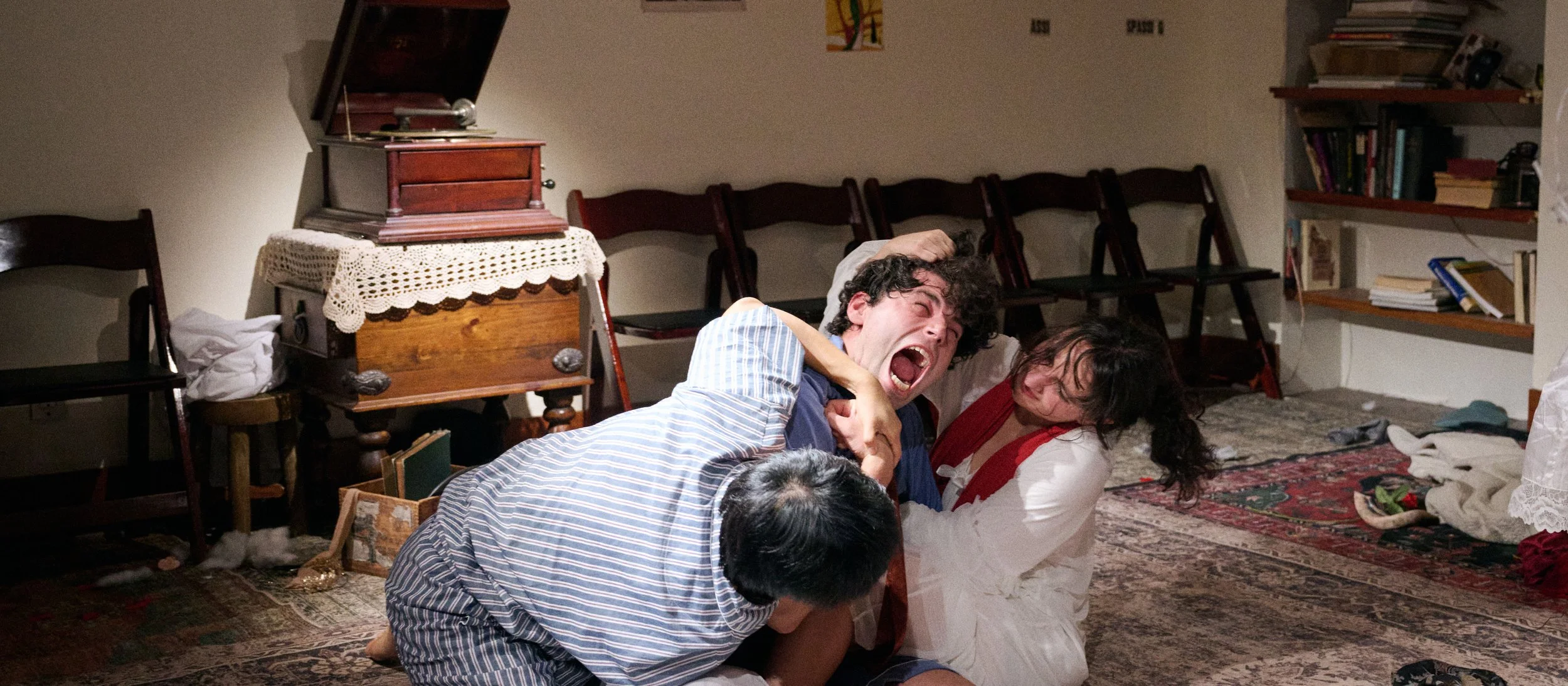
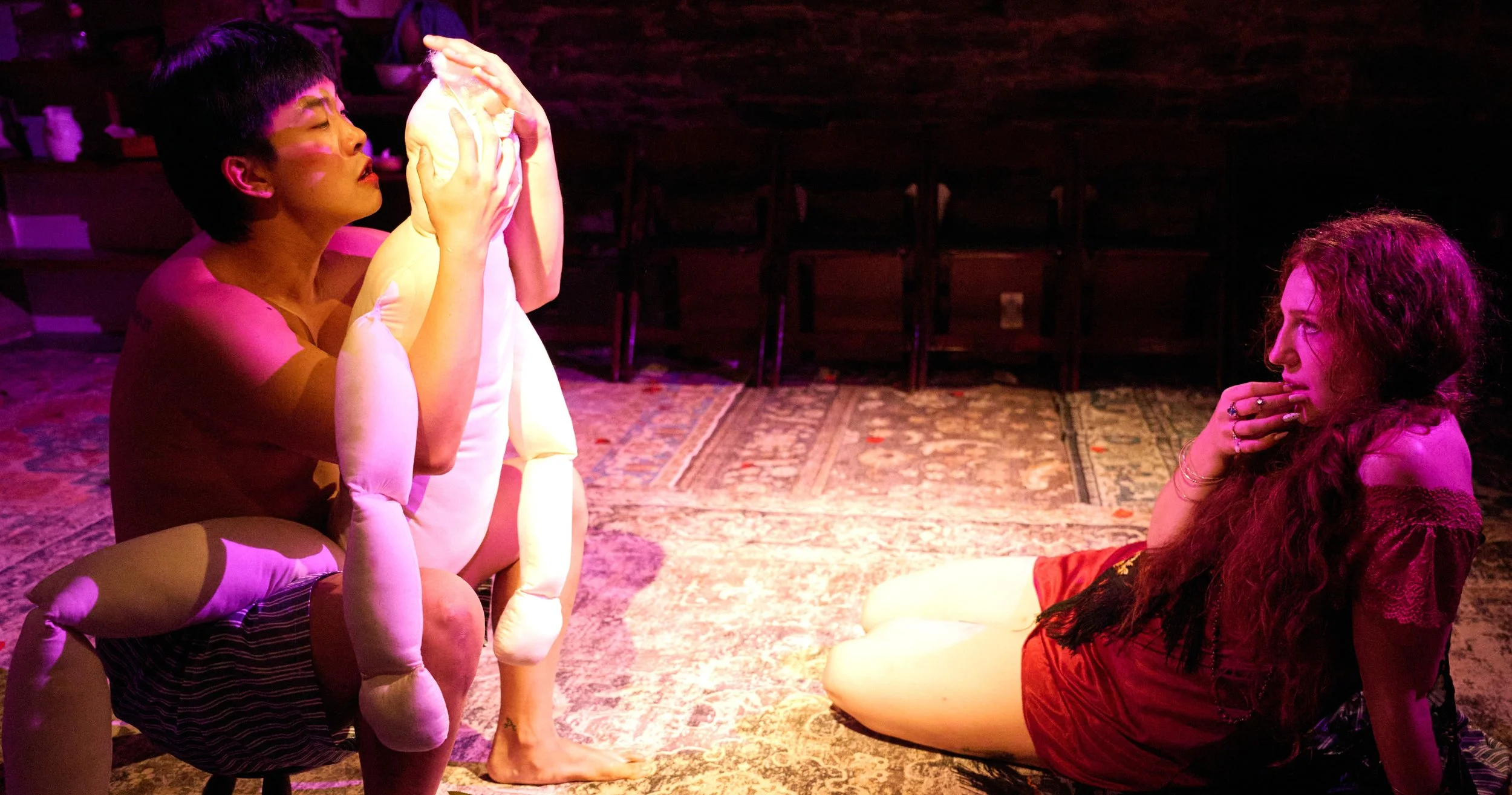
Victor Gao (left) portrays Gerard and Maysie Jane is Elisabeth in Michael Gardner’s new stage adaptation of Jean Cocteau’s novella, Les Enfants Terribles.
French poet and avant-garde artist Jean Cocteau wrote his 1929 novella Les Enfants Terribles (The Terrible Children) in just 17 days while recovering from an opium addiction at a clinic. In Michael Gardner’s ambitious new stage adaptation, which he also directs, Cocteau’s dark, hypnotic fable explores the dangerous power of imagination, suggesting how unbridled fantasy and obsessive isolation can transform an internal refuge into a destructive prison.
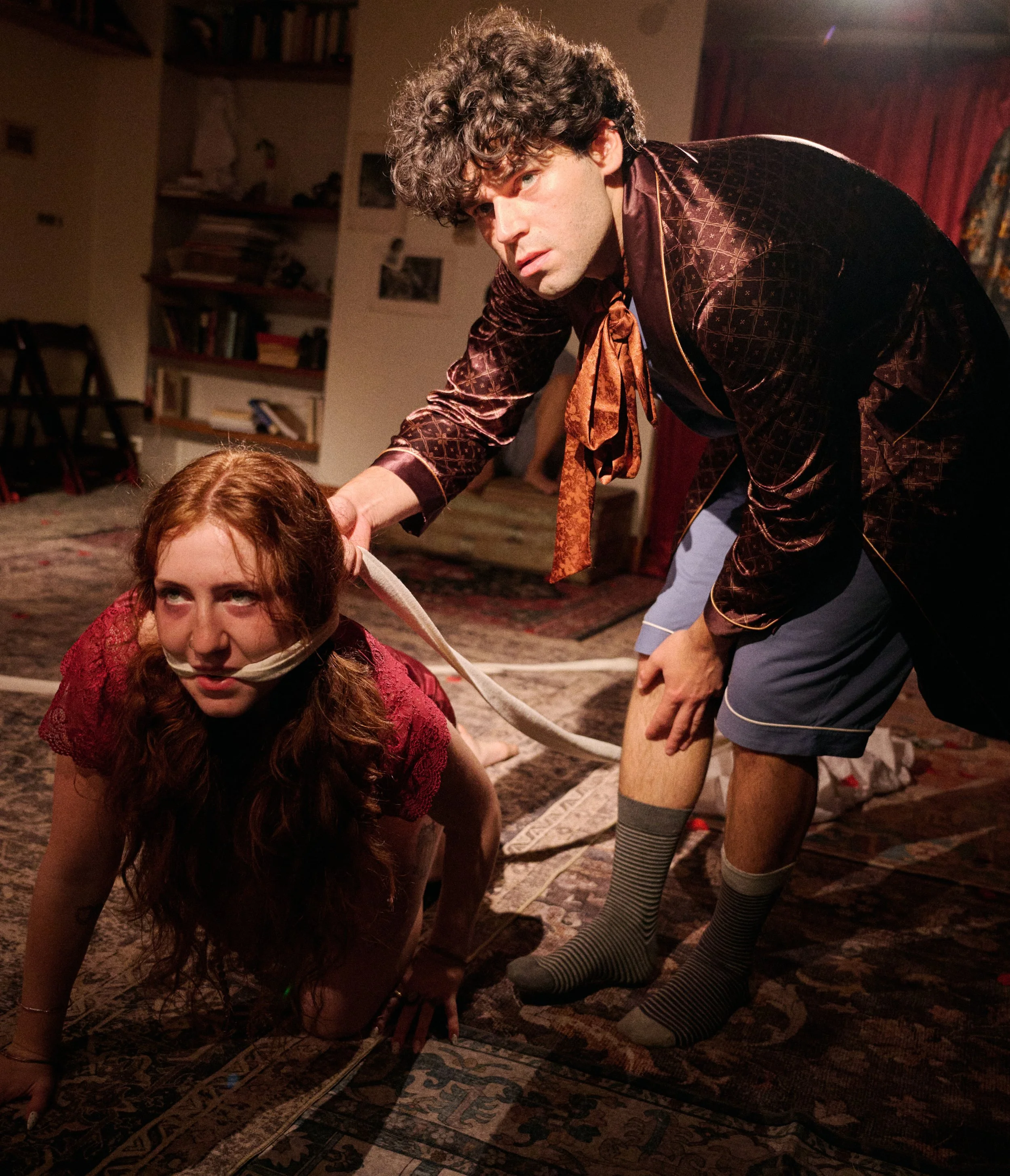
Jane and Rutger Scott play codependent siblings, Elisabeth and Paul, in the Cocteau work.
Cocteau’s novella follows Paul and Elisabeth, codependent siblings whose father is absent and whose mother is bedridden and dying. They retreat from society into a bedroom governed by their “game” of imagination and psychological manipulation. When their mother dies, they become orphans, deepening their dependence on each other. Their cloistered world is disrupted when Paul falls in love with Agathe, a young woman who resembles his schoolboy crush, Dargelos. Jealous of this intrusion, Maysie Jane’s chillingly manipulative Elisabeth orchestrates a web of deceit, persuading Agathe to marry their friend Gérard and convincing Paul that his love is unrequited. When Paul discovers his sister’s manipulation, the revelation shatters their shared reality, leaving them unable to survive the collapse of the world they have created together.
A director’s note offers a key to Cocteau’s surreal treatment of time, which Gardner carries into his adaptation: The story “takes place over 4 years, and, at the same time, as a game played for 100 minutes in front of an imaginary audience.” Like Cocteau, Gardner leaves the calendar years ambiguous, focusing instead on the siblings’ isolating psychological games inside a claustrophobic room. Yet, while the production avoids specific historical markers, its setting evokes late-1920s Paris, giving this seemingly timeless world a distinct period atmosphere.
“‘The game’ turns sibling intimacy into obsession, jealousy and ultimately destruction. ”
Although Cocteau’s Les Enfants Terribles has inspired several adaptations—including Jean-Pierre Melville’s 1950 film, Philip Glass’s 1996 dance opera, and choreographer Fabrizio Monteverde’s 1985 ballet La Boule de Neige—it has received little theatrical attention. Gardner is among the few theater artists to have taken on the novella directly, embracing its surreal material.
Gardner stages Les Enfants Terribles in the East Village Basement, an intimate space with a maximum occupancy of 45. The audience sits on mahogany chairs surrounding the performance area on three sides, placing spectators close to the actors and their claustrophobic world.
Gardner hews closely to Cocteau’s novella. He keeps the schoolmate Dargelos as the catalyst for “the game,” having him injure Paul in a brutal snowball fight that forces Rutger Scott’s dreamily detached Paul into total domestic confinement with Elisabeth, who aptly sums up their situation with exasperated weariness:
Jesus Christ. All I do is slog, day and night, tending to our poor, dear sick mother, lying in bed, waiting to die, while the two of you play war and make trouble. Kill yourselves. See if I care! And it’s all your fault, isn’t it, Gerard! I’ll bet it is. I’ll bet it is, too! And who has to nurse Paul back to health now? You? No, me! On top of our dear, poor sick mother suffering in silence while I administer her medicines, change her linens, sweep the floors, take the laundry, wash the dishes, fix the meals, clean the windows …
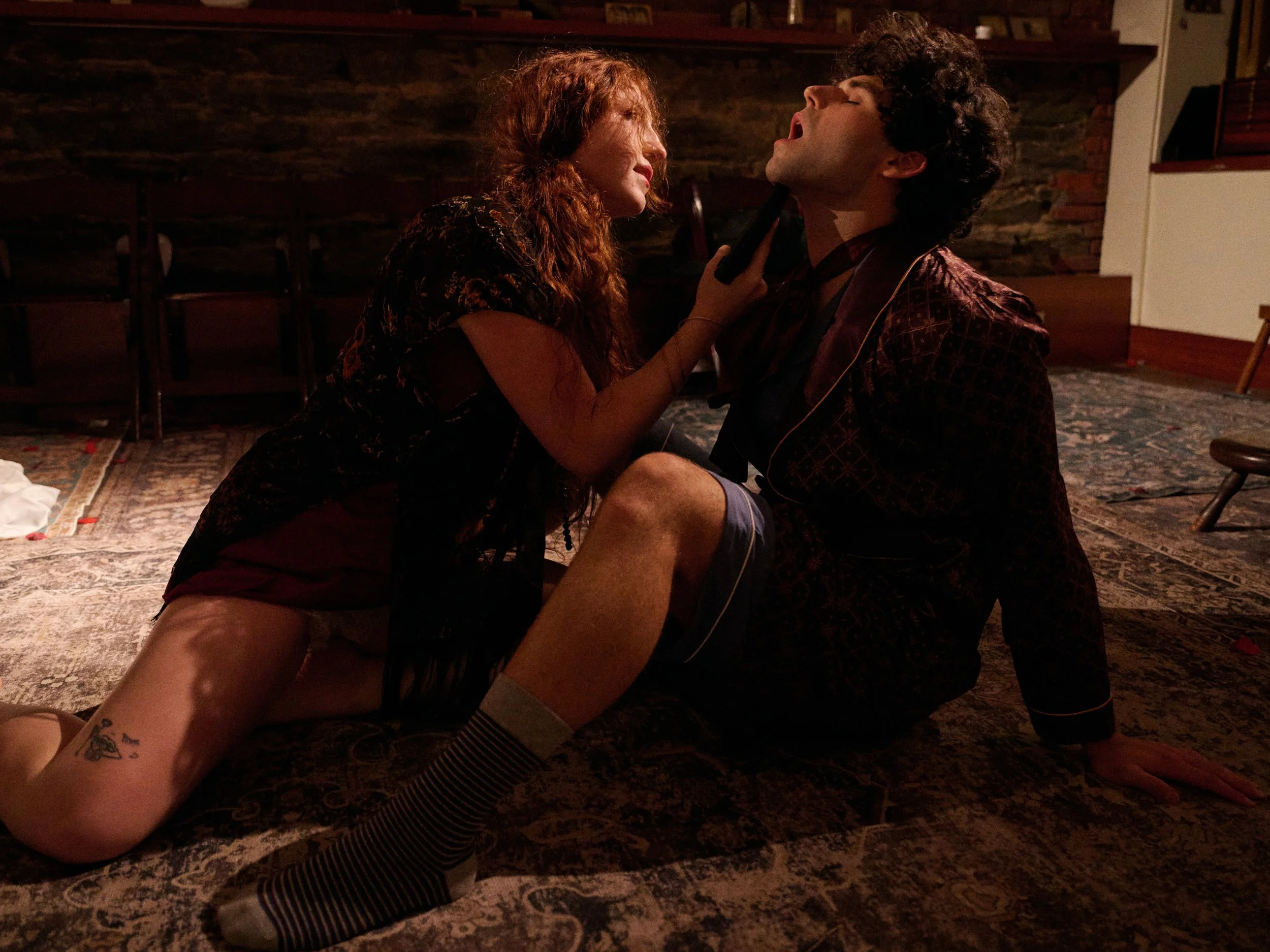
Elisabeth and Paul retreat from society into a bedroom governed by their “game” of imagination and psychological manipulation. Photographs by Kent Meister.
A tragic domino effect drives Les Enfants Terribles, and Gardner heightens its momentum with hallucinatory, breakneck pacing. Events seem to propel one another with almost no time for the characters—or the audience—to recover, as “the game” turns sibling intimacy into obsession, jealousy and ultimately destruction. The result is a grim echo of Greek tragedy, as the siblings’ increasingly destructive moves hurtle toward an ending that seems both shocking and inexorable. In a more modern light, Paul and Elisabeth’s strife can be seen as a precursor to Edward Albee’s Who’s Afraid of Virginia Woolf? Both works probe the psychological anatomy of relationships in which ritualized, cruel mind games create an insular alternate reality.
Gardner’s production also comes with a substantial content warning. Elements include strong sexual and suicidal content, simulated gun violence, and antisemitic, homophobic and misogynistic language, as well as references to rape and depictions of attitudes toward sex, gender and sexuality that may be disturbing to contemporary audiences. This is not a production suited to every theatergoer.
The production’s greatest asset is the magnetic chemistry of its four-person cast: In addition to Jane and Scott, Victor Gao’s Gerard is the soul of loyalty, and Caroline (Lina) DeFazio imbues Agatha with innocence. Their characters’ lived-in glances and overlapping lines help create a remarkably unified ensemble, grounding the play’s emotional intensity.
Gardner’s new stage version of Cocteau’s Les Enfants Terribles may not plumb all the depths of the original, but its delirious momentum and dark intensity make for a potent theatrical experience.
Les Enfants Terribles plays at East Village Basement (321 E. 9th St.) through Oct. 4. Evening performances are at 7 p.m. Wednesday through Saturday; matinees are at 2 p.m. on Saturday and Sunday. For more information, visit enfantsplay.com.
Playwright: Jean Cocteau
Director & Adaptor: Michael Gardner
If you enjoyed this review, please click on the Like icon below.
