
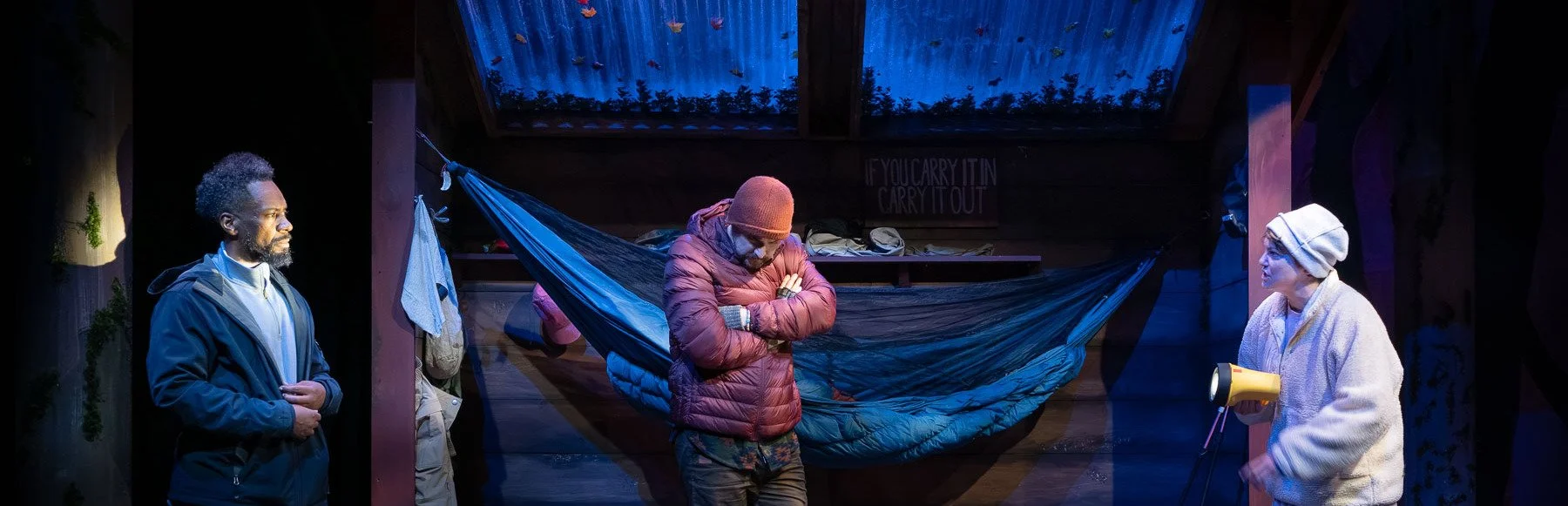
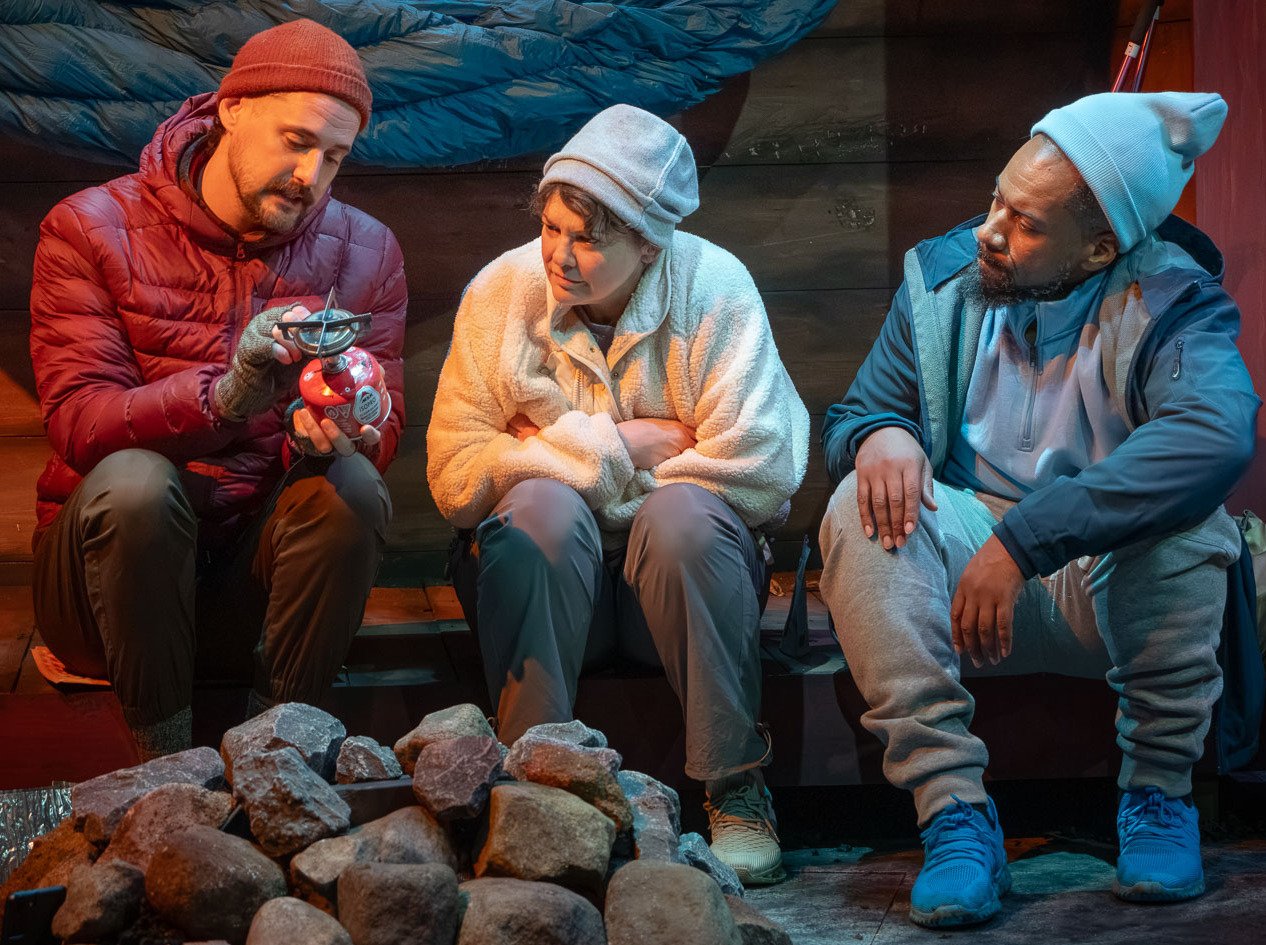
Lean-To’s characters—Xavier (John Alejandro Jeffords, left), Yvonne (Larisa Oleynik), and Zed (Joshua David Robinson)—are XYZ, though it’s unclear why.
In Stephen Sheffer’s new play Lean-To, strangers camp out in the titular structure during a hike. While the setting is rendered beautifully, the drama flops due to a script full of extended silences, platitudinous conversation, and ill-conceived character behavior.
Lean-To opens with Xavier (John Alejandro Jeffords), a gay man hiking solo, arriving at the rustic shelter, located in an unnamed woods, not far from an unnamed city. The audience watches as Xavier unloads his backpack, stretches and rehydrates, changes his shoes and socks, makes a video for social media, and strings up his hammock.
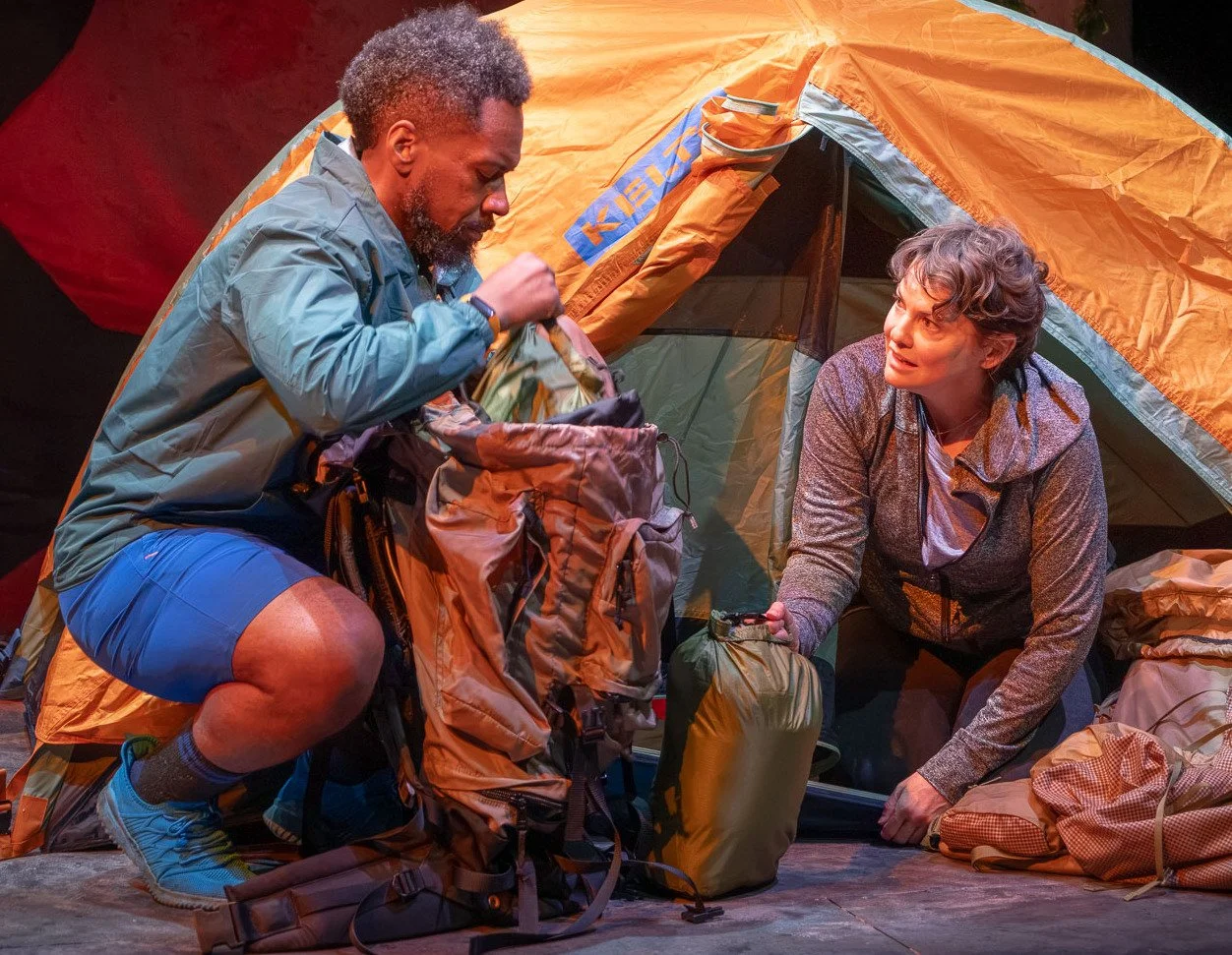
Zed (Robinson) is a reluctant participant in the outdoor adventure Yvonne (Oleynik, right) has planned. Photographs by Burdette Parks.
Soon after he’s settled in, two other hikers, Yvonne (Larisa Oleynik) and Zed (Joshua David Robinson), reach the lean-to. The audience must then watch them assemble their tent, step by step and without speaking to each other—because, Yvonne suggests, “nonverbal communication stuff might be helpful.”
Yvonne and Zed have been dating for four months, and this hiking excursion is meant to rejuvenate their relationship. One might wonder why anybody would stick with a relationship that needs such therapy after only four months. Maybe Yvonne would understand the problem if she saw her boyfriend sniffing another man’s (dirty) underwear, as Zed does while she’s inside the tent and Xavier is off collecting firewood—possibly the strangest way a playwright has ever indicated one character’s attraction to another.
One might wonder, too, why Yvonne—who describes the past four months as “kinda hell”—hasn’t realized that if she’s in a “constant thought spiral of whether or not this match is right” and that if she needs to repeatedly thank Zed for joining her on the trip, he’s probably not the one for her. Sheffer apparently thinks depicting Yvonne, an attorney, as an insecure flibbertigibbet fills that plot hole. Oleynik shows admirable commitment to her poorly defined role, as her castmates do with theirs.
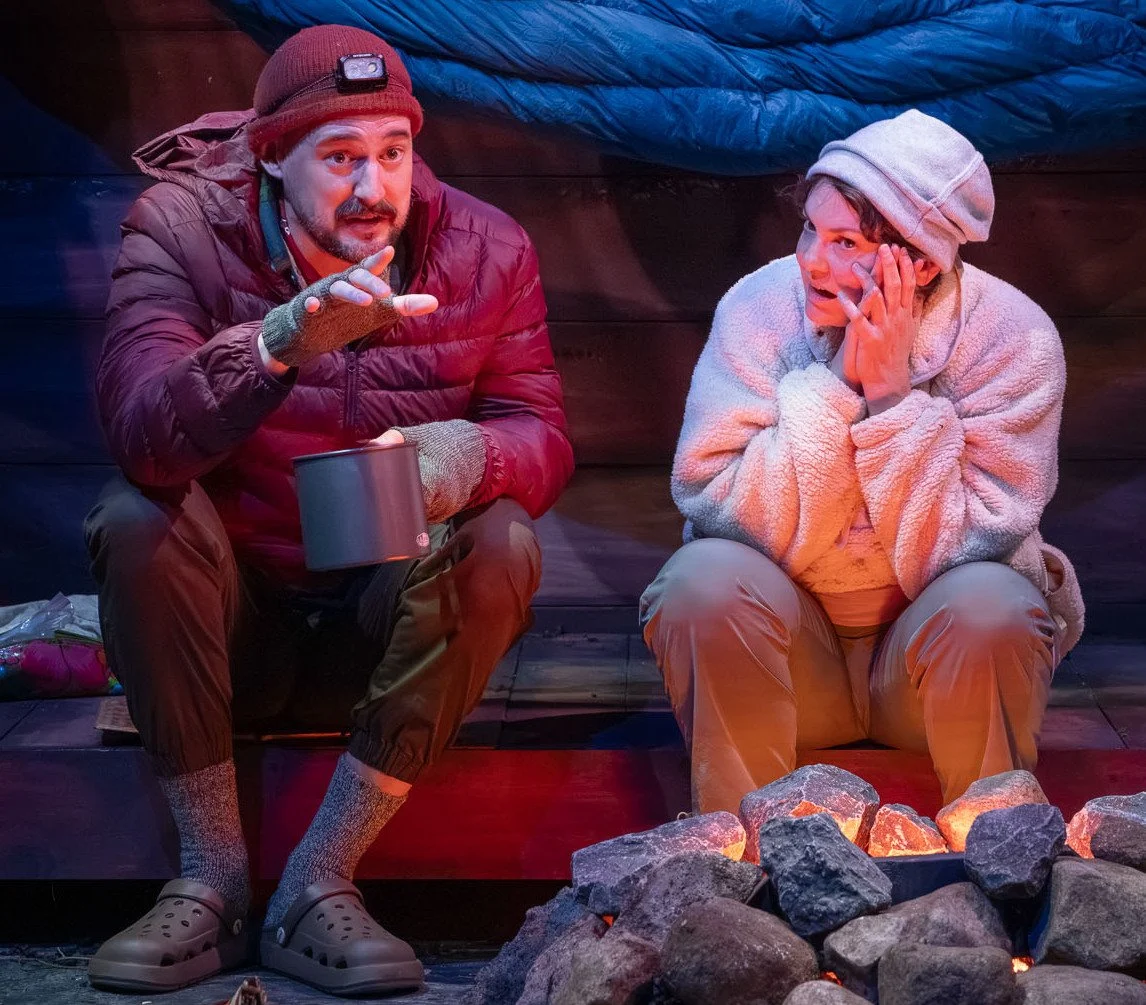
Xavier (Jeffords) shows Yvonne (Oleynik) how to cook in the woods in Lean-To.
The playwright has said Lean-To was inspired by the idea of strangers bonding, the human propensity to connect with others. But is the connection in Lean-To one to celebrate? It’s fleeting—and for at least one of the three people, harmful. And to get to the bonding, the audience has to wait out those real-time campsite setups, along with equally protracted discussions about setting up.
When the characters do start conversing, Zed launches into a long monologue—would somebody really subject a stranger to that?—in which he recalls his only previous camping experience, as an eight-year-old with broken front teeth (from biting on rocks). Zed’s tale has a lot of convoluted yet generic details that don’t actually illuminate his personality or struggles. He felt “sadness that my parents dropped me off at that bus and let me get taken away”? So do lots of kids on their way to camp. Getting his teeth fixed was “a great motivator to pursue a professional career so that I could afford it”? That sounds like a rather preposterous cause-and-effect.
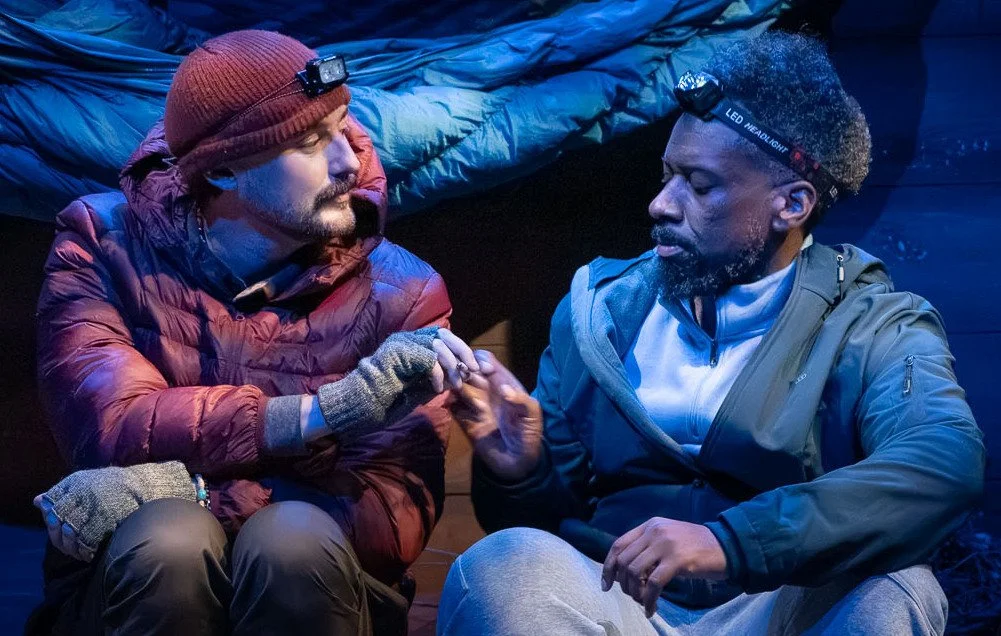
The 59E59 Theaters/New Light Theater Project production of Lean-To, with Jeffords and Robinson (and Oleynik) in the cast, originated at Pendragon Theatre upstate.
An even more egregious use of monologuing occurs late in the play, when Yvonne goes on a disjointed ramble that’s both unnatural (the other characters should be saying or doing something) and unproductive. Zed’s occasional references to being Black seem kind of pointless too. Hiking, he remarks, gives him a fear “of being out, of being on someone else’s property”; he says of his childhood fights, “I was playing into an expectation.” It’s purely lip service, though, as his comments don’t lead to further conversation.
Now that might be real bonding. Instead, Zed, Yvonne and Xavier offer one another mundane insights as if they’re great self-aware epiphanies:
“It’s a natural impulse to want to connect, to feel closeness.”
“Someone who knows all sorts of stuff, can fix stuff, I could see the appeal of that [in a romantic partner].”
“That [the city] is not the real world. That world is the construct. This is the real world.”
“Things aren’t always what they seem. Things we put in place don’t always stay in place just because we want them to.”
Lean-To may falter in its aspirations of profundity, as well as in its plot and character development, but it’s lovely to look at. Scenic designer Connor Gallerani’s re-creation of a lean-to and the outcropping where it stands is so precisely observed, it feels immersive. This note-perfect wilderness scene is enhanced by Jennie Gorn’s sound design (birds, rustling leaves) and Elaine Wong’s lighting, which traces the natural progression from bright daylight to dusk to deepest nighttime. Props chief Peggy Orman also deserves recognition for the REI shopping cart’s worth of camping gear onstage.
Lean-To’s set definitely looks like a place you’d want to go. Whether you’d want to be there in the company of this particular trio is another matter.
Lean-To runs through Oct. 10 at 59E59 Theaters. Performances are at 7:15 p.m. Tuesday through Saturday, with matinees at 2:15 p.m. on Saturday and Sunday. For tickets and more information, visit 59e59.org.
Playwright: Stephen Sheffer
Director: Jesse Jou
Scenic Designer: Connor Gallerani
Costume Designer: Krista Grevas
Lighting Designer: Elaine Wong
Sound Designer: Jennie Gorn
If you enjoyed this review, please click on the Like icon below.
