
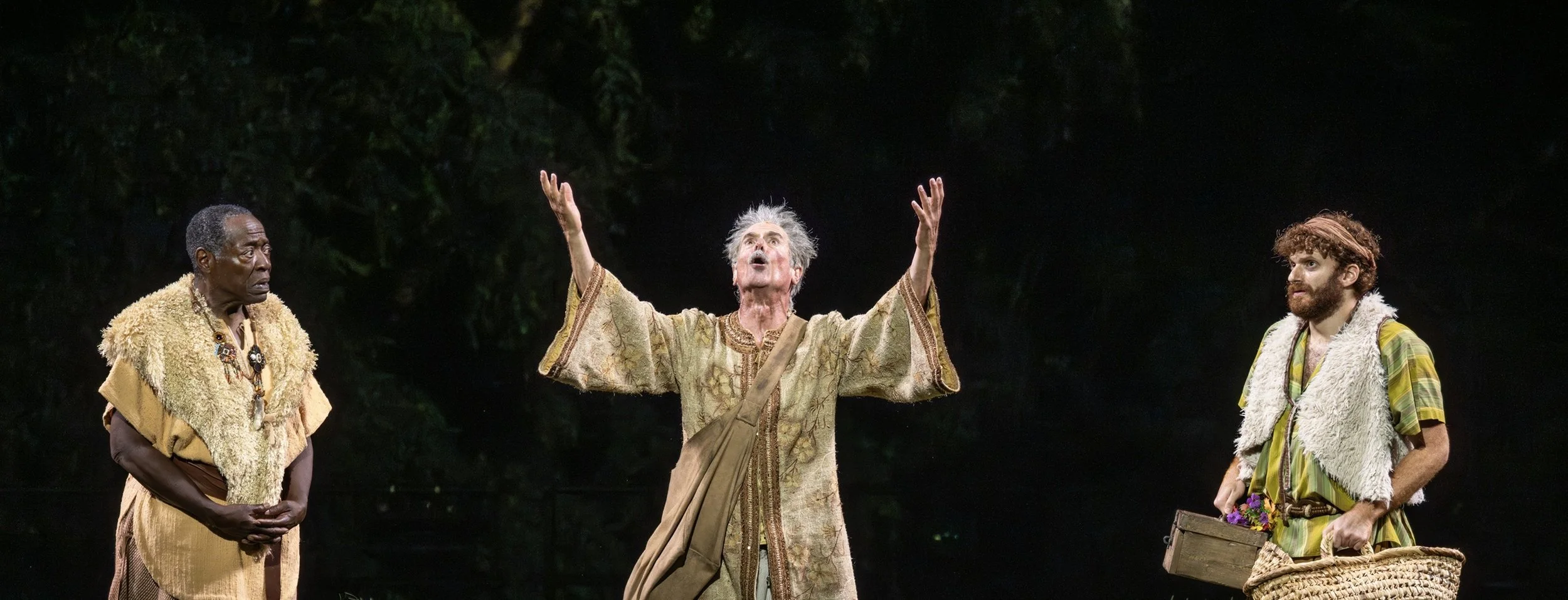
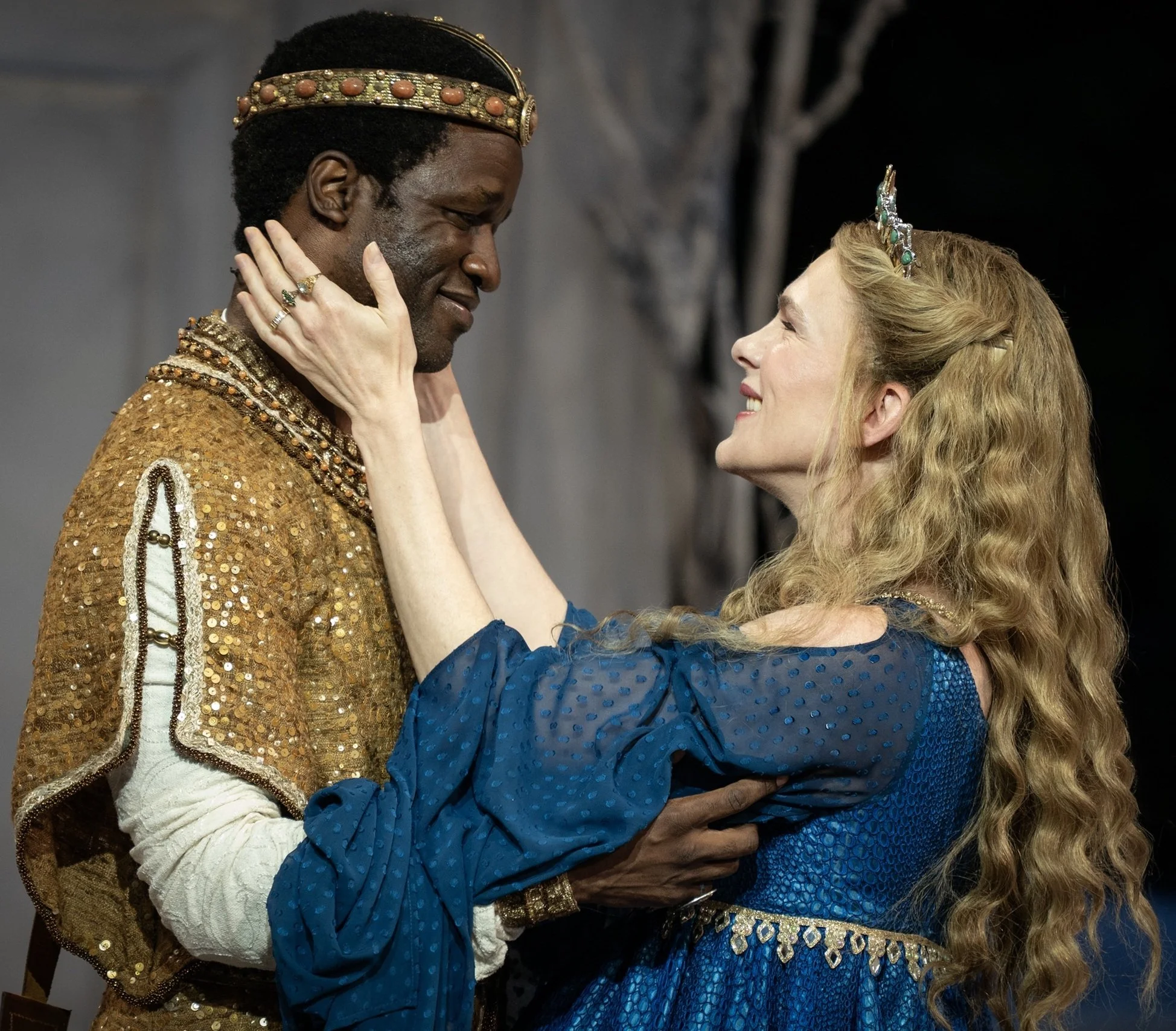
Bohemian King Polixenes (Gilbert Owuor, left) shares a friendly moment with Hermione (Lily Rabe), the wife of his best friend, King Leontes of Sicilia, which will send Leontes into a spiral of sexual jealousy, in Shakespeare’s late romance The Winter’s Tale.
“A sad tale’s best for winter,” says Mamillius, the young son of Leontes and Hermione, king and queen of Sicilia, in Shakespeare’s late play The Winter’s Tale (ca. 1610). Mamillius may be right, but a sad tale can also work on a sweltering night in Central Park, as Daniel Sullivan’s no-frills, emotionally intense staging demonstrates.
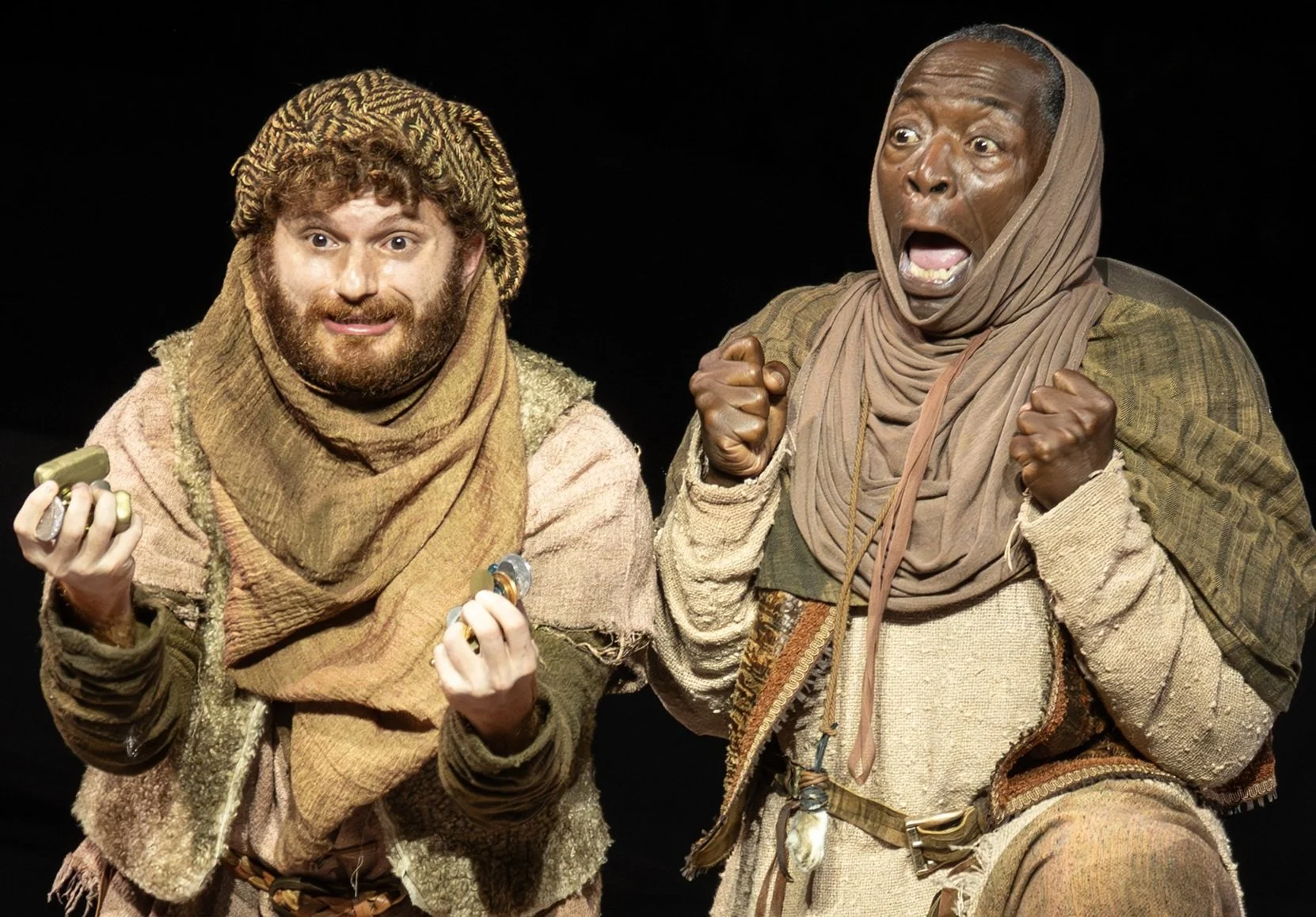
Chuck Cooper (right) as the Old Shepherd and Michael Khalid Karadsheh as his son are astonished to find an abandoned baby and a chest of gold.
Sullivan eschews a concept-first approach or changes to setting and time, allowing the actors to dig into the complexity of Shakespeare’s characters and verse. This is a great strength, but the traditional method is here paired with a reluctance to trim the text (the running time is 3½ hours), which makes for sequences that drag, especially in the play’s notorious comic-pastoral scenes.
But for The Winter’s Tale, the question is whether a production can pull off the mysterious and stunning denouement of a statue come to life, and its emotional resonance. This one succeeds, even if the audience has a long wait for the payoff.
Categorized as a comedy in the First Folio, The Winter’s Tale has since been dubbed one of Shakespeare’s romances—near tragedies that pivot to miraculous redemption. The play begins with Shakespeare’s career-long fascination with sexual jealousy: Leontes’s (Raúl Esparza) best friend, Polixenes (Gilbert Owuor), king of Bohemia, is visiting the Sicilian court but must leave; Leontes’s own entreaties for him to stay are fruitless, so he asks Hermione (Lily Rabe) to try instead, and his friend relents. Leontes becomes seized with the notion that they are having an affair, and that his wife’s unborn child is his guest’s.
Leontes’s jealousy springs entirely from his own misogyny and paranoia. His conviction that he has been living as a cuckold overrides even the Oracle’s testimony of Hermione’s innocence, as well as the protestations of his loyal servant Camillo (an excellent Teagle F. Bougere):
Camillo. Good my lord, be cured
Of this diseased opinion, and betimes,
For ’tis most dangerous.
Leontes. Say it be, ’tis true.
Camillo. No, no, my lord.
Leontes. It is. You lie, you lie.
I say thou liest, Camillo, and I hate thee.
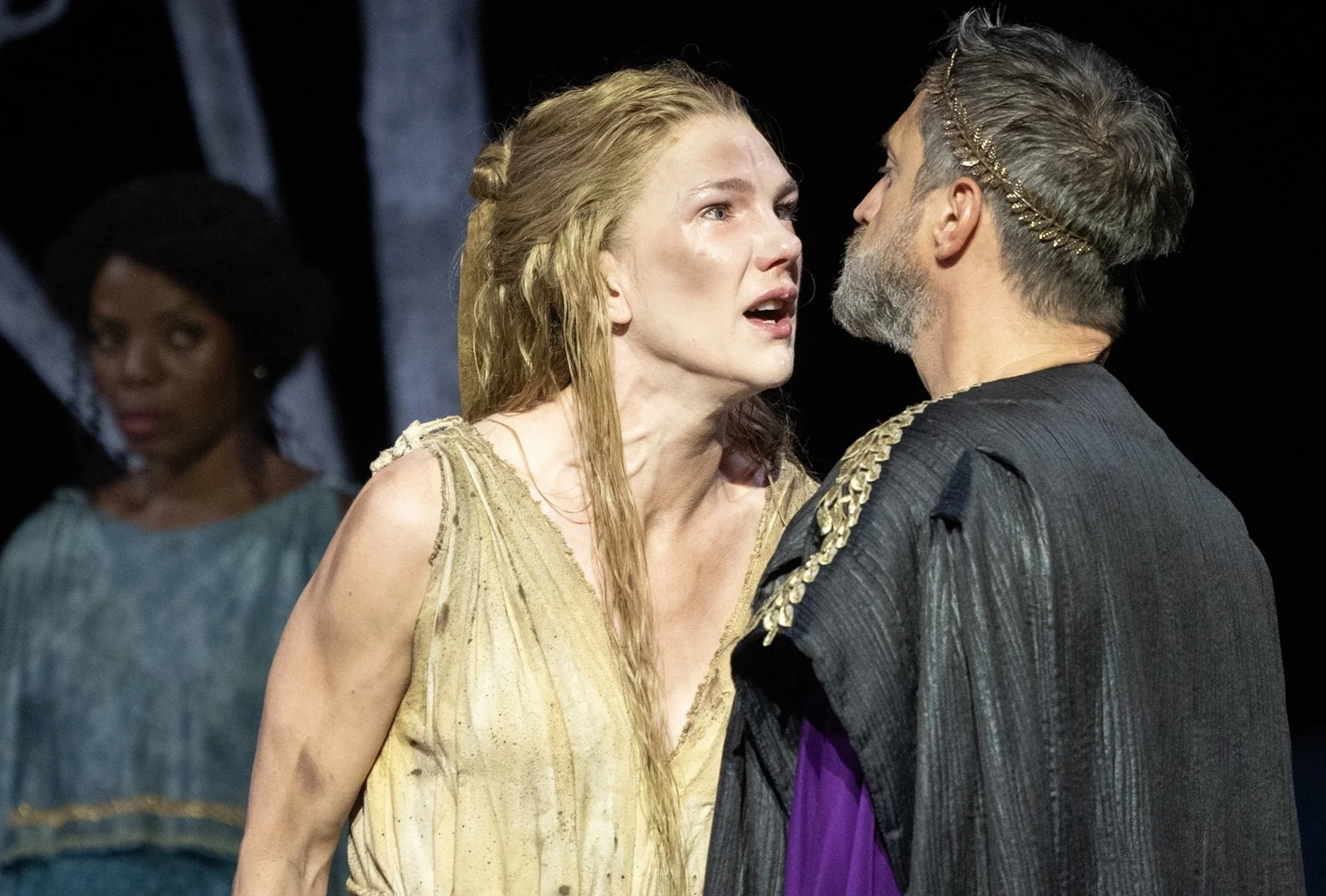
Hermione confronts Leontes in a righteous fury during her trial for adultery and treason. Photographs by Joan Marcus.
The arrest of Hermione follows, then the death of Mamillius (Matthew Eby), and finally the death of Hermione. Leontes realizes his mistake too late: he has already ordered Antigonus (Steven Skybell) to abandon Hermione’s daughter, born during her imprisonment, on a foreign shore, which he does, before meeting his end pursued by a bear. Throughout, Antigonus’s wife, the fearless and honest Paulina (Marsha Stephanie Blake), is the only one who truly stands up to the tyrant.
Sixteen years later—Shakespeare skips past them via the choric figure of Time—the abandoned child, Perdita, has been raised by an Old Shepherd (Chuck Cooper) and is in love with Polixenes’s son, Prince Florizel (Daniel Kyri), while Leontes remains in unending grief in Sicilia. Cooper as the Old Shepherd and Michael Khalid Karadsheh as his son are a delight, but the sheep-shearing courtship plot and the trickster Autolycus (Skybell again) test the audience’s patience. Here, Sullivan’s fidelity to the text works against the production.
Machinations concocted by Camillo, who has fled to Bohemia to serve Polixenes but desires to go home again, reunite everyone in Sicilia; many of the revelations and recognitions occur offstage, presumably to preserve the wonder of the finale.
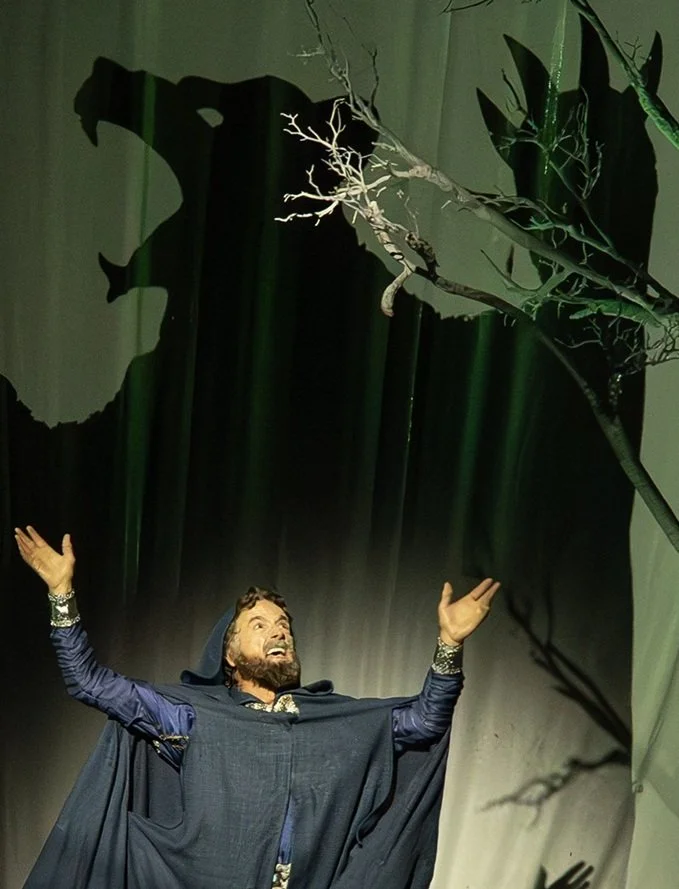
Antigonus (Steven Skybell) suffers his fate at the hands of the most famous stage direction in Shakespeare: “Exit, pursued by a bear.”
Esparza struggles initially to make Leontes’s sudden, violent jealousy persuasive, but shines in depicting the character’s journey from rage to devastation to contemplative melancholy. Rabe is compelling as Hermione, rendering her self-defense at her trial with impassioned fury that feels proportionate to the injustice of her situation.
Blake is a revelation as Paulina. Shakespeare scholar Richard Strier has written about the character as the culmination of Shakespeare’s interest in righteous disobedience—the “shrew” who once had to be tamed becoming a figure to be admired and celebrated. Blake makes that interpretation thrillingly clear.
Paulina is also the playwright’s avatar, orchestrating the ending, with the statue coming to life at her command. “It is required / You do awake your faith,” Paulina tells the assembled guests, but also the audience. This is not the faith of organized religion—as usual in Shakespeare, the gods are quite useless—but faith in the imagination, in theater itself.
The statue of Hermione, as Leontes tactlessly points out, has wrinkles reflecting the passage of time—so has she been alive and hidden for 16 years, or is this genuine magic? With Rabe covered in white, as though she were alabaster, and Bradley King’s lighting reinforcing the effect, Sullivan seems to opt for the latter—though the distinction doesn’t really matter. The scene is a testament to the power of theatrical belief, which is, after all, the only miracle Shakespeare ever really promises.
The Public Theater production of The Winter’s Tale runs through Aug. 23 at the Delacorte Theater in Central Park. Evening performances are at 8 p.m. Tuesday through Sunday. For more information, visit publictheater.org.
Playwright: William Shakespeare
Director: Daniel Sullivan
Scenic Design: Manuti Evans
Costume Design: Linda Cho
Lighting Design: Bradley King
Choreography: Mimi Lieber
Sound Design: Brian Ronan
Composer: Tom Kitt
If you enjoyed this review, please click on the Like icon below.
