
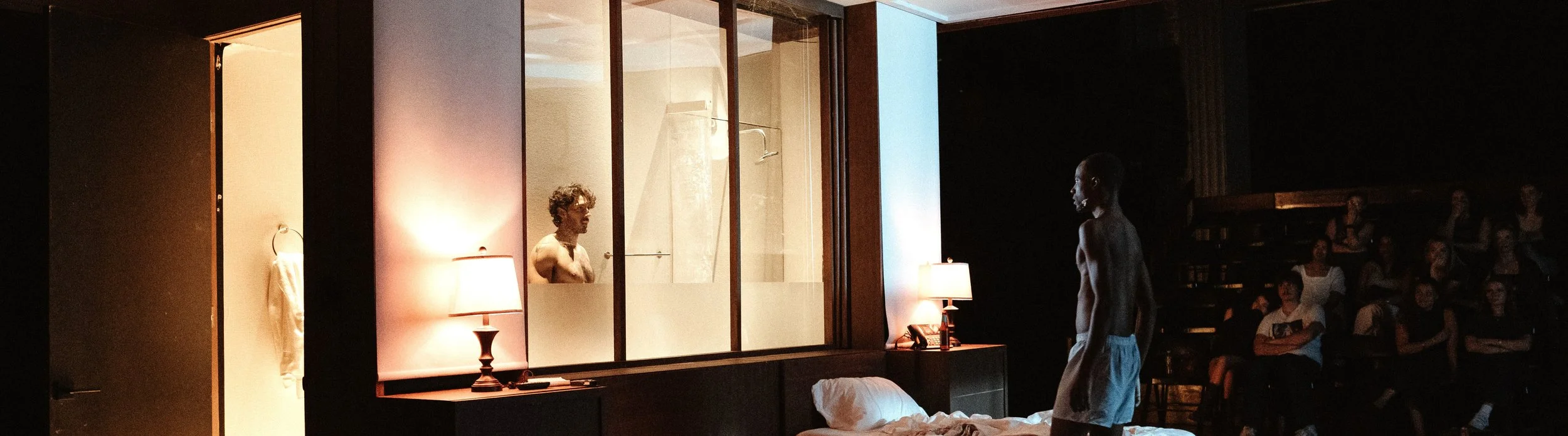
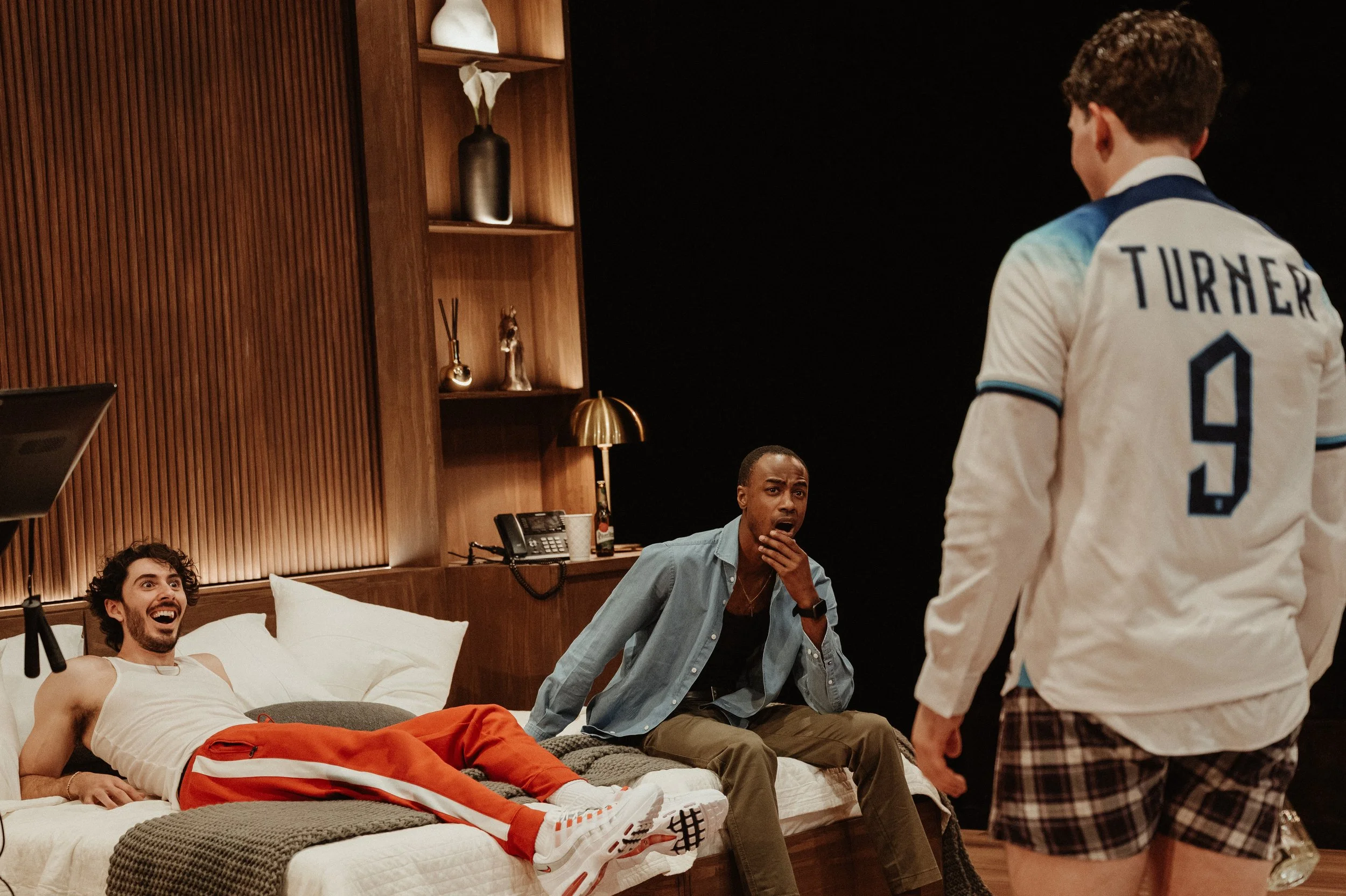
Matisse Ratron-Neal plays Jason (left), Terry Bell (center) is Ade, and Oliver Rowland-Jones plays the bellhop Harry in John Donnelly’s The Pass.
In John Donnelly’s The Pass, directed by Max Hunter, two rising British soccer stars confront the volatile intersection of masculinity, desire, and celebrity when a hotel-room encounter threatens to upend their carefully constructed futures. Spanning 12 years and three hotel rooms, this provocative drama tackles the high stakes of being young, ambitious, and closeted in a world where the pressure to perform extends far beyond the playing field.
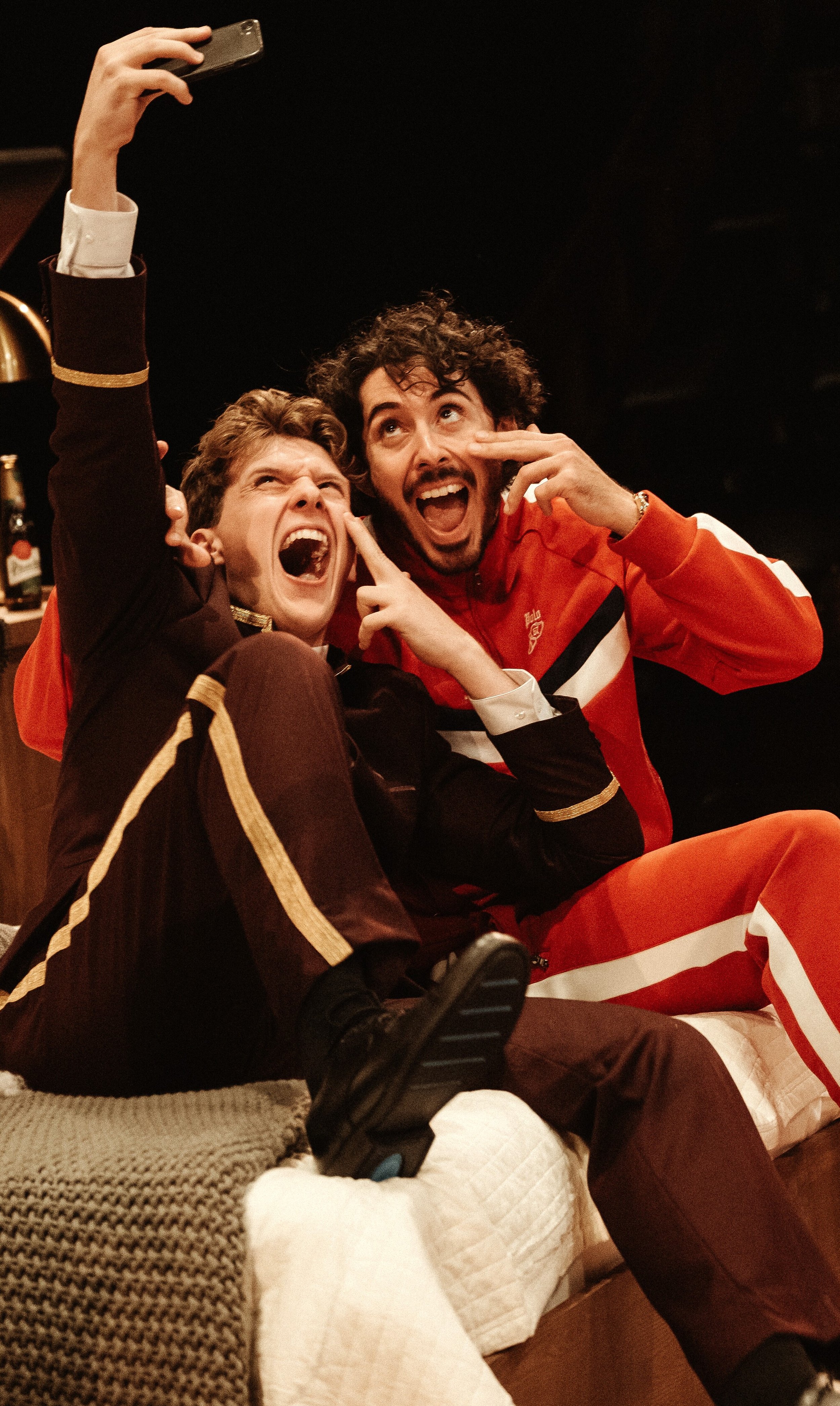
The bellhop Harry asks Jason, a famous soccer player, to pose for a “selfie” with him.
Donnelly’s gay sports drama debuted at London’s Royal Court Theatre in 2014 before becoming a 2016 film. Its three vignettes unfold in hotel rooms that are neither home nor workplace, making them ideal pressure cookers: with their close walls and limited means of escape, secrets emerge, small arguments escalate into bitter confrontations, and the rules of ordinary life seem temporarily suspended. The rooms thus become fitting settings for characters caught between public identities and private desires.
In the first vignette, 17-year-old soccer hopefuls Jason (Matisse Ratron-Neal) and Ade (Terry Bell) spend the night in a Bulgarian hotel room with twin beds before a crucial European Championship match. Their locker-room talk and roughhousing initially seem like typical teenage bravado, but their banter takes an increasingly ugly turn, becoming first racially charged and then sexual. Beneath the posturing, however, lies a more immediate anxiety: only one of them may have a future with the team. As Ade bluntly puts it:
Let’s not pretend we don’t know what’s going on. We got eight months left on our contracts, they gonna let one of us go. They’re doing it soon, else they get nothing. They can’t keep us both on, not with this new formation.
When Jason asks whether Ade will pass him the ball if he has the better position, the question carries significance beyond the soccer field. Their friendship, professional futures and willingness to trust each other are all suddenly in play.
“Hotel rooms ... ‘become fitting settings for characters caught between public identities and private desires.’”
The second vignette moves to a more luxurious hotel seven years later in Spain, where the flatter television screen and larger minibar subtly reflect Jason’s upward trajectory. Now 24, he is a famous soccer player, married with children. Dressed for a warm summer evening, he picks up Lyndsey (Ino Badanjak), a 29-year-old erotic dancer, at a local club. But she has been hired to discover whether Jason is “gay, or whatever,” and is secretly recording their conversation. When Jason discovers the camera in her bag, his anger exposes more than his suspicion of other people’s motives. “I’m not a man who lets other people dictate the pattern of play!” he declares, revealing his determination to control not only the game and the room but also the public image he has constructed.
The third vignette brings Jason 12 years forward, near the end of a career battered by injury, divorce and addiction. In an English hotel room, he reunites with Ade, now a plumber, recreational soccer player and, significantly, a man in a relationship with another man. The contrast is telling: while Jason has acquired fame and fortune, Ade has built a modest life in which he seems more at ease with himself. Their reunion turns increasingly frightening when a starstruck bellhop, Harry (Oliver Rowland-Jones), joins Jason in a series of competitive, destructive drinking games that leave the room trashed.
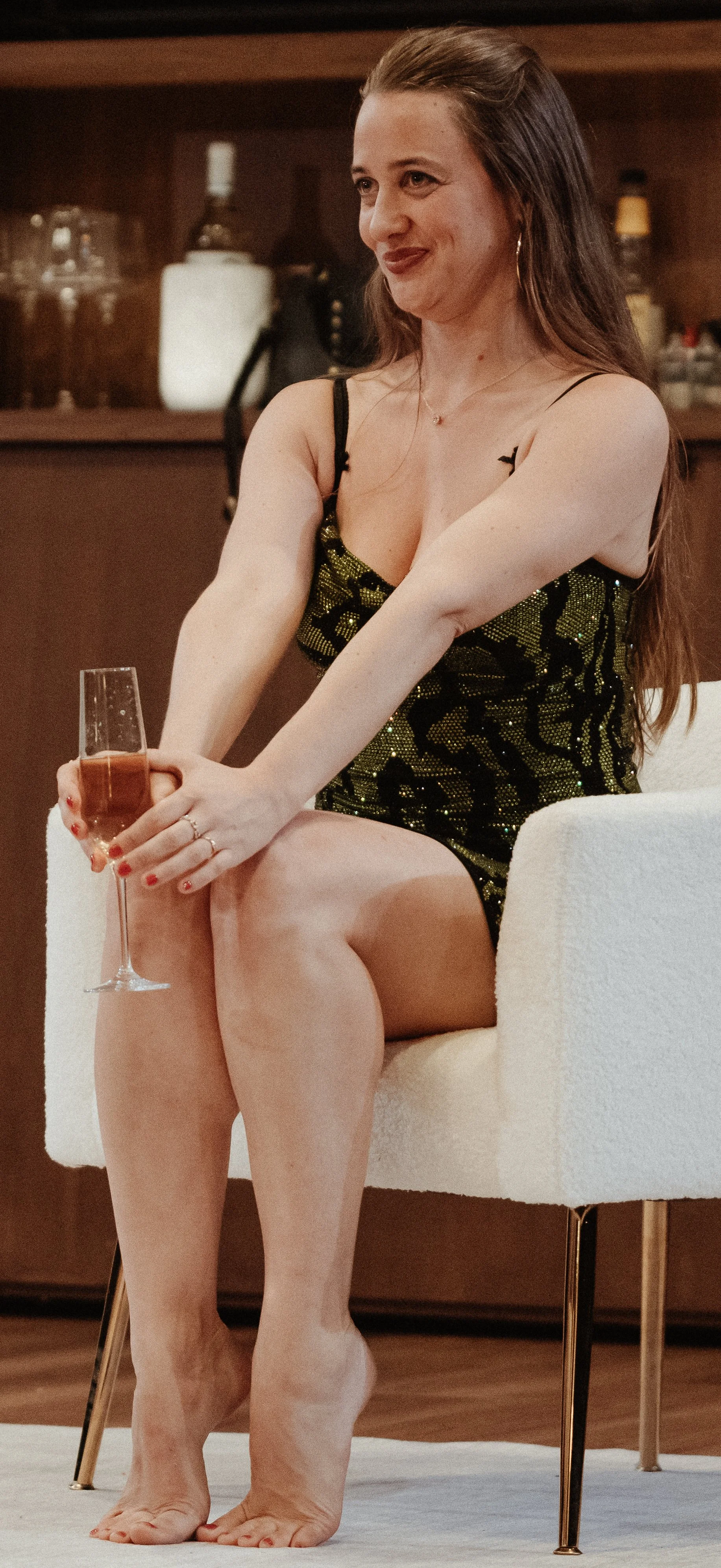
In vignette 2, Ino Badanjak plays Lyndsey, an erotic dancer with ulterior motives whom Jason picks up at a local club. Photographs by Andy Henderson.
More disturbing is Jason’s apparent inability to feel compassion for those beneath him. At one point, he tries to manipulate Ade by offering him a piece of his privileged life: “It’s yours. The villa. I want you to have it. You could live there.” But Ade recoils from the tinsel and entrapment accompanying it. Like his mythological namesake, Jason is left amid the wreckage of what he has built, lonely and unhappy despite his success. With Ade and Harry gone, he is finally alone with the consequences of his choices, even as he tries to convince himself that he still occupies the moral high ground.
The acting is excellent. Ratron-Neal is every inch the soccer star as Jason, with a swagger that Jude Bellingham could envy. Bell gives Ade a layered performance as a once-promising athlete who ultimately wins at life. Badanjak deftly combines the seductive allure of a table dancer with Lyndsey’s calculating instincts, while Rowland-Jones gets the fanboy bellhop just right.
Theatergoers sensitive to sexually graphic language may find The Pass off-putting. But for those willing to enter its claustrophobic hotel rooms, the play offers a provocative glimpse into the pressures of masculinity, sexuality and celebrity—and the steep price of maintaining a carefully constructed public image.
The Pass plays at La MaMa (66 E. 4th St.) through Aug. 31. Evening performances are at 5 p.m. Sunday and 7 p.m. Monday, Wednesday, Thursday, Friday, and Saturday; matinees are at 2 p.m. Saturday and 1 p.m. Sunday. For more information, visit themaxhuntercompany.com.
Playwright: John Donnelly
Director: Max Hunter
Scenic Design: Thomas Jenkeleit
Lighting Design: Cheyenne Sykes
Costume Design: Amanda Roberge
Sound Design: Megan Culley
If you enjoyed this review, please click on the Like icon below.
