
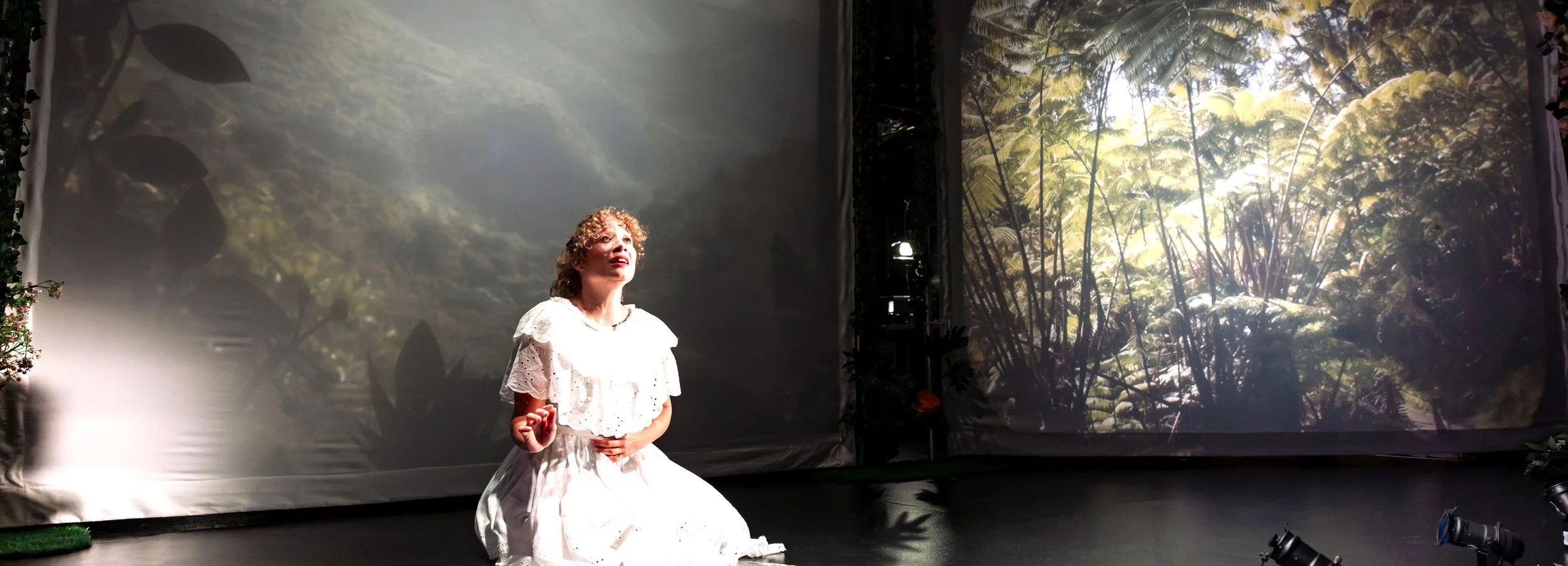
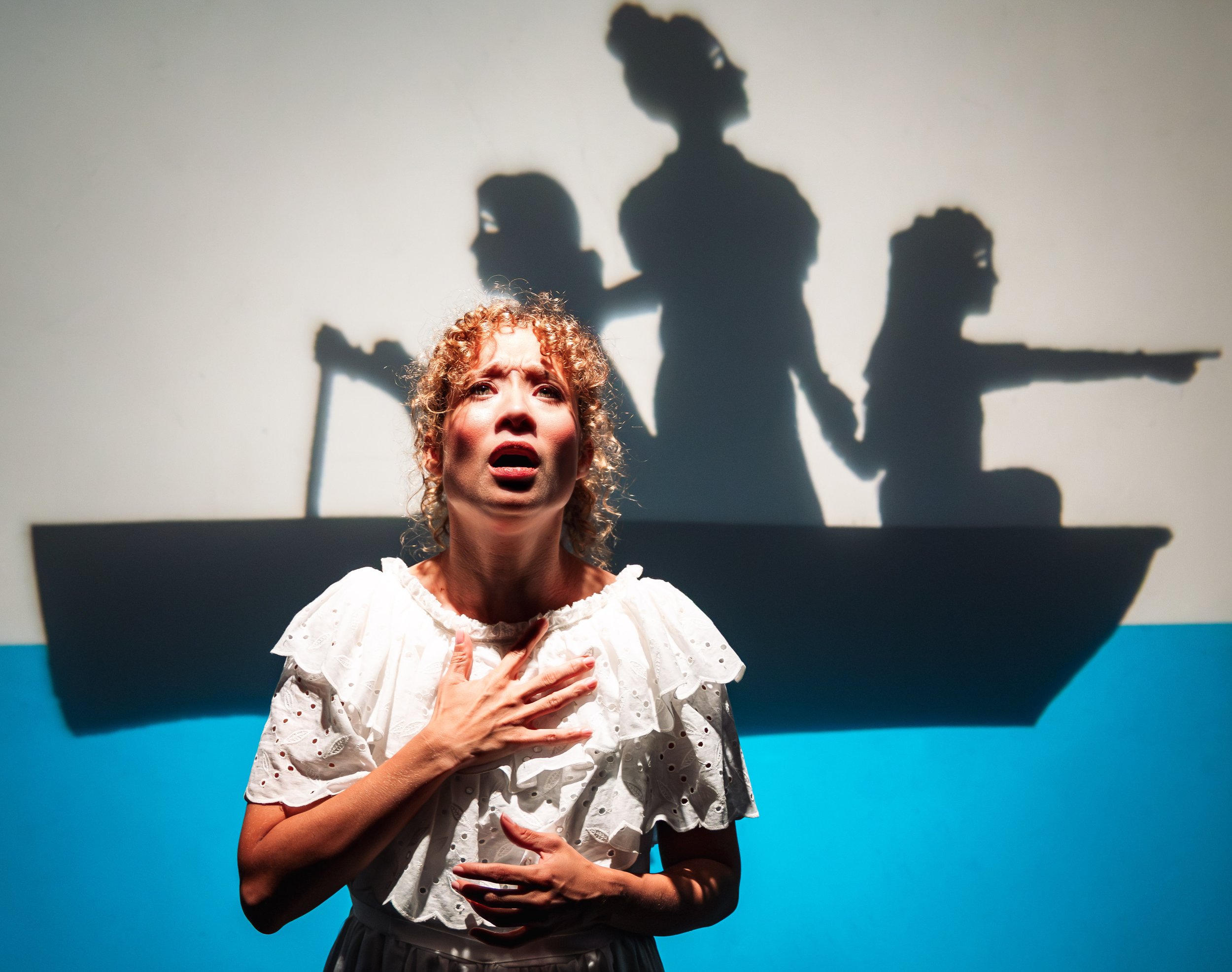
Samantha Blain as Lulu recounts her family’s journey from Cuba to the United States.
Even a powerful story can become more compelling when told through the traditions of its culture. Such is the case with Samantha Blain’s new play Isla, which embraces puppetry, music and magical realism to tell, in 75 minutes, a story of how Blain’s family fled Cuba. The world premiere production is a bilingual shadow play with beautiful, lilting songs, accompanied by guitarist Claron Hayden. All the artistic elements come together in a wonderful, multifaceted production.
The story unfolds in four parts: The Return, in which personal remembrances introduce the playwright’s family; The Vision, featuring dream sequences of birds, creatures, and flora; The Decline, showing changes in the lives of the characters before and after the Cuban revolution of 1959; and The Departure, capturing the emotional turmoil facing the country and the sisters as they emigrate to the United States.
Throughout these sequences, the sisters—Blain as LuLu, Daniela Delahuerta as Carmen, and Tiffany Iris as Alina—are the key characters. The women perform as a trio. They sing in harmony and glide gracefully barefoot about the stage and behind the triptych. They “fight” playfully, tugging at fabric, and at other times wrap themselves in a warm embrace, showing the strength of their bond.

Daniela Delahuerta (Carmen) expresses her doubts about leaving Cuba and family.
The Return introduces the family through personal remembrances, as in the song “Mi Isla”:
Mi Corazon es me familia
Support and love, not
Unfamiliar
Just watch me.
Directors Roman Sanchez and Mikayla Stanley brilliantly use shadow puppetry to complement and enhance the story, illustrating and animating the action of the script.
Puppetry is a traditional art form in Latin culture; in Cuba it was supported by the government after the revolution, leading to the creation of the Teatro Nacional de Guiñol (TNG), or National Puppet Theater. The play’s creators wisely recognize its importance.
In The Decline segment, for instance, the shadow puppets project the grim realities of the revolution of 1959, showing changes in the lives of the characters before and after it:
Everything went into decay. It was as if uh...if uh...
You couldn’t bring any money. God forbid, you have money, you’re in trouble, you get arrested.
But if you don’t pay, you gotta leave.
The segments feature marching armies, bombs and explosions, rotting fruit, children forced to work in fields, and the sisters sailing away from their home in a tiny boat. Although somewhat cartoonish, the puppets powerfully capture the emotional toll of forced emigration. So essential is the puppetry that Isla’s puppeteers—Casey Scott Leach, Erica Knight, and Jessie March—take a well-deserved curtain call.
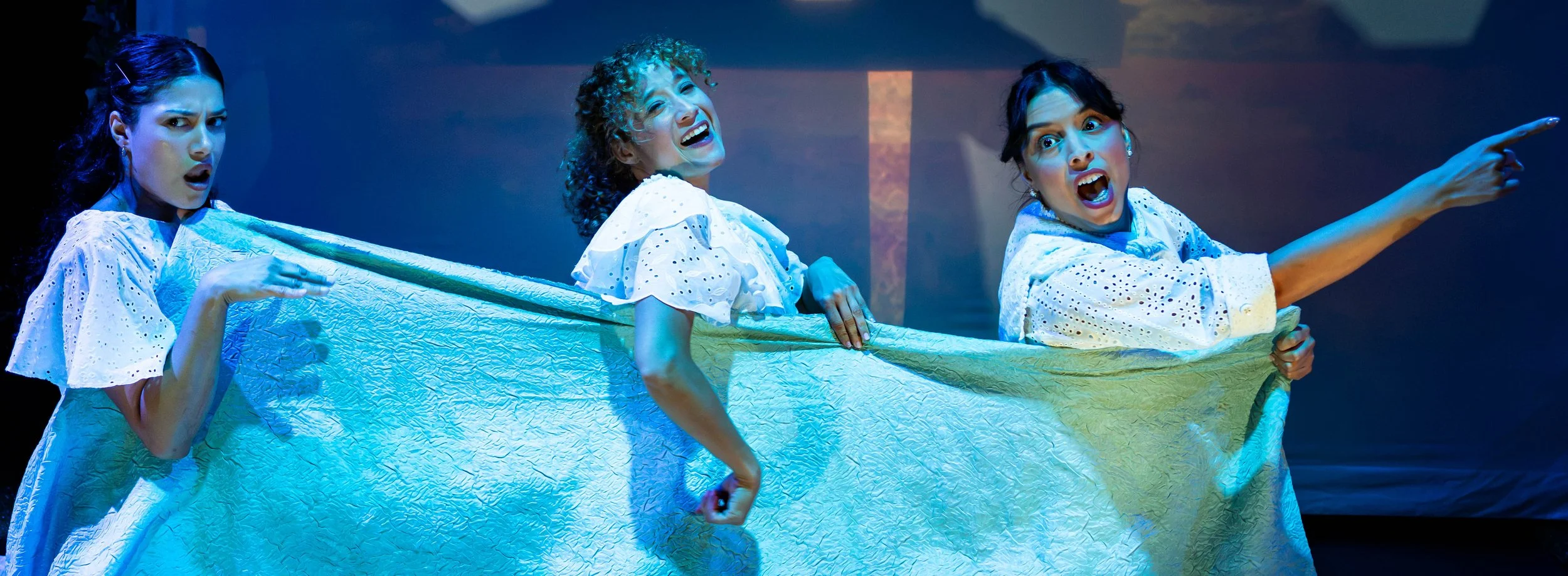
Three sisters, Tiffany Iris (Alina), Samantha Blain (Lulu) and Daniela Delahuerta (Carmen) harmonize about their sisterhood. Photographs by Rebecca J. Michelson.
The other Latin element used to great effect is magical realism, most notably associated with Nobel Prize–winning Colombian novelist Gabriel García Márquez and his One Hundred Years of Solitude. Isla exists in a place where crocodiles are used to disarm weapons and creatures scamper about, stealing pencils and a notebook.
In addition to recorded interviews with family members, a tapestry of images is projected onto a wide screen divided into a triptych. At times, three-dimensional puppets scamper across the stage and then appear as two-dimensional projections of themselves. Then the cast steps behind the triptych and joins the two-dimensional world. As magical realism dictates, this transformation is perfectly natural and unexplained as part of the story. It just is.
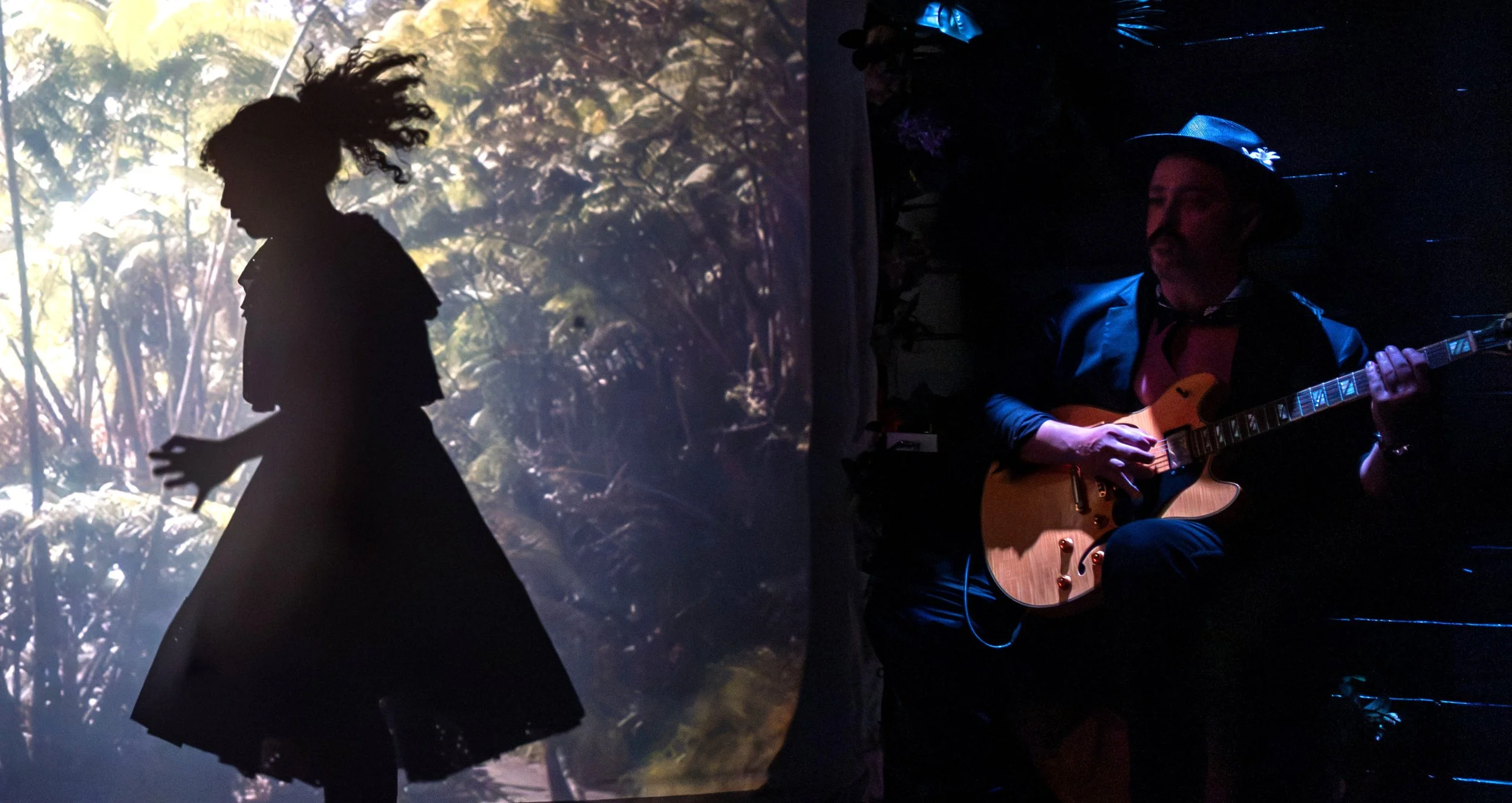
Guitarist Claron Hayden adds soulful accompaniment to Isla’s story.
The final segment, The Departures, reflects the emotional turmoil facing the country and the sisters as they emigrate to the United States. In a recorded interview, they recall their feelings:
I had big trauma. I left my home, I left my country, my parents.
Let’s put it this way, praise the lord that nothing ever happened to us. Pfft.
Terror. Political terror. Personal terror.
All these elements—music, cast performances, recorded interviews with family members, lighting that captures and shifts moods, multimedia projections, silhouettes of family and the cast, and flowing fabric used to create the illusion of waves as the girls sail away—blend joyfully into a shared vision.
As Blain explained at the start, her wish was to share her stories with her daughter, which she did. Thankfully, she also shared her story with the audience.
Hit the Lights! Company’s production of Isla runs through Aug. 29 at WP Theater (2162 Broadway at 76th). Evening performances are at 7 p.m. Wednesday through Sunday (no performance Aug. 20); matinees are at 2 p.m. Sundays; an additional youth performance is set for 2 p.m. Aug. 1. For tickets and additional information, visit their program here.
Creators: Hit The Lights! Company & Samantha Blain
Directors: Roman Sanchez & Mikayla Stanley
Composers: Samantha Blain & Claron Hayden
Puppetry: Casey Scott Leach, Erica Knight & Jessie March
Lighting design: Vittoria Orlando
Costume design: L.A. Clevenson
If you enjoyed this review, please click on the Like icon below.
