
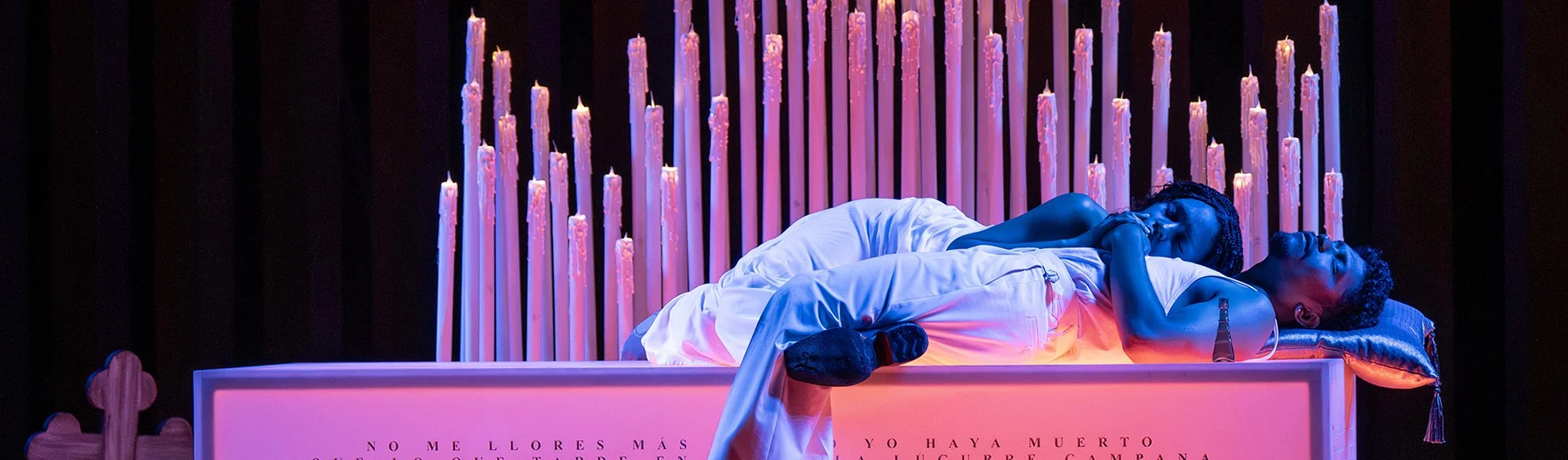
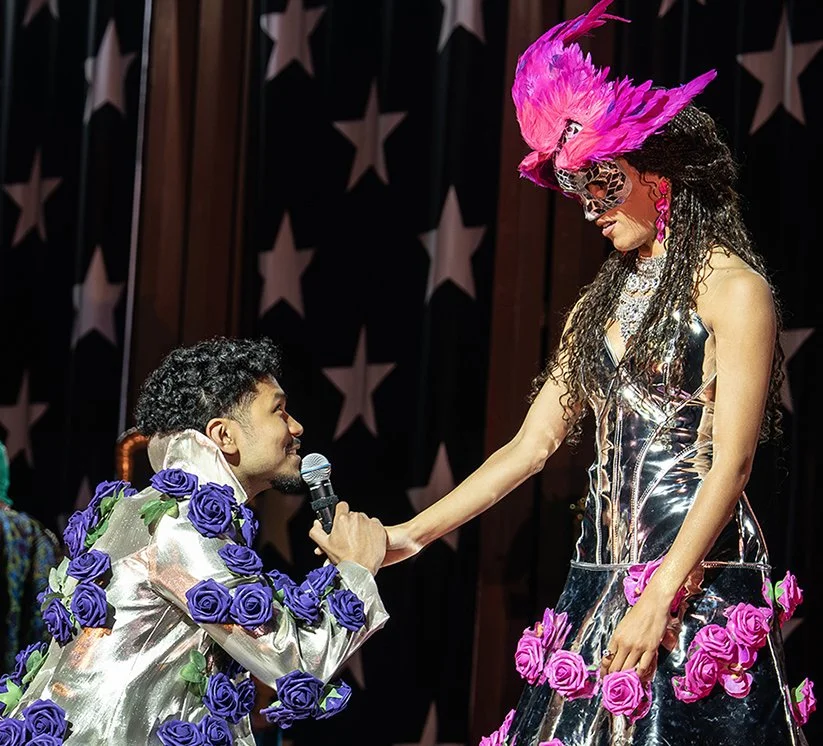
Daniel Bravo Hernández and Ra’Mya Latiah Aikens play the star-crossed lovers in the Free Shakespeare in the Park production of Romeo and Juliet.
At the newly revitalized Delacorte Theater, Saheem Ali’s stirring production of Romeo and Juliet reimagines Shakespeare’s Verona as a divided community along the U.S.-Mexico border, bringing fresh urgency to the tale of the star-crossed lovers. By allowing Romeo and Juliet to speak to one another in Spanish amid a world of conflict, Ali illuminates both the intimacy of their bond and the forces determined to keep them apart.
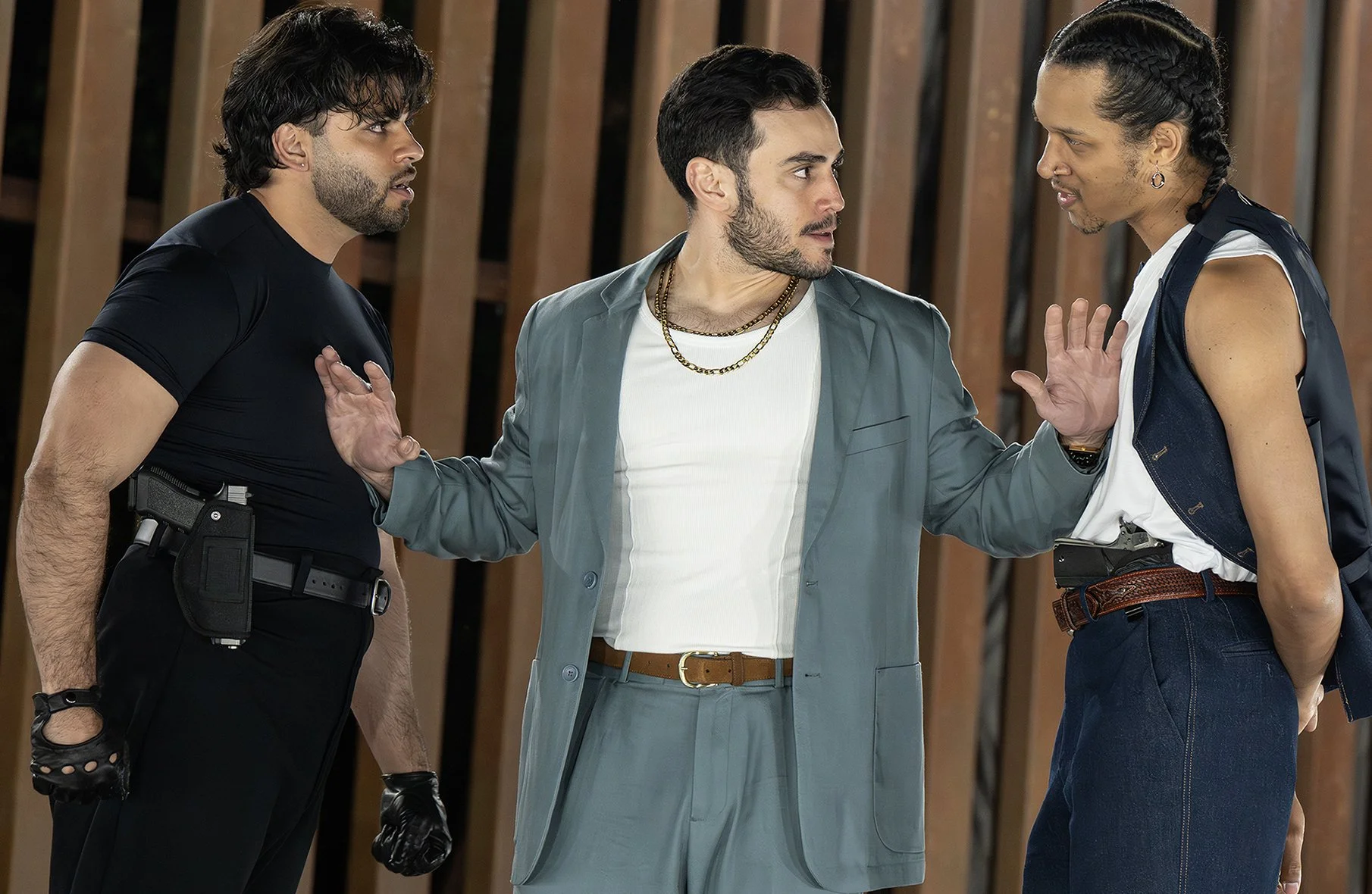
Zack Lopez Roa as Benvolio (center) tries to quell the fiery tempers of Ariyan Kassam’s Tybalt (left) and Caleb Joshua Eberhardt’s Mercutio.
The production remains faithful to the spirit of Shakespeare’s tragedy as it transforms the Montague-Capulet feud into a present-day conflict: the company raucously enters the stage with a citizen/protestor carrying a sign reading “Defund the Wall.” Against this backdrop, Romeo and Juliet speak to each other almost exclusively in Spanish, creating a private linguistic space beyond the reach of their feuding families. The effect is particularly vivid in the orchard scene, where the musicality and emotional immediacy of their exchanges deepen the sense that their intimate language transcends the divisions surrounding them.
The bilingual approach should not intimidate theatergoers unfamiliar with Spanish. Because the vast majority of the text remains in English, and the lovers occasionally slip into English during their exchanges, the story remains easy to follow. Ali further grounds the audience by retaining Shakespeare’s Prologue, sung by Francis Jue’s Friar Laurence in a truncated form and concluding with a Spanish couplet, which clearly establishes the lovers’ fate from the outset.
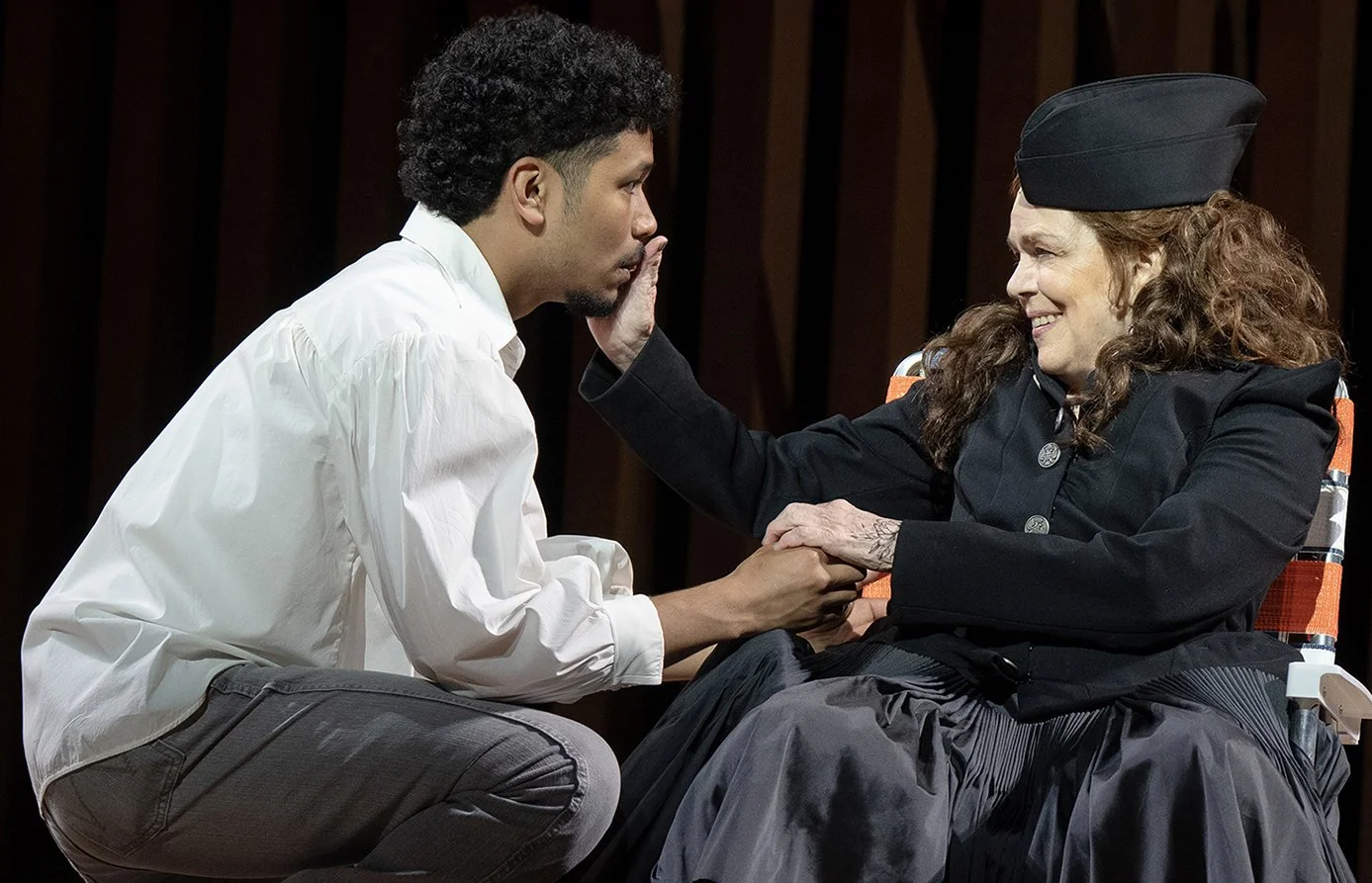
Romeo is drawn into a heart-to-heart conversation with Deirdre O’Connell as Juliet’s Nurse.
The production’s success ultimately rests on the shoulders of its young lovers, and Daniel Bravo Hernández and Raya Latiah Aikens prove ideally matched. Neither merely recites Shakespeare’s verse; both invest it with a naturalism that makes their attraction feel immediate and deeply felt. Aikens captures Juliet’s blend of youthful rebellion and vulnerability, while Hernández brings a sincerity and ardor to Romeo that make his devotion wholly believable. Their chemistry is especially evident in the balcony scene, where the fluid movement between English and Spanish transforms their exchanges into an intimate language of their own. Most fascinating, however, is the way this interplay between languages disrupts the familiar rhythms of Shakespeare’s verse and, paradoxically, makes it feel more alive. Because Juliet learned Spanish from the household servant Pedro (named Peter in the original), she occasionally searches for the right word, first expressing it in English before translating it: “If that thy bent of love be honorable, / Thy purpose marriage, matrimonio, send me word tomorrow…” Such moments lend the speeches an endearing spontaneity that makes the lovers’ relationship feel discovered rather than predetermined.
Among the supporting cast, LaChanze is especially memorable as Lady Capulet. Eschewing maternal warmth, she presents Juliet’s mother as a status-conscious aristocrat whose loyalty to family expectations outweighs any affection for her daughter (“I would the fool were married to her grave!”)
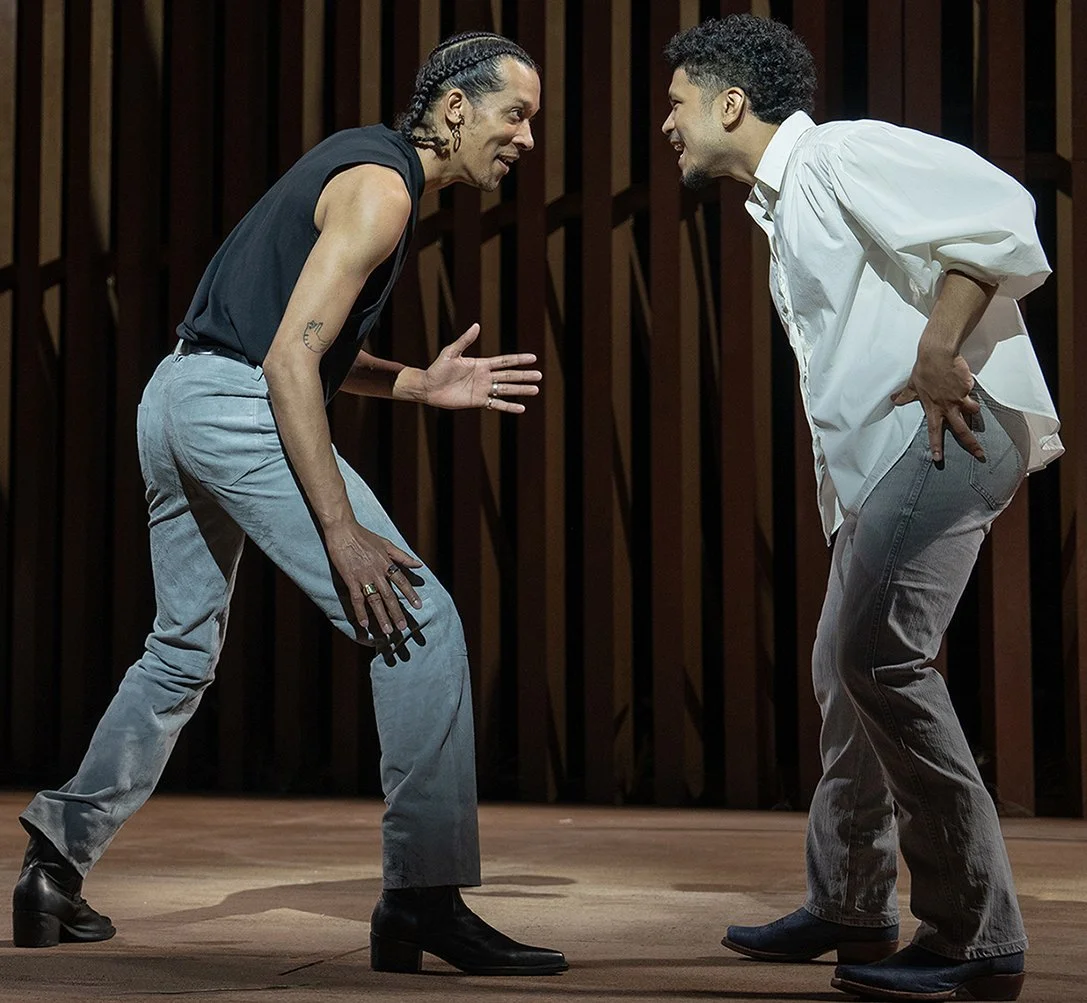
Mercutio tries to puncture the romantic ideals of his friend Romeo. Photographs by Joan Marcus.
Caleb Joshua Eberhardt gives a masterly performance as Mercutio. Although his quips have been curtailed in this production, he delivers his key Queen Mab speech superbly, not just as a whimsical fantasy but as a dark psychological exploration.
Jue delivers a finely calibrated performance as Friar Laurence, capturing both the character’s benevolence and his fatal shortsightedness. Though the friar repeatedly counsels moderation and prudence (“Wisely and slow, they stumble that run fast”), Jue subtly reveals a man whose actions rarely live up to his own advice.
Maruti Evans’s evocative set design foreshadows the tragedy to come. Spread across the Delacorte’s expansive semicircular thrust stage is a graveyard marked by two caskets and a scattering of Christian crosses. Looming behind them are colossal statues of the Virgin of Guadalupe and La Catrina, the iconic skeletal figure associated with Día de Muertos, standing sentinel between the stage and Central Park beyond. Although the picturesque backdrop of Turtle Pond and Belvedere Castle, coupled with summer breezes carrying the fragrance of the nearby Shakespeare Garden, softens the visual landscape, Evans’s design remains unmistakably steeped in mortality—a striking embodiment of memento mori.
Ali further underscores the lovers’ doomed trajectory through the recurring presence of three black-robed, white-masked figures who silently observe the action from the stage’s margins. Whether interpreted as the Fates of Greek mythology or as more contemporary harbingers of destiny, their appearances serve as a haunting reminder that Romeo and Juliet’s path has been charted long before they meet.
If Shakespeare’s tragedy ends in loss, Ali’s production offers a gentle epilogue of hope. Each night a real-life wedding ceremony or vow renewal is conducted by actor Francis Jue, an ordained officiant of the Universal Life church. (Couples are selected beforehand by the Public). The ceremony sends audiences into the night reminded that love stories need not all end like Romeo and Juliet’s.
The Public Theater production of William Shakespeare’s Romeo and Juliet plays through June 28 at the Delacorte Theater in Central Park (enter at 81st Street). Evening performances are at 8 p.m. Tuesday through Sunday. For tickets and information, visit publictheater.org.
Playwright: William Shakespeare
Director: Saheem Ali
Scenic Design: Maruti Evans
Lighting Design: Christopher Akerlind
Costume Design: Oana Botez
Sound Design: Mike Tracey
If you enjoyed this review, please click on the Like icon below.
