
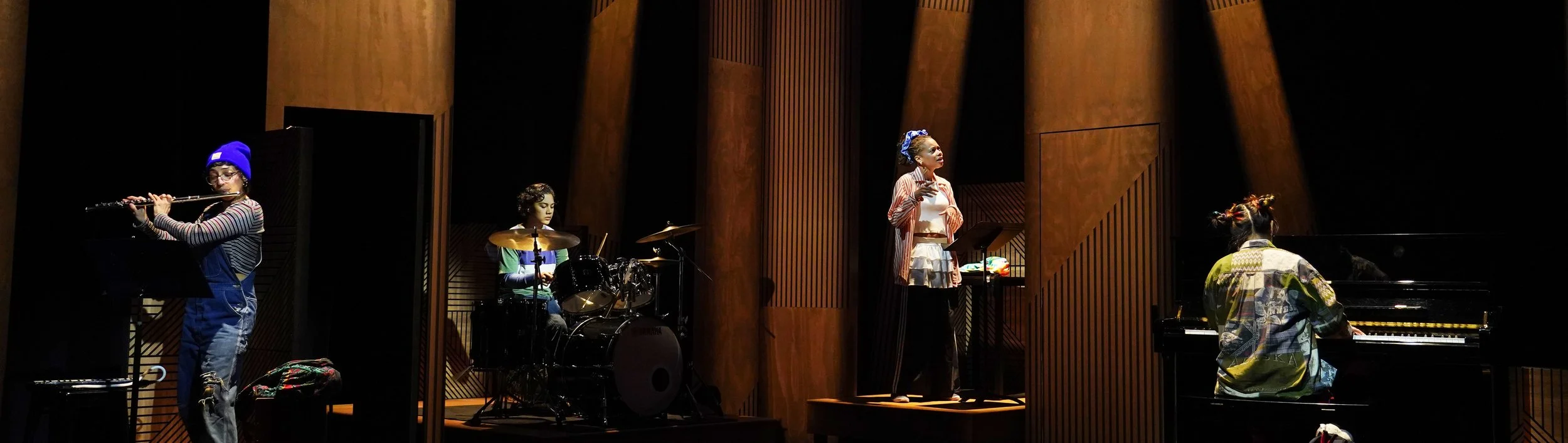
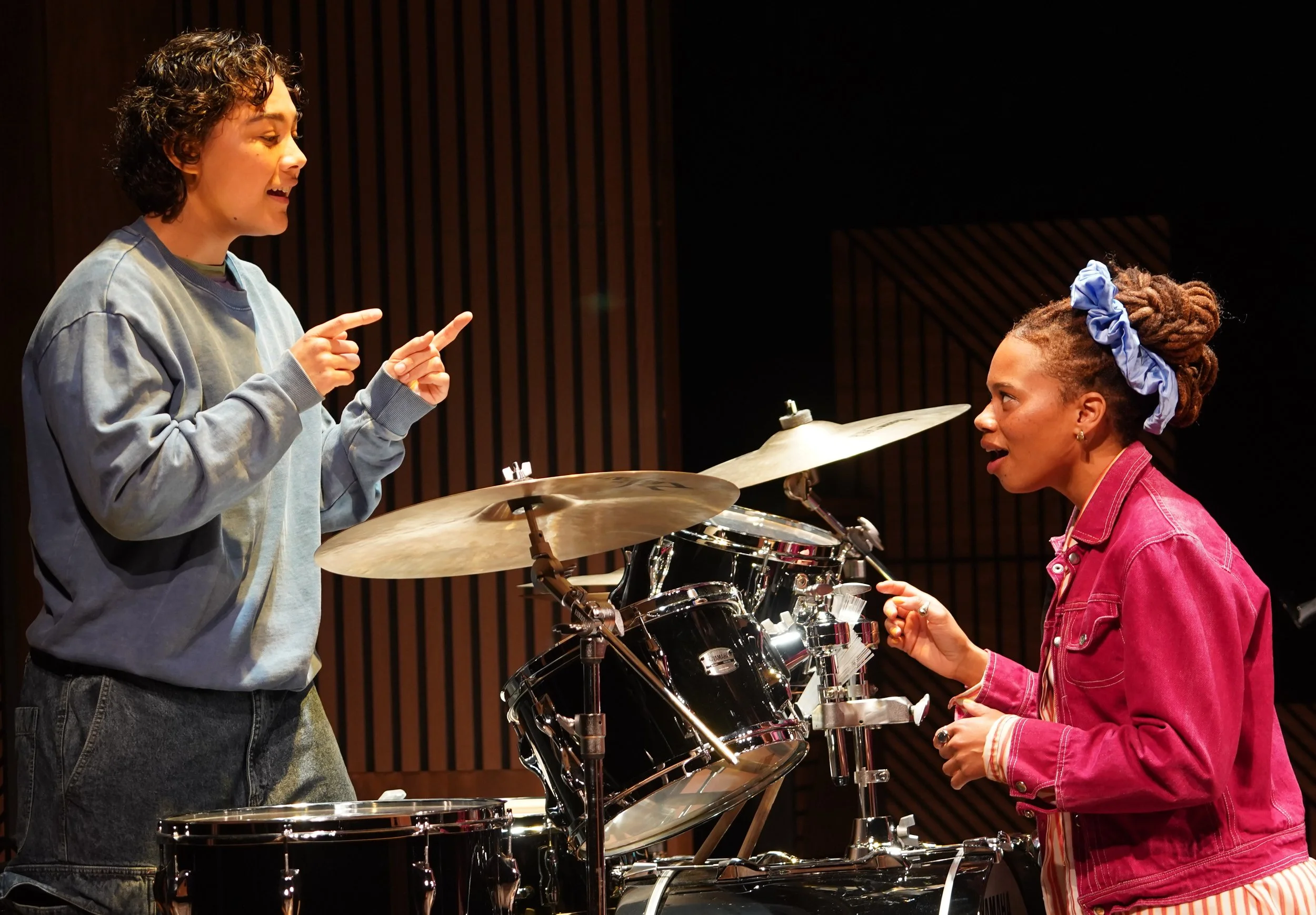
Margot (Naomi Latta, left) teaches Fax (Hillary Fisher) to create “chance music” in Eisa Davis’ ||:Girls:|| ||:Chance:|| ||:Music:||.
Angsty-girl plays have been flourishing on New York stages, and in several of these ensemble dramas, the characters use music to let out their frustrations—see, for example, the group dance breaks in John Proctor Is the Villain, All Nighter and the just-extended Dad Don’t Read This. For the title characters of Eisa Davis’ disarming ||:Girls:|| ||:Chance:|| ||:Music:||, though, music represents more than a release. It’s their way of communicating, of making sense of their world, of discovering just what they’re capable of and what (and who) they truly care about.
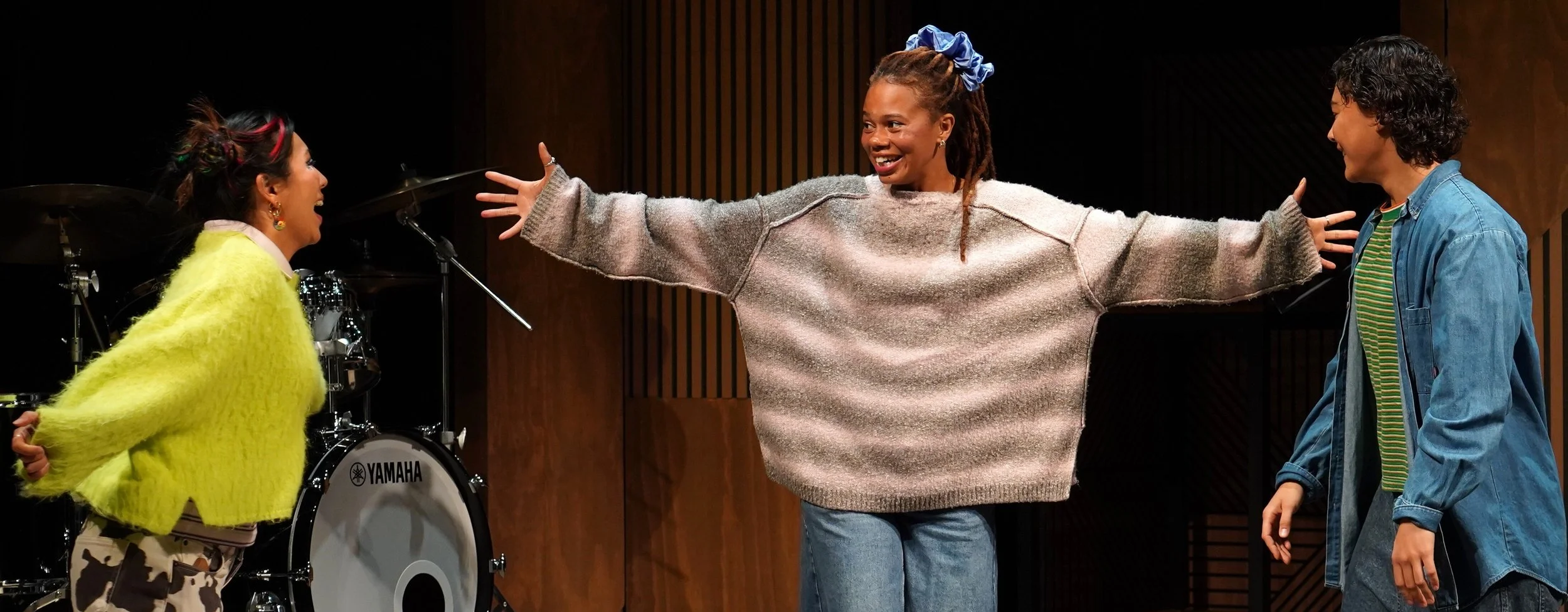
Rile (Yeena Sung, left) bonds with Fax (Fisher, center) and Margot (Latta) as students in a summer music program.
||:Girls:|| ||:Chance:|| ||:Music:||centers on three teens attending a summer music school in Northern California: Fax (Hillary Fisher), a vocalist; Rile (Yeena Sung), who plays the piano; and the drummer Margot (Naomi Latta). A fourth character, Clementine (Gianna DiGregorio Rivera), is also a student in the program but not part of the other three’s friendship.
The play’s mix of audience participation, dialogue scenes, monologues, flash-forwards, and live music performance can give it, at least early on, a fragmented or impressionistic feel. But if you don’t warm to ||:Girls:|| ||:Chance:|| ||:Music:|| from the start, it definitely grows on you as Davis’s intentions with her storytelling become clearer. Drawing parallels between the girls’ attitudes toward music and their attitudes toward life, Davis crafts an emotionally resonant work that tells a traditional story—about a formative summer for some young people—in a nontraditional manner. She and the cast offer a portrait of young womanhood that’s both universal—the intense bonding, jealousies, sexual awakening—and very specific to this group of girls.
“Davis’s savvy use of improvisation as an influence in the girls’ music-making as well as in their personal growth further distinguishes her script.”
Each actor is finely attuned to her character’s distinctive personality and how it mirrors her approach to music. Fax, chatty and eager to please, enjoys singing but doesn’t see it in her future other than as an extracurricular credit to impress college admission offices (“How would I make a living? I just want to do well”). Margot, possibly suicidal, needs music; it's her outlet, her refuge from an unhappy home life. Rile, who always speaks her mind, is as nonchalant about her talent as she is toward her unconventional parentage (“I was a whole project … with mom carrying her girlfriend’s egg with donor sperm from the bank, but after all that, my mom’s girlfriend broke up with her”). And Clementine, quieter and less dramatic than the others, is naturally gifted but disciplined: “I’m interested in practicing so that’s what I do … I just like to do what I’m good at.”
Sung, Latta and Rivera play instruments onstage, and along with Fisher, they perform pieces ranging from a Chopin étude to a bolero. They also return time and again to a “tone row,” a 12-note melody that’s the basis for musical improvisation (and that’s determined, preshow, by audience members placing stickers on a picture of piano keys).
Improvisation—the chance of the title—proves to be an important matter for the girls, musically and interpersonally. Fax has to learn how to “throw herself into the chaos and entropy” as a performer and, likewise, how to live according to her desires, not her planning. Margot, on the other hand, never bothers with music books or rules, and she’s winging it in life too. Rile also discovers “a release from the drudgery” in experimenting musically, and by extending herself personally.
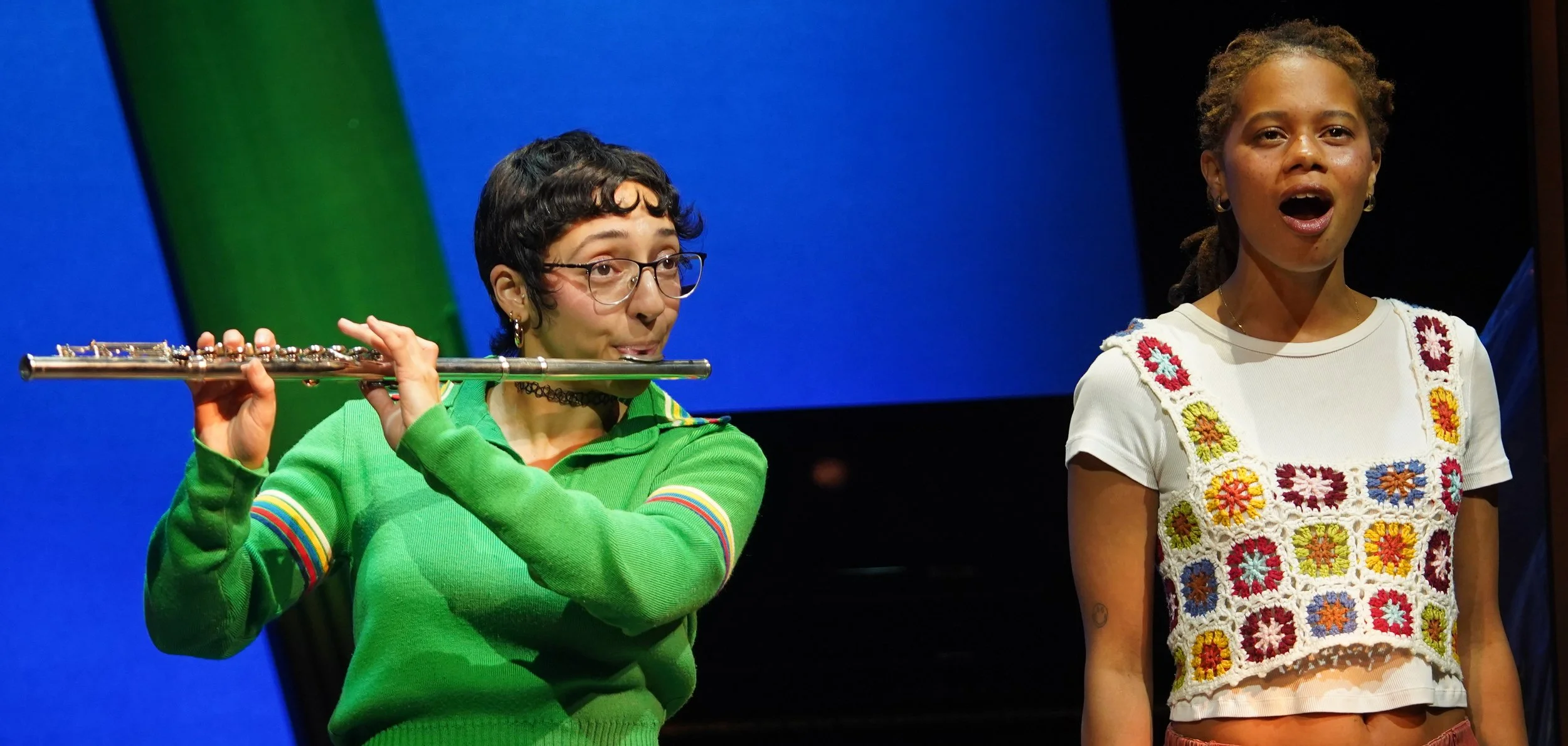
Clementine (Gianna DiGregorio Rivera, left) accompanies Fax (Fisher). Photographs by Carol Rosegg.
Davis’s savvy use of improvisation as an influence in the girls’ music-making as well as in their personal growth further distinguishes her script and adds another layer of meaning to the story. The playwright also considers the endangered world these girls face. “It’s hard to even feel all of what’s going on,” Fax says during one of the conversations where an environmental crisis (floods, wildfires, microplastics, a mountain lion in the streets, a “redwood that fell over”) is mentioned.
Late in the play, a natural disaster does hit: an earthquake, which feels scarily real due to the excellent simulation effected by the design team (Fan Zhang on sound, Russell H. Champa on lighting, and Nina Ball on sets). Costume design is commendable as well. From the girlie colors and patterns of Fax’s outfits, to a trio of Labubu hanging from Rile’s backpack, to the whole cast’s oversize sweaters, costumer Mel Ng shows a keen eye for detail.
That audience-created “chance music” and unusually punctuated title (it uses the musical notation for repeat) are really just gimmicky scene-setters, not essential to the plot. The play’s substance comes from its compelling cast of characters, Davis’s deep empathy for them, and her astutely observed script. As coming-of-age tale or tribute to the importance of art in one’s life, ||:Girls:|| ||:Chance:|| ||:Music:|| impresses.
||:Girls:||:Chance:||:Music:|| runs through June 21 at the Vineyard Theatre (108 E. 15th St.). Evening performances are at 7 p.m. Tuesday through Saturday, with matinees at 2 p.m. Saturday and Sunday; vineyardtheatre.org.
Playwright: Eisa Davis
Director: Pam MacKinnon
Sets: Nina Ball
Costumes: Mel Ng
Lighting: Russell H. Champa
Sound: Fan Zhang
If you enjoyed this review, please click on the Like icon below.
