

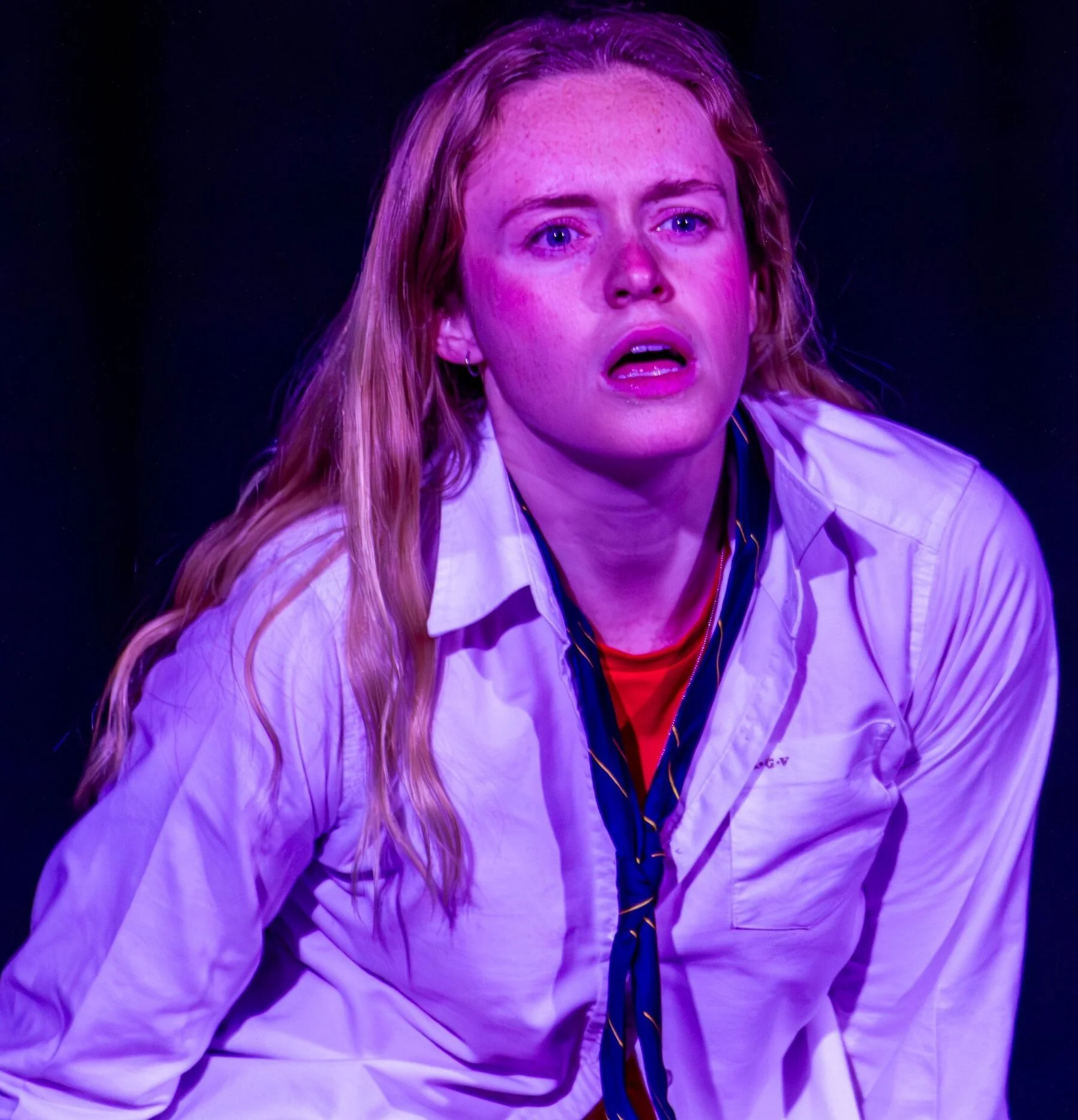
Playwright-performer Mimi Martin stars in Youth in Flames, a coming-of-age story amid the 2019 Hong Kong protests.
Millie, the cheeky British teenage expatriate at the center of Youth in Flames, begins the play drifting contentedly through life. In playwright-performer Mimi Martin’s engaging and deeply affecting solo drama, directed by Jessica Wiley, that carefree detachment is challenged by the turmoil of the 2019 Hong Kong protests, leading to a journey of self-discovery and moral reckoning.
The play follows Millie, a British expatriate teenager whose parents have allowed her considerable independence while they pursue demanding international careers around the world. Her closest local friend, Jesse, has become involved in the massive protests that erupted over a proposed extradition bill, legislation that many feared would erode Hong Kong’s autonomy under the “one country, two systems” arrangement established after the 1997 British handover to China. As the demonstrations swell into a wider movement demanding democratic reform and government accountability, Millie finds herself pulled from the comfort of privilege into by an awakening political consciousness.
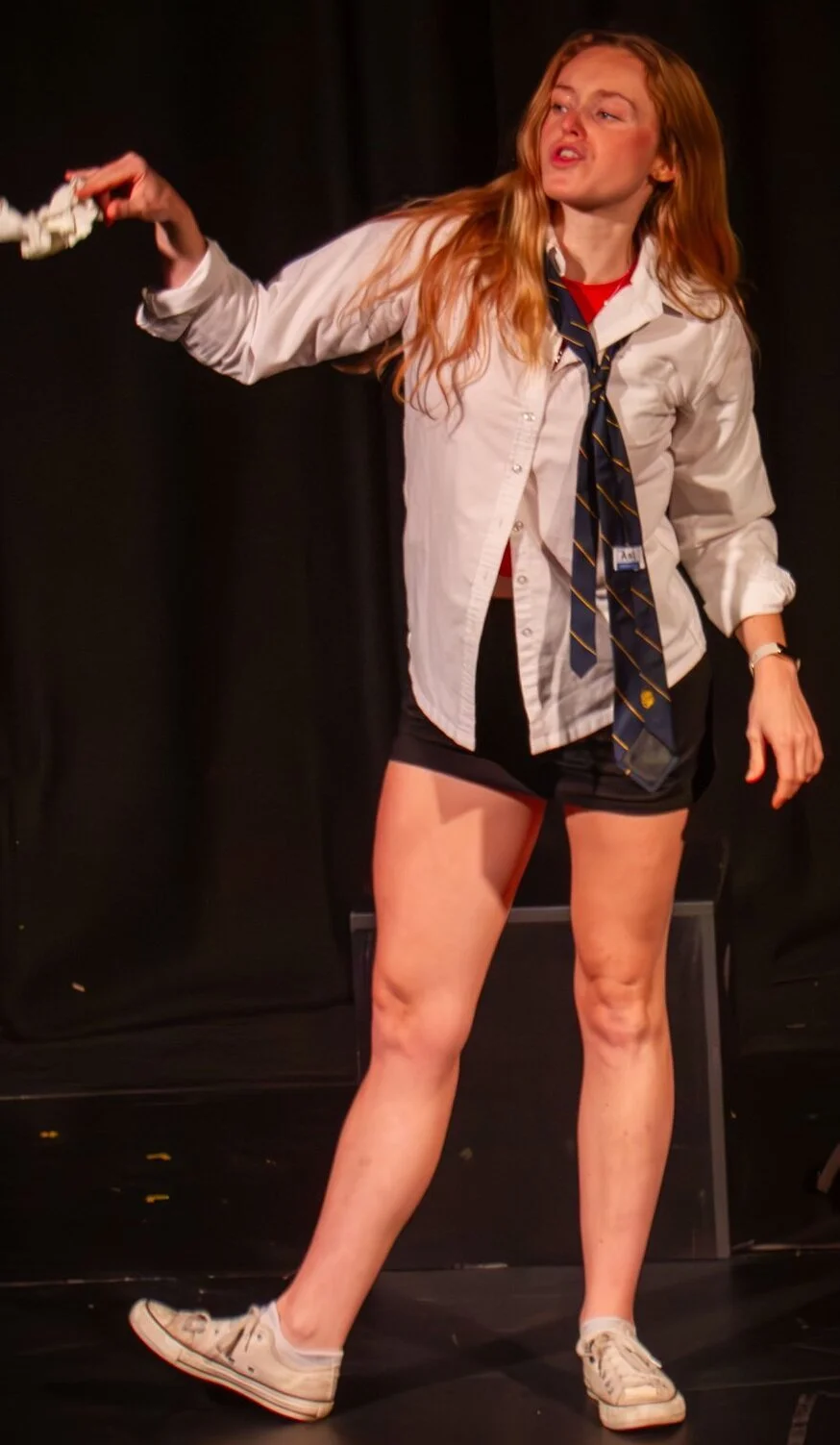
The rebellious protagonist Millie trades notes with her friend Jesse at school, which lands her in detention.
Although the political backdrop is important, the thrust of Youth in Flames is Millie’s transformation from observer to participant and her growing awareness of the consequences of political indifference. Martin gradually peels back the layers of Millie’s personality, revealing an impulsive teenager whose flaws make her eventual awakening all the more compelling.
At first Millie appears far more interested in testing boundaries than engaging with the world around her. At school, she trades notes with Jesse and lands in detention, while Jesse’s mother dismisses her as a gweilo (a Cantonese term, literally meaning white ghost or foreign devil) and a poor influence on her son. The charge is not entirely unfair: Millie frequents nightclubs, drinks to excess, and drifts through adolescence with little sense of purpose. Early on she tries to coerce Jesse into having his first alcoholic drink at her favorite bar:
Jesse: I don’t want to drink.
Millie: Yes, you do –
Jesse: No, I don’t. I want to be at the protest.
Things begin to change when Jesse persuades her to accompany him to a protest. What starts as another youthful act of rebellion soon exposes her to forces far larger than herself. Guy Martin’s realistic sound design proves especially effective here, filling the theater with chants of “Free Hong Kong!” while police warnings—“Leave now or be dispersed by force!”—create an atmosphere of mounting tension. Overwhelmed by the scale of the demonstration, Millie observes:
The crowd is huge. Everywhere I look there are banners for Hong Kong independence. Jesse! Look! The police are here. They’re not in normal uniform though. It’s like something out of a futuristic war film. . .This is big, bigger than me.
The speech captures the moment when her carefree self-absorption begins to give way to political awareness. When she is knocked to the ground and separated from Jesse amid the chaos, the protest ceases to be an abstract cause and becomes something immediate and personal.
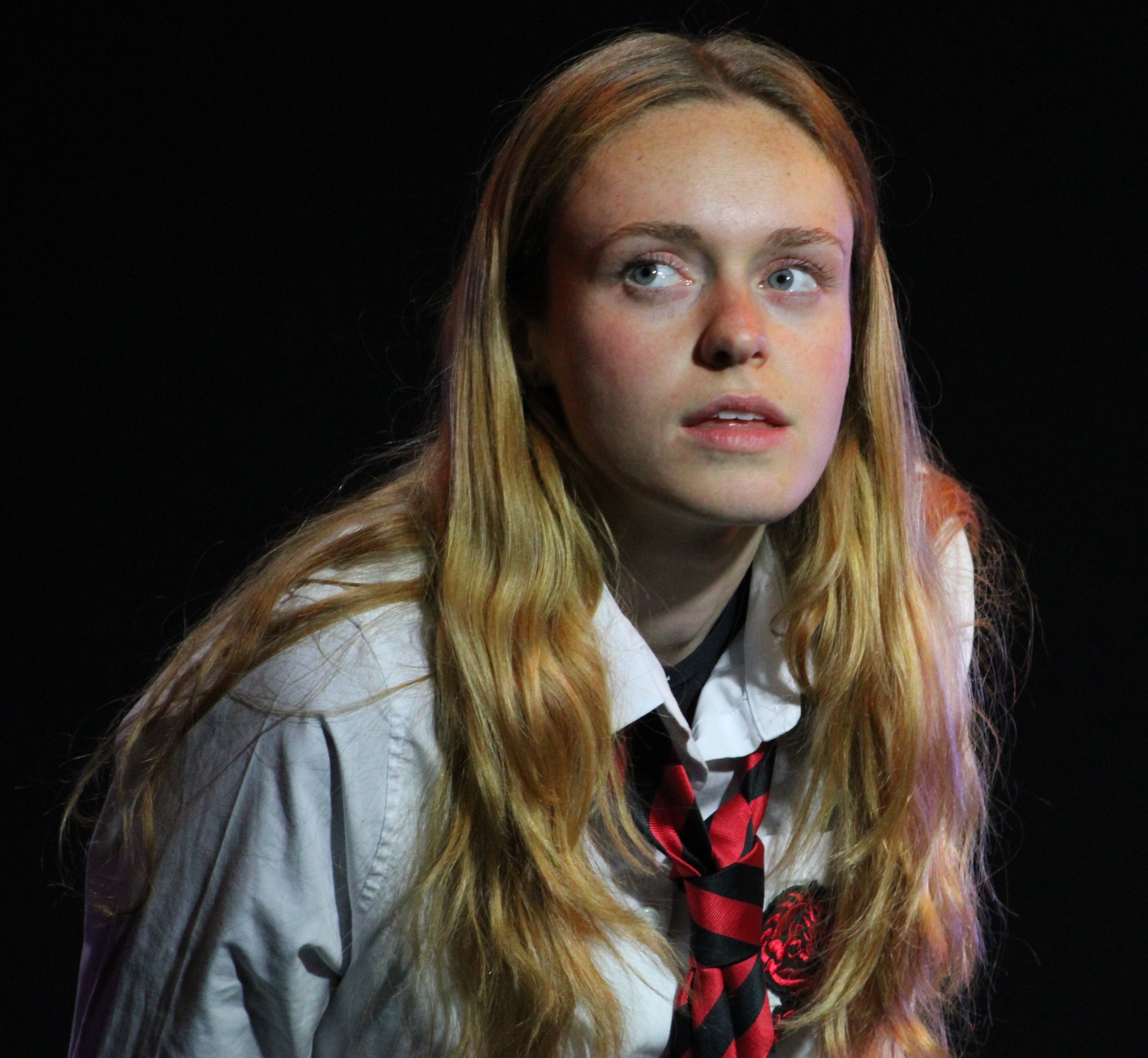
Martin draws on her firsthand experience as a former Hong Kong resident, imparting an authenticity to work. Photographs by Beckett Guimaraes.
Ciara Moss’s lighting design proves equally effective in shaping the production’s emotional landscape. Whether isolating Martin in a simple spotlight as she inhabits the various characters who populate Millie’s world or flooding the stage with pulsing strobe effects during nightclub and protest sequences, Moss heightens the mood of each scene. Yet some of her most meaningful work comes in quieter moments, when the lighting is subdued. The visual dimming echoes one of Millie’s most telling observations in a late scene about Hong Kong’s changing cityscape: “The city lights . . . don’t shine as bright; surveillance cameras take their place.” The line serves as both a literal observation and a poignant metaphor for a society in which personal freedoms are increasingly overshadowed by state scrutiny.
Martin delivers a remarkable performance, fully inhabiting Millie’s journey from carefree adolescent to politically awakened young woman. She also deftly portrays the other figures in Millie’s life, shifting between characters with subtle changes in posture, expression, and voice. Just as impressive is her rapport with the audience. In the intimate confines of Theater C, Martin embraces direct eye contact, creating an immediacy that draws one deeper into the story. Whether recounting events, dancing through nightclub scenes, or conveying moments of fear and uncertainty, she remains thoroughly present and emotionally truthful.
The play’s authenticity is undoubtedly strengthened by Martin’s personal connection to the material. When she was 18, she had lived in Hong Kong for eight years. She draws inspiration from her experience while shaping events into a fictional coming-of-age story. Youth in Flames succeeds as both a portrait of an adolescent searching for a sense of home and a city struggling to preserve its identity. In bringing those parallel journeys to life, Martin delivers an incandescent performance.
Youth in Flames plays through June 28 at 59 E. 59 Theaters (59 E. 59 St.). Evening performances are at 7:30 p.m. Tuesday through Saturday; matinees are at 2:30 p.m. Saturday and Sunday. For more information, visit 59e59.org.
Playwright: Mimi Martin
Director: Jessica Wiley
Lighting Design: Ciara Moss
Sound Design: Guy Martin
If you enjoyed this review, please click on the Like icon below.
