
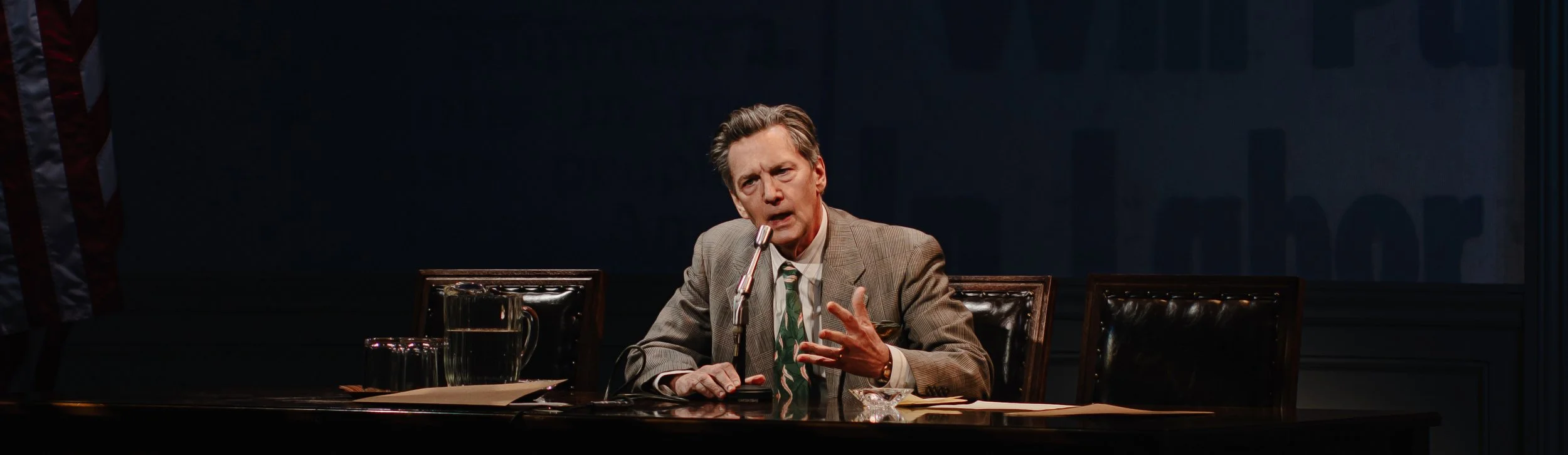
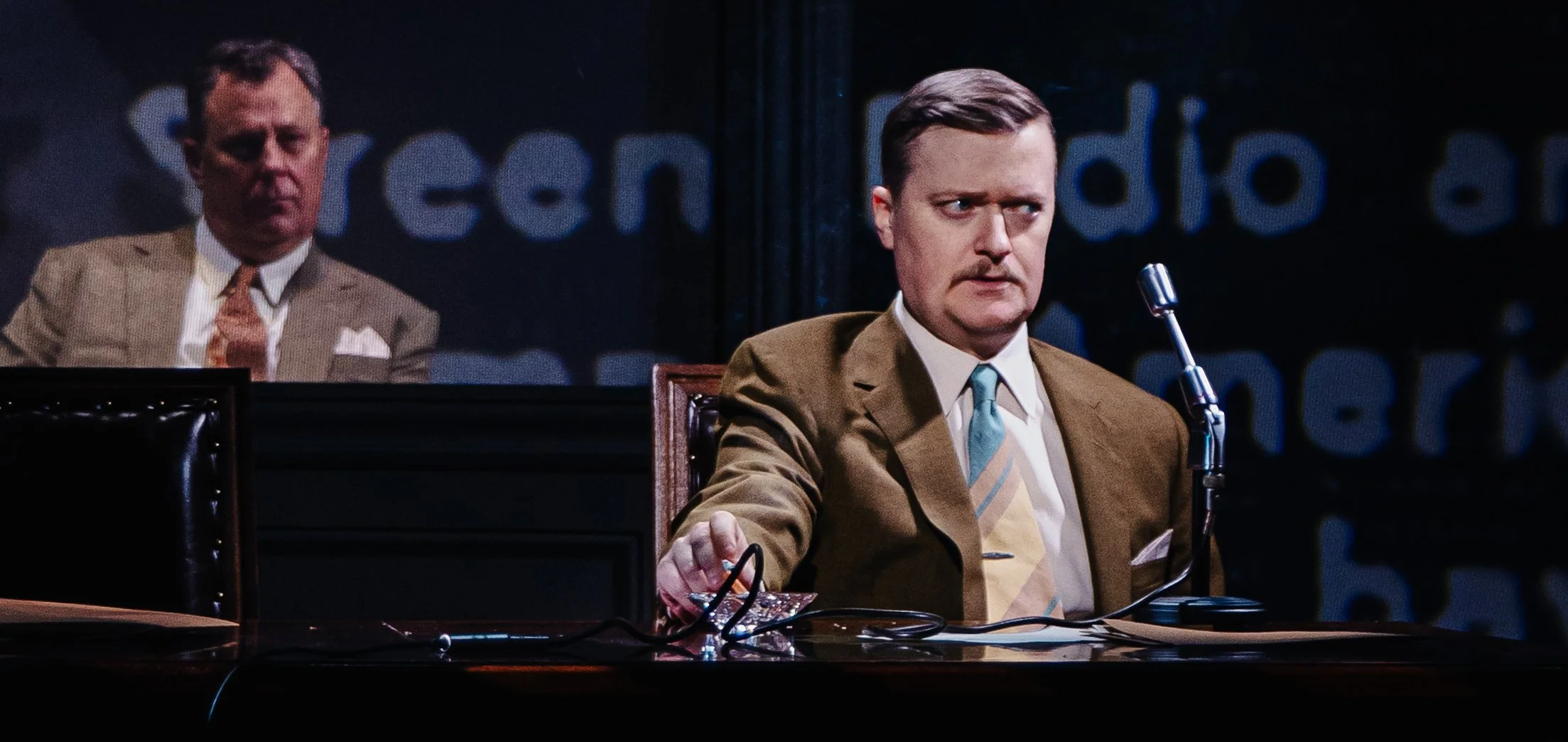
Many of the actors play multiple witnesses. Stephen Boyer testifies as Ring Lardner Jr., while Brooks Ashmanskas looks on.
Eric Bentley’s 1972 play Are You Now or Have You Ever Been revisits the House Un-American Activities Committee’s (HUAC) investigation into Communist influence in the entertainment industry during the mid-20th century. The dialogue is drawn directly from the hearing’s transcripts, making this revival as much a documentary as a drama. Directed by Anna D. Shapiro, the production captures the grind of a political investigation in all its tedious forms.
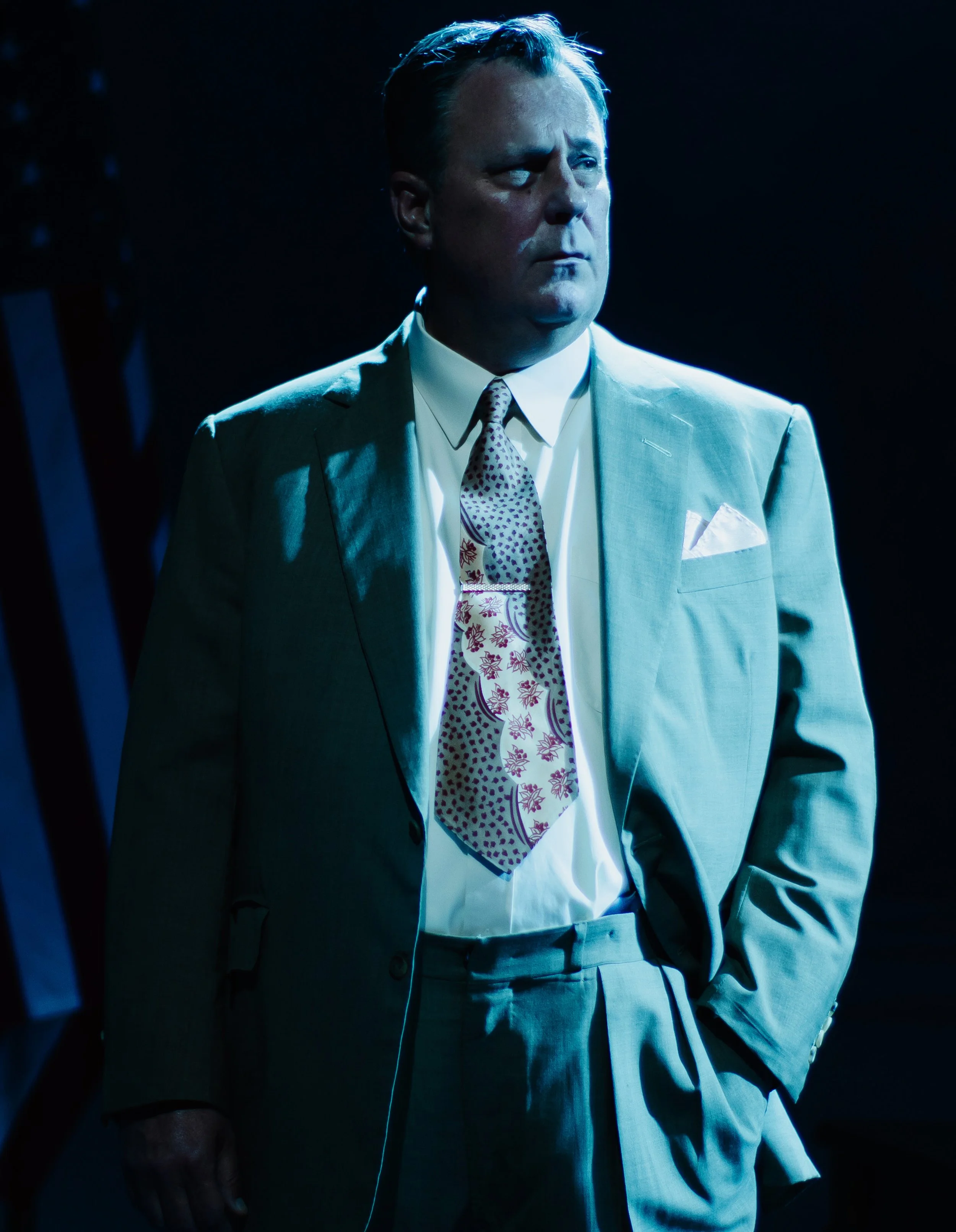
Brooks Ashmanskas plays, among other characters, film director Edward Dmytryk, best-known for The Caine Mutiny (1954).
Those subpoenaed are asked, essentially, one question: “Are you now or have you ever been a member of the Communist Party?” What follows is a variety of responses. These hearings continued for more than a decade (1947–58), producing a blacklist and sending several individuals to prison. By dramatizing the emotional distress inflicted on the targets, Shapiro presents a prominent example of political power being misused.
The production portrays the committee’s search for “truth” as increasingly contradictory, particularly when members justify their actions by claiming to represent the will of the people while dismissing First and Fifth Amendment protections.
For contemporary theatergoers, although these proceedings took place nearly seven decades ago, Bentley’s 50-year-old play still has relevance. It serves as a reminder of the abusive power that the U.S. government can wield.
The production employs visuals to reinforce the testimony. Newspaper headlines and articles are projected in the background, while the clickety-clack of a manual typewriter—a sound perhaps recognizable only to the baby boomers in the audience—provides context and updates on the individuals appearing before the committee. The static stage setting effectively mirrors the decorum and rigidity of a legal proceeding.
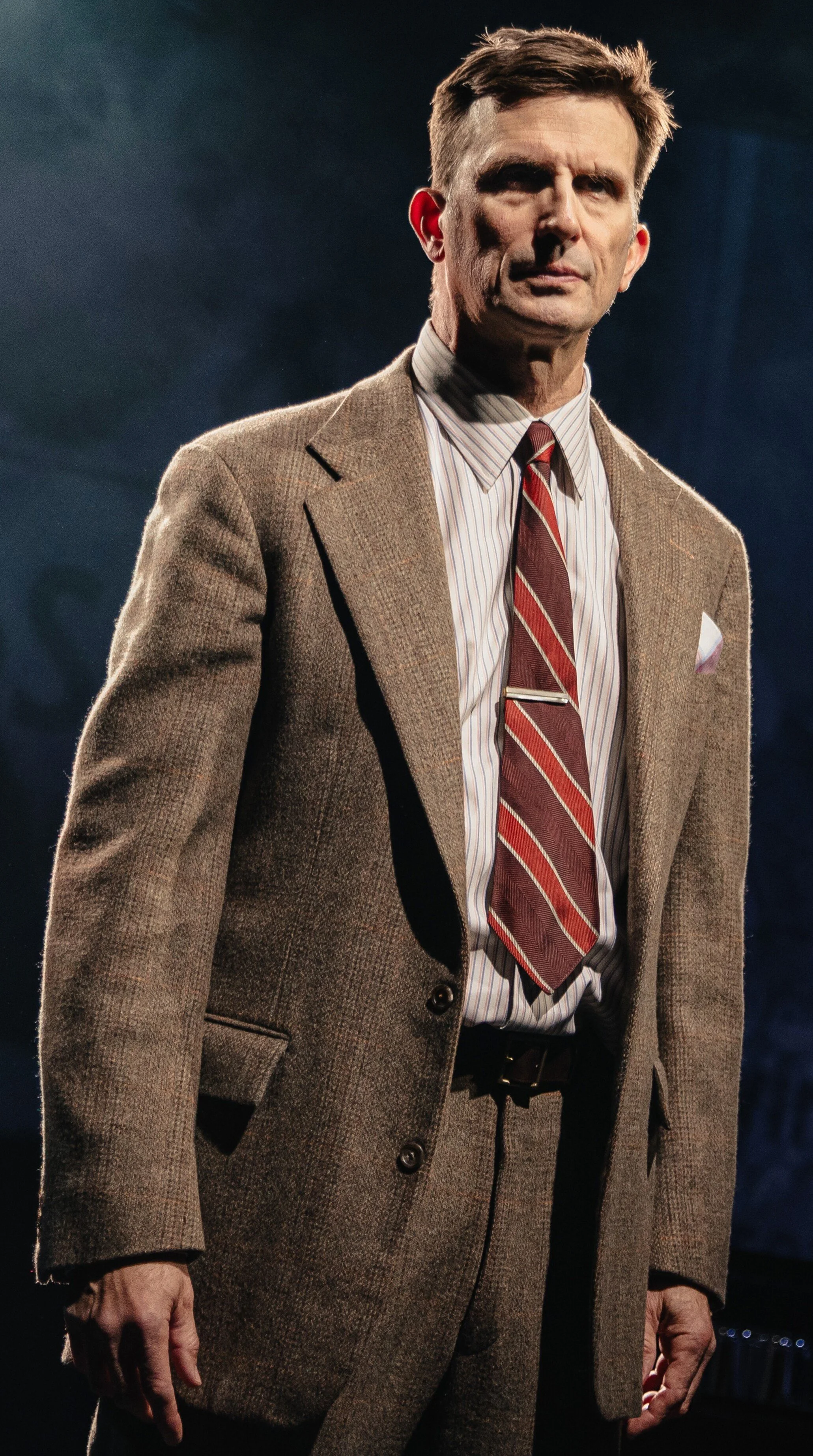
Among the characters played by Frederick Weller is director Elia Kazan, whose “naming names” outraged liberals.
As a documentary, its accuracy is admirable. As theater, however, it often resembles an actual government hearing, with a mixture of anguish and distrust on both sides. Actors deliver much of their dialogue while standing or sitting behind desks, and at times the production feels like an extended table read. The burden falls on the actors—17 witnesses—to make their characters’ cases.
Andrew McCarthy’s portrayal of actor Larry Parks effectively opens the proceedings and illustrates the emotional turmoil experienced by many of those who were subpoenaed—from refusing to “name names,” to relenting, to regret, and ultimately to the destruction of a career.
Each witness makes a personal decision about how to proceed—all emerge damaged personally, professionally, or morally. Yet some choose to resist: characters such as playwright Abe Burrows (David Krumholtz), co-writer of the book for the hit musical Guys and Dolls; gravel-voiced actor Lionel Stander (Jay O. Sanders), best known for his late-career turn as the manservant to Robert Wagner and Stefanie Powers on the TV series Hart to Hart; and singer Paul Robeson (Billy Eugene Jones), star of the 1936 film Show Boat, bring moments of humor, dignity, and hope to an otherwise sobering production.
Burrows humorously recounts his introduction to Communism that coincided with his move to Hollywood. Admitting that he was part of the social circle, he denied ever actually joining the party.

Sally Murphy plays dramatist Lillian Hellman, one of the few women called to testify. Photographs by Marc J. .Franklin.
In those days, I was invited everywhere. Attended more parties than anyone. The Saturday Evening Post did an article about me and the fact that I played at parties all over Hollywood. … I used to go to too many, and, when I started to get asked by people I didn’t know, I began to quit going.
Sanders delivers Stander’s testimony with mounting indignation, transforming a transcript excerpt into one of the evening’s most theatrical moments, furiously defending his rights and willing to testify against his accusers:
I have knowledge of subversive action! I know of a group of fanatics who are trying to undermine the Constitution of the United States by depriving artists of life, liberty, and the pursuit of happiness without due process of law! I can cite instances! … A group of ex-Bundists, America Firsters, and anti-Semites, people who hate everybody, Negroes, minority groups, and most likely themselves—
Finally, Billy Eugene Jones gives Robeson’s testimony tremendous force, turning a procedural exchange into a powerful challenge to the committee’s authoGentlemen. … Wherever I have been in the world, the first to die in the struggle against fascism were the Communists. … The Fifth Amendment does not infer criminality. Chief Justice Warren has been very clear on that. I invoke the Fifth Amendment.
Ending with Robeson’s voice silenced, the production underscores how political institutions can suppress dissent while claiming to protect democracy. Bentley’s play may document events from the mid-twentieth century, but its warnings about governmental power still resonate.
Are You Now or Have You Ever Been runs through Sept. 11 at New York City Center Stage (131 West 55th St.). Evening performances are at 7:30 p.m. Tuesday through Sunday and at 8 p.m.; matinees are at 2 p.m. Wednesday and Saturday and at 3 p.m. Sunday. For tickets and additional information, visit areyounowplay.com.
Playwright: Eric Bentley
Director: Anna D. Shapiro
Associate Director: Zoe Adams
Scenic Design: Andrew Boyce
Costume Design: Johanna Pan
Lighting Design: Donald Holder
Sound Design: Rob Milburn & Michael Bodeen
Projection Design: Brittany Bland
If you enjoyed this review, please click on the Like icon below.
