

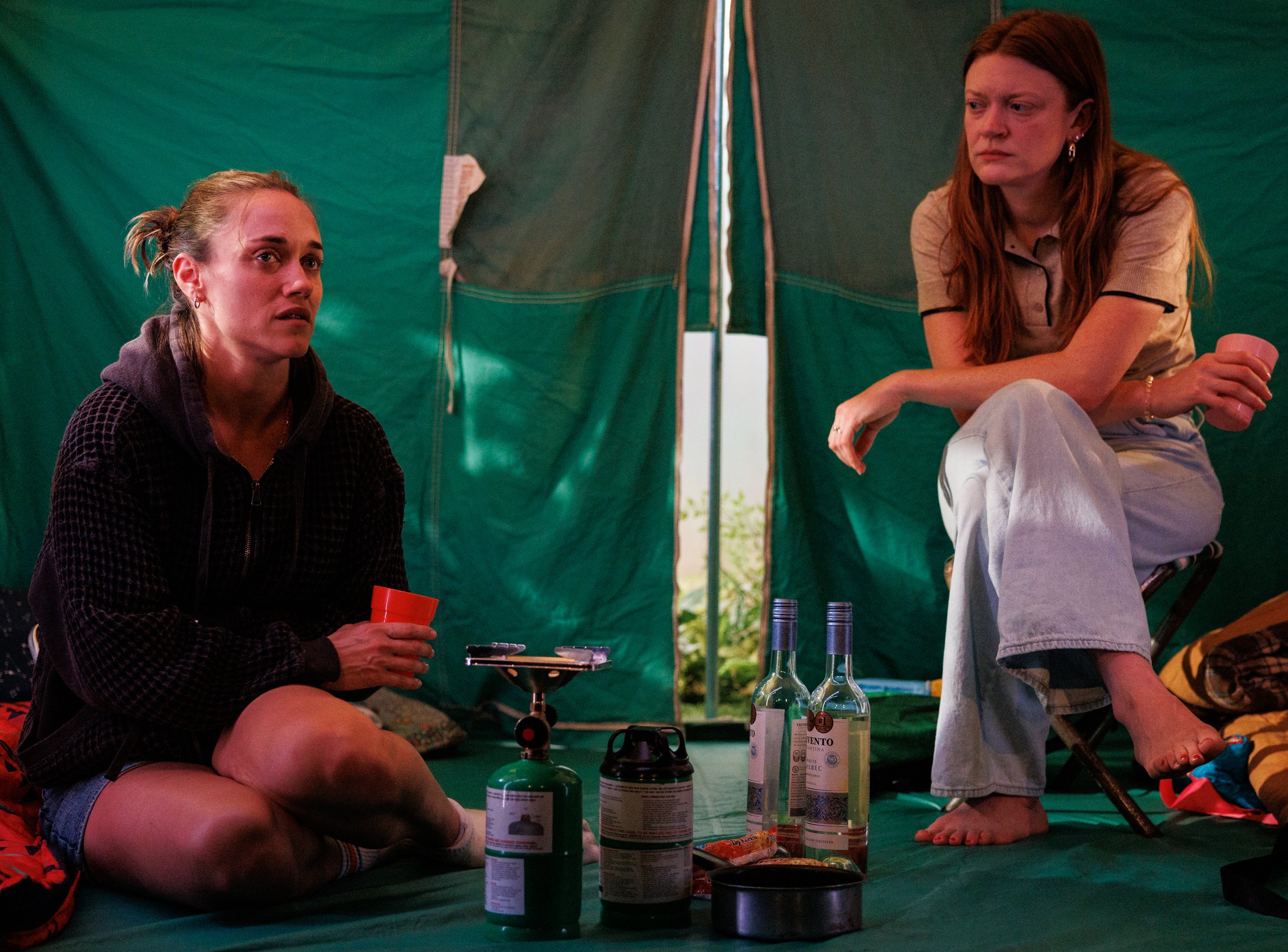
Victoria Lynne Barclay’s Camping takes place entirely within a tent, as two friends, Brit (Alice Kremelberg, left) and Ari, (Colby Minifie) return to the tent periodically over 25 years.
A tent creates a confined yet evocative space—the image might conjure up strong memories and associations, perhaps of childhood camping trips or adolescent backyard adventures or later-in-life attempts at experiencing the great outdoors. For Ari and Brit, the protagonists of Victoria Lynne Barclay’s new two-hander Camping, the tent is a world unto itself. From ages 15 to 40, the two women navigate life—including relationships with inadequate men—and feelings for each other that they can never quite come to terms with, through events that always return them to the same tent. That Barclay makes this contrivance feel largely natural is one of the strengths of this sensitively observed play.
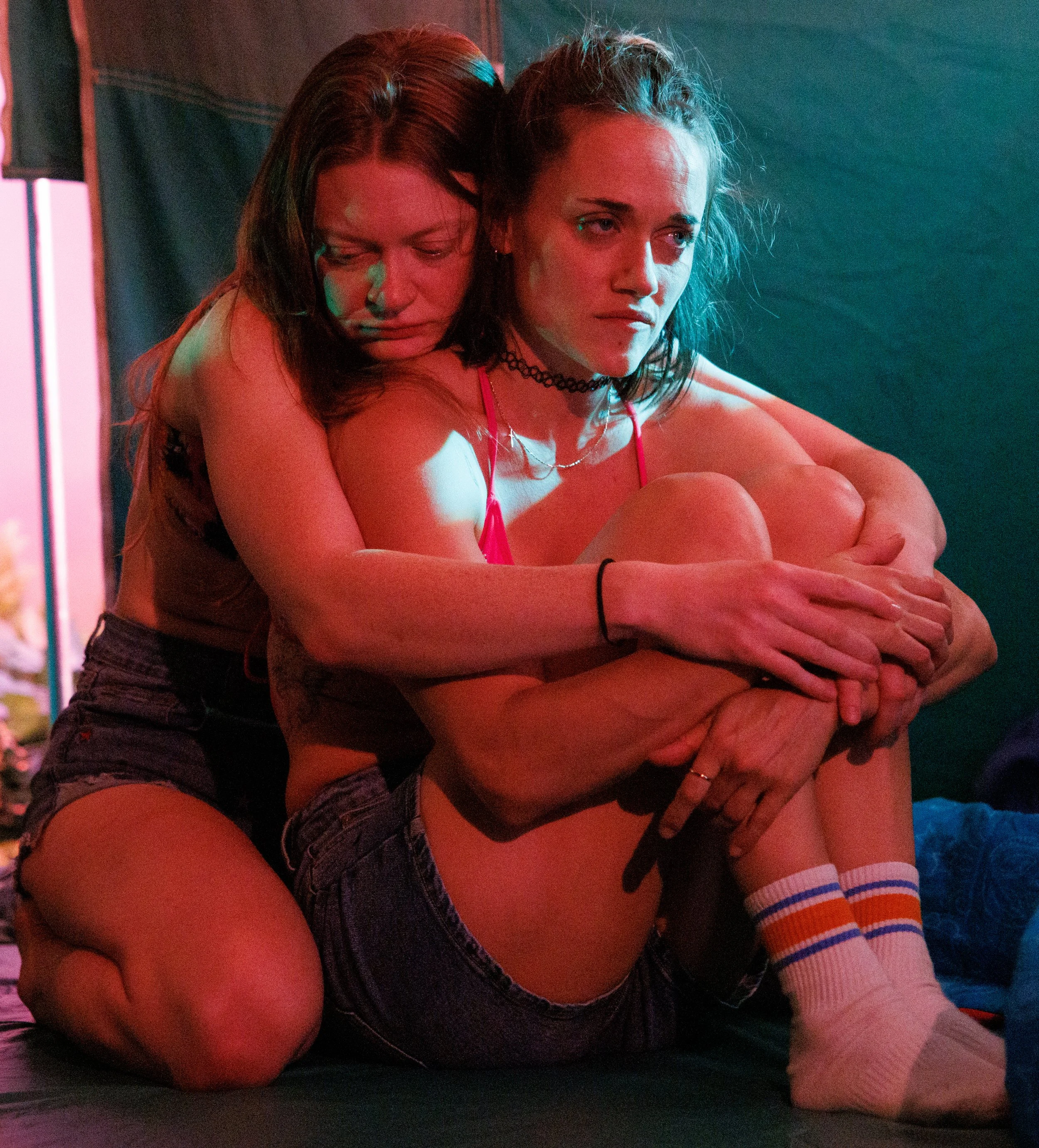
Ari and Brit, here at a rave while Ari is in college, have several falling outs but always seem to find their way back to each other. Photographs by Maria Baranova.
During 85 minutes, the audience never glimpses the two friends outside of the tent. In fact, no part of the exterior world is visible in Krit Robinson’s scenic design of a large green canvas tent, one side open to face the audience, serving as a proscenium.
First Ari (Colby Minifie) and Brit (Alice Kremelberg) are high-school freshmen in small-town Ohio awaiting the arrival of two guys so they can lose their virginity, motivated largely by fear they are the only ones at their school who haven’t. “I just want it to be over. I want it to be like two hours from now right now,” Brit says.
This sentiment, and their experience that night, initiates a pattern of subordinating their own desires and pleasure to social expectations and the accommodation of men. Within their nervous chatter and joking about their bodies they often come up against the line of same-sex desire, toward the possibility of something more fulfilling, before retreating. This comes to the fore three years later, when Ari and Brit are 18 and back in the tent supervising a Girl Scout outing. Ari walked in on two girls in the troop during an intimate moment:
Ari: Like Brit they were … making out. With like, hands.
Brit: Are they like bored? Or like practicing?
When Ari points out that they are probably just girlfriends, Brit rehearses bigotry she has picked up from her family and church:
Like, I don’t like, I don’t think that’s actually normal, two girls? … And and, like, I dunno, like like one time at youth group Pastor Paul was like … “God created the female vagina to lubricate itself for the specific purpose of accepting the penis.”
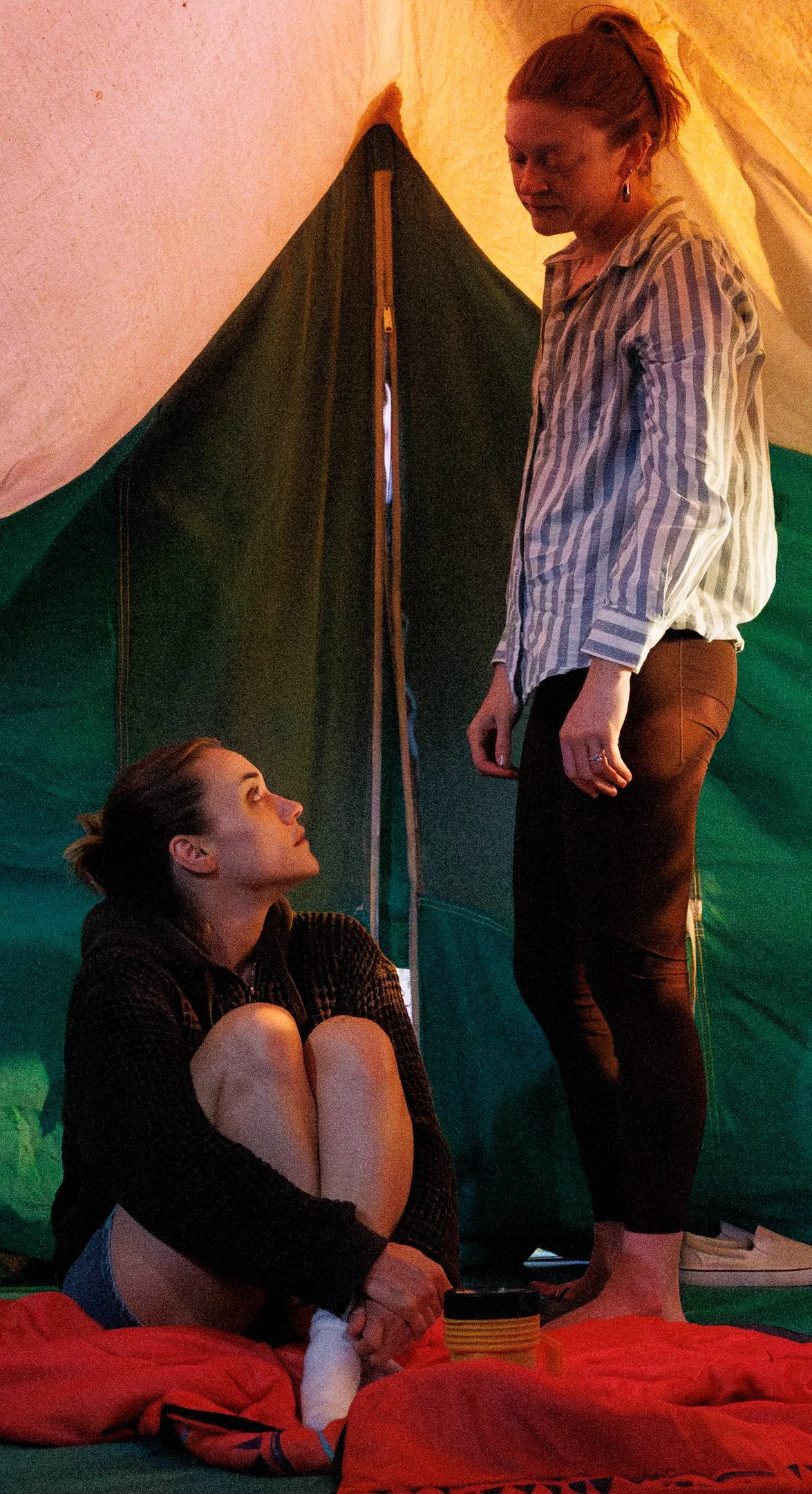
Never with much luck in their male partners, Brit and Ari navigate a lifelong friendship that perhaps should have been something more.
Ari is stung, but redirects toward humor: “Anyone who says ‘accepting the penis’ is weird.” While their attitudes evolve, and their paths diverge when Ari goes to college and becomes more worldly than Brit, they seem trapped in a way of thinking that minimizes their desire for each other, in the face of the terrible men they marry and have children with. A kiss they share at a rave during Ari’s time in college remains for a long time an unspoken moment when the veil of social expectations dropped, just briefly.
Under the direction of Adrienne Campbell-Holt, Minifie gives a striking performance as Ari, particularly in the youthful sequences, where her energy and wit are battling with her insecurities. Kremelberg’s Brit is steely and outwardly confident, though burdened by labeling herself “trash” and never thinking she can, or should, transcend that category. Campbell-Holt’s nimble staging doesn’t allow the restricted space of the tent to become a liability, and every gesture or repositioning of a sleeping bag becomes meaningful as the pas de deux between Ari and Brit unfolds.
Salvador Zamora’s sound design provides glimpses of the world beyond the tent—a car pulling up, Girl Scouts being mischievous, wildly behaved toddlers stressing their parents’ tolerance, the sports chants of asinine husbands—which offers the sense that, despite their pain and frustrations, inside the tent is the only place in the world that really matters to this pair.
Barclay’s writing in the adolescent and college-aged periods is sharply observant, mixing in quiet profundity among the bodily jokes and teenage angst. The distance between who these people could be and what society has in store for them reaches toward tragic proportions. The adult sequences are less natural, even occasionally stilted, with some clichéd acts of disloyalty and reconciliation.
In a moving, bittersweet conclusion, as the old tent begins to give way around them during a storm, awareness finally opens up, and the dream of a better, if out-of-reach future, comes into view. Camping is Barclay’s playwriting debut, and it marks her as a writer to watch—one who knows that a small space can contain everything.
The Colt Coeur production of Camping runs through July 11 at HERE Arts Center (145 Sixth Ave.). Performances are on Tuesday through Saturday, but showtimes are irregular; please visit here.org for details.
Playwright: Victoria Lynne Barclay
Director: Adrienne Campbell-Holt
Scenic Design: Krit Robinson
Costume Design: Sarita P. Fellows
Lighting Design: Vittoria Orlando
Sound Design: Salvador Zamora
If you enjoyed this review, please click on the Like icon below.
