
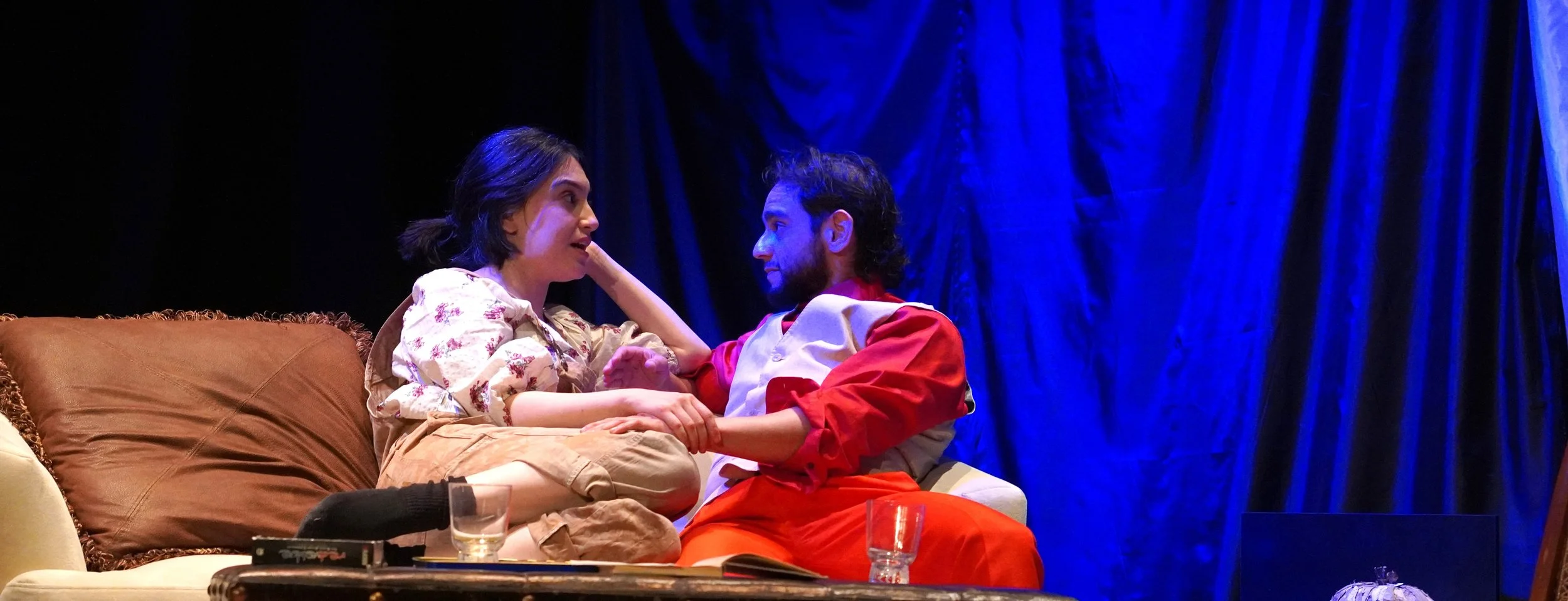
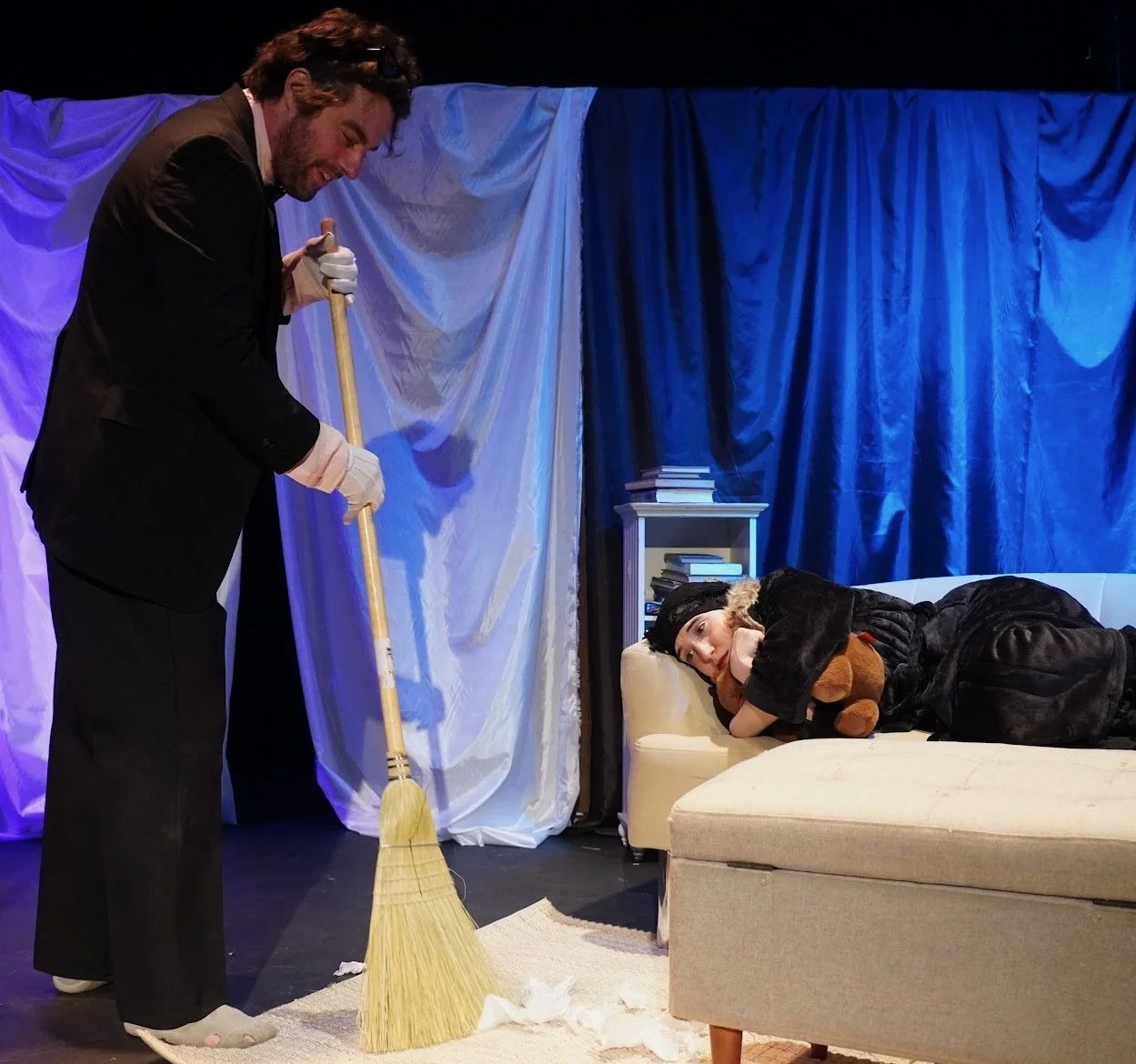
Jacob Goldblas (left) plays the practical manservant Luka, and Luna Vintner portrays the young melancholic widow Popova in Chekhov’s The Bear.
In A Night of Chekhov, director Sanio Kurtesevic ambitiously compresses three lesser-known Anton Chekhov works into a brisk evening of comic despair and emotional misfire. While flashes of Chekhov’s wit emerge throughout Swan Song, The Proposal, and The Bear, the ensemble has not yet fully settled into the rhythms of the material, resulting in performances that often feel tentative and uneven.
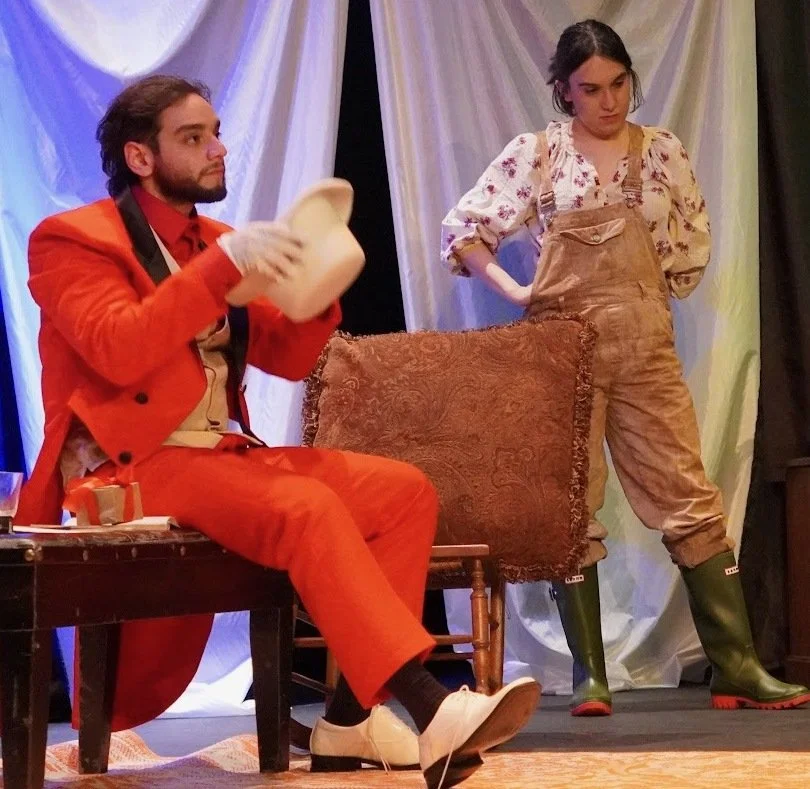
Damian Cruces as the neighbor and suitor Lomov, and Vintner is the hot-headed Natalya in Chekhov’s The Proposal at the Actors Temple Theater.
First up is Swan Song (1887), a compact yet piercing meditation on mortality, loneliness, and the fleeting nature of theatrical fame. The play follows an elderly actor, Svetlovidov (in the original a male), who remains behind in an empty theater after her final performance, drifting through drunken reminiscence and painful self-reckoning. Joined by the theater’s aging prompter Nikita, she confronts lost youth, failed romances, sacrifices, and the ephemeral triumphs of a life devoted to the stage.
Luna Vintner, portraying the aging comedian, may not yet fully inhabit the psychological depths of the sexagenarian, but she effectively captures the character’s oscillation between comedy and despair through her boozy ramblings and impassioned recitations from Shakespeare and Aeschylus. At the heart of Swan Song, however, lies the existential terror of an actor confronting obscurity once the applause fades. That anguish emerges most poignantly in an exchange between Svetlovidov and the elderly prompter Nikita, sensitively played by Jacob Goldbas:
Nikita: Lord, you’ve forgotten where you even live.
Svetlovidov: I don’t want to go there. . . I am alone there. I have no one, Nikitushka, no family, no old woman, no children.
Despite its melancholy atmosphere, Chekhov ultimately offers a measure of consolation through art itself, put in the mouth of the character Svetlovidov: “Where there is art, where there is talent, there is no old age, no loneliness, no illness, and death itself is only half what it is.” With its portrait of an aging thespian taking stock of her life and craft, Swan Song anticipates later backstage dramas such as The Dresser and A Life in the Theatre, while also foreshadowing the emotional currents of Chekhov’s mature masterpieces like The Seagull. Even in miniature form, the play remains a small but resonant gem.
The evening’s tone shifts dramatically with The Proposal (1888), Chekhov’s wonderfully sharp subversion of the traditional romantic comedy. A nervous landowner arrives at his neighbor’s home intending to ask for his daughter’s hand in marriage, but the carefully orchestrated courtship quickly descends into comic warfare fueled by petty grievances, inflated pride, and bruised egos.
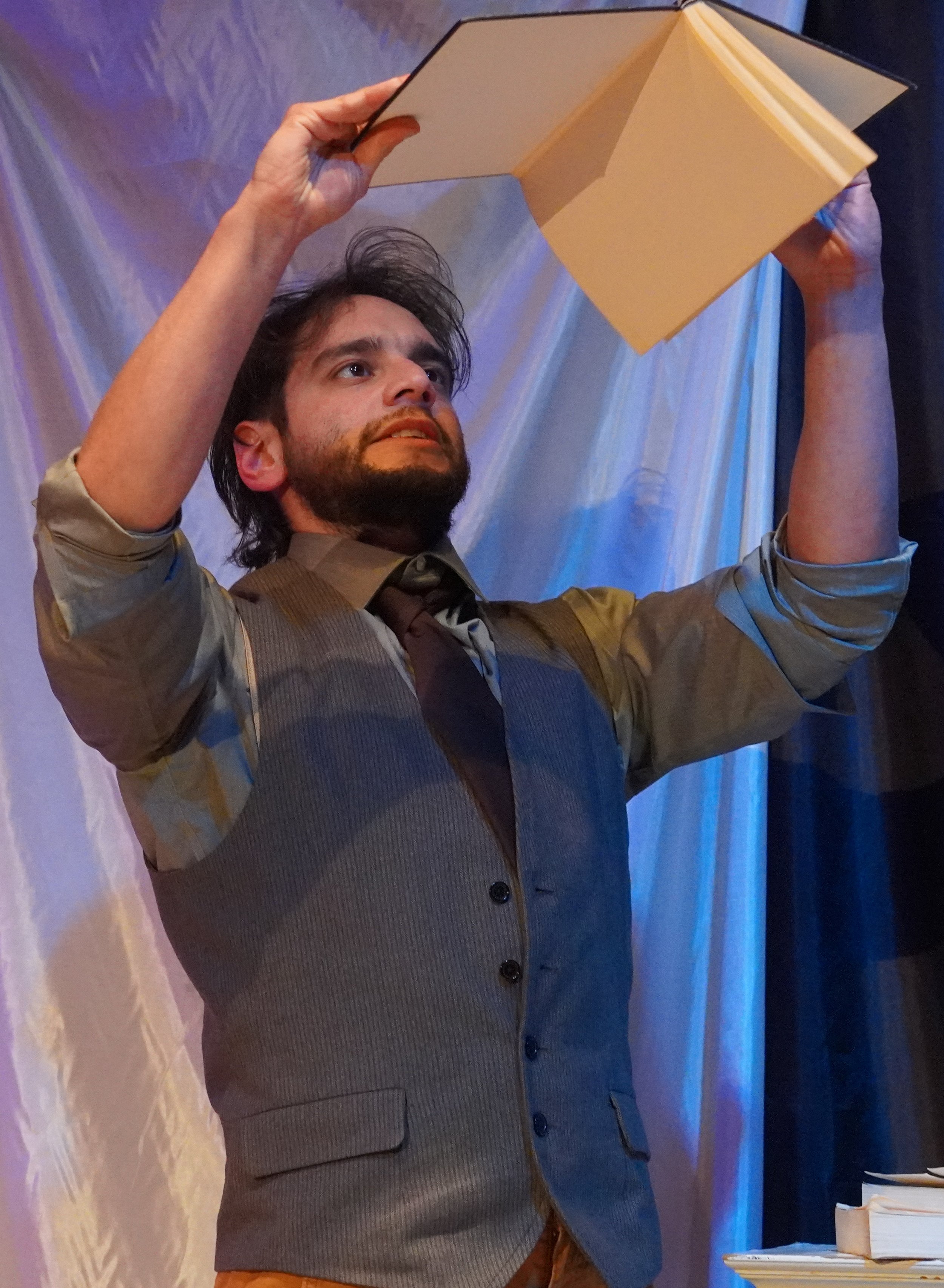
Cruces captures both the blustering misogyny and unexpected romantic vulnerability of Smirnov in Chekhov’s The Bear. Photographs by Hayden Jones.
This tightly wound farce demands impeccable comic timing from its performers, and Goldbas as the blustering father Chubukov, Vintner as the hot-tempered Natalya, and Damian Cruces as the neurotic suitor Lomov are well on their way toward fully inhabiting their delightfully unhinged roles. Whether Cruces’s indignant Lomov takes offense at Natalya’s accusation that he is attempting to seize the disputed Oxen Meadows (“So by your account, I am a usurper, madam!”) or Chubukov erupts into a heated defense of Lomov’s hunting dog (“The moment you notice that someone’s dog is getting the better of your Ugadai, you start in with your this, that, and the other.”), the escalating absurdity reveals something darker beneath the laughter: wounded vanity, possessiveness, and an almost pathological inability to listen.
Of the evening’s three offerings, The Proposal emerges as the most fully realized production and the funniest, allowing both Chekhov’s wit and the cast’s comic instincts to land with the greatest confidence.
The Bear (1888), the final entry in this Chekhovian triptych, centers on a fiery clash between the boorish creditor Smirnov (Cruces) and the recently widowed Popova (Vintner), whose refusal to surrender her dignity turns a debt collection into a battle of wills—and, eventually, reluctant attraction. In this sharply observed farce, Chekhov skewers the gender conventions of 19th-century Russia, exposing both Smirnov’s swaggering machismo and Popova’s theatrical mourning as equally absurd performances.
While Cruces and Vintner have not yet fully settled into their combative roles, the production lands the pair’s duel scene with considerable comic flair, culminating in Smirnov’s hilariously awestruck admission: “A duel, now that is equality, emancipation, both sexes are equal here. I’ll shoot her on principle, but what a woman!”
Seen at an early preview, A Night of Chekhov often feels like a production still searching for its emotional footing. Yet the evening also reveals flashes of genuine promise, particularly in The Proposal, and one suspects that with additional performances the cast will grow more comfortable inhabiting Chekhov’s volatile characters, trusting the playwright’s language, and grounding their performances in emotional truth rather than theatrical flourish. If that happens, Kurtesevic may well have a rewarding showcase for the wit, melancholy, and humanity that animate these rarely staged one-act gems.
A Night of Chekhov plays through June 28 at Actors Temple Theater (339 W. 47th St.). Evening performances are at 7 p.m. Tuesday, Wednesday, Thursday, Saturday, and Sunday; matinees are at 3 p.m. Saturday. For more information, visit duseproductions.com.
Playwright: Anton Chekhov
Director: Sanio Kurtesevic
