
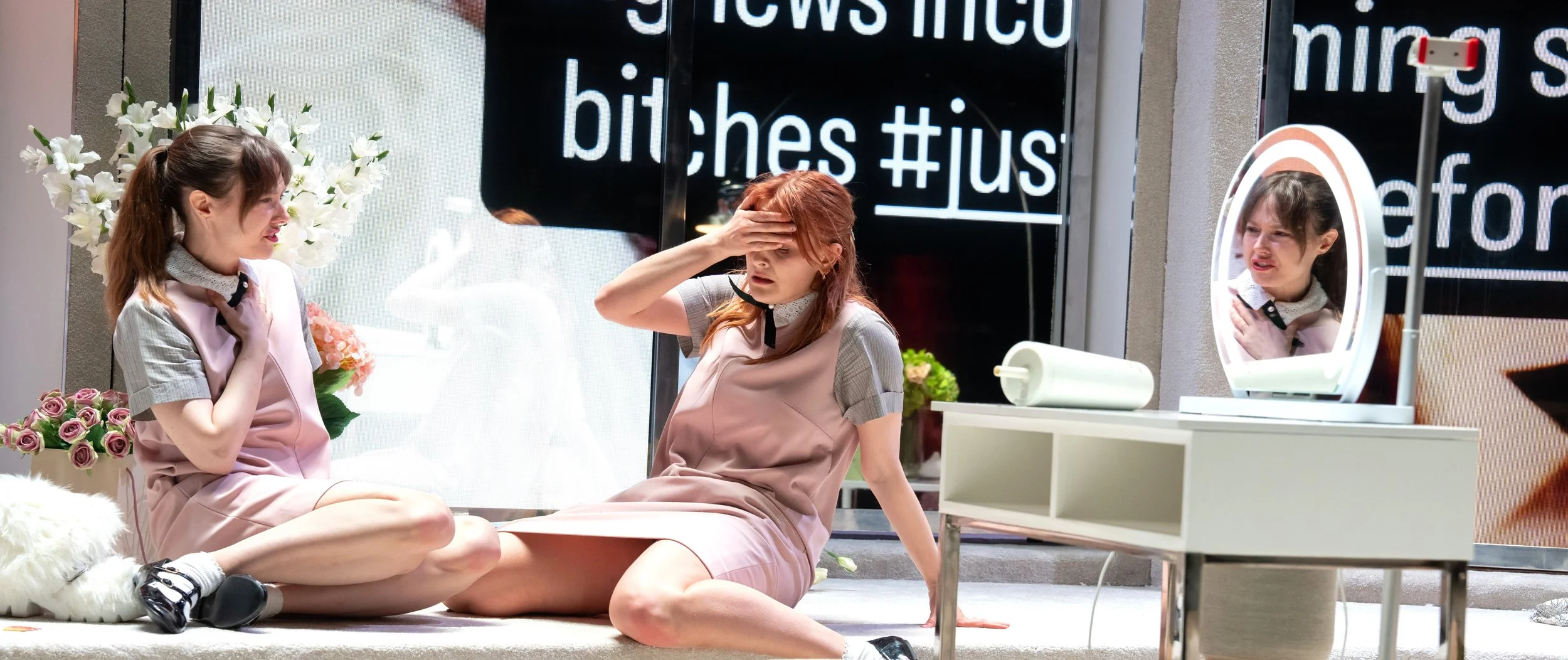
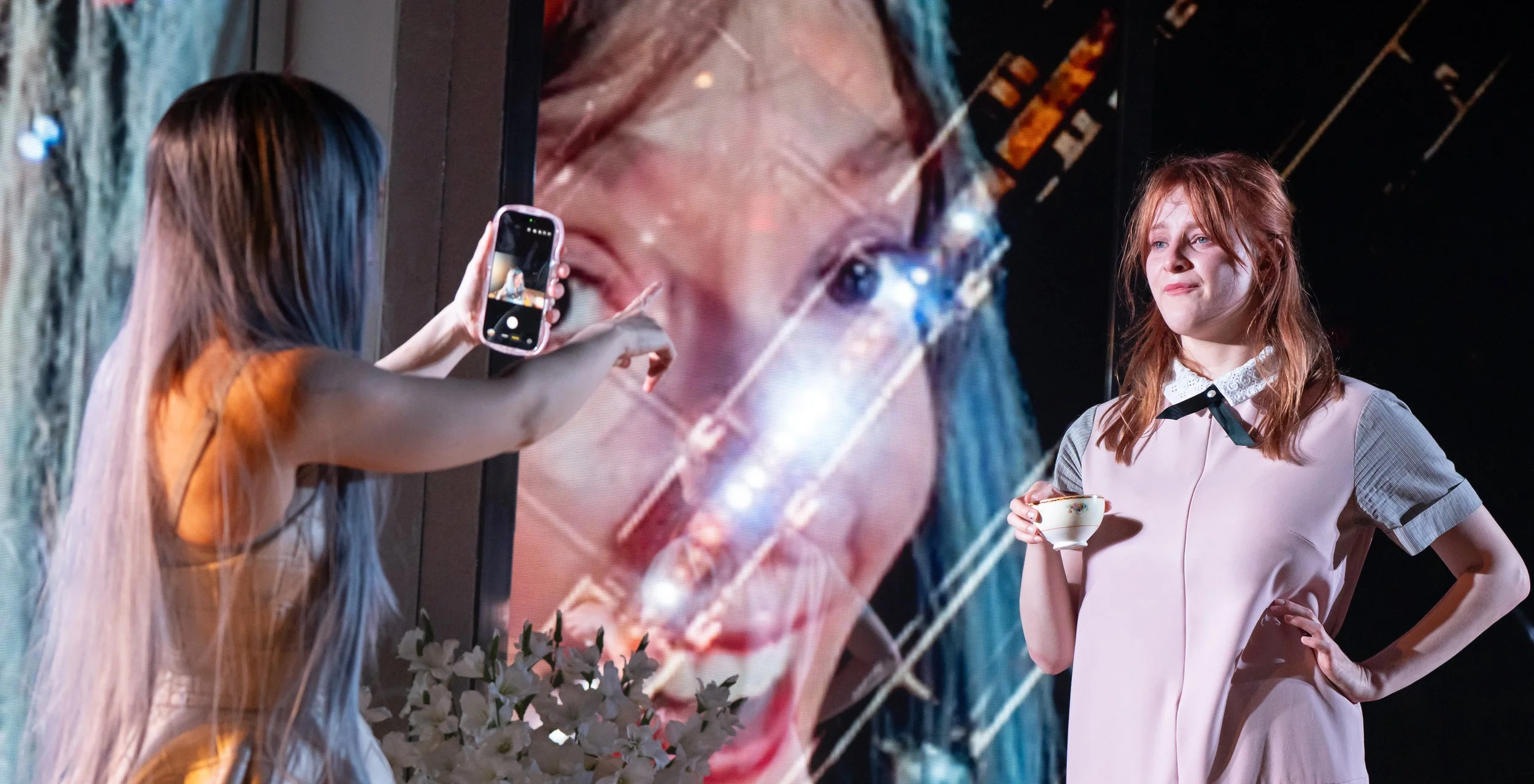
Sisters Claire (Lydia Wilson) and Solange (Phia Saban) work as maids for Madame (Yerin Ha) in Kip Williams’ social media soaked version of Jean Genet’s twisted play The Maids.
Jean Genet’s The Maids remains one of the theater’s strangest and most unsettling explorations of class, identity, fantasy, and performance. In director Kip Williams’s “new version,” Genet’s world of ritualized role-playing is transplanted into the age of Instagram filters, live-streams, and social media influencer culture—a contemporary framework that proves surprisingly well-suited to Genet’s original obsessions.
Two sisters, Solange (Phia Saban) and Claire (Lydia Wilson), work for Madame (Yerin Ha), a social media influencer and trust-fund baby, whom they both love and hate. When she is away, they take turns role-playing as Madame and each other. They dress up in her clothing, try on her wigs and shoes; each speaks in a nasty and belittling tone to the one playing servant.
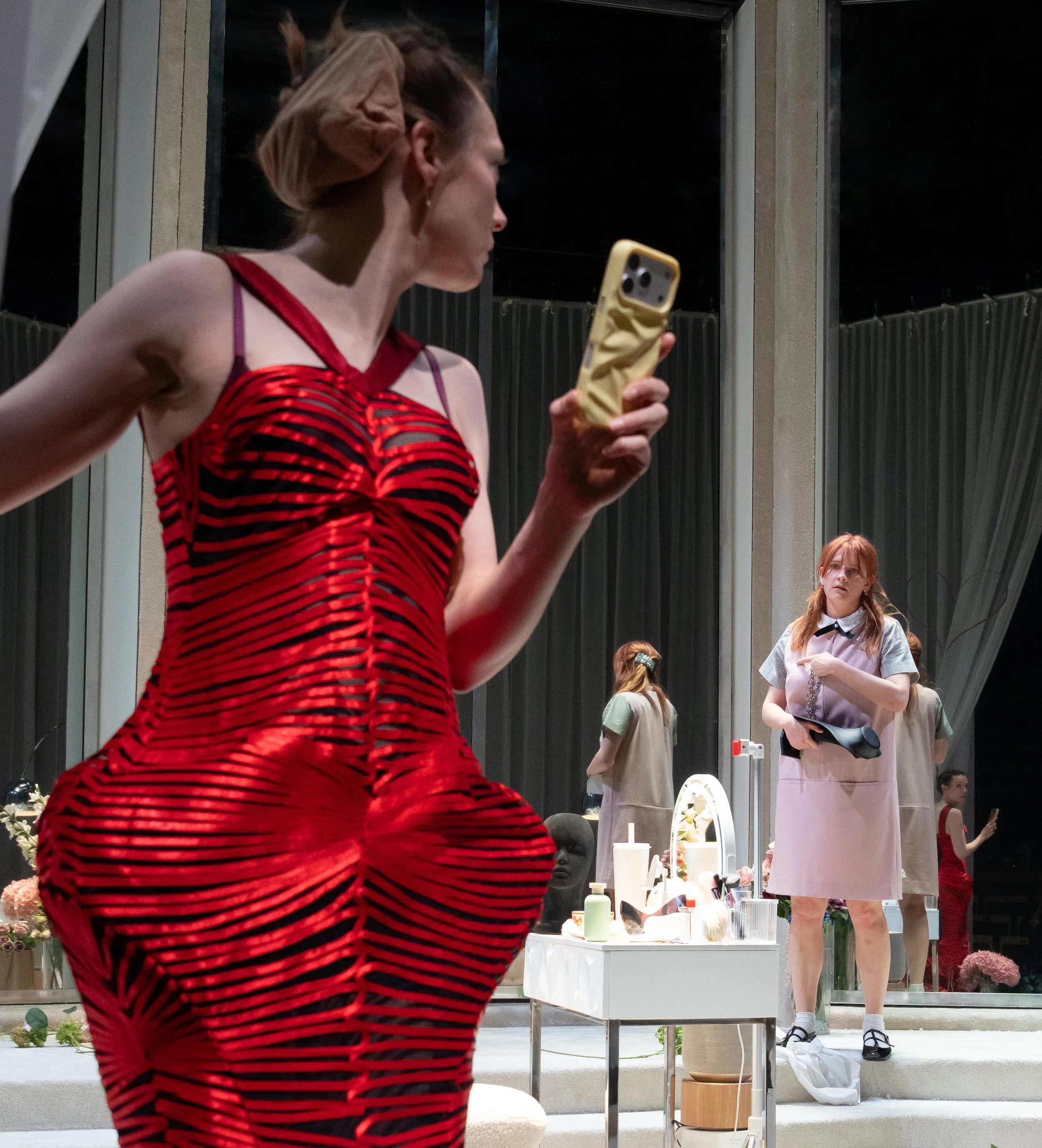
Nothing is ever perfect: Claire role-plays as the demanding Madame, while Solange plays her sister Claire.
In one scenario, Claire (as Madame) shrieks at Solange (as Claire):
No, you’re just like them. You act like you’re obsessed with me, but what you really want is to end me. Obliterate me with your disgusting little hands. No more Madame! Asphyxiate me with these disgusting flowers?
In their loathing for Madame, they want to eventually kill her, but in their role-playing, they never get there because they enjoy the charade too much:
Solange: The same thing happens every time. And it’s all your fault, you’re never ready. I can’t finish you off.
Claire: We waste too much time with the preliminaries.
Solange and Claire, thirtysomethings in Genet’s play, are aptly cast here as millennials who are as obsessed with capturing their lives on social media as Madame (in her mid-20s), their Gen-Z predecessor. They are servants to Madame but also to their Instagram fantasies. As they live-stream their role-playing, they use various filters, which give them exaggerated lips and doe eyes (video design by Zakk Hein). Another filter ages them, and yet another transforms them into images of Madame and her boyfriend to further their imagined roles.
In the preface to Genet’s original (1947), Jean-Paul Sartre wrote:
This extraordinary faking, this mad jumble of appearances, this superimposing of whirligigs which keep sending us back and forth from the true to the fake and from the fake to the true, is an infernal machine. …
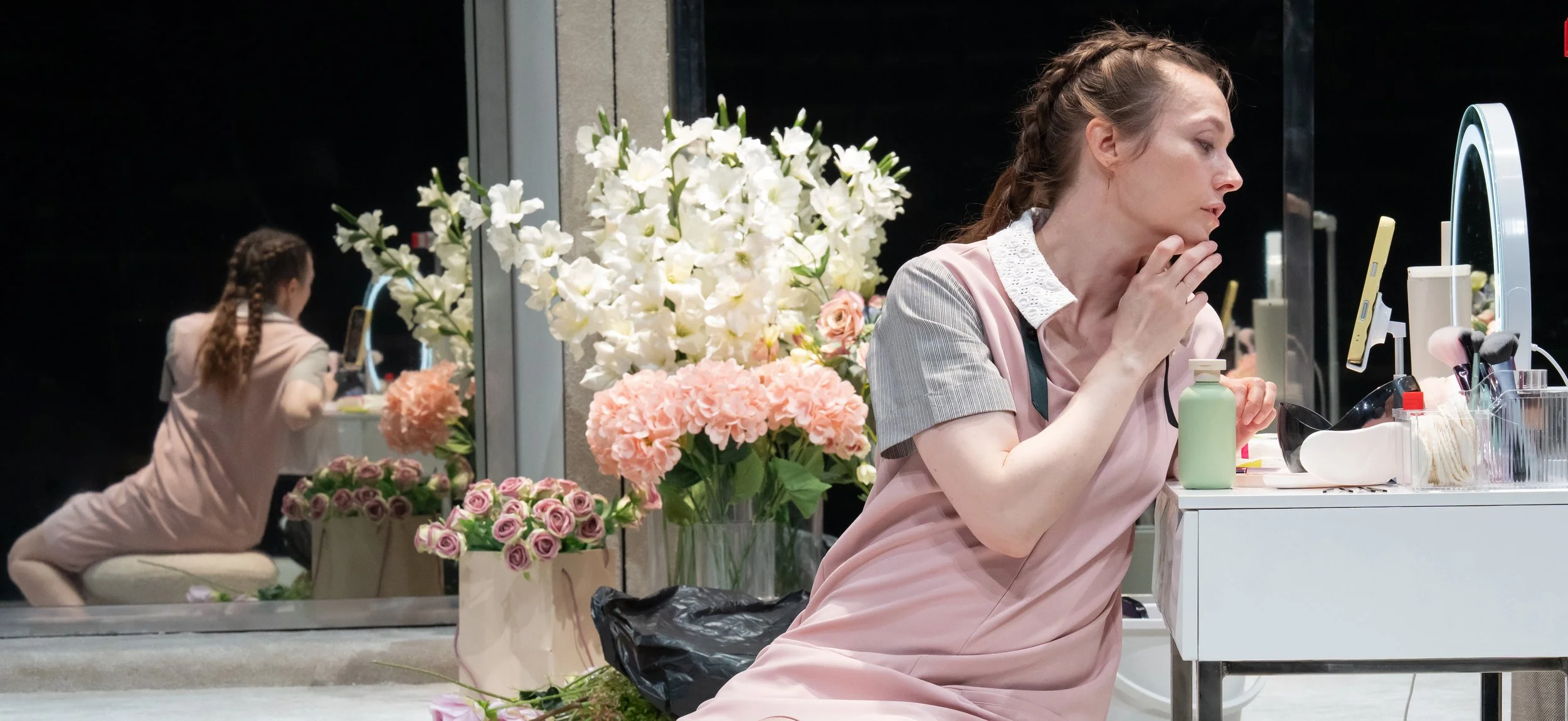
Vanity and identity are one as Claire (Wilson) tries to figure out which persona to stream next.
In Williams’s version of Genet’s work, pop and contemporary cultural references are scattered throughout: Ozempic, Uber Eats, Facebook Marketplace, dick pics, Ikea, silicon boobs, and the “ick” (a term that first appeared in the 1990s, meaning a feeling of disgust or repulsion toward a romantic partner), to further enhance the digital, bubble-wrapped world he has created.
Madame enters mid-play, in a crisis. Her boyfriend has been arrested for embezzlement (Claire has sent an anonymous tip to the police), and she is worried about being canceled. She declares, “I’m in mourning for my actual life,” and wants to know, “What’s my narrative?”
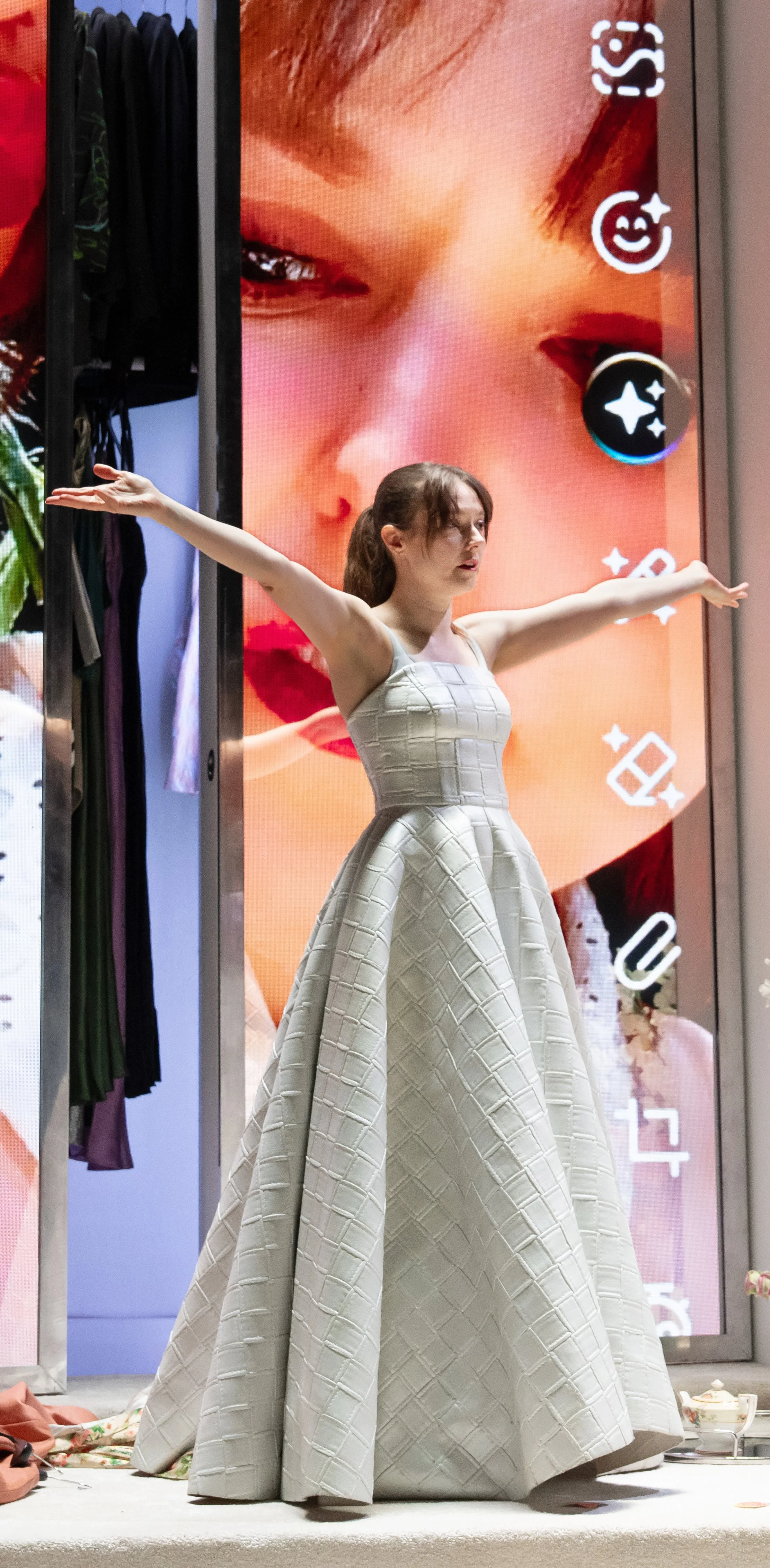
Claire is Instagram-ready as she emerges triumphant from Madame’s closet, wearing her best dress. Photographs by Julieta Cervantes.
The entire play takes place in Madame’s bedroom. The action begins behind a gauzy curtain and a stage full of flowers (set design by Rosanna Viz), creating a soft filtered division between audience and actors. Two large closets have mirrored exteriors and sliding doors where the video streams are projected in larger-than-life proportions. When the curtains eventually open, the lighting (Jon Clark) is stark, giving the production a showroom quality. Techno music pumps into the theater throughout the play (sound by Dan Balfour; music by DJ Walde).
Beneath the digital onslaught, a solitary note of truth exists in the sisters’ relationship: a genuine fear that their role-playing will spiral out of control, and that one will eliminate the other once Madame is gone:
Solange: I’m younger than you.
Claire: What’s that mean?
Solange: Stronger.
Claire: It’s me who’s in real danger, you want me gone.
The actors deliver their lines at warp speed, barely pausing for breath. Combined with the constant streaming of live video, Williams creates a claustrophobic, circus-like environment. While the characters occasionally lean into caricatures for laughs, the contemporary elements capture the true, dark spirit of Genet’s play.
Claire, increasingly unable to separate fantasy from reality, continues streaming even while attempting to hide in the back of Madame’s closet. Each filter turns more and more bizarre as she is taken on a hallucinatory journey to imagined places of escape. Solange tries to pull back but as the characters strive to live entirely for social media, they find it difficult to distinguish between their real selves and their digital identities and one another. Where does Claire end and Solange begin? And where is the rein on reality?
Direction & Adaptation (from The Maids by Jean Genet): Kip Williams
Set Designer: Rossana Viz
Costume Design: Marg Horwell
Lighting Design: Jon Clark
Sound Design: Dan Balfour
Video Design: Zakk Hein
Composer: DJ Walde
The Donmar Warehouse production of The Maids runs through June 14 at St. Ann’s Warehouse (45 Water St., Brooklyn). Evening performances are at 7:30 p.m. Tuesday through Saturday and 5 p.m. on Sunday; matinees are at 2 p.m. on Wednesday and Saturday. For tickets and additional information, visit stannswarehouse.org.
If you enjoyed this review, please click on the Like icon below.
