
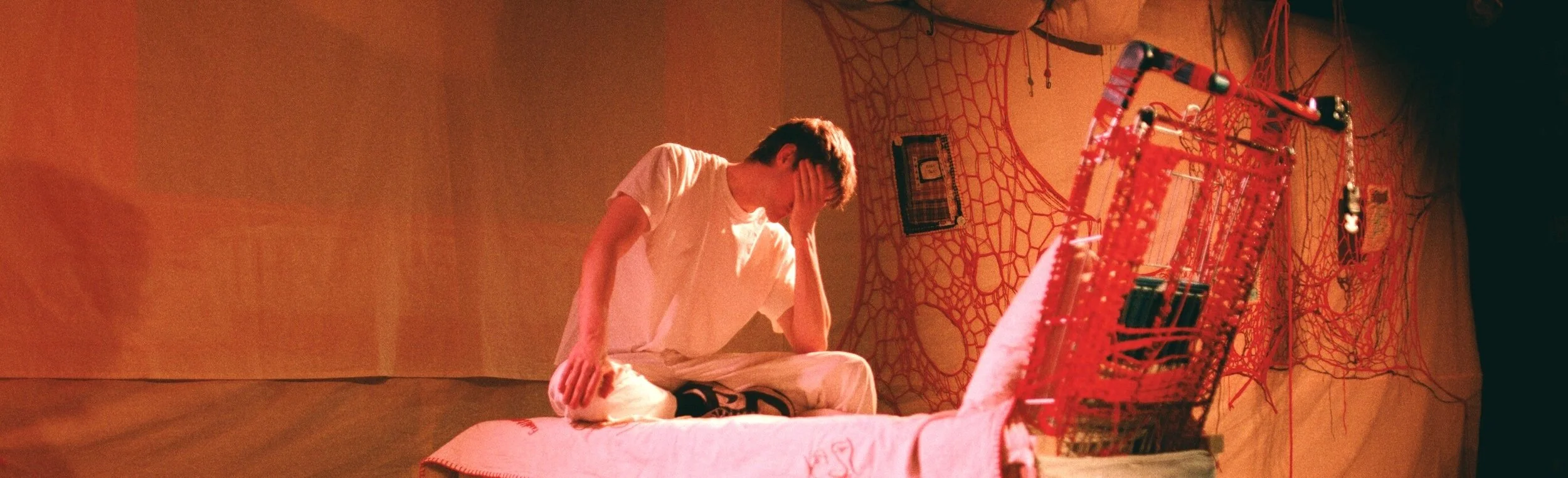
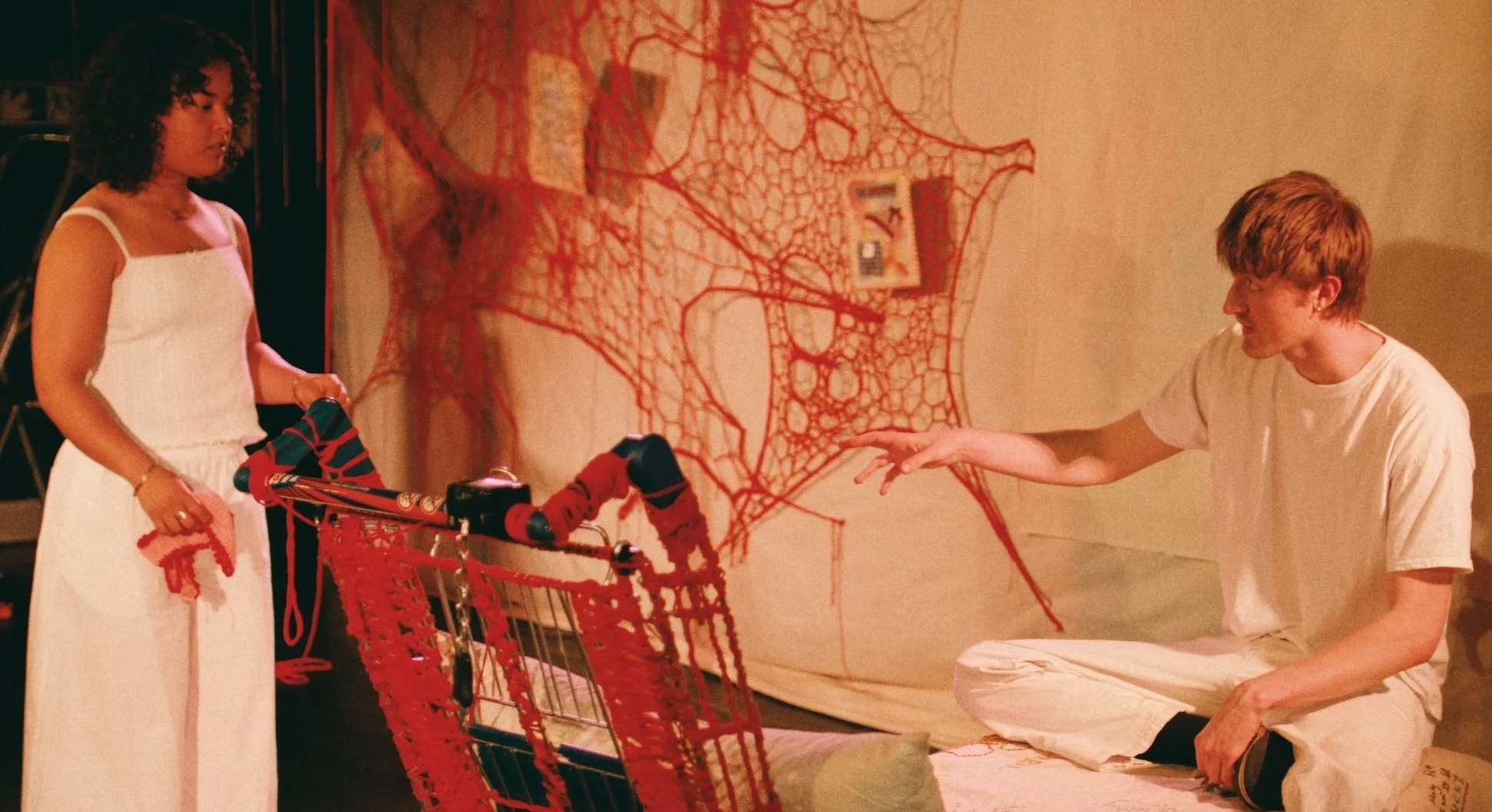
Grace (Amaia Naima Aguinaga) and Eli (Francis Nunnery) discuss their decade-long relationship in This Is Not About Me. Behind them the set design displays clues to their issues.
Hannah Caplan’s This Is Not About Me, a play about creating art, demonstrates the best aspects of collaboration: a smart script, captivating direction, immersive set design, and wonderful performances. Caplan’s dialogue crackles with wit and insight, while director Douglas Clarke-Wood allows the play’s 20-plus scenes and multiple storylines to flow beautifully. The result is a production that is joyful, funny, and a delight for both the ear and the eye.
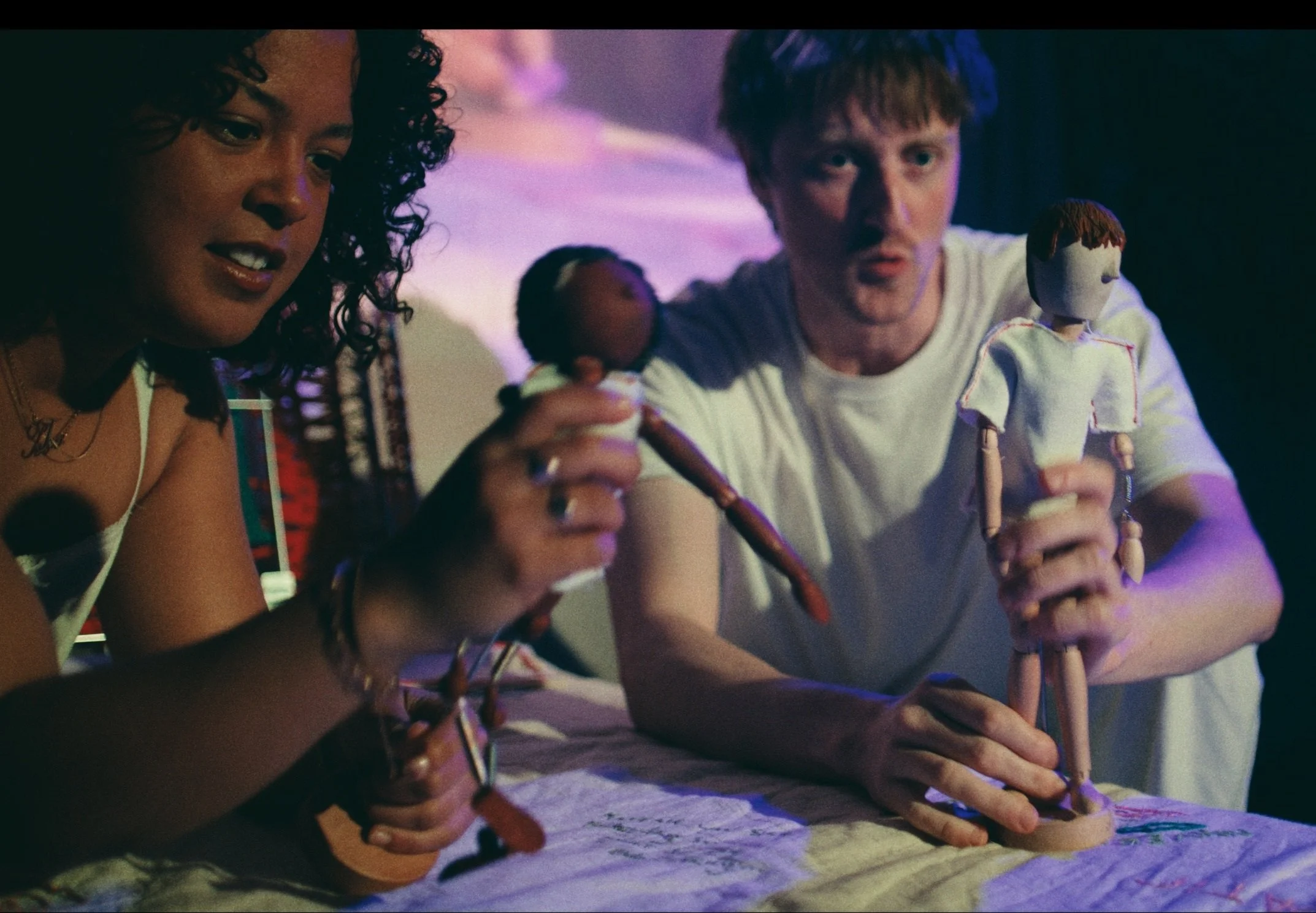
Pint-sized puppets stand in for Grace and Eli’s guarded feelings.
The play follows the decade-long relationship between two characters—Grace (Amaia Naima Aguinaga) and Eli (Francis Nunnery). Grace is writing a play that she insists is not about her. Despite her protests, however, their relationship forms the play’s narrative. The work explores both the process of creating art and the power a writer wields when transforming personal experience into narrative.
Clarke-Wood’s direction balances the script’s serious and playful rhythms while smartly illustrating the divide between the characters’ reality and the writer’s perspective. With the aid of projected text and inventive set design, scenes shift tonally from tender romantic moments to terse discussions about creative differences and personal perspectives.
Along the way, serious topics such as love, sex, truth, perspective, authenticity, accuracy, and friendship are addressed, though never without a playful attitude. Caplan’s dialogue seamlessly combines seriousness with absurdity:
They’re making me choose a skin tone for my sex toy. I am consumed by the political implications. Every option feels like the racist one.
Grace, who has been friends with Eli since they were 14 years old, emphatically states that the writer of a play defines reality, regardless of how closely inspiration for a character may resemble real life. In a scene entitled “Things We Hate About Each Other” (the words are cleverly displayed on a pillow in the scene), they evaluate each other.
Grace: The thing I hate most about Eli ... when things get too much, too close for comfort, he gets distant, shuts down, then dips. He’s so scared of abandonment that he makes sure to beat you to it.
Eli: Grace has issues with control. It’s pathological. If things don’t play out like the script in her head, she freaks out. Isolates, then goes mental.
Grace: He’s got a bit of a “nice guy syndrome.” He thinks that because he respects women, he’s incapable of hurting them. And he does respect women, and he is a nice guy. But since when does that deserve a fucking medal?
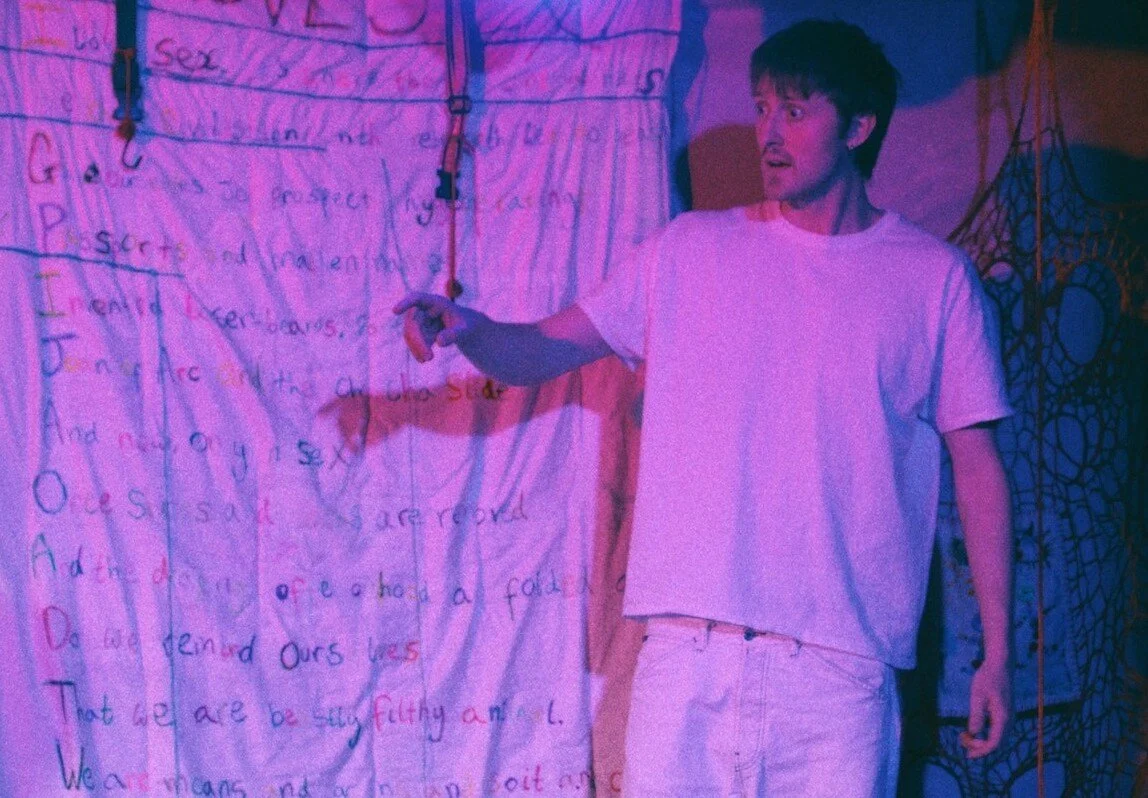
Eli asserts the belief that he is not being portrayed accurately or authentically. Photographs by Inigo Woodham-Smith.
Aguinaga delivers a magnetic performance as Grace, capturing both the character’s exuberance and her need to control the narratives around her. Nunnery provides an effective counterpoint as Eli, whose quieter reserve masks frustration, affection, and emotional uncertainty. Together, they create a believable intimacy.
Caplan’s script repeatedly returns to the distinction between reality and perception:
We had this experience together. Right there, that’s reality. Our interpretation of it is truth. Reality’s a constant, but truth—that’s up for grabs.
In addition to the compelling dynamic between Grace and Eli, Caplan and Clarke-Wood expand their collaborative vision through the production’s visual and technical design. Caplan and his co–set designer, Lolly Whitney Low, have created a kind of neural tapestry, filling the space with visual clues. Pillows, hanging yarn, projected text, and handwritten notes become extensions of Grace’s interior world.
Another pillow, embroidered with “Things We Love About Each Other,” introduces reflections on the relationship, while an unfurled comforter reveals a thought on sex:
I wish I could write anything half as honest as sex. But it keeps itself so fucking secret.
Clarke-Wood and Inigo Woodham-Smith’s video elements further enrich the staging without overwhelming it, adding variety to the production’s rapid transitions. In another example of how the creative duo slyly address serious topics like love and friendship, Grace and Eli use puppets to break emotional tension and express difficult truths through humor—as children might use puppets to talk about traumatic events with a counselor.
Caplan and Clarke-Wood have created a production that is inventive without sacrificing emotional immediacy—a funny, thoughtful, and deeply collaborative piece of theater about the fragile line between experience and the stories we tell about it.
Part of the Brits Off Broadway festival, This Is Not About Me runs through June 7 at 59E59 Theaters (59 E. 59th St.). Performances are at 7:30 p.m. Tuesday through Sunday; matinees are at 2:30 p.m. Saturday and Sunday. For tickets and additional information, visit 59e59.org.
Playwright: Hannah Caplan
Director: Douglas Clarke-Wood
Set Design: Hannah Caplan & Lolly Whitney Low
Sound Design: Danae Crawford & Jake Wood
Video Design: Douglas Clarke-Wood & Inigo Woodham-Smith
Lighting Design: Jake Wood
Puppetry: Ruby Boswell-Green & Lolly Whitney Low
