
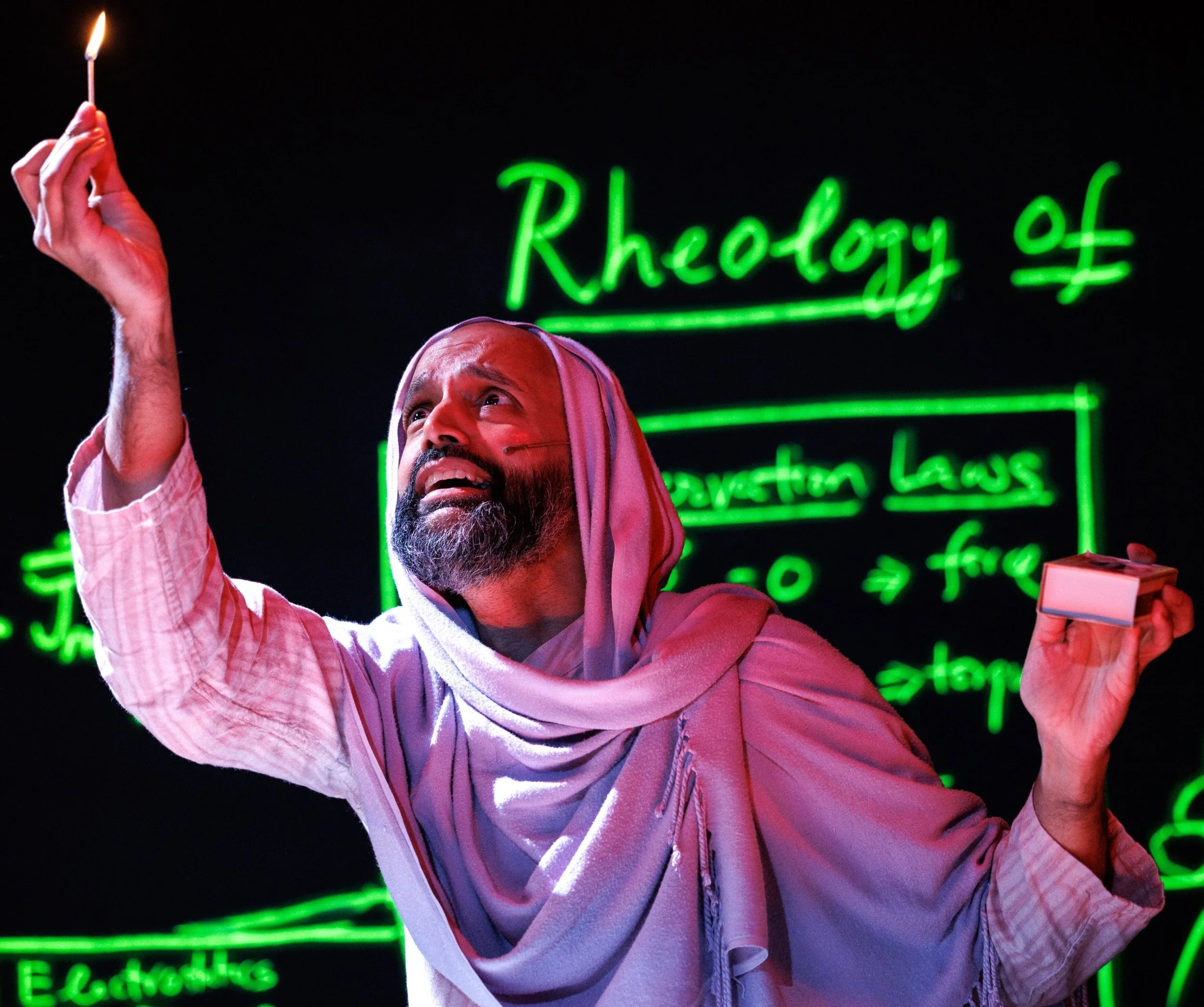
Shayok Misha Chowdhury wrote and directs Rheology, in which he undergoes exposure therapy for his fear of his mother’s death. Here he enacts his grief as though in a melodrama by Bengali playwright Rabindranath Tagore.
In Shayok Misha Chowdhury’s Rheology, now at Playwrights Horizons after a spring 2025 run at the Bushwick Starr in Brooklyn, the writer and director creates a form of exposure therapy for his consuming fear of his mother’s death by confronting the prospect directly, in performance, alongside his real-life mother, Bubul Chakraborty. She is not an actor or a theater-maker, but an acclaimed theoretical physicist and professor at Brandeis University in Massachusetts.
Rheology is framed by a physics-class setting, with a highly theatrical, whimsical meditation on death and grief in between. It takes the audience on an unconventional journey, and, though the central metaphor can feel a bit on the nose and the execution occasionally vague, the piece arrives at genuine catharsis in a moving finale.
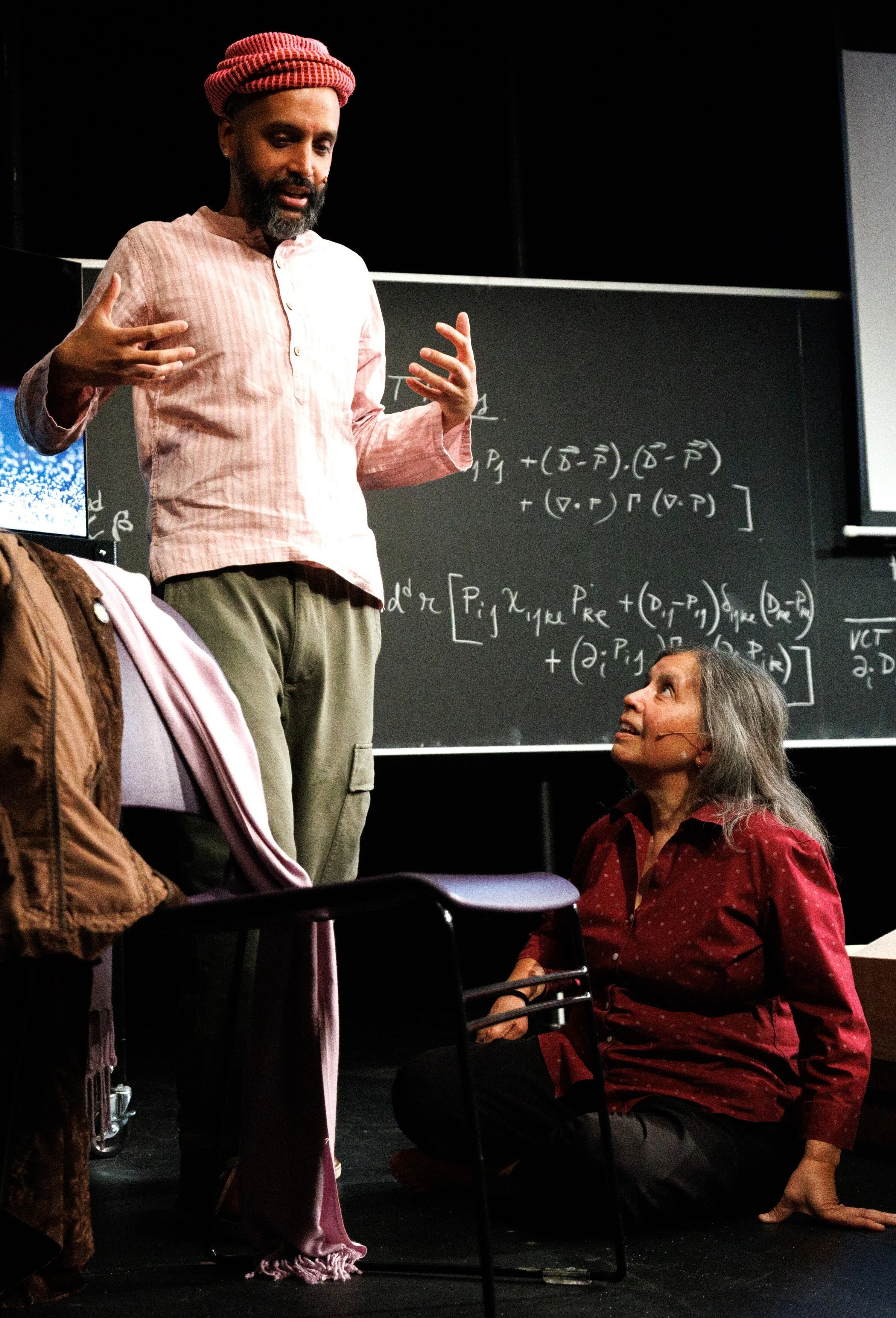
Misha and his real-life mother, Bubul Chakraborty, an acclaimed theoretical physicist, discuss her death.
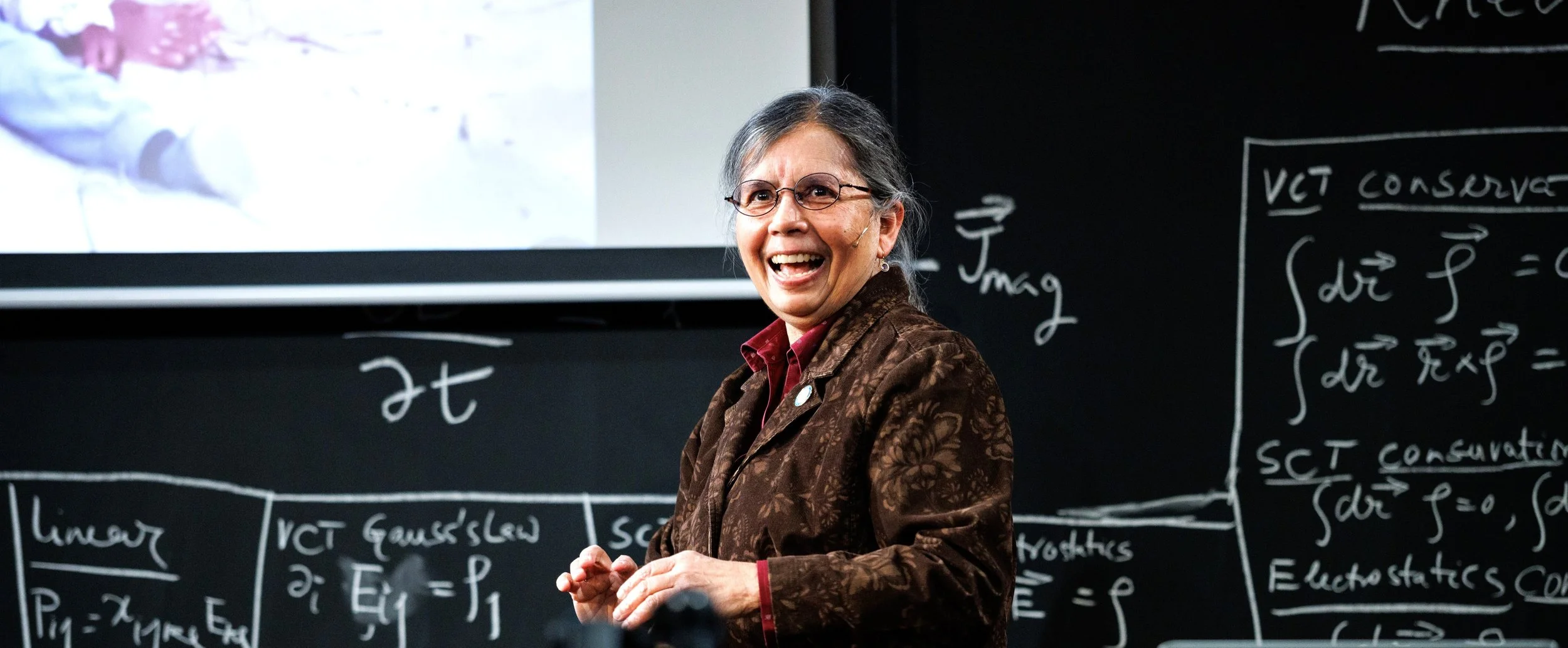
Chakraborty, as she tells the audience, has spent the last 20 years studying sand—specifically, its status as a “fragile solid” and how such substances “hold together even as they come apart from themselves.” Sand and the concept of the fragile solid are everywhere in Krit Robinson’s scenic design, which includes a sandbox placed in front of the stage-long chalkboards on which Chakraborty writes equations, as well as a table with an hourglass filled with sand, its fall magnified by a video camera onto a screen (video design by Kameron Neal).
In trying to explain the liminal status of sand, Chakraborty solicits from the audience what they think of as properties of solids and liquids. This accords with the classroom setting, but it has the potential for awkwardness—on the night I attended, a persistent, would-be authority kept interjecting until Chakraborty instructed everyone that the questions were now rhetorical.
Then something appears to go wrong—which again provoked the audience to chime in and even call out for help in one case—before being mischievously revealed as part of the show. At this point, Misha, miked up and seated in the audience, questions his mother, and then introduces himself to the audience and explains the premise of his piece—namely, that he has a phobia of his mother dying:
Whenever I’ve expressed to her that I could not in fact survive her death, my mom is like: but how do you know that, that’s not a statement of fact, that’s a hypothesis, where’s the evidence? You need to gather evidence to support your hypothesis. And I was like: how do I do that? And she was like: I thought you did experimental theater?
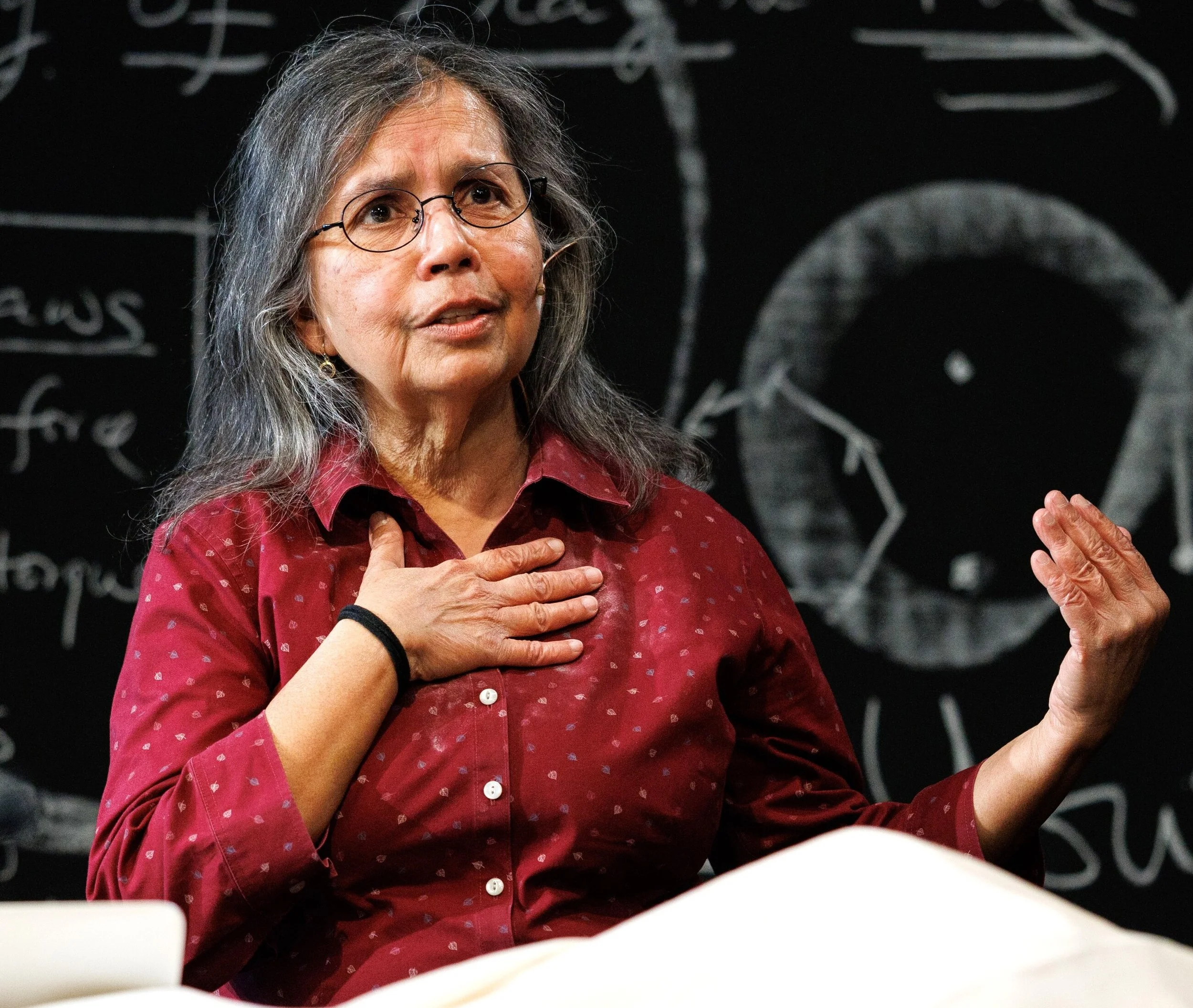
Chakraborty was the first tenured woman in the physics department at Brandeis University. The opening of Rheology takes the form of a physics class. Photographs by Maria Baranova.
Misha’s tone here is designed to sound improvisational, as are his instructions and questions to his mother, but the whole thing is carefully choreographed, with the only improvisation required, presumably, resulting from audience participation early on. With the quasi-lecture opening and “tricking” the audience, he seems interested in the nature of theatrical illusion itself, and how an audience’s readiness to buy into that illusion depends so much on the presentation—if the house lights are up, are we not in the play yet?
When the play segues into the exploration of Chakraborty’s death, or, rather, Misha’s reaction to that death, the more explicitly theatrical it gets: house lights down, the cellist George Crotty offering accompaniment, the blackboard transformed into something luminous and glowing.
Misha invokes melodramas by the Bengali playwright and Nobel laureate Rabindranath Tagore, and they act out Chakraborty’s death in this vein, using both English and Bengali (with supertitles), the classroom table now a deathbed, with Misha lying next to his mother. Misha reverts to a childhood self, and finds humor in the exaggerated, high melodramatic mode. At one point he dons pajamas and uncovers a skeleton in the sandbox and then reenacts the deathbed scene with it.
Eventually Chakraborty takes control of the narrative again: house lights up, physics professor back in action. First she discusses her own mother and her mother’s death, and then, drawing on the analogy of sand and fragile matter, she offers a final hypothesis to Misha, to test once she is gone. She also at this point defines the title of the play: “Rheology is the science of how matter responds to external stresses, and fragile matter has its own distinct rheology.”
Chowdhury’s play ultimately offers what its title suggests: a theory of how we might hold together when we’re seemingly falling apart—and a hypothesis, at least, that we do.
Rheology runs through May 29 at Playwrights Horizons (416 West 42nd St.). Evening performances are at 7 p.m. Monday, Tuesday, and Friday; matinees are at 2 p.m. Saturday. For tickets and more information, visit playwrightshorizons.org.
Playwright & Director: Shayok Misha Chowdhury
Scenic Design: Krit Robinson
Costume Design: Enver Chakartash
Lighting Design: Masha Tsimring & Mextly Couzin
Sound Design: Tei Blow
Video Design: Kameron Neal
Music Director & Cello: George Crotty
