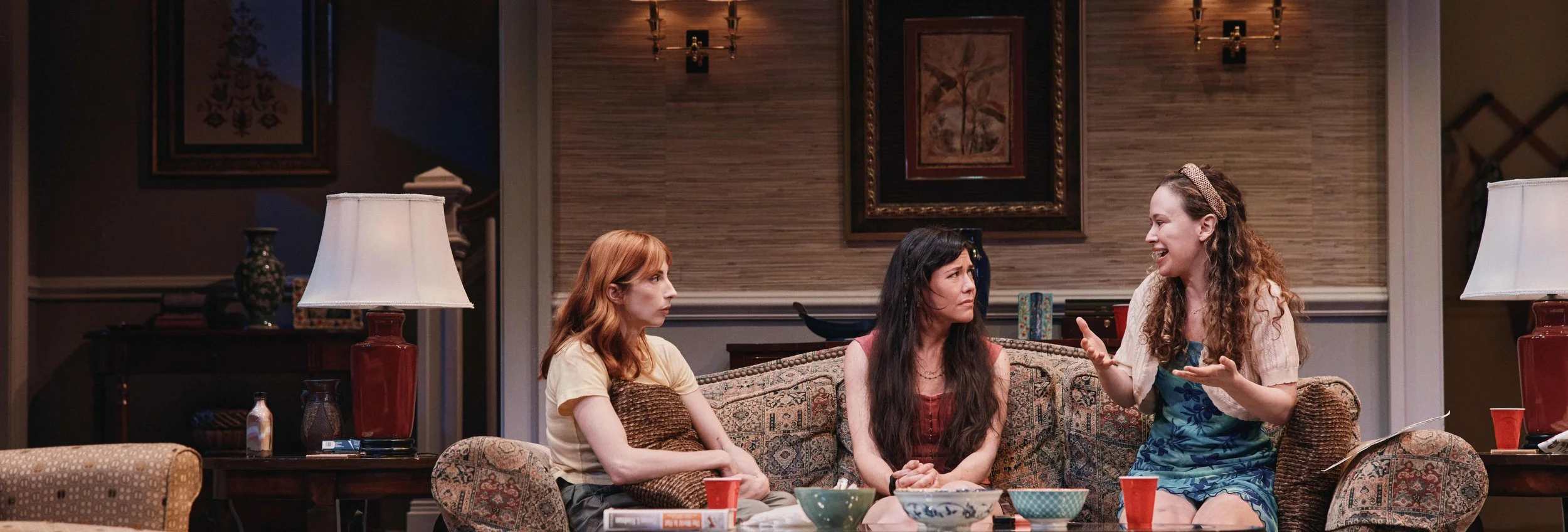
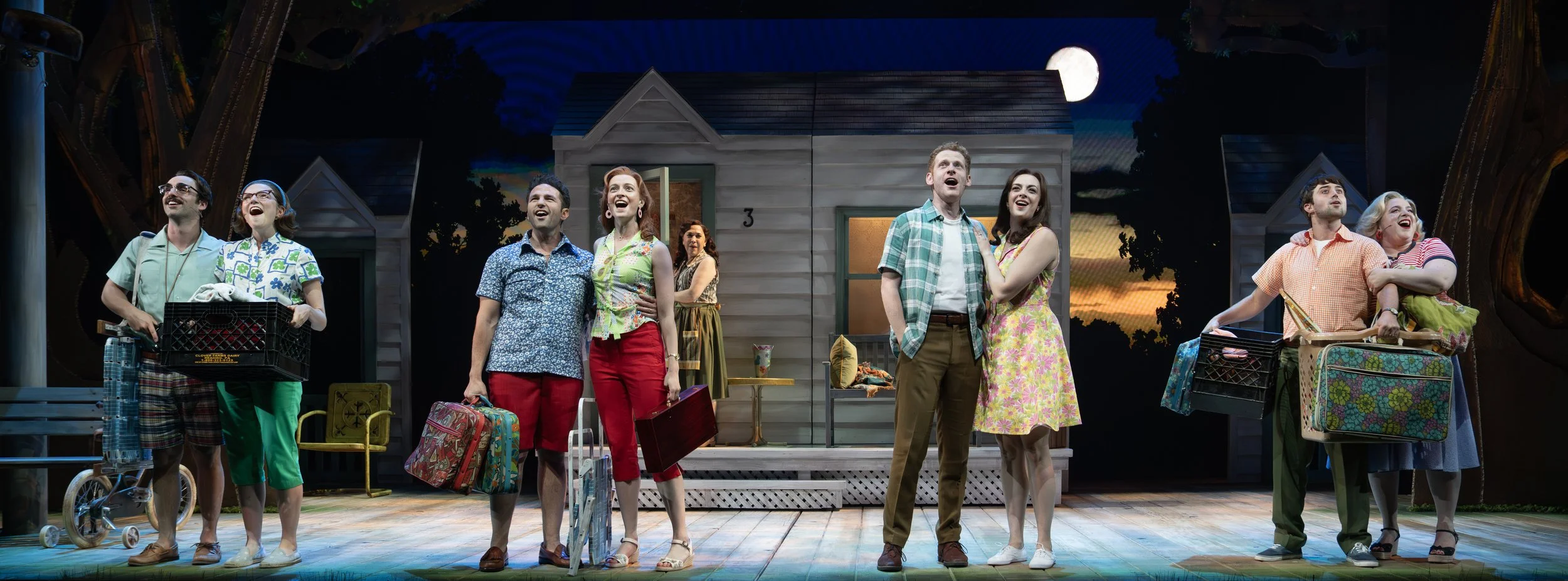
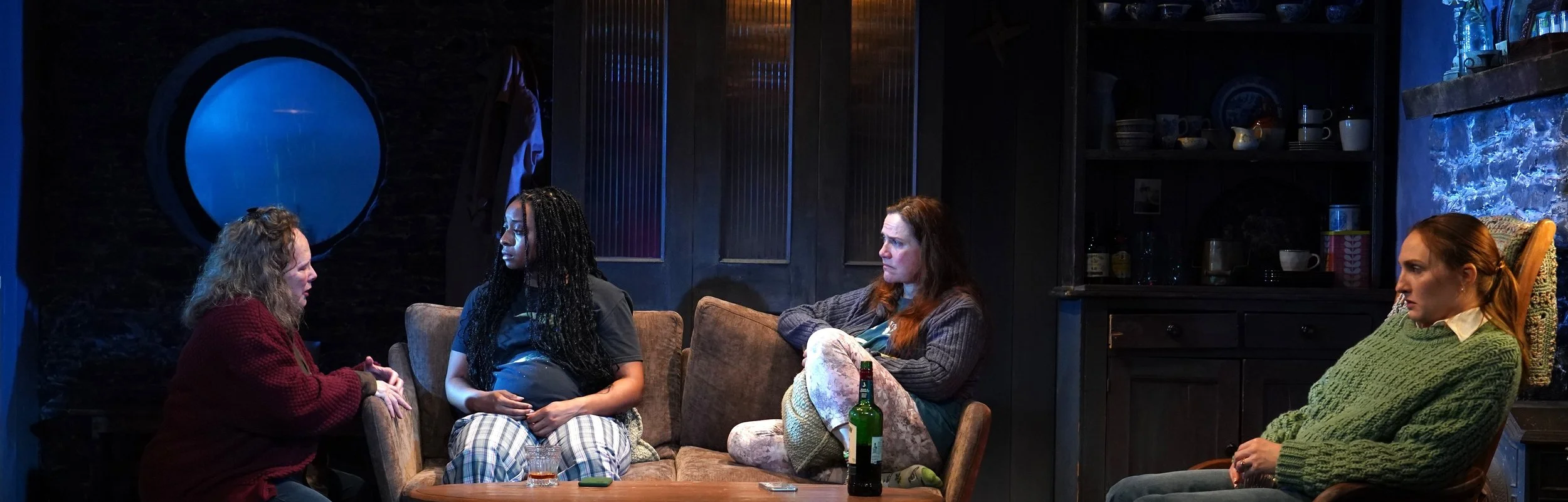
Paris Is Yearning

Founded in 2006 by director and choreographer Austin McCormick, Company XIV has developed a signature fusion of theater, classical and modern dance, opera, drag, circus, live music, burlesque, and performance art. The title of its latest creation, Paris, is a double entendre of sorts—referring at once to the beloved City of Light as well as the legendary prince of Troy. Indeed, Paris unites Grecian gods and goddesses with Parisian flâneurs and can-can girls, resulting in an indulgent, adults-only revue of sublime talent. 

Click for print friendly PDF version of this blog post

Who’s the Fool?

There are only so many ways to describe the Jessica Scott's avant-garde Ship of Fools, currently at HERE Arts Center. On the one hand, it is a unique combination of original music, puppetry, video, and live action, yet on the other it comes across as disjointed and meaningless—imagine Disney’s “It’s a Small World” born in the 1960s Haight-Ashbury. The audience is seated on a platform that moves left or right, and sometimes rotates completely, giving the performers time to set up the next vignette on the perimeter. 

Click for print friendly PDF version of this blog post

Consequences of Our Actions

Can a trial change history?  What happens when standards of behavior are violated and not brought to public reckoning? The Trial of an American President is a courtroom drama of a trial that will never take place, of legal arguments that will not be made, and finally, of a verdict that will also not happen, except perhaps in the court of public opinion, if the writer has his way 

Click for print friendly PDF version of this blog post

A Classic Comedy Conquest

Playwright Oliver Goldsmith found fame with his play She Stoops to Conquer in 1773, despite his rather unfashionable social reputation among London’s upper crust. Indeed, Goldsmith made it his life’s work to go against the grain, and She Stoops to Conquer exemplifies his disdain for Sentimental Comedy—a genre that was en vogue in the first part of the 18th century. Those saccharine works featured one-dimensional characters whose apotheosis was meant to instill what Sentimental playwright Richard Steele haughtily deemed “a joy too exquisite for laughter.” Cynthia Darlow as Mrs. Hardcastle and Richard Thierot as the trickster Tony Lumpkin. Top, from left: Jeremy Beck plays Marlow, Tony Roach is Hastings, and Thierot.

Goldsmith, on the other hand, was a champion of hearty laughter, which this play—when produced well—can stir up in droves. Compared to Sentimental characters, Goldsmith’s characters are imperfect, and therein likable. The Actors Company Theatre (TACT) is staging a slightly imperfect (and therein quite likable) production of Goldsmith’s important play, directed and adapted by Scott Alan Evans. The moments when this production shines most are when it is faithful to Goldsmith’s unique genre of “laughing comedy,” aimed to elicit belly laughs with physical ridiculousness and silly twists of plot.

She Stoops to Conquer presents a bouquet of delightful characters—two eligible ingénues, a couple of bachelors from the city, and a pair of meddling parents—all of whom are subject to the playful deceits of the puckish Tony Lumpkin (Richard Thieriot). The action takes place at Mr. and Mrs. Hardcastle’s estate in the English countryside. Their daughter Kate (Mairin Lee) and their ward, Constance Neville (Justine Salata), are excited to receive two handsome young suitors (Charles Marlow and George Hastings, played by Jeremy Beck and Tony Roach) at the estate that evening.

Tony, who also happens to be Kate’s illegitimate brother, foils the plan when he intercepts the suitors at the village pub. Wanting to free himself of his mutually undesired betrothal to Constance, Tony concocts some of his signature meddling. Bringing the suitors to the estate, Tony leads them to believe that they are staying a night at an inn—and that the elder Hardcastles are actually innkeepers. This creates room for Kate, disguised as a barmaid, to woo the painfully shy Marlow, and for her cousin Constance to pursue her true love Hastings.

Hastings (Roach) attempts to woo Kate Hardcastle (Mairin xombeody). Photos by some to come.

Overall, the cast seems to enjoy themselves in this genre. Thieriot as Tony absolutely sparkles with his mix of conniving wit and lowbrow buffoonery. As his bumbling parents, Cynthia Darlow and John Rothman are adorably befuddled by their son’s antics. Things really get good after intermission, in which Tony sends his enraged mother and Constance on a 40-mile carriage ride to nowhere, and Mr. Hardcastle finally snaps after being treated like the help in his own home. The two sets of young lovers deserve even more spice, however, especially in light of their comic counterparts; perhaps that could be created with more emphasis on physical humor rather than delivery of language.

One distinct aspect of this production is its intermittent puncturing of the fourth wall. Evans’s direction leans heavily on this device, employing a considerable amount of direct audience interaction and unmasking of the usual theatrical dressings. For example, there is no backdrop to hide the actors as they await their entrances. Instead, they are visibly seated in two rows of chairs on either side of the stage, which is a raised platform. Admittedly, Goldsmith's original script contains plenty of asides—monologues that characters deliver directly to the audience—but by stripping the stage bare, Evans’s adaptation carries the meta-theater several steps further. The bits of audience interaction between scenes undermine the actors’ comic choices and interrupt the flow and style of the play. All in all, however, this nontraditional choice does not sink the production, which provides both a fun night at the theater as well as an opportunity to experience one of England’s most important and beloved plays.

TACT’s She Stoops to Conquer plays at the Clurman Theatre at Theatre Row (410 West 42nd Street between Ninth and Tenth avenues) until Nov. 5. Tickets are available online here or by calling the TACT Member Hotline at (212) 560-2184 or (212) 947-8844.

Click for print friendly PDF version of this blog post

Ibsen as Detox

When newspaper editor Hovstad cries, "We must destroy this myth that our leaders are infallible," in the rousing performance of Public Enemy at the Pearl Theatre Company, the audience titters and sighs. That same day, the Washington Post had released a tape of presidential nominee Donald Trump making extremely lewd remarks about women. With Trump's words ringing in the collective consciousness of the audience, playwright David Harrower's adaptation of Henrik Ibsen's 1882 play An Enemy of the People has transposed an almost 150-year-old story about small-town bureaucracy to the higher, tenser key of our present-day political landscape. That is not to say that Public Enemy is toxic, exhausting or anything like the American political process has been this past year. On the contrary, it rejuvenates the public with an eloquent tale of justice and ambition. From left: John Keating as Aslasken, Jimonn Cole as Thomas Stockman and Alex Purcell as Billing. Top: Jones with Jimonn Cole as his brother Peter. Photos by Russ Rowland.

Director Hal Brooks, who is artistic director of the Pearl, has confirmed the company's commitment to showcasing incisive, relevant classical theater with Harrower's masterly take on one of the Norwegian playwright's lesser-known plays. Written as a biting response to critics, whose moralistic reviews he despised, Ibsen deliberately set out to magnify the hypocrisy of human nature, and how it is writ especially large in political processes. He chooses to place his little human drama in a fairly provincial town, where the family of Dr. Thomas Stockmann (Jimmon Cole) and his wife (Nilaja Sun) is enjoying a life of newly-found comfort—they're on the upswing after some hard financial times.

Also in the mix are the Stockmanns' friends: fiery newspapermen Hovstad (Robert Tann) and Billing (Alex Purcell), and world-weary sailor Horster (Carol Schultz). Thomas's brother, Peter (Guiesseppe Jones), is the disciplined, severe, and fastidious mayor of the town; in short, he is nothing like his open, intellectual and charismatic brother. When Thomas discovers that the town's famous baths are swimming with lethal bacteria, and that Peter is attempting to cover up the discovery with threats against his security and his family, Thomas is forced to decide between standing by his ideals as a physician, or enveloping himself in willful ignorance.

Cole has an easy, eager charisma about him. It's part of what makes Stockmann's character the Messianic figure in his small town. His truth-seeking is admirable, and recalls Bernie Sanders' inspiring messages, but Stockmann is more interesting than his real-life counterpart. For one thing, he is scaled down to fit the stuffy intimacy of a small town (scenic designer Harry Feiner has built a subdued, wooden interior for the Stockmanns’ home, while costumer Barbara A. Bell elegantly signifies the passage of time with the wear and tear of the characters' clothes). Cole does not scale down his part, however: with his sonorous voice and endearingly bitter humor, he renders Stockmann larger than life.

From left: xxxx as Akslasken, Cole as Thomas Stockmann, and Nilaja Sun as Mrs. Stockmann.

His brother the mayor, played by Jones, is a blustering, up-for-the-challenge sparring partner. Fastidious and severe, Peter raises the hackles of more than one “reformist,” namely Hovstad and Billing. Their personalities knot up nicely toward the latter half of the play, as does Arielle Goldman's Petra, the Stockmanns' daughter, a teacher. John Keating, who plays a businessman called Aslasken, is a particular revelation in his studied impression of a fickle everyman.

There is an unending tension between the authority and the reformist in Brooks's conception of Ibsen's play. Within this tension, however, is a complexity difficult to explore on stage: the variable nature of truth. Do we seek truth from our authority figures—policemen, politicians, councils of elders—or do we seek it from the reformers—journalists, leaders of movements, and the common man? When the disgraced Roman politician-turned-farmer Cincinnatus was called to serve as Rome's dictator during a period of social strife, he became a paragon of civic virtue when he resigned immediately after peace was restored, and picked up the plow again.

In An Enemy of the People, Ibsen quietly acknowledges that our most beloved leaders are impossible contradictions: they are both the authority and the reformist, both the leader and the common man. Harrower elegantly exposes Ibsen's sadder, but less delusional reality—that while we seek the truth of the reformer (Thomas Stockmann), we give way to fear and accept the truth of the authority (Peter Stockmann). Let's hope our current political theater, with all its muddy truths and maniacal lust for power, takes a note out of Brooks' precise, magnetic production of Ibsen's timely play.

Performances of Public Enemy run through Nov. 6 at the Pearl Theatre (555 West 42nd St.). Tickets are $69-$99 and may be purchased by calling (212) 563-9261 or visiting pearltheatre.org.

Click for print friendly PDF version of this blog post

One Man’s Treasure

As the saying goes, “One man’s trash is another man’s treasure.” So it is in Storage Locker, a black satire riffing on A&E’s reality show Storage Wars. Written by Jeff Stolzer, the play is often quite funny, with expressive banter between a husband and wife who secure the winning bid on an abandoned storage unit. Stolzer is a clever writer. In Storage Locker he develops interesting and layered characters, intricately weaving them into shifts in time. Bryn Packard and Nicole Betancourt, who play the husband and wife, deliver the dialogue with velocity of a couple that have been together for awhile. Stolzer easily takes them from ridiculing each other to playful and loving in a blink. Betancourt is smart and sassy, a diminutive “spitfire” to Packard’s “I’m the provider, I make the decisions” husband. They are believable and engaging.

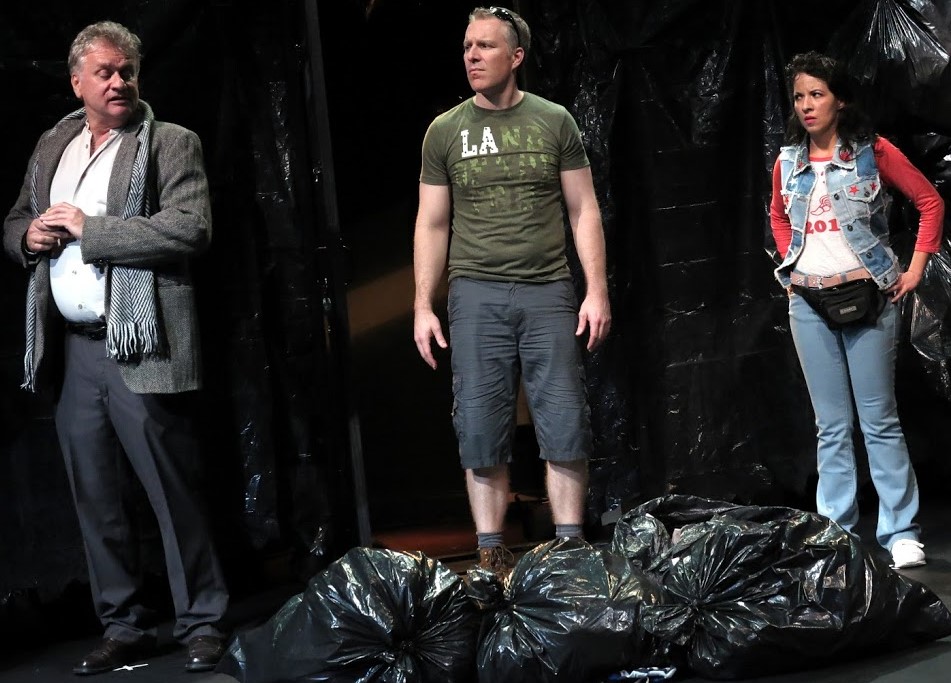
Bryn Packard (left) and Nicole Betancourt star in "Storage Locker." Top: Packard and Betancourt square off as David Crommett looks on. Photographs by Jonathan Slaff.

Director Julián Mesri invests the script with a tempo that draws the audience in. With a video camera on a tripod and monitor, soon enough it becomes evident that the pieces of masking tape on the floor are marks to make sure the actors are in the sight line of the camera for television production. Reality television has little to do with reality, after all. Here, the audience is inventively caught between observing the actors on stage and through the monitor. Betancourt and Packard have a great time playing to the camera; their chemistry is contagious. Mesri’s use of the stage, including the sound booth and emergency stairwell, as well as video camera equipment, helps creates a comic romp through one man’s trash.

Also watching the monitor is an older man seated with his back to the audience. He fiddles with a Rubik’s Cube. In time, the older man (David Crommett) enters the fray, wanting to purchase the storage unit from the husband and wife. He claims he was late to the auction because of a doctor’s appointment. Crommett plays the character in the manner of a master manipulator. He toys with both the husband and wife, luring one with his tales of woe and the other with the wisdom he has developed over 30 years of choosing which storage units pay off. That might be a Picasso behind the trunk. Again, the fun of Mesri’s direction is watching the actors running to the sound booth as if to engage the television producers for direction or utilizing the camera as a handheld and chasing the old man.

From left, Crommett, Packard and Betancourt in "Storage Locker."

Stolzer’s script, with an ample amount of intrigue, and Mesri’s keen staging keep everything moving smoothly until the last five minutes, when it all just sputters. Oddly, with everything that’s going for it, the play devolves at the very end into a confusing “fade to black” puddle. Even the actors, who until this point were spot on, appear lost. Throughout the play the storyline arches and pulls back, reels and sways, and then, suddenly, it’s as if someone lost the last two pages of the script—65 minutes of witticisms, laughter, cajoling, and get-rich-quick banter followed by five minutes of “What just happened?”

The set design by Warren Stiles looks all wrong, and a simple site visit to Gotham Mini Storage should have been required. Instead of a storage facility of cement hallways and orange metal roll-up doors, there is only black plastic sheeting, ragged at the bottom where it doesn’t come completely to the floor and light seeps under. Trash bags the characters pull from the storage unit that are supposedly filled with 50 pieces of clothing are kicked around as if they are filled with crumpled paper.

The lighting by Miguel Valderrama appears to toy with the otherworldly, in a Twilight Zone manner, but falls just a bit short. Most likely his efforts would have paid off with an appropriate set, but how does one light a misstep? Director Mesri put together an interesting original score, which included excerpts from Leos Janáček’s first and second string quartets.

Storage Locker is a perfect example of why small theaters are one of the best “play-grounds” for makers of theater. Playwrights get to test their writing skills, directors hone their craft, and actors perfect character development—all for the pleasure of the audience, which gets to bear witness to the creative process. For 65 minutes, or 92% of the time, Storage Locker and its quirky, delicious contents deliver.

Storage Locker can be seen at 8 p.m. Thursdays through Saturdays and at 3 p.m. Sundays through Oct. 30 at IATI Theater (64 East 4th St., between Bowery and Second Avenue). The running time is 70 minutes. Tickets are $30; students and seniors $25. For more information and to purchase tickets visit iatitheater.org/programs/detail/storagelocker.

Click for print friendly PDF version of this blog post

Grin and Beer It!

A Brief History of Beerbegins, quite appropriately, by inviting the audience to drink beer. This is not an average toast, however, as the audience is encouraged to really taste the beer—exploring its effervescence, hoppiness, and temperature. Thus begins William Glenn and Trish Parry’s wacky journey through time and space to simultaneously delve into the origins of beer and save it from some unspecified nefarious threat. Despite the plot’s silliness, Glenn and Parry are charming to watch under Jeffrey Mayhew’s direction as they wholeheartedly commit to the ridiculousness of their show.

Click for print friendly PDF version of this blog post

Night of Reckoning

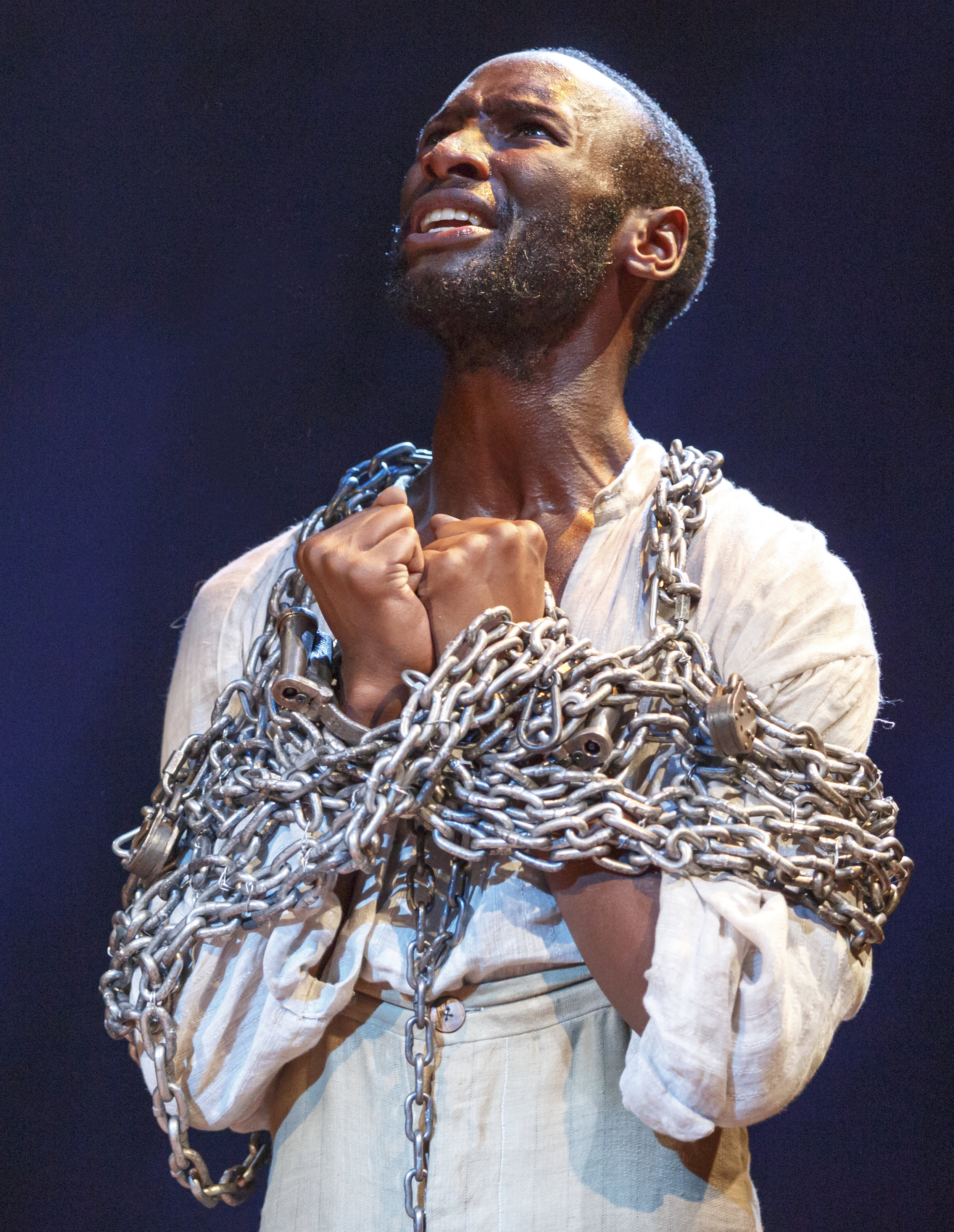
Nat Turner seems to be the historical figure of the moment. He is the subject of the controversial film The Birth of a Nation as well as Nathan Alan Davis’s new play Nat Turner in Jerusalem. Whether the two works mark a resurgence of interest in Turner—William Styron won a Pulitzer Prize back in 1967 for his novel about the slave who led a bloody rebellion, The Confessions of Nat Turner—is uncertain. Davis has a narrower focus: the last night Turner spent in jail, as he receives alternating visits from his prison guard and the chronicler of his deeds, Thomas Gray. Phillip James Brannon plays Nat Turner on the night before his hanging, in "Nat Turner in Jerusalem" at the New York Theatre Workshop. Top: Turner receives a visit from his chronicler, Thomas Gray (Rowan Vickers).

Working with a small canvas—only two actors, one of whom plays two roles—Davis paints a portrait of a prophet of sorts. (The Biblical overtone suggested by the title is appropriate to the play, although the Jerusalem was in Virginia, where Turner was hanged.) Davis’s protagonist is a generally mild-mannered former preacher, as the historical Turner was; he had been taught to read the Bible, but not allowed to read anything else. He became a pastor to the slaves, and a leader. During a monthlong uprising that he led beginning in August 1831, he managed to enlist other slaves to his cause, and they killed 12 men, 19 women and 24 children. Davis makes it clear that the deaths of the last were horrifying and inexcusable—one child was thrown headless into a fireplace to burn.

In spite of Davis’s early forthrightness about the horrors Turner perpetrated, the character, played with passion and philosophical nuance by Phillip James Brannon, gradually emerges as something of an Old Testament prophet of vengeance, imbued with a righteousness that some may find uncomfortable. It is perhaps the only way Turner’s story can be made understandable and receive any feeling akin to empathy, but it’s a subtle canonization at odds with his butchery.

There are intimations of the New Testament as well, as if Turner is also Christ-like. His chronicler Thomas Gray, whom Turner calls “Doubting Thomas,” refers to an episode “wherein you claim…to have spent thirty days alone in the wilderness.” The dual-edged reference is to Turner’s escaping capture for a month as much as to Christ’s 30 days in the wilderness. The Guard (Rowan Vickers plays both, but fares better as the Guard) shares bread with Turner. And echoes of Peter denying Christ arise in the Guard’s attempt to backpedal from a commitment he made to attend Turner’s hanging so the prisoner will spy a friendly face. (Davis’s notion that blacks will attend the hanging is a miscalculation, surely; given the recent slaughter of blacks in retaliation, it’s a stretch to believe they would gather at the gallows or that the white populace would permit them to assemble at such an incendiary event.)

The duologues Davis has devised between Turner and his two visitors are engaging and often eloquent. Turner declares, “It is Negro women, servants in wealthy houses who feed and nurture children like your daughter. Women whose own children may be snatched from them at any time and sent God knows where.”

Gray and Turner talk about his rebellion. Photos by Joan Marcus.

Yet occasional moments ring false. Gray, considering a whale-oil lamp, says he feels “melancholy for the whales.... Sometimes I worry that there’s a limit. That one day there won’t be any whales left.” The sentiment might have been lifted from a recent Sierra Club press release on global warming. An example of Turner’s wit is also awkward. “Few men aspire to be the guards of prisoners,” he tells Gray in reporting a conversation with his guard. “It is little better than being a prisoner oneself. I said to one of the guards the other day, ‘Which one of us is on the wrong side of the bars? Which one of us is the real captive?’” It’s a sentiment that might be drawn from 1960s movies like King of Hearts or Cool Hand Luke.

Credibility aside, the production by Megan Sandberg-Zakian is deftly pared down and engaging, and Davis’s poetic language is given full weight. The only décor of the play, which is staged in traverse, is two large abstract paintings in gray and black, with hints of dull yellow and blue, and a platform that moves, scene by scene, from one side of the central stage to the other (the scenic design is by Susan Zeeman Rogers). An irritating loud-rock score (sound is by Nathan Leigh), akin to the pounding noise Neil LaBute used in The Shape of Things (2001), will drive you batty if you arrive too early—that is to say, more than 30 seconds before the play begins. At least what follows is, with whatever flaws it has, much more palatable.

Nat Turner in Jerusalem runs through Oct. 16 at the New York Theatre Workshop (79 E. 4th St.). Evening performances are at 7 p.m. Tuesday, Wednesday and Sunday; and at 8 p.m. Thursday, Friday and Saturday. Matinee performances are at 2 p.m. Saturday and Sunday. Tickets cost $69. Tickets may be purchased by calling 212-460-5475 or visiting nytw.org.


Click for print friendly PDF version of this blog post

Cirque Ex Machina

Inside Cirque Du Soleil’s trademark blue-and-yellow big top, a stream of dusty golden light fills the tent, like so many metallic birds flitting above our heads. It seems the perfect setting for this Quebec-based nouveau cirque’s foray into the Victorian age, in a production engagingly titled KuriosCabinet of Curiosities. Written and directed by Michel Laprise, the show on Randall’s Island retrofits modernity with a captivating, old-age charm. The effect is transportive; the assorted delights of fishlike contortionists, aerialists and a hugely entertaining live band, prove just enough to take the audience on a trip well worth remembering.

Click for print friendly PDF version of this blog post

Living and Laughing Together

Fans of the hit television sitcom The Golden Girls can now experience Blanche (Cat Greenfield), Rose (Arlee Chadwick), Dorothy (Michael LaMasa) and Sophia (Emmanuelle Zeesman) all over again. But this time these lovely ladies have returned as puppets in Jonathan Rockefeller’s That Golden Girls Show!—A Puppet Parody. Capitalizing on moments from the original television show for loyal fans is where this production shines. Nostalgia quickly sets in upon entering the theater. Scenic and lighting designer David Goldstein marvelously transforms the stage into the women’s popular 1985 Miami living room and kitchen. 

Click for print friendly PDF version of this blog post

Aboveground Racial Politics

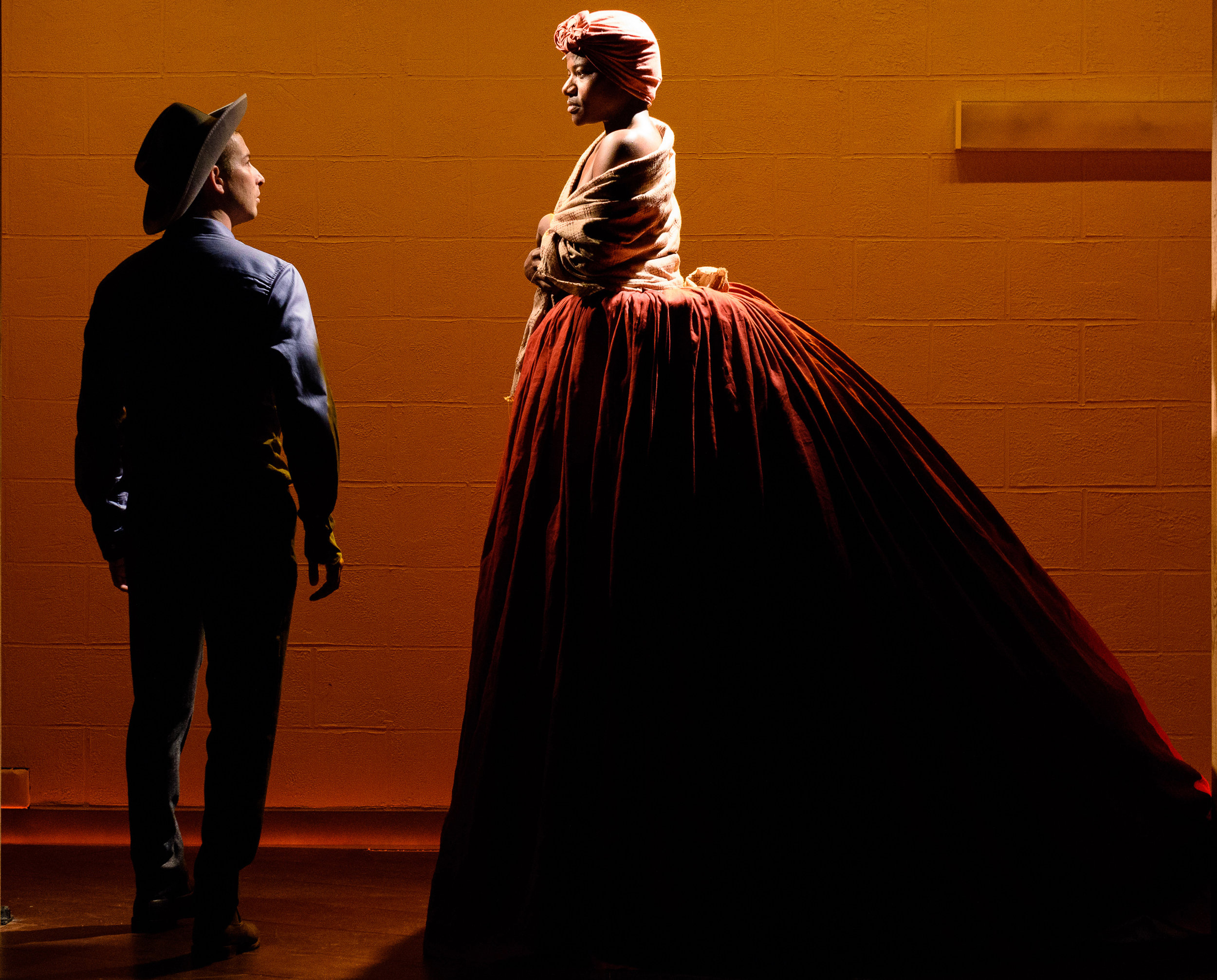
Underground Railroad Game, a bold and imaginative theatrical piece created by Jennifer Kidwell and Scott Sheppard, is a bawdy satire in which the audience is made to look head-on at the serious issues of race, sexuality, and how we deal with them in the aftermath of slavery. Guided by a thoughtful director, Taibi Magar, the piece exposes the damage that has been done to the national psyche by slavery’s devastating legacy, especially in terms of interracial relationships and the ways we communicate. Scott Sheppard (left) and xxx Kidwell star in their show about America's racial history, "Underground Railroad Games," at Ars Nova. Top: the pair take on modern characters as well as those of the Civil War era.

Two teachers—Caroline (Kidwell), an African American woman, and Stuart (Sheppard), a white man, are teaching a fifth-grade class project on the Civil War. Dressed as a Quaker abolitionist, Stuart aids a distressed runaway (Kidwell) in a campy tête-à-tête that establishes the sexual energy between the two characters immediately. Then the action abruptly changes to the bright, fluorescent-filled modern classroom where the two are enthusiastically teaching the issues of the Civil War. The teachers quickly include the “class” (i.e. the audience) in the “games” of war, incorporating “safehouse signs” and “slave dolls.” Soon the battle of the sexes is added to the mix, as well as interracial relationships, as the teachers spend time together outside the classroom.

Kidwell as Caroline gives a raw, bold, yet vulnerable interpretation of the African-American woman and her torn relationship with white men. Sheppard’s comical yet painfully exposed performance as Stuart breaks through serious barriers that society doesn’t often discuss. Sheppard and Kidwell’s dramatic exposition feels especially relevant with the racial tensions in the U.S. right now. Magar’s choices as director show the negative effects of slavery’s legacy and the way it has stunted the nation’s ability to heal through open and honest discourse.

The authors use stereotypes of African-American women from old movies such as Gone with the Wind, yet Magar has invested the piece with both melodramatic flair and honesty. Particularly riveting is a segment when Caroline is dressed in Mammy costume in daguerreotype silhouette. As Kidwell plays the runaway slave hiding in the barn, her blood-red, antebellum skirt is the focus as the character sensually moves her arms and upper body in beautiful rhythm with her song that draws Sheppard’s abolitionist to her breast. They offer a tender, painful look at the two characters’ complicated sexual relationship as a result of the shackles of enslavement. Kidwell seductively pulls her skirt up and Sheppard kneels down to her, disappearing in the velvet billows. The skirt eventually becomes a pup tent where the two teachers are discussing social issues and their relationship, foreshadowing the theme of the power of language and the bruises of misunderstanding because of white privilege.

Sheppard (left) as an abolitionist who aids a runaway slave (Kidwell). Photos by Ben Arons.

The designers contribute sinister fog, dogs barking, creaking barn doors, crickets, and bobwhites chirping (sound design is by Mikaal Sulaiman) in the distance.

Kidwell and Sheppard have been working on this piece since they met as teachers several years ago; it is produced with the Philadelphia-based troupe Lightning Rod Special. Through the period story, they carefully expose the sexually charged, precarious relationship between African-American women and white men in this country today.

Magar guides them through some volatile moments: triggered by Stuart’s response to the phrase “nigger lover” in a classroom prank, Miss Caroline rears up in righteous indignation into a fiery S&M dance with him that is not for the prudish nor for small children. The two rage against their attraction for each other and the forces that pull them apart, leaving Teacher Stuart completely bare on stage, both physically and emotionally, and Kidwell takes Sheppard to school in an S&M dance that leaves him completely exposed, revealing a sinister essence at the core of their relationship. The play ends with both standing barren and disconnected. But with that, it is clear that only through empathy and open discussion, can we heal from our history’s wounds.

Although the past has left its ugly mark, Underground Railroad Games challenges us to look at our past with honesty and move ahead to a positive future.

Underground Railroad Game plays at Ars Nova (511 West 54th St.) through Nov. 11.  Performances are at 7 p.m. Mon.-Wed. and at 8 p.m. Thurs.-Sat.; matinees are at 3 p.m. Saturdays. Tickets are $35; for more information, visit arsnovanyc.com or call (212) 352-3101.

Click for print friendly PDF version of this blog post

Miranda Rights—And Wrongs

Perhaps it was inevitable that Gerard Alessandrini, the creator of many seasons of Forbidden Broadway, would be lured back by the possibilities of the phenomenon of Hamilton. Having put the long-running satirical revue on hiatus in 2014 (after Forbidden Broadway Comes Out Swinging), Alessandrini has devised a terrific new show, Spamilton, at the Triad. Structured around Lin-Manuel Miranda’s runaway hit, the show features a stronger through-line than Alessandrini usually fashions to encompass the revue elements. For lovers of musical theater, Forbidden Broadway, and Hamilton, Spamilton provides a raucous goulash of mostly on-target barbs, yet it is also in the Forbidden Broadway mold, with “appearances” by stars such as Bernadette Peters, J. Lo, Beyoncé, and, inevitably, Liza Minnelli. Most important, fans can rejoice that Alessandrini is back at the top of his game. And the targets are not just Hamilton the musical, but the art form itself, the actors in Hamilton, and anything currently on Broadway.

Nicholas Edwards plays Hamilton star Daveed Diggs, the actor who plays Thomas Jefferson and the Marquis de Lafayette in "Hamilton." Top, from left: Chris Anthony Giles, Dan Rosales, Juwan Crawley and Nora Schell fill out the cast of "Spamilton."

The revue, written and directed by Alessandrini, takes the form of a fantasia. Inspired by the Kennedys and their love of the musical, Camelot, which Jackie said she played each night at bedtime, he imagines the Obamas turning in, with the President (Chris Anthony Giles) putting on a vinyl of Hamilton. Then Alessandrini lets loose. Part biography, part parody, the show details Miranda’s upbringing, his love of musicals, and his determination to build a better Broadway musical, in a clever rap that upends the expectation of traditionalism from him:

This blue collar shining beacon/Puerto Rican/Got a lot farther/By being a lot smarter/By stretching rhymes harder/By being a trend-starter.

Lurking beneath the flattery of “trend-starter,” though, is Alessandrini’s deep skepticism about rap as a medium for shows. Later in the revue, to the tune of “Children Will Listen,” from Into the Woods, he writes:

"Careful the rap you play/No one will listen/Careful how dense the phrase/ People will leave/Or heave."

“Children like rap today/But children don’t listen/Parents may lavish praise/But they could deceive/So take it from me/Careful the rap you say/ Incessantly/No one will listen."

Yet the canny creator also realizes that Miranda didn’t come out of nowhere. He has been influenced by Sondheim, whose genius has spawned inferior work from countless lesser talents. To the music of “Another Hundred People,” from Company, Sondheim gets his share of blame:

“Another hundred syllables came out of my mouth/And fell onto the ground/While another hundred syllables are gonna go south/And are sticking around/As another hundred syllables repeat the refrain/And are waiting for us/In the second quatrain/And I’m starting to cuss/Ev’ry word I say.”

“It’s a lyric by Sondheim/All you can eat word buffet/A lyric by Sondheim/ Too hard to sing, or to play/And ev’ry day/Some say, ‘No way…’”

From left, Schell, Edwards and Giles in a number from the revue. Photos by

Nora Schell, a powerhouse singer, delivers the Sondheim parody with panache, and she plays Michelle Obama and most of the other women’s roles. Gina Kreiezmar appears as a guest diva to play a beggar woman trying to cadge tickets to Hamilton, to the tune of the Beggar Woman’s “No Place Like London” in Sweeney Todd, and as Liza Minnelli she sings, to the tune of “Down With Love,” “Down With Rap”: “Down with rap and all of the hip-hop trends/Down with rap and all of the rhymes it bends.”

Aficionados will have fun identifying the melodies and references, which include Camelot, of course, but also The Unsinkable Molly Brown, The Music Man, Sweeney Todd, Into the Woods, and non-theater music such as the theme from The Fresh Prince of Bel-Air. And, thanks to Miranda’s good nature, Alessandrini has permission to use music from Hamilton itself, which he does effectively—skewering Barbra Streisand in all her narcissism and her Revolutionary garb at the Tony Awards, singing, to the music of Miranda’s big show-stopper, “I wanna be in the film when it happens, the film when it happens…”

Occasionally, Alessandrini’s swift segues may leave one confused, particularly at the appearance of an old man who missed something because he went to the bathroom. But Spamilton thrives on the energy of its cast of talented unknowns, who include Nicholas Edwards as a prancing Daveed Diggs in a volcanic wig (Diggs the actor is satirized in the number “Fresh Prince of Big Hair”) and Juwan Crawley, whose appearance in Dustin Cross’s costumes (as the genie in Aladdin and as a rather famous orphan) are the juiciest sight gags of the evening.

Whether or not you view Spamilton as a stopgap till you can score tickets to Hamilton, or as a exemplar of sharp-witted parody, Alessandrini’s show is chock-full of pleasures.

Spamilton plays through Dec. 31 at The Triad Theater. Tickets at $69 are selling quickly but are available for the popular show beginning Oct. 5. There is a two-drink minimum and cabaret seating. Performance times vary; for information and tickets, visit triadnyc.com.

Click for print friendly PDF version of this blog post

Tortured Souls

Nicole Kontolefa as Sue and Marta Mondelli as Emma. Photography by Seth Perlman.

Marta Mondelli’s Toscana, or What I Remember begins as the story of two couples whose lives intersect at a hotel in Tuscany in the middle of February. Each is tortured in his or her own right. It starts interestingly enough with Emma (Mondelli herself), an Italian who has been living in New York, and her husband, Fred (Scott Barton), who is paralyzed from the waist down and confined to a wheelchair. To say they annoy each other is an understatement. Emma, who often hears a little girl singing and playing, is neurotic, bitter, and foul-mouthed. If she loves Fred, it’s hard to tell. “All of a sudden he gets in this stupid chair, and I have to carry him around like a baby in a stroller,” she complains.

The second couple, “Sue and Larry Cole from Wisconsin,” played by Nicole Kontolefa and Lance Olds, add a bit of lightness to the play initially, but not for long. Larry is a botanist visiting Italy for a conference, while the pregnant Sue annoys him by frequently apologizing to him. He detests the phrase “I’m sorry” so much that she ends up apologizing repeatedly, a gag that should have been funny. Though not as unpleasant as Emma and Fred are to each other, the Coles are wound tight. Sue becomes a little unnerved that she’s forgotten her sunblock—even though it’s 50 degrees in February! Larry is concerned about his speech at the conference. “Hopefully, no one will scream at me today,” he says. “Plant scientists are so conservative.” The typical Midwestern characters are written in a way that suggests it’s their first trip abroad.

Kontolefa, however, exhibits a range of emotion. She begins as an awkward young wife, concerned about her pregnancy. But her Sue is either afraid of Larry or afraid of losing him. When confronted with the possibility that her husband and Emma may have kissed, she displays a strength that shows a depth of character, losing any previous hints of schoolgirl silliness.

Director Tara Elliott keeps things moving along smoothly. However, she was not able to elicit from the actors the subtleties necessary to portray Fred and Emma convincingly. Playwright Mondelli was unable to flip the switch from neurotic and mean-spirited to loving and doting for the bipolar Emma. Barton was only able to move off the emotion of exasperation when he had dialogue with Sue about her pregnancy.

Nicole Kontolefa as Sue and Scott Barton as Fred in Toscana, Or Things I Remember. Pictured above is Scott Barton. Photography by Seth Perlman.

Furthermore, Mondelli’s script is underdeveloped. Too many times the conversations come off as inane cocktail conversation and unnervingly repetitive. Emma asks Sue, “How far along are you?” and she replies, “Ten weeks.” Emma retorts, “How many months is that?” Or Larry’s insipid argument that plants don’t respond to music but yet “they communicate to each other through electricity.” When Sue wants to push Fred in his wheelchair, Larry interjects, “Sue, you’re weak.” No, she’s pregnant; since it’s already been revealed that he’s been through one pregnancy with his first wife, why would he jump to “weak” when there is nothing in the script to suggest it?

On the other hand, there are elements that complicate the story that Mondelli leaves undeveloped. For instance, there’s the recurring sound of a child singing offstage—while appropriate to hear the child singing before the play begins, which sets the tone, it makes little sense during the play for the audience to hear the child, given a turn of events late in the production. Although Emma repeatedly swears at the child, which paints her as callous, there’s a persuasive twist that comes too late to redeem her.

Oddly, there is something to Toscana, which is probably what brought it to the stage in the first place. However, it wasn’t nurtured and developed to its full potential, which can happen when the playwright is also cast as the lead. Surprisingly, after all that, the play resonated more the next day than immediately after. Maybe the dust had to settle on too much unfinished, stilted dialogue to get to the heart of Toscana in the moment.

Toscana, or What I Remember is at Cherry Lane Studio (38 Commerce St. in Greenwich Village) through Oct. 1. Performances are at 7 p.m., Tuesday-Saturday; Matinees are at 2 p.m. Sept. 25 and 3 p.m. Oct. 1. Tickets are $18 general admission and $15 for students/seniors. For tickets, go to https://web.ovationtix.com/trs/pr/963985. For more information, visit toscanaorwhatiremember.com.

Click for print friendly PDF version of this blog post

Young But Wise

Shelagh Delaney was only 18 when her first play, A Taste of Honey, premiered in London in 1958 and she added to the gender diversity of the Angry Young Men of postwar British theater. The play was developed at the acclaimed producer Joan Littlewood’s Theatre Workshop, and it contains some of Littlewood’s hallmarks, notably a jazz trio playing standards that evokes the British music hall (a popular influence in British theater, used by John Osborne as the setting for The Entertainer and by Littlewood herself in Oh, What a Lovely War!—and on through Privates on Parade, right up to One Man, Two Guv’nors in 2011). Rebekah Brockman is Jo, and Ad Otukoya is the saior she has a fling with, in Shelagh Delaney's "A Taste of Honey." Top: Brockman with Rachel Botchan as her mother, Helen.

As with Osborne, Arnold Wesker, and John Arden, the focus of the “angry theater” was the travails of the working-class English. Delaney’s play is set in Manchester, and concerns Jo, who is 17 and lives with her mother, Helen (Rachel Botchan), a sometime prostitute. For the late 1950s, and for an author of 18, A Taste of Honey is astonishingly frank and casual about taboo topics of the period. Jo refers diffidently to Helen’s “immoral earnings.” Jo herself has an affair with a black sailor (Ade Otukoya) and becomes pregnant by him. She sets up house with a fellow art student, Geoffrey (John Evans Reese), who is gay and has more nurturing instincts toward her than Helen does.

Jo’s fractious relationship with her mother is, in Delaney’s play, the fault of both characters. Rebekah Brockman’s Jo is irritatingly immature and impractical, yet self-confident, and she and Helen squabble frequently. Helen has clearly not taken a strong hand in raising her daughter, and Jo is a free spirit as a result, mouthing off in a way that the vast majority of middle-class 1950s teenagers probably wouldn’t dare to.

Meanwhile, the narcissistic Helen blows hot and cold about caring for her daughter. “Why don’t you learn from my mistakes?” she asks Jo solicitously at one point. “It takes half a life to learn from your own.” Yet she’s also capable of saying, “I never have thought about you when I’ve been happy.” It’s a measure of Delaney’s maturity that she can create characters so complex and show the struggles of their lives so vividly.

Brockman takes issue with the race of the doll brought to her by the nurturing gay friend Geoffrey (John Evans Reese).

The play focuses on Jo’s coming of age. Helen has a roistering time with a former client/boyfriend named Smith (Bradford Cover, with an eyepatch), who has tracked her to their new digs. Joe resents Smith and spars with him verbally, even though he makes overtures to be kind to her. (In The Angry Theatre, John Russell Taylor, who saw Delaney’s original script, says Smith’s kindness was toned down in Littlewood’s final version.) Eventually Helen runs off with him, only returning after Smith has run off with a younger woman. Meanwhile, Jo and Geoff have established a home of a sort—Jo works in a shoe shop by day and a bar at night. But Botchan’s selfish, blundering Helen, now displaced, ousts Evans’s gentle, patient Geoff in the awkward, melancholy climax.

The play is a dream play, with flights of fancy and high theatricality in spite of its working-class milieu—Jo talks about the sailor being “an African prince,” and Geoffrey yearns to be a father figure in a heterosexual family and fit in. Characters deliver asides to the audience in the manner of Restoration comedy. Director Austin Pendleton uses the jazz trio not only to punctuate verses of songs that the characters break into, and to cover scene changes, but also as a silent chorus. When Helen shows them racy advertisements, Max Boiko (trumpet), Walter Stinson (bass), and Phil Faconti (guitar) play along and take a look with wry reactions; two of them often share the sofa with the speaking characters. (Harry Feiner’s scenic design delivers a heavier dose of realism, with its drab browns, duns and mustards, visually enlivened only by Barbara A. Bell’s bright dresses for Helen.)

Still, there’s a sense that, even with its open artifice, Delaney’s characters were lifted out of a vacuum and placed in this setting. As a dream play, it’s not as easy to adjust to or as persuasive as, say, The Glass Menagerie. Delaney never had a bigger success than A Taste of Honey, and it’s rarely revived nowadays. It has perhaps frayed a bit at the edges, but it’s still a work that continually surprises with its modern feel. The Pearl Theatre’s season opener is a welcome opportunity to see it.

The Pearl Theatre's production of A Taste of Honey will play through Oct. 30 at 555 W. 42nd St. Performances are at 7 p.m. on Sept. 20, 22, Oct. 3, 4, 10, 12, 13, 16, 20 and 24; at 8 p.m. Sept. 23, 24, Oct. 21, 22, and 29; and at 2 p.m. Oct. 2, 22, 23, and 30. Tickets are $59 and may be purchased by calling the theater at (212) 563-9261 or visiting pearltheatre.org.


Click for print friendly PDF version of this blog post

Looking for God and Love

Serious pianists love to study the great composers in order to explore and channel the music they are to perform. Hershey Felder, the writer and star of the solo show Maestro, is a serious pianist and composer in his own right. He is also a gifted and highly successful singer, director, and producer. His one-man show is the natural rumination of one serious musician about another. A revelatory moment as Hershey Felder playing Leonard Bernstein demonstrates Dimitri Mitropoulos’s conducting style. Top: Felder, a virtuoso pianist, plays a nine- foot Steinway center stage as Bernstein.

Maestro is the story of the larger-than-life phenomenon that was Leonard Bernstein: conductor of the celebrated New York Philharmonic and orchestras worldwide; the second most performed classical composer in the United States, who also wrote the scores for the hit West Side Story and other Broadway shows; the creator of 53 Young People’s Concerts and proselytizer on behalf of the classical music tradition to the millions he reached on TV and in lectures all over the world. In this and other plays, Felder has created a piece of biographical theater. His one-man plays about Gershwin, Chopin, Beethoven, Liszt, Irving Berlin, and now Bernstein, use story, song, and music to probe the lives of great musicians and deepen our understanding of music itself.

Bernstein’s overarching passion was to compose. In Lenny’s voice, Felder explains what lies behind the works he composes: “and in every one of these pieces, I am busy looking for God. And for love. Because as composers, that’s what we’re always doing.” This desire, the desire to compose and all it encompasses, is the spine of Felder’s play. Will Bernstein find God? Will he find love? Will he write the great works he so badly wants to write?

Felder takes on Lenny, the controversies about his life and his music, and looks for the truth behind the noise of his fame. He shows us a man whose betrayal of his marriage and loss of his wife to cancer upended his life. And he shows us a man who, for all of his achievements as a composer, was never embraced by the classical composing establishment, which rigidly favored atonalism. Bernstein not only believed that tonality and melody were at the heart of all great classical music, he wrote successful musicals; brought classical impulses into his popular music; brought popular idioms into his serious classical compositions; and was just too populist in every way to win the seal of approval of that elite club whose tenets he rejected. He paid a heavy price.

Felder as Bernstein on a television set. Photos by xxxxxxxx.

Beautifully directed by Joel Zwick, the work uses projection and lighting (Christopher Ashe) as well as audio (Eric Carstensen) in striking, even brilliant ways. Does Felder do justice to Bernstein? Do we know the man more deeply after the play than we did before? These are questions that theatergoers will answer for themselves. But in bringing us a character whose passion and achievements were in music, Felder’s own musicianship, his teaching moments riffing on music that occur throughout the play, and his prowess at the keyboard, bring us more deeply into the soul of Bernstein than this genre might have otherwise permitted.

A solo show is a special feat for any actor. Maestro runs one hour and 45 minutes and includes challenging work at the keyboard, some of it while also singing or speaking. At the same time, is it mean-spirited to say there is a bit too much West Side Story and that, if the final song were cut, the play would end on the more tragic note intended by Felder, without sentimentality? Interestingly, as a baritone, Felder sings in a soft and lilting popular style and also in a steelier, more trained classical style, sometimes combining both, just as Bernstein was forever migrating from one style to the next in unexpected ways. Vocally this usually works—but not always.

Did Bernstein find God and love in his composing and in his life? In the most powerful moment at the end of the play—better experienced than described here—Bernstein combatively turns and asks questions of the audience. Then he recites a poem Bernstein wrote in which he sums up how he views his life in the face of his approaching death. Did Bernstein find God and love in his composing? No, Felder says, not in Bernstein’s eyes. And yes, Felder says, in the eyes and hearts of all of us who listen to his story and, even more important, to the maverick genius and passionate heart of the music that beats beneath it.

Maestro runs through Oct. 23 at 59E59 Theaters (59 E. 59th St.). Evening performances are at 7 p.m. Tues.–Thurs. and at 8 p.m. Friday and Saturday; matinees are at 2 p.m. Saturday and 3 p.m. Sunday. (Additional performances are at 2 p.m. Sept. 29 and Oct. 13. There are no performances on Sept. 24 or Oct. 11 or at 7 p.m. Oct. 2.) Tickets are $25–$70. For more information, call Ticket Central at (212) 279-4200 or visit www.59e59.org.

Click for print friendly PDF version of this blog post

Feathered Enemies

The Birds, Conor McPherson’s creepy new play, is derived neither from Aristophanes nor Alfred Hitchcock. It does, however, share DNA with the 1963 film because both draw from a short story by Daphne du Maurier. (Hitchcock also used du Maurier novels as source material for Jamaica Inn and his Oscar-winning Rebecca.) Don’t expect to find real birds or even simulated ones in the pocket drama at 59E59 Theaters. Fans of the movie won’t find a pompous female ornithologist with environmental concerns or a schoolteacher with her eyes pecked out either.

Click for print friendly PDF version of this blog post

That Pharmaceutical Connection

The drug that gives Ana Nogueira’s new play its name, Empathitrax, fosters complete intimacy between two people in a relationship. The users take it with water, then wait a bit and touch each other—waves of empathy ensue as the feelings of the other become utterly accessible. It’s apparent almost immediately that the man and woman in Empathitrax—Nogueira’s script identifies them only as Him and Her—need artificial stimulation. As they meet with a delivery guy from Empath in their minimalist living room to discuss dosages and procedures, they interrupt themselves, grasp at each other awkwardly, smile uncomfortably and generally broadcast that their relationship is strong but that there might be some problems.

Jimmi Simpson (left) plays Him, a man in a relationship that's having difficulty, and Oliver is his friend. Top, Simpson with Justine Lupe as Her.

Jimmi Simpson (left) plays Him, a man in a relationship that's having difficulty, and Oliver is his friend. Top, Simpson with Justine Lupe as Her.

Nogueira develops her theme carefully. Focusing on a drug that interferes with one’s natural personality traits is not a fresh topic—Placebo and The Effect have been there—but Nogueira’s play is still a strong entry in a subgenre of modern drama. It allows its actors to work with a wide range of emotions. And those actors—Jimmi Simpson and Justine Lupe as Him and Her, and Genesis Oliver, who doubles as the Empath delivery man and as Him’s buddy Matty D.—give astonishingly good performances, not just charting the emotions unleashed by the drug, but investing the science-fiction aspect of the story with credibility. As they undergo the effects of Empathitrax, they touch each other and each feels what the other is feeling. The physical empathy they enact is persuasive and overpowering.

Simpson once starred on Broadway in The Farnsworth Invention and looked set to be a fixture in the theater, but forsook it for television work. He was clearly an actor of great gifts, and they have not diminished. He uses every second of stage time, much like Vanessa Redgrave, to create a pointillist portrait. One is afraid to look away for fear of missing the tiniest apt grimace, deep breath, or shoulder shift that conveys crucial information.

If Him is calm, rational, giving and patient with his partner to a fault in their daily lives, Her can still push his buttons at times. She buys a bed they cannot afford without consulting him, and that provokes exasperation. But every interaction, every hesitation, every flash of emotion between Simpson and Lupe is precisely evoked under Adrienne Campbell-Holt’s superb direction.

Her confronts the Empath delivery man (Oliver). Photos by Robert Altman

Her confronts the Empath delivery man (Oliver). Photos by Robert Altman

Lupe’s Her is needy and insecure, and although the opening scene with the delivery man plays like a Cowardian comedy of manners, things turn darker. “This play is a comedy, until it’s not,” reads a direction in the script. And it’s quite funny for awhile, as Him subsequently meets with his buddy Matty on the rooftop to vape and describe his experience with the drug. “I guess that I didn’t know how much the little things mattered to her and she, she didn’t realize just how much I cared about her,” he says. “But now we can actually show each other, transfer the information. It’s quick and it’s potent.”

Matty tries to relate every emotion to a past drug experience: “So it’s like doing Molly?” he asks. “So like, a Xanax.” He’s an expert on artificial stimulants, but, in a scene at a party with Her, he reveals that his impetus to using drugs may well be a result of his sick father: “He’s like, almost catatonic, all the shit they have him on. It’s keeping him alive which is good, I guess. But.” To which Her responds: “But what’s the point of being alive if you aren’t really taking it all in.”

It’s a modern dilemma—the desire to experience everything. Even the rampaging use of the Internet to see life in all corners of the earth, to miss nothing, to signpost one’s existence for others to notice, is a symptom. Her tries to finesse the shortcomings of her relationship with him by adopting a dog, Rufus, who is kept in a crate and sometimes barks and sometimes is heard chewing on treats (the sound design is by Matt Otto). Rufus’s unconditional love cheers her, and Lupe has a couple monologues with the dog, in which she displays her neediness: “Do you like me even a little? Do you realize I saved your life? No one in the world knows what could have happened to you if you stayed in that shelter.”

In Nogueira’s satisfying ending, well grounded but still a surprise, the author comes down on the side of natural experience rather than chemically induced effects. Simpson’s Him does something uncharacteristic—he improvises—and the delicacy and romance of the final moments pull the play back from the darkness enveloping it. It’s no longer a comedy gone awry.

Colt Coeur's production of Empathitrax plays at HERE Arts Center (145 Sixth Ave., entrance on Dominick Street) through Oct. 1. Evening performances are at 8:30 p.m. Thursday through Saturday, and 7 p.m. Sundays and on Monday, Sept. 26. There is also a matinee at 4 p.m. on Oct. 1. Tickets are $18 and may be purchased by visiting here.org.  

Click for print friendly PDF version of this blog post

Cracking Open

In Honor Molloy's Crackskull Row, a hovel in Dublin becomes the unlikely setting for an emotionally overwrought, Oedipal drama. The play is set in 1999, but it has the audience fooled—Molloy's play has all the trappings of a mid-20th-century, Joycean family narrative. Although the audience often hears references to staples of modern life—mobile phones, an ESB (Electricity Supply Board) company, even Oxfam—they sound anachronistic against this landscape of aged, mournful nostalgia. But for all its old-world charm, Molloy's riveting words don't translate perfectly to the stage. Directed by a courageous Kira Simring and staged by the cell at the Workshop Theatre, this beautifully written, hauntingly poetic story struggles to find the right tongues for its finely crafted words. John Charles McLaughlin as Rasher & Terry Donnelly as Masher. Top: Colin Lane as Basher & Gina Costigan as Dolly. Photos by Michael Bonasio.

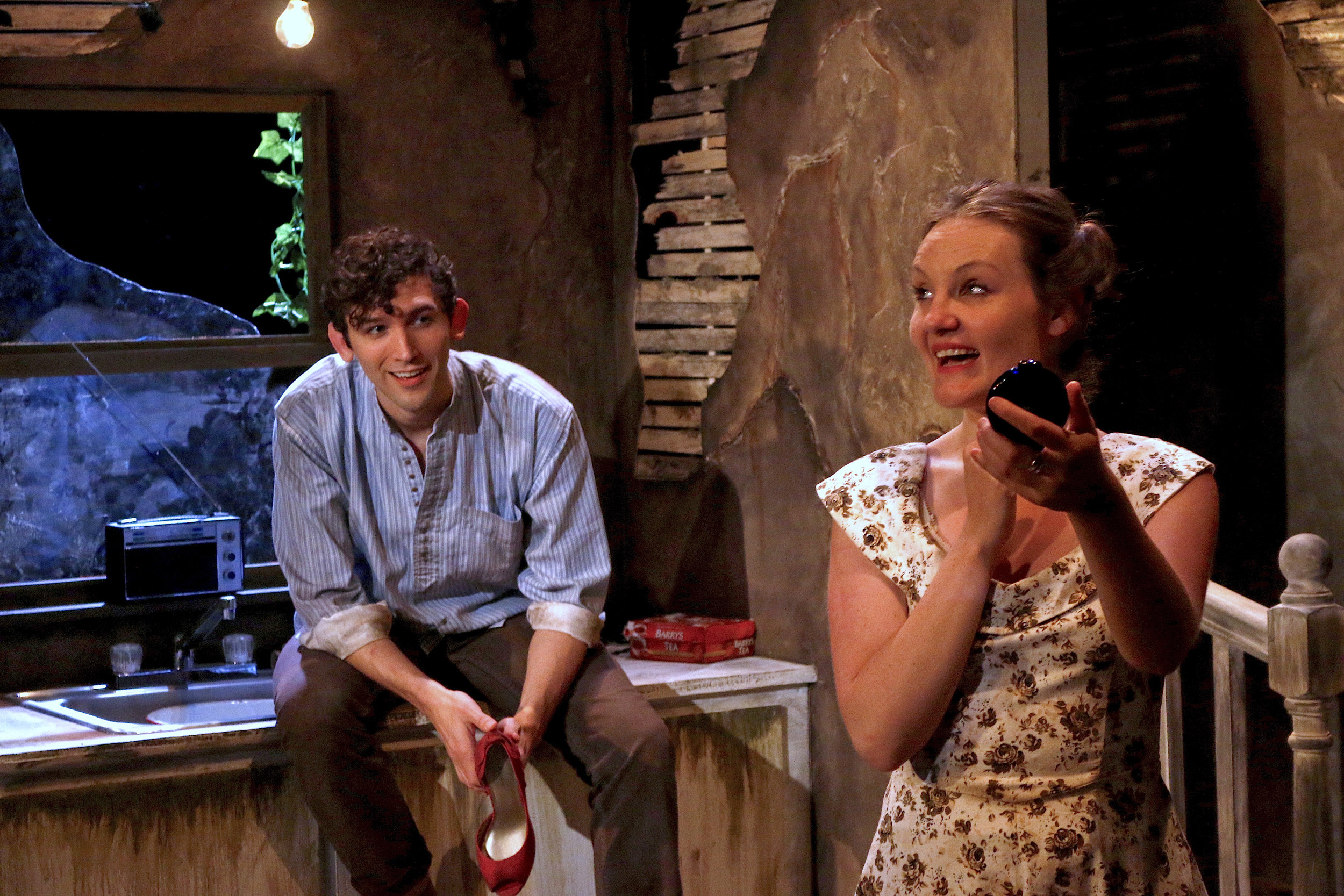
The production opens with the dour throb of a drum and that sprightly music so unique to the Irish musical tradition. An old man named Rasher/Basher, played by Colin Lane, enters, a lone figure with light streaming around him, and says that the sound we hear is "the thrum of the bodhran." It is a kind of Irish drum, well-known for its dooming, thumping sound. He talks wearily, anxiously, about his past, saying that his 'Da' was a musician, and that, although he's been away from home for 33 years, he's become the "spit and shite" of his father's likeness. A sense of foreboding takes hold, the rhythm of the bodhran notwithstanding. Then we see the ramshackle insides of a Dublin home. A vast, untidy sofa, wooden walls with peeling plaster, and a film of dirt covering the kitchen all clue us into the premise of Crackskull Row: a home has been leveled by the passage of time but seems ripe for renewed activity.

What follows is a disturbing but absorbing puzzle about Rasher Moorigan (John Charles McLaughlin), his father Basher (Lane, who also plays the older Rasher), mother Masher (Terry Donnelly) and daughter Dolly (Gina Costigan). Masher is almost literally rotting inside her electricity-less, plumbing-less home on Crackskull Row, her bills from the ESB piling up on the sofa. And while her past bothers her terribly, she is saved by the remembrance of her son, Rasher, and the sustenance of her daughter, Dolly. But it's soon apparent that the narrator, an aged Rasher, himself is unreliable, as are one's eyes and ears. Personae are fluid; the four players inhabit other bodies, take on different accents, and change their clothes easily. Suffice it to say that Rasher and Masher Moorigan are hiding a lethal, 30-year-old secret, the reverberations of which are still knocking around in their battered skulls.

Rasher (McLaughlin) and Dolly (Costigan) share a moment.

There is much to admire about the production, including some fine performances from John Charles McLaughlin, who plays a young, on-edge, perversely romantic Rasher, and Gina Costigan, whose Dolly is a complex, willful thing. But their enthusiasm doesn't quite make up for the uneasy adaptation from script to stage. Crackskull Row often values dramatic potential over clarity, and while some climactic, intimate scenes (like Rasher's interactions with Dolly, or the dying moments of the play) are intensely dramatic, others fall into a spasmodic mode of meaningless activity. The result is not just an abrogation of Molloy's authorial intent for Crackskull Row, but a confusingly paced, occasionally overwrought performance.

Save for a few rare scenes of sparkling chemistry, the production threatens to come away at the seams. Molloy's dialogue is chock-full of intelligent wordplay, quick humor, and wit, but combined with the Irish brogue and quick delivery, her words (when delivered on stage) take a while to register. As a result, the enjoyment of the play is temporarily stunted. Much of the magic that can be read in Molloy's teasing, metaphorical writing is either difficult to find or nonexistent in the staging. We happen upon the wordplay, or a throwaway malapropism, a little too late to derive a complete appreciation of the story.

Yet, the production is redeemed and revived by its flowing, narrative core, and the actors who bring it to life. The chemistry between McLaughlin and Costigan is palpable; it's not for nothing that the Masher-Rasher relationship is central to the play. Lane brings a nostalgic weariness to his role, and lends a dreamy gravitas to the production. But it is Costigan who bears much of Molloy's light-hearted darkness from the page to the stage; she plays Dolly with riveting, minimalist understanding. Even her mirror, Terry Donnelly's Masher, does not waste a single movement (although words seem to be held in lower regard). To help us forget this latter discourtesy, M. Florian Staab (responsible for all the original music and sound design) punctuates scene changes with welcome percussion and fiddle-song. In moments of stillness or silence, there is Daniel Geggatt’s set to appreciate, in blue, brown and yellow, seeming for all intents and purposes like a living thing. As for the other living things taking the stage, they—and the playwright—are among the only reasons you should take a trip to the Workshop Theater this week.

The cell's production of Crackskull Row runs through Sept. 25. Evening performances are at 7 p.m. Thursday through Saturday; matinees are at 3 p.m. Saturday and Sunday. There are additional performances at 7 p.m. on Sept. 14 and 21. The Main Stage of the Workshop Theatre is at 312 West 36th St. (between Eighth and Ninth avenues). Tickets are $25. For more information about the show and tickets, visit www.thecelltheatre.org.

Click for print friendly PDF version of this blog post

When Women Burn

The visual imagery presented in The Flea's The Trojan Women strikes two seemingly disparate chords upon viewing. One is of The Rape of the Sabine Women, an ancient Roman story about soldiers who arrived on the shores of Italy. The men abducted and otherwise ravished a group of Sabine women. Another image, more overt (and one we are asked to leave the theater with), is the violent uprooting of millions of Syrian refugees from their homes. As Hecuba, Helen, Andromache and Cassandra bitterly mourn their fallen city, we cannot help but think of their lives in a foreign, hostile country, as they are carried off in boats that are almost as precarious as their hollow futures. Lindsley Howard (as Cassandra). Top: Clea DeCrane, Rebeca Rad (as Helen), Jenny Jarnagin, DeAnna Supplee (as Hecuba), Chun Cho & Amanda Centeno. Photos by Allison Stock.

This resonance, sometimes obvious and sometimes thrillingly unspoken, is the beating heart of this drama, written by the silver-tongued Ellen McLaughlin. Enveloping this drama, which has survived well past its antiquarian origins, is the tragic, antediluvian helplessness of postwar women at the hands of their conquerors. It is the human tension of the play, with its mostly female cast, that rings through McLaughlin's words and lifts the story into beautiful, complex territories. Directed by Anne Cecelia Haney and under the much-lauded artistic directorship of Niegel Smith, this adaptation of Euripides' antebellum narrative, if occasionally flighty, is moving and cinematic in its scope.

The play begins with the drugged monotone of waves crashing against a beach, as we are welcomed into The Flea's downstairs theater. It seats perhaps forty—the intimacy of the space threatens our bubble of suspended disbelief. As if painted onto the wall, a turbaned, blindfolded woman sits, waiting. On the floor lie some six women—this is the Chorus—curled up and covered in grey blankets. The music of the sea gradually bestirs the blindfolded woman, and from her commanding voice and gait, we gather that she is Hecuba (played by a marvelous DeAnna Supplee), former queen of Troy and war prize for the Greeks. The women of Troy have been captured by their enemies the Greeks following the sack of Troy, and are waiting to be shipped off to kings' courts as slaves, concubines or second wives—harder luck perhaps than their Sabine ancestors. Cassandra (a powerful Lindsley Howard) and Andromache (Casey Wortmann, wonderful) are among the most haunted: the former has been 'made mad' by the god Apollo for spurning his love, and the latter is the widow of Hector, a fallen Trojan prince. All are violently helpless and burning with war trauma, with nothing to do but wait.

Haney has expertly interpreted McLaughlin's words, which retain most of the flair and poetry of Euripides' original. As the Trojan women dream of their future lives, they repeat stories of far off countries: "If you wash your hair in their rivers," one of them says, "they come out gold." Haney builds particular emphasis around this optimism, for it is mirrored in the current refugee crisis that has shaken the world with its sorrow. Here is where McLaughlin, who first adapted the story with the Bosnian war and its aftermath in mind, becomes fickle: the plot is held together by the barest of backbones, and for all the characters' elegies and monologues, there are times when the postwar narrative seems too forced, too distant. But when we are reminded, it is powerful: doctors, engineers and artists leave behind their burning cities for lives as taxi drivers, postmen and even unemployment, just as Hecuba, Andromache, and their once regal companions become less than their former selves. They resign themselves to lives of physical and emotional imprisonment.

Phil Feldman (as Talthybius) & Casey Wortmann (as Andromache). Photo by Allison Stock.

Hecuba embodies all the nostalgia, mad sorrow and pride of her fallen Trojan citizens. Supplee delivers the fallen queen's lines with wounded ferocity; even when she whispers, there is weight and regality behind it. Tears shine perpetually in Hecuba's eyes—her only equal is Helen (Rebeca Rad), played with a great deal more pathos and wit than the original character is intended to have. In the 1971 film, starring the luminescent Vanessa Redgrave and Katharine Hepburn as Andromache and Hecuba respectively, Helen is a teasing, dangerous, one-dimensional male fantasy (both ancient playwright and seventies era director were male, after all). Rad anneals this fantasy with humanity; her lines are the most moving ones McLaughlin has written in the play.

The entrance of a male soldier, Talthybius (Phil Feldman) towards the end spins the play into a climax. Suffice it to say, he is dressed in combat gear and bears bad news for the women, just as they have seemingly reconciled themselves to their futures. In happier moments, the play has spontaneous moments of song and dance, welcome augmentations to the narrative. Lighting and sound design (Scot Gianelli and Ben Vigus respectively) are both characters of their own, booming and crackling with emotion as the play progresses. Both are also responsible for the cinematic sweep of the concluding scenes, perhaps some of the best minutes of The Trojan Women. Come for the nostalgia and the instructive, present performances, but stay for those dying moments.

The Trojan Women runs through Sept. 26. Performances are Thursday through Saturday at 9 p.m. and Sunday at 3 p.m. Tickets are $15-$20 with the lowest priced tickets available on a first-come, first-served basis. The Flea Theater is located at 41 White St. between Church St. and Broadway. Purchase tickets by calling 212-352-3101 or visit theflea.org.

Click for print friendly PDF version of this blog post

Order in the House

Are all plays that are lost and recovered theatrical treasures? At first, A Day by the Sea, the Mint Theater’s production of a neglected 1953 play by British dramatist N.C. Hunter, suggests the answer is no. However, under Austin Pendleton’s steady and gentle direction, we gradually see how effectively Hunter scratches the surface of social interactions to reveal what lies beneath: sadness, anger, and disappointments, as well as hopes and dreams. As the play opens, Julian Anson (Julian Elfer), a civil servant living in Paris, has come for a visit to see his mother at the family’s seaside estate. He doesn’t really want to stay. He barely sits down, and when offered a lawn chair, appears extremely uncomfortable in Elfer’s fine characterization. He captures Julian’s physical and social awkwardness. His stooped posture and pinched face communicate frustration, and his body seems to lean toward the exit, like he’s yearning to make a quick escape.

David Anson (George Morfogen, left) gets an earful from Doctor Farley (Philip Goodwin) in N.C. Hunter's "A Day by the Sea." Top, from left: Julian Anson (Julian Elfer), Laura Anson (Jill Tanner), and William Gregson (Curzon Dobell). Photos by Richard Termine.

Julian’s mother, Elinor Anson (Jill Tanner), has been keeping up the estate, but she is particularly frustrated by Julian’s lack of interest in the villa, and also by her aging uncle, David Anson (George Morfogen), who seems about to expire. Morfogen brings the right combination of lethargy and energy to the role, showing both a doddering elder and someone who’s not quite ready to give up on life. Elinor frets over the household expenses, part of which go to alcohol consumed by David’s live-in caretaker, Doctor Farley (Philip Goodwin), who often launches into dark, despairing tangents. Julian’s response is “the drinking isn’t dangerous, just boring.” Additionally, there is the estate’s accountant, William Gregson (Curzon Dobell), who also seems to be in limbo.

A group of visitors is also in the mix. Frances Farrar (Katie Firth), who is staying at the villa with her children while she disentangles herself from a marriage, has been away for 20 years. She was raised by Elinor, along with Julian, after she was orphaned. Though hardly scandalous today, in the period of the play divorce is talked about with a hushed air. Frances is what might be called a “hot mess.”

Another “hot mess” is the nanny, Miss Mathiesen (Polly McKie) who, at 35, has never been married, but has her eye on the doctor. The actual day of Hunter’s title occurs in the second act (of three), and it brings forth the tensions that lead to Julian’s recognition of his stiflingly rigid life. Elinor insists he join the family for the outing, which forces him to meet his boss, Humphrey Caldwell (Sean Gormley), at the beach, where Caldwell delivers unpleasant news. At first Julian’s reaction is angry and impulsive: he uncharacteristically climbs a cliff to retrieve a lost kite for one of France’s two children. Climbing the cliff, retrieving the kite, and tearing his trousers—all seem to loosen him up, and he becomes more candid and open.

A Day by the Sea initially seems like a play of manners. Hunter and his fellow playwrights (Noel Coward among them) were replaced in the 1950s by “the angry young men,” a group of writers who focused on the working class and their struggles living in postwar Britain, still reeling from the devastation of World War II. Plays like John Osborne’s Look Back in Anger and Harold Pinter’s The Birthday Party presented human nature in a cynical way and had characters who were cruel and self-serving as they scrambled to survive.

Frances Farrar (Katie Firth) and Julian (Elfer) appear content for a moment.

Although Hunter’s play is not raw like those of Pinter and Osborne, it’s not Disney either—not everyone lives happily ever after. Instead, it shows how much we really just march through life. Expert lighting by Xavier Pierce and the sets by Charles Morgan suggest the ease and comfort of an English seaside villa, but they don’t undermine the fact that personal revolutions are often frustrating, fraught with despair, and don't always lead to the expected outcome. In the end Julian tries to make sense of it all but finds no simple answers. He looks out at the vista and talks about possibly transforming the landscape to get a better view of the sea. His mother, who has done nothing but goad and chastise him for not being more successful as a civil servant, is clearly happy that he might stick around a little longer. And why not? What more perfect setting to contemplate life?

The Mint Theater production of A Day by the Sea runs through Oct. 23 at the Beckett Theater (410 West 42nd St. between Ninth and Dyer avenues). Evening performances are at 7:30 p.m. Tuesday through Saturday; matinees are at 2:30 p.m. Saturday and Sunday, with a special matinee on Wednesday, Sept. 21. Tickets are $57 and may be purchased online at Telecharge.com, by phone at 212-239-6200 or in person at the Theatre Row box office. For more information, visit minttheater.org.


Click for print friendly PDF version of this blog post