
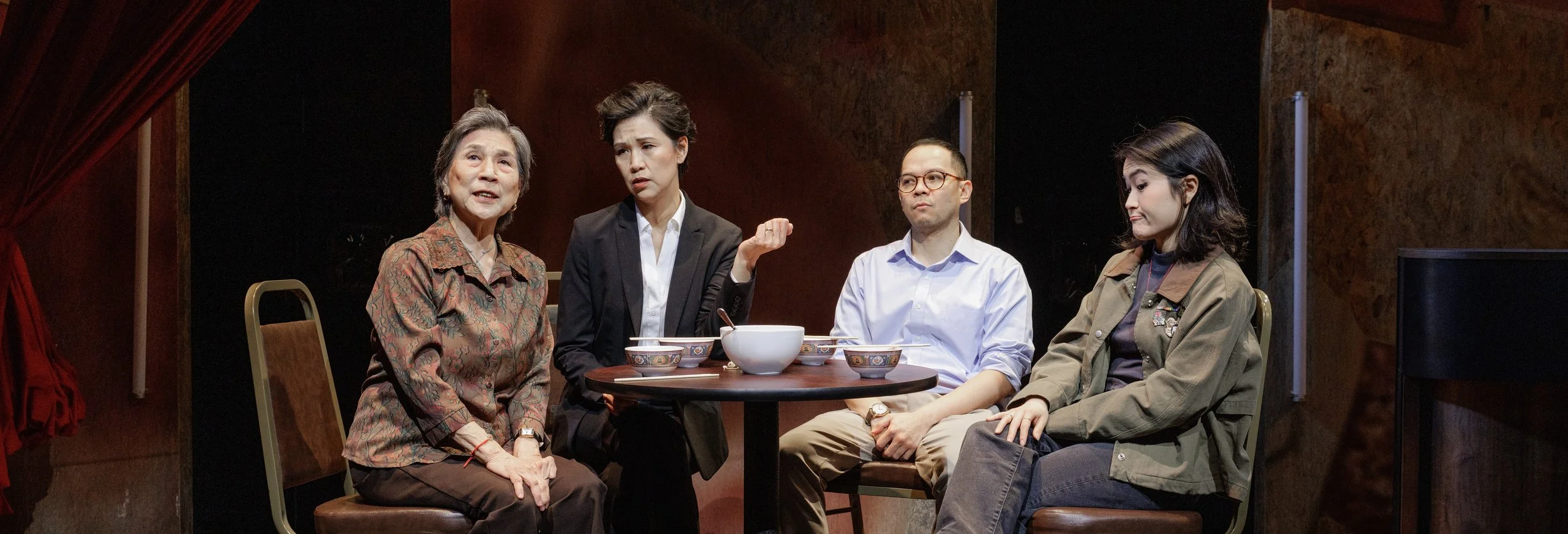

Vive ‘Le Dingdong’!

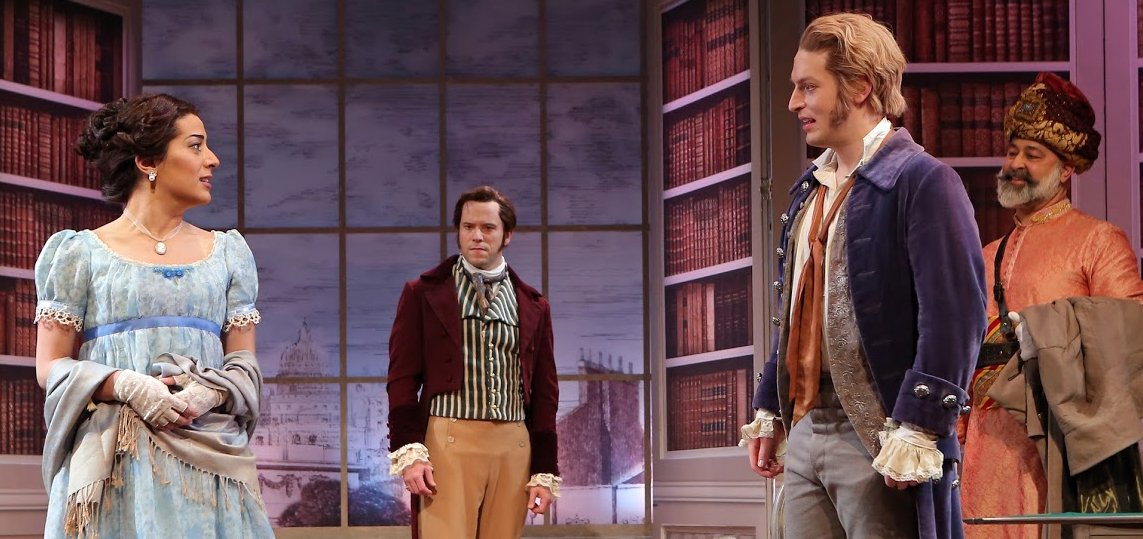
Director Hal Brooks unbridles five actors in The Dingdong, Mark Shanahan’s updated adaptation of Georges Feydeau’s 1896 farce Le Dindon. He propels it even further into the absurd by having those five actors bring to charming, boisterous and nuanced life 12 distinct characters.

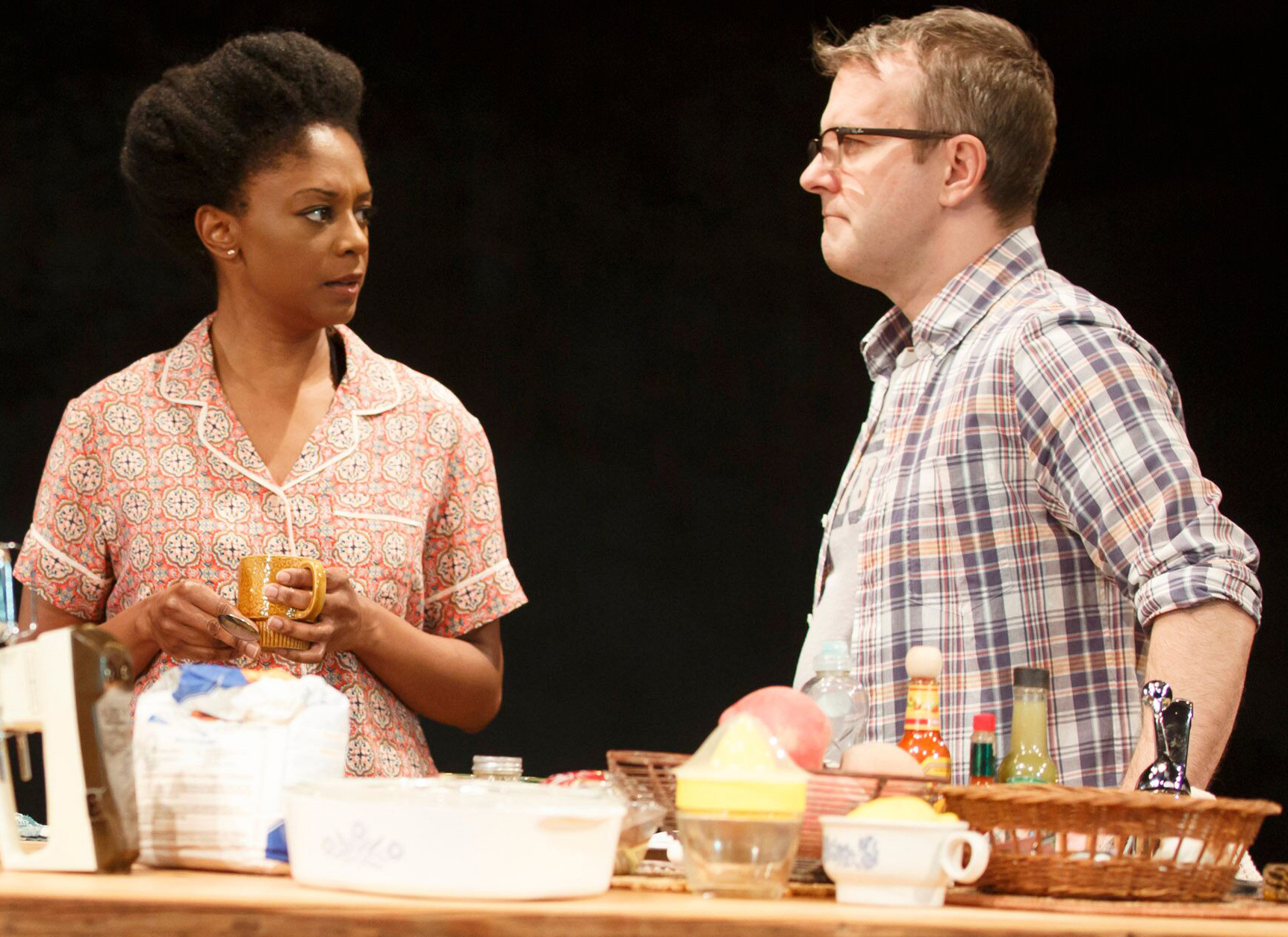
The farce begins with Lucy Vatelin (Rachel Botchan), a married woman, attempting to slam the door on an overzealous suitor, Pontegnac (Bradford Cover). With Pontegnac’s arm and leg precariously lodged in the door, she is leaning against it, insisting he go away. “Everyone this side of the Seine heard you shout that you wanted to make passionate love to me!” she complains loudly, while screaming for her husband to save her. Unfortunately, Pontegnac is an old friend of her husband (Chris Mixon). 
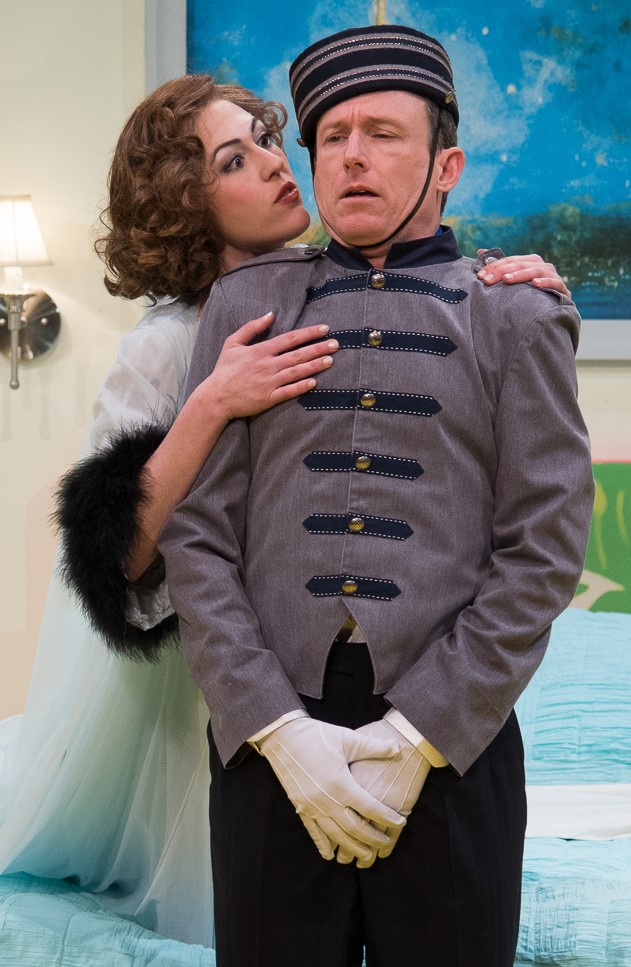
Lucy has another suitor, Redillon (Brad Heberlee), who calls on her as well. With Vatelin out of the room taking a business call, Redillon and Pontegnac square off. Meanwhile, Mme. Pontegnac (Kelley Curran), suspecting her husband's infidelity, has followed him to the Vatelins’ home, where Lucy, worn down, makes a pact with Pontegnac, agreeing to have an affair with him if her husband should ever be unfaithful. Pontegnac knows full well he hasn't been.

The first-act characters include Fabiola (also Curran) as Vatelin’s Italian lover, who has traveled to Paris (with her Hungarian husband) to find him and profess her love. The second act introduces even more, at The Hotel Ultimus, with doors slamming, a 17-year-old bellboy and a Parisian policeman (both played by Heberlee), luggage mix-ups, a French chambermaid, an old, practically deaf woman (Botchan) with uncontrollable flatulence, and a New Yorker named Mandy (Curran).

Two multifaceted performers capture the pure essence of farce in their multiple roles. Kelley Curran bursts onto the stage as the epitome of a sophisticated, bold Frenchwoman and shortly after reappears as an Italian lover with all the bravado of an early Sophia Loren. Act II opens with Curran as Mandy and, only to outdo herself, she closes the play as a fetching French maid. Wigs, costumes and shoes take an actor only so far in a role—Curran is each character.

Heberlee is also a delight, energetically embodying three characters—the flamboyant, sex-driven Redillon (who is a doppelgänger to Feydeau), the bellboy and the policeman. It is his role as Redillon in Act I, at one moment writhing on the floor and professing his love to Lucy, and in the next attempting to explain to Vatelin why he is on the floor (he is cleaning, after all) that is the most endearing. During the standoff with Pontegnac the actors pose like two preening cocks in the farmyard, arguing who is the greater lothario (“I would never discuss matters of intimacy with another man’s wife”).

Cover appears to have the most difficulty playing multiple characters, relying on his best Tim Conway impression, at times shuffling or gasping before each line. Act I finds him and Botchan in awkward and unnecessary movements with odd pacing.

Designing a 1938 French townhouse, Sandra Goldmark uses striking black and white striped walls, a sunrise-yellow floor, and tone-on-tone fabric chaises for Act I. Lighting designer Mike Inwood adds a wonderful layer of sunlight streaming through a lattice window. In Act II, at the Hotel Ultimus, there are bright green and yellow panels with a matching headboard and bedspread. A brief set change and the scene becomes the Honeymoon Suite of the Hotel Rue Cromartin, where the stagehands, decked out à la Marcel Marceau, replace the fabric with bright red floral patterns, as well as a painting of the Eiffel Tower.

Working in concert with the set designer, costumer Amy Clark mixes and matches contrasting colors and patterns. Her attention to detail with smart wigs and colorful hats, down to gartered socks and Redillon’s man-about-town look, is like pure icing on a Pimm’s Cup cupcake from Prohibition Bakery.

George Feydeau is one of the most famous writers of bedroom farce, and Mark Shanahan’s adaptation is a remarkable homage. Witty banter, along with exaggerated physicality, are at the heart of The Dingdong. Even the most pursed lip might be cajoled to laugh out loud.

Performances run through May 15 at the Pearl Theatre, 555 West 42nd St., (212) 563-9261. Tickets are $65 regular, $85 premium ($40 members, $20 student rush, $20 Thursday rush). Visit pearltheatre.org for specific dates and times.

Click for print friendly PDF version of this blog post

Laughs, Both Light and Hearty

By the time that Richard Brinsley Sheridan premiered The School for Scandal at London’s Drury Lane Theatre in 1777, the era of licentious, innuendo-ridden Restoration comedies had long passed. So, too, had the more recent heyday of sentimental comedies, which sanitized the dirty-minded plots and dialogues of the Restoration in order to produce what Sir Richard Steele called “a pleasure too exquisite for laughter.” With its good-hearted lovers and amoral gossips, Sheridan’s The School for Scandal fell somewhere between Restoration and sentimental comedy. Red Bull Theatre’s production of Scandal, directed by Marc Vietor, delightfully balances this classic play’s sweet, charming love story and its bawdy, boisterous comic gags.

Examining the foibles of 18th-century British society, The School for Scandal weaves several plot lines together.  First, there is a salon of gossips, led by Lady Sneerwell, who keep a collective ear to the ground for any and every morsel of news about town. Lady Teazle, the young wife of Sir Peter, is one of Sneerwell’s lackeys and is becoming dangerously flirtatious with Mr. Joseph Surface. He and his brother, Charles, are vying for the love of Maria; but while Joseph is after her family fortune, his financially ruined yet idealistic brother truly loves her. Meanwhile, the brothers’ uncle, Sir Oliver, returned from the East Indies, decides to observe his nephews’ affairs in disguise. 

Known for its curation of historical works with heightened language, Red Bull Theater is a venerated and well-supported Off-Broadway institution. The production values of Scandal’s costumes, lighting, and set design are remarkably high. Anna Louizos’s functional and dynamic set beautifully absorbs the precise lighting design by Russell H. Champa. Louizos and Champa take few risks in their designs, but this simplicity suitably frames the more ornate costumes and acting.

The wigs and costumes by hair designer Charles G. LaPointe and costume designer Andrea Lauer are themselves characters in this show. LaPointe’s wig creations for the play’s active gossips (including Lady Sneerwell, Mr. Snake, Lady Teazle, and Mrs. Candour) are as overdone and extravagant as the stories these characters fabricate in their salons. Lauer takes some historical liberties with her costume design, such as Mr. Midas’s mobster look and Lady Sneerwell’s leopard-print bodice, but her real shining moment is in her selection of colors and textures. Lustrous brocades, sparkling lace trimmings, dainty rosettes: down to the last detail, Lauer’s costumes take center stage in every scene. Viewers will delight in the curtain call, when the entire costume design comes together, revealing a veritable rainbow of characters.

This is not to say that the actors are upstaged by the resplendent costumes. On the contrary, the cast brings forth a delightful, stylized, and measured ensemble performance. This is an especially formidable accomplishment because of Sheridan’s love of soliloquies, which offer an actor plenty of opportunities to ham it up at the expense of other cast members. Each actor takes his shining moment, but no character seems to be pulling all the comic or dramatic weight.

As Sir Peter Teazle and Lady Teazle, Mark Linn-Baker and Helen Cespedes manage to elicit some likability amid their constant bickering. Though they are not so likable, the gaggle of society gossips is alternatively hilarious. Led by the Tony-nominated and Obie-winning Dana Ivey as Mrs. Candour, these colorful characters drum up energy and humor whenever the production begins to lull. Also notable are the vocal and physical comedic choices of Sir Benjamin Backbite (Ryan Garbayo), his uncle Mr. Crabtree (Derek Smith), and especially the foppish Mr. Snake (Jacob Dresch). Quadruple-cast in the small roles of Rufus, William, Hastings, and Trip, Ben Mehl manages to find a different delightful quirk for each servant.

Overall, Vietor’s direction emphasizes the skills of these well-trained actors, as well as the polished design elements. The infamous screen scene in Joseph's parlor is delightfully blocked for maximum ridiculousness. The pacing flows, and the jokes are well-timed.

The scenic transitions are their own little mini-vignettes. The production is, in a production sense, largely flawless. Paradoxically, the play's flawlessness is its only fault—and this is also the weakness of Sheridan’s genre. While it is nice to escape to a world in which good is good and bad is bad, the polished morality and well-made plot of The School for Scandal may feel too much like a fairy tale for a viewer to relate to it on a more personal level. Nonetheless, the production elicits laughs both light and hearty and is an excellent example of the genre.

Red Bull Theatre's The School for Scandal runs through May 8 at the Lucille Lortel Theatre (121 Christopher St. between Hudson and Bleecker). Evening performances are at 7:30 p.m. Tuesday and Wednesday and 8 p.m. Thursday through Saturday; matinees are at 2 p.m. Saturday and 3 p.m. Sunday. Tickets are available at the Red Bull Theatre’s website, redbulltheater.com, or by calling (212) 352-3101.

Click for print friendly PDF version of this blog post

Sins of the Past

Scottish playwright Sharman Macdonald’s When I Was a Girl I Used To Scream and Shout, directed by John Keating, at the Clurman Theater, captures the tensions that often exist between parents and children. In this case, the play centers on a mother’s attempt to reconcile with her daughter. Morag (pronounced “MORE-ag”), played primly with repressed exuberance by Aedin Moloney, treats her daughter, Fiona, to a seaside holiday on the Scottish coast—to the town where they once lived.

Morag has a difficult time connecting with Fiona, who, at 32, is childless and unmarried. Morag is upset that Fiona hasn’t given her any grandchildren and tells her that “every woman needs to have a child” and, later, “a woman’s body is a clock that runs down rapidly.” Fiona, played by Barrie Kreinik with the needed detachment that comes from a childhood of disappointment, is also a vegetarian, a lifestyle choice that her mother understands as little as her marriage and childless state. In John Keating’s production, Luke Hegel Cantarella’s simple set allows rapid scene changes between the past divisions and the present encounter of the two women. The whole is enhanced by the lilting music of Paddy Moloney of the Chieftains.

Morag talks a blue streak and, as Fiona says, “cares passionately about everything: life and a ham sandwich.” Morag has packed not only tea in a thermos, but coffee and a picnic basket full of sandwiches and other goodies. Morag is clearly prepared for the activities that people undertake in life, but not really for life itself. She has believed so firmly in the traditional institution of marriage that it led her to make choices that deeply affected Fiona. Five years after Fiona’s father left, she finally met a new man whose work will take him to the Middle East. Morag makes arrangements for Fiona to live with the family of her best friend, Vari, played with spunk by Zoe Watkins. But Fiona wants her mother to stay. After all, she’s only 15.

Morag, however, chooses the new man over her daughter, and while she’s making plans to leave, Fiona is looking for ways to make her stay. She finds what she thinks is a surefire solution: getting pregnant. Having explored her sexuality with Vari, Fiona lures Ewan (Colby Howell), a winsome boy a few years older than her, and one whom Vari had let kiss and fondle her, to the beach and tells him she’s ready to have sex. He’s eager to lose his virginity so willingly gives in. Fiona gets pregnant as a result of that encounter, but the plan backfires, and her mother still goes off with her new husband. It’s a bitter pill to swallow, and Fiona’s sadness over her past abandonment engulfs her. We see why Fiona’s mother wants to reconcile with her daughter, but it’s very hard for people to change. Morag only knows one way: her way. Her ideas about life hang in delicate balance. If she didn’t believe in what she had done—choosing a husband (a man) over her daughter—life probably would have broken her.

In comparison to Fiona’s childhood friend Vari, who has let herself become fat as a result of an unsatisfying marriage and three children, Fiona is thin and independent. Vari calls Fiona a “privileged feminist.” However, in reality Fiona is haunted by the ghosts of the past. She carries her confusion and resentment silently into the present. At the end of the play, when her mother begs her to talk to her, Fiona sits stonily beside her, but the fight is gone. Perhaps the barriers of contention have finally been torn down on this seaside excursion. At least, the vision of the three women eating a soft ice cream and sharing a shot of whiskey indicates a ray of hope that the wounds of the past and the relationship between mother and daughter will eventually be repaired. 

Fallen Angel Theatre Company's production of When I Was a Girl I Used to Scream and Shout is playing through May 8 at the Clurman Theatre on Theater Row (410 W. 42nd St. between Ninth Avenue and Dyer Street). Evening performances are at 8 p.m. Wednesday through Saturday; matinees are at 2 p.m. Saturday and 3 p.m. Sunday. Tickets are $46.25; for more information visit fallenangeltheatre.org or telecharge.com


Click for print friendly PDF version of this blog post

Gather, Ye Illuminati Hopefuls

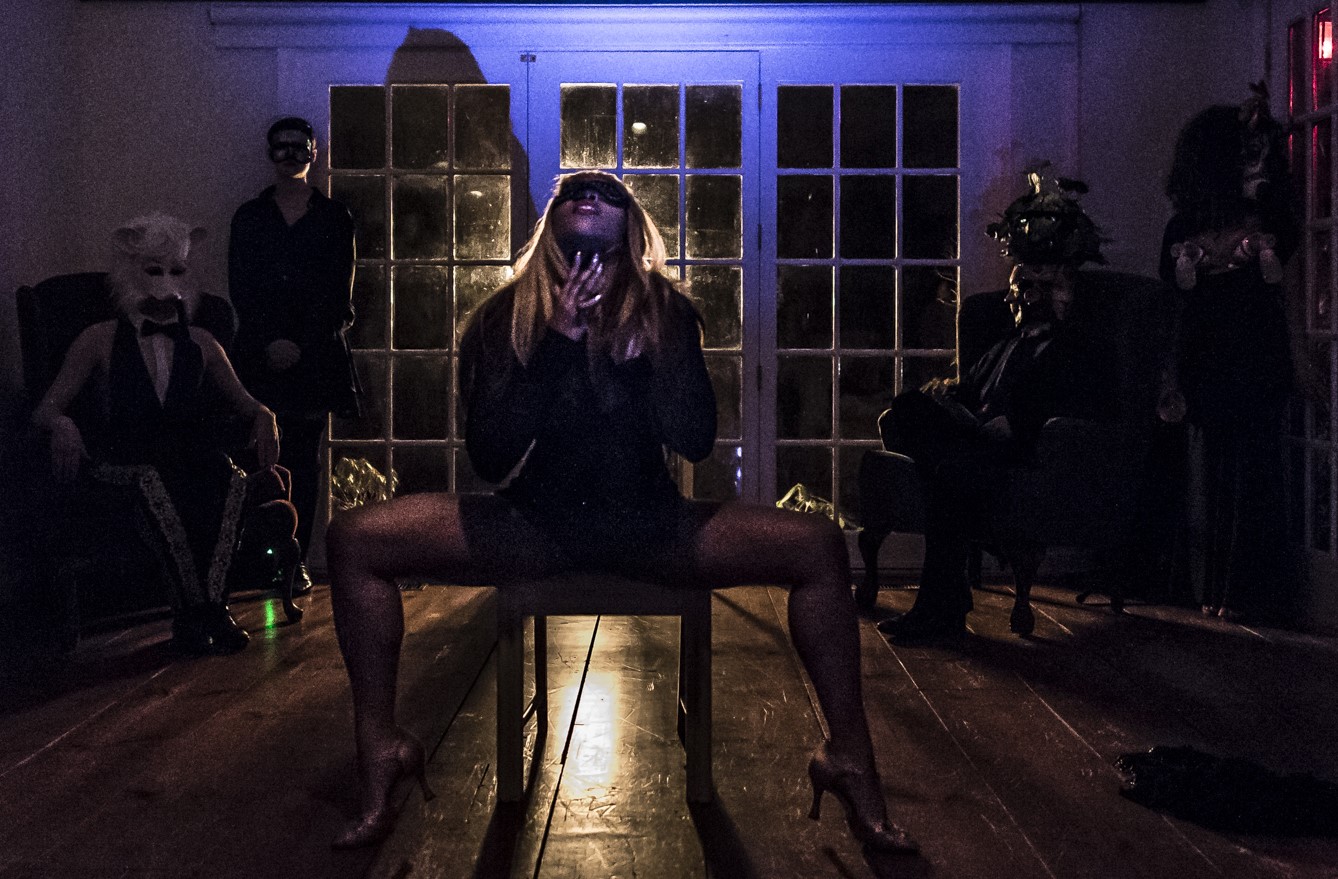
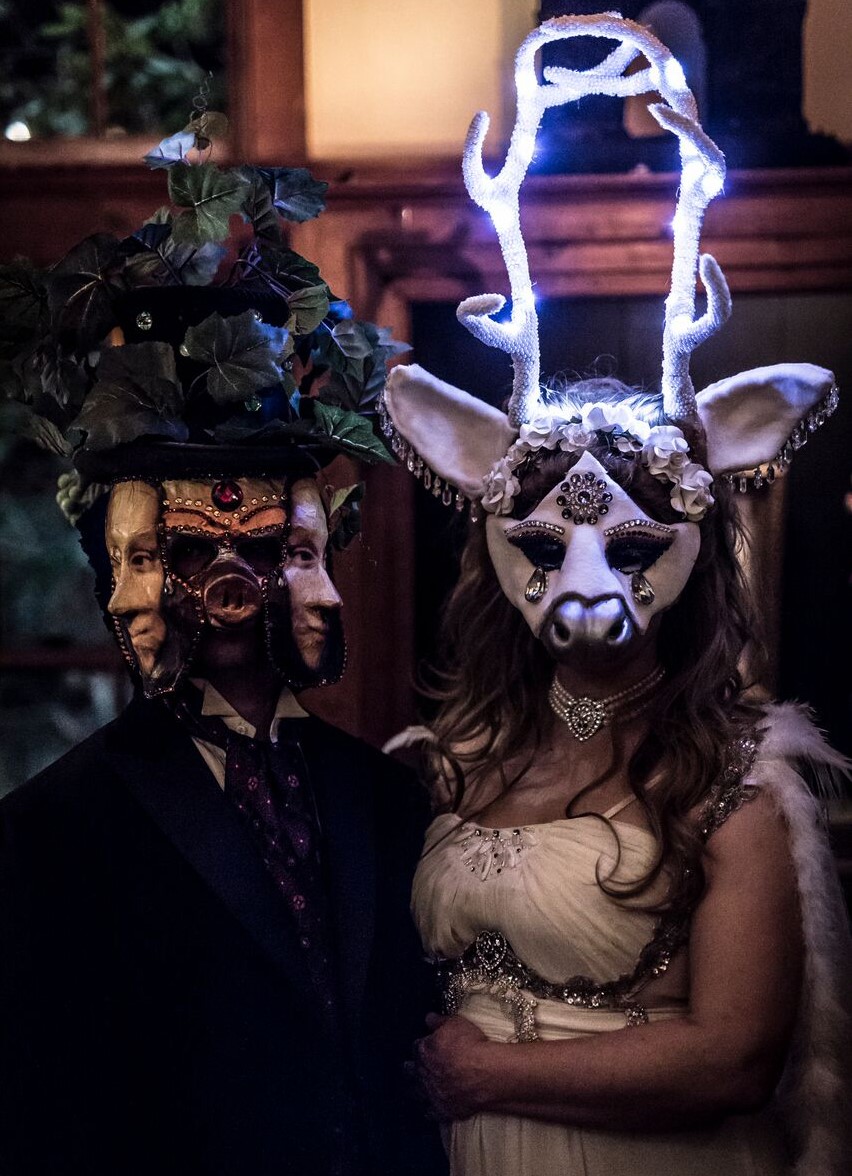
In 1972, wealthy Parisian socialite Marie-Hélène de Rothschild threw an elaborately occult Illuminati Ball at her family’s chateau. Guests of honor included Salvador Dali and Audrey Hepburn, and the coveted invitations requested “black tie, long dresses, & Surrealist heads.” Today, nearly 50 years later, immersive maven Cynthia von Buhler reimagines the Illuminati Ball at her estate, and her guest list could include you. Known for her previous immersive productions Speakeasy Dollhouse and Midnight Frolic, von Buhler is at it again with her most exclusive experience yet. 

Like the original Rothschild event, von Buhler takes care to construct an atmosphere of selectivity and secrecy beginning at the participant’s initial point of entry. Potential guests must apply for attendance and, once chosen, are delivered precise instructions on what to wear and where to meet. Von Buhler then shuttles participants to her estate via a limousine fitted with blackout curtains. For even the most seasoned immersive theatergoers, the secretive applications, invitations, and strict instructions are enough to drum up some excitement and anticipation about the evening to come.

Once at the estate, participants are greeted with an intriguing welcome ritual, which sets the mood for the evening’s slate of variety performances. The masks and costumes designed by Kat Mon Dieu skillfully echo the leaked photos of the original ball, reiterating the pagan imagery of hybrid human-animals that continues throughout the experience.
 
As in Midnight Frolic, von Buhler convenes a dream team including burlesque legend Delysia LaChatte (Circe), operatic songbird Katie Kat (Parthenope), and fire performer Lady Blaze. LaChatte especially captivates with her dynamic fan and chair work (and as a woman of color she also adds some much needed diversity to the cast). During dinner, aerial duo Rachel Boyadjis and Sara Zepezauer will leave guests speechless with their strength and sheer beauty.  While strong female performances recur in Illuminati Ball,so does female nudity. Oddly, however, none of the men in the production disrobe—an unfortunate perpetuation of traditional gender politics. 

While the individual talents of the interspersed performances provide ample diversions, certain aspects of The Illuminati Ball disrupt its immersive flow. A bit of shuffling amongst organizers while boarding and riding the limousine partially dispels the illusion that participants are actually being considered for candidacy in the Illuminati. While it is no small feat to conceal the complicated logistics involved in such an elaborate immersive experience, the success of the production relies on this very concealment. Furthermore, Illuminati Ball seems only partially committed to its narrative. Some performers, such as the honey-voiced Eden Atencio as Kamadhenu and von Buhler herself as the heiress of the estate, seem more committed to interacting candidly with audience members.  Other characters seem more concerned with advancing the plot, which crescendos confusingly in the middle of dessert. Transitions between dinner, group scenes, and individual interactions feel a bit like herding cats.

Casting the production’s somewhat disjointed storyline aside, Illuminati Ball provides something else far more special in its discarding of the fourth wall. The ability to eat with and interact with the actors and the fellow attendees is the production’s greatest joy. 

The conviviality is amplified by the evening’s spread of small plates and cocktails, the quality of which far surpasses any usual dinner theater fare. The dinner, lovingly prepared and artfully plated by chef Erin Orr, consists of delightful colors and textures. The real sorcerer behind this production is mixologist Bootleg Greg, whose (virtually unlimited) flavorful concoctions fuel the evening’s revelry. For better or for worse, the drama of Illuminati’s muddled storyline is eclipsed by the evening’s more sensual pleasures of food, drink, socialization, music, and dance. In any case, the most pleasant surprise of The Illuminati Ball is its unique ability to facilitate connections among audience members, actors, and performers as they carouse in the moonlight. 

The Illuminati Ball: An Immersive Excursion by Cynthia von Buhler runs bi-monthly on Saturday evenings through Aug. 20 (specific dates here) at 6 p.m. at a secret location one hour outside of Manhattan. Apply for attendance here

Click for print friendly PDF version of this blog post

Loss Takes On Many Forms

Holding on to the past can weigh upon a family. In her first play, Keep, Francesca Pazniokas explores how the emotional weight of a missing woman burdens her three sisters. Keep is inspired by her years of struggling to mask an addiction to hoarding. The production centers on a young hoarder, Naomi (Kim Krane), and her older sisters, Jane (Madison Comerzan) and Kara (Jenna D'Angelo). As Jane and Kara attempt to clean Naomi’s cramped apartment, they learn about what happened to their sister, Margo (Leslie Marseglia), who disappeared some years earlier. No, Jane and Kara do not find Margo’s decaying body underneath Naomi’s rug. Instead, they discover how disconnected their sisterhood has become.

Naomi does not sleep much and spends most of her time within a small area of her apartment, surrounded by junk and next to her filthy mattress. Jane and Kara arrive, and the three women blend together. They give bland first impressions as characters and are not easily distinguishable. Shortly after, Jane is revealed as more than a doting, artificial suburbanite who affectionately calls Naomi “Nooni”; she’s a lesbian who is in a relationship with a psychiatrist. Kara takes on a reckless and commanding leadership role and demands that the apartment be cleaned. Meekly, Naomi follows along with uncluttering her apartment and goes in and out of spouting incoherent passages like, “A rabbit, I think. A rabbit kicks a clot of blood and it–or someone boils it. I’m trying to remember. I think it was a rabbit.”

What doesn’t ring true is the sense of an actual intervention like those shown on an episode of A&E’s addictive television show Hoarders. The twist that is offered in Keep does not cure Naomi of her hoarding disorder. Other disorders like attention-deficit/hyperactivity disorder (ADHD), obsessive-compulsive disorder (OCD), obsessive-compulsive personality disorder (OCPD) and depression can be associated with hoarding. It is ambiguous if Naomi is struggling with any of these associated disorders or if she is just schizophrenic or bipolar. Hoarders are likely to be more guarded and attached to their items than Naomi’s passive nature indicates, and so Naomi’s hoarding disorder lacks some credibility. Although director Stephanie C. Cunningham brings out the sense of loss the sister feel, perhaps she could have urged bolder character choices.

The play is supposed to take place somewhere along the East Coast during the transition from winter to spring, but this is also ambiguous. Set designer Alfred Schatz creates a hoarder’s haven, with stacks of unpacked moving boxes, piles of old mail, and random pieces of furniture. It is like an antique store that has been turned into a storage unit. The set becomes enchanting after Margo appears, when lighting designer Cate DiGirolamo transforms the ceiling into a sparkling starry night.

The storytelling techniques used to show how these three sisters deal with the loss of Margo is the real value of this 80-minute production. Though they start out seeming indistinguishable, it becomes clear that Naomi lives in the past, Kara lives in the present, and Jane lives in the future. The distance between the three of them also brings them together because the separation reminds them of the intimacy they all once shared. Only Naomi really knows what happened to Margo, but, through the help of Jane and Kara, Naomi eventually reveals the truth.

Although simple and subtle, the play lands like a character study, without strong motivations from the characters. Because the characters do not coherently or explicitly stand for something, it is the plot that eventually moves the discussion forward. Pazniokas aims to dive deep into America’s “disposable society” and the value of human life, but lands somewhere between vaguely characterizing mental illness and grief.

The production is more successful at conveying how young women cope with isolation and alienation. The sisters’ disconnection is not due to modern technology or even mental illness in Keep, but because these characters have withheld who they really are from one another for so many years. The bonds of sisterhood began disintegrating after Margo left; the absent sister is the only one who frees herself of this burden but is unsuccessful at transforming her sisters—and this is where the true divide lives. Keep reminds theatergoers that the affinity shared between sisters can be powerful and ephemeral.

Keep runs until April 30 at the TGB Theatre (312 West 36 St., between 8th and 9th avenues) in Manhattan. Evening performances are at 8 p.m. Thursday through Saturday; there is an additional performance on April 27 at 8 p.m. There are no matinees. Tickets cost $18. To purchase tickets, call 800-411-8881 or visit BrownPaperTickets.com.

Click for print friendly PDF version of this blog post

Breaking Gender Barriers in ‘Shrew’

New York theater is known for challenging the status quo, and  that is what the Queen’s Company is all about—breaking down barriers by creating gender-blind performances of the classics and reaching out to a broader, more diverse community in its perspective on those classics, in particular Shakespeare. Artistic director Rebecca Patterson’s vision shows she understands that Shakespeare transcends time and place. His characters represent all of humanity and hit at a deeper core—the truly humane one. Because every actor was cast according to how her personality fit the role, not according to gender, the production is an organic ensemble theatrical experience.

photo by Bob Pileggi

Patterson, a Lucille Lortel Award winner, is an actor’s director. Every moment in the play was active, honest and alive with brilliance. Having the role of Bianca played by the lovely Sweetie Doll (a blow-up sex doll) was a hysterically funny touch. In that single choice, Patterson shows one of the most important themes of the play—women’s oppression by men’s control of sexuality. Choices in music that fit key moments of the performance further heighten that theme and the emotional tension of this famous love story. Particularly funny yet thought-provoking was the pantomime of a Tina Turner song performed by Petruchio’s motley servants, led by Ashley Samona Baker as Grumio. As they perform, Katharina fights her shrewish instincts to be right. The lyrics and their playful performance reveal the inner conflict of that moment when Kate breaks and realizes she is fighting a losing battle.

The cast is perfect. The entire ensemble deserves praise for playing multiple roles with ease. Elizabeth Preston as Petruchio was spot on. Catherine Dalton as Hortensio was delightful in her Brant Russell physicality. Their playful interaction was reminiscent of Orlando Bloom and Johnny Depp in Pirates of the Caribbean. But Preston was no overacting pirate; she was more like Depp in Chocolat—sexy, sensitive, cool. She captured Petruchio’s arrogance and willfulness, but also his vulnerability. Preston reveals Petruchio’s genuine respect and interest in Katharina when Petruchio reflects on how Katharina aggressively deals with Hortensio as the ill-fated music instructor: “Now, by the world, it is a lusty wench. I love her ten times more than e'er I did.” Preston’s performance breaks the gender barriers, yet nothing is overstated or falsely posed. In her direction, Patterson has shown the true meaning of Petruchio and Katharina’s relationship—they represent all the nuances of falling in love and giving oneself over completely to another.

photo by Bob Pileggi

Tiffany Abercrombie is a stoic Katharina, creating a mother of the modern woman. The chemistry between Petruchio and Katharina is crucial to this play, and these two sensual interpretations reveal perhaps a more honest point Shakespeare was making—that love is not a prideful battle but a partnership made from love and respect. Under Patterson’s thoughtful direction, Abercrombie’s heartfelt confession as Katharina, as she infamously reprimands women, becomes more a proclamation of true love. And Petruchio’s response becomes that of a repentant faithful lover.

Their final kiss truly is a declaration of respectful love. It no longer is an issue of man’s will against woman’s but more about how wonderful love can be when it is with the mate who is a perfect match. Patterson’s interpretation gives Shakespeare’s play a fairy-tale ending of renewed faith in love, not a battle of wills and submission.

The set, lighting and costuming were simple and basic, with a dance of colors rich with textured fabrics of wool, fur, and velvet fully enhancing the raw beauty of the time and place of this wonderful play. Muted blue lighting against the brown wools and furs for the servants, the burgundy velvet for Baptista, and the bold red lace for Katharina mirrored the emotions of the characters but also reflected the barriers of caste and class.

Patterson’s talented entourage of technical artists worked seamlessly within her artistic vision. Set designer Angelica Borrero, lighting designer Alberto Ruiz, costume designer Elizabeth Flores and sound designer Beth Lake created an atmosphere that set the tone and playful mood of this timeless story. Patterson and her troupe really honored Shakespeare and all he represents in theatrical history. For Shakespeare lovers, this is a must-see production.

The Queen’s Company’s The Taming of the Shrew runs through May 1 at the Wild Project (195 East 3rd St., between Avenues A and B). Performances are at 8 p.m. Tuesday through Saturday and at 3 p.m. on Sunday. Tickets are available by calling (866) 811-4111. Tickets are 2-for-1 on Tuesday nights. For information, visit http://QueensCompany.org.

Click for print friendly PDF version of this blog post

Ancient Cradle of Rationalism

The pleasures come out of left field in Nathan the Wise, a 1787 play by Gotthold Ephraim Lessing that most theater aficionados would not expect to see staged—if they had ever heard of it. Even Lessing never saw it produced; the original production, after his death in 1781, flopped. Schiller revised it for a successful 1801 production, and Goethe acclaimed it, and if not for the championship of those two great playwrights, it might still be gathering dust in a library in Deutschland. So artistic director Brian Kulick deserves kudos for choosing this rarity as his valedictory production before handing the reins of Classic Stage Company to John Doyle.

Lessing’s original runs more than four-and-a-half hours, according to adaptor/translator Edward Kemp, who has rendered the verse into prose and made massive cuts. What’s left still reflects Lessing’s Enlightenment respect for Judaism, Christianity and Islam. The conflict of the three great religions is interwoven in Lessing’s plot, which rests on coincidences, but ones that are unforeseen, for the most part.

Lessing’s story involves Nathan (F. Murray Abraham), a kindhearted Jewish merchant living under the rule of Saladin in 1192, after the Sultan has driven out the Crusaders. He has just returned from a trip to buy goods. During his absence, his daughter, Rachel (Erin Neufer), was rescued from a fire by a Knight Templar (for film buffs, the Knights Templar are the same guys who fashioned a falcon on Malta a few centuries later).

The knight, Conrad, was walking the streets after being released from prison by a merciful Saladin (Austin Durant). The Templar, a rarity now that the Crusaders have been driven out, finds himself attracted to Rachel. Meanwhile, Saladin’s unexpected mercy to the Christian soldier is rumored to be due only to Conrad’s resemblance to the Sultan’s brother Assad, who disappeared years earlier. (Lean and pale, Stark Sands doesn’t resemble anyone Middle Eastern, so whatever resemblance one is expected to embrace is a stretch.)

For his part, Nathan is married to a Christian woman, Daya, who was born in Europe and apparently maintains her religion while married to Nathan, although Rachel has been raised as a Jew. Other characters include Saladin’s sister, Sittah (Shiva Kalaiselvan), who keeps her brother company and bails him out financially from the cost of his wars, although he is close to bankrupt and needs to borrow from Nathan. Lastly, there’s a dervish who has become Saladin’s treasurer and has seen how the sultan’s wars have drained the country’s coffers.

Tony Straiges’s simple décor of Oriental rugs, a chessboard and camp chairs for the characters evokes Jerusalem in 1192, shortly after Richard the Lionheart has departed. Indeed, Saladin’s sister Sittah was once considered a possible mate for Richard’s brother Prince John, the same Prince John who persecuted Robin Hood and later signed the Magna Carta—but those are other stories.

Still, Kulick maintains the atmosphere of a fable as Lessing's Enlightenment rationalism shows a society in which characters of different religions figure out how to live in relative harmony. A projection of bombed-out clay homes in the Middle East, with satellite dishes and telephone lines, overlain at times by Arabic script, provides some connective tissue to modern strife, and the characters, though dressed in gorgeous robes—the Jews’ have Hebrew lettering—occasionally appear with modern clothes. But the contemporary touches are subtle, and there’s a gentle, friendly atmosphere. All the characters are so good that it’s just a tad dull. By intermission one questions where the conflict is.

The second half provides it, as Conrad, whose roots are in Swabia, a district of Germany, learns Rachel was born Christian; his heathen-hating Crusader instincts kick in. Danger increases after Conrad approaches an old priest (John Christopher Jones) with a hypothetical situation—Jew raises Christian girl—to seek guidance, but the priest reports him to the patriarch, and Conrad is called on the oriental carpet, as it were. The patriarch wants him to assassinate Saladin, who has learned of Conrad’s relationship to Rachel and has also been befriended by Nathan, who wants to lend him money.

How it all plays out is unexpected, although the twists may become apparent shortly before they occur. But there’s such a pleasant atmosphere of idealism, respect and generosity that one comes away delighted by its virtues.

Brian Kulick’s farewell production, Nathan the Wise, plays at Classic Stage Company (138 E. 13th St. between Third and Fourth Avenues) through May 1. Evening performances are at 7 p.m. Tuesday through Thursday and 8 p.m. Friday and Saturday. Matinees are at 2 p.m. Saturday and 3 p.m. Sunday. For ticket information, call (212) 352-3101 or visit classicstage.org.


Click for print friendly PDF version of this blog post

Pleasing the Parents Moscowitz

Right out of the gate Marshall Goldberg’s original comedy Daddy Issues gets the audience laughing. As lights go up on the lead character, Donald Moscowitz, the audience sees his perfectly toned tush doing what appear to be butt exercises while he’s looking for his cat. “Here pussy-puss-puss. That’s a good kitty. Meow,” croons Donald.

Click for print friendly PDF version of this blog post

Tongue, Meet Cheek

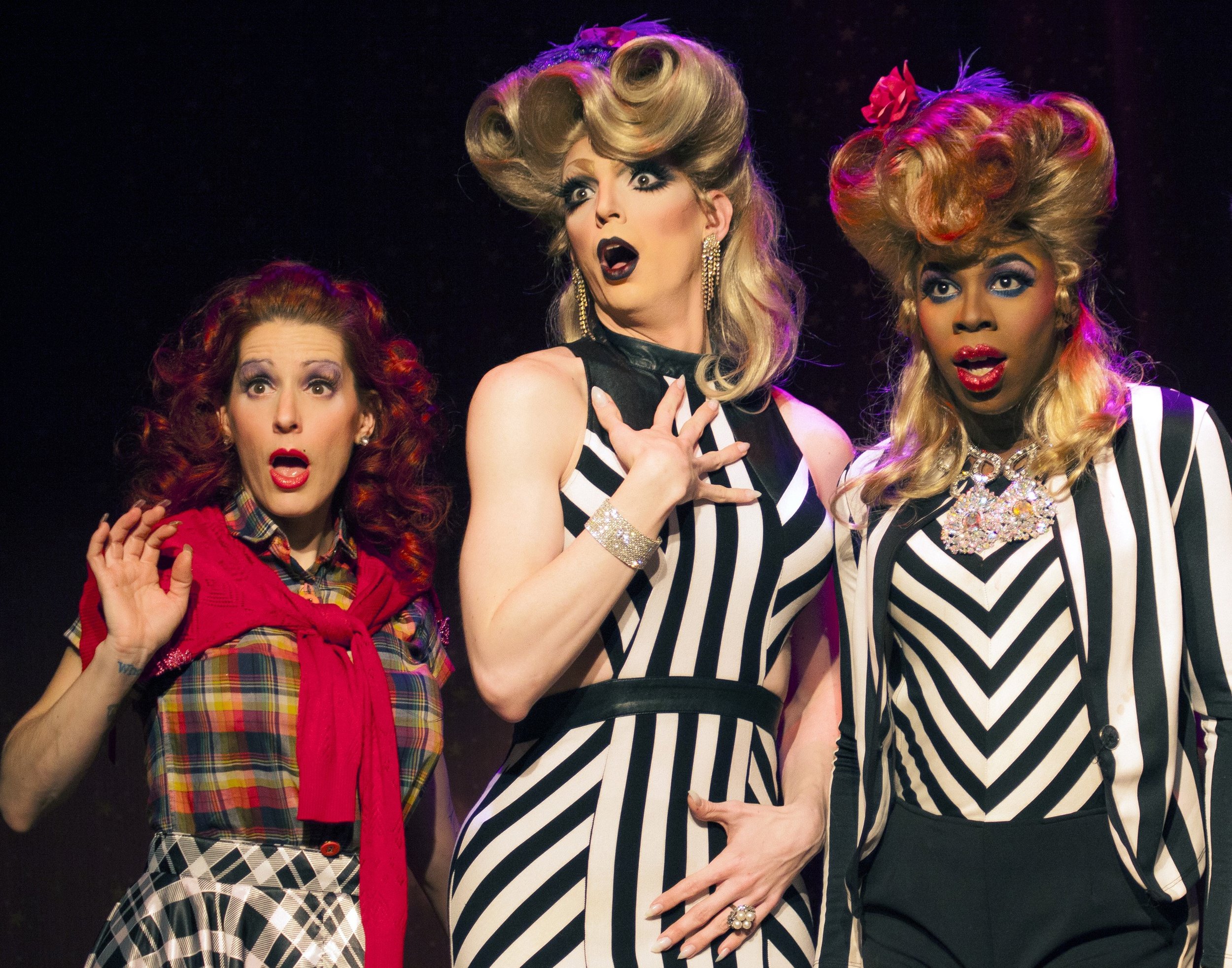
Follow Nasty Drew (no not a typo) and the Harder boy (well, there is only one after all) as they attempt to solve The Mystery of the Family Jewels, a fun, sexy, raucous evening of tongue-in-cheek comedy, a little drag (hello, family jewels?) and some outrageous burlesque. What burlesque has to do with a spoof of the teen-mystery-novel genre is a good question, but somehow they seriously pull it all together and take it all off. 

The mystery is set up by Franklin W. Dixon and Carolyn Keene, respective authors of the super sleuths’ series, The Hardy Boys and Nancy Drew. Tigger! as Dixon and Fancy Feast as Keene are as colorful as their names, in a Dead Men Don’t Wear Plaid kind of way, and create a playful, publishing-world rivalry. When Dixon attempts to engage Keene in a dialogue about the Hardy Boys, she dismisses him with, “Those two boys, always carousing around in that flashy convertible, always seeking to emulate and please the Hardy patriarch. Such strong father issues.” Dixon, not to be outmaneuvered, refers to Nancy Drew’s “questionable relations with those lady ‘cousins’ of hers…” The evening is filled with double entendres (“It’s even more colossal than my ‘Case of the Mysterious Hole in the Wall’”) and early Batman/Boy Wonder dialogue (“Jumpin’ catfish, what is it?”) Laughter, mixed with a ton of silliness and a whole lot of skin, will certainly chase the workday blues away.

Dixon and Keene introduce Nasty Drew (Nasty Canasta) and That Harder Boy (Chris Harder) who take on solving The Mystery of the Family Jewels, which is written and directed by Harder. In the course of the investigation, they meet with the buxom Lady Sussanah LaVeux De Cock; her bawdy cousin Mona Crackers; randy Police Chief McDaniels; the mechanic with lesbian tendencies Nadina North; and Cecilia “Sissy” LaVeux De Cock, Lady LaVeux De Cock’s estranged “twin” sister, among others. (The characters are played by a rotating cast of performers based on the show’s schedule.)

In The Mystery of the Family Jewels the puns, sight gags and extraordinary burlesque keep coming. Pearls Daily as Mona Crackers, who is purportedly from the wrong side of the tracks, delivers a 1920s style flapper number in a wonderful homage to the queen of burlesque, Gypsy Rose Lee. Nasty Canasta follows with a funny and entertaining undercover number employing a fake nose, glasses and mustache, which at first glance seems silly, but just wait.

Feast, who also plays North, Brookeville’s “semiretired, show-stopping sensation of stage and screen,” performs a most bodacious burlesque piece and steals the show with dialogue in the manner of legendary Mae West. Not to be outdone, the men have their own time baring all in the limelight. Ben Franklin as Police Chief McDaniels pulls off “You’ve gotta have a gimmick” burlesque that is straight—in this context used loosely—from Gypsy with hula hoops, the unbelievably limber Tigger! takes it down to a sock puppet, and Chris Harder woos the fans in his unforgettable, charming style, sock garters and all.

The show is sponsored in part by a few local businesses, and commercials are written into the script to promote them. It’s a fun gimmick that needs more attention to detail in the venerable, radio announcer style. Although issues with the show's sound and lighting may be attributed to the slightly random performance schedule, the biggest drawback is that some comic lines can’t be heard and sound levels overpower a few of the songs.

It’s evident that the Mystery of the Family Jewels has a following with a rowdy, adoring audience in attendance, and it’s easy to see why. The cast, taking their lead from Harder and Canasta, has a blast giving their all and baring all. If they break character or a prop doesn’t appear as expected, don’t be surprised, it just adds to the frivolity.

Performances of Mystery of the Family Jewels are 10 p.m. April 29 and  May 13 and 9:30 p.m. May 1 and 15 at the Laurie Beechman Theater inside West Bank Cafe (407 West 42nd St.at Ninth Avenue). The theater is accessible from the A,C,E,N,R,V,F,1,2,3 trains at 42nd Street. Tickets are $22, plus a $20 food/drink minimum. A $35 VIP ticket includes reserved seating, a gift bag and a meet-and-greet. To purchase tickets, call 212-352-3101 or visit www.SpinCycleNYC.com.

Click for print friendly PDF version of this blog post

Q&A: The Queen’s Company’s ‘Shrew’ Is on Message

The very notion or necessity of taming an outspoken, independent woman—or a shrew—is about as offensive as it gets. It’s a criticism Shakespeare came up against even in his time, so any production today must partly run afoul of such discussion. But Rebecca Patterson has been directing the play long enough to know better. Having first done Taming of the Shrew in 2005 and having workshopped it for the last few years, she’s secure in the knowledge that Shakespeare always moves “toward the light” and doesn’t worry that the real message will be lost.

OffOffOnline: What is your interpretation of The Taming of the Shrew?

Rebecca Patterson: Shakespeare is a humanist. He has extreme compassion for people who are getting the short end of the stick, so this is not a battle of the sexes. It’s about marriage and the oppression that happens at the most intimate of places, which is in our hearts and our bedrooms. On the other hand, he’s also extremely honest, and writing in a misogynistic time. This meant he explored his world but still hoped to shift domination and submission in relationships on a path toward egalitarianism.

OffOffOnline: Are we allowed to laugh?

Patterson: That’s what’s so amazing about the play. It’s dark, it’s dangerous, and it’s funny. Of course, the situation Katherina is caught in is not funny. But one of the most empowering things you can do is laugh or tell a joke.  So there are points that are hilarious, but the one thing that is often ignored is the Bianca story. What I’ve done—given the expectations for her suitors—was have her played by a—

OffOffOnline: By what?

Patterson: A blow-up doll.

OffOffOnline: Oh, really.

Patterson [laughing]: Exactly. A blow-up doll is perfect, because she’s what everybody wants her to be.

OffOffOnline: Does she speak?

Patterson: That’s what made it so easy to lift out her lines. She doesn’t really affect anybody and doesn’t have any effect. So people talk around her, but she does speak at the end because even the blow-up doll finds her voice.

OffOffOnline: What are you trying to get across by using an all-female cast?

Patterson: Nothing. One of the things that I’ve found is contemporary women are better able to channel the Renaissance male reality, which is emotionally accessible and strong. Still, Shakespeare is all about humanity—not necessarily men and women. So if we do an all-female cast, it resonates simply as human.

OffOffOnline: Why do you think women have better access?

Patterson: Because contemporary men from a young age are taught not to show their emotion, but the Renaissance man must have a fully expressed emotional life to understand Shakespeare’s journeys. You have to see into their souls, and that degree of inner transparency is easier for contemporary women.

OffOffOnline: How else do you diverge from the original?

Paterson: Shakespeare is like a diamond: there are so many difference facets. But I am true to the words that are spoken. The only thing is I have streamlined some scenes because the theatrical expectations are different from the audience. Still, people always ask if I keep the final scene where Katherina lays out the expectation that women had to be subservient. That’s what he wrote. Shakespeare was being honest, but the play doesn’t end there. We take a modern context. For anybody who’s been caught in a marriage of subservience, there’s a journey that still needs to be taken—especially for the dominator to get to a place where they can truly love.

OffOffOnline: Was Shakespeare the only one who wrote in rhyme?

Patterson: They all wrote that way at the time. It was thought that the elevated speech was how you unleashed the human heart. Shakespeare was just the one who did it best.

OffOffOnline: What if you don’t necessarily speak Shakespeare. Can you still enjoy this?

Patterson: My actors are extremely talented and well trained classical actors. So people walk out of our play, and say, “I’m impressed how you updated the language.” But we don’t. The trick is you have to find the rhythms of the language. I liken it to rap. So we make him strut, and the consonants and vowels actually reach inside of us to play our hearts.

OffOffOnline: How do you see your role as a director?

Patterson: My actors see the text as I do, so all I do is guide them to places where there might be a misinterpretation. It’s less about doing it wrong, and more about “There’s something else here” or “I don’t think this is what the moment is about.”

Tickets can be purchased by calling OvationTix at (866) 811-4111 or online at web.ovationtix.com/trs/cal/621/1459483200000. The Taming of the Shrew runs through May 1 at the Wild Project (195 East 3rd St. between Avenues A and B) in Manhattan.
Performances are at 8 p.m. Tuesday through Saturday and 3 p.m. on Sunday.

Click for print friendly PDF version of this blog post

Henry V

Henry V

Henry V, the capstone of the Royal Shakespeare Company productions at BAM in this 400th anniversary year of Shakespeare’s death, is a robust staging of a play often regarded as excessively jingoistic. Yet in the hands of director Gregory Doran, it proves far more nuanced than that, a lively and fascinating mixture of the heroism and opportunism that war produces. Alex Hassell inhabits the nobility of Henry V more persuasively than he does the callow prince in the two parts of Henry IV; tall and strapping, he bears the weight of duties with confidence and speaks the renowned speeches thrillingly.

Click for print friendly PDF version of this blog post

Henry IV, Parts 1 and 2

Henry IV, Parts 1 and 2 feature image

Shakespeare’s two plays that focus on the reign of King Henry IV are a panoramic view of medieval life. The historical portions, which occur early in the 1400s, take on the question of a monarch’s duty to his country, not least of which is preparing the heir to take over. Ignoring his father’s complaints, Prince Hal (Alex Hassell), Henry’s heir, fritters away his time with lowlifes, notably Falstaff, the fat, rascally knight who is one of Shakespeare’s great creations. The political maneuvering of nobles in rebellion also shapes the narrative about high-born responsibility, leadership and compassion.

Matthew Needham plays Hotspur in Henry IV, Part 1. Top (from left): Antony Sher as Falstaff, Sam Marks as Poins, and Alex Hassell as Prince Hal.

Matthew Needham plays Hotspur in Henry IV, Part 1. Top (from left): Antony Sher as Falstaff, Sam Marks as Poins, and Alex Hassell as Prince Hal.

Yet in the tavern scenes and, in Part 2, the country scenes with Justice Shallow and Silence that involve conscription of men for war, the life of the common man is portrayed, more closely reflecting Shakespeare’s own time. From the king down to the lowest conscriptee, the plays provide a broad view of issues that touched Queen Elizabeth I and her subjects.

As Henry IV, Part 1 opens, the king (Jasper Britton) announces plans for a crusade to Jerusalem to retake the city from the Saracens—something he promised in his last speech in Richard II, the chronological predecessor (and also part of the RSC’s visit to the Brooklyn Academy of Music). Quickly, however, Henry is advised of rebels gathering against him: the Earl of Northumberland (Sean Chapman), a former ally in deposing Richard II; his brother, the Earl of Worcester (Antony Byrne); Northumberland’s son, and Lady Percy’s brother, Lord Mortimer (Robert Gilbert). Chief among them, though, is Matthew Needham’s stunningly good Hotspur, a fierce, intemperate warrior whose skill at arms is set against the dissipated life of Prince Hal (Alex Hassell). The trip to the Holy Land must be postponed.

Falstaff, the surrogate father to Hal, is embodied by Antony Sher, a great actor who has nevertheless seldom tackled comedy. Anyone who has seen him in classical roles (Massinger’s The Roman Actor, Marlowe’s Tamburlaine, Marston’s The Malcontent) knows he is a master of the language and a powerful stage presence. As Falstaff, though, something is not quite right. Sher growls a lot to sound dissipated and lumbers around to seem overweight. He can nail the wit, but one has the impression of someone giving a grand performance (and Falstaff is an actor at heart) but not completely inhabiting the character. He’s great fun to watch, but his roistering as Falstaff doesn’t feel natural. Yet there are splendid moments: when he’s trying to connect with his cronies in the darkness on Gad’s Hill to rob some pilgrims, he comes on, stepping slowly and whispering loudly, “Poins? Poins?” to find his compatriot.

Needham (right) with Jasper Britton as King Henry IV. Photographs by Richard Termine.

Needham (right) with Jasper Britton as King Henry IV. Photographs by Richard Termine.

In a similar way Hassell is not totally persuasive as Hal. Frivolity and callowness don’t sit naturally on him, but as he assumes the gravitas required of a future king, he becomes more persuasive. He gives the speeches clearly but, perhaps because he’s the centerpiece of three plays, there are times when they’re closer to masterly recitation than insightful characterization.

In Part 1, however, Britton, overshadowed in Richard II by David Tennant’s terrific performance, comes into his own as Henry, the usurping king who struggles with his son’s wastrel ways. His halting first lines, “So shaken as we are, so wan with care,” present a royal whose voice literally trembles. And news of Hotspur’s valor against rebels brings joy until his counselor Westmoreland remarks, “It is a conquest for a prince to boast of”—pointing up that Hal should have been leading the victory. The haunted Henry’s grappling with his son’s fecklessness is an important through line for both parts. Part 2, however, also affords Hassell the opportunity to navigate from Hal’s callowness to something that fits the actor better: nobility and valor.

Looser than Part 1Henry IV, Part 2 also lacks Hotspur. Moreover, the lower-class scenes in it prove a slog. One problem is that Antony Byrne’s Pistol, a swaggering braggart soldier, is a type that may have been funny 400 years ago but grates now. Made up as a yob, with thick black mascara under his eyes and a braid, and dressed in a punkish leather outfit by Stephanie Arditti, he is a tedious figure, offsetting Falstaff’s raillery. Thus, much of the first half of Part 2 is an ordeal, redeemed after intermission by Oliver Ford Davies’ hilarious Justice Shallow, paired with Jim Hooper’s wide-eyed, perplexed Silence.

Hassell as Hal banters with Sher as Falstaff.

Hassell as Hal banters with Sher as Falstaff.

But the most memorable scenes are those with Hotspur. “I can call spirits from the vasty deep,” says Joshua Richards’s Gandalfian Welshman, Owen Glendower, a behemoth in skins and long gray beard, and Hotspur’s in-law. To which Hotspur replies: “Why, so can I, or so can any man/But will they come when you do call for them?” And his scenes with his wife (Jennifer Kirby) are both touching and frustrating; though in love, each tries to connect emotionally with the other and doesn’t always succeed. Other standouts are Sam Marks’s vital Poins and Richards (again) as a red-nosed, dryly comic Bardolph, one of Falstaff’s cronies.

The plays are rich with smart business by director Gregory Doran. With Hotspur on a tear, his father, Northumberland, grabs him by the scruff of his neck and forces him to his knees. Some extended comic business with the serving-boy Francis plays beautifully (and sets up a cameo for Henry V). One clumsy interpolation, however, is Doran’s opening Part 2 with Rumour (Byrne) coming on in modern clothes against a field of projections of #Rumour. It may be intended to parallel gossip on the Internet, but it’s a jarring moment.

Though the first part is the stronger play, together the pair are an indispensable challenge that any lover of Shakespeare’s work will want to experience. They aren’t often done together, and this is an opportunity to hear verse-speaking of a high order and experience outstanding, if not flawless, productions.

The Royal Shakespeare Company’s Henry IV, Part 1 and Part 2 play in repertory with Richard II and Henry V through May 1 at BAM Harvey Theater (30 Lafayette Ave. between Ashland Place and St. Felix Street in Brooklyn). Tickets start at $35. Visit www.bam.org/theater for information.

Click for print friendly PDF version of this blog post

Boy? Girl? Or Both?

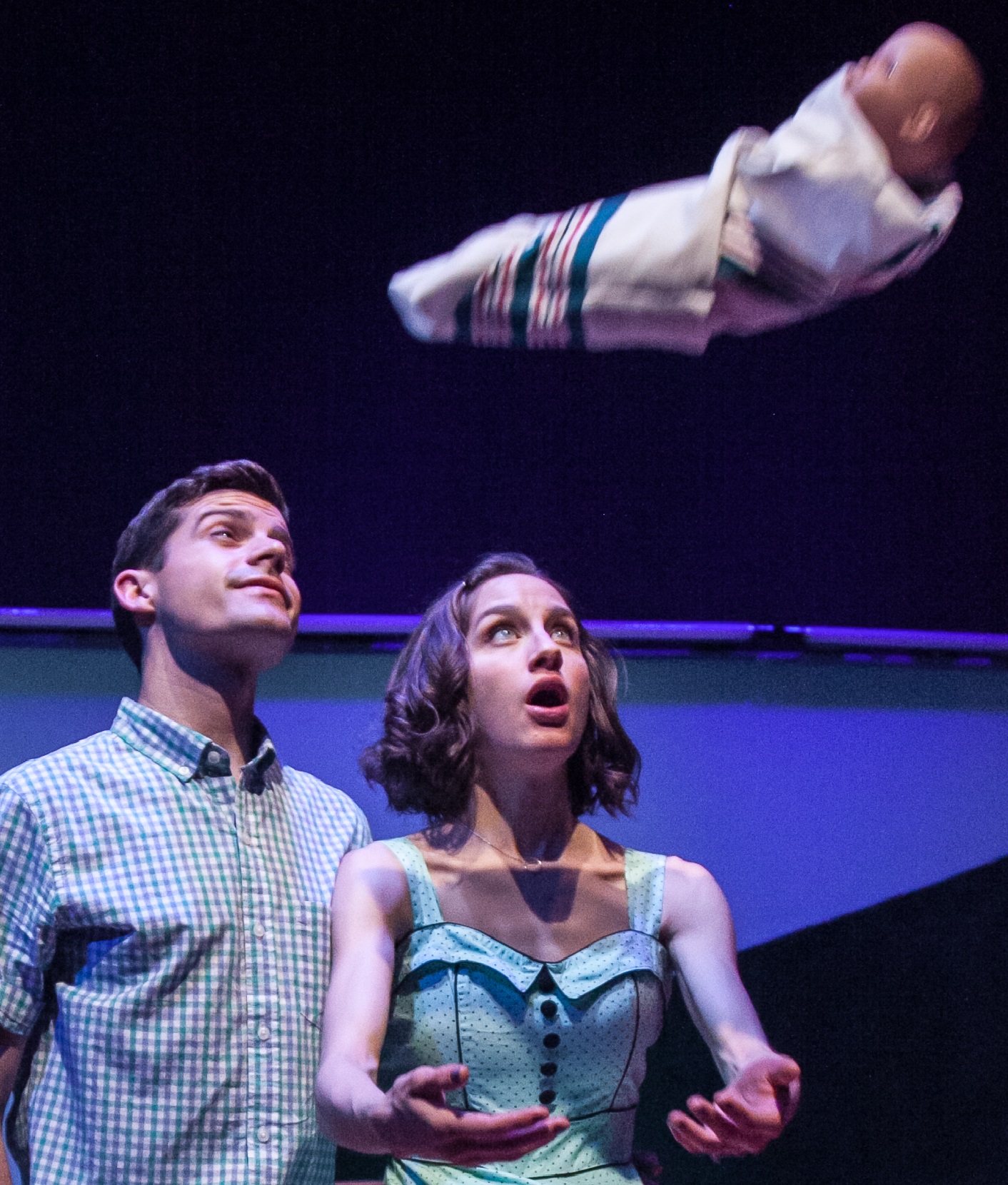
Darren and Janet are the typical white couple, living typical middle-class lives, and waiting for their baby to arrive. Will it be a girl? Will it be a boy? What the couple was not expecting was for the baby to be, well, both.  

Explaining gender and sex with an interesting twist, Happily After Ever is a pleasant way to begin a conversation about a hot-button issue. The play begins with Darren (Jeffrey Brian Adams) and Janet (Molly-Ann Nordin) meeting for the first time at a bus stop. “It’s so endearing and not at all coincidental that we happen to be two such attractive, single people sitting next to each other and waiting for a bus that won’t come,” Janet says as the two sit on a bus bench in the rain. And as quickly as their conversation started, the two become married, and suddenly Janet is pregnant—all  within about 10 minutes. This lighthearted, rom-com scenario of falling in love at first sight quickly changes when the couple finds out that their baby is intersex. The happy-go-lucky couple is then stuck with the tough decision—what sex should the baby be? 

The intersex baby becomes the “odd cookie out” in this cookie-cutter world, leaving Darren and Janet to figure out how to balance their love for their new bundle of joy with their fear of raising a child that is not like everyone else. For the rest of the play, the audience sees into the couple’s home and listens in on their conversations around what sex their baby should be. In addition to their baby’s sex, the couple comments on the way they act and how it is heavily influenced on their gender. With satirical humor drenched in almost every line, the conversations between the couple are upbeat and often produce chuckles.

To add pressure to these new parents, their neighbors, Jerry (Brennan Lowery) and Dharma (Marlon Meikle), come over every week for game night. This odd couple are the typical judgmental neighbors. They add to the satirical humor and outwardly judge themselves and their neighbors’ lives. Although they are jealous that the younger couple have a baby, their dissatisfaction of a baby being more than one sex increases the fear in Darren and Janet’s already distraught minds. Even their talking dog Tommy (Jim Anderson) can smell the sadness on Janet.

In a desperate need to go back to normal, the couple tries different ways to cope with their situation. They even try to ignore their infant:

Darren: I can’t think, Janet. It’s like there’s a noise that won’t go away…. It’s almost like…
Janet: A baby.
Darren: Not quite. Although now that you mention it…
Janet: It’s the baby, Darren.
Darren: Right. The baby.

Obviously this tactic does not work. Their distress escalates to a point where by the end of the play, Darren and Janet have to choose the baby’s sex. Will they choose a boy? Will they choose a girl? Or will they choose to leave the baby as it is and be both?

Sitting in an intimate theater, the audience will get a chance to laugh at the absurdity of the way gender is perceived through the eyes of two typical newlyweds with an atypical child. But in focusing on white middle-class adults, Zlatos steers away from delving into the experience of intersex people. Instead, she focuses the humor on the people who are not intersex. 

Costume designer Stephanie Levin helps to amplify these gender perceptions in costumes that reflect both femininity and masculinity. With a cute polka-dot dress for Janet and a fitted shirt and trousers for Darren, the couple is picture-perfect for any Friday night game night with the neighbors. To add to the contrast of female and male on stage, set designer Rebecca Lord-Surratt paints the stage with baby blue walls and hot pink floors, diagonally divided by a suburban green lawn. The set pieces are great for quick transitions and easily transform to the appropriate piece furniture during each scene, while the lights designed by Megan Dallas Estes give the set a crisp, clean sitcom feel. They fit perfectly in this quirky, perky look at gender issues.

Director Sherri Eden keeps up the quickly paced dialogue. The chemistry between Janet and Darren is a little more believable than the chemistry between Dharma and Jerry—however, both fall a bit flat. Their relationships lack a passion and connection with each other that makes their interactions with their significant others less interesting and exciting to watch. However, the overall performances of the actors are engaging and keep the audience giggling throughout.  

Happily After Ever is an enjoyable show with easy and lighthearted jokes. Shining light on the daily life of a struggling couple, their neighbors, and a talking dog helps the audience become aware how gender and sex heavily influence the way people think and act.

Happily After Ever runs until April 16 at 59E59 Theaters (59 East 59th St. between Park and Madison avenues) in Manhattan. Evening performances are at 7:30 p.m. Tuesday through Thursday and at 8:30 p.m. Friday and Saturday; matinees are at 3:30 pm. on Sundays. Tickets are $18. To purchase tickets, call Ticket Central at (212) 279-4200 or go to www.59e59.org.

Click for print friendly PDF version of this blog post

Richard II

Richard II feature image

Gregory Doran’s production of Richard II at the Brooklyn Academy of Music is a thunderous start to “King and Country,” the umbrella title for Shakespeare’s histories of three consecutive kings, Richard II, Henry IV (in two parts) and Henry V, visiting from the Royal Shakespeare Company, where Doran is artistic director.

Perhaps “thunderous” is not the right word, since David Tennant’s Richard is never shown at war, but is a frivolous and arrogant ruler as the play opens. He holds himself imperiously aloof in the early scenes, clutching his orb and scepter, but Tennant also finds much humor in the flawed character. The play turns on family relationships, and in describing his cousin, Henry Bolingbroke, the actor terms him “my father’s brother’s son” with slight hesitation between the words, as if Richard is saying to himself, “I’ve got to get this tricky part right.”

Jasper Britton (left) is Henry Bolingbroke and Matthew Needham is his son, Harry Percy, aka Hotspur, in Richard II. Top: King Richard II (David Tennant, right) with Sam Marks as Aumerle.

Jasper Britton (left) is Henry Bolingbroke and Matthew Needham is his son, Harry Percy, aka Hotspur, in Richard II. Top: King Richard II (David Tennant, right) with Sam Marks as Aumerle.

In order to fund wars to subjugate the Irish, Richard plans to tax the rich. With Bolingbroke banished for feuding with another noble, and his father, John of Gaunt, dead, Richard seizes the inheritance that belongs to his cousin, and goes off to war, where he is unaware of a rebellion at home: Bolingbroke has returned from exile to claim his inheritance and is likely to depose Richard. At the center of the play is the issue of divine right: does the king rule as God’s representative on Earth? Is everything he does God’s will?

Doran plays up the notion of Richard as a divine figure with costume supervisor Stephanie Arditti’s white robe that gives Richard, with very long hair, the look of Christ. The language of Christianity is threaded throughout: “balm,” “water” and “Pilate.” In a climactic scene, Richard himself calls his eventual killer “Judas.” (It’s a key change from Shakespeare, where Richard is slain by Sir Piers Exton, an assassin; this murderer is closer to home.)

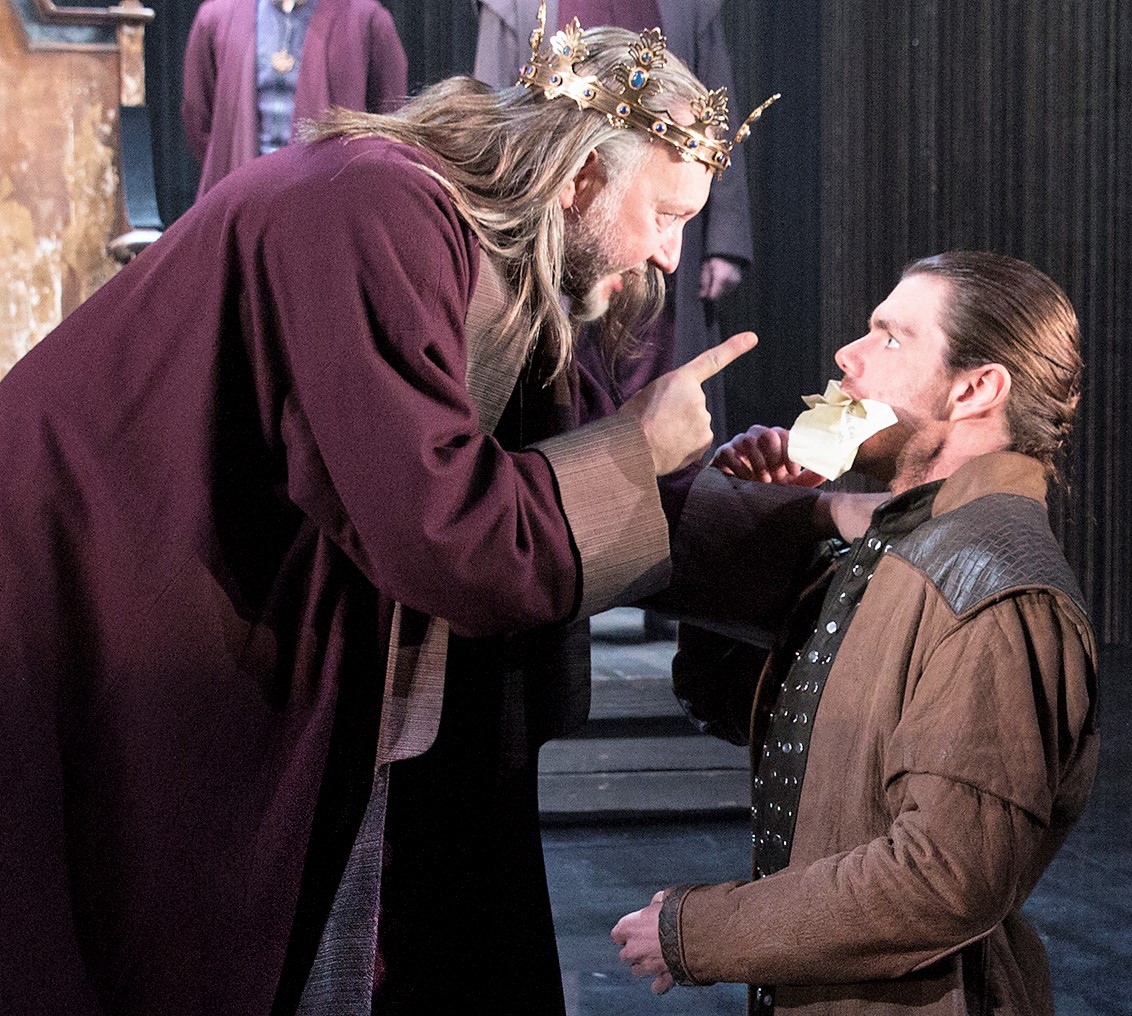
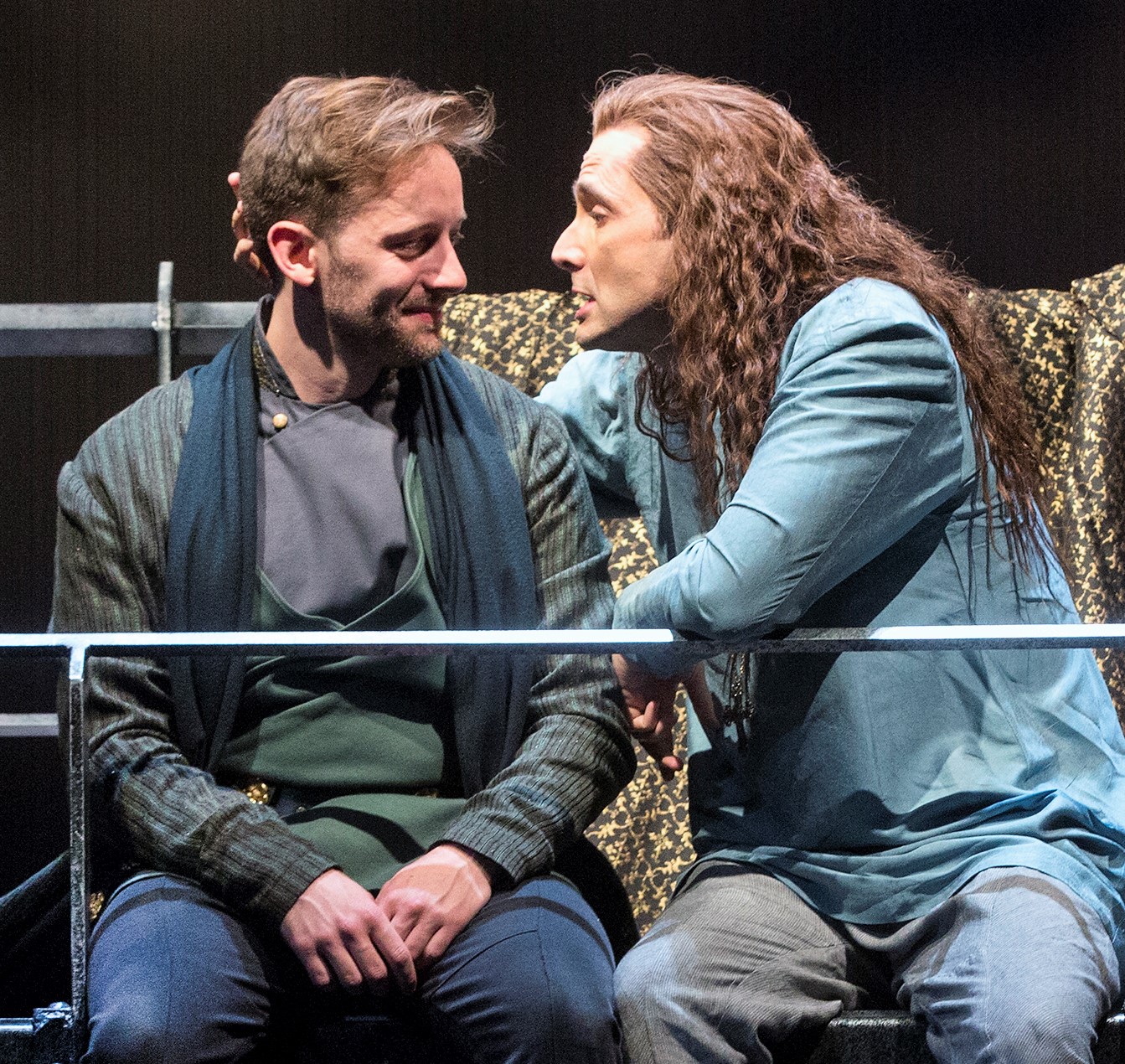
The other key relatives in Richard II besides the short-lived John of Gaunt (Julian Glover), who delivers the speech about “this earth, this realm, this England” thrillingly, are the Duke of York, the last of seven sons and also Richard’s uncle, and his son Aumerle (Sam Marks), who becomes Richard’s cousin-with-benefits in Doran’s reading—the homosexual subtext is more forthright here but not unheard-of. Oliver Ford Davies plays the Duke of York with a booming voice, by turns denouncing his nephew Bolingbroke and then backing off. Torn between believing the king is chosen by God, yet finding his regency while the king fights in Ireland is undermined by men with troops, he finally says, “I am neuter” in a great Shakespearean pun.

There is a brief appearance, too, by Harry Percy (Matthew Needham), who will become known as Hotspur by Henry IV, Part 1 and is already clearly a man of action and sinew, albeit a bit dim.

Britton (right) with Sean Chapman as Northumberland. Photographs by Richard Termine.

Britton (right) with Sean Chapman as Northumberland. Photographs by Richard Termine.

Richard II is all verse, and is spoken commandingly here. Tennant raises the pitch of his voice as the lightweight king. His delivery of “For God’s sake, let us sit upon the ground/And tell sad stories of the death of kings” is beautifully staged—his dwindled retinue all sit, although it’s clear their butts are unfamiliar with the Earth. When Richard then takes off his crown and contemplates it, the parallel of Hamlet looking at Yorick’s skull is unmistakable. (Some critics viewed Tennant’s Hamlet in 2008 as the best since Laurence Olivier’s; this New York debut is mandatory for anyone who regrets missing that.) The crown itself is used again when Tennant spars wittily and cleverly with Bolingbroke. He takes it off and holds it out to his side. “Seize the crown,” Richard tells Bolingbroke, and then, in the tone of coaxing a dog to fetch, “Heee-re, cousin.”

With the language on display, the primary feature of Stephen Brimson Lewis's set is a catwalk that descends at times for Richard’s court appearances; projections, including a white stag and a bloody moon, add color. Trios of trumpeters and plainsong singers in the side balconies provide considerable aural texture, while the smell of incense is an unexpected addition of medieval atmosphere along with Tim Mitchell’s tenebrous lighting.

Any quibbles are minor. Occasionally a character lowers a voice and a word or phrase is dropped. Leigh Quinn’s Queen is passionate and speaks clearly, but one wishes her power of projection were as strong as her acting.

Overall, though, Doran has created this 14th-century Shakespearean world with great precision, attending not just to Tennant’s towering performance, but to tiny moments: the forgetfulness of Jane Lapotaire’s Duchess of Gloucester, the dry joke cracked by a lady-in-waiting and the chilling prophesies from a minor character: “The pale-faced moon looks bloody on the earth/And lean-looked prophets whisper fearful change.” This Richard II is curtain-raiser to what promises to be a landmark visit.

The Royal Shakespeare Company’s Richard II plays in repertory with Henry IV, Parts 1 and 2, and Henry V, through April 21 at BAM Harvey Theater (30 Lafayette Ave. between Ashland Place and St. Felix Street in Brooklyn) through April 29. Tickets start at $35 and are currently on standby for this performance. Visit www.bam.org/theater/2016/richard-ii for information on availability or the day-ticket lottery.  

Click for print friendly PDF version of this blog post

Crossing Into Madness

The filth, danger and enchantment of the South comes alive in Adam Rapp’s Wolf in the River and it all takes place around a fresh mound of earth with intoxicating purple flowers. The Man (Jack Ellis) is a shapechanger and he stands barefoot in the dirt, like he is on a soapbox, and counts each audience member one at a time. He is shirtless and holds his torso firmly as he moves around the room demonstrating his dominance. The shapechanger can supernaturally change from a man, to a wolf, and to a nasty, old woman named Dumptruck Lorna. The Wolf smells a pair of used panties from a canvas sack and examines a muddy sundress, cutoff jean shorts, sneakers and a cell phone. Ghoulish men and women known as the Lost Choir creep around the space and hide in the shadows. Suddenly, a distraught, young woman, Tana Weed (Kate Thulin), runs onto the stage naked, grabs the items and is attacked by the Wolf and Lost Choir.

The production explores Tana’s relationship with her apparent first love, Debo (Maki Borden)—a jovial young man from Benton, Illinois. Lighting designer Masha Tsimring uses the warm light from a worn fridge skillfully to create intimacy as Tana and Debo talk to each other over the phone. Scenic designer Arnulfo Maldonado constructs a psychotic background with black stick figures drawn across plywood walls and a thick rope looming over the stage. On a back wall hangs a picture of Jesus Christ with a green, plastic Christmas garland and red bow.

Tana also experiences a contrasting world of chaos and violence that is ran by Monty Mae Maloney (Xanthe Paige). Monty is a blood collector and uses a cane with an alligator head on top of it even though she walks perfectly well. She is also the girlfriend of Tana’s older brother, Dothan (William Apps). Dothan is a dishonorably discharged veteran who spends his time silently tinkering with electronic gadgets. Monty’s gang consists of Aikin (Karen Eilbacher) and Ansel Pinwood (Mike Swift), who goes by Pin. Aikin appears to be a masculine lesbian and eats the purple flowers to get high. Pin runs onto the stage half-naked with a printed copy of Miley Cyrus’ face taped to a blow-up doll. He has sex with the doll over the mound of dirt. Monty ensures that her crew have their intravenous medical ports working properly so that she can draw blood from them.

Theatergoers experience Tana’s worlds as though they are sitting right next to her, and this intimacy is the real value of this production. When Monty slams Tana’s head into the fridge, audience members might even get fake blood splattered on their clothes. The fresh soil from the center mound of earth and burning incense also brings a sense of smell to these worlds. Tana’s life is exposed, criticized and objectified. Nothing, including Tana’s virginity, is not left unjudged. Under Rapp’s direction, The Flea Theater’s resident volunteer acting company, The Bats, have these worlds come alive in raw form.

Rapp and the cast make bold choices and commit to them, but the challenge is having these choices payoff with theatergoers. The vulgarity in some of the scenes can create distance for theatergoers who are trying to relate to the characters and understand the storyline. It is awkward watching the Wolf engage with audience members when the audience is still just trying to figure out what is going on. The overall aim and vision can be unclear and other markets may not respond to this material.

At the same time there is so much depth to these characters that each of them could have their own play written about them. The issues are rooted more so in the characters and not the plot. Each character’s stand is like figments of Tana’s imagination. The violence, nudity and sexual situations do effectively show the characters’ vulnerability, desperation and fears–even when theatergoers have already seen enough.

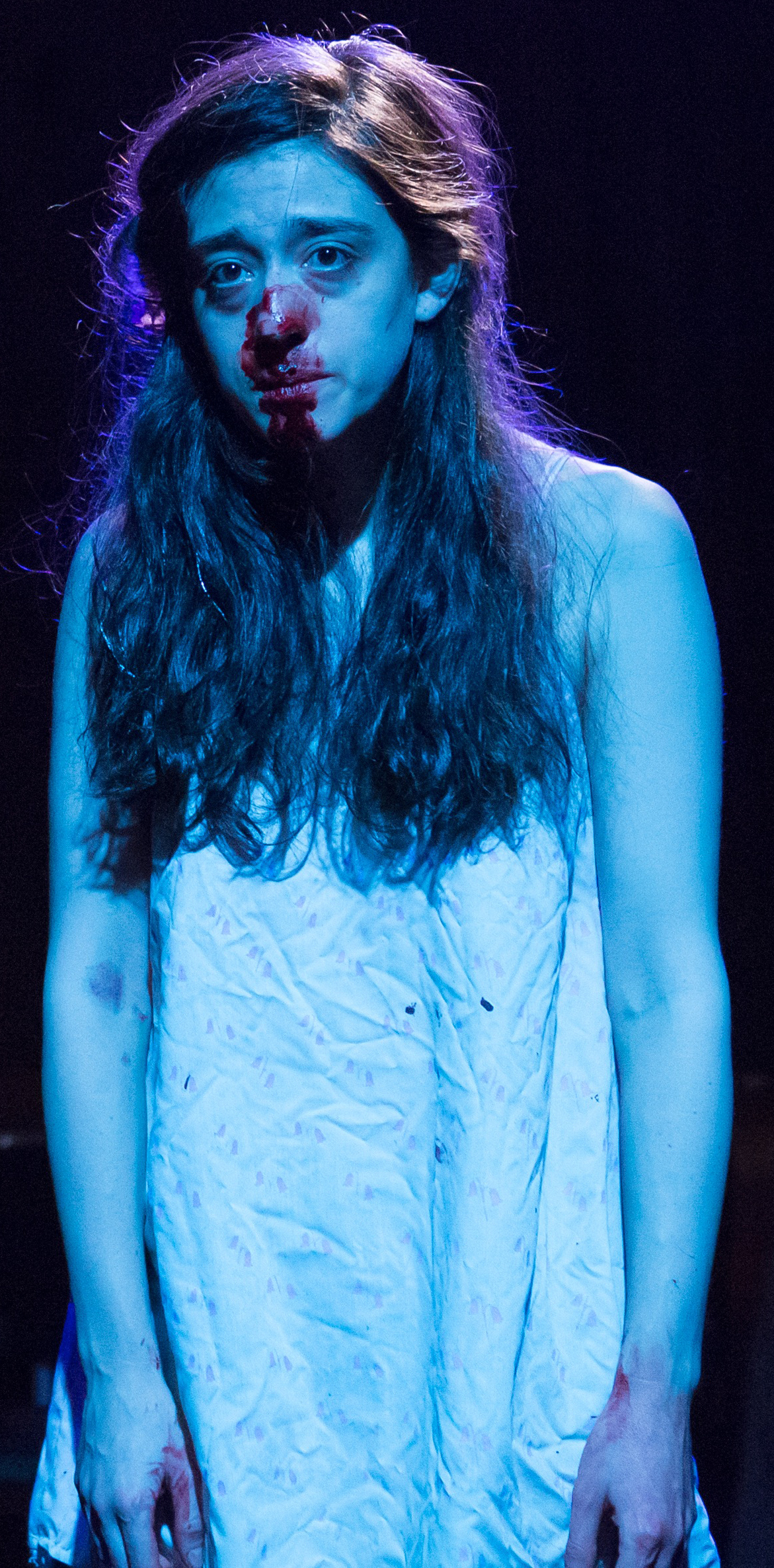
Wolf in the River is recommended for theatergoers who want to be challenged and still have the patience to see what this production has to offer at the end. It is not recommended for those seeking a nicely woven and easy-to-swallow story. Thulin’s performance as Tana is solid and her ability to stay in character and be innocent while going through hell is very impressive. Tana’s hunched shoulders and bloody nose suggests that she is timid and defeated, but her determination to leave her hometown and run away with Debo stays present in her eyes. She is not a victim, but a survivor who hides her reality from Debo. The audience is the river and the Wolf says, “You go for miles and your current’s so strong this time a year that the people in this town string ropes across to help folks get to the other side.”

Wolf in the River runs until June 6 at The Flea Theater (41 White St. between Church Street and Broadway) in Manhattan. Evening performances are Monday and Thursday-Saturday at 7 p.m. and select matinee performances are Saturday at 1 p.m. and Sunday at 3 p.m. Tickets range from $20-$100. To purchase tickets, call 212-352-3101 or visit TheFlea.org.

Click for print friendly PDF version of this blog post

Shards of Light

How many times has someone attempted to explain the "situation" in the Middle East? And, of those times, how many have felt one-sided? No matter how hard the best of us try, the reasoning often has a bent, a leaning toward one side or another. “It’s complicated,” after all. In Wrestling Jerusalem, Aaron Davidman presents 17 voices of men, women, Israelis, Palestinians, Brits, doctors, farmers, and rabbis, among others, in a manner that can be heard and understood with refreshing deference. His affinity for the material, as well as the struggle and heartbreak of people, is breathtaking.

As the playwright, Davidman has done his homework. “You might say it all started in 1948” or “You might go back to World War I,” he says, but wherever you might think he is leading you, it’s not where he’s going. Wrestling Jerusalem is in uncharted territory. Six Day War, Intifada, United Nations Resolution 181, Invasion of Lebanon, or the settlements: he unwraps the causes and the concerns, the politicians and the terror attacks with such deftness that he draws the audience into being concerned regardless of any predilection they had when they walked in. He causes one to care, to want to know more. “If, if, if, if, if, if,” he declares. If only this hadn’t happened or if that hadn’t occurred, things would be different, right? It’s the manner in which he constructs the inquiry that is at heart of his invitation to look deeper, practically challenging the audience not to care.

Davidman’s skill reaches well beyond his writing. His talent as an actor, adept at the nuance and complexities of characterization, is thoroughly engaging. Each of the 17 is based on people he has encountered in his attempt to understand the Israeli-Palestinian conflict, whether in North America or on his travels through Israel and Palestine. Like a chameleon he embodies the subtleties of Farah, a Palestinian woman in her 30s, or Professor Horowitz, a British man in his 50s, or Rabbi Moses, an American in his 60s. Davidman sings Yiddish songs from his days at children’s camp to the cherished “Shalom Aleichem.” He dances to folk songs from the homeland as Allen Willner’s lighting creates shadows around him. It is equally as powerful to observe him on the ground pushing invisible sand, as it is to viscerally feel his fear crossing the Israeli border into Palestine; he is that passionate.

The backdrop for this extraordinary experience is a beautiful, yet simple painted tarp along the back wall designed by Nephelie Andonyadis. At times it has the feeling of windswept sand and at others a ragged mountain range, depending on the lighting of Willner who colors the backdrop and space with rich oranges and yellows, or a vibrant blue, and then in an instant throws Davidman into the harsh, bright sunlight of the Ben Gurion tarmac. Bruno Louchouarn is responsible for original music and haunting sound effects. Credit for the keen direction of Wrestling Jerusalem goes to Cuban playwright and director Michael John Garcés. He brings a rich and varied background in community-focused plays, which is particularly evident in this production.

There are many profound and wrenching moments in the 90-minute Wrestling Jerusalem. Davidman’s character, Ibrahim, a Palestinian cries, “The only Israelis my children have known drive tanks, invade neighborhoods, intimidate their parents at checkpoints. The only Israelis I have known own the water trucks that deliver my water. My water.” His interaction with Rabbi Moses, who emphatically declares, “Adonai Echad does not mean there is only one God. Adoni Echad means God is One. What’s the difference? There’s a huge difference. God is One. One, not the number. One, the truth of indivisibility.”

All of which is extremely important in a landscape where people, politicians, and religion drive the conversation as to “who does the Holy Land belong to?”

“As the muezzin’s call to prayer floats out over the Wall,” Davidman tries to make sense of it all. “Please. You can hear the cry inside the cracks. Please, God, help me. Help us. The Wailing Wall holds the tears of generations.” His inquiry into the Middle East conflict may not answer any questions or even the ones everyone has come to expect, however he wrestles the word humanity into the bright light of day. “’And it’s the work of human beings,’” say the Kabbalists, “’to find those sparks, those fragments of goodness, and put them back together. It’s how we heal the world, they say.’”

Wrestling Jerusalem runs through April 17 at the 59E59 Theaters (59th between Madison and Park Avenues) in Manhattan. Evening performances are Tuesday through Thursday at 7:15 p.m. and Friday and Saturday at 8:15 p.m. Matinees are Sunday at 3:15 p.m. There is no late seating. Tickets cost $35. To purchase tickets, go to 59e59.org or visit TicketCentral.com.

Click for print friendly PDF version of this blog post

Steal This Hamlet

The New York Shakespeare Exchange’s Hamlet 10, now playing at the Flamboyán Theater, is a production of rare emotional power and a directorial tour de force. In bringing us a Hamlet played, not by one, but by all ten of its actors, Hamlet is liberated from the very idea of a character as a role played by a single actor. Could there be any convention more fundamental to the theater itself than the notion that a character is played by, and physically embodied by, the actor who plays that character? However interesting the design of the set and skillful the acting, what makes this production significant in the world of the theater in a way that no other recent production can rival, is its upturning of this most unquestioned convention, the identification of one actor with one role.

Ross Williams, the director of this production and the producing artistic director and founder of the New York Shakespeare Exchange, not only distributes the role and lines of Hamlet among all ten of his actors, he ignores gender, age, race and ethnicity entirely in the assigning of roles. Two women play the roles of Polonius and of Rosencrantz. Julie DeLaurier plays a wonderful speechifying and bumbling Polonius and Sarin Monae West, a feisty Rosencrantz. Hamlet’s lines are spoken at times by women and at other times by men of a diverse cast who differ in age, in race, and in ethnicity. Sometimes lines are spoken in unison and sometimes, within a soliloquy perhaps, the lines travel from one actor to the next, from one gender to the next, from one race, ethnicity, and body type to the next.

Hamlet is thus fluid. He is everywhere and nowhere; he is no one and everyone. Much as, in the collective imagination, he has grown over the past centuries to mythic proportions. Hamlet in this production is not a body but a presence, one that physically expands and contracts according to how many actors are speaking his lines at any given moment and where and how the actors are grouped on the “stage.” When all ten actors, some standing up close to the front row of the audience and others further back, spoke the opening section of the all too familiar “To be or not to be,” together but deliberately not in unison, followed by one actor declaiming the speech in its entirety from center stage, the words burst through their familiar containers. One of Shakespeare’s greatest soliloquies had regained an originary power and was newly fierce, fresh, and wrenching in a way we could not have imagined.

Elivia Bovenzi, the costume designer, has dressed the actors in relatively comfortable modern dress. In a brilliant stroke, the scenic designer, Jason Lajka and the director, Williams, dreamt up a stage that consists of a set of boxes, much like oversized children’s blocks, some of them with several steps and some not, that can be pulled apart and rearranged at will. In the opening scene of the play, there is a center stage of these boxes pushed together from which the actors speak. In the wonderful gravedigger’s scene, actor Nathaniel P. Claridad jumps into a turned over box, while the other boxes have been pulled from view.

With so minimalist a set and so multiple, fluid and large a presence of Hamlet himself, the production lifts Shakespeare’s language to a commanding position. And that, is to privilege the beauty, the genius, the poetry and the emotional range of the essential Shakespeare.

Who would have thought that an audience could so “suspend its disbelief” as to go along with and accept this new and wildly imaginative approach to the character of Hamlet. Williams and the New York Shakespeare Exchange have stretched theater conventions and opened our eyes to possibilities within the theater we had not dreamed of. There is no doubt that the theater of the future will steal from Williams’ Hamlet 10!

Hamlet 10 runs until April 9 at the Flamboyán Theater (107 Suffolk St. between Rivington St. and Delancey St.) in Manhattan. Evening performances are Wednesday through Saturday at 7:30 p.m. and matinees are Sunday at 3 p.m. Tickets cost $18. To purchase tickets, call 917-428-0065 or visit shakespeareexchange.org.

Click for print friendly PDF version of this blog post

Air Pump Wheezes

Anne Washburn’s perplexing Antlia Pneumatica takes its name from a constellation. In the 1750s, French astronomer Nicolas-Louis de Lacaille “pulled together leftover stars and made new constellations,” explains Adrian, a visitor to a remote Texas home. The astronomer named one of the constellations he created “the air pump,” known by its Latin name as Antlia Pneumatica. It’s one of the few fascinating points in Washburn’s meandering play.

Adrian is an unexpected guest at an isolated house in Texas Hill Country, where several people have gathered for a Big Chill-style reunion, although that isn’t immediately apparent. The hostess is Nina (Annie Parisse) and Adrian (Rob Campbell) is a lover of hers from 16 years earlier. Already present when Adrian pops in are Ula (Maria Striar), a frizzy-haired compatriot, and Liz (April Mathis), an African-American woman who is Nina’s sister. 

Subtitled “a play about place, space, grace,” Antlia Pneumatica is structured as a collection of scenes around a kitchen island, monologues, stories, recitations and audio conversations. Most of the latter involve Nina’s two children, who are 5 and 7, but there is a scene of a nighttime encounter of two of the adults that proves a red herring. During these voice-overs, for seemingly interminable stretches, the stage is dark. Although a note from the playwright extols the art of listening to rather than seeing a play, the scenes come off as a torturous radio show and may spur you to cancel your subscription to NPR.

Insofar as Washburn’s title has any parallel to the action, it seems to be that she has used bits and pieces and leftovers as the meat of her story, in the same way that Nicolas-Louis de Lacaille collected unused stars for his constellations.

The deceased friend is named Sean, and he lived in New York; most of the characters had lost touch with him following his downward spiral into alcoholism. Much is made of who is coming for the scattering of Sean’s ashes, and a viewer has to listen closely to realize that, as the play progresses, other characters have arrived besides the ones who are on stage. New cars belonging to new names are parked in the driveway. 

The conversations seem deliberately mundane and opaque, and although director Ken Rus Schmoll imparts a certain sporadic charge to them, and there’s a sense that the characters know one another so well they use shorthand to communicate, the effect is frequently to leave the listener at a loss.

A friend named Len (Nat DeWolf) arrives, full of stories about olden times for the children. One of them explains the origin of the term “bachelor.” Originally, he claims, “bachelors was the term for unattached men who would stumble from the brush and happen across a celebration and get invited in out of politeness... back then it was the polite term for a man who was really all but an animal.” If the speech has a point, it seems to be that man has only recently evolved from barbarity, that his time on earth is dwarfed by the stars. The prevalent mood is bewilderment: the lives shown are a random collection of half-memories and dreams. Yet a sense of flailing uncertainty and a rueful glance back at the wake of one’s life don’t carry the gravitas that one suspects Washburn wants.

When Len arrives carrying the ashes of Sean (earlier the character who was picking them up was a woman, but who knows what happened to her?), there’s talk about where to scatter him, and Nina even suggests baking a teaspoon into food they’d consume. This plot twist is not only unpalatable, but it has been done to death: the mistreatment of cremated remains in the theater is a Ph.D. thesis waiting to happen.

Late in the play, a friend named Bama arrives, and Crystal Finn brings an espresso shot of energy to the lethargic proceedings as a fast-talking Southern charmer. (Finn appears earlier in a scene with the others, all standing at the forestage and speaking directly to the audience; there’s no effort to explain who her character is or why she’s there and then disappears until the end.) A recollection from Bama sparks a story from Len that ends the drama on a supernatural note. The cast sings a song as the play peters out.

Washburn has a following and her work is produced regularly, but she also has skeptics. Obscure and unsatisfying, Antlia Pneumatica will give the latter plenty of reason to carp.

Anne Washburn’s Antlia Pneumatica runs through April 24 at Playwrights Horizons (416 W. 42nd St. between 9th and 10th Aves. in Manhattan). Evening performances are at 7:30 p.m. on Wednesday-Saturday and at 7 p.m. on Sunday; matinees are at 2 p.m. on Saturday and Sunday. For tickets, call Ticket Central at 212-279-4200 or visit TicketCentral.com.

Click for print friendly PDF version of this blog post

I Want to be Your Friend

Very much like a schoolgirl dancing around her room, Alicia Dattner begins her one-woman show, The Oy of Sex, with a rousing version of “I Want to be Your Lover” by Prince. As she settles she begins to engage the audience by talking about sexual experiences. Dattner kids around and says, “O.K., you first.” The evening proceeds into an autobiographical journey exploring the world of sex, more specifically love and sexual addiction. “You–we–will never be the same, from this night forward.” Tall order. Her background as a stand-up comic is clearly evident by her delivery, timing, and most importantly, storytelling.

Dattner takes the audience to her early puberty days with “Dear Diary, I can’t wait until the kissing starts!” and then she practices kissing with her hand aka Señor Wences. For her high school and college years Dattner says, “it’s kind of like my clitoris was slutty, but my cervix was a prude.” Eventually she surrenders her virginity after listening to “April in Paris” when the guy she was seeing didn’t leave. “This must be what love is, right?” to her eventual disappointment, “I waited 21 years for that? It’s just his penis going in and out?” and Dattner mimics the motion with her hands. There are some great lines in The Oy of Sex as one might expect from a seasoned stand-up comic. Describing her boyfriends and sexual adventures, Dattner is often quite funny. “Max was sort of like a frat boy, without the college. Not a catch. More of a catch and release. He was so dumb that he thought anthology was the study of ass holes.” Dattner also says, “My dad's family is Jewish, and my mom's family is atheist. So I want to marry a doctor who's good enough for me, but I don't believe he exists.” Pause, rimshot. The performance rests comfortably between stand-up comedy and a working copy of a ‘chick flick.’ What’s missing is a range of emotion.

Dattner is smart, funny, entertaining, talented and full of energy. Her delivery of getting hit on by another woman, Anastasia, was complete with wild abandon even as she was faking it with "When Harry Met Sally" style. It was almost as if watching Anastasia go down on her–it was that good. When Dattner is asked to reciprocate Dattner's expression is priceless. But this performance is not just comedy nor is it stand-up. As Dattner continues through the many lovers and trips to Burning Man it gets clear that sex and love for her is a problem, and instead of a new lover she seeks help. Dealing with addictions, while serious, can be funny and still be enlightening. The confluence of a great writer with a talented actor can bring out the depth that comes with the desperate actions of an addict wrapped up with self-effacing humor. Dattner’s range remains in the realm of stand-up, and make no mistake she is quite funny.

Whether Dattner’s choice, or her director Tom Bentley-Fisher, she uses a hand-held microphone the entire performance. It is not necessary for a theater like The Bridge. As a stand-up comedian working a large house it is indispensable or it can be useful for sight gags. It is phallic, after all. However in this experience it boxed her in as a stand-up comedian. While she is quite adept at choreographing her use of a microphone it got between her and the audience limiting her range of emotion, especially as she attempts to express more vulnerability delving deeper into her 12-step program and interactions with her sponsor. On stage Dattner owns the word certitude, and she is incredibly self-assured; delivering a solo show you have to be. However, the development of an intimate relationship with the audience beyond being funny is lacking. It's as if she wants to bring more to the stage but is locked in an old paradigm.

Dattner brings the The Oy of Sex full circle, declaring, “Knowingly or unknowingly, your consciousness has been raised.” She goes on to say, “But from this moment forward, you're a different person.” Again, a tall order. There is a lot of laughs, and she brings an incredible amount of energy to the stage. Dattner opens her life up to intense scrutiny for everyone to see, but as good as a stand-up comedian as she is, and she has honed her craft, it still feels like stand-up. The raffle after the curtain call confirmed it.

The Oy of Sex runs until April 17 at The Bridge at Shetler Studios (244 W. 54 St. between Broadway and Eighth Ave.) in Manhattan. Evening performances are Wednesday through Saturday at 8 p.m. and Sunday at 2 p.m. and 7 p.m. on April 10 and 17. Tickets cost $20. To purchase tickets, call 212-868-4444 or visit smarttix.com.

Click for print friendly PDF version of this blog post

“The Ring Has Awoken…”

Sam Gamgee, in the movie Lord of the Rings: The Fellowship of the Ring, righteously declares that "there’s some good in this world, Mr. Frodo…  and it’s worth fighting for.” Good theater is also worth fighting for, and you may very well find yourself battling to get a ticket to see Fly, You Fools! Presented by Recent Cutbacks, it is currently playing Friday evenings at Peoples Improv Theater in Manhattan.

Click for print friendly PDF version of this blog post