
Whiskey Needs Respect

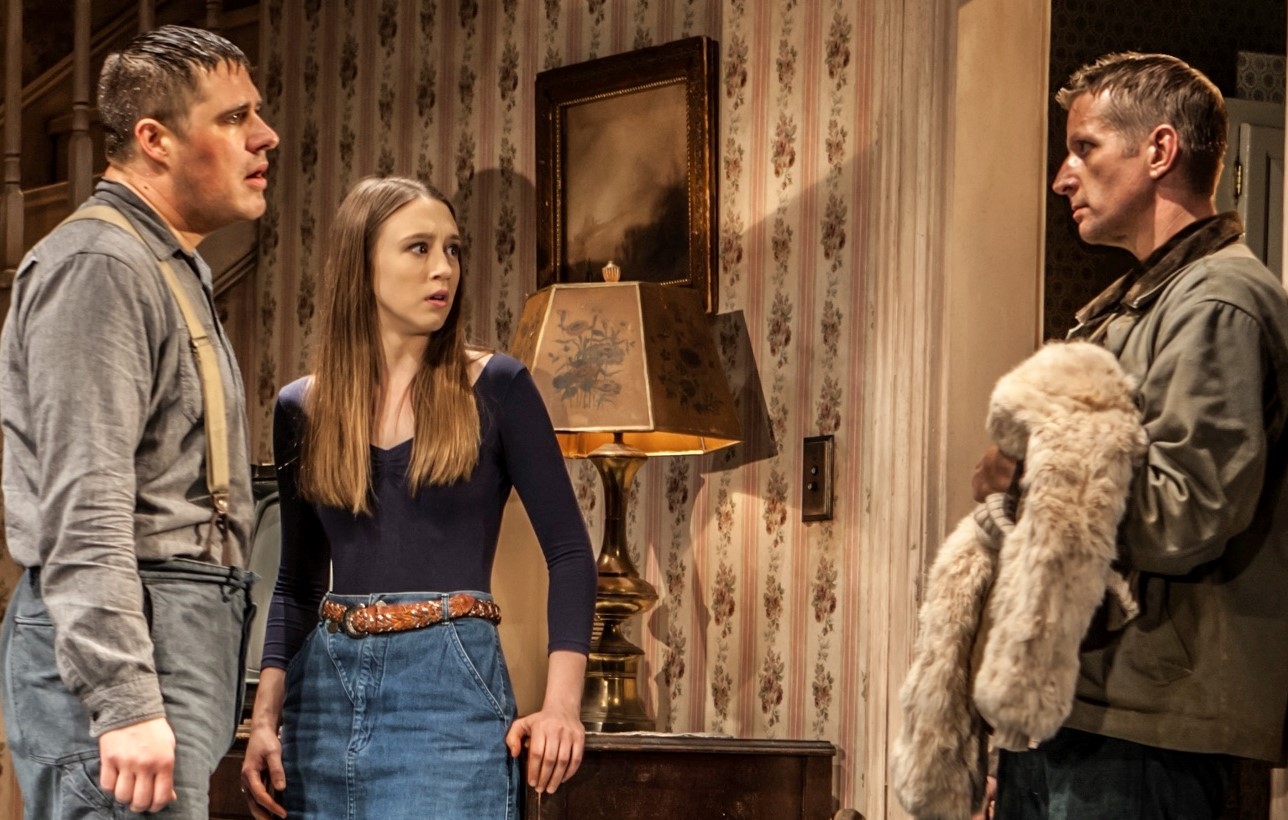
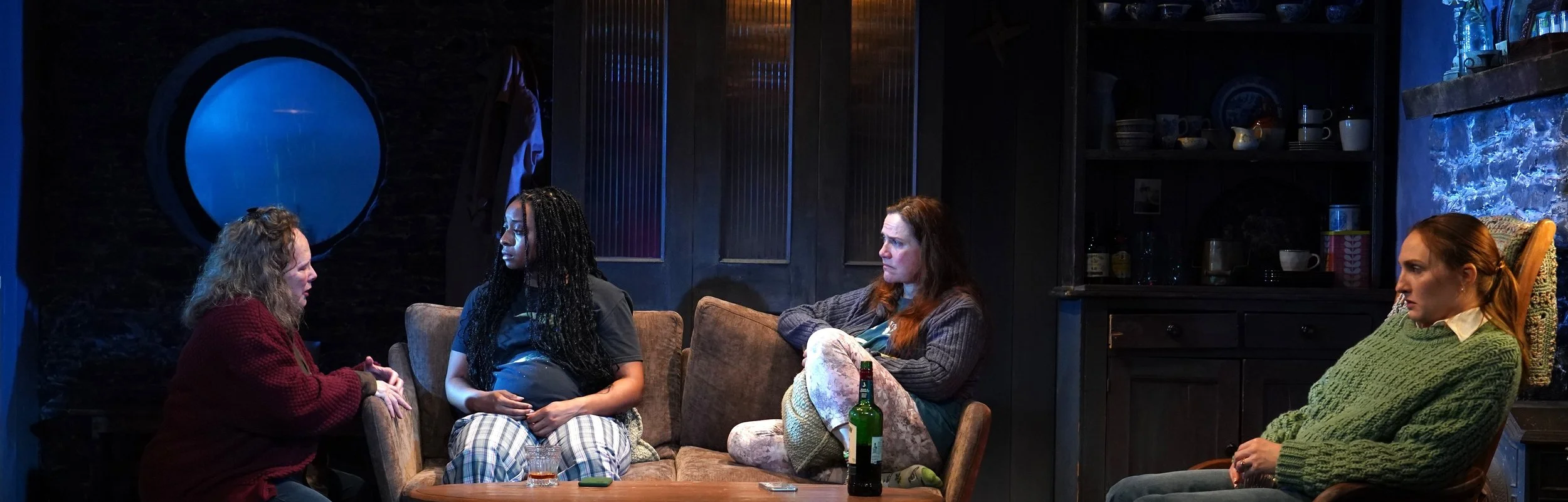
Eric Gilde’s new play the goodbye room focuses on a common experience in most everyone’s life—the death of a parent—but more important, it asks the question, “What’s left of the living?” There are those who have to handle the funeral arrangements, travel home for the service, or find a way to relate to one another during a time of grief. It’s the relating that most often gets in the way. Gilde has done an exemplary job of capturing the essence of this experience, and, as the director, creates the space for four talented actors to bring it to life.
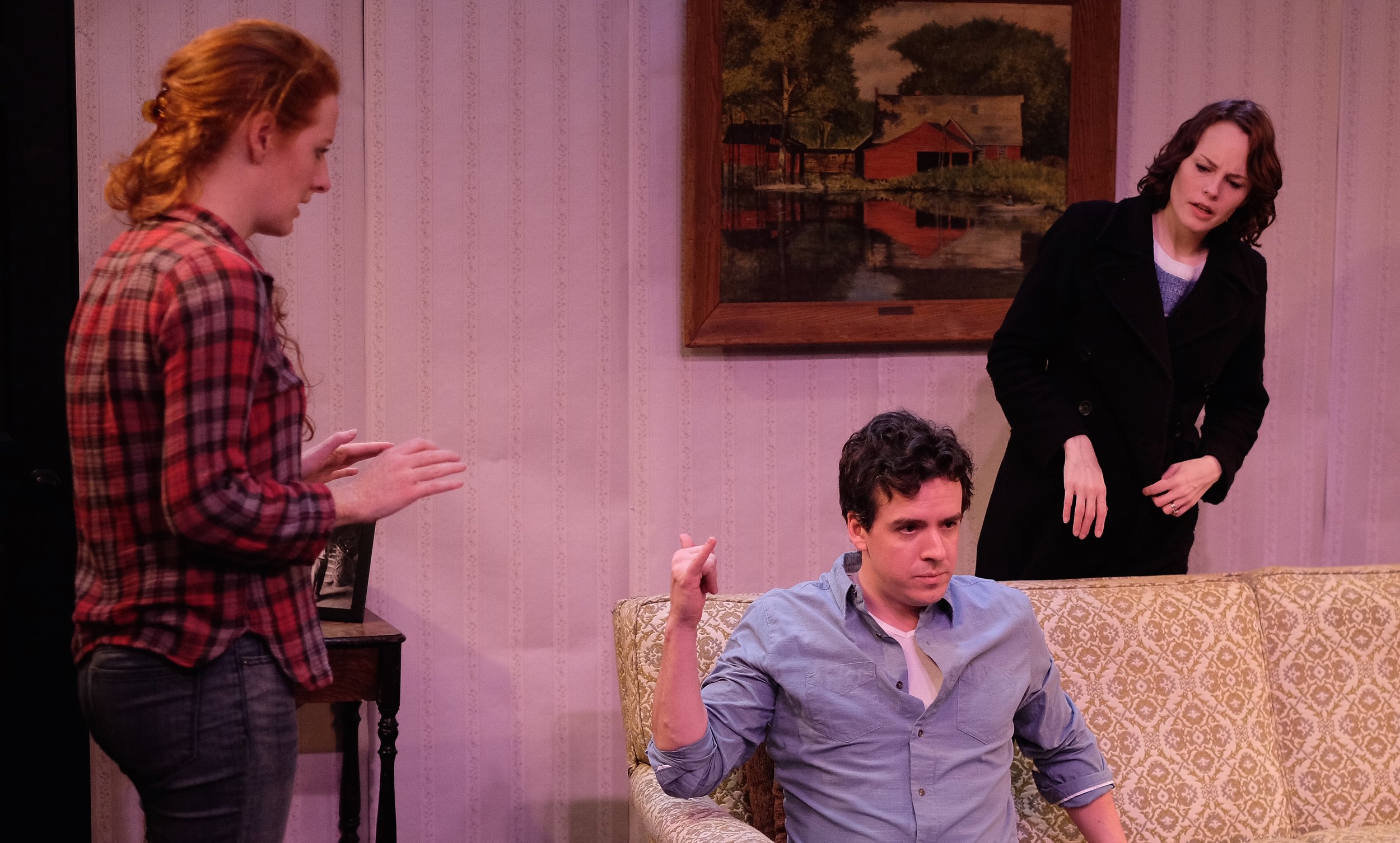
It is a detailed re-creation that, without nuanced performances, could easily come off as flat. There is nothing new, there are no great surprises and no profound personal breakthroughs in the goodbye room. However, it’s the precise manner in which Gilde wrote the dialogue, directed the actors, and how they delivered it that enhances the drama.

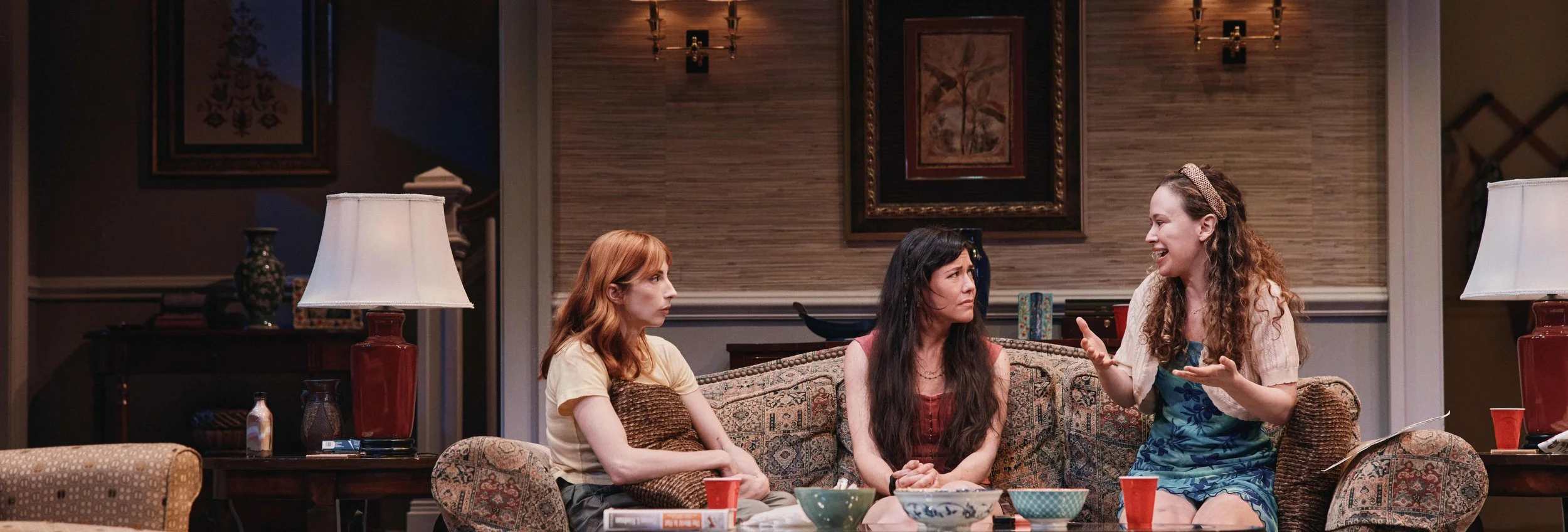
Michael Selkirk plays the grieving Edgar, whose wife has just passed on. Edgar has two daughters—the “good,” overworked, overwhelmed daughter Maggie (Sarah Killough) and complicated Rebecca, affectionately referred to as Bex (Ellen Adair), who married and moved to Chicago five years ago. Bex laments not coming home sooner, while Maggie plays the busy martyr who stayed behind to work and take care of the parents. This sibling story has been told and retold following the death of a parent; however, it’s Gilde’s staccato dialogue, with the characters talking over one another, coupled with the generous space between the words, where the crux is to be found. Included in this drama is the affable family friend and former love interest Sebastian (Craig Wesley Divino.)

Bex is wound tightly, from the moment we hear the car door slam to when she finally tersely reveals, “Larry and I are getting divorced.” The estrangement from her family is exemplified by her awkward attempts to console her father or hug her sister. She often finds a way to make it more about herself than anyone else. Maggie, equally tense, lets on to anyone who will listen how busy and overwhelmed she is. Sebastian has found his second family and doesn’t want to let go, always being available to lend a helping hand. Edgar is trying desperately to understand this new void in his life, even while shuffling off to make coffee or trying make sure his girls are comfortable.

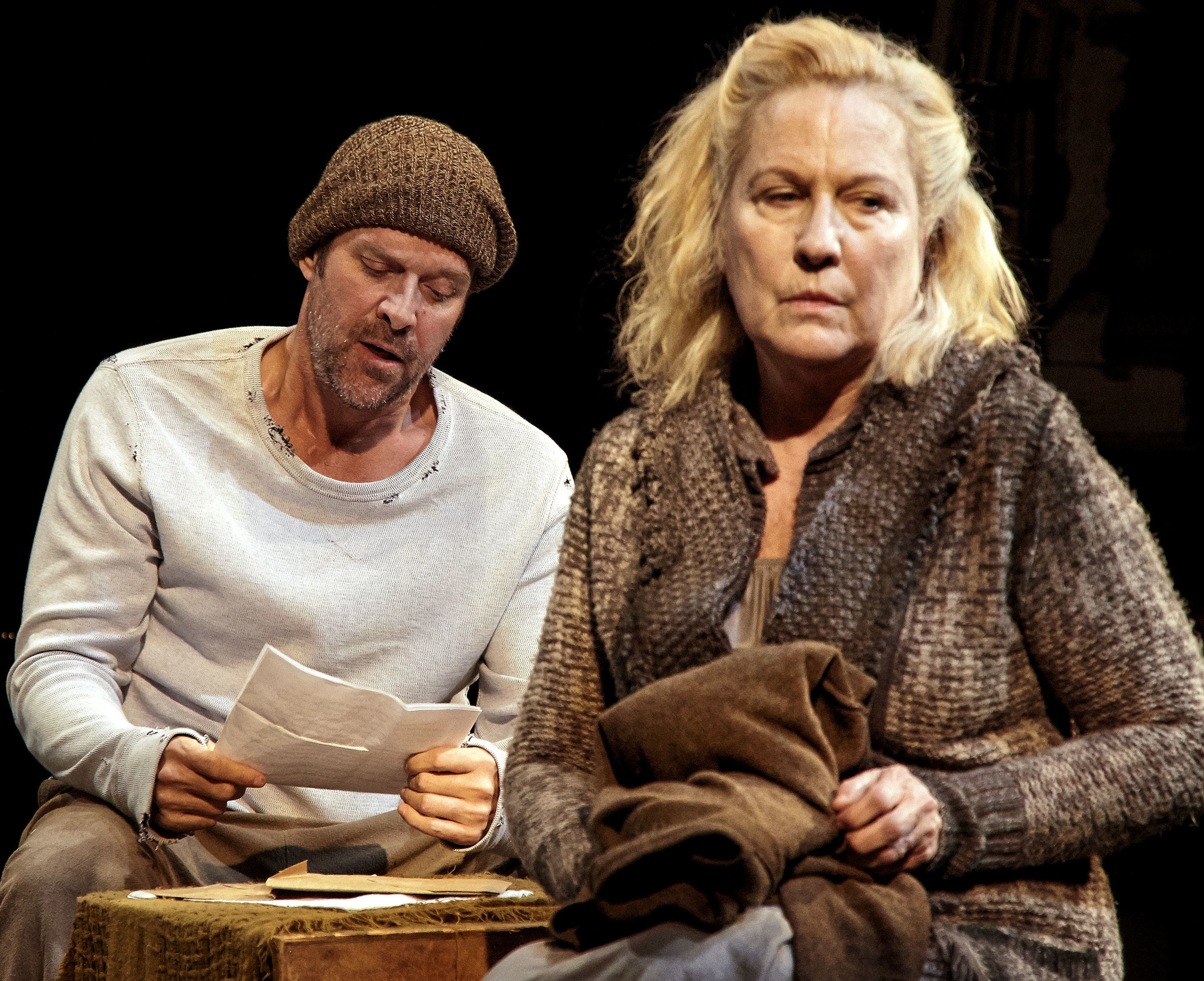
It’s when he shares his Irish whiskey with Sebastian that Selkirk delivers everything that resides just behind the dialogue. “I don’t think you should come around here for awhile,” he says, pausing for a moment, then saying, “Drink up.” The rage that seethes behind his full beard and scraggly appearance is subtle yet profound.

Justin Spurtz’s set covers every base, from the 1950s paint-by-numbers framed art on the wall to the collection of family photos and the paper plates complete with grease stains left behind by the pizza. There is the patterned family sofa that has lost its firmness over the years, and the coatrack filled with winter coats and scarves. Spurtz even includes a bit of whimsy with Bex’s childhood mug.

Jacob Subotnick layers on a sound design that complements each scene, from car doors closing to LPs with crooners on the vintage stereo turntable to the subtle patter of rain. The volume of the mobile-phone ring in the handbag was on point, and the iPod selection set the scene for the sisters to share too much wine, and finally themselves, is perfect.

Gilde’s drama touches slightly on the concept of the lingering spirit of the departed, with lights flickering or the broken stereo finally playing. It’s a welcome relief from the family drama being played out, but it’s also a hint that there is more to life than silly squabbles or playing the blame game one more time. Maybe love, as messy as it can be, transcends the boundaries of this reality to remind us of what’s important.

“The goodbye room” is at the Bridge Theatre at Shetler Studios (244 West 54th St., 12th floor) through March 19. Remaining performances are Wednesdays through Saturdays at 8 p.m. and Sundays at 3 p.m., plus Tuesday, March 15, at 8 p.m. Tickets are $15 and $18 and may be purchased by visiting Artful.ly.

 

Click for print friendly PDF version of this blog post

Waterlogged Ethics

March 8th, 2016

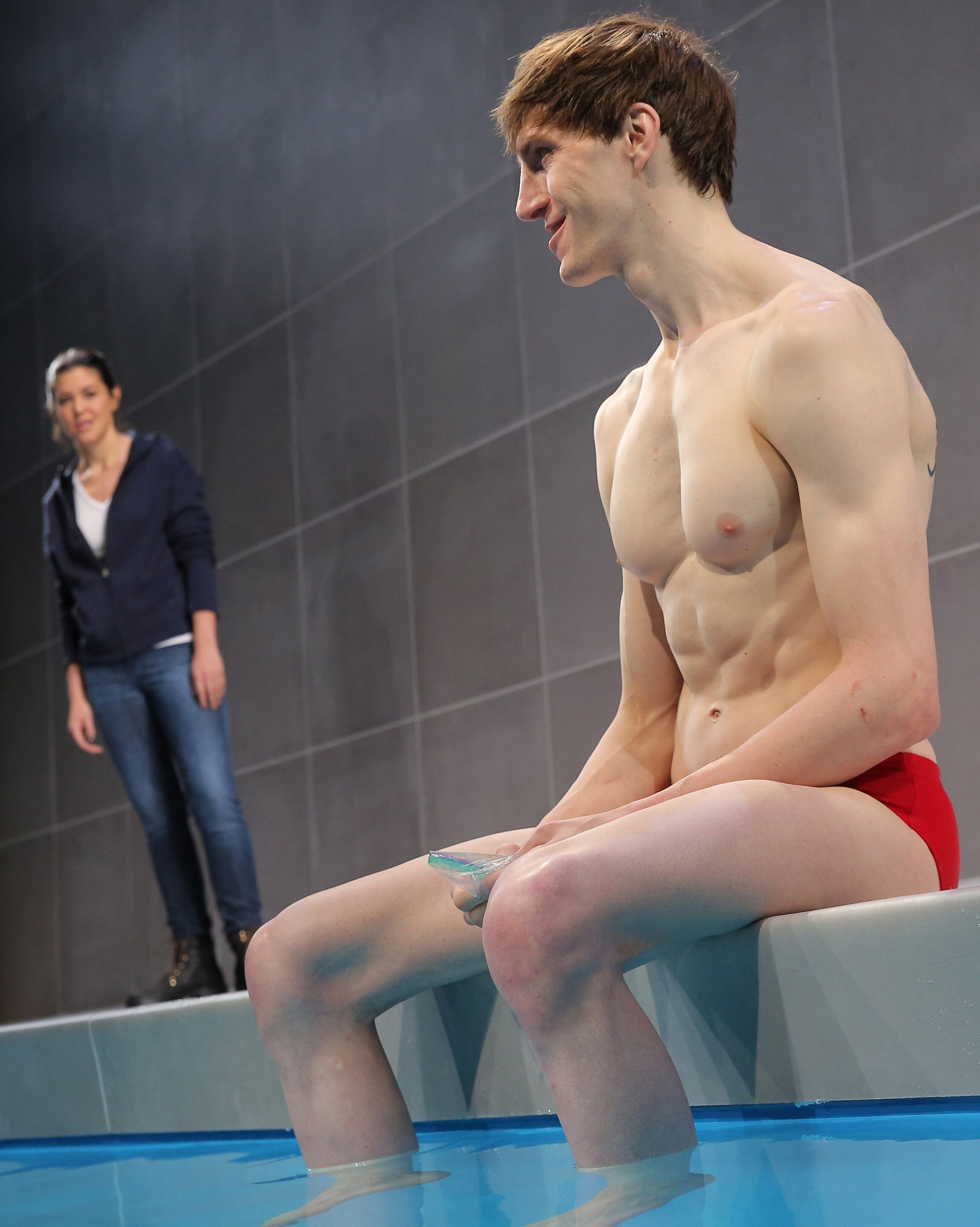
Yes—there’s really a pool on stage at Red Speedo, the new play by Lucas Hnath (The Christians) at the New York Theatre Workshop through March 27. The pool is certainly an achievement for scenic designer Riccardo Hernandez, since it immediately places the audience in the natatorium where swimming stud Ray (Alex Breaux) awaits the following day’s Olympic trials.

But the lane of serene blue water that spans the forestage stands in stark contrast to the murky ethical dilemmas that Hnath examines. Ray’s future as an Olympic swimmer and Speedo-sponsored star are threatened by a dependence on performance-enhancing drugs; a brother whose financial well-being is inextricably tied to Ray’s success; an ex-girlfriend whom he desperately wants to marry; and a coach who is also looking for his piece of the glory.

Ray’s brother, Peter (Lucas Caleb Rooney), is a lawyer who yearns to quit his job and play full-time agent to his younger sibling. He’s willing to do whatever it takes to get his cut from the Speedo deal he has negotiated—even if it means turning a blind eye to Ray’s reliance on HCG—a synthetic testosterone classified as a performance-enhancing drug.

Ray’s ex-girlfriend Lydia (Zoë Winters) is bitter and angry after losing her license to practice sports psychology when she dabbled in the realm of pharmaceuticals. Peter helped get her convicted after speaking to the prosecution and relaying private information.

Ray’s coach (Peter Jay Fernandez) tries to take the ethical high road when he discovers what he believes are another swimmer’s drugs in his office refrigerator. But when he realizes they belong to his star pupil, he quickly changes his tune.

Then there’s Breaux as the athlete himself. The actor does a wonderful job portraying a character with more depth than meets the eye. Though Ray appears to be unintelligent and inept at grasping complex scenarios, it’s quickly evident that he’s not as dumb as he seems. Even his hideously large back and leg tattoo of a sea serpent is his own stroke of quasi-genius: “Just thought it would be good for publicity and stuff, because we all kinda look the same when we swim, because we all have goggles and swim caps, so I thought it would be a good idea to make myself really easy to spot, so like when I’m swimming, and they have the camera overhead watching us swim, it’s really easy to know which one I am, and everyone will be like ‘Whoa, who’s that guy with the sea serpent, he’s awesome.’” He is scared to fail and scared of what it will take to win, which results in his saying to Peter, Lydia and Coach exactly what each wants to hear—even if it isn’t true. But even though he’s a pawn in their endgames, he’s playing them too.

Director Lileana Blain-Cruz keeps Hnath’s script moving quickly, though the snappy, rapid-fire dialogue sometimes seems forced. It’s unclear if the choppiness is due to directing or acting choices. The script really soars when each character has a longer chance to speak—granting the audience a look inside their psyches. The air horn signifying changes in scene, however, does little to aid the audience, aside from causing them to jump.

For the most part, Rooney makes Peter deliciously deplorable. And while the rest of the cast hold their own, there’s nothing spectacular about their characters. What is spectacular is a climactic fight scene between Peter and Ray, choreographed by Thomas Schall, that takes full advantage of Hernandez’s set.

Hnath’s writing leaves no clear protagonist and offers no ethical calls throughout the 80-minute intermission-less production. Rather, he leaves the audience to ponder that all-too-gray area between right and wrong, good and bad.

Lucas Hnath’sRed Speedo plays through April 3 at the New York Theatre Workshop (79 East Fourth St.). Evening performances are at 7 p.m. Tuesday, Wednesday and Sunday; at 8 p.m. Thursday through Saturday. Matinees are Saturday and Sunday at 2 p.m. Tickets may be purchased by calling the box office at (212) 780-9037 or visiting nytw.org.

Click for print friendly PDF version of this blog post

Young, Scrappy and Hungry

In the musky glory of The Kraine Theater, the March family spits crazy rhymes and self-professedly drops beats like a smooth silk ribbon. Although jaunty violins welcome us inside, it is the quick enticement of Lil' Theatre Company's hip-hop musical that soon settles us into our seats. Lindsay Taylor and Sara Stock are the writers of Lil' Women: A Rap Musical, which was inspired not just by Louisa May Alcott's novel but also by a certain popular rap musical that sends all who see it into fits of religious praise: Hamilton. The influence is too obvious to go unnoticed—sometimes to the production's occasional weakness. In an effort to reconcile the massive success of its progenitor with its own relative obscurity, Lil' Women drops hints of its inspiration while trying to break new ground with reasonable success. 

Originally from the show streets of Orlando, Taylor's production is one of the more standout shows at this year's FRIGID NY festival—she is credited as the director and producer of Lil' Women. Its concept invites apprehension and interest in equal measure: taking a beloved classic and subverting its white, all-American tradition is no easy task. Many already know the story: Meg, Jo, Beth and Amy March weather crises of faith, friendship and love as they grow up under the benevolent eye of their parents, mischievous Laurie (the boy next door) and John Brooke (his tutor). It reads like a soapy, sweet tale, promising an uncomplicated ending. But somehow Taylor's hilarious spin on the March family makes it easy to forget the all too well-known plot, and enjoy the droll, nudge-nudge moments of musical inspiration that slips and slides from the pens of Taylor and Stock.

Beth pulsates with witty energy; she isn't the dowdy, quiet angel that Alcott canonized in her book. Megan Borkes renders her active, self-aware and irrepressibly engaging. Croix Provence's Amy begins as a childish caricature of Alcott's character, but by the end of the play, she is brimming with womanly wit and charm. Even mature Meg, played by the highly entertaining Toni Bonaccorso, sneaks in some character development even as the show speeds through the plot. Her meet-cute romance with John (a disarmingly funny Gregory Coleman) is a delight to watch, and her command as a rapper, while seemingly incongruous for a dimpling redhead, is especially astonishing. But by and large, the play is carried on the very able shoulders of Rebecca Siegel, who plays the glorious spitfire that is Jo March. Siegel is perhaps the best rapper of all her sisters (although Meg might disagree; the two have a fantastic rap battle— mediated by her mother, played by writer Sara Stock—that helps the audience settle who the better rapper is), and her singing voice is quite agreeable too. Her most poignant, Jo-like moments come during her interactions with Beth, Laurie (a rib-ticklingly wonderful Adam DelMedico) and Friedrich Bhaer (played by a superb Justin Aldridge), the three most important agents in her life. 

The reigning star of the show is the music: rhymes and dialogues flow seamlessly from the actors. The cast does not for a second call into question its rapping abilities. A particularly enjoyable song (and one that refused to stop playing in one's head) is "Commander in Chief" sung by Mr. March, played by the supremely talented Jason Blackwater. The partnership between Taylor and music writer Isaac Folch renders even the most mawkish episodes from Alcott's book (namely Mr. March's return from the war) side-splittingly funny. If there is one avenue where they falter, it is in the story. For a tale as often told as Little Women, it might take more than a rap musical to refresh its well-known denouements. But even as the show whizzes past key scenes (Beth's passing, John and Meg's married life, Jo's publications and Amy's brush with death), the production leaves us quite content in its attempt to refurbish a beloved story. 

The costuming is subdued yet appropriate; it doesn't seem anarchic or anachronistic, as most period costumes do in intimate settings (costume is by Borkes, Siegel and Taylor). The set is an empty black box, and in some ways makes the action in front of it all the more colorful. The main star of the show, however, is the music. Hip-hop is a nascent musical medium, especially on the Broadway stage. Hamilton has made rap music palatable to the largely white, upper middle-class audiences of New York, with the same brand of spine-tingling newness that Lil' Women has successfully emulated. One could say that Miranda's juggernaut endeavor has just spawned the first (of its undoubtedly many) children, and no-one's complaining. Lil' Women, for all its overt obeisances to Lin-Manuel Miranda's genius, borrows the same penchant for envelope-pushing musical entertainment.

The last performance of Lil' Women: A Rap Musical at The Kraine Theater (85 East 4th St. between 2nd and 3rd Aves.) was March 5. As part of Orlando International Fringe Theatre Festival, Lil' Women will run from May 19-29 at the Orlando Shakespeare Theater (812 E. Rollins St.) in Orlando, FL. Tickets are $11 with the purchase of the Fringe button starting April 14 at www.orlandofringe.org.

Click for print friendly PDF version of this blog post

A Queer Wonderland

Lewis Carroll’s Alice in Wonderland and Prohibition-era speakeasies in New York City may not seem like kindred worlds, but Danny Ashkenasi blends them together in his new musical Speakeasy: John & Jane’s Adventures in the Wonderland. Indeed, both Carroll’s wonderland and Ashkenasi’s queer underworld in Speakeasy are ruled by chaos, intoxication, and frenzy. For better and for worse, director Lisa Moira’s production of this new musical is similarly chaotic; but in spite of technical glitches and some awkward performance moments, the cast of Speakeasy offer some sparkling moments of musical theater.

The standout performances in Speakeasy often offset the production's technical creaks. Kayleigh Shuler as Jane and Matias Polar as John are the heartbeat of the show; they are the flawless young lovers, never missing a note or a cue. As Jane’s best friend, hooch-maker, and possible extramarital love interest, the fiery Bevin Bell-Hall charms the room as Roberta White. The characters of Duchess Bentley (Camille Atkinson) and Julian Carnation (Tim Connell) represent the struggles of Julian Eltinge and Gladys Bentley, queer denizens of Prohibition-era New York City. Atkinson and Connell portray their gender-bending historical characters with sensitivity and humor. 

Finally, absolutely knocking the Ziegfeld-girl aesthetic out of the park are Alice Radice and Anne Bragg as Dora and DeeDee Tweedle. Just try to keep from smiling as Radice and Bragg shuffle around the stage in their blonde bobs and lobster-claw hands. With their stellar comic, dance and musical skills, this vaudeville duo steals the show.

One moment of great synergy in Speakeasy is the song “All Hail the Maidens,” which most of the ensemble performs in drag. While the blocking in many of Speakeasy’s scenes fail to fill the large theater space, J. Alan Hanna’s choreography for “All Hail the Maidens” is exuberant and fun. Torian Brackett, Cody Keown, Sylvester McCracken III, Nick DeFrancesco and Brandon Mellette are gorgeous and fabulous in drag. This moment of the show gives a rare glimpse of the hidden safe spaces made available to queer and non-gender-normative people in Prohibition-era New York. 

Speakeasy tries to do a lot in three hours. It is at once a fantasy adventure, a sexual coming of age, a straight love story, a piece of historical fiction, a gay play and a musical. Songs like “Once I had a Friend,” “Shadow and Light,” and several other numbers probe human sexuality and the tension that exists between status quo and queer desire.  

Speakeasy gives short shrift, however, to the racial tensions that loomed large during this historical era (and in many ways, still loom today). In the song “Harlem,” the all-white ensemble sings of slumming uptown. Slumming was the practice of middle- and upper-class white people venturing into poor neighborhoods of New York to dance, drink, and have sexual encounters with people of color. As the ensemble for “Harlem” cavorts, Brandon Mellette sweeps up their mess upstage (and is the only person of color visible). The song gestures towards a larger issue of racial inequality, and the appropriative politics of slumming; but after “Harlem,” the issue is not further explored. With a bevy of songs exploring queer sexuality, it seems that historical racial tension deserves more attention from a show entitled Speakeasy.  

Finally, as a brand-new musical, Speakeasy needs a polishing of its more technical points. For whatever reason, there are many moments when Bri Malloy as Chet Cheshire is not off book, and his voice gets lost upstage. Furthermore, though Darcy Dunn’s powerful voice as Caroline Chrysalides can compete with the pianist, many other solo voices are lost in the din. Line flubs and costume malfunctions also threaten to take an audience member out of the experience. This is no surprise, because the show is huge in scope—with more than 30 musical numbers and a lot of scenic transitions. Perhaps a scaled-back version of Speakeasy, with fewer plot offshoots and shorter musical numbers, would result in a more polished final product.

This is not to say that Speakeasy lacks charm; it simply lacks polish. Speakeasy satisfies many interests, and might be enjoyed by fans of drag, lovers of Alice in Wonderland, and history buffs interested in Prohibition-era New York. It is a marathon of a show, but contains performance gems that are worth the wait.

Speakeasy: John and Jane’s Adventures in the Wonderland runs through March 13th at Theatre for the New City. Evening performances are Wednesdays through Saturdays at 8 p.m.; matinees are Saturdays at 2 p.m. and Sundays at 3 p.m. Tickets are $18. Visit TheaterForTheNewCity.net or call SmartTix at 212-868-4444.


Click for print friendly PDF version of this blog post

Fairy Tale With a Thump

Energetic and well sung, with an electrifying rock score, The Wildness at Ars Nova is undermined by a book that cobbles together elements that don’t always blend fluidly. Written by Lauren Worsham and Kyle Jarrow (the latter composed the score), the story involves a group of millennials who come together every year for an event called “The Wildness” in order “to purge our doubts and fears,” says the bandleader, Kyle. (The character Kyle is played by Jarrow; all the actors use real first names for their millennial roles.) At this gathering the band and singers, a Brooklyn group called Sky-Pony, enact a fairy tale first related by one of their group, Michael.

This year, the fifth of “The Wildness,” Michael is not present. He has disappeared without explanation. His sister, Lilli, therefore, must play the part of Princess Ada in the fairy tale, which has 12 chapters. (Apparently Michael cross-dressed for the part.) Worsham plays Lilli’s friend Lauren and Ada’s “handmaiden,” Zira; other band members play characters in the story-within-a-story. For instance, David Blasher, a cellist, plays David and also the Ruler, Princess Ada’s father, who forbids the villagers to leave their city and enter the surrounding forest, a.k.a. the Wildness, because of dragons living there.

But the city also faces a crisis: the drinking water has turned brackish. (If this plot element existed before the events in Flint, Mich., it plays awkwardly now.) According to the ruler, “The spring turns foul when our faith falters/Only the blessed heir can make it pure again./On sunrise of the second day of the third week/of the fourth moon/Ada will lead us into a rapturous new era.”

If this sounds silly in the description, it is less so under Sam Buntrock’s excellent direction, using a traverse stage with terrific club lighting by Brian Tovar. Still, the script feels disjointed as it echoes a variety of sources. For instance, lyrics from the first song—“New to the city, nothing going how you planned/You’re lost and kind of artistic/So…you start a rock band”—may pinpoint millennial angst, but they also hark back to the Lost Generation of the 1920s, only with a more adolescent vibe.  

Venturing into the forest, Ada and Zira find an empty cabin with six “magical” objects: candy, a knife, a mirror, a gift-wrapped book, a boot and a coat. The cabin is empty, but they revisit it periodically to wonder about the Builder, apparently never having learned the story of Goldilocks and the Three Bears.

Occasionally the fairy tale is interrupted for “oversharing” by cast members or two people chosen beforehand from the audience. The latter, dubbed the “Brave Ones,” spill the beans about some personal crisis as if they were in a psyche-building therapy session. When the performers overshare, they mopingly recall the missing Michael with a good deal more anguish and feeling than the audience can muster. At the end of each oversharing, the audience is encouraged to respond: “You’re not alone.” (It’s an echo that invites unfavorable comparison with Sondheim’s “No One Is Alone” from Into the Woods, which also involves magical objects and forays into a creepy forest.)

At other times the language takes on a strangely Christian revivalist tone, as when Kyle urges a call-and-response.

Kyle: “As Zira and Ada doubted themselves, haven’t we all?”
Audience: “Yes, indeed.”
Kyle: “As they struggled with temptation, haven’t we all?”
Audience: “Yes, indeed.”

The eclecticism of adolescent angst, millennial disaffection, team building, and fundamentalist Christianity gets a further twist from the punk outfits—miniskirts, frilly stockings with garters, and sparkling bodices—that Tilly Grimes has designed for the women.

Yet another shift in tonality occurs as Ada confronts her father with the truth that there are no dragons in the woods, and the fear he has instilled in the populace is just a form of control. In a trite scene, the king acknowledges the deception, but contends that the people can’t handle the truth. After Ada defies him and discloses the lie and the existence of the cabin, the violent uproar that ensues justifies her father’s view that a dictatorship along Stalinist lines is more stable than a democracy.

Topping it all off is a finale with the lyrics: “Everyone will end up with nothing, and though I don’t know why, it makes me feel better.” Seemingly intended as a communal affirmation, the song comes across rather as eleventh-hour millennial Schadenfreude. It only makes one wish that the collage-like book could match the quality of the music and performances in this respectable, if muddled, effort.

Ars Nova (511 W. 54th St., between 10th and 11th avenues) in collaboration with the Play Company presents The Wildness: Sky-Pony's Rock Fairy Tale through March 26. Evening performances are at 8 p.m. Monday-Saturday; with select Fridays at 7 and 10 p.m. Tickets are $35, with special $10 tickets for the 10 p.m. performances. Tickets are available by calling (212) 352-3101 or visiting Arsnovanyc.com.

Click for print friendly PDF version of this blog post

Love in the Fen

There are some choices that are done in the name of love. Fen, by British playwright Caryl Churchill, directed by Patricia Lynn, presents the choices many would not consider. As the audience walks into the lower theater of IATI, the set is staged with five metal wash buckets used for collecting vegetables and stones, a table and two chairs, all representative of the agricultural life in Britain in 1983. Most of the townspeople work on the local farm. They share their stories and also bare their shame there.

Upon entering, the audience finds itself in the middle of a love affair between Val (Aimee Ranger) and Frank (David Rudi Utter). She has left her husband and two daughters to be with the man she loves. She has broken traditional gender roles and is torn with being morally correct and being with the love of her life.

As the play continues, the audience is introduced to a daughter and her stepmother, played by Lauren Lubow and Katie Consamus, respectively. All the characters take on multiple roles, and among the outstanding cast, Lubow skillfully switches out of hers effortlessly and poignantly. 

The women’s stories are intriguing and tragic. Their lives reflect the small-town and farming mentality where poverty permeates the air. Love is often not a choice but a luxury. We see the abuse of a stepmother continue, a farm owner contemplating selling his land; we see hunger and loss. All through these stories is woven the notion of love and what it means for these people. Churchill is a great storyteller and her characters, although there are many to keep track of, reflect the deepness of her words. 

Throughout, Lynn has drawn excellent performances from her actors. Lynn does a spectacular job of organizing seamless transitions and strategic blocking; still, the number of characters became confusing. Additionally, Lynn and set design consultant Allyson Lubow’s use of the space was excellent. The space can feel rather confining, but the production used all of it efficiently and relevantly. It felt like we were in the outskirts of their world, peeping in quietly.

As Val comes to grips with the dilemma of leaving her family for love, she arrives at a decision that will end her misery.The decision may seem rash and illogical to a viewer, but considering her outlook on life, it might have been the best one.

Fen leaves audiences thinking about choice and love and everything in between.

Presented by Red Garnet Theater Company at the IATI Theater Black Box, 64 East 4th St. Closed Feb. 21.

Click for print friendly PDF version of this blog post

Writer Madness

The Golden Smile by Yaakov Bressler and directed by Joey Stamp is an absurd, hilarious and energetic play that is sure to break the winter funk. The play opens with a group of characters, patients to be more exact, in a mental institution. The patients try to create a play that will save their privileges in the recreational room. Some patients have an ulterior motive to win the heart of their beloved Claude–who is never seen but heard about in songs. Theatergoers enter the patients’ world, which is filled with twists and turns, and witness what the patients will do to write their play.

The cast is fun and filled with energy. The audience gets to see a glimpse of the characters’ mental conditions and personalities. However, their personalities can be more diverse and more nuanced as the play provides the space for this type of character exploration. One actor that stands out is Sofiya Cheyenne (Group Leader). Cheyenne is captivating and delivers a strong and engaging performance. Cheyenne really puts a punch to the witty and sarcastic lines. The entire cast, Andy McCain (Writer), Jody Doo (Sarcastic Actor), Flynn Harne (The Messenger), Robert DiDomenico (Loathing Actor) and Isaac Boorstin (Angry Actor) are talented and versed in both acting and musical theater.

The songs are playful, graphic and wacky. Composer and Musical Director Zach Stamp matches the music with these wonky characters. The music moves along with the tone and nature of the play. Costume and Prop Managers Rivkah Spolin, Shelly Ben-Yshay and Carrie Pieper designed the set and costumes accordingly. The set and costumes coordinate with the vibrant personalities on stage. They do an excellent job alongside Stamp’s direction. The creative team piece this insane world together for audiences to be hooked for a whole hour!

There are two plots in this play: one of the actual play and the other of the characters’ creative play. The big plot flows and the audience clearly understands the wants of each character. They all collectively want to write this play but they have different ideas and direction on how to go about it. How they figure it out is the fun part for the audience. Eventually, the group comes to an agreement and they have a play. Their play’s plot gets a little sloppy when they begin their quest for the Golden Smile. Then again, they are mental patients so their level of coherence may be off. Bressler has to be very clear with his intention at this point. The patients show strength, courage and determination, and represent much of who they are as a group.

In the end, they create a tender story about preservation and happiness, which by the same token is ironic considering their circumstances. They find their “golden smile” as many writers or artists in general find theirs. Bressler seems to be drawing connections to how insane the writing process is for writers and what better way to show this than to have mental patients trying to write a play. It is a wonderful premise and one that many writers would agree with. This is Bressler’s first play–he has a knack for humor and sharp dialogue. Audiences will be excited to see how his work evolves.

The Golden Smile serves to be an exhilarating night at the theater. Watch it for the humor, energy, witty lines and music. It is sure to get everyone walking out with a smile and maybe even a golden one.

The Golden Smile is part of the Frigid Festival, which is showing over 150 performances in two theaters and over the span of three weeks. The festival is founded on the idea of providing theater artists the opportunity to produce their own work.

The Golden Smile runs until March 5 at The Kraine Theater (85 East 4 St. between 2 and 3 Aves.) in Manhattan. Tickets are $15. To purchase tickets, call (212) 777-6088 or horsetrade.info.

Click for print friendly PDF version of this blog post

A Baby Pink Kinda Life

Most little girls wish to be seen as cute, popular, and smart. They want to receive positive attention. They want to have lots of friends and fun things to show off to them like cute clothes, toys, and makeup. In Julia Sun’s case all she ever wanted was “to look nicer than I was.”

Sun’s solo show, Acute…Girl, which she wrote and in which she performs a variety of characters, draws on her life. The play opens when Sun is just about to turn 10. She relates that her dad used to tell her “that as soon as you acknowledge your flaw, nobody can use it against you.” Sun’s flaw is wanting to be popular and to look prettier. She goes out of her way to get in the popular circles at school. She allows her “best friend” Stephanie Trimmer and the other “Glamour Squad” girls to copy from her homework so she can sit with them during lunchtime at the popular table. Being from a low-income family and around a grandfather who “believes paying attention to one’s appearance is almost like a cardinal sin” means that getting a “baby pink Hello Kitty watch” for her 10th birthday wasn’t going to happen.

As Sun’s story progresses, she moves into a new school district in sixth grade and the urge to be popular, noticed, and prettier just keeps getting stronger. She takes hand-me-downs from Stephanie before her move, proclaiming that in the next chapter of her life she is going to be seen as stylish. It works. She is asked out by David Cohen, the most popular guy in middle school, who tells her, “I need to get a library card because I am checking you out.” She is once again associated with the cool kids, although it still doesn't feel like she had earned the title of truly being popular.

In high school she decides that she is going to prove to herself that she can be popular all on her own, without anyone else’s status to cling to. She gets a job behind her parents’ back at the “Vidal Sassoon Hair Salon” as a receptionist. It allows her to get free haircuts and styling as well as meet the man who tells her that she can make it as a model. She earns money so she can be coached in modeling and for costume wear for the Miss Teen America competition.

After all of her hard work over the years, Sun reports, she is now a TV commentator in New York City. “I get to be prettier whenever I want now,” she says. “I’m the blonde now, so who cares if I’m not put-together in the subway?” Sun’s retelling of her life’s major events is done with humor and a sweetness that is carried throughout. The costume choice of Sun’s ninth-grade self—black ballet flats, pink tutu-like skirt, and tiara—give her an air of innocence. Under the direction of Christine R. Miller, Sun takes on many different physical levels with her body and finds mannerisms to make each of the characters distinct. Most impressive is when she mimics a ballet performance, finalizing the dance sequence with fully extended splits. However, Sun’s French accent could use some work.

Sun’s show is a no-frills, no-fuss show, yet another commonplace story of a young girl growing up in American society and reaching for celebrity. Sun conveys to the audience that she takes charge of her “flaw” and the way she becomes popular in high school. She goes from relying on other people to make her feel popular to making life decisions that helped her get to where she is now: a confident local celebrity who no longer worries about how she looks every day because she is known as a beautiful woman. She has a team of people to make her beautiful whenever she wishes.

There is, however, a major gap in Sun’s story. How is it that she went from being in high school and participating in the Miss Teen America Competition to being spotted as a local celebrity in the New York subway? How did Sun end up in New York, when she is originally from San Francisco? It seems as if the time limit imposed by the FRIGID festival has forced Sun to end her play in a disjointed, abrupt manner. Perhaps she will expand the show with the missing details if she decides to perform it again.

Although Sun's story is fun and fluffy, the show could be improved with more deeply developed characters and profound life experiences.

Acute…Girl can be seen at the Kraine Theater (85 East 4th St.) through March 3, at 8:50 p.m.Tickets are $15-$18 and are available at tinyurl.com/AcuteGirlTickets or at the theater beforehand. This show is part of the 10th annual FRIGID Fest more info at www.frigidnewyork.info.

Click for print friendly PDF version of this blog post

Shakespeare’s Game of Thrones

The first of Shakespeare’s quartet of late romances, Pericles (1608) is certainly one of the least known of his plays. Most scholars agree that the first two acts are by lesser light George Wilkins. Yet the production at Theatre for a New Audience is so engaging and visually sumptuous that one can only wonder it’s not a staple of the canon.

The opportunity to notch Pericles, the 35th of Shakespeare’s 37 plays that he has directed, has brought British director Trevor Nunn to Brooklyn. And Nunn’s genius in handling the notoriously corrupt text has pulled it all together, even though the main story splits into two and then three parts as the hapless Pericles endures loss and separation from his family.

Antioch is where Wilkins sets the plot in motion. There Christian Camargo’s prince, wooing the daughter of King Antiochus (Earl Baker Jr.), must solve a riddle to win her hand. Otherwise, his head may end up with others sitting atop cypress-draped spears. But the answer exposes a deadly secret, and Pericles flees the city. Unable to settle safely in Tyre, Pericles hands the reins to Helicanus (Philip Casnoff), his trusted adviser, and wanders around the Mediterranean. He has numerous setbacks and adventures, including marriage to Gia Crovatin’s elegant, demure Thaisa (a princess). They have a daughter, Marina, named by Pericles after Thaisa dies in childbirth, and he leaves her to be raised by friends as he heads to reclaim his throne. Betrayal and misfortune follow, and, believing Marina dead, he withdraws into misery. But, as Shakespeare turns a corner from his tragedies to the life-affirming romances, miracles do happen. 

It all sounds pretty sappy, but it’s as spirited as Game of Thrones, what with jousts, shipwrecks and even pirates. Using gossamer, pleated tunics and gowns, costume designer Constance Hoffman creates distinct Levantine kingdoms: white for Pentapolis; black for Tarsus; indigo in Tyre; and in Mytilene, bright, Arabic-style clothes. The set by Robert Jones features an upstage wall with a large circle with panels that open to reveal varied terrains: a desert, perhaps, or, in a stunning coup de théâtre, a huge gray moon with the goddess Diana. 

The story is based on a Renaissance novel by John Gower, who appears as the Chorus, eagerly spinning out the tale. Raphael Nash Thompson invests him with authority and sometimes a rich baritone, as he sings portions of the verse to an extensive score provided by Shaun Davey and played by 10 musicians from the PigPen Theatre Company, several of whom double in the small roles.

Nunn takes other liberties with the text, drawing on Wilkins’s 1608 novelization of the play for information to smooth out bumps. A nifty scene is interpolated when the surrogate Helicanus tries to quiet the demands of other lords for an explanation where their prince has gone, in front of a visitor that Helicanus suspects is an assassin. It’s a well-written scene, but it’s not from the play. One can sense Nunn’s sure hand in even the smallest details—when that same assassin, Oberon K.A. Adjepong’s Thaliard, arrives in Tyre, he looks around and says, “So this is Tyre, and this the court,” with a snort of disgust and an air of superiority. 

For the most part, the actors handle the language with skill. Although Pericles is, like Job, more victim than agent of his destiny, Camargo speaks the verse confidently and is as heroic as the part allows, growing from callow youth to a man chastened by life’s hardships. 

The more colorful roles are seized with relish. John Rothman as King Simonides is a merry monarch, trying to get his daughter, Thaisa, and Pericles to pair up. The strapping Ian Lassiter as Lysimachus, governor of Mytilene, starts off as a randy patron of the brothel where Marina is determined to keep her chastity and charts a touching transformation to her ally and eventual suitor. Will Swenson is a well-spoken Cleon, the starving King of Tarsus, whose life and country Pericles saves. Yet years later Cleon becomes morally hamstrung after his wife, Dionyza (Nina Hellman), plots Marina’s murder.

Not all is perfect. Patrice Johnson Chevannes as the Bawd misses a lot of the humor in the part. And the Marina of Lilly Englert is a major drawback. Englert radiates innocence and purity, but when she speaks, she sucks air audibly before every line and sometimes between phrases; the character sounds like she’s having an asthma attack. Her irritating aspirations mar some key moments, including the great reconciliation scene with Pericles.

On the whole, though, this rarely staged romance is a feast for the eyes and the ears, a gem from a master Shakespearean director that you won’t want to miss.

Trevor Nunn’s production of Pericles runs through April 10 at Theatre for a New Audience at the Polonsky Shakespeare Center (262 Ashland Place between Rockwell Place and Ashland Place) in Brooklyn. Evening performances are at 7:30 p.m. on Tuesday-Saturday, and matinees are at 2 p.m. on Saturday and Sunday. Tickets are $75-$85 and may be ordered by calling OvationTix at 866-811-4111.

Click for print friendly PDF version of this blog post

Tales of the Road to Freedom

Frederick Douglass said, “Slaves sing most when they are most unhappy. The songs of the slave represent the sorrows of his heart; and he is relieved by them, only as an aching heart is relieved by its tears.” It felt like the spirit of Douglas was downtown at the Gene Frankel Theatre, inspiring all who hear the call to go see Pappy on Da Underground Railroad. This heartrending one-man show, developed by cabaret performer Richard Johnson, under the direction of Keith Allan with musical accompaniment by Terry Wallstein is in honor of Black History Month. Johnson soulfully weaves the tales of trials and tribulations on the trail to freedom with Harriet Tubman on the Underground Railroad. With honest, down to earth direction and staging, this charming piece found its perfect venue at the Gene Frankel Theatre.

Raw, vulnerable, intuitive, fiery, wise, and out smarting, Pappy is the culmination of all the heroes of that dark time in American history. Soulfully singing some of the old classic spirituals such as “Wade in the Water” and “Steal Away” Johnson, as Pappy, explains how Harriet Tubman used song to guide runaway slaves to freedom. Through Johnson’s characterizations, we learn about the spirit of a people who were willing to pay the price for freedom and how it takes courage and determination to continue to fight for it.

Long-time cabaret performer Johnson authentically brings to life a part of our past that should never be forgotten. In the storytelling tradition of Haley’s Chicken George or Walker’s Celie, without overacted characterization, Johnson shows us the passion of a powerful survivor in his magnetic Pappy. With pathos, he comically impersonates his giggly first love, Mary, who pined for another. He mimics her obsession for, “Jacob! Jacob! Jacob!” and then tenderly reveals she killed herself by drinking lye after her lover was beaten to death for killing the master’s son who raped her. What hits to the core is how Johnson weaves Pappy’s memory with his heart-rending vocal of “Balm in Gilead,” accompanied by the mournful piano rendering of musical director Terry Wallstein.

Johnson’s subtle interpretation of Harriet Tubman is truly inspired. There is never doubt that Pappy is an authority on Tubman. He tells of his first meeting with the sassy Tubman and how she convinces him to come with her on the freedom trail. With hands on his hips, and a molasses sweet voice, he mirrors her command, to go back south to get her mother.

With assistance from technical crew, Stephon Legere, Luis Rivera and Cesar Perez, Allan uses a minimal set, allowing Johnson’s own energy to create the time and place. Small wooden platforms transform from tree stump to safe house cellar doors to a boat on the river, to train tracks to the north. Johnson guides us by the North Star and the sounds and signals along the riverbanks to freedom. The use of haunting sound effects enhances the menace in the moment, further heightening the historical significance of Pappy’s story.

As Johnson sings the doleful spirituals of those times and interweaves the stories of survival and escape to the Promised Land of Canada, he paints a clear picture of those heroes and villains he deals with along the way. Speaking to the audience as if they were his new group of runaways, Johnson creates the suspense and urgency of the time and place in a very internal and organic way, making his audience feel very much the eminent dangers of the ghostly swamps, in the pitch black night.

Perhaps one of the most suspenseful moments was when Johnson transforms into the racist slave hunter and his dog. As the slave hunter reveals his reasons for hating runaway slaves so much—his favorite boyhood mammy was sold off because of her runaway son—the crescendo of his anger rises with the sound of the barking of his dog. This brilliant direction really enhanced the danger of that moment in the journey to freedom.

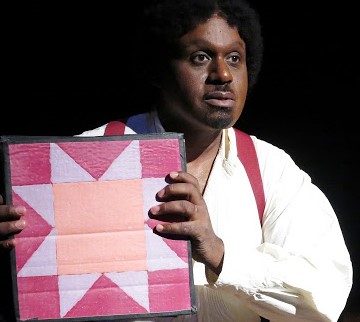
Johnson really draws in his audience as his partners on the Underground Trail. When Johnson illuminates on the hidden meanings of the railroad terms, he also sheds light on how significant the building of the railroads were to the emancipation of slaves. Sitting comfortably Indian style, Pappy decodes the meaning of the symbols of the quilts and reveals the ingenuity and sophistication of a people intend on gaining freedom. With the eerie sounds of the river flowing in sync with Johnson’s rich vocalization of the classic, “Follow the Drinking Gourd,” he elucidates on how each symbol will be signs along the way to guide his motley runaways to safety in Canaan, which Pappy declares is the name for Canada. On reaching the Promised Land of Freedom, Pappy leaves us with a sense of hope for the future, as long as we never forget those champions of the past.

In these tumultuous times, Johnson’s exploration of the past is very significant. It encourages us to be as brave and determined as people like Harriet Tubman and all the unsung heroes of that time. In order to change history, we must learn from it. Johnson, in his poignant characterization of Pappy, leaves us with the great message that the heroes of yesterday can inspire the heroes of tomorrow. As Alice Walker said, “Harriet Tubman was not our great-grandmother for nothing.”

Pappy on Da Underground Railroad's last performance was Feb. 27 at the Gene Frankel Theatre (24 Bond St. between Bowery and Lafayette St.) in Manhattan. For more information, visit brownpapertickets.com.

Click for print friendly PDF version of this blog post

Let's Have a Conversation

While some people struggle with racial issues every day, other people have the leisure to study them. In the production of Smart People, the audience peers into the lives of four educated individuals who are all interacting with race in their own way. Some of these characters live a privileged life, while the other characters struggle with racism and stereotyping in their lives. Although this production touches upon important issues that are still prevalent in our society, Smart People decides to not go in depth with the discussion of racism, and instead keeps it as a nice conversation.

Click for print friendly PDF version of this blog post

81 and Still a Bawdy Broad

As the lights illuminate the scant set design on stage—a keyboard, table, chair, a white and gold embellished frock on the wall and ukulele—a man appears and begins to play an overture of music on the keyboard while a petite, 81-year-old woman arrives in a gold sequined beret adorned with an Eiffel tower sewed on top. This cabaret duo of singer D’yan Forest and her longtime friend and pianist Richard Danley then begin the one-woman cabaret stand-up comedy show, A Broad Abroad!

Forest’s show is a compilation of her personal memoirs. She jokes that she tells her age at the beginning of the show “just in case I don’t make it to the end.” She is not the typical, cookie-baking, grandmother figure. Instead, she recounts her travel experiences across the globe and “studies in men, life and pantomime.” Forest tells you every dirty detail down to cunnilingus and warbling about dying her hair and her lady bush that reflects her “I ain’t 20 either and I don’t care neither. And I dye my hair not just here, but there," mentality. As for her thoughts on the horizontal mambo, she says, “Most of my friends have given up on sex. Not me, my rule is it ain’t over until the fat lady is dead.” 

The solo entertainer is energetic in her delivery on stage. She strums the ukulele quite impressively as she sings in French, German and Italian. She shows off her still nimble body when laying down on stage and getting up with ease while telling the story of her escapades in a Turkish bath. When she sings the song, "La Vie en Rose," her eyes twinkle with emotion and vigor.

Forest is a skilled artist who delightfully played musical renditions of nostalgic classics. However, some of the jokes that she and her co-writer, Eric Kornfeld, have written as transitions are predictable and stale. These include references to the old joke (“My parents went to China, and all I got was this lousy t-shirt.") and the inevitable math problem that happens when an older person hooks up with a younger person (“One thing I know for sure 25 goes into 76 many more times than 76 goes into 25.”). 

The out-of-date script shows Forest's lack of a fresh perspective on the common-life experiences of women. Instead, she teaches you the age-old lesson, “Nobody told you life would be easy but it doesn’t mean you can’t have fun.” In topics of divorce and her perceived inability to make her mother happy, Forest appears heartfelt and authentic. Despite this, the audience's biggest takeaway is that she runs off and avoids the problems at hand. She would much rather be having sex and learning a new language than diving into life lessons.

Clearly, Forest doesn't seem to care whether or not the audience is laughing with her or at her. Her pure love of cabaret is illustrated in her command of the stage. Although she has lived her life with gusto, perhaps it’s time for some deep philosophical reflection?

A Broad Abroad! is running in the 10th annual FRIGID Festival at The Kraine Theater (85 East 4th St. between 2nd Ave. and Bowery) in Manhattan. Remaining dates and times: Wednesday, March 2 at 5:30 p.m. and Friday, March 4 at 8:30 p.m. Tickets are $15 for adults and $10 for students, seniors and the military. Visit www.horsetrade.info to purchase tickets.

Click for print friendly PDF version of this blog post

The Steps Before Marriage

For any couple—gay or straight—the road to marriage can be filled with potholes, breakdowns and driving down one-way streets in the wrong direction. David Auxier-Loyola’s semi-autobiographical The EnGaygement, follows the evolution of his relationship with Carlos (Seph Stanek) from dating to getting engaged in New York City. The EnGaygement was originally written to be a musical and is still being further developed. Its current version is being directed by Duncan Pflaster and performed as a cabaret show at the Metropolitan Room.

The production opens with the group song, “Just Another Night,” and David singing about spending another evening at a gay bar and longing for a soulmate. Carlos sings about looking for sex at a gay leather bar called the Eagle. David appears awkward, lonely and indecisive, and Carlos is determined and focused. After the group song, David cannot decide if he should call his diary a journal because “journal” sounds more masculine for a 35‐year‐old man. Instead of reading from his diary-journal entries, David suddenly performs the song, “Like a Perfect Song.” David sings about finding true love after having his heart broken and then being alone again in the end. There are 17 songs in this show with 12 A. being a reprise of “Like a Perfect Song.” Musical director and arranger, Mark York, plays the piano beautifully throughout this performance.

In scene two, Carlos starts by saying, “Once upon a time” and then distinguishes that he is not telling a fairy tale but a "manly tale" about a princely, handsome man. Carlos then sings about his many failed relationships and how he is content with dating himself in the song, “Single and Lovin’ It.” Next, David has dinner at the apartment of his friend Colleen (Colleen Harris) and her “southern, liberal, bisexual, agnostic, PC‐hating, musical theater lovin' son of a bitch” husband, Jason (Jason Whitfield). Lastly, cast members Chris-Ian (Chris-Ian Sanchez) and Elliott (Elliott Mattox) provide comic relief.

The value of this production is its characterization of gay culture and its ability to have the characters’ personalities relate with theatergoers. The cast brings high energy and makes the text come alive. Within this space, Sanchez’s remarkable singing and acting talents stand out brilliantly.  Sanchez’s facial expressions and his ability to naturally dive into his character makes this show worth watching. On the other hand, the characters and their challenges seem outdated—like they are all still stuck in the '90s. It is unclear if this production is supposed to take place during the 1990s in New York City. The legalization of same-sex marriage or the popular use of dating apps are not present in David and Carlos’ world.

The ensemble also does not effectively represent the ethnically diverse lesbian, gay, bisexual and transgender (LGBT) community in New York City. In doing so, The EnGaygement feels more like it takes place in New Jersey or Long Island. A more conceivable representation of New York City’s LGBT community would be the addition of a transgender character. Colleen and Jason seem more like good friends, siblings or cousins than a married couple in love. Likewise, one of the weaker scenes is when Carlos divulges that a rock hit his neck and he was a victim of gay bashing on Gay Street and Christopher Street.

The larger challenge with the current evolution of this production is its inability to powerfully stand for something extraordinary. Much of the material in this production revolves around superficial antics and heartache that is shared between two grown men who are supposedly in love with each other. It is like spending an evening watching two gay men break up, get back together, break up again, and then sing about why they cannot find love. Some of the cast members also appear to be reading their lines from the script and it gives the impression that the production is more of a public reading. At times, The EnGaygement feels more like a vanity project than a potentially new, bold musical. This limits the production’s ability to travel outside of the New York City market and reach future audiences who are seeking this material. More dialogue between the songs can further develop the plot and characters. Most importantly, Auxier-Loyola can make a bold choice and commit to either having The EnGaygement live in New York City’s cabaret world or as an Off-Broadway musical. Right now, The EnGaygement lives somewhere as a work in progress—like a house that is starting to lose its original floor plan because it is always in a state of renovation.

The EnGaygement is recommended for theatergoers who enjoy listening to live singing while having a drink at a plush venue. It is not recommended for those seeking an accomplished musical or an innovative cabaret show that will leave them transformed. There is no doubt that this production has vast potential and a very talented cast, but its holes are showing because its overall aim and direction fall short.

The EnGaygement runs until June 22 at the Metropolitan Room (34 West 22 St. between 5th Ave. and Ave. of the Americas) in Manhattan. Evening performances are April 21, May 24 and June 22 at 7 p.m. with no matinee performances. Tickets range from $20-$115 (plus a two-drink minimum). To purchase tickets, call 212-206-0440 or visit metropolitanroom.com.

Click for print friendly PDF version of this blog post

Wordless Wonder

What is the definition of HTI—Hug Transmitted Infection? Mike Spara tells you in his wordless solo sketch, "Give That Guy a Hug," one of more than 14 that constitute his show Conversations With ... Body Language. In the “Hug” sketch, Spara portrays a man who wants to give out free hugs. In the background, words on a projection screen explain that the man who is trying to give away free hugs is “totally clean and free of STDs: Sexually Transmitted Diseases, or to use the less archaic term, STIs: Sexually Transmitted Infections.” 

Click for print friendly PDF version of this blog post

If I Only Had a Heart

Many people are familiar with Hollywood’s The Wizard of Oz and the Tin Man—found in the woods with an ax in his hands and rusted in place from a storm that had passed. But did you know that this man was not always made out of tin? In fact, this Tin Man was once a woodsman made of out of flesh, blood and a real heart.

In the play The Woodsman, the audience is taken back to the days before he turned into tin and the house dropped on the Wicked Witch of the East. Writer James Ortiz constructed his version of the life of the Woodsman. Ortiz collected information from the original book and film and the history of the town that the Woodsman lived in up until the day Dorothy took her first step in Oz.

Playing the leading role as Nick Chopper the Woodsman, Ortiz is also the creator, co-director, set and puppet designer. Although not alone in making this performance possible, Ortiz’s talents are shown not only in his great acting abilities but also in bringing such a memorable childhood story to fruition.

In this production it is the ensemble and the violinist Naomi Florin who bring this performance to life. With Florin and the majority of the ensemble remaining on stage for the entirety of the performance, they are the ones who control the sounds and music. The ensemble manages the set changes and they contribute to the lighting with flashlights. The ensemble also creates sound effects, performs magic, and becomes parts of the set.

The puppets are one of the most important features in this production. Puppet designer Ortiz created puppets that add life to the magical people and creatures that exist within this world. In addition to their other duties, the cast members are also the puppeteers. Although the audience can see the ensemble controlling the puppets, the group of talented actors do a fantastic job at working seamlessly together. The puppets are like an extension of the actors as they move throughout the space and even appear from the shadows. With the help of one to four cast members the puppets become bigger than life. The voices of the puppets come alive by having multiple actors control these magical beings. Layers of sounds and eerie, enchanted sounds are also used.

Audiences are transported into a different world when they enter the theater. The ceiling and aisles are lined with lights, that are encased in mason jars, and hanging from trees. The space feels mystical and like when a story is about to be told to a child. Lighting designers Catherine Clark and Jamie Roderick use lighting delicately to create various shadows and the enchanted forest.

In order to allow quick transitions, Ortiz uses acting blocks that can be moved easily throughout the space to create various settings. Audience members who are not seated in the front row will probably not see one or two of the moments that happen on the stage. However, not seeing these moments will not prevent theatergoers from understanding what is happening.

Overall, The Woodsman is a heart-touching play that brings to life a story that has not been told. With the great music composed by Edward W. Hardy, meaningful lyrics by Jen Loring, and strong visuals envisioned by Ortiz, this play will remind any audience member of The Wizard of Oz and the infamous Tin Man. 

The Woodsman runs until May 29 at New World Stages (340 West 50th St. between 8th and 9th Aves.) in Manhattan. Tickets range from $45-$105. To purchase tickets, call (212) 239-6200 or visit thewoodsmanplay.com.

Click for print friendly PDF version of this blog post

What Gives You the Right?

What havoc would the world endure if all fossil fuels disappeared overnight? What extraordinary chaos would each nation encounter? What would you do if you were thrown into darkness without electricity and power? For some people, these scenarios may seem far-fetched, extreme or an unworthy conversation for the stage. Jupiter (a play about power) begins to examine, through the course of a 200-year dialogue, what could occur as a result. It is through the haunting and beautifully delivered experience of Jupiter that possibility, along with responsibility, is born from awareness.
 
Written by Jeremy Pickard, Jupiter is a well-thought-out, cutting-edge play. Believability needs to be suspended for five minutes—the amount of time it takes to explain the science-fiction underpinning that the protagonist, Joe (Pickard), has the power to make fossil fuels disappear in a blink and then put himself in orbit, far from the madness about to ensue. And he uses it. His only link to the world below is 1950s-style radio that is used to communicate with a woman introduced as Humanity (Sarah Ellen Stephens).
 
Darkness envelops the world. Mobile phones are useless and communication trickles. Gangs rove around seeking food while friends and neighbors huddle together to stay warm or share what they have left. Bodies begin to litter the wayside. The larger question is, Why the need for this extreme? Humanity angrily expresses to Joe that treaties and accords had been reached, partnerships created and world leaders have begun to understand the need to work together to save the planet. Joe’s reply—it’s too late. For every step mankind can take, he has played out each scenario to its fullest, and not one will make a difference. Only a complete reboot will put mankind on a course correction.
 
For 200 years Joe and Humanity quarrel, debate, discuss and agree to disagree. The loneliness in orbit begins to affect Joe, and even the robot he built for companionship is not enough. The world and its remaining inhabitants transition ever so slowly out of the period of intense darkness and anarchy. The piece suggests that maybe there is hope.
 
The situation of the play was inspired by the 1815 eruption of Mount Tambora on the Indonesian island of Sumbawa; it caused a “volcanic winter” that led to famine and disease. Although the disruption in Jupiter is manmade, the results would be similar.

Credited as co-creators along with writer Pickard are Jonathan Camuzeaux, Lani Fu, Megan McClain and Simón Adinia Hanukai, who directs the piece. Fueled by global concerns about the environment, they are part of the eco-theater company Superhero Clubhouse, “a collective of artists and scientists” working to create “original performances via a collaborative, green and rigorous process,” according to its website. (Camuzeaux and Hanukai’s Kaimera Productions is a co-producer).
 
Composer Camuzeaux, who emigrated to the U.S. in 2009, creates haunting music using a rare stringed instrument called a sazouki; he also delivers a telling narration early in the performance and later portrays the robot Cowboy. Hanukai, who is originally from Azerbaijan, splits his time between New York and Paris. His rich and diverse background in dance, theater and education shows in the movement, layout and character development.

It is clear that they not only embody a worldview but also deliver it with extraordinary purpose and aplomb. Pickard’s script is powerful and concise, and he creates a character with the halting manner of Rod Serling. The play/performance progresses with such deference to the experience of the audience that the focused collaboration produces its intent boldly and with great detail.

Stephens, who carries a large share of the acting responsibility, brings all the nuance of mankind together as Humanity. While Pickard created a way of being for Joe that is consistent, the actress moves through a palette of emotions. She brought conviction and intensity to her part.

So committed were the collaborators of Jupiter to bringing a greater awareness to the issue of global energy beyond the play that the creative team secured a grant to attach solar panels to the theater. While not always enough power for an entire performance, there is a television monitor above the stage letting the audience know how much energy is used in kilowatt hours and the grams of carbon dioxide required. Additionally, after each performance is a panel discussion with the cast and a guest for those who would like to hear more. Gavin Schmidt, director of the NASA Goddard Institute for Space Studies in New York, climatologist, and co-founder of the award-winning climate science blog RealClimate, was on hand to answer questions.

The deeply moving Jupiter delivers its message in an insightful and  powerful evening, and beyond.

Jupiter (a play about power) will be presented at La Mama Theatre Club (74a East 4th St.) through Feb. 28. Performances are at 7:30 p.m. on Thursday-Saturday, with matinees at 2 p.m. on Sunday. Tickets are available by calling the box office at 212-475-7710 or through OvationTix at 866-811-4111.

Click for print friendly PDF version of this blog post

Tennessee Stretching

The opportunity to see two late plays by Tennessee Williams, one a world premiere, is a tempting prospect for theater lovers. Although the general judgment prevails that The Night of the Iguana (1961) was his last great work, there have been productions of the failed plays of the later years that attempt to restore luster to them. The Two-Character Play, Kingdom of Earth, A Lovely Sunday in Crève Coeur, and In the Bar of a Tokyo Hotel have their partisans. In the same spirit, the ambitious Playhouse Creatures Theatre Company has put together a bill of A Recluse and His Guest and The Remarkable Rooming-house of Mme. Le Monde, both written in 1982, the year before Williams died. They are strange one-acts, and if they were by a lesser-known writer they might not be worth a look. However, they benefit from the inventive shoestring productions given them by director Cosmin Chivu and provide an engrossing evening.

Justin West’s set for each features junk: mounted animal heads, Cornell-like boxes and rusty radiators clutter the space; crates serve as chairs and tables. Buzzy TV monitors are used in both works, most unusually in Recluse and His Guest, which is set in “a far northern town in a remote time.” The TV monitors are less out of place among costumer Angela Wendt’s furs, greatcoats, and leather aprons and boots, which suggest a Game of Thrones era and a fairy-tale setting that jibes with the plot of Recluse. Into the town of Staad trudges a starving, penniless woman, Nevrika (Kate Skinner), to start life anew. She has trekked through forests and fields and avoided wolves. She is scorned by townspeople, but after an encounter with a wealthy but amoral “gentleman,” Nevrika arrives at the door of a recluse, Ott (Ford Austin), and insinuates herself into his life.

Quite apart from his desire to be alone, Ott has justifiable misgivings about Nevrika. For one thing, she talks to animals, cawing occasionally and bringing home a hen that lays eggs for them. Gradually, he adjusts to her company and finds her useful as she straightens his home, rubs his back and helps him bathe. He allows her to stay even after a letter of warning arrives about her. Skinner invests Nevrika with cunning and desperation, and Austin’s Ott is both harsh and floundering in the face of her growing affection. Her grooming him for an appearance at the spring ball in Staad foreshadows a Shavian ending.

The Remarkable Rooming-house of Mme. Le Monde is a shorter and slighter piece. A starving cripple named Mint lives in the attic of a rooming-house, where he is raped by the young son of Mme. Le Monde regularly. Mint (Jade Ziane) hauls himself around his upper room on hooks that descend on ropes, but the ropes are of varying heights, and sometimes he falls to the floor. When an old school chum, Hall (Patrick Darwin Williams) arrives, things turn ugly. Mint has biscuits (i.e., cookies, since the piece is set in London) and tea for his guest, who has stopped to service Mme. Le Monde (Skinner again, in a red fright wig) on his way upstairs. But the nattily dressed Hall, who is a confidence man, helps himself to tea and biscuits relentlessly, keeping the hapless Mint away from nourishment.

Willliams’s dialogue in the piece can seem like a high-school version of Joe Orton: Hall and Mint were educated together at the sniggeringly named Scrotum-on-Swansea. “At Scrotum-on-Swansea you were a notorious fag and bed-wetter, but reasonably mobile,” Hall recalls with a posh accent. “Now you get about only by swinging from hook to hook, like that historical ape-man swinging from branch to branch in the jungle.” The sexual frankness, arch dialogue and nudity are part of Orton’s repertoire, and, as John Lahr points out in Tennessee Williams: Mad Pilgrimage of the Flesh, in 1982 Williams was working on another play, A House Not Meant to Stand, which “broadcast the influence of British playwright Joe Orton.” Clearly Mme. Le Monde, from the same year, also reflects Orton, but it lacks the comic snap of the younger man’s work.

Mme. Le Monde ends grimly but satisfyingly. Chivu has used the TV monitors skillfully to replace a collapsible staircase called for by the script. These short plays aren't earth-shattering discoveries, but they have many small pleasures, not least for fans of Williams’s work. Playhouse Creatures deserves credit for spotting those rewards.

Two one-act plays, A Recluse and His Guest and The Remarkable Rooming-house of Mme. Le Monde, comprise Tennessee Williams 1982, presented by Playhouse Creatures Theatre Company through March 6 at Walkerspace (46 Walker St. between Broadway and Church Street) in Tribeca. Evening performances are at 7:30 p.m. on Feb. 24–28, March 2–6, and March 9–13, with a matinee on March 5 at 3 p.m. Tickets are $40 and may be purchased by calling 800-838-3006 or visiting PlayhouseCreatures.org.

Click for print friendly PDF version of this blog post

A Band of Big-Top Singers

The Extraordinary Fall of the Four Legged-Woman, a new musical being shown at the 10th annual FRIGID New York festival, is based on real-life human marvel Myrtle Corbin, a woman with four legs, two of her own and the other pair belonging to a Siamese twin sister, who was fully formed only from the waist down. The show does not go into a detailed historical account of Corbin, but one suspects that the creators have been inspired by Side Show, the Broadway musical about the Hilton sisters, who were conjoined twins.

Extraordinary Fall focuses only on a small part of Corbin’s story, during which she is a member of a traveling circus sideshow. On opening night, a mysterious man comes to see it. Corbin (Madeline Bugeau-Heartt) reveals her extra pair of legs in a sly manner, lifting the outer layers of her skirt slowly. The man, Dr. Clinton Bicknell (Justy Kosek), falls head over heels for Corbin and returns every night to pursue her romantically. 

The other characters have individual acts, though what they are and what oddities make these characters “freaks”—or even if all these characters are freaks. It may be that they just have unique talents to perform. The character of Oswald (Marcus Herndon), for example, has chosen to stop performing, but the reason for his decision is never made clear, nor is the type of act he used to perform. Is he the strongest man in the world? In a choreographed movement (by Kory Geller), during one of his solos, the actor makes circles on the floor with his foot. It's not clear whether it represents Oswald becoming some sort of man-bull when he gets angry or something else.

At one point in the musical the character of Lola (Lindsey Ackerman) explains to the character of Simon-Elizabeth that she finds it easier to expose herself fully to the audience each time that she performs. Again, it is not clear what Lola is referring to. In her act she seems to be a sword swallower and tightrope walker, and she also does a striptease. Does she mean exposure relating to the striptease act? Is Simon-Elizabeth exposing himself as a hermaphrodite or a transgendered male to female? Although the show has holes in it, the way it examines what it means to be “other" is powerful. 

Although the setting is Arizona—“The light was dark one night in Arizona./The brittle stardust sunk down low" goes a lyric—Michelle Rickert’s design doesn't really evoke the terrain. It's up to the dialogue to refer to dust, to the clear nights when stars can be seen for miles and miles, and to heat that warms the days in the cooler months but turns brisk at night. 

Lily Ali-Oshatz, who plays M the Ringmaster, also wrote the show’s book, music and lyrics. This 55-minute musical, sung a capella in its entirety, is an impressive endeavor. There are haunting melodies that are hard to forget. The cast of five all have a strong musical sense and individual singing styles and vocal qualities.They have been costumed by TDF Costume Collection with stunning clothes that give the show a sense of the 1800s time period. Especially notable are the ringmaster’s striped cropped pants.

The minimalist style of set design and props also works well for the show. Bright-colored umbrellas with interior lined white twinkle lights serve many uses. Not only are they umbrellas, but they become other elements in the musical. When spinning around they are train wheels. When the actors line up with them, they act as a “theatrical flat” to create a sense of privacy as the lovers Corbin and Bicknell sing their intimate love song. Stacked on top of one another, the umbrellas become logs in a campfire, as cast members sit around them to listen to Oswald’s storytelling.

Despite the flaws, the overall concept, vision, and music are good enough to win plaudits for Ali-Oshatz's maiden effort. 

The Extraordinary Fall of the Four-Legged Woman is playing at the Kraine Theater (85 E. 4th St.). Remaining performances are Feb. 22 at 8:50 p.m.; Saturday, Feb. 27 at 1:40 p.m.; and Wednesday, March 2, at 8:50 p.m. Tickets are $10-$18 and are available online at www.frigidnewyork.info or at the Kraine Theater box office.

Click for print friendly PDF version of this blog post

#IKEA Angst Emoji, Emoji

The script for Help Me Out Here, an entry in the 2016 FRIGID New York festival, pulls material from text messages written when people were drunk, iPhone notes, personal journals, positive affirmation recordings, and sprawling Post-it notes on which writers look for the meaning of existence—all while assembling a chair from IKEA. Michael Joel and Kaitlin Overton, who conceived the script, also perform and co-directed the piece; they keep their real first names as the characters.

Taking on three jobs to produce one’s own work in the theater requires a dynamic, steadfast vision to provide the ultimate experience for the audience. When it occurs, magic happens; however, even though the angst of a younger generation lost in the mobile phone/social media argument—"If I’m so connected, why do I feel so alone?"—is conveyed in Help Me Out Here, the play comes up short. Conceptually it has footing, but with only 40 minutes of material, there are too many missteps.

Lonely, frustrated and uninspired, Michael sits down to write but settles into how many different ways he can scrawl "dip shit." He drinks wine from a ceramic coffee mug. With the help of her own bottle of wine, Kaitlin, meanwhile, is attempting to assemble an IKEA chair while sending needy text messages to Michael, some of which are answered, and some not. Equally as lonely, and exacerbated by the chair, she seeks solace and empowerment from self-help CDs. Until the closing scene, they are both on stage delivering monologues but have no physical interaction besides the text messaging.
 
Michael has more of the in-depth dialogue that provides insight into his anxious view of himself and the world. His diatribe on hashtags is particularly telling: “Look at what is happening in the world. Humanity as a whole is a fucking hellscape,” he says. “And what is anyone doing about it? Nothing. Fucking hashtags. That’s about as far as we have advanced as a society.”
 
Riffing on the proverb "When one door closes...," Michael uncovers an ah-ha moment: “So you start and end every day pushing and pushing at this door, and you end up wasting years of your life trying to push this door open when finally you get the sense enough to look at your surroundings and notice that this whole time, printed on the handle of the door it says in big bold black fucking letters ‘Pull.’”

He attempts to go to a party but instead listens to every neurotic thought in his head, delivered as a voice-over. Soon enough he is barely managing a lame excuse to the hostess to make his exit. Meanwhile, maybe because of the wine or just because she is growing weary waiting for a response to her text messages, Kaitlin falls asleep. The parts of an unfinished chair and the instruction manual are all around her.

Kaitlin’s challenge assembling an Ikea chair against the backdrop of life is a keen metaphor for both of them. The inclusion of her character, however, lacks conviction from the playwrights, as evidenced by her lack of dialogue. Michael battles with life, world and God issues while Kaitlin listens to positive affirmation on a CD and argues with a how-to manual. This type of dialogue only reaffirms the age-old myth that men are strong and educated, while women are weak and helpless.

A different director could have brought a fresh eye to the play: one who addresses cracks in the storyline while pulling/pushing the actors to dig deeper. Perhaps because of their closeness to this material neither Joel or Overton has addressed inconsistencies in the script. Kaitlin, in a text message, asks Michael if he has a screwdriver. When he arrives they finish the chair, but without a screwdriver, they never reference the screwdriver, using an Allen wrench instead.

However, the real problem is that the directors of Help Me Out Here have given Kaitlin so little substantial dialogue and a dated female story line. “I don’t understand these instruction booklets,” she says. “I never have and I never will.” Even in the modern age of IKEA, the writing behind Kaitlin’s monologues has not allowed her character to progress. Instead, she is relegated to being either unwilling or unable to understand an instruction manual or the need to have a man come to the rescue.

The next morning, Kaitlin awakens, still surrounded by the pieces of an unfinished chair, and she calls Michael. Human interaction, not another text message, moves him to come over. Maybe, after all, it’s not so much a man to the rescue but rather the bigger picture that people can accomplish more together with a glass of wine than by going it solo. Until the playwrights, or a different director, rethink the point of the angst, there is not much to help.

A No Dominion Theatre Company production, Help Me Out Here plays at Under St. Marks (94 St. Marks Place) in Manhattan. Remaining performances are Wednesday, Feb. 24, at 7:10 p.m.; Saturday, Feb. 27, at 10:30 p.m.; and Saturday, March 5, at 12:30 p.m. Tickets are $18 for adults and $13 for students at www.horsetrade.info. For a complete list of plays presented by FRIGID New York, visit www.horsetrade.info/frigid-festival

Click for print friendly PDF version of this blog post

Horrors in the Heartland

It’s been 20 years since the Broadway revival of Buried Child, and the production by The New Group at the Pershing Square Signature Center suggests that Sam Shepard’s 1978 Pulitzer Prize-winning play has lost some luster. Echoing classic American dramas of dysfunctional families—notably Who’s Afraid of Virginia Woolf? and Long Day’s Journey Into Night—Shepard’s portrait of the American dream gone awry is a post-Vietnam nightmare that combines melodrama and absurdist elements. The latter can try one’s patience, as Shepard hacks away at American mythology with a scythe.

In Derek McLane’s shabby, brownishly-decorated Illinois farmhouse live three people: Dodge (Ed Harris), a sickly, cantankerous, whiskey-swilling patriarch who lounges on a beat-up sofa with a ratty blanket that is every bit as necessary to him as Linus’s in Peanuts. This feeble figure, whose name evokes Dodge City and Western heroism gone to seed, is married to Amy Madigan’s beady-eyed Halie, a woman who is cuckolding him with the local priest, Father Dewis (Larry Pine), who buys her telltale yellow roses. From him, she also wants public support for a statue of their late son Ansel, a basketball “star,” she claims, who died under mysterious circumstances. 

A new inhabitant is another son, Tilden, played by Paul Sparks as mentally challenged in the vein of Lennie Small in Of Mice and Men. Tilden has returned home after 27 years in New Mexico; he is generally soft-spoken as well as soft-headed. He finds corn in the backyard when his parents swear nothing grows there, brings it inside and shucks it. Occasionally, he mutters in a shell-shocked way about a secret and something buried in the yard.  

Dodge and Halie have a third son, Bradley (Rich Sommer), who uses a wooden leg after a chain-saw accident. Dodge is terrified that Bradley will sneak in and cut his hair while he’s asleep, and indeed, an emasculation in the manner of Samson occurs at the end of Act I. (Shepard’s 1978 version was three acts; in 1996 he reworked the script, and the current production plays without intermission.)

The couple who upset the apple cart, as it were, are Vince, Tilden’s son and the grandson of Dodge and Halie, and his girlfriend, Shelly (Taissa Farmiga); they drop in on his grandparents while traveling cross-country to see Tilden in New Mexico. (Parent-child communications in this family take a beating: Nat Wolff’s Vince hasn't seen his grandparents in six years; and, of course, he has no idea his father has left New Mexico. Moreover, neither father nor grandfather recognizes Vince, let alone remembers him.)

Both McLane’s set and Susan Hilferty’s costumes do a fine job of conveying realism, but much is left unexplained, and one’s suspension of disbelief often strains under Shepard’s symbolism. Why does Vince leave the house to buy liquor and not return till the next morning? Apparently so Shelly can be victimized by the sadistic Bradley and scorned by Dodge and Halie. And when they turn hostile, why doesn’t she explain more quickly that she is their grandson’s girlfriend? Or warn off Bradley before he takes advantage of her? The stage time that it takes for her to use common sense is, as Mark Twain would say, “a stretcher.”

In a climactic moment, when Halie discovers that the backyard has a bounty of vegetables, she yells to Dodge: “Tilden was right about the corn, you know. I’ve never seen such corn… dazzling. Tall as a man already… Carrots, too. Potatoes. Peas.” The idea that a field of high corn would not have been noticed in the backyard defies realism, as does Halie’s mention of potatoes. If she has not seen the corn until now, how can she possibly claim there are potatoes under the earth? But the symbolism of a harvest sprouting from blood and death is the point, not rationality or realism. 

Still, in Tilden’s corn-shucking and later, Shelly’s cutting up carrots, director Scott Elliott brings out the humor, although the two younger cast members pale in gravitas and skill compared with the superb veterans. Elliott also creates a terrific sense of febrile menace and poisoned trust. “You think because people propagate they have to love their offspring?” Dodge asks Shelly. “You never seen a bitch eat her puppies?” Life in this American home resembles a dogfight.

Shepard’s cynical view of American ideals and debased notions of national self-esteem were certainly fashionable in the late 1970s. To a large extent they are still hanging around. But Buried Child, for all the vigor of its performances, feels just a bit stale. 

The New Group production of Buried Child will play through April 3 at the Alice Griffin Jewel Box Theatre at the Pershing Square Signature Center (480 West 42nd St., between 9th and 10th Avenues) in Manhattan. Evening performances are Tuesday-Friday at 7:30 p.m., and Saturdays at 8 p.m. Matinees are Saturday and Sunday at 2 p.m., and on Wednesdays at 2 p.m. Tickets are $25-$115 and may be arranged visiting www.thenewgroup.org, or through Ticket Central at 212-279-4200, or in person at 416 West 42nd St. (noon to 8 p.m. daily).

Click for print friendly PDF version of this blog post