


Murder in the First. And Second.

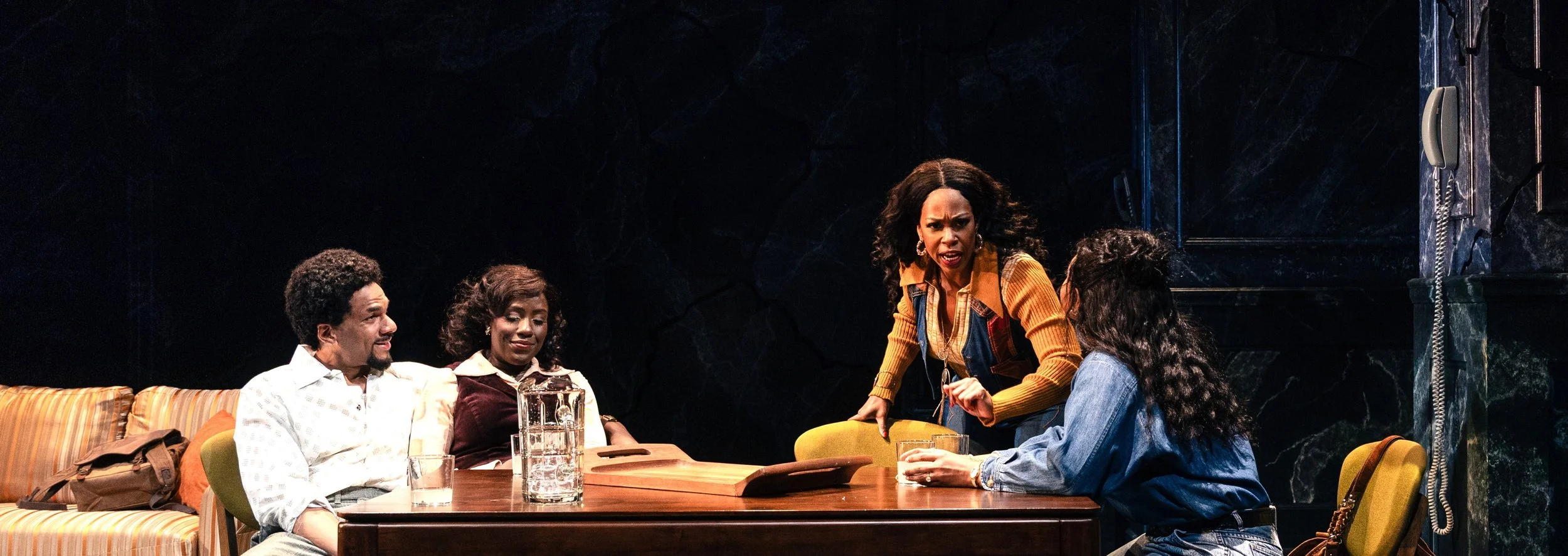
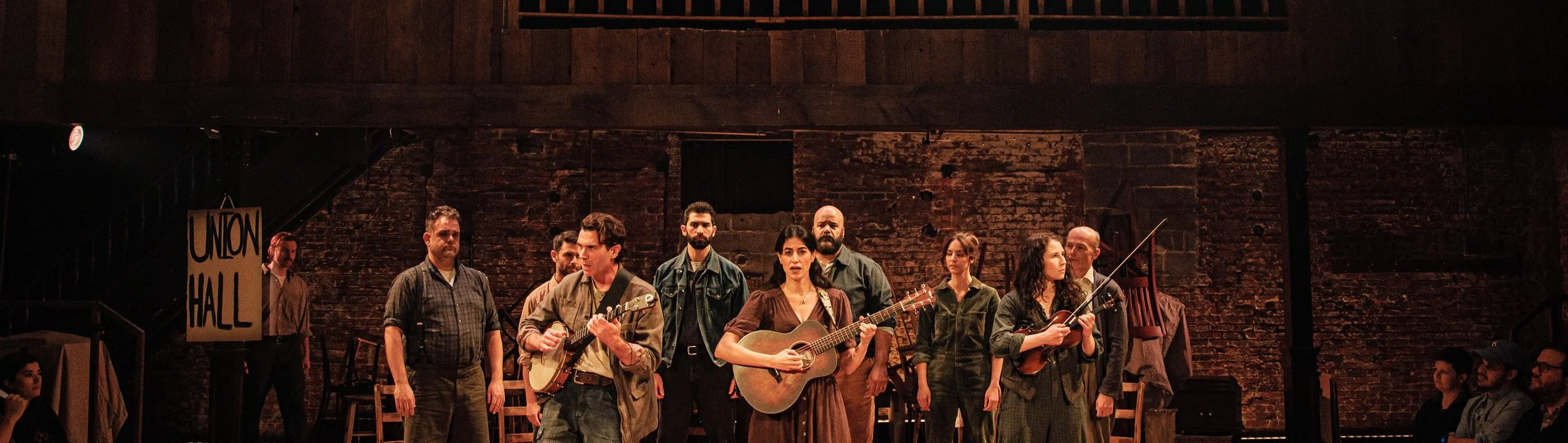
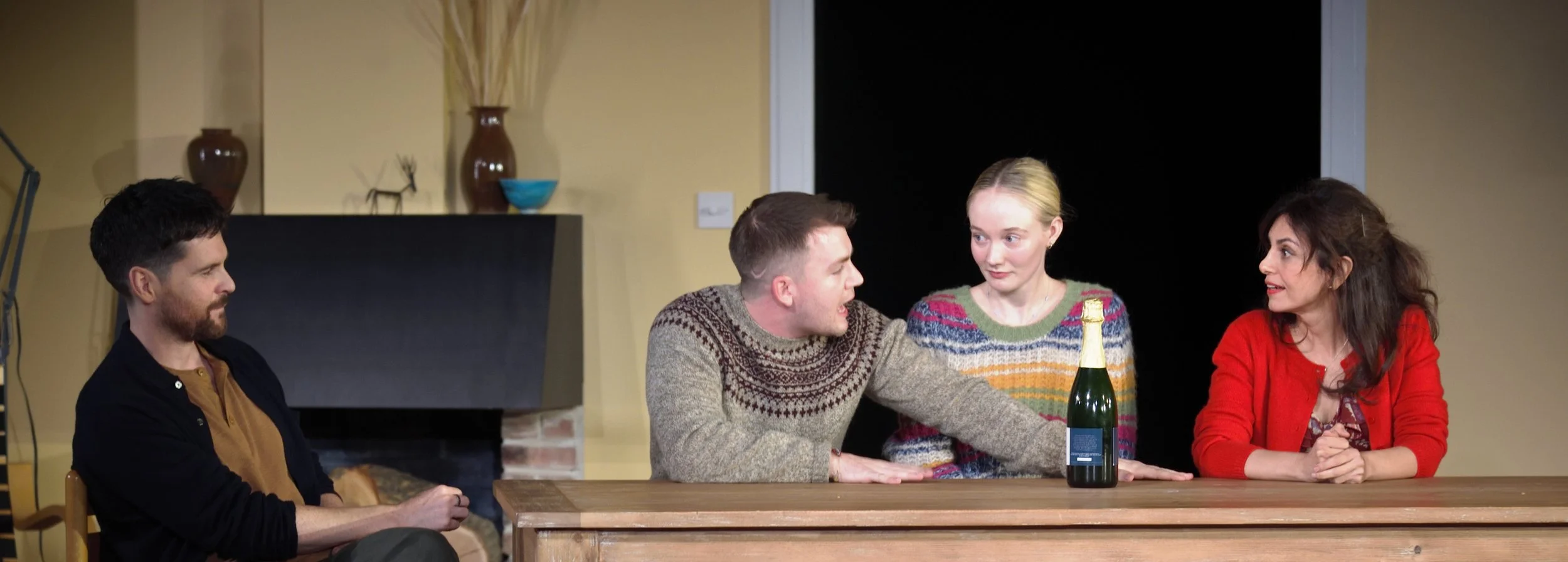
A sheriff department with a sheriff on perpetual vacation. An artist with a penchant for photographing nudes and pastries. A daffy old mayor. A brilliant private eye. The community of Sentinal, Oklahoma, as depicted in Sneaky Snake Productions' Detectives and Victims, currently playing at The Brick Theater in Williamsburg, is home to a collection of likable oddballs. Described in publicity materials as "two independent and interlocking plays," Detectives and Victims, which are designed to be seen in any order, play in rotating rep under the title A Brief History of Murder. Like the cult David Lynch TV show Twin Peaks, A Brief History of Murder, by Richard Lovejoy, addresses violent crime in a small town America by coloring a standard detective drama formula with shades of fantasy. As both Victims and Detectives spiral toward their bloody conclusions, the plays take harder turns into the supernatural. With two plays, a twenty member ensemble, a couple of musical numbers, multiple set changes and some very gory costume details, A Brief History of Murder constitutes a highly ambitious project. Under the direction of Ivanna Cullinan, the large cast delivers a consistently fun performance, even as the plays fail to deliver a neatly solved crime.

Neither Victims nor Detectives fully explains the mysteries and murders on its own. It would be enormously exciting and a delightful playwriting feat if, taken in tandem, the two plays worked together to reveal one another's secrets and render the full picture more clear. Unfortunately, that doesn't happen. Neither does the two-part production wholly emphasize varied perspectives. Although Detectives and Victims ostensibly focus on each play's titular characters, there is a lot of overlap between them. The two-part production most often plays less like two pieces of a master puzzle than like an experiment in staging alternate drafts of a singular script.

It's lucky, then, that Lovejoy is a playwright with a gift for writing good dialogue and comedic zingers. "I really can't afford any further library fines," says a Local Avid Reader (Lovejoy, in a brief cameo) upon discovering the town librarian brutally murdered with her heart and eyes ripped out, "I have a son." Indeed, some of the most obviously neat aspects to the double-billed production are the scenes we see twice; recognition of the familiar scenes is fun mostly because the jokes in them are pretty great. Under Cullinan's direction, the stage perspective is flipped in the alternate productions, a nice touch.

Cullinan deserves special credit for keeping each play under control, even as the plays themselves descend into zaniness. Both Victims and Detectives run just over an hour and half; each play begins with a clearly stated premise and identifiable subplots which grow murky as the plays grow more heavily mythological until it becomes clear that the mysteries have spun too far out of control for the scripts to explicate. In the hands of a lesser director, such a realization might cue audience restlessness, but Cullinan reigns the production in so tightly that its descent into carnage signals not only dilution of an otherwise cohesive plot but a joyously maudlin production choice. She also demonstrates an impressive ability to keep an enormous ensemble on the same stylistic page, an especially important quality for a production evocative of genre fiction.

The majority of A Brief History of Murder's characters appear in both Vicitims and Detectives, making the second play audiences see -- whichever play that is -- full of warmly familiar faces. It's crucial to the productions' ability to build suspense that audiences like the characters; we need to care whether they live or die and whether they are good or evil. Happily, we do. As the only obvious predator of the production, Timothy McCown Reynolds delivers a coolly creepy performance. Based on the Norse mythological wolf Fenrus, McCown Reynolds skulks about the playing space. "Historically, until this moment, you never missed a thing. Now," he tells a startled former agent of the KBG, "you rarely miss a thing," with a delivery that makes the observation as devastating as any of the gruesome murders depicted onstage. Other standout performers include Kent Meister as a chillaxed artist whose world unexpectedly crumbles, Jesse Wilson as a debilitatingly nervous rookie cop, and Adam Swiderski as a cagey KGB agent turned nude model.

While the large cast bolsters the productions' boisterous, epic aesthetic, both scripts would benefit from some slimming down of a few superfluities. A vacationing marine and her doting husband who fancy themselves detectives (a comedic duo of Sheila Joon and Salvatore Brienik) are among the few characters to appear in Victims only and their presence adds little to the production; a cancer diagnosis in Detectives is a distracting admission. The nymphish Portal sisters, (Sarah Malinda Engelke, Kathryn Lawson, and Eve Udesky), dressed in confusing shiny gold dresses, possess otherwordly powers of an unexplained sort; their last name is insufficient articulation of their identities or their purpose in the play.

A Brief History of Murder's production team gives the town of Sentinal, Oklahoma a homey feel. Costume designer Jim Hammer dresses the characters in comfy Westernesque clothes that contrast nicely with the play's wonderfully silly nude model scenes. Chris Chappell's original music and sound design adds a nice dynamic, infusing otherwise light scenes with a sense of the ominous. As the production's gore and effects designer, Laura Moss does nice work that celebrates the productions' roots in Grand Guignol theater.

Sneaky Snake Producions is an inventive theater company whose last production, Adventure Quest, also written by Lovejoy, traded on the absurd limitations that make up the worlds of video game quests. A Brief History of Murder draws inspiration from the considerably less limited worlds of ancient mythology. The result is a pair of plays that lose a little in their overexuberance but whose crafted enthusiasm for their material is itself a source of delight.

Click for print friendly PDF version of this blog post

Home Fires Burning

Family dramas are one of the most tried-and-true storytelling genres. Perhaps that is why Chris Henry’s production of Sean Cullen’s Safe Home adds in a few extra elements – audio-visual effects, a non-linear storytelling approach. But all the tricks in the world cannot disguise the fact that this play still needs a lot of work. It’s not clear exactly why – Home has already endured development readings at Lincoln Center Theater, Primary Stages, and Stanford University (by the American Conservatory Theatre and a workshop production with New York's CAP 21 in 2008). With this much of an investment of both time and effort, one would think the central Hollytree family in the show would be far easier to relate to than this fractured tale allows.

Cullen sets Home in the early 1950s, during the Korean War. Eldest Hollytree son Jimmy (Eric Miller), aka “Lucky” has chosen to serve overseas. Not to spoil anything, since it is revealed during the play’s first scene, but Lucky is less than his name implies – he doesn’t make it back alive. Cullen’s subsequent seven scenes hurtle back and forth between 1951 and 1953 to show some of the fallout of Lucky’s death and some of the events that led him to make his fateful decision.

Except that in the aggregate, many of these scenes feel either incomplete or inconsequential. Lucky is unemployed and lost – his home life does nothing to help him feel grounded. His mother, Ada (Cynthia Mace, a reservoir of anguish), is a negative Nelly prone to antagonizing her family, though it is unclear why. Is she chronically depressed? Disappointed by life? Or was there an earlier specific incident that led her here?

Similarly, patriarch Jim (Michael Cullen)’s hands are always bandaged due to ambiguous work with radiators that perpetually causes them to bleed. He can be as volatile as his wife when angry, but gets provoked by the oddest of occasions, for instance, at the arrival of Claire Baggot (Katy Wright Mead), the girl Lucky left behind. Even if their motivations are questionable, Cullen and Mace are terrific at displaying regret and disappointment

Henry has difficulty finding the human elements beneath Cullen’s out-of-order storytelling structure. The audience never gets a chance to feel either conflict or chemistry in the flashback portrayals of Lucky’s attraction to Claire; the scenes play mostly as filler, with the momentum drained out of them.

Other scenes fail to register appropriately as well. Home misuses Hollytree brother Pat (an excellent Eric Saxvik) in his several scenes. One scene in which Pat tries to open Lucky’s coffin to see if his body is actually inside seems too dragged out. One wishes that Cullen would make good on this character’s potential. Is he doomed to follow Lucky’s path, or does he have more choices than his older brother? Another flashback scene, in which Jim feels threatened by Lucky, seems to short, as if Cullen the playwright needs to provide more background to warrant such paranoia. (Ian Hyland is impressive as John, the youngest Hollytree brother).

Perhaps part of the problem with this production of Home is a case of myopia. Is the playwright too close to his subject? In the program, he explains that Home emerged over a sixteen-year process inspired by his own family. His grandparents, Ada and Jim, lived and raised three sons in Buffalo, and one of his uncles was indeed killed in the Korean War. Before his death, he sent home a lengthy letter “from a cold and lonely outpost in Korea.”

It is likely that Cullen, the playwright, could not separate his family adequately from the work. He introduces issues but doesn’t explore any of them fully. Henry also makes no effort to further elucidate Cullen’s narrative choices, and then makes an additional poor choice: at one point in the show, a character with a cigarette in hand opens up a window onstage and leaves it open for the duration of the show. The freezing cold outside temperature then permeates the theater for the rest of the performance, making it difficult to attend to the play.

All of these factors make Home feel half-baked. There is a potentially moving, relevant story here, but it has yet to be unearthed.

Click for print friendly PDF version of this blog post

An Unsavory Burger from Mythical Greece

An elegant young woman poised behind a flowered bedecked lectern, draped in azure, handed patrons programs the way a hostess doles out menus. The opening night meal at Teatro Circulo was not, for example, foie gras, or anything else so proper-- but it was fine. Its taste was a fusion of the great myths and drama of classical Greece flavored with a putrid modern disdain of ourselves. Teaser Cow, a dark comedy written by Clay McLeod Chapman, convinces one of author Tom Robbins assessment of this playwright work. That is, it “races back and forth along the serrated edges of everyday American madness, objectively recording each whimper of anguish, each whisper of skewed desire.” Before “anguish” and “madness,” however, the show begins with a suspiciously catchy jingle accompanied by an all too happy commercial host who is selling hamburgers. From there the play unfolds into a mesh of mythological and urban landscapes that reconcile themselves cleverly, if not gorily, in the ending. The basic plot is familiar: the Minotaur is born of the punishment to King Minos given to him by his father Zeus for not sacrificing him a prized animal. Zeus forces Pasiphaë, Minos’s wife to copulate with a steer and thus conceive the Minotaur, a monstrosity, hidden in a labyrinth lest he ever escape. Teaser Cow follows that same premise with some minor 21st century adjustments.

In Chapman’s version of the myth, the characters are colorful and the majority of the action occurs in a dirty fast food kitchen. King Minos is the CEO of Minos Burgers, whose burgers are extremely tasty, but have a shocking secret. Minos’ daughter, Ariadne, works as a drive through host because her father wants her “to work her way up.” In the process of working “her way up” she has become addicted to ketchup, sucking and chewing on it like tobacco. Theseus, an Athenian burger slinger, is wooing Ariadne and his character, like others, is disgusted by the nature of his work. The origin of the infantile and mute Hysteerion, who has a gigantic bovine head and dons blue baby pajamas, is revealed to the audience slowly. Pasiphaë, the mother of Hysteerion, enjoys her liquor, which allows her to be both comically amusing and tragic.

Surveying the Mediterranean from presumably a high point in Crete, Theseus laments to Ariadne that Crete, Athens, Sparta and Corinth “have all become the same, a Minus Burgers can be found in each city!” This vignette showcases one of the many gripping temporal shifts between present and ancient time. These shifts allow for an interpretation of today’s food industry, which makes a thinly veiled suggestion: the 21st beef industry is every bit the abomination of the ancient Minotaur.

Plot aside, the company of One Year Lease is enjoyable to watch. There is a clear trust expressed between these actors who come from as far as New Zealand, Australia and Greece. If there are stand out moments then one is the whimsical midwifery of Babis Gousias, who enchants the stage with graceful mystery. Unfortunately, there were times when one hoped Gousias would have trusted the natural cadence of his voice more consistently. Christina Lind stood out as a neurotically prude Ariadne, while her mother, Pasiphaë, played by Sarah-Jane Casey, was powerfully feminine and like her on stage husband, her character reached tragic dimensions.

While there is no arguing with taste, Teaser Cow should satisfy most audiences. The plot is cleverly constructed and entertaining but also earnest. It may, however, make you consider more carefully before you order your next burger.

Click for print friendly PDF version of this blog post

An Odyssey

"Am I awake or asleep?" That uncertainty, voiced by characters throughout the International WOW Company's Auto Da Fe, permeates the production, which works hard to create a dreamlike aesthetic. Nate Lemoine's set design drapes the deep floor and backdrop of the large playing space in blue tarp, with white ladders of varying heights providing definition against the otherwise seamless expanse. Jullian J. Mesri's sound design provides near-constant ambiance setting music; a fog machine provides a lot of fog. Under the direction of International WOW Artistic Director Josh Fox, Auto Da Fe would benefit from a greater sense of dramatic clarity, even as it attempts to stage foggy consciousness and indefinite geography. An Odyssey adaption by Japanese playwright Masataka Matsuda, the International WOW production marks the play's English language premiere. Inernational WOW has over a decade of experience in international collaboration, and its rendering of Auto Da Fe is at its strongest in its use of multiculturalism to evoke life after war. With a 28-member ensemble of diverse ethnicities and nationalities, Auto Da Fe is perhaps among the most genuinely multicultural productions to play Off-Broadway in recent memory; rather than localize this U.S. translation of a Japanese adaption of the Greeks, International WOW integrates multicultural aesthetics to weave a story that approaches timelessness. Piles of empty shoes and rent clothing, which have become near artistic shorthand for human disasters ranging from the dead of Vietnam to the Dirty Wars of Argentina to the Holocaust, are put to good use in this production, effectively invoking a history of global horrors without needing to identify a singular crisis.

The young ensemble executes each movement with a lot of dedication; a greater degree of actorly precision might help avoid the preciousness which plagues the production. Loosely following a soldier called Odyseaus A through a war ravaged landscape, Auto Da Fe relies on scenes and images rather than on linear plot. Most of the ensemble remains onstage for the duration of the production, and Fox clearly has paid a lot of attention to stage pictures created by the large cast. At an intermissionless hour and forty minutes, however, the imagistic production grows tedious even before its penultimate scene overwhelms every other aspect of the production.

As Auto Da Fe nears its end, a small group of soldiers discusses rape as a tactic of war. An angry soldier argues for miscegenation as genocide: by raping and impregnating local women, he says, the soldiers will systematically put an end to the enemy's race. Next, the company's young women and a few young men cue up to to be raped by the soldiers, played by young male theater types doing their self-serious best at performing militaristic aggression. One of the soldiers takes a woman from the front of the line and shoves her toward the rapist, who throws her onto a pile of rags. Were the scene to end there, it might have more powerfully suggested the horrors to come, but this lengthy production is unsatisfied with brief images suggestive of futurity. Like most scenes in the production, the rape sequence goes on much too long, undoing its own power in the process.

Where Auto Da Fe's other overlong sequences tend to start intriguing and become cloying, the rape scene becomes flat out offensive. If it's at all possible to depict a marathon rape sequence theatrically, doing so would require more mighty exactitude than the young Auto Da Fe ensemble possesses. Further weakening the horrors of rape, as the long line of rape victims take turns on the clothing pile, yet another member of the ensemble speaks into a microphone of his mother's sad response to his father's infidelities. Recitation of memory fragments occur throughout the production, so at its least inappropriate, the spoken-word memory of familial strife provides an alternate focus to the rapist; at its most idiotic, it suggests a parallel between adultery and rape.

Auto Da Fe has many beautiful design elements and a hardworking young cast. Within the excess, the production has good moments evocative of the International WOW Company's more successful work. Good intentions undoubtedly went into the making of Auto Da Fe but especially given the horrors of its subject matter, good intentions are insufficient. Military rape is the most graphic aspect of war addressed by the play, and presenting it in the manner used here reveals the WOW Company at its most immature, incapable of evoking the horrors of rape and overpowering the good work that went into other parts of the production.

Click for print friendly PDF version of this blog post

Nothing Foul Here

Nearly a decade since its initial run, Richard Greenberg’s Take Me Out can now be viewed as a period piece, of sorts. Out was a watershed play, addressing homosexuality and ignorance in the world of American sports in the wake of moderately controversial statements made by Mike Piazza and John Rocker. It crystallized a few offhand comments into a work of art. And yet even though it went on to nab the Tony for Best Play and land on the Pulitzer shortlist, Greenberg’s signature piece was not a flawless work. Greenberg’s themes in Out are as abundant as they are passionate, but it runs the risk of feeling like a polemic. Fortunately, director Fabio Taliercio manages to navigate past many of these hurdles in his deeply perceptive production of the show, presented by Brooklyn’s Heights Players. He focuses on the people behind the ideas, and makes the best of an extremely talented ensemble.

Most of the cast play teammates of the fictional Empires, a Yankees-esque team enduring a drought. Darren Lemming (Ugo Chukwu), a cocky (though not arrogant) mixed-race teammate meant to recall the stature of Derek Jeter, outs himself at a press conference. It’s a decision that affects the Empires and several other key individuals. To Greenberg’s credit, many of these consequences are unforeseeable.

Also to Greenberg’s credit is how well he endows several prominent roles. Lemming might appear to be the lead of Out, but there are several other characters drawn with less broad strokes. These include Kippy Sunderstrom (Seth Grugle), the play’s omniscient narrator, widely regarded to be the smartest player in the league. Grugle proves himself to be quite a polished performer in a layered role – he is able to suggest that he is a well-read, open-minded figure and still not quite understand how Lemming, a friend with whom he spends more time than with his wife and children, could keep such an important secret from him. (The actor also deserves extra points for mastering Greenberg’s demanding dialogue with the same nimble skill that Eminem displays when wrapping his tongue around rap lyrics.)

Of course, anyone familiar with earlier incarnations of Out will also remember that it’s the lone non-slugger who nearly steals the whole show. Mason Marzac (Nathan Richard Wagner), is Lemming’s accountant (and eventually more), but he also serves as a surrogate for Greenberg himself. The sheepish number cruncher becomes a fan of the great American pastime for the first time, ascribing the sport as a symbol of democracy.

Mason is a clever invention on Greenberg’s part – he explains baseball for those (given theater audiences, many) unfamiliar with the details of the sport, and acts as a cheerleader for those audience members that are already fans. Marzac is the jewel in this show’s crown, and Wagner shines. He nails Marzac’s several impassioned monologues in a turn that is as enthusiastic as it is completely endearing.

It’s the fourth pivotal character, though, that both Greenberg and this production have some trouble pinning down. The Empires recruit Shane Mungitt (Craig Peterson), a prejudiced hick, to be their relief pitcher. He saves the team but becomes a divisive presence when he speaks out publicly about his racist and homophobic beliefs.

Mungitt is a tricky character to play. Is he merely uneducated, socially awkward, or is there something more sociopathic toward him? A first act scene in which Lemming and Sunderstrom try to engage him plays awkwardly, and doesn’t do justice to Mungitt. As the play escalates, however, and Mungitt emerges as a more fully formed character, Peterson acquits himself better, giving greater insight into the pitcher’s malevolence.

Taliercio is a skilled and patient storyteller, and his production manages to undercut some of Greenberg’s other flaws. First of all, it’s a boon to have a cast that more closely resembles the actual age of a pro baseball team than the original production had; it lends the characters’ immature, sometimes misguided reactions added authenticity. Additionally, Lemming’s motivation for coming out is never clear in the text. He is a self-described loner, does not have a surging libido, and is not currently attached to anyone, so why bother, aside from the fact that it is necessary to ignite Greenberg’s plot? Chukwu goes a very long way to unmasking the man, suggesting a solitude and an intelligence that have been quietly eroding him from the inside.

There are several other players to be applauded here: Mike Basile provides necessary comic relief as the bullet-headed Toddy Koovitz, while Doua Moua is terrific as Takeshi Kawabata, the Japanese ball player who refuses to learn English in order to keep his game pure – Greenberg provides him, too, with a special monologue that the actor makes the most of. Bryant Wingfield also nails his scenes as Davey Battle, an opponent of the Empires but friend to Lemming.

I also commend Carl Tallent's moveable set, which, among other locales, serves as press box, clubhouse, and locker room. That last setting brings to mind the show’s most polarizing element, which is the nudity in the shower scenes. It’s far from gratuitous – these scenes allow the audience to either share or dismiss the players’ discomfort following Lemming’s coming out. What I do wish is that Greenberg had crafted an earlier scene showing how this was a nonissue prior to the announcement. Also, eliminating one of the production’s two intermissions might help allay the play’s few momentary lulls (it currently runs just shy of three hours).

Out still manages to make the most of its source material, though, and then some, in this intelligent production full of all-stars. They should be full of pride.

Click for print friendly PDF version of this blog post

Old Wives' Tales

Playwright Barbara Wiechmann’s Aunt Leaf takes place in the Hudson River Valley in the early 1900s. Though much is made of that region in the production’s press materials, the setting could be just about anywhere with a forest and a river. Aunt Leaf is the story of a quiet 11-year-old named Annabelle Wood, whose decrepit Great Aunt Leaf (described at one point as “a gassy pile of blinking black rags”) comes to stay for the summer. Young Annabelle, the only person in the large house who has any meaningful contact with the bedridden and unhappy Aunt Leaf, rapidly internalizes her aunt’s hopeful declarations that “people come back” and that “living things are made of stories.” Aunt Leaf explains that she has heard her long-deceased husband whistling one night on the lawn.

Encouraging each others’ fecund imaginations, Annabelle dutifully reports to her aunt the snapping of twigs, the barking of dogs, the rustling of leaves and other assorted natural activity, the two of them imbuing each event with otherworldly significance. Everything that happens becomes a symbol or omen. Soon, Annabelle’s vivid imagination gets the better of her and she begins inventing entirely new activity, nourishing Aunt Leaf’s myth and offering the old woman small glimpses of nostalgic happiness.

Actors Alan Benditt, Pal Bernstein and Rachael Richman do a fine job of storytelling; all three play Aunt Leaf, Annabelle and other assorted minor characters. For effect, they continually repeat and overlap each other’s sometimes breathtakingly poetic sentences; unfortunately, it’s soon overdone and occasionally annoying. At merely 45 minutes, Aunt Leaf is a somewhat sparse ghost story; when filler appears, it’s fairly obvious: “So Annabelle ran--down the hall, past her sisters, past her mother, past her father, down the stairs, around the landing, out the back door, and into the dark of the lawn and the woods.”

Ultimately, Aunt Leaf is about more than the blurring of reality and imagination. It’s about unremitting loneliness, isolation and, though unmentioned, it’s also about what is likely serious depression. Since the production lists an “Education Outreach Coordinator” (Amy Harris) and has received support from the Children’s Theatre Foundation of America, I suspect that it was vetted by educators to determine that the material is appropriate for “children ages 9 and up.”

Nonetheless, Aunt Leaf strikes me as an adult play and I would hesitate to take an average nine year-old to this production. Much as questions have lingered for at least two centuries as to the suitability for children of the material in Grimm’s Fairy Tales, one must question whether Aunt Leaf is really appropriate for very young people, or at least certain very young people. The program suggests several “Things to Talk About On the Way Home,” apparently for parents and educators. One of them is “Do you think it’s ok to lie?” This seems incongruous. Using Aunt Leaf to teach children about the pitfalls of lying is like explaining the deaths of their pet lizards by making them watch The Seventh Seal.

The set is fittingly dark and creepy. Amelia Dombrowski’s costuming evokes a pastoral world a century old and Sarah Edkins’ spare set design is inventive: a grandfather clock doubles at one point as a coffin. Yet, the most astonishing feature of this production, and the one that permits me to recommend this play, at least to adults and perhaps teenagers, is the beautiful—frequently sublime—projection imagery of Robert Flynt. As the actors tell the story of Annabelle and Aunt Leaf, they and the set are often shrouded in transcendent projections of leaves, or willows, or faces, or stars. These projections add a mysterious, profound dimension to an ordinary, if particularly bleak, ghost story; it’s almost as if the pages of an illustrated storybook are being revealed to us, slowly, one by one.

Click for print friendly PDF version of this blog post

Video is Not the Killer

Mid-century detective stories provide rich fodder for venues of all stripes, from the commercial glitz of Broadway, where The 39 Steps is about to wrap up a four and half year run ("Alfred Hitchcock meets hilarious" declared its early publicity), to the DIY inventiveness of the New York International Fringe Festival, where Race McCloud, Private Eye) premiered last summer. The most recent production to spoof and celebrate the gumshoe genre is Radio Star, produced by Horse Trade Theater Group and Tanya O'Debra at the Red Room on East Fourth Street, which presents itself as a live broadcast of a 1940's radio drama, with a twist: O'Debra, who also wrote the script, plays each of the parts. As a governing conceit, the stage-performance-as-radio-broadcast yields fun results. The performance space stays unchanged throughout the production, which begins just before O'Debra enters the theater, dressed in a fur stole, and concludes with her exit just under an hour later. As the show's bow-tied Announcer and Soundman, J. Lincoln Hallowell, Jr. creates sound effects the old fashioned way (tap shoes indicate walking, the lid of wood box mimics doors closing) and also via a Mac laptop, which plays music to set ambiance (composed by Andrew Mauriello) and commercials to set time period (the show is purportedly sponsored by "Iron Lung Cigarettes"). Hallowell's presence, like the sounds he cues, goes a long way toward creating the radio show atmosphere in a minimal amount of space, and especially toward supporting O'Debra as she takes on the play's varied, delightfully silly roles.

Perched on a tall chair and reading from a music stand, O'Debra nails each of the gumshoe archetypes. The story revolves around private dick Nick McKittrick, hired by the beautiful, unflappable Fanny Larue to solve the murder of her newly deceased husband. Along the way he encounters a bumbling inventor named Wally, a defensive secretary named Betty Buttons, and a disgusting manservent named Lucifer, among others. As a playwright, O'Debra peppers the script with punning innuendo ("Don't test me! The results will not be positive!") and winking anachronism (snuggies). As an actor under the direction of Peter Cook, she delivers each performance sans irony. It's a smart choice that keeps the pace up and the laughs funny through to the play's cute, final revelation.

Radio Star premiered at the Edinburgh Fringe Festival, where minimal sets and virtuosic performances help U.S. productions first to get themselves overseas and, once there, to stand out from the pack. Those qualities prove equally useful in The Red Room, a theater sometimes misused by less minimalist productions attempting elaborate set changes in the small playing space. With its intimate house, raised seats, and (yes) red walls, The Red Room makes a perfect home for Radio Star's broadcast-as-theater, fully encapsulating the production. O'Debra's disciplined, vivacious performance fills the space from red wall to red wall.

Click for print friendly PDF version of this blog post

Thanks for the Memories

Should you receive a telephone call asking you to re-tell the plot of Romeo and Juliet, those star-crossed lovers from the ever-warring Montague and Capulet families, what would you say? Could you retrieve the play from the fog of high school or college? Would you be embarrassed at gaps in your recollection? Would you embellish the details, or gloss over those parts you can’t recall? Pavol Liska and Kelly Copper, the dynamic duo behind the Nature Theater of Oklahoma, called people, including both actors in this production, with precisely that question, to gather material for the frequently hilarious and often charmingRomeo and Juliet. The play’s main content consists of eight monologues, recited by “Bobby” (Robert M. Johanson) and “Anne” (Anne Gidley), talented actors who funnel the confusion, colloquialisms, slang, frustrations, vulgarities and naiveté of the telephone interviewees through Shakespearean affect, to produce sidesplitting results. Picture, if you will, an earnest Shakespearean actor (or a purported Shakespearean actor, which is even funnier) in very tight tights reciting the following somewhat damaged recollection of Juliet’s death, as conveyed by one interviewee, and infused as it is with contemporary allusions:

“There was some like – It was – it was in- Like they set it up as this like – It was already in the morgue… Sort of thing. Like she – Went – And – Killed herself in this very… IT’S SORT OF LIKE ANNA NICOLE! You know?”

Even though the conversations may be loaded with material from acquaintances of Liska and Copper (conversations with complete strangers may have added a different, perhaps less candid and bawdy dimension), this particular Romeo and Juliet succeeds in demonstrating the universality of the great tragedy and its impact on our society’s collective memory. Even though the interviewees get it so wrong, somehow, in the end, they get it right. Peter Nigrini’s simple set is clever in its signaling of the dialogue’s lack of sophistication. It’s a simple wooden painted stage—with painted curtains—in front of which the actors stand to recite their monologues.

Romeo and Juliet, consists of three distinct parts. The first part—the longest—is the hilarious recitation of the interviewees’ interpretations of the play. Once that’s over, in my opinion, the play should have ended. The second and third parts, unfortunately, are troubling and don’t really take us anywhere. It’s almost as if Liska and Copper are struggling to find a way to end the piece, and that wrapping it up with the interviewees’ recollections wasn’t quite enough. (Don’t even ask about the giant chicken that comes up from under the stage between some monologues. It’s hilarious, by the way.).

Ultimately, Liska and Copper concoct a somewhat boring exchange between Ms. Gridley and Mr. Johanson about subjects like “neediness.” Strangely, the actors even comment on their views of acting and even on the very enterprise in which they’ve just engaged:

ANNE

…Like I think if – I think if an actor is CONSTANTLY involved in projects that – he is making a sacrifice – himself because he doesn’t believe in the project, he doesn’t –

BOBBY

Or just wants to be loved!

ANNE

- Or thinks – he thinks it’s mediocre! He thinks it’s beneath his talent! But he keeps doing it and doing…

Why would anyone want to include this exchange in the very play in which the actors are performing? This incongruent and dull dialogue continues, nearly unabated, for a full 15 minutes. Once this disaster ends, the production’s creators stillcan’t seem figure out how to end the play, so they turn very serious, going directly to the balcony scene in the real Romeo and Juliet, shrouding the audience in darkness. It almost works, but not quite. It’s too awkwardly juxtaposed to the previous exchange and it ultimately seems like an afterthought.

Why not trust the interviewees to end the play, rather than simply use them as laughingstock? They may not have been sophisticated but they sometimes uttered, perhaps to even their own amazement, something universal and quite profound. Had I been struggling with the play’s ending, I might have simply turned back to the wobbly Bobby in Monologue #6:

“She POISONED herself! And EVERYONE is sad, and they’re like… ‘WHY are we all fighting?!’ It’s all about: WHY ARE WE ALL FIGHTING?! Why can’t we just – LOVE one another?! I think that’s what it’s all about. Yeah.”

Despite the significant problems in its latter parts, the first hour of the play remains ingenious and unlike anything we have seen in recent theater. For that alone, this Romeo and Juliet is well worth the price of admission.

Click for print friendly PDF version of this blog post

Talk, Glorious Talk

Misalliance may not be as well known as Bernard Shaw’s other country estate play, Heartbreak House, but Jeff Steitzer’s production of his seldom produced comedy at the Pearl Theatre makes it sparkle as brightly as any of the more famous plays. It’s talky, as Shaw always is, but what talk! A sterling cast wrings gallons of juice out of the intellectually stimulating dialogue. Shaw’s subjects encompass child-rearing, relations between the generations, sex, education, and conformity. Hypatia Tarleton (Lee Stark), whose father, John, is an underwear tycoon, has determined to marry weedy Bentley Summerhays (Steven Boyer), the sniveling son of a former colonial governor. Her choices are narrowing, Hypatia reckons, and Bentley is the best she thinks she can do.

However, Bentley is given to tantrums to get his way, and they naturally irritate Hypatia’s brother, John (Bradford Cover), a solidly dependable worker in his father’s factory who opposes his sister’s misalliance. Meanwhile, Dominic Cuskern’s Lord Summerhays has himself approached Hypatia about marriage, stealing his son’s thunder.

After a plane with two passengers crash-lands in the Tarletons’ greenhouse, scattering shards of debris in Bill Clarke’s bright, comfortable sun room, more romantic entanglements ensue. Hypatia falls for the pilot, dashing Joey Percival (a strapping yet stolid Michael Brusasco), who happens to be a schoolmate of Bentley’s. And Hypatia’s father falls for the passenger, Polish aviatrix Lina Szczepanowska, a woman from a family that makes it a point of honor that one member every day must risk his or her life—one of the wackiest conceits in all of Shaw's work.

Lina is fearless, strong, and independent—a 20th-century woman, or perhaps Shaw’s Superwoman. Erika Rolfsrud finds all the rich possibilities in the character: toughness and bravado, perhaps a hint of lesbianism in the way she disdains the men who worship her, and a streak of genuine spirituality. Lina reads the Bible “to remind myself that I have a soul.” (The accents, from Polish to northern brogue to lower-class, are a credit to dialogue director Dudley Knight.)

The debate covers age vs. youth, upper class vs. lower, and sex, rather unabashedly for 1909. The lower-class Mrs. Tarleton (the cheery Robin Leslie Brown, alternately prim and forward-thinking) is proud of her upward mobility and her loss of accent and lower-class values. “At 40,” she brags to Hypatia, “I talked like a duchess.” Ironically, she’s speaking only of her accent. Her discussion of her shock at discovering that duchesses and marchionesses converse about unmentionable subjects—like drainage—is a highlight in a play with many, and the way she shudders with discomfort at hearing the word “secreted” is just one hallmark of the shrewd and careful direction.

Strangely, the real hero in Misalliance isn’t the young Johnny, or Bentley, or Joey, but Dan Daily’s John Tarleton, a young man trapped in a middle-aged body. Tarleton is a self-made man who has what he calls "superabundant vitality," which includes a fair share of lust. Yet he's also an intellectual who funds free libraries. He wanted to be a writer of literature but found himself easily making money and unable to forgo it for art.

Tarleton is always urging authors on his listeners for mental stimulation. “Read Pepys' diary,” he advises (it helps to know that Pepys was candid about his sexual exploits), or “Read Dickens” (not the novels, but the letters to his family). And about the notion of Superman, “Read whatsisname”—Shaw himself, of course. Daily embodies the duality of the character, as well as the sense of his disappointments.

Through it all the cast sinks its teeth into Shaw’s characteristic zingers, such as Summerhays’ observation, “Democracy reads well, but it doesn’t act well.” Perhaps Lee Stark throws her arms about a bit too physically for a young woman in 1909—she seems almost as active as Lina—but she captures both Hypatia’s high spirit ("I want to be an active verb") and her dissatisfaction. Pearl regular Sean McNall acquits himself well as the burglar, an unaccustomed character part. And the running joke of Lina dragging various men off to the gymnasium is never overplayed. If you haven’t ever seen Shaw, this is a good place to start. And even if you have, you still may not conceive what a treat awaits you at the Pearl.

Click for print friendly PDF version of this blog post

Star Wars

The Mint Theater is devoted to unearthing forgotten plays. Its mission, according to its website, is to reclaim these plays “for our time through research, dramaturgy, production, publication and a variety of enrichment programs.” They have mined a worthy treasure in Maurine Dallas Watkins’ So Help Me God, a 70-year-old play that’s slightly tarnished by time but still golden. Watkins’s influence has not been wholly ignored by time. Though God never got its due back when she was alive, the playwright enjoyed considerable success; her The Brave Little Woman told the story of Roxie Hart and was adapted into an early dramatic version of Chicago, which provided the blueprint for the Bob Fosse musical. Shortly thereafter, Watkins became best known as a screenwriter.

In fact, God resembles one of the most famous movies of all time. But if this backstage drama about the rivalry between the leading diva of her time and an ingénue that aspires to take her place sounds more than a little reminiscent of All About Eve (or, perhaps, Applause, its later musical incarnation), it shouldn’t; Watkins’s play pre-dates Joseph Mankiewicz’s work by more than two decades.

However, God does suffer a bit by comparison. It feels more primitive than the better-defined Eve, in which two actresses fight to be stars and both end up losing a piece of themselves. God is a bit more lopsided. Kristen Johnston is Lily Darnley, famous and a force to be reckoned with. She is rehearsing a play, “Empty Hands,” scheduled to begin its out-of-town tryout run. This is to be the work that solidifies Lily as a “serious actress.” Desperate not to take any chances on the play’s reception, Lily makes demand after demand, changing lines and altering her character completely so that the audience will like her even better than they already do.

If that audience could see her behind the scenes, however, they’d surely run the other way. Lily is a monster, as her fan Kerren-Heppuch Lane (Anna Chlumsky) learns when she sneaks into a rehearsal. Before long, of course, Kerren assumes the role of understudy. But Watkins never makes the starlet’s talons as sharp as the star’s. While her very presence threatens Lily, Kerren is no match for her; unlike Eve, Kerren will not stop at nothing to become a star. She merely takes advantage of certain circumstances as they are thrust upon her, the way anyone would. Kerren is neither bad nor purely innocent. What she is is forgettable, and as a result, hard to root for. Meanwhile, though Lily is basically evil, she is also far more interesting. Thus, the central conflict between God’s two leads is a lose-lose.

Watkins’ skill is winning when pointed at the other backstage machinations, which I imagine were far more revelatory when God was written than they are to a Perez Hilton-saturated generation. Hurricane Lily creates a revolving door of creative forces. She plots to replace leading actor Jules Meredith (Kevin O’Donnell) with arrogant British actor Desmond Armstrong (Matthew Waterson), while actor Bart Henley (John G. Preston) fights to beef up his own role. The hoops that these men jump through are both farcical and familiar, and give the play much of its bite. I was particularly impressed by O’Donnell, who combined elements of self-awareness and doltishness for Jules.

Other supporting actors who round out the “Empty Hands” company help as well. Jeremy Lawrence is terrific as Blake, the stage manager who becomes a human pinball, bouncing from one dictate to another. So are Ned Noyes as George Herrick, a playwright forced to make one compromise after another until his work bears no resemblance to its original form, and Allen Lewis Rickman as Mose Jason, a producer who might as well be a general at war. Catherine Curtin as supporting player Belle is also spot-on.

Bank’s play moves great, even churning laughter from some of Watkins’ more dated dialogue, until he returns to his leading ladies. Johnston, a towering actress with a thunderous voice, makes Lily a perfect blowhard, and gets the physicality down adeptly (especially after Lily has consumed a good deal of vodka). Chlumsky can communicate Kerren’s determination, but not the fire that propels her to carry forth against such a considerable foe. The character never transforms in front of the audience. She just reappears having made new choices; Chlumsky can make Kerren’s individual scenes work, but she cannot bridge the sizeable gap between them.

It may be that both actresses are underserved by the material; Lily and Kerren have very little time alone to go at each other onstage until the climax in the third act, which proves problematic for several reasons. God is a three-act play, but there is no intermission between the second and third acts, and it takes an awkwardly long time to change the set (still, Bill Clarke’s design is terrific, as are Clint Ramos’ period costumes).

More importantly, the third act is only one scene long, and it isn’t very long at that. Has Bank trimmed down too much, or was there simply not that much going on during the show’s climax? One leaves wondering if some of Watkins’ observations – which are dead-right almost three-quarters of a century later – have lost some of their dramatic edge in this adaptation.

But God certainly is a work worth discovering, both for its entertainment and its historical value. I look forward to seeing the next rare gem that The Mint Theater digs up.

Click for print friendly PDF version of this blog post

Scenes from a Bad Economy

If catastrophe has provided inspiration to artists at least since the days of Aristotle, in more contemporary times The Flea Theater has provided a forum for plays that respond to contemporary crises (Anne Nelson's The Guys to 9/11, Beau Willimon's Lower Ninth to Hurricane Katrina). With The Great Recession, The Flea takes on the current economic downturn with an evening of ten minute plays by six prominent playwrights (Thomas Bradshaw, Sheila Callaghan, Erin Courtney, Will Eno, Itmar Moses, and Adam Rapp) whose careers have been nurtured by The Flea. Performed by The Bats, the Flea's company of early-career actors, The Great Recession creates not only a collage of stories about economic hardship but a snapshot of how some of the country's most talented playwrights respond, in their work, to crisis. One of the great pleasures of the evening is seeing each playwright's signature style distilled into ten minutes. Perhaps unsurprisingly, Rapp's has a vigorous fight to the death; Bradshaw's a gang of gleefully shallow people aping real feeling; and Callaghan's a smattering of stream of consciousness dialogue that teeter-totters between wisdom and gibberish.

The plays' scopes range from the national (Eno's Unum cleverly follows dollar bills in transactions to and from the Federal Reserve) to the personal (Moses' Fucked looks at the recession's subtle impact on the trajectory of a young couple's relationship; it also makes really good use of cell phones). Striking a balance between the two, Courtney's Severed infuses multifaceted impacts of the recession with a sweet human exchange. That's perhaps one of the best things plays can offer crisis, and Courtney achieves it with a nod to the role that media has played in narrating the recession. Four actors, splayed across the stage in cut-out frames indicative of monitors, discuss the recession's impact on their lives. Footage for a documentary, their stories comprise a literal backdrop for the interaction at the crux of the play: an artist (nailed by Amy Jackson, who balances quirk with resignation) and a businessman (Ronald Washington, with relaxed certitude) share an unlikely exchange while awaiting their turns before the camera. Director Davis McCallum deftly shifts focus between the dialogue and monologues while the likable ensemble lends warmth to each story, particularly Reynaldo Piniella in the role of an aspiring actor who explains that he's "not even at the status level to be in a show with a big enough of a budget to get cancelled." The line draws big laughs from an audience evidently familiar with the predicament.

Severed is not the only play of the collection to draw upon the recession's impact on the theater world: New York Living tells the story of theater kids swapping romantic partners and dealing with the real estate fallout that ensues. Bradshaw's writing clips over familiar tropes without dwelling in sentiment. His plays are among the funniest, darkest work written today. They are also proving to be among the more difficult to direct. Zany characters spiral out of control and into absurdity, but if played as broad comedy, his calibrated writing loses its satirical bite. Played too straight, on the other hand, it comes across as blandly made for TV. Director Ethan McSweeny here tends toward the former, to mixed results. An enthusiastic quartet of actors (Raul Sigmund Julia, Anna Greenfield, Andy Gershenzon, and Morgan Reis) delivers an engaging performance as individuals but never quite gets on the same stylistic page. Literal bells and whistles (okay, only the bells are literal) go off each time a character says the word recession, accompanied by a light cue, which is more goofy commentary than the script seems to require. Still, the overall effect of the play is a happy one that gets momentum up and keeps it there.

Other plays in the collection take a more dystopic approach. Adam Rapp's Classic Kitchen Timer tells the story of out-of-work Midwestern laborers who come to New York for a kill-or-be-killed social experiment. Hosted by a ghoulishly suave Nick Maccarone, Classic Kitchen Timer positions the recession between those for whom it's a disaster and those for whom it's an opportunity. Sheila Callaghan's Recess, in contrast, is set in a near future in which the Recession has worsened, apparently affecting everyone: nearly a dozen destitute young people share makeshift quarters in a cramped basement, struggling to hold onto sanity and stave off starvation. Director Kip Fagan fails to elicit much in the way of hard edges from the youthful cast, which keeps their familial tenderness from achieving real poignancy. Recess is perhaps the one play where an absence of older characters feels limiting.

On the whole, however, the ensemble of young actors lends the production a feeling of camaraderie. Transitions between plays are undertaken by the ensemble, with as much attention to presentation as to execution, which goes a long way toward creating unity between the six plays. Onstage, the Bats' ease with one another makes a strong case not only for the benefits of the Flea's training program but for the high quality of work that a theater with a resident ensemble can achieve.

Click for print friendly PDF version of this blog post

Can't Buy A Thrill

After the 1957 publication of Jack Kerouac’s On the Road, generations of dreamy, disenfranchised or just plain bored young men (mostly) and women set out to trace his yearning and debauched path across the heart of America. Many even wrote passionately about their experiences, trying to emulate their Beat idols. Yet, despite valiant attempts, the end results often rang hollow. The moment had, simply, passed. Performer, playwright and college instructor Lián Amaris's hero is a more recent figure but no less worshiped in certain circles: the great monologuist Spalding Gray, who, after years of depression, committed suicide in 2004 by likely leaping from the Staten Island Ferry.

In the frequently insufferable Swimming to Spalding, Amaris loosely follows Gray’s “map of experience” through Thailand as described in his acclaimed 1987 film, Swimming to Cambodia. Exactly why Ms. Amaris undertakes this she never fully explains, but we get the distinct impression that, much as the Beat fans idolized Kerouac, Cassady and Ginsberg, she just really, really digs Spalding Gray.

Because in his exotic travels Gray sought out what he called “perfect moments,” so Ms. Amaris must seek hers, too. Gray witnessed an acrobatic girlie show in Patpong. Amaris and her traveling partner, Erin, must do the same. Amaris visits a brothel and even selects a female prostitute like Gray might have. She states that her “mission” is “to participate in this exchange.” Why, again, one wonders? This time we get an explanation—of sorts: “I had an ex-boyfriend who had spent some time as a self-loathing, woman-hating John, so I felt particularly compelled to put something in the world back in balance.” Um, ok.

Ms. Amaris’s homage includes using the same simple props Gray used: a table with microphone, a spiral notebook and a glass of water. Amaris throws in a bottle of Jack Daniels for effect and sits at the very same table Gray used to perform many of his monologues at P.S. 122. A central launching point of Ms. Amaris’ play, like Gray’s, is the legendary “Thai stick.” In Swimming to Cambodia Gray noted how marijuana disagreed with his innate fear and paranoia. Yet, ever hopeful, he decides one more time to try it, at the suggestion of a trusted friend. This time, he reasons, it may be different, and he might for once experience the bliss others describe.

A substantial and particularly hilarious part of Gray’s monologue details his crushed mind-altering hopes. Predictably — at least to his audience — a tremendous wave of anxiety washes over the charmingly neurotic Gray, resulting in horrifying hallucinations and physical illness. And as if that weren’t bad enough, he is scheduled to film his major scene in The Killing Fields the next morning. This is the reason he has come to Thailand in the first place.

Unfortunately, no similar moments exist in Ms. Amaris’s monologue. Whether based in fact or not, her workmanlike piece sounds invented, contrived and lacks anything like Gray’s formidable imagination, humor or wit. Amaris spends quite a bit of time convincing us how coolly true to Gray she is. Yet, instead of smoking the Thai stick, she fakes it. She doesn’t seem to realize the other hints of experiential and cultural fraudulence she carelessly drops. She goes to a girlie bar and “buys” a girl for the evening. Then, to symbolically right the collective wrong of sexual tourism, she decides to give the girl money to do whatever she wants for the night. Yet, the next evening, she and Erin wallow in the attentions of what she repeatedly calls “boy sushi” at a boy bar. At another bar, the pair make a (typically American) show of their relative affluence by buying beers for the ladyboy performers and delight in their exuberant thanks: “Okay, yes, it was extravagant, but since we weren’t renting any boys, what a show to buy all the boys a beer… the beer was cold, but the boys got hotter and hotter.” Privileged girls gone wild!

What could be an obviously more hip twenty-something story? Let’s see, up through this point we’ve got exotic travel, sex tourism, alcohol, marijuana (even if uninhaled), androgyny, and bisexuality. The only thing missing is a mental breakdown. Oh, wait, that comes later, when we find that Ms. Amaris has been involuntarily—and inexplicably—committed for 72 hours to a psychiatric facility. Yet, dang it, whip smart babe that she is (and frequently reminds us), she manages to get out in only 33 hours by outwitting her shrinks.

The best part of Amaris’s monologue occurs when it’s not all about her. She begins a brief relationship with a very troubled Iraqi War veteran she somehow has time to get to know during those 33 hours of psychotherapy. And, though we’ve heard many recent war-related horror stories (frankly, hers is a bit over-the-top, even by those standards), the last third of Swimming to Spalding finally begins to approach what Gray was trying to do in Swimming to Cambodia; that is, weave disparate personal (but not wholly self-absorbed) stories and life experiences into a cohesive narrative that resonates both politically and universally.

Unfortunately, Ms. Amaris loses that promising thread almost instantly and you realize that that was a lucky moment for her…maybe her play’s “perfect moment.” It’s back to her. She’s off to New Orleans for a conference and then back off to Thailand and you realize that this play really does not cohere—and won’t. More than pretentious, with its implicit condescension of its human material, Swimming to Spalding is, in the end, insulting. Despite competent direction by Richard Schechner, the production simply can’t shrug off the poseur quality of Amaris and her tale.

In parts of Swimming to Cambodia, one wonders if Mr. Gray would ever get out of the scrapes in which he finds himself: bouncing, unbelted, in a helicopter 1000 feet up for a quick scene after being promised that it would only rise ten; nearly drowning in untested waters in the Indian Ocean; or hallucinating on Thai sticks in a misguided search of his perfect moment. Danger, and not just personal danger, lurks all around. Yet, in Swimming to Spalding, we sense that Ms. Amaris is simply slumming for hopelessly derivative material. After her tale wraps up, we have no doubt that she’ll be back at her teaching position, fully in control, perhaps even by the very next morning.

Click for print friendly PDF version of this blog post

People Who Need People

The four characters in Meg’s New Friend are readily identifiable. They’re upwardly mobile New York thirtysomethings, and more importantly, they’re all smart. Very smart. They are informed, responsible and open-minded. They know exactly where they want to be, and yet have no idea how to get there. Friend, directed by Mark Armstrong, is a story about human folly and intention, written by the Production Company’s playwright-in-residence, Blair Singer. He takes what could be a facile story about finding one’s place in the world and imbues it with plenty of texture. It is fast-paced, funny, incisive and nuanced. It’s hard to tell whether Singer’s writing, a uniformly marvelous ensemble, or Armstrong’s vision is responsible for this polished staging, so perfectly do all of these elements gel in a production at Manhattan Theatre Source that flirts with perfection.

Meg (Megan McQuillan) is a telejournalist who has yet to make good on her ambition, personally or professionally. In addition to getting stuck covering puff pieces, she’s stuck in a three-year relationship with Sam (Michael Solomon), her lawyer boyfriend, that seems to be flickering out. Her best friend, Rachel (Mary Cross), who is Samuel’s sister, is in a similar stasis. Though a successful ER doc, she’s nearing 40 and has not yet married. (It remains a bit unclear how long Rachel, who is about seven years older than Meg and works in an entirely different profession, has been friends with Meg. Did Meg meet Samuel through Rachel, or became friends with Rachel through Samuel?)

Rachel’s current boyfriend, Ty (Damon Gupton), seems like an intriguing prospect, however. He’s smart, funny, and teaches yoga and pilates to at-risk youth. He also happens to be black, a fact that matters more to Meg than it does to Rachel. Meg thinks Ty’s classes would make for a great story. She also makes a mission out of the man. Realizing that she has never had a true male friend, or black friend, Meg decides that Ty should be her first.

Friend unfolds in ways both unexpected and not, but it is far from skin deep. Though gender and race factor into the play, these issues remain on the periphery. And while Friend would work splendidly as sheer entertainment, Singer digs deeper; this is a play about people, not themes, and the playwright makes sharp observations about topics both topical and universal in a completely accessible way.

The crux of Friend is chiefly how people connect and the role language plays as both tool and weapon in their interactions with each other. These characters are hyper-articulate – Meg and Solomon rely on using language for a living – and are masters at the politics of talking, manipulating words to their advantage. Their capacity for language knows no bounds except for those that characters put up themselves.

Singer possesses a finely tuned ear to the rhythms of how people talk, how they hesitate, when they talk fast, and when they cut off their own sentences or those of others. They use words to shield how they feel, to say one thing when they mean something else entirely, to gauge others, even to provoke them. Sometimes, they even use language to lie to themselves. Other times, they go out on a limb and tell the whole truth.

In this way, Singer’s chosen dialogue really matters. Watch from scene to scene as various characters talk to each other, and witness the subtle shifts in power. Different characters drive different scenes. The way Meg and Sam talk to each other feels true, the way a couple who has been together for several years might speak. Sam speaks to Meg in an entirely different way than he does with Rachel – and after he has learned an important lesson, the dynamic in the way he and Meg speak shifts yet again. (Solomon makes smart, subtle choices in his scenes.)

Meg, for her part, shows entirely different parts of herself in the way she interacts with Sam and the way she interacts with Ty, and Singer’s words emphasize how their new friendship deepens over the course of the play. There are carefully calibrated differences in the way Meg and Rachel each talk to Ty as well.

Too often there is a self-awareness that cuts through the work when an actor knows that he or she has good material. Singer’s lines are lightening-fast and razor-sharp, but if his actors know it, their characters never do. They take their material and make it organic; there isn’t a false note to be found in Armstrong’s production. Like Mike Nichols, he is a master at peeling back the layers of ordinary people in ordinary situations while keeping the play fluid. April Bartlett’s scenic design and Isaac Butler’s sound work goes a long way toward achieving this effect as well.

These characters are mirrors, and the cast goes to great lengths to mine the kernels of truth Singer has planted within them. They map the places where each is confident and where they are not. Meg, for example, is beautiful, charismatic, and talented, and yet comes to realize that she has actually engineered some of the roadblocks she has encountered in life, and McQuillan nails this character’s development in an astute, emotionally bare performance. Gupton, too, is outstanding, and makes sense of a complicated character. He shows how a red-blooded male can be giving in some ways and self-serving in others and not necessarily be bad. Cross brings a great duality to her scenes. She’s hysterical and heartbreaking all at the same time.

I have refrained from saying too much about what happens in Friend, though there is plenty to discuss afterward. Singer has crafted a smart play that never once condescends to his audience, and with it, the Production Company proves just how alive Off-Off-Broadway can be.

Click for print friendly PDF version of this blog post

Posthumous Collaboration

Shakespeare’s tragedy Troilus and Cressida was neglected for centuries, but its popularity picked up following World War II. The play calls into question the glory of war-making and the constancy of love with bitter irony, both attitudes that would have been out of fashion before World War I but slowly gained ground after the massive conflicts in the first half of the 20th century. The play affords a host of outstanding male roles, particularly those of Ulysses and Pandarus, as well as debates on the nature of time and honor. Still, Classic Stage Company’s artistic director Brian Kulick has opted not to stage Shakespeare’s play intact. Rather, he has blended it with The Iron Age, a forgotten play by Thomas Heywood, author of A Woman Killed with Kindness, as well as plays on the ages of gold, silver, and brass. It proves, on the whole, a canny experiment. One is reminded that Shakespeare’s contemporaries had some impressive writing chops, and the opening scene in which Craig Baldwin’s silver-tongued, passionate Paris seduces Tina Benko’s Helen in the tent of Menelaus (Luis Moreno) in Sparta is a compelling example of Heywood’s skill: “I want your lips to help me make a kiss,” he tells her.

Swiftly, though, Kulick’s adaptation joins “the princes orgulous, their high blood chaf’d” on the Scamander Plain outside Troy, and Shakespeare takes over. In Troilus and Cressida the lines are delivered by a Prologue, but Kulick gives them to Thersites, the scabrous hanger-on whose mantra is “War and lechery, war and lechery!” Fans of the Bard may lament the loss of key elements of his play —gone missing are Cassandra and Nestor, for instance, as well as the wily Pandarus and the marvelous scene in which Helen and Paris toy with him, demanding he sing for her — yet the result of the twinned works is a successful overview of the whole Trojan War, from Helen’s abduction to the famous gift horse.

The look is spare and modern. Oana Botez-Ban has dressed the male actors in kneeboots, sleeveless T's and Mao jackets, and slacks with suspenders, all black. The Greeks are bearded, the Trojans clean-shaven. The effect is timelessness, though one wishes Botez-Ban had expanded Helen’s wardrobe. Is it likely that the siren who launched the war and for whom so much had been sacrificed would still be wearing the same frock seven years after her abduction?

Simplicity extends to the playing area, a large sand pit over-canopied initially with red, and then with white. It works well as a battlefield where the forces clash, sometimes with staffs, sometimes with shields. Shakespeare ends with the death of Hector and Troilus cursing Pandarus, who foresees his coming painful death. Heywood takes the story beyond, showing the killing of Troilus and the competition for Hector’s armor. The latter gives Bill Christ’s hulking but childlike Ajax some good speeches, including a lament after losing to the crafty, hair-splitting Ulysses. For his part, Steven Skybell as the mercenary Ithacan delivers his own character's famous speeches on degree and time with a riveting aplomb.

Satisfying though the adaptation is, it’s marred by some awkward directorial decisions. Primary among them is that Patroclus, Achilles’ lover — “his masculine whore,” as Thersites bluntly puts it — is played by the lithe, slender and definitely female Xanthe Elbrick, who, even with a tattoo and a dose of swagger, is unconvincing as a man whose occupation is war (though she is splendid as Andromache later on). The gender-bending makes nonsense of the hint of camp that Dion Mucciacito suggests in his slightly fey Achilles, and it muddles the whole issue of sexual preference that is clearly part of Shakespeare's and Homer's stories.

As for Thersites, self-described as a wrinkled, diseased hunchback, he’s no such thing; the vigorous Steven Rattazzi plays him in the pink, with a lot of growling insults, and not a hint that his spite may be due to being abused for his infirmities.

The production also lessens the importance of Troilus and Cressida, and given the actors involved, that’s not a bad thing. Neither Finn Wittrock’s Troilus nor Dylan Moore’s Cressida — a character not in The Iliad at all, but rather one created by Chaucer — seem rooted in anything but the 21st century. Their inflections and body movements are so modern as to be jarring, and their passion becomes a distraction from the main event, Ulysses’ attempt to get Achilles out of his tent and Patroclus’s arms and into battle against Hector. Nonetheless, one feels inclined to applaud Kulick’s conception of the story. It’s a fascinating, resonant examination of the high cost of war and the flawed humans that conduct it.

Click for print friendly PDF version of this blog post

She Like Girls: A Cry for Consciousness

The senseless hate crime that ended the life of twenty-one year-old Matthew Shepard may have put a face on violence against people in the LGBT community, but it in no way ended such discrimination. A Wikipedia search reveals more than 40 known fatalities in similar situations in the following eleven years. The recent release of the book Remembering Matthew, written by his mother, Judy, honors her son’s legacy and serves as a reminder that the fight for compassion over cruelty is a fight still being waged.

The upcoming She Like Girls is a similar plea for tolerance. This Working Man’s Clothes Production, premiering at the Ohio Theater on December 3, is written by Chisa Hutchinson. The playwright tells the story of Kia Clark (Karen Eilbacher), an African-American teenager who happens to be gay. As her relationship with inner-city high school classmate Marisol Feliciano (Karen Sours) matures, the couple find themselves facing increasingly hostile treatment from their peers. Though the play itself has fictional elements, Girls is inspired by actual events.

“What drew me to telling this particular story is the fact that on the one hand you see this story all the time on stage, but on the other you never see it on stage,” Hutchinson said. “I just mean that it's a regular love story, but the love is between people who are conspicuously underrepresented in theater.”

And yet, Hutchinson avows, her play is universal: “Everyone knows what it's like to discover love.”

The story of Girls is harrowing, to be sure, but Working Man’s Clothes has a history of unflinching shows, including To Nineveh (a 2006 NY IT Awards winner for Best Play), Many Worlds, and Penetrator. The company, whose artistic council consists of Adam Belvo, Darcie Champagne, Jared Culverhouse, Terry Jenkins, and Jake Platt, prides itself on putting on productions that never compromise, works that have something to say. And it’s clear that these passionate players have a lot to say about this show.

“She Like Girls has a great human story at its heart, namely, that of the blooming love relationship between Kia and Marisol,” co-star Adam Belvo said, “but more importantly, it’s about how this relationship affects the surrounding community. WMC has always found ways to find the human elements in shows and bring them to life. Here you have two inner city girls who, in spite of a generally disapproving community and monumental hardships surrounding their choice, decide to choose each other, love, and self-actualization instead of hiding behind what society and their community tell them is ‘right’ when it is so obviously wrong for them.”

Is the company worried about finding an audience for such hard-hitting material? “There is no dancing around facts, a girl was murdered,” Champagne, said of the events that constitute Girls. “The play is difficult, [but] we love it, we salivate for it. We love the challenge. When we read something and it moves us, then it's on for us-- we operate from a very visceral, emotional place.

“I am so over entertainment for entertainment's sake,” Champagne continued. “Escapism is just being too lazy to be held accountable. I know that may sound harsh, but we see the world around us and want to try to influence it or reflect back somehow. If you come to see this play, it will leave an impression. You will think about it later. To me, that makes it relevant.”

“There are still incidents of hatred and misunderstanding that continue to plague gays and those with sexual preferences that fall outside of relationships involving ‘one man, one woman,’” Belvo said. “The show brings to life the story of someone coming to terms with who she is, and becoming this person without being ashamed or afraid, which is always an important life lesson to be learned and repeated, no matter what the circumstances are.”

Director Jared Culverhouse agrees that the show is not only timely, but also accessible. “I grew up as an only child with a single mom in a welfare household and I think the way that this poor community is represented [in the play] is honest and human. The play isn't about being poor or being gay or being young, it’s about dealing with what you've got and trying to make the best out of what you have. Too many plays that take place in a poor community only focus on the negative aspects. This play may deal with an unhappy subject, but it's written with a smile on its face.”

Smiles may help, but Hutchinson acknowledges that she definitely met resistance when trying to get her play off the ground. “It's been hard convincing them that I'm not trying to convert them or get them to be okay with homosexuality. I'm just trying to get them to be okay with people, she said. “Fortunately, this play comes with a very loving and supportive community attached. Not just the LGBT community, but a community of artists and activists and other humans who just really like the play and want to see it evolve. Many of them are coming to this production and they're going to see how kick-ass WMC is and spread the word.”

Belvo agreed: “Fighting against adversity plays a major role in this script, something I feel WMC handles well and excels in putting on stage.”

Girls may have found a proper home in Working Man’s Clothes, but the whole company had difficulty keeping its house. The Ohio’s literal lease on life is in constant question. “Spaces are really hard to come by nowadays,” Champagne explained. “Real estate in the theater world is rough right now and so many theaters are closing. It's insane to me that even The Ohio Theater is in danger of shutting down – it’s one of the last great theaters in this city. It's a sad state of affairs.”

Nonetheless, the company has not lost focus on the main task at hand, namely, shedding light on the human cost of ignorance and intolerance. “The biggest challenge has been balancing the beauty of a life with the violent tragedy that ended it,” Jenkins said. He hopes that Girls will foster awareness of the “impact hate can have or has had on human life, which will hopefully instill in the audience an awareness of the consequences of complacency, an awareness that will motivate them to act.”

“I hope people are able to come away with a greater understanding of and respect for the hardships young people face in coming to terms with identity questions, specifically their sexuality,” Belvo said. “Also how communities deal with these issues, from the perspective of parents, teachers, and peers. Most importantly, that issues of violence and discrimination against the LGBT community are not a thing of the past, that these problems continue to plague us. We need to be vigilant in helping to end them.”

Perhaps Culverhouse sums up Girls’ appeal best: “The wonderful thing about this play is that it deals with real people,” he said. “To me, as a director, there is no subject more relevant than the human condition.”

Click for print friendly PDF version of this blog post

New Friend of Production Company Presents True Test of Self

Most actors thrive on playing a diverse array of characters. Roles that force them to stretch. Roles that challenge them. Roles that require them to question the inner recesses of someone entirely different from who they are.

So what happens when an actor is cast in the juicy role of…herself?

That is exactly what has happened to Megan McQuillan, the actress who plays the title role in Meg’s New Friend, written by Blair Singer and mounted by The Production Company. Well, not exactly. McQuillan doesn’t portray herself, per se; she plays Meg, a local New York television features reporter who realizes that, in this current environment of hope and change, none of her friends are African-American. The tide turns when she encounters the African-American boyfriend of her best friend. So how much of Meg the actress overlaps with Meg the character?

“I think the character of ‘Meg’ and I talk and think alike in many ways; we share the same sense of humor and I think we could probably play twins, we look so similar!” joked McQuillan. However, the actress got serious, explaining that she sees her character as someone distinct from herself. “I think the mistake would be for me to approach this as ‘playing myself.’ She's not me, and I'm doing the same kind of work I would do on any role – finding out what's driving her, why she does what she does. At the same time, though, the language feels great in my mouth. It feels familiar in a way. That's really fun to work on.”

McQuillan credits Singer for crafting a role that feels so real and so rich. “The story itself is drawn wholly from Blair's creative mind,” McQuillan explained. And while Meg the character may be lifelike, the life reflected does not belong to the actress. There is a thick line between the two Megs. “In real life, I myself have a really diverse group of awesome friends, and a very happy romantic relationship, so [what happens in the play] is purely fiction.”

“Audience members aren't really playing off any knowledge of the ‘real Meg,’” director Mark Armstrong said. “Which is not to say that the role doesn't tap into things she does especially well as an actress, because it certainly does.”

McQuillan and Singer first worked together in another Production Company work, last year’s The Most Damaging Wound (also directed by Armstrong). “Blair talked to me last winter, right after we finished working on Wound, about a script he was working on,” she said. “The lead character was named Meg, but he assured me that it wasn't really ‘me’ me.”

Friend is not the first time that Singer has written a play in which an actor was called upon to play himself. In his last work, Matthew Modine Saves the Alpacas, which recently ended a run at Los Angeles’ Geffen Playhouse, Emmy-nominated actor Modine also played a fictitious version of himself.

This endeavor, however, required less in the way of research. Singer said that he was very impressed by McQuillan. “Meg is a real talent, very confident, beautiful, and also vulnerable,” the playwright explained. “I committed to create a character for her since I knew where I could stretch her. I wanted to create a role worthy of her talent and really push her.” After a pause, Singer added: “This play definitely pushes her.”

Singer stresses that the character of Meg really is just that, not a reflection of the actress. He knows very little of her personal life, the details of which never surface in Friend. “After my initial picturing of her in the show, the character just took off,” he said. “She gets the rhythms of the character, the humor, the self-deprecation. I knew [the character] wasn’t going to cry, she wasn’t going to be a victim.” Singer is also quick to point out that McQuillan took ownership of the role. “There was some resistance in the room,” Singer confessed to watching McQuillan make the namesake role her own. Regarding some of the choices she made, “sometimes I saw them differently.”

In fact, if the character of Meg is true to any real life individual, it is actually that of the playwright, not the star. “Though I’m very happy with my life,” Singer, who is married and has a young daughter, admitted, “certain things could always be better,” citing his own career trajectory as an example. “Some things have gone my way, and some have not. I thought Meg [the character] was an interesting vessel to channel my thoughts about…wanting to be better at life, professionally, personally. Meg [the actress] was open to that exploration.”

It should be said that Friend is no one-woman show. The cast also includes Mary Cross, Damon Gupton, and Michael Solomon, who also shared the stage with McQuillan in Wound. “It's spectacular fun to be sharing the stage with this company of actors as well,” McQuillan said. “Talk about talent!”

The company has worked hard to ensure that their show is accessible to people of any name. Singer developed the play over the last year, refining Friend over the course of several readings. It was even part of MCC’s Playlabs series last spring. “The MCC reading was pretty special. There was a warm audience, and the feedback from that night was super positive,” McQuillan said.

Who knows? Maybe there’s a little Meg in all of us.

Meg’s New Friend plays at Manhattan Theatre Source from Nov. 29 through Dec. 20. For more information, please visit http://www.productioncompany.org/index.html.

Click for print friendly PDF version of this blog post

Pint-sized Heroine, Gallons of Fun

It would be tempting to say that Alan Ayckbourn’s new play is one of his best or one of his most innovative, but his plays have been so successful and varied over the last 35 years that such a statement isn’t saying much. Rather say that My Wonderful Day, arriving here as part of the Brits Off Broadway festival, shows the 70-year-old playwright still at the peak of the comic brilliance that he has displayed for more than three decades. The title refers to the homework essay for Winnie, almost 9, who is being kept out of school because of some mild hoarseness. But her mother, Laverne (Petra Letang), has brought Winnie with her to a house-cleaning job. Laverne’s husband has left her, and she is almost ready to deliver another child, but she’s upbeat and confident nonetheless. As Winnie sits quietly by, she observes and records the strange behavior of the adults she encounters.

And the events of the day? Well, there's the grumpy homeowner Kevin (Terence Booth), a TV star who is on the outs with his wife, Paula. After a violent argument the night before—according to Laverne, the kitchen “looks like they were hurling food”—Paula has taken French leave. Speaking of French, it’s also Tuesday, and Winnie has to practice learning the language by using it at all times—it’s Laverne’s dream to take her children back to her ancestral home, Martinique. Consequently, Kevin thinks Winnie doesn’t understand English.

The confusion extends to Kevin’s go-to guy and former best man, Josh, who turns up after it’s discovered that Paula has sabotaged a marketing DVD for Kevin’s business. Why would the absent Paula do such a thing? Well, it may have to do with Kevin’s assistant, Tiffany (Ruth Gibson), a bouncy, warm-hearted redhead in a miniskirt whose office skills may not be her best asset. All three say things in front of Winnie that they shouldn’t say and that Winnie dutifully scribbles down for her essay.

Because Winnie has to be quiet, much of the play is built on physical comedy, and Ayckbourn’s direction of it is superb, evoking the feel of silent films. Every time Winnie turns to record something in her notebook, you’ll chuckle. There’s a scene when the starving Josh—there’s no food in the house—sees Winnie eating a cookie from her backpack and wants her to share the other that he knows she has. Closer and closer he inches his chair, salivating and wheedling, before finally making a grab for the backpack.

Ayckbourn also knows the way adults behave with children, and vice versa, and the verbal humor arises accordingly: Tiffany tries to entice the uninterested Winnie into watching the DVD with “It’s a commercially mass-produced copy of a corporate video labeled Fantacity!” And as Tiffany watches it (the effective lighting by Mick Hughes places the audience under a flickering big-screen TV), Winnie fidgets, balances a pencil on her upper lip, and slouches in her chair. It doesn’t sound like much, but Ayesha Antoine’s tour de force performance as Winnie is breathtaking. Antoine, who is 28, has nailed the psyche and movements of a 9-year-old, and is utterly convincing. And her facial expressions evoke the genius of Buster Keaton.

In plays like Absurd Person Singular, Things We Do for Love, and his quintessential The Norman Conquests, which had a hit revival on Broadway this year, Ayckbourn has shown he is a master of wringing comedy from the misery and infidelities of the British bourgeoisie.

Here, Paul Kemp’s divorced, disheveled Josh is probably an alcoholic, and he chokes up thinking about his daughter Amber. Tiffany has a monologue about being sent to boarding school and "lonely love" that explains her need to connect to the child Winnie and possibly her attraction to the older Kevin. It’s also inevitable that Kevin’s affair will be discovered (by the late-arriving Paula, embodied by Alexandra Mathie as a formidable mix of starch and bark). As in the greatest comedy, tragedy is close by.

Roger Glossop provides unremarkable, sterile furniture for kitchen, office and living room, and Hughes supplies mood lighting for each, with hallways delineated by lozenges of light as characters walk through them. The simplicity is apt, since the young Winnie wouldn’t pay much attention to such things anyway, and it helps to see the strange surroundings sketchily through her eyes. It also keeps the emphasis on the situations and the actors, who seize their opportunities with relish. What Kemp does with the line, “I’ve known violent women,” is priceless. And the final moments, played in silence, are pitch-perfect. My Wonderful Day more than keeps the promise of its title.

Click for print friendly PDF version of this blog post

Singles in the City

Boyfriends may come and boyfriends may go, but the dating game will last forever, as will works dedicated to the crusade. Kiss Me on the Mouth, Melanie Angelina Maras’ paean to looking for love, fits squarely within this rubric. Yet even with the addition of another playwright – the smart Stephen Adly Guirgis directs Mouth -- this play still feels somewhat unrealized. Amy (Megan Hart) and Christina (Aubyn Philabaum) are lifelong friends navigating the New York dating circuit. One brief scene serves as prologue before each woman attaches herself to a man of varying commitment and credibility, so what we initially learn about the two female protagonists is limited. Amy is the guilt-ridden one of the two, citing Mother Theresa as a hero; Christina, on the other hand, is independently wealthy, likely alcoholic, and far more experienced.

Before Amy can get herself to a nunnery, though, both women have hitched their wagons to troubled trains. Andre (an amusing Troy Lococo), a Latin lover, manages to seduce Amy with his transparent, if humorous, lothario ways. It’s clear this relationship is going nowhere, but it takes Amy, who I assume has indeed dated in the past, far too long to realize this.

Amy eventually becomes a supporting player, however, as Christine’s relationship emerges as Mouth’s A storyline. She starts dating Gabriel (Ken Matthews), a tortured artist prone to hiding his love away. Their relationship looks like it might have potential at first – they take things slow, Christine opens up to him. As the play moves along, though, both Christine and Gabriel seem to do an about-face, making various repeated choices designed to self-sabotage.

Maras’ structure, still in somewhat raw form, has benefits and drawbacks. On the plus side, Philabaum and Matthews get the opportunity to dig deep into their characters. Philabaum manages to justify her character’s need for gratification by suggesting that a neglectful upbringing has left her deeply empty inside. It’s a harrowing portrayal that emerges as the evening’s star turn. Matthews also imbues Gabriel with massive insecurity; he puts his art before his relationships but recognizes that he does so at his own peril. We see why a relationship between Christine and Gabriel might actually work – and while it can’t.

But we cannot learn about all four characters at once in this play. Some need to be established, while others provide revelation. Maras’ play needs to either focus on Christine and Gabriel’s relationship, or on Amy and Christine’s close-but-complicated friendship, but it currently straddles the line. Christine, we learn, has seduced past boyfriends of Amy's, and Amy has known about this duplicity. So why do they remain friends? It might be best for Maras to have provided more interaction between the two women at the play’s beginning, and fewer scenes involving both of their burgeoning relationships. Somehow, we need to know more about Amy and Christine, even if it means knowing less about Gabriel and Andre (limited as that character is to begin with.) Hart handles her material very capably, but she should have more of it.

This leads into another problem with the play: Guirgis would be wise to use fewer scene changes. There are too many short scenes in Mouth, which breaks the momentum. A show this minimalist shouldn’t require its actors to move one or two pieces of furniture on and off stage constantly. Laurie Helpern’s modern set, paired with Melissa Mizell’s lighting, does the trick just fine.

I like Maras’ voice, and look forward to hearing more from her. Mouth has plenty of potential, it just needs some work - like any good relationship.

Click for print friendly PDF version of this blog post

Prepare to be Seduced by Flux's History

Over the past couple of years, Flux Theatre Ensemble has garnered a reputation for excellence in both its production aspects and its choice of material, and so far they have yet to disappoint. The Lesser Seductions of History, written by August Schulenburg and directed by Heather Cohn, is a masterpiece, a glorious gift that they have offered up to the world, specific to one generation but timeless to all in its celebration of life, death, and the choices we make (or are forced to take) to exist in this harsh world. Flux Theatre Ensemble has bitten off a lot this time: No less than the encapsulation of an entire decade into an evening's entertainment. And what a decade it was! The 1960's, a time of intense social change and societal unrest, and one that many people are drawing frightening parallels to in this decade (the Rabbit-hole of Vietnam/Iraq, anyone?). Has Flux Theatre Ensemble bitten off more than they can chew with this one? How can one small group of players dare, as Shakespeare once asked, on such an unworthy scaffold to bring forth so great an object? The answer is, of course, that the play works only if the audience lets these players, ciphers to this great accompt, on their imaginary forces work.

Schulenburg and Flux are no stranger to the works of William Shakespeare, having produced A Midsummer Night's Dream in their season of transformation (Christina Shipp's Bottom will forever be a favorite of mine, no pun intended). It is no surprise, then, that the Bard's influence is sometimes heavily felt in this production. From the dramatic and elevated stakes faced by many of the characters, to the minimalist set considerations, to the passage of time and the framing sequences, together with the almost cinematic cutting back and forth from scene to scene which Shakespeare employed long before anyone had dreamed of the cinema, Lesser Seductions follows in the footsteps of the greatest dramatists that has come before. There may not be much new or original here, but the play is staged and performed so exquisitely, the story told with such style, one is reminded that even the old tales are good ones.

Not everyone will immediately take to the character of History (played by Candice Holdorf and referred to in the program as “One”), who has the unenviable task of presenting both prologue and epilogue, as well as moving the story from one decade to the next. Nevertheless, History plays her part and inexorably marches on into the future, while at the same time offering up Her observations on the past. The play may have worked without this character, but then by whom would we have been seduced, even if only to a lesser degree? The character of One does have a lot of challenges placed upon her, not the least of which includes interacting with the audience at several points, as well as, in another wink at Shakespeare, humbly asking for the audience's applause at show's end in true Puckish style. Candice Holdorf tackles the job with gusto as usual, and deftly goes from wielding ultimate power to serving as the meekest of History's subjects.

The entire cast is admirable, and as this is truly an ensemble, I cannot fail to mention each member. Jake Alexander as Isaac Cohen deftly transforms from a jazz-loving hepcat to a flower-loving Aquarian. Tiffany Clementi excels as Marie Cohen, Isaac's much abused wife, and Isaiah Tanenbaum brings an odd charm to his portrayal of Lee Cohen, Isaac's cousin. Matthew Archambault and Jason Paradine, as Barry and Bobby Tanner respectively, offer delightful performances. Michael Davis plays George Ward, a talented but tortured musician, while Raushanah Simmons plays the part of Martha Ward, George's sister and one of the truly devoted, first to her brother and Christ, then to the Party and the Cause. Ingrid Nordstrom as Anisa Hansen, Christina Shipp as Lizzie Ann Hansen, and Kelly O'Donnell as Tegan Tyrone all deliver startling, sublime performances.

All design elements are well represented with this production, from Lauren Parrish's mood-enhancing lighting design, cast in lots of soft white and cool colors, to Will Lowry's simple yet elegant table and chairs set, perfectly suited to the story requirements. Becky Kelly's costume choices, simple and not overstated, clearly represent the characters depicted. Perhaps the most critical element in a show about a period of history so steeped in aural fixations is the sound, and Asa Wember manages to exceed all expectations. In what is clearly a technically difficult show, Asa's design is always supportive, never overbearing, and suits the action perfectly.

Heather Cohn, as director, combines intelligence, imagination, and wisdom, and tempers all with a modicum of heart. Actors can only be as good as they are allowed to be by their director, and Heather has a great handle on her actors, as well as a distinguishing eye for detail. While all the stars in the Flux firmament shine oh so brightly, Heather Cohn seems to be their North star, giving them guidance, whilst August Schulenburg, in this production anyway, serves as both master architect and heart of hearts to what truly may be their greatest show yet.

Click for print friendly PDF version of this blog post

Nothing Rotten Here

Tom Stoppard’s metatheatrical work Rosencrantz and Guildenstern Are Dead was one of his earliest major successes. Premiering over four decades ago, this alternate perspective on the events of Shakespeare’s Hamlet hit on such themes as death, fate, solitude, and other existential matters, and did so with humor and élan. No wonder it brought him the first of his three Tony Awards for Best Play. What a relief it is then, to see Cat Parker’s well-executed rendering of this masterpiece at T. Schreiber Studio’s Gloria Maddox Theater. Eric Percival and Julian Elfer are the title characters, sent for by the newly crowned King Claudius, though they have little idea as to why. The two pass the time with an epic coin-flipping contest, which, in the absurd fashion that pervades Stoppard’s play, Rosencrantz wins 92 consecutive times. This rejection of the laws of probability suggests to the two that they may not be entirely in a world of their own free will, but perhaps “within un-, sub- or supernatural forces.”

This tongue-in-cheek storytelling style pervades the whole show. Though the action portrays what takes place offstage during Hamlet, knowledge of that show is helpful but not mandatory. Claudius manipulates Rosencrantz and Guildenstern, childhood friends of Prince Hamlet, to spy and report on him. Hamlet, however, in a rare act of follow-through, outsmarts them and sends them to their deaths. From their vantage point, however, all that they can see is how insane Hamlet’s ranting seems.

Later, after the two characters witness “The Murder of Gonzago,” Hamlet’s play-within-a-play, Rosencrantz and Guildenstern find themselves on a ship that is supposed to take the prince to England with the troupe that staged the performance. During this voyage, however, they are ambushed by pirates and lose their prisoner before resigning themselves to their fate.

And while Stoppard elevates his title characters to lead status, he also comments on how ultimately insignificant they remain. They exist in their own universe, unable to make sense of much of the world around them, and occasionally confuse their names, suggesting just how interchangeable they appear to audiences. At various points throughout the play, the two characters hit upon sage philosophical truths, only to dismiss or forget them as quickly as they first devised them.

Rosencrantz is blessed by two dazzling performances. Percival and Elfer are outstanding, giving energetic, rich and touching performances and demonstrating a terrific grasp of the cadences of the language (Page Clements is credited as the dialogue coach). Percival makes Rosencrantz a lovable dolt, while Elfer makes Guildenstern the more Type-A of the duo. He devours the role with relish.

Of course, the entire ensemble is to be commended. Erik Jonsun is The Player, a traveling actor, and delivers a stunning turn that hits all the comedic, melancholic and sympathetic notes for which Stoppard’s play so effortlessly strives. Additionally, the other performing actors who make up the acting and troupe and pivotal characters from Hamlet (mere minor characters here, of course), are uniformly excellent.

Parker opts to stage Rosencrantz in the round, which contributes to the sense of incomprehensible chaos the leads share, and moves the dense show quite fluidly. Karen Ledger’s costume design also deserves mention, as does Michael Hagins' authentic fight choreography.

Stoppard used Rosencrantz as a bit of a smokescreen, a palatable way to ask tough, defining questions about the art. What makes a character? What does it take to tell a story adequately and convincingly? The answers are all here in Parker’s production, proof that the playwright’s show is aging just fine.

Click for print friendly PDF version of this blog post