
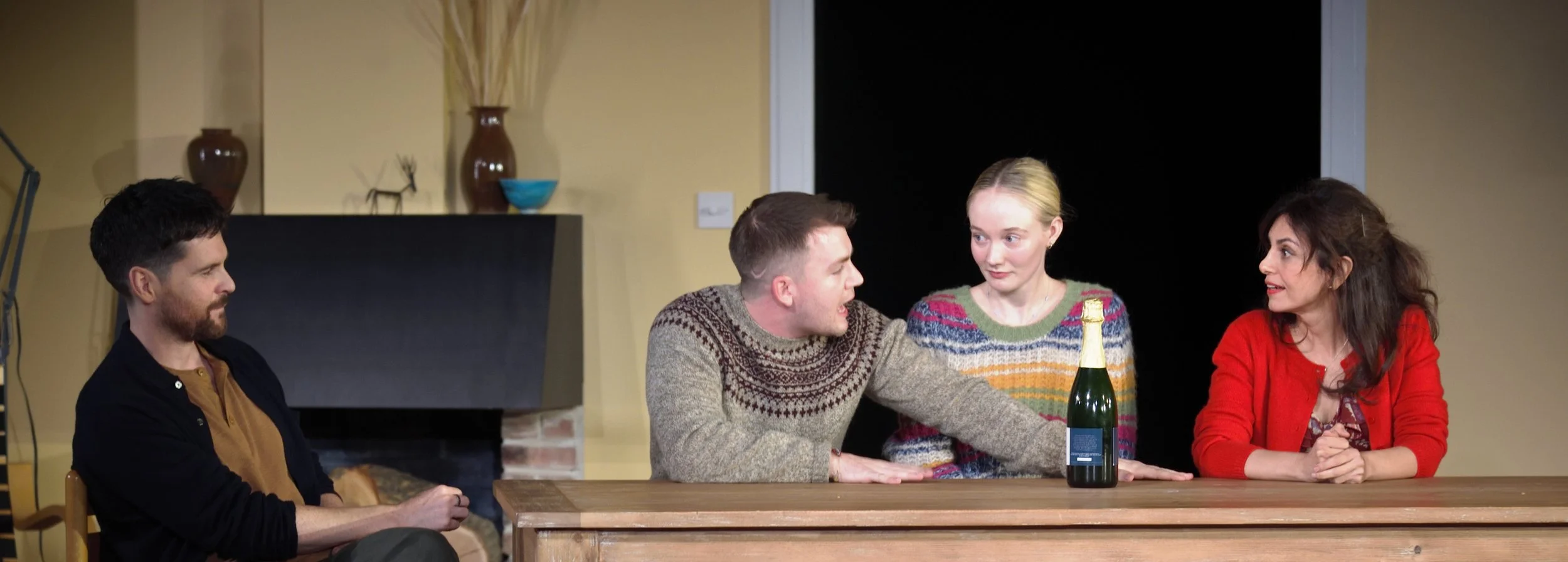
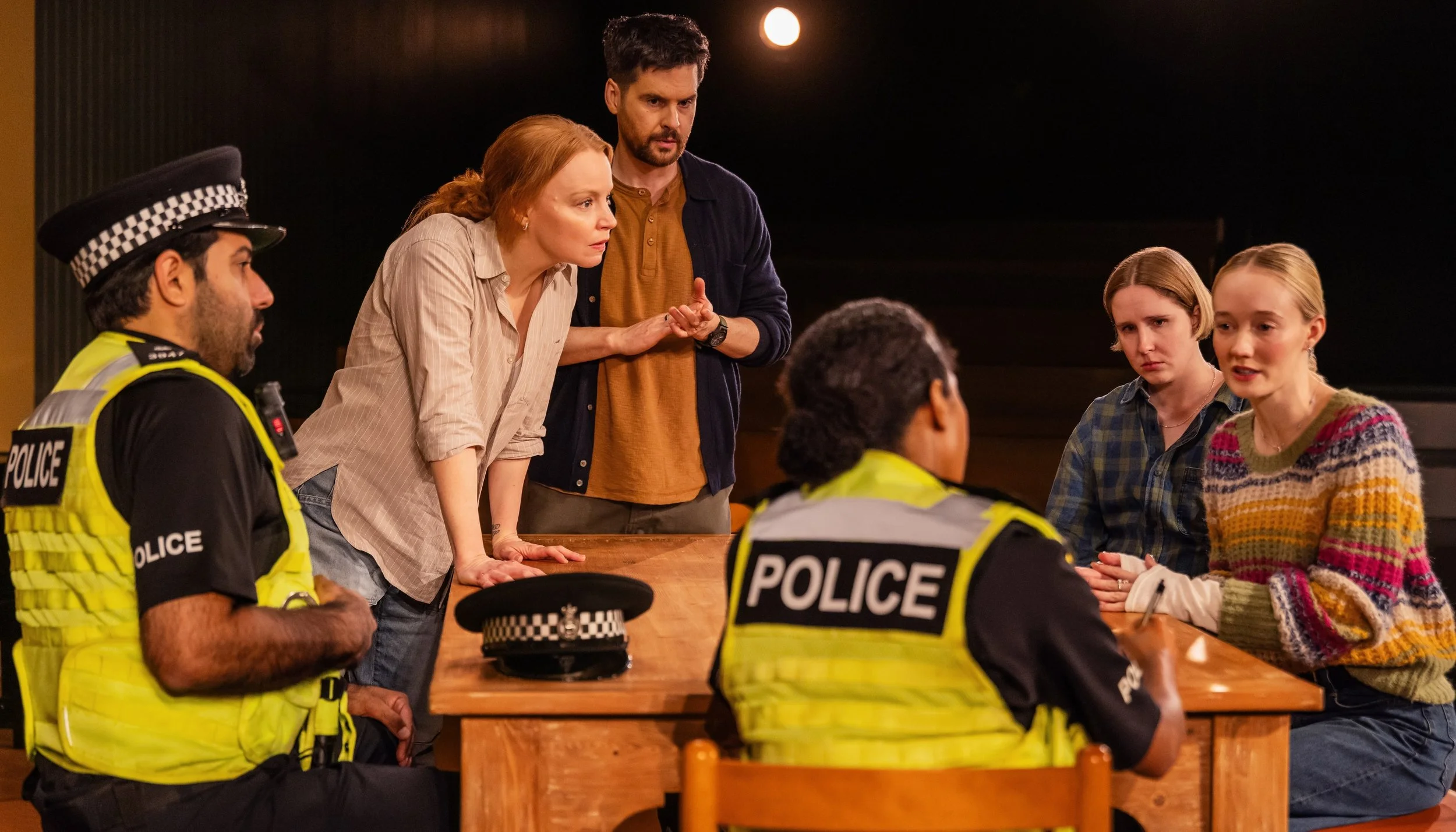
Constables played by Jaspal Binning (left) and Brittany Bradford question Oscar’s family, portrayed by (from left) Lauren Ambrose, Tom Riley, Nina Ross and Elizabeth Yeoman. Photograph by Matthew Murphy. (Banner photograph by Knud Adams.)
With a title like The Unbelievers and a stage half filled with church pews, one might expect some discourse on religion from Nick Payne’s latest drama. Instead, the Manhattan Theatre Club production offers nearly two intermissionless hours of tedious conversation and few significant insights on any topic. A stellar performance by Lauren Ambrose is the U.K.-set play’s saving grace.
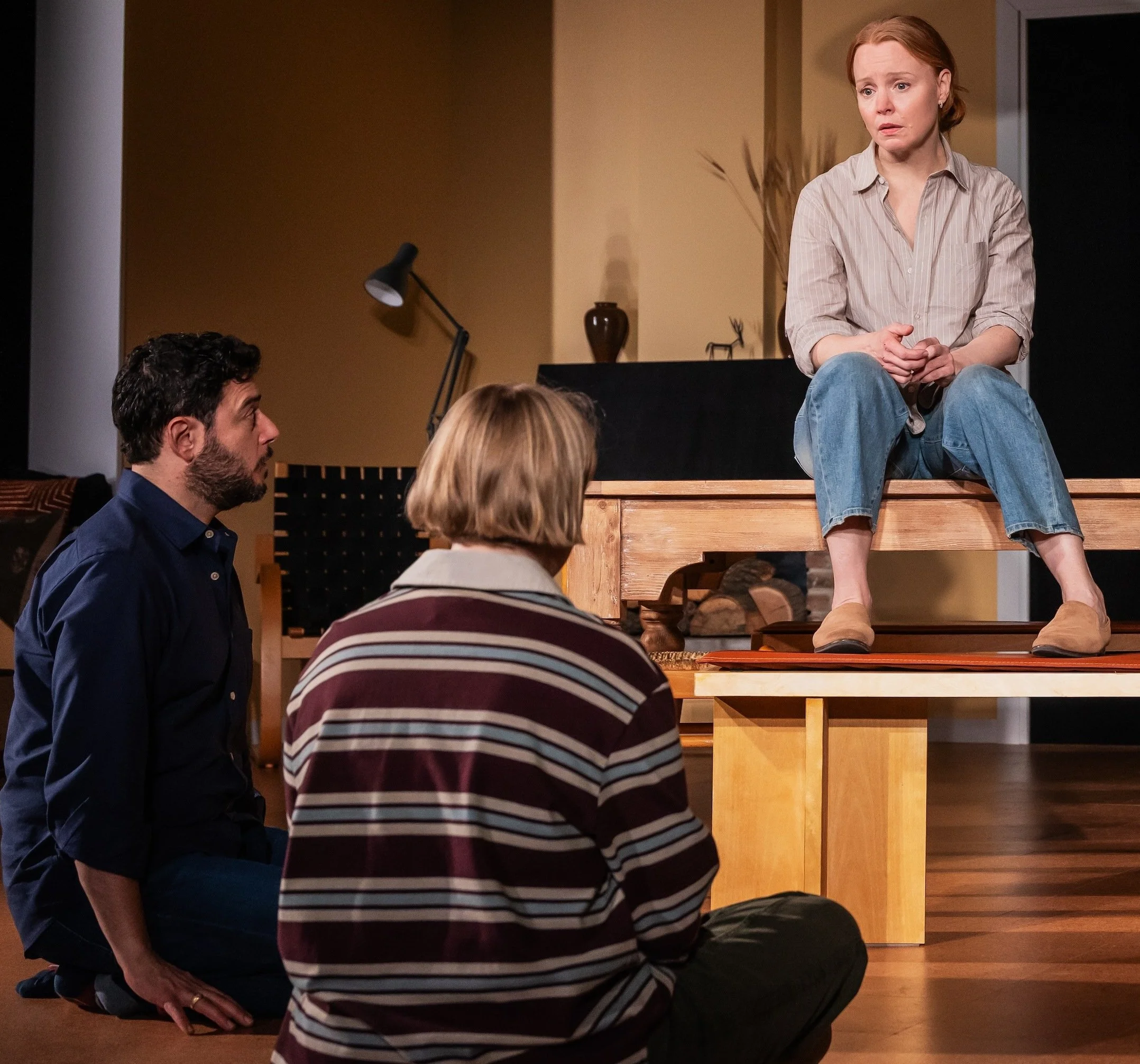
Clad in a baggy, unflattering costume, Ambrose (right, with Tabbal and Ross) still commands the stage in Nick Payne’s The Unbelievers. Photograph by Matthew Murphy.
Ambrose plays Miriam Wright, mother of a 15-year-old boy named Oscar who never came home from school one day. Scenes alternate between three time frames: a few days, one year and seven years after Oscar’s disappearance. The Unbelievers is not out to solve the mystery of his whereabouts; it’s concerned with those he left behind. They include his father, David (Tom Riley), who separated from Miriam shortly before their son went missing; his sister Mags (Elizabeth Yeoman), a couple of years older than Oscar; and his half sister, Nancy (Nina Ross), Miriam’s daughter from her first marriage. Also on hand is Nancy’s father, Karl (Hadi Tabbal), who’s become a vicar.
It’s Karl’s church that occupies half of The Unbelievers’ set, depicted by rows of pews—onstage seating for some audience members—stained glass and a triple lancet window. (The other side of the stage shows the interior of the family home.) Yet the church’s prominence in the scenic design doesn’t seem warranted by the script, as it has only one conversation related to religion, when Miriam and Karl discuss his belief in God.
“Unbelievers” could refer to Miriam and David—“raging atheists,” according to their daughter—or to everyone except Miriam. Seven years later, the other family members have accepted Oscar’s absence and are moving on: Mags is expecting a baby with her boyfriend (Jack DiFalco); David is in a new relationship, and he wants to hold a memorial service for Oscar (“Seven years means we have the right to apply for a certificate of presumed death”). But Miriam is getting ready to chase a long-shot clue all the way to Belgium. “My son is alive,” she insists.
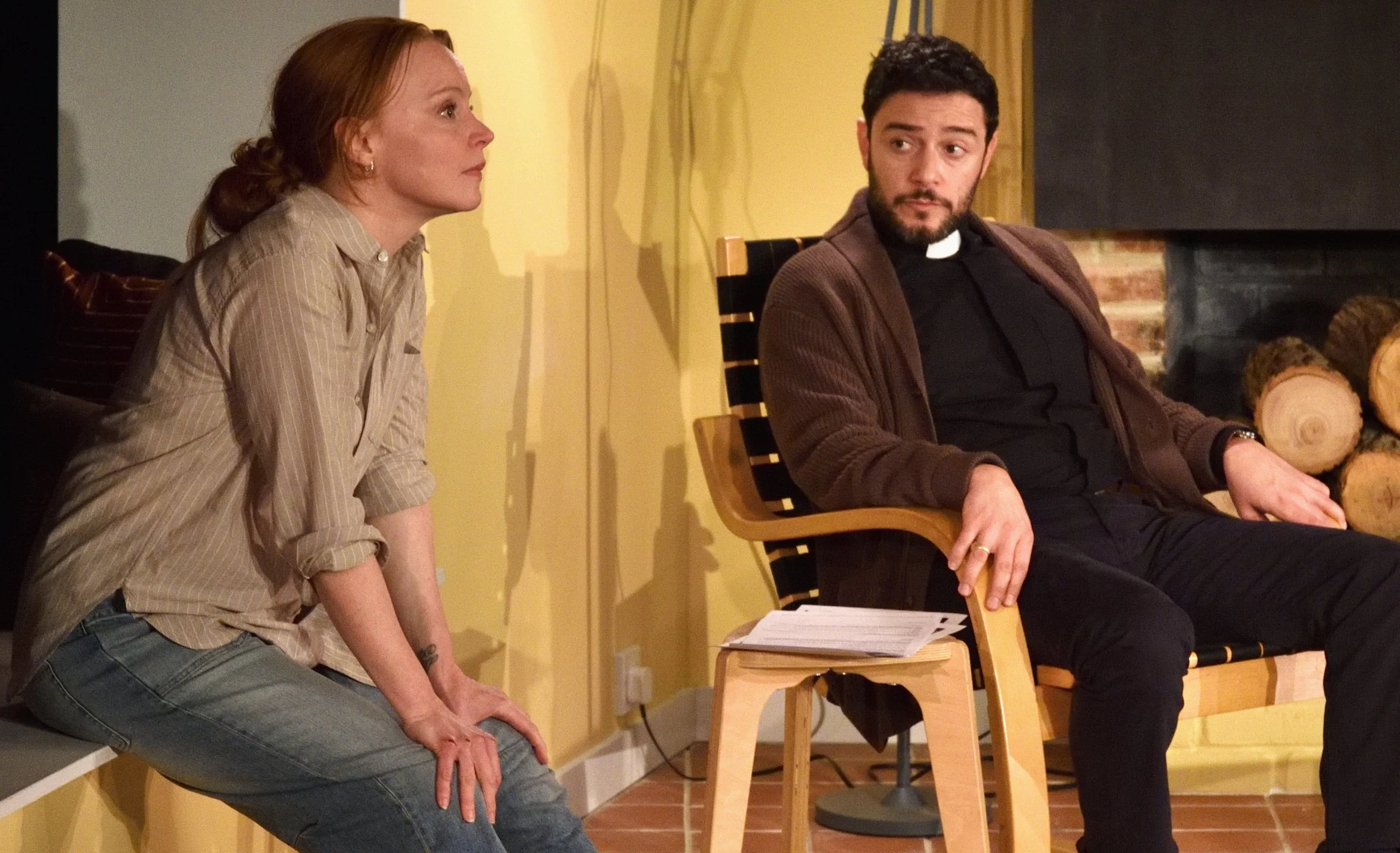
Miriam (Ambrose) used to be married to Karl (Hadi Tabbal), who’s now a vicar. Photograph by Knud Adams.
Payne and his characters treat Miriam’s tenacity as an unhinged obsession—this isn’t a particularly sympathetic or sentimental characterization of a mother who has lost a child. Miriam yells at people, punches her car window and runs over a neighbor child’s bicycle. She propositions each of her ex-husbands, and goads David’s girlfriend (Marjan Neshat) into a hug, then hurts her by squeezing too hard. Even Miriam’s hospitality has a hard edge, as she keeps offering people “something to eat” no matter how much they say no.
While Oscar’s case goes unsolved over the seven years, nothing extraordinary happens to his loved ones. Every scene involves a different pair or group of people talking, with little movement—most of the time, the characters are seated or standing around the family’s dining room table. Much of the dialogue sounds like any family’s chatter around the dinner table, which is not particularly interesting to outsiders and doesn’t build dramatic momentum. Plus, too often somebody goes off on an inconsequential tangent about puffins, or Ikea food, or the phrase “pull out all the stops,” or some other random subject.
Only Miriam’s outbursts jolt the play out of its torpor. Onstage virtually the entire time, Ambrose gives an impassioned performance. She finds an emotional logic in Miriam’s contradictions, embodying a woman whose feelings and expressions of love are distorted by grief and her own prickliness. It’s a surprisingly mature performance for Ambrose, who rose to fame—albeit 25-plus years ago—playing a teenager on Six Feet Under and whose New York theater roles (Juliet, Eliza Doolittle) have mostly been ingenues.
Ambrose’s most fascinating moment occurs when Nancy invites a paranormal specialist to try to contact Oscar. (Sleeping in her old bedroom, Nancy felt a mysterious draft at night, heard crying and thought she saw the figure of a boy in the corner.) During the séance, Miriam suddenly spits out a monologue composed of unrelated comments made in previous scenes, as if she’s the one being exorcised.
That scene, as well as one where Miriam asks Karl to pray with her, are two of the only poignant passages in The Unbelievers. Overall, the play feels aimless and devoid of any discernible point. And its storytelling is not enhanced by the jumbled chronology, which was more of an innovation when Payne used it in his 2012 breakout, Constellations, but now has gotten gimmicky. At least one other current off-Broadway show, Pre-Existing Condition, does the same thing.
The Unbelievers runs through Nov. 29 at City Center Stage I (131 W. 55th St.). Evening performances are at 7 p.m. Tuesday through Friday, and at 8 p.m. Saturday (no evening performance Nov. 25 or 26); matinees are at 2 p.m. Wednesday, Saturday and Sunday. For tickets and more information, visit manhattantheatreclub.com.
Playwright: Nick Payne
Director: Knud Adams
Scenic Designer: Paul Steinberg
Costume Designer: Enver Chakartash
Lighting Designer: Masha Tsimring
Sound Designer: Sinan Refik Zafar
