
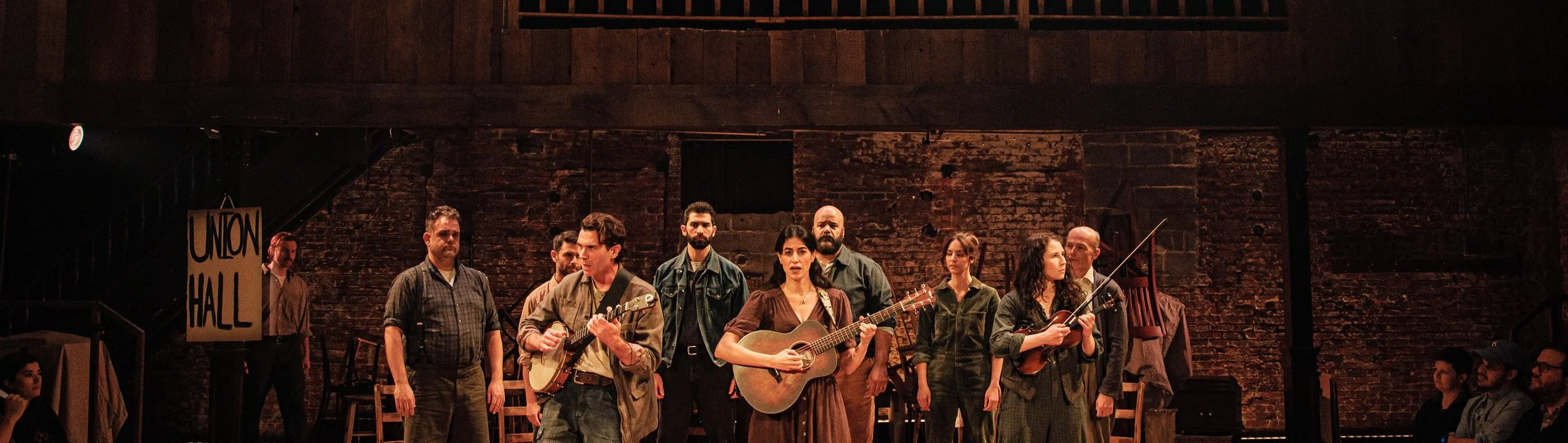
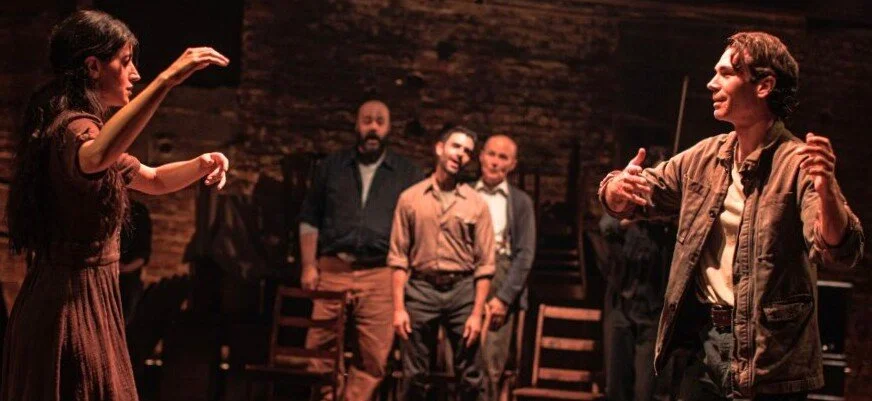
From left: Sahar Milani, Austin Durant, Adam Kantor, Henry Stram, and Cameron Scoggins star in the Classic Stage Company’s revival of Clifford Odets’s Waiting for Lefty.
Clifford Odets’s Waiting for Lefty, the fiery one-act that launched his playwriting career in the depths of the Great Depression in 1935, moves through seven scenes, from a union hall to a desperate family trying to put food on the table. As critic Harold Clurman recalled in a 1963 appreciation of Odets, “though he had a thrilling gift for dialogue, he was no literary man.” Steven Pasquale’s production for Classic Stage Company, however, intersperses protest songs and dance sequences among the scenes. Although well performed, they dilute the raw intensity of the original.

Scoggins and Milani, who make up the folk duo Yeller Tooth, are principal musicians in Steven Pasquale’s production and contributed original music as well. Photographs by Marc J. Franklin.
A director is entitled to consider a work anew, of course, and even Elia Kazan, who had a role in the premiere, proposed a revival to Odets in 1963 that would add a “preamble of newsreels.” Pasquale’s background in musical theater bestows on him the authority to add music to Lefty—but the effect is to transform a work of scathing agitprop into a high-toned musical revue.
Though written more than 90 years ago, Odets’s scenes in the union hall or in workplaces or in the home feel as if they have played out across the United States in the years leading up to the recent election. In the first of them, Joe (Raffi Barsoumian), a taxi driver, arrives home to learn from his caustic wife, Edna (Tala Ashe), that his household items have been repossessed:
Joe: Can I help it if times are bad? What do you want me to do—jump off a bridge or something?
Edna: Don’t yell. I just put the kids to bed so they won’t know they missed a meal.
The small amount Joe has earned gives rise to Edna’s rebuke—in language that Isaac Butler, author of The Method, calls “street elocutions with such density and fire that they become poetry.”
Edna: You’re a four-star bust. If you think I’m standing for it much longer, you’re crazy as a bedbug.
Joe: I’d get another job if I could. There’s no work—you know it.
The spine of the play is a taxi drivers’ union deciding whether to go out on strike. There are scenes of friction among the members who want to strike and the ones who balk at it, and even the exposure of a management spy. The only person who has the authority to calm things down is Lefty, but Lefty isn’t to be found.
Odets also focuses on the individual choices that must be made. Edna tells Joe to “get brass toes on your shoes and know where to kick!” A later scene finds a lab assistant named Miller (a forceful Austin Durant) being offered a new laboratory and a raise if he takes a job that most Americans of the period would abhor, particularly ones who had fought in World War I and knew about mustard gas and death tolls—supervisor in a poison-gas factory. The proposal comes from a smooth-talking industrialist, Fayette (a weaselly Henry Stram). Fayette doesn’t hesitate to raise the pay to overcome Miller’s reluctance—it’s clearly a bribe.
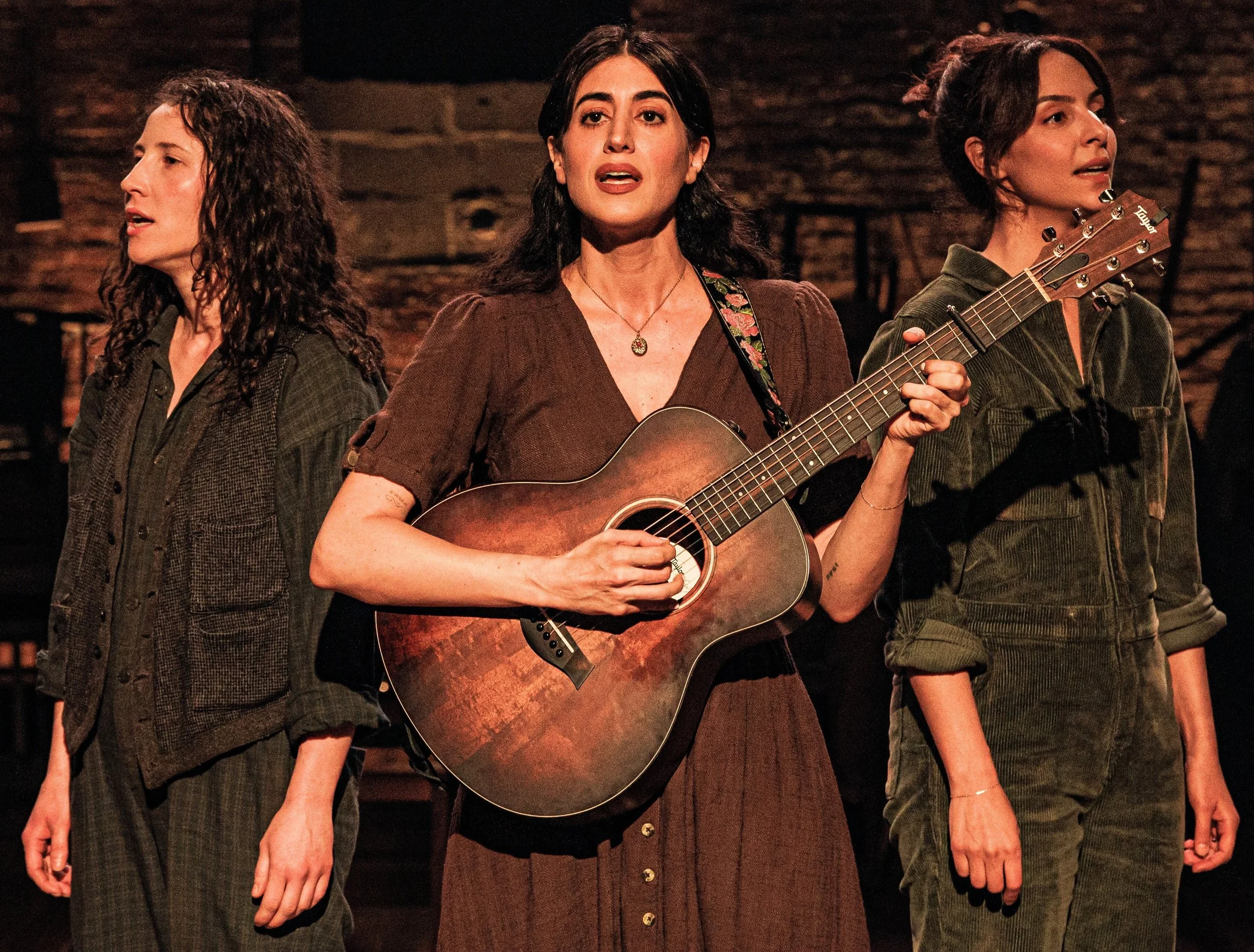
Milani (center) is joined by Doireann Mac Mahon (left), and Tala Ashe in a song.
Another episode involves Ben (Adam Kantor), a surgeon who, despite years of hard work, is pushed aside when a senator’s nephew takes over an operation on one of his patients. The nephew is “incompetent as hell,” Ben tells his supervisor, Barnes (also Stram). But the key problem, Ben believes, is that he is Jewish. Barnes assures him that it’s not: “I’ve said before—doesn’t seem to be much difference between wealthy Jews and rich Gentiles. Cut from the same cloth.” The root of the problem, Odets suggests, is capitalism itself.
Pasquale’s production is strongly acted. As a director, he uses the space fully, including the aisles, although he doesn’t have “plants” rising from the audience during the union deliberations (a technique the original production’s directors, Odets and Sanford Meisner, borrowed from the Austrian Max Reinhardt).
Cameron Scoggins and Sahar Milani, a.k.a. the folk-music duo Yeller Tooth, have contributed original incidental music, and choreographer Susan Misner has created the dances, including a crucial one near the climax, showing what happened to Lefty (danced beautifully by Zach McNally). He is attacked in slow motion by anti-union thugs in a dark alley (lighting by Mextly Couzin).
Other dance sequences—frequently simple, undulating group movements—and the labor-movement songs chosen to transition between scenes are also well presented. Among them is the classic “Brother, Can You Spare a Dime?” (by lyricist E.Y. Harburg and composer Jay Gorney). Mournful as its melody is, it is still a pleasure to listen to—but its hazy nostalgia dampens the fury that Odets intended to spark.
Waiting for Lefty plays through Dec. 6 at Classic Stage Company (136 E. 13th St.). Evening performances are at 7 p.m. Tuesday through Saturday (except Thanksgiving); matinees are at 2 p.m. Saturday and Sunday, with an additional matinee on Wednesday, Nov. 25. For tickets and more information, visit classicstage.org.
Playwright: Clifford Odets
Director: Steven Pasquale
Original Music & Arrangements: Yeller Tooth (Cameron Scoggins, Sahar Milani)
Choreography: Susan Misner
Scenic Design: Scott Adam Davis
Costume Design: Marián Talán de la Rosa
Lighting Design: Mextly Couzin
Sound Design: Palmer Hefferan
If you enjoyed this review, please click on the Like icon below.
