
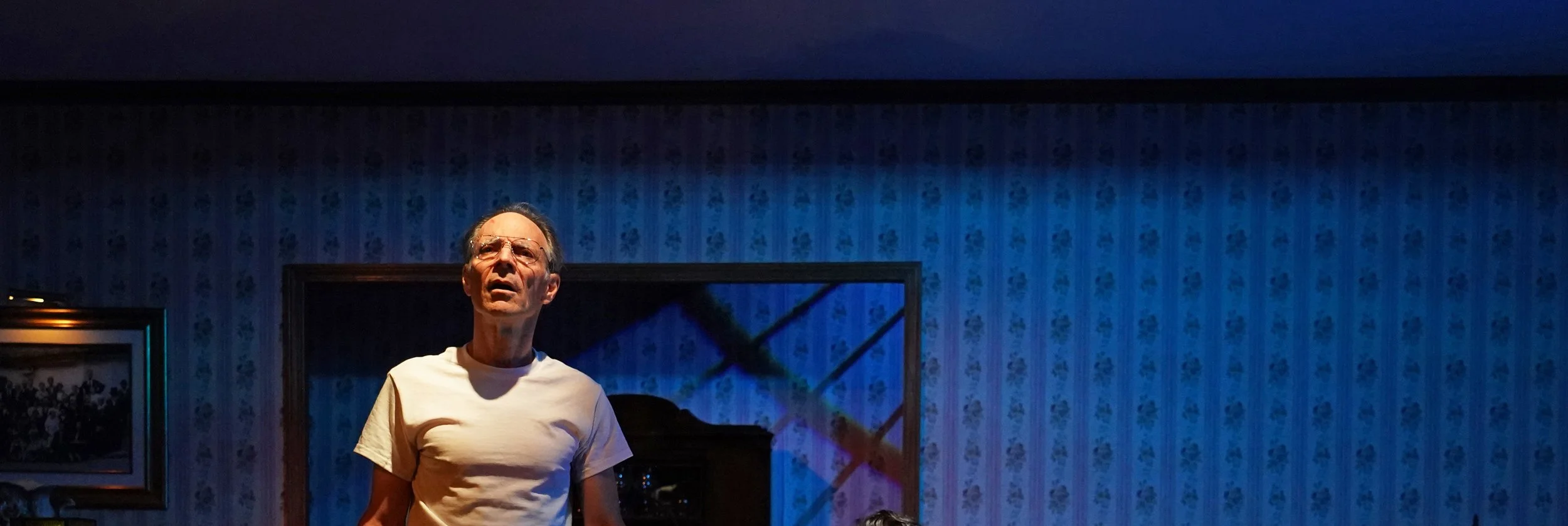
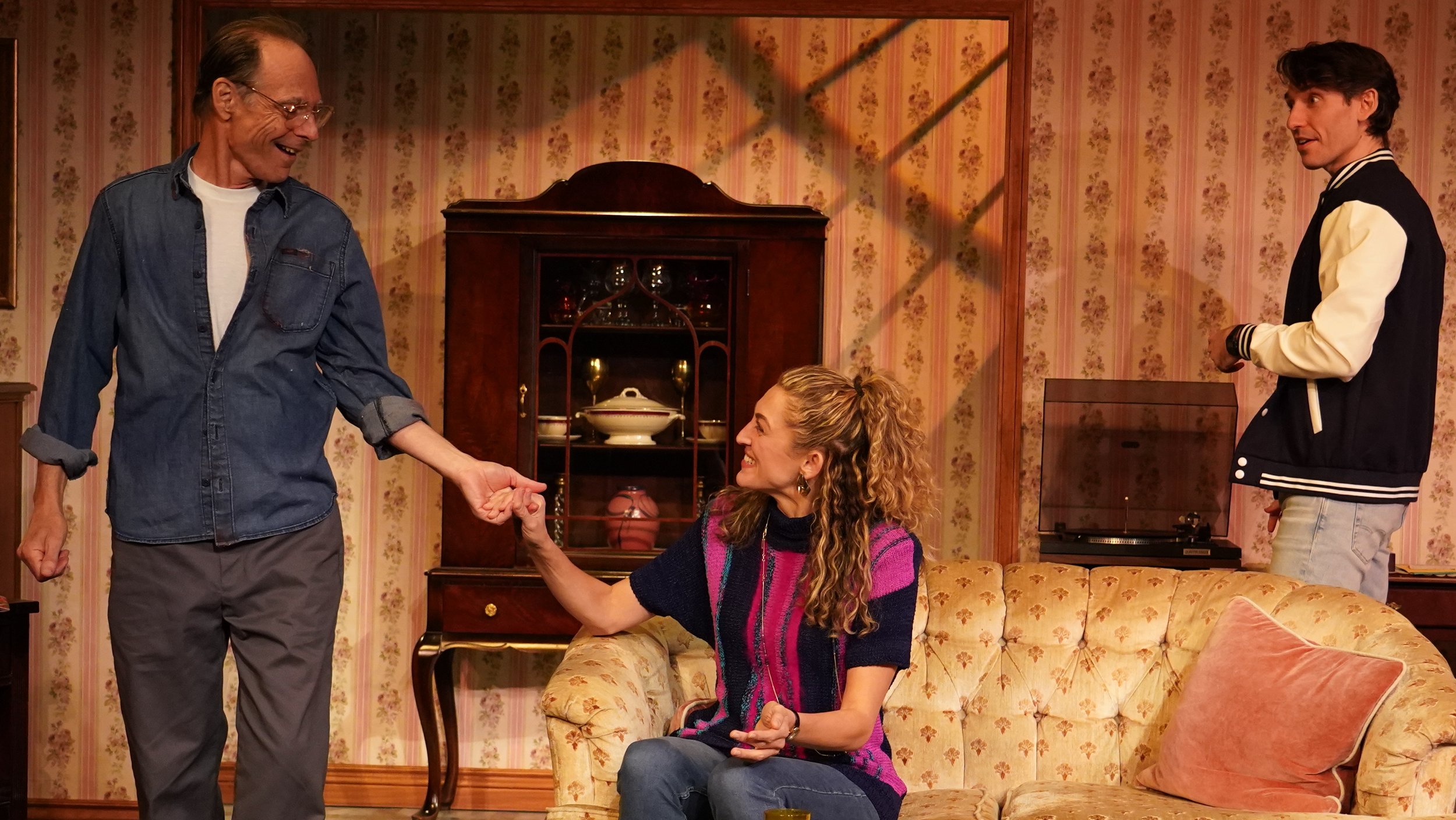
Leo Gellert (Sam Guncler, left) charms Christine (Amanda Kristin Nichols) as his son Jake (Leighton Samuels) looks on in Cary Gitter’s The Steel Man.
Intergenerational trauma can cripple, and many Holocaust survivors pass the scars of their wartime experiences on to their children, even inadvertently. Cary Gitter’s The Steel Man, inspired by a true story, identifies the underlying pain of a physically intact yet severely damaged man trapped in a destructive dance with his only child.
It’s 1983, during a recession, and the steel industry in Pittsburgh has all but collapsed. Leo Gellert (Sam Guncler), a 70-year-old Hungarian who survived imprisonment at Auschwitz, came to the Squirrel Hill district as a steelworker after World War II and has built a new life there—except that he has not yet resolved his old one. He’s unemployed and a recent widower. His days are filled with bitter memories and loss, especially as he has just returned from his wife’s Jewish ritual of unveiling (a post-mourning memorial service and monument-setting).
Leo’s son, Jake (Leighton Samuels), who has escorted him home from the ceremony, is a 28-year-old would-be actor. He listens to Leo’s diatribe against the rabbi and synagogue, rebuts it, and then indulges his cantankerous father by chanting the Torah portion.
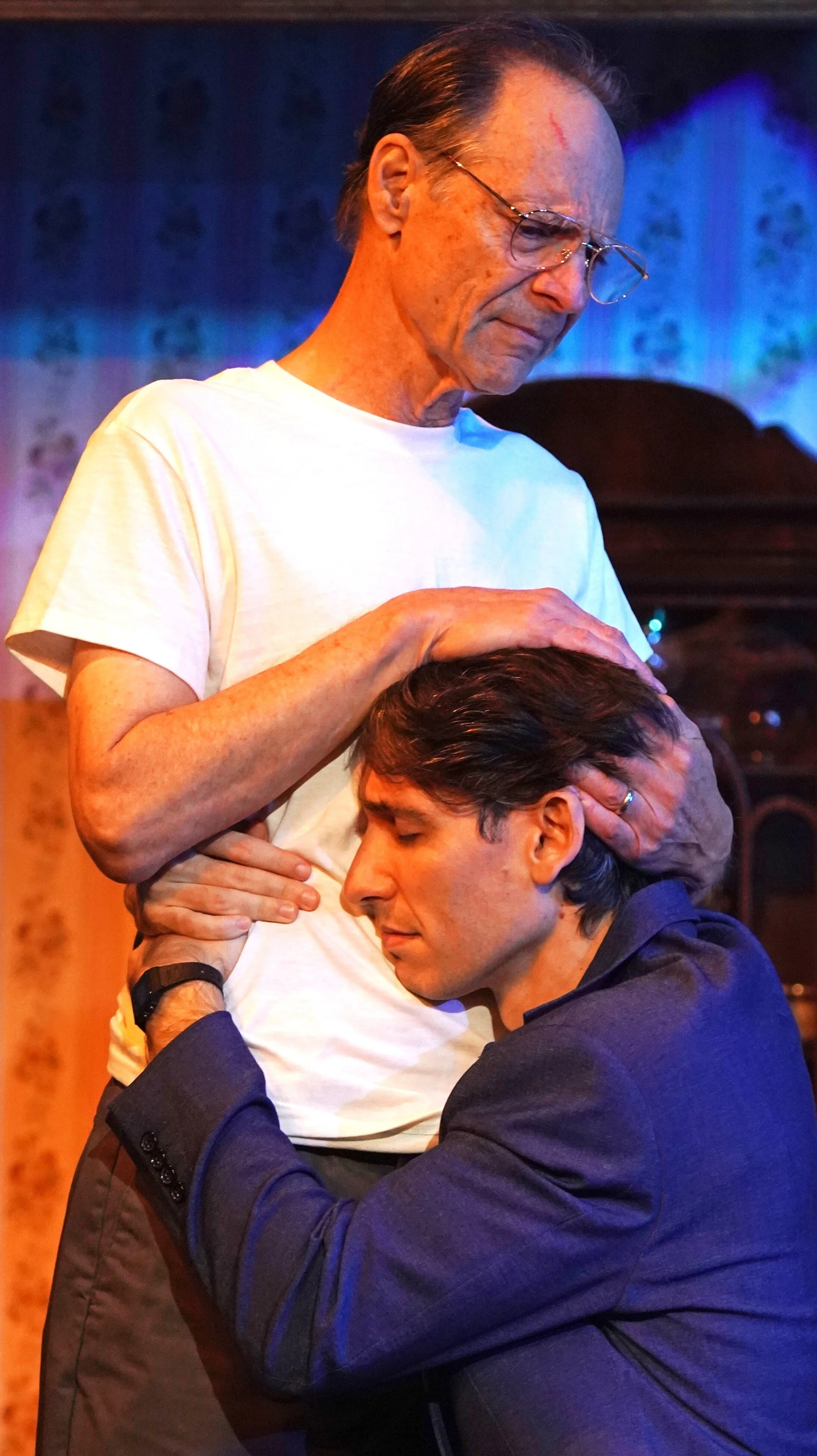
No matter how difficult Leo can be, Jake deeply loves his father. Photographs by Carol Rosegg.
It doesn’t take much for Leo to flip the switch from charm to anger, and Jake is now the most frequent recipient. Leo surrounds himself with ornate, Hungarian-style pieces of heavy furniture (scenic design by Christopher and Justin Swader) and timeless Jewish ritual objects. The pieces represent happy memories but also an ambivalent attitude toward organized religion.
Leo is not ambivalent, though, about his desire for vengeance, and he shows Jake a gun he hopes to use on Bako, a former hometown friend who betrayed his family to the Nazis. He recently has learned that Bako is alive and in Florida. Leo asks Jake to accompany him there so that he can kill Bako, and, fueled with rage, blurts out that he had a 7-year-old sister, Róza, who died with his entire family as well.
Jake: Sister? I never knew you had a sister
Leo: I did. My sister, Róza. She was the youngest. She loved to be outside. She run around the
field, swim in the lake. Play with the dogs. Sometimes she hide in the grass till it’s dark,
and we can’t see her. But we hear her. She was always singing.
The gun and Róza’s existence rattle Jake, but he has his own revelations for Leo. He has a non-Jewish girlfriend, Christine Sommers (Amanda Kristin Nichols), a journalist who will move with him to New York; she’ll work and he’ll attend acting school. He asks Leo to bring her to a Sabbath meal. Leo consents, and Christine finds him charming, unlike Jake’s description. Nevertheless, it doesn’t take Leo long to snap at her and, in a subsequent tirade, he verbally abuses both her and Jake.
Director Joe Brancato has mustered all the ingredients for a seismic storm. As a mistrustful man, Guncler’s Leo keeps his toxicity going by pushing others, including his only son, away and simultaneously guilting him to keep him at bay.
Jake: You know ... ever since Mom died, you keep ... cutting people off.
Leo: I’m cutting off? Who? …
Jake: It’s like you just keep making your circle smaller and smaller—
Leo: Good! Nice, small circle. Who needs big circle? The more people in circle, the more they stab you in the back.
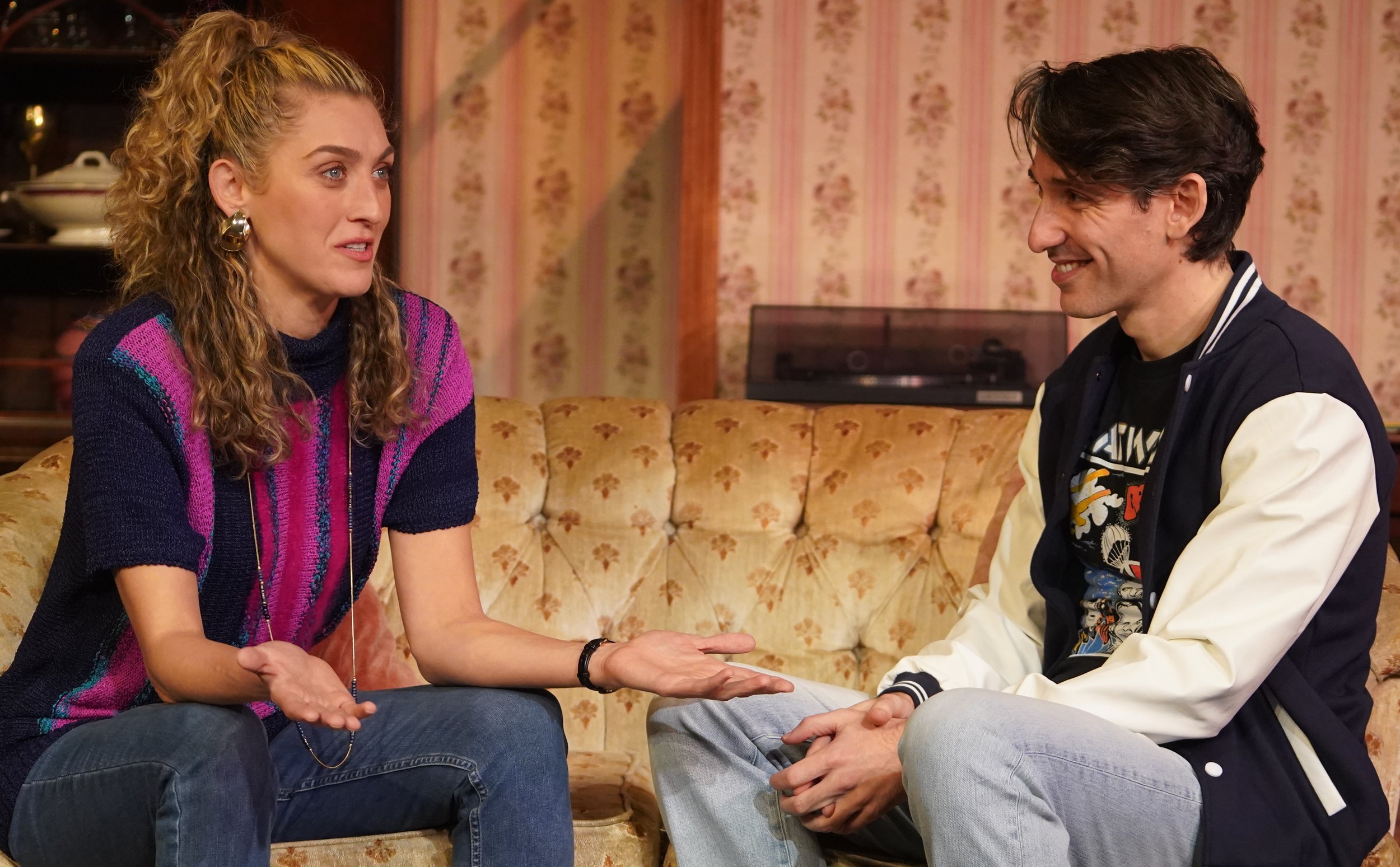
Christine and Jake contemplate their move to New York.
Samuels’ Jake is convincing as a dutiful yet resentful son who struggles to break loose. Will he or won’t he? Nichols’s Christine, in recognizing Jake’s dilemma, also respects his right to work it out himself, and she has a right not to wait around to see what happens.
As a tragic protagonist, Leo can, at the same time, fantasize about his missed opportunity to be an actor because he obeyed his mother and remained home rather than packing for England; he had a minor role in a film shot on his family’s farm. As a victim, he can seek vigilante justice by pursuing his archenemy Bako, who stole from his everything he loved, including Róza.
As the Steel Man, (symbolically, not just professionally), he’s indestructible—although logically, he should be dead, but he isn’t. Leo is all these personae, but which Leo will emerge as the dominant one? Gitter’s script portends some major standoffs—Leo vs. Jake, Leo vs. Christine vs. Jake, and finally Leo vs. Bako. Not all of them end as anticipated, but the potential for volcanic-level eruptions and suspense throughout are riveting, and a surprise ending brings some level of closure.
The Steel Man runs at 59E59 Theatres (59 East 59th St.) through Dec. 13. Performances are at 7:15 p.m. Tuesdays through Saturdays, except for Nov. 25 and 26; matinees are at 2:15 p.m. on Saturdays and Sundays. For more information, or to purchase tickets, call (646) 892-7999 or visit 59e59.org.
Playwright: Cary Gitter
Director: Joe Brancato
Lighting Design: Ed McCarthy
Scenic Design: Christopher and Justin Swader
Original Music & Sound Design: Max Silverman
Costume Design: Christian Fleming
Projections Design: Brian Pacelli
